One Call Close Life Insurance Telesales Script Revealed
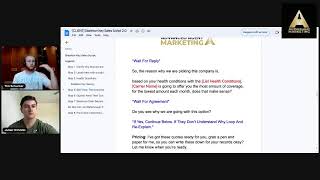
Julian and Tim walk through a complete life insurance telesales script designed to close on one call. The pitch presents three whole-life options (50k, 40k, 30k), uses price-anchoring and mirroring to move prospects toward application, and relies on agents memorizing objection flashcards and word-tracks to handle pushback.
Questions this video answers
October 24, 2023.
November 3, 2023.
50,000 ≈ $200/month; 40,000 ≈ $150/month; 30,000 ≈ $100/month.
Mutual of Omaha (referred to as Mutual Omaha).
Wrote over $10k in commissions twice in one month and had an over $35k month.
Chapters
You mean to start with that first?
All right, so surprise. Live here, we're jumping on. We're going to be revealing our telesale script. I'll let Julian kind of intro what the script is and I'll pull it up and share it with you guys.
Hey, what's up guys? Today we're going to be talking about the. The script that I used to write over 10k in commissions twice last month. This was an over 35k month for me while still running this business. And so I wanted to share this with you because I know if you're doing this full time, calling leads and you know, you're wanting to follow a proven system, then this is going to be exactly what you want and exactly what you need. And if you're a newer agent who's looking for the. For something to follow, this is exactly what I wish I had when I started. So we're going to jump straight into it here. Tim's going to share his screen and we're going to kind of review this script with you so you have an understanding of how it works and also what we're saying and kind of why we're saying it that way. You know how to relate to the client and also get these deals closed. So let's jump straight in here, see if we can't get this script pulled up here. Tim, jump right in. There we go. So real quick, the legend up at the top, that's not part of the script. That just tells you how to read the script. So if it says fill in the blank, as you can see and read. I have had a few questions about this. If it says, hey, client first name. You put the client's first name in there. Super, super simple key point is basically what you need to do to follow along with the script. So it says clarify why they're there. You need to know why they're looking to buy insurance.
You know, action, obviously to do something and then the black text is what you're going to actually say. So without any further ado, let's jump straight in. Tim, do you want to just role play this out or how do you want to do that?
Yeah, we can just kind of role play it and then do like a quick explanation. I don't want this to be like a 40 minute video or anything crazy. Just kind of a quick overview for people of the scri grand.
Hey, is Tim there?
Yeah, this is Tim. Who's calling?
Tim, it's just Julian. I have that form you sent us here at Zoo Assurance about the Life insurance programs here in California. Is that ring a bell?
Yeah, that. I think I filled that in last night after I was done playing Candy Crush.
Oh, okay. Gotcha. Yeah. Reason I'm calling is just to see what you qualify for and get you a quote. Is this your first time looking to life insurance?
Yep.
Yeah, first time.
Oh, okay. Awesome. And then whenever you filled this out, what exactly was it that you were concerned about? Was it leaving money behind for family or just covering your funeral expenses?
I'm just trying to make sure my grandkids don't have to bury me, you know, don't have to pay for the burial and whatnot, you know?
Okay. And then it looks like you listed your beneficiary as your grandkids. Is that correct?
Yeah, that's right.
Awesome. Okay, that makes sense. So you just want to make sure that your grandkids don't have to worry about paying for your funeral or any other final expenses, is that right?
Exactly. Exactly.
Yep.
Okay.
Awesome. Now, if you weren't able to call on the off chance you weren't able to qualify for any of these programs here today, how would that affect your grandkids? Would they be able to pay for this?
Well, given that they're 7 and 5, I don't think so. Their mom, you know, isn't really present, so they'd probably be in a pretty tough bind there. Honestly, I'd probably just, you know, end up having a really, really bad funeral. So I want to make sure that they have money. You know, I expect to live, you know, another 10, 15 years. So by the time they're older, I want them to be able to bury me and everything. So if I don't get anything, they're. They're just gonna, you know, cheap out and kind of give me a crappy funeral, is my thought.
Wow. Okay. So we're not. To make sure we can get this taken care of and protect your grandkids, I'm going to kind of ask you a few health questions here, Tim, just so we can see what you qualify for.
Okay, sounds good.
Awesome. And so then I'll just go through the health questions here. Do you want to go down a little bit?
You want to kind of recap, like, the. Kind of a little bit of the psychology behind why we're doing this, and because that's ultimately, I think, one of the most important pieces here is this labeling them with a problem.
Yeah. So I'll go through here.
This right here is, like, what sells the whole thing.
Right. So I'll go through Here. And basically, like, I usually will spend a lot more time on mirroring for the sake of this video. This script is just to basically give you guys an idea of how it works. But whenever they're like, yeah, no, like, I just want to make sure my grandkids have to pay it. Like, okay, that makes sense. You know, you want to make sure your grandkids have to worry about paying for your funeral. Is that right? Yes. Okay, gotcha. And you know, how. How old are they? Like, are they working? Or is this, like, are you trying to just make sure that they have, you know, have something behind? Like, what does that look like? I'll try and dive a little bit deeper, and I'll just mirror them, as in, you know, saying back to them what they're saying. Yeah, no, they wouldn't be able to pay for it. Wow. They wouldn't be able to pay for it. Yeah, no, it'd be pretty messed up. That is messed up. You know what I mean? I'll just kind of repeat back to them what they're saying, and. And then I'll kind of ask this next question here to make sure that they. They see that they have that need, and then I'll start, you know, basically making that transition, and later we'll start talking about it even more again, which you guys will see as well. So this right here is just to get an idea of whether or not they have a need. If a guy jumps on and says, yeah, I don't need life insurance. I got nobody to leave anything to.
I don't care if they throw me in the. In the dirt and just leave me there, and I just rot. Like, if this. If I meet that guy and he's like, yeah, and, you know, as long if it's anything more than 30 bucks a month, I'm not doing anything. Like, that guy doesn't have a need. And so I just want to get off the phone as fast as possible to get on with someone who does have a need. So this helps you figure out why they're there and whether or not they even are a qualified prospect, which is why I love spending a lot of time on that.
On the front end, 100%. And ultimately, like, the. The way you close somebody who wants to be cremated versus the one somebody you want to be buried, like, almost differs a little bit, because sometimes the people who want to be buried are scared of being cremated. So you kind of throw in that. Whereas with someone who's being cremated, maybe it's a little bit less expensive. So it's just making sure their kids don't have to pay for it. What, like figuring out the why and figuring out what the actual reason is. Like, that's the most important part. Because later on in the script, if they ever give you any objections or anything like that, you're going to be tying in those benefits that they wanted that you discovered on step number two, which is finding out what their problem is.
Yeah, and I usually spend. I usually spend about double the time asking them if they already have life insurance and they want to just leave something behind. I usually spend about double the time asking them questions to make sure that when we have that conversation, I'm not going to just be a commoditized insurance guy. Because if they come behind, it's just extra. Like you're. We're selling the. We're selling the steak, not the sizzle, usually. So if you're gonna sell the sizzle, you got to make sure that's what they really want. Right. And so you know what kind of they want. So jumping into it, I'll just go straight into health questions. I'll touch on all the major ones. If you guys want to learn more about that, you can, you can click on this using our script, and then I'll transition here out of that after plugging in their health questions and everything. And I'll say, okay, so based on what you're telling me, Tim, it seems like you might qualify for one of the programs here in the area. I'm gonna get a few quotes pulled up real quick for you. Give me one second. Now, are you familiar with the different types of life insurance, like term and whole life?
No. No clue.
Okay, gotcha. So basically, term life insurance is kind of like milk, eggs and cheese. It's great while it lasts, but know once it expires, you kind of just got to throw it out. Now, usually when people get this. I like to clarify here, it's not a scam. So many people feel like they get taken advantage of because they pay into it forever, but it's actually. It just serves a different purpose. Right. And so if a vegetarian goes to a steakhouse, they're probably in the wrong spot. But if you get a. A carnivore who goes into a steakhouse, it couldn't be better. And so for what you're looking for, you want something that's going to be permanent, it's going to be there when your kids or when you pass away for your grandkids to have some money left behind. Whereas if something were to expire you might want to use that to cover like the cost of a mortgage or something. And that's not really our goal here. You see what I mean by that?
Yeah, I do. Side note here real quick, Julian. So if I'm like an agent watching this video and I just heard you say all that, none of that is in the script. So how do I know what to say there?
Yeah, so part of this is just going to be like, because you do want to have your own personality in the script. And so like, I don't even always use the example of milk, eggs and cheese, because sometimes it just doesn't hit like they don't get it. Or maybe they're like. Maybe the conversation flows a little bit different. We talked. Oh, man, I love my cars. Or I'll always make. I'll try to reference it to whatever they're. They're giving me in the conversation to play around with. So part of this is just industry knowledge and explaining Term and whole life insurance. If you want to go bare bones, hey, term does xyz. Whole life is xyz. You can do that. But I find that stories, similes, metaphors, and, you know, things of that nature usually help to get the point across a little bit better. And so that's kind of like something I tell you to do yourself, not don't. You don't have to use mine.
Okay, awesome. So, you know, I'm the prospect. Yeah, that makes sense. Perfect.
Great. So what got you looking into life insurance then, Tim?
Yeah, I mean, like, like I told you before, just, you know, wanted to make sure that my grandkids don't have to pay for my funeral.
Okay, gotcha. So I looked at all of the. The life insurance companies because I'm what's called a broker. So my job is just to find you the. The most coverage for the lowest price. That way you don't have to shop around. Does that make sense?
It does, yeah.
Okay, perfect. So the quotes I'm getting pulled up here for a company called Mutual Omaha. Have you ever heard of them before?
No, I haven't.
Okay. The reason that I'm picking this company is because based on the health conditions that you gave me, with the high blood pressure and the cholesterol, it looks like they're actually going to offer you the lowest. The most amount of coverage for the lowest amount each month. Does that make sense?
It does. Yeah.
Okay. So do you kind of see, like, why we're going with them versus maybe somebody else who might charge you a little bit more or something? Like that?
Yeah, yeah. I'm a fixed income, you know, I want to pay the lowest rate possible, so I see why that would make sense.
Exactly. And side note, guys, this is not in the script, but if they ever give you the fixed income thing, make sure that you bounce this back to them every time. Tim, I totally understand. Most of my clients actually are in a fixed income, which is exactly the type of person that these plans are designed for, which is specifically why we're looking at them versus going with somebody else that may not be designed for someone on a fixed income. Does that make sense?
It does, yeah.
Perfect. And so I've got these quotes ready for you here. Grab a pen and paper for me so you can write these down for your records. Okay. Let me know when you're ready.
Okay, I'm ready.
Okay. So I wanted to give you a range of options so we could figure out which one makes the most sense for you here. I looked up quotes with. With this company for 50,000, 40,000 and 30,000. Go ahead and put 50,000 at the top, then 40, then 30, and let me know you got it all down.
Got it. Awesome. Great. So I've got. It looks like the 50,000 only came in at. And this, by the way, just to make sure, Tim, this is whole life insurance. It is going to be covering you from day one. So if you were to get smacked by a bus after you make your first payment, that check's gonna go straight to your grandkids, the five and seven year old. Okay? So there wouldn't be any situations where, you know, you wouldn't be covered. There's no waiting periods or anything of that nature. This is day one coverage. That way you're all, you know, squared away. If something were to happen to you. This is like. Basically because you only have, you know, little, very little health issues. This is basically the Ferrari of insurance. So the. Let me know when you're ready. I've got the. The 50,000 quote for you here.
Okay. All right, so that's going to be 200.
The 12, the. The 40,000 is going to be 1.
And then the.
30,000 is only going to be a hundred a month. Let me know you got it all down.
Got it. So I'm gonna explain exactly why I had you write it this way in just a second. But out of these three options, which one do you think makes the most sense for you?
Probably the middle one.
Okay, now go ahead and circle that for me, and that way we can come back to it. Let me know when you're Done.
Okay, got it. Okay, now, perfect. So the reason that I had you write it this way is because it's a very simple equation. If you pay the small one, they pay the big one. So if you were to choose the. You said the middle one, the 40,000 for 150amonth. Then if you pay the 150, they pay the big one. And the reason that I had you put an equal sign is because the price number goes up and the price number goes down. And does that make sense so far?
It does, yeah.
Perfect. And if he told me. I'm going to just clarify and. Perfect. And Tim, you said that you ended up circling the middle one. Is that correct?
It is, yeah.
Okay. Now basically the next steps are. You have to scroll down a little bit.
Oh, my bad.
Okay. Basically the next steps are. We're going to run through an application to see if you even get accepted here. Tim, this makes sure that your grandkids don't have to worry about getting stuck with paying for the. The burial that we talked about if something were to happen to you. Okay.
Got it.
Sounds good.
Yep. So I'm going to verify some information with you real quick here, and then I'll just go straight into the application. There's instructions for how you can ask for social and banking if you guys need to know how to do that and get the highest conversion rate. This is a tested method that we've used and we've tried it different ways. This is what I've seen. Convert at the best rate. And so statistically, you will see a higher likelihood of success if you follow that versus other ways of asking.
Now, if you look at step six here, this is going to be for the objections. We have objections. Flashcards, the passwords included under words under it tells you right there how to do it. This is basically all the word tracks you'll need to overcome any objections kind of.
Objection.
What's that?
I think there might be a delay. Tim, you still there?
I think I lost you there for a second. Can you hear me?
Yeah, I've got you. Can you hear me?
Yeah, you got me?
Yeah, I can hear you. Yo, real quick, because when you kind of went through these quotes, you said a lot more than kind of just what's on here. So if I'm an agent and I'm kind of watching through this part.
Right.
Selling them the outcome, going through the quotes. How do you recommend going through the quotes? Because it sounded like you basically did like a value stack before.
Again, this is for speed purposes. I'm not going through and like really hammering everything home, beating it up and like really going through in depth like what I'm doing on the phones as much as I will in a real conversation, which you can actually see on our YouTube channel live if you want to watch those sales calls. But the reason why I go through here is like, I basically want to like get them to write down from top to bottom what they're going to get. And the reason I do the highest one from the top all the way to the bottom is because it's a price anchor. So as soon as they write down 50,000 that there's a psychological trigger that clicks that says, oh, 50,000, that's a big number. So now they're less, they're more desensitized to the pricing. So then when I have the pricing come in at 50,000 afterwards it's like, okay, that's not terrible. And then now that I've price anchored them at 50,000, when I go down to 30,000, which is closer to where they're probably going to want to spend their money then now that 30,000 no longer seems expensive, but if I go to 30, if I start with 30,000, I go all the way to 10,000. Now it's like, okay, the 10,000, like I guess that would be better because the 30,000 looks kind of expensive. So that's kind of what I like to do there. And then I like to remind them of what they're actually getting. And again, this goes back to like make your, like this is a question based framework and I want you guys to kind of throw your own, your own personality in there because you're going to sell a little bit different than I will. Like for example, just looking at Tim and I, for me, I have a very like high energy, let's roll, let's do this, like super excited, blah, blah, blah. Like I'm just really like fast and Tim is a little bit more, I would say a little bit more relaxed and he's a little bit more logical, whereas I'm a little bit more emotionally selling leaning. And that's kind of, I'd say that's kind of like some of the key differences just between us. You, if you're watching this, you might sell completely differently. And so I want you to give your own personality in here. Because if you're trying to fit into the confines of, of a curriculum that you don't necessarily subscribe to the entire message to, that's when you start sounding like you're not genuine or you start throwing Things in there that, like, you know, if you, maybe if you throw in there a milk, eggs and cheese, you might feel weird. And there's some things that other people say that I don't like. There's other things that, like, I say that people don't like. And so just make sure you make it a little bit of your own. And that way you can sell from your personality instead of trying to copy me and be me. But the questions themselves, the framework, that's what, that's what's most important.
100.
So 100, just to clarify, I know we got stuck there for a second. These are the objections flashcards. They have the word tracks to make sure that you have, you know, you can get in there and everything and go over that. There's a password right there to get into the quizlet and the object. Those are the, like, those word tracks will get you through navigating all of those objections. Step seven here, basically just a cool down. So I like to, once I finish up, I like to kind of give them an idea of next steps. Setting expectations for any type of business is super important. So if I just say, okay, great, have a good one. Thank you for applying. I've heard clients tell me that they had that happen to them. It just. They ended up getting a policy two weeks later, but they canceled it because they didn't even know if they got approved. And they just called up and said, hey, I don't know if I got approved or not, but can you just please cancel it? And so I want to make sure I set the expectations properly and clear up any last, like, you know, objections or obstacles, if they still even have any. That way there's no afterthought or buyer's remorse. So I'll go through here. Now, Tim, before we get wrapped up here, there's three things you need to remember. Number one, your policy is going to arrive in the next five to 10 business days. And sometimes the post office can take a little bit longer, but if you don't get it, give me a call. Number two, if you were to pass away the day after your first payment, you know you're. And I'll usually have the beneficiary names. After doing the application, your daughter Maya or granddaughter Maya will get paid a check. Number three, your first payment is set to come out on November 3rd of 2023. What questions you have for me on this?
Nothing. Okay, perfect. And then I'll go through the do not call list. Cooldown. So started putting my clients on the do not call list. I have a step by step walkthrough in there for how to do it. If you've never done it super easy, I mean, you could literally give my dog an iPad and she could figure it out. It's not hard at all. But I do have it in there for you just in case. And then you can. I also put instructions for those so you can walk them through what to do on their end so that they can actually get subscribed. Because if you just fill it out and they don't subscribe, they will still get calls, which puts you at a higher risk for chargebacks and replacements.
Then this is when we go through the next part here is like going through the claims process. So we have text templates and a. Basically a conversation guide for how to call a beneficiary to try and turn that into an opportunity. It's a little bit harder to get the beneficiary to buy than a referral oftentimes because you're trying to sell them term life insurance. And like a seven year old, I can't even. I would have to talk to their parents to sell them something. Right? And so like depending on how old they are, this one can be a little bit tricky. Unless they're older and then their kids are in their 40s, 50s. That's where it starts to get really juicy. And you can sell them a final expense policy as well. But you do want to explain the claims process to the beneficiary for stickiness. So if I call up, you know, obviously I wouldn't call Tim's grandkids at this point, but if I call his kids and I say, hey, you know, your dad just got life insurance and he wanted me to go over the claims process with you, then that way you understand how it works. And he's going to be leaving this to your grandkids. Right? I want to make sure that you understand how this works. Because if you need anything you need to say, you need to save my number, give me a call now. If he cancels his life insurance, I can just reach out to his beneficiary and say, hey, is everything okay? I saw his payment go through. Did he pass away? And at that point, if they know I'm going to call their beneficiary, it's really hard to cancel. Because then if I call them and say, hey, Dad's payment didn't go through, and they're like, what? And then I call and then they call him up, they're like, hey, did you. Is everything okay? Your Payment for life insurance didn't go through. Right now he's got more skin in the game. And so it's a super helpful way to keep business on the books. Because it's really hard for someone to explain, hey, I would rather have cigarettes than life insurance, because that's more important to me than your future. Right. It's just a very difficult dynamic for them, and so they don't really want to do that. And therefore, this helps with that. Right. So this is basically just setting that up. But I think that covers pretty much everything. I mean, Tim, do you have any other questions for me that you think we should cover for the agents?
I think no. I think that's pretty much it basically best. Like, let's say, for example, because obviously we're putting this inside of the. Inside of the course.
How would I. What's the best way to study the script? Like, how do I learn this? How do I practice this? How do I get it down? How do I kind of make this fluid and everything?
Yeah. Personally, I would probably listen to the video like, this is how I study things. I probably listen to the video, like, four or five times, personally. That way I can get some auditory learning. I would do that while I'm cleaning. I would do that while I'm, like, maybe driving to the store. Things that are, like, menial tasks that I can more or less duplicate my efforts on something. Right. So I'm learning and doing something else at the same time. Then when I have time that I can actually dedicate solely to the script, I. I'd probably go through and read it, and then I might even record myself reading it and then listen to myself reading it while I read it. That way I can get a good handle on what the word track is. And then from there, I'd probably compartmentalize it into each separate step. So it's like step one, step two, step three. And I'd do that in separate videos so that I can get comfortable with those word tracks. Because if I keep. If I go into my intro every time, and I'm like, hey, Tim. Hey. Like, if I don't even have my own intro down, then there's absolutely no way I'm gonna be able. Because then I don't even know how to get this conversation started. So that's how I would.
So basically, if I'm an agent right now watching this, I need to listen to this video a couple times over, right? Maybe two, three, four, five times.
And.
And then basically, you said record yourself going through step one, clarifying Whether there. And ultimately, like, if you get this part down, which this is not hard to learn, like, let's be really real. It's like, you know, three sentences that you have to say. Once you get part one down, record yourself and then listen to yourself doing it a couple times. Then you say, move on to part two. So you basically compartmentalize it and learn it in different steps.
Yeah, because, I mean, part of. The. Part of the problem that people run into with sales is that they try to learn how to do one portion of a script. And it's usually not. It's usually the portion of the script that they associate with the outcome, which is the close. And so everybody's like, oh, I'm a closer. Always be closing. And so they focus on trying to learn how to close. And then the problem that comes up is that they don't even know how to get to the close. And so they keep trying to. They're basically trying to fly to Dubai, but they got no plane, right? And so they're like, oh, I'm gonna get in Dubai. When I get in Dubai, I'm gonna spend all this money. I'm gonna get me a Ferrari Lamborghini, blah, blah. And it's like, d. You don't even have a plane there. And so you got to make sure that you're focused on, like, what the catalyst is for the conversation versus just the final outcome of the. Of the conversation that we are actually able to get there and close the deal. Because without that, there is no. Like, with no cook, there's no food. Right. So you just basically.
So step one, get. Step one down. Step two, figure, like, make sure that you can ask these questions very naturally and kind of dive deeper into figuring out what their why is. And then the health questions is pretty simple. Selling them. The outcome is basically just kind of going through the different quotes reiterating why you picked that carrier, and then kind of value stacking. Whole life insurance is going to cover this, cover that, going through the prices and everything from there. But basically, just listen to this video a couple times, kind of study each individual section, read it, record yourself reading it, and then listen to yourself reading it over and over until you kind of get everything down and it becomes natural. Would you say that that's a pretty good strategy for. For people going forward?
I. I would say so. And then eventually what will happen too is you'll start picking up, like, little micro reactions. So, like, you'll. You'll start to understand what it is that is good for you or bad for you. So, like, for example, maybe I say, like, I like to say, does that make sense? And I'm also a little bit like, people say I'm kind of forceful or like, I guess, direct, often tower forward. I. Forward is what I meant. People sound very forward. So be like, like, does that make sense? Tim, do you see why we're going with this option? Right? And so, like, it's. It's a very direct question to basically reveal any objections that might come up. I'm asking for an objection more or less, and that's why I asked that question twice. But you might say, does that make sense? And they're like, yeah. And then they're like. And then you might like, if you don't deliver it with the right confidence. So if you're like, well, I mean, Tim, do you see, like, why we're. Do you. Do you see why we're. We're picking this one now? They might like, get a little bit of doubt because they're like, well, I don't know. I don't know why we're picking this one. If you don't value stack, right, so if you don't actually do the front work, then the back end is gonna. Is gonna lag off a little bit, which could affect you. And so, like, getting familiar with asking these questions and then doing it with confidence and saying it with the right tonality, that's what's gonna. That's gonna be what's gonna actually change the game for you. It's not about what you say, it's about how you say it. And so, for example, like, when I. Again, when I go through this, I'm like, okay, so the reason that we're picking this company, Tim, is because you told me that you'd have the cholesterol on the high blood pressure. It looks like this company is actually going to offer you the lowest amount of coverage for. For the most amount of coverage for the lowest price every single month. Does that make sense?
Yeah.
Yeah, of course. Right? Okay, perfect. So do you see why we're going with this option?
100. 100.
Okay, gotcha. So I've got these quotes ready for you. Grab a pen and paper for me so you can write these down to your record. Okay. Let me know when you're ready. And so you see, I'm just like, fast. That's me, though. And so, like, you gotta get comfortable with that. Because if I don't know this word track and I jump into the script and I'm like, okay, so the reason why we are picking this company is based on your health conditions. But. Okay, so, Tim, you don't look like a professional anymore, right? Because then now I'm like, I'm unprepared. I look like a clown. You're not going to, you know, be a doctor walking into surgery saying, okay, heart surgery. Let's see, what's the heart surgery? Cut the chest open, whatever. We'll figure it out. Right. So be a professional coming to work. That's my biggest advice there.
Awesome. Well, appreciate you guys checking this video out. Hopefully you guys got some value from it. And we'll see you guys in the next one. Peace.










