Ready, Fire, Aim By Michael Masterson (Book Summary)
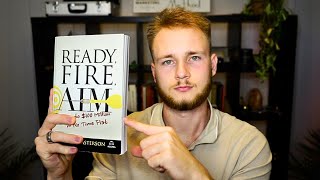
Michael Masterson's Ready, Fire, Aim breaks scaling into four stages: infancy ($0–$1M) focuses on finding product-market fit and selling fast; childhood ($1M–$10M) means building systems and raising customer value; adolescence ($10M–$50M) requires KPIs and replacing the founder in key roles; maturity ($50M–$100M) emphasizes innovation and acquisitions. The speaker has lived through stage two.
Chapters
This book right here is considered to be the greatest business book of all time. And in this video, I'm going to be breaking down exactly why that is and how you can use this book to scale a business to $100 million. So without any further ado, let's go ahead and dive right on in. Alrighty. So we're going to start with what this book refers to as stage one growth. All right? So stage one is basically what they call infancy. So it's when you're at zero to $1 million. So a lot of you guys watching this channel, this is where you're at. So this will be a very valuable, important piece of the entire puzzle. So the core thing that you want to focus on from 0 to 100 or 0 to 1 million is literally just figuring out what the hell you're going to sell and how you're gonna sell it. Okay? So the key focus here is you want to focus on finding a market and finding a problem that you can solve, okay? So you're not looking at how you can make the perfect product. You're not looking at branding, okay? Like, no branding. Branding doesn't make any sense at this point. I see, like, the amount of business owners that spend days trying to figure out what their logo should be or, like their tagline or designing business cards. These are the people that always fail, okay? So don't worry about branding. You don't even worry about your product being good. The only thing that you're worried about is finding a market to serve.
Okay, an offer.
This is in the very beginning. And an optimal way to sell it, okay?
Which is called the OSS Optimal Selling Strategy. That's the strategy, okay? So at this point, what you're looking for is again, a problem, which is a problem in a market, a group of people that are experiencing a similar problem, and all you need to figure out is how to sell them a solution, okay? You don't even need to, like, you don't need to invest any time into making the product super good. It just needs to be good enough. What that's called is an MVP or minimum viable product. Once you have an mvp, you can start selling it. And what you do is you figure out what does the market want, right? And then once you figure out what they want, then you build that into your product. You don't build it and then try to sell it. You figure out what they want, and then you build it. This is the key. This is what most people get completely wrong, is they go out and they spend months Developing some software, some bullshit, and then they find out that nobody even cares. And now they're stuck trying to figure out how to sell it. That is the worst thing that you could possibly do. Okay, so what you're going to do is you get out your mvp, you start going and you sell it to the market. And they're either going to say, hey, this is great, I'm really happy, or they're going to be like, oh my God, this is the worst thing ever.
I hate you. Right? Hopefully they won't say that. But then what you do is you take that feedback. Whether it's negative or whether it's positive, it doesn't really matter. But you take that and then you reiterate, you make tweaks and changes to your product, and then you launch.
Version 2.0, right? And then you take that back to the market and the cycle repeats over and over and over and over and over until you end up having a actually good, solid product. All right? Now what you also want to focus on in this stage is finding your optimal selling strategy. So, oss. So whenever you hear, like Hormozi talk about.
One avatar.
One product.
One channel, that's his channel to get to one mil. This is the book that he got it from is ready, fire, aim. So what that's called is your optimal selling strategy. Alright, so this is the other thing that you want to focus on.
The key is the main thing you need to remember here is just embrace things being imperfect. Your products not gonna be perfect. Your logo is probably gonna look like shit, if you even have a logo. And the main thing you need to just be prioritizing is speed of execution over perfection. Okay, that's stage one. Then once you find that, you literally just do more. Okay? Once you find your optimal selling system and you're making money, just spend like whatever your optimal selling system is. If it's ads, spend more money on ads. If it's content, make more freaking content. If it's referrals, get more referrals. If it's outreach, do more outreach. Like, that's literally all that it is. Getting to a million dollars a year in revenue is the easiest thing. Once you have your OSS. Okay, that's stage one. Let's talk about stage two. This is where I am currently at stage two. This is 10 mil or not 10 mil. 1 mil to 10 mil. All right, now, good lord, this drawing. I might even be better off without this pen. But we're just going to run with it. All right?
Stage two is one Million to ten million. All right? I believe in the book they refer to this as childhood. So if you're putting $10 million a year that says $10 million a year on a pedestal, they consider this childhood. All right? So.
Once you have an oss, you're gonna optimal selling strategy from stage one. You're gonna start to get a group of customers. Okay? Your goal is you want to have a group of qualified customers.
So these are the people that you sold to. Right? Now what you'll find is within this group of customers, you're going to have, you know, customers are fractal. So what that means is that like a small percentage of your customers are going to be contributing to a large portion of your money and even smaller percentage of those customers are going to be a large portion of the revenue. So.
What you do is you start creating back end offers to sell to your customer base. Because the way that you need to think about it is there's no business out there.
That is just front end. Every business has continuity or LTV. So let's say it cost you, for simple math, $10 to acquire a customer. And every customer on average spends $30, right? This is great, but it's only great while you're small because as you start to scale up, this cost is going to increase. So now once you start scaling, instead of it being $10 to acquire a customer, it's $20 to acquire a customer that spends $30. But now also you have the cost to fulfill and you have your whole team. So now your profit is essentially going down. So what you do to solve this is you start selling them more things on the back end so that instead of them only spending $30, now they start spending $50.
Or $100.
Or maybe even $200 or 300 or 500 or whatever, right? And at that point, if they're spending $200 on average because of all these products that you have to sell them and the continuity, I mean, you could even pay $30 or even $50 to acquire that customer. And if they're paying 200, it doesn't matter. Right? So what you need to do is like at this stage you're essentially like building an actual business as opposed to just being like an offer. Alright? And you do that by.
Rapidly testing and developing what's called tipping point products.
Tipping point products. All right.
Cool. So let me explain that concept. So if you have a glass of water.
And you, the glass is like all the way full, okay? If you drop one little droplet on there, it's probably just gonna, you know, be a little more full. If you do another droplet on there, it might just be even a little more full. Another droplet, it might be a little more full, but at a certain point there's going to be one singular droplet that goes on there that causes the water to spill over, which is called the Tipping Point. There's also a book called the Tipping Point by Malcolm Gladwell. That's another book. I haven't read it, but it is the name of a book. All right, now what you want to do is whenever, whenever a product like goes big, for example, it's never like a brand new idea or completely revolutionary idea. It's always an iteration of a current product with like one thing changed. So for example, if you guys remember vine, alright, vine essentially took what YouTube did, but they just made it six seconds, right? So vine was a tipping point product. They took something that was already, already working. People were sending me, you know, people are watching videos online, they just made it add and they made them six seconds, right? Then TikTok, which I think TikTok used to be, musically they took the exact same concept, but they just extended the six seconds and essentially invented short form, right? And then YouTube shorts.
And then Instagram reels. These are all, they're not revolutionary ideas. They're literally all just copycatting each other every single time they're knocking off a product and changing one thing about it. Instead of it being on YouTube, it's on Instagram. Instead of it being six seconds, it's, you know, teenagers dancing online. Instead of being teenagers dancing online, it's on YouTube, right? So they're all like one, it's all, only one thing is changed. So the exit. One of the examples they give in the book is like, let's say you owned a steakhouse, right?
And if you were to launch a second business, you could either launch another restaurant called the Fish House, where, guess what, you'd sell fish, or you could start wholesaling steaks just as an example. Now if you notice, there's only one thing changed in each of these examples. Instead of having a restaurant here, you're now wholesaling, but instead of selling steak, in this example, you're just selling fish. What you wouldn't do is you wouldn't go and say, okay, cool, I'm going to now do fish wholesale because you're changing too many things, okay? So the concept is you're essentially just like, you're introducing things that are currently working in the market and you're you're changing one thing to help to make it better. Right now your goal here, put simply, is just increase ltv, increase the lifetime value of a customer. The other thing you want to focus on in stage two is building a team.
And delegating.
And then what you should be focusing on is creating systems.
For testing new products.
And the way that you want to think about it is.
Your front end product is meant to acquire a customer. So front end.
Is to acquire a customer.
Your back end is where you make the profit and you can make stupid profit.
Back end is where you make this stupid profit. Okay? Don't try to make your profit on the front end because you'll end up inhibiting your scale. You make a ton, a shit ton of money on the back. That's the game. Okay, cool. Now that's stage two. I will warn you, moving forward into stage three, I have zero experience. So I'm literally just quoting the book. My business currently does around 4, $400,000 a month. I think we'll hit $500,000 a month next month. So I have no personal experience with running a 10 to 15, 50 million dollar a year business yet. So I'm just gonna be quoting the book. Okay, so stage three, 10 to 50 mil.
All right.
So here the main keys of the book are creating.
KPIs that are well known across the team and then holding people accountable. Okay?
So what you're really looking for is there's a concept called entrepreneurs. So an entrepreneur is someone that owns and starts a business. An intrapreneur essentially is like, they essentially are like they're starting a business within a business. So what happens is you start to have these like mini business units. All right? So for example, if you look at Amazon, Amazon doesn't only sell stuff online, okay? They have Audible.
They have aws, they have Whole Foods.
They have fba.
They have Amazon Basics, where they even own some of their own brands. And I mean, this could go on and on, but as you see, these are all individual. Like, each of these could be their own business. Like, you could have a business that just sells things on Amazon. You could have a fulfillment service, you could have a grocery store, you could have a cloud computing service. So they have all of these individuals, they also have Alexa. Right? Like there's all these business units under the umbrella that is Amazon, right?
So at this stage, you're starting to find and develop these intrapreneurs that can then build business units within your business. All right?
The other thing is you kind of start to Replace yourself within the key roles. And in stage two you're more so like a project manager where you're assigning tasks and giving things to people. At this stage you more so start to become the person who is, you're leading through other people. So you're, you're finding and promoting leaders within the company. Then you're just holding them accountable to metrics, right? So that's stage three. Now we're going to move on to stage four.
Stage four is 50 million to $100 million. All right now, full transparency. I actually haven't listened to this part of the book because once I got to the 1mil to 10mil part of the book, I was just like, all right, cool, I'm going to pause here, but I did get some notes just on the book and I'll kind of report on this for you guys. So this point you start to focus on innovation. So like continuing to create new products.
Mergers and acquisitions. So you actually start to go out and buy other businesses.
And new verticals. So kind of like what I was just talking about there. But doubling down on that, the next thing you do is you focus on company culture. Like your company culture becomes a competitive advantage above like apart from all of the other businesses, right? So for example, nobody thinks of.
What'S like a, nobody thinks of.
Like a great company culture at ExxonMobil, right? Like no one cares. Granted, ExxonMobil makes a ton of money, but as an example, nobody is like wow, they have a great company culture. But people say, oh, Apple has a great company culture or Google has a great company culture or Tesla has a great company culture. That is a competitive advantage which allows them to, to recruit and attract more talent which then helps them grow their business. So it's like it more so becomes about the people you're able to bring in.
From the culture and the people you're able to develop than the things you're able to do as an individual contributor, right? And here you really start to focus on like you are basically just building a leadership team that runs the entire business.
While you are more so just like casting the vision.
You essentially just become a professional vision caster and strategic thinker. Alright, so ladies and gentlemen, that's ready. Fire. Aim. Hope you guys enjoyed this video. Got value from it. If you haven't read the book, I would highly recommend going ahead and reading it. And if you had, let me know what you think of the summary. See you in the next one.










