Step By Step Guide To Close Clients For Your AI Agency
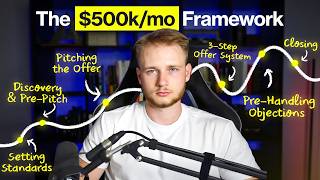
Transcript of a YouTube video walkthrough (role-play) teaching agency owners a repeatable sales process for acquiring and closing high-value clients. Covers first impressions/standards, discovery (past/present/future), pitching benefits over features, a three-part offer framework, AI-powered lead nurture and automation, pre-handling/temp-checks, and a closing pattern that emphasizes accountability and humor. Includes concrete pricing/offer examples and a live role-play with an attorney prospect.
Questions this video answers
Reported show rates range from about 40% (poor adherence) up to about 80% (well-followed system).
Trial: 10 appointments/week at $2,000 per show → $80,000 for the month; entry-level alternative mentioned at $20,000; a smaller test of 8 appointments offered at $16,000 (one-time).
Prospect suggested 5 appointments (~$10k); Julian proposed 8 appointments for $16k as the on-the-spot deal.
Prospect current revenue ~ $3.5M/year, target $10M/year; target monthly equivalent ~ $833K/month and a deadline phrased as by September 28, 2026 (explicit date mentioned in the transcript).
Automated systems + AI lead nurture are claimed to cut sales calls down to on average less than 30 minutes.
Chapters
All right, look, here's the truth. Most agency owners cannot sell for shit. You just have a bunch of nerds who know how to run ads or know how to build automations, jumping on calls and completely floundering when trying to close deals. But what separates big agencies from small agencies is not just how good they are at fulfilling on their service, but it really comes down to how good they are at getting and closing clients. Which is exactly why in this video, I'm bringing in my business partner who runs our $500,000 per month sales team, to show you guys our entire sales process, how to structure the pitch and how you can consistently acquire high level clients to grow your agency. So without any further ado, let's dive in.
All right, cool.
So this is my business partner, Julian. He runs our sales team and as a frickin sales wizard. So Julian, you want to dive in, show people how the pitch works, how we structure the offer and how they can close some deals?
Yeah, for sure. So I'll start with how your sales process should be laid out. So the biggest thing that I kind of learned the hard way is like you can't just fumble your way through a call where you just like show up friendly and start telling them about how great everything is. I've taken, you know, over 10,000 sales calls or sales presentations in my career so far. And so I've got a lot of repetition behind this. So the first thing, if you're taking notes, go ahead and write this down, is going to be first impressions. So this is basically like when the prospect shows up to the call with you and how they're going to conduct the relationship with you. Like are they going to take you seriously? Are they going to look at you like a pro or are they going to look at you like some sleazy sales rep that's just trying to take their money. And so the way that I go about setting the proper frame is what a lot of people call it. But the first impression that I'm going about setting here is I'm here to be friendly, but not their friend. Right. So I will smile, I will be gracious when they jump on the call. I'm not gonna be an asshole. But I'm also not gonna start talking about like their cats, their dogs, and, you know, their grandma's first cousin and whether they came over from Europe or not back, you know, hundreds of years ago. Right. We don't wanna end up in that world. It's a dark world to end up in. And so another way that you can ensure that your calls have standards. Is holding your prospect accountable to showing up like a professional. Some of the ways that I do that is getting them to take notes, pulling out a pen and paper. If they don't pull out a pen and paper, I literally won't conduct the call if their camera's not on or they're in the car. I literally won't conduct the call unless they either pull over and have their camera on or if it's just their camera off, unless they turn that on and are, like, ready to. Ready to have a professional conversation or consultation, depending on how you position it. Biggest thing, stay away from talking about BS here. Just get straight to business as fast as humanly possible without being rude. So we can kind of play that out role. Play it out a little bit if you'd like, here so they can see what that looks like, and then we can go through the rest of the process.
Cool.
Hey, Tim. What's going on, man?
What up?
How's it going? How's it going? Where are you calling in from?
I'm calling in from Scottsdale, Arizona.
Love to see it, man. I'd love to see that, but I can't see you. Is your. Is your camera working? What's going on over there?
Yeah, it's working. I'm just not gonna turn it on. I'm a little. A little shy, to be honest.
No worries, man. I grew up homeschooled, so I'm pretty shy myself. One of the standards that we have here as a company policy, though, is having your camera on just so you and I can get to know each other a little bit better. Let me know when you got that on, and I'm gonna knock something out right here real quick. Just send an email when you got that on. We can get started.
Got it? Yeah, I'll turn it on.
Cool. Oh, dude, I thought you were gonna show up looking like Frankenstein's monster. No problems here. Love to see it, man. Well, cool. Why don't we go ahead and dive right in? You got a pen and paper?
I have a pen, but I don't have paper. I usually just, like. I'm kind of just remember things.
Yeah, for sure. No problem. Go ahead and grab that paper for me real quick, and we can go ahead and get started. I just want to make sure that, you know, I'm gonna go over a lot of stuff today to help you get your business to the next level, and I want to make sure nothing's missed so that even if we don't do business here, Together today, you can walk away with some value either way. Let me know when you're ready.
Okay, cool.
Awesome. Cool. Yeah, man. Well, with that being said, and then I'm just gonna go straight into setting expectations for basically the rest of the call and that. That's pretty much it. And sometimes it might, you might feel a little uncomfortable at first doing that kind of stuff. But, like, I've done it so many times and I've had people, like, you know, lose their mind on it. And I'm just like, yeah, dude, I'm just literally not going to go through this call and eventually, like, what people realize, because you get so confident in saying it, that you're serious and you have standards, and then the wrong people will just jump off the call, which is totally fine. Like, I don't want to deal with somebody who, especially in our industry, we're in financial services, like, if you can't show up on a camera to talk to your client, like, you're not going to make any money. So that's one of the standards we have. We can go into the next piece here if that works for you. So the next thing I wanted to talk about was number two on your sales process, which is discovery and pre pitch. And so this part is super, super important in terms of. I would say actually this is the most important part of the call because this is the part of the call where you're going to be asking questions primarily around three things that you need to understand. So if you're writing this down, these are the three things you need. Where have they been, right? What have they done in the past? Have they tried a solution like yours? What have they been doing? What kind of results are they getting, et cetera, like, everything I can get, the clearer the better. Where are they at currently? What are they doing right, like, what kind of results are they getting? What are they trying? Are they doing things themselves, et cetera, et cetera. And number three, where do they want to go? And if you can nail these three things, you can usually get by pretty much any sales call to the end of it and be able to close them because, you know, basically past, present and future, which gives you the ability to tell them what they need based off of what they have and what they want, essentially. So with that being said, I want to also instill into you as the agency owner, or if you're. Or if you're a closer watching this back to the standards thing, in this part of the call, you should also be almost qualifying them in a way to make sure that you're actually even comfortable hiring them on as a client. Essentially what I don't want to do is I don't want to just like whore out the offer is what I call it, where I'm jumping on and I'm just telling them about like how we take everybody on and like, we're ready to get started. We'll bring them in right now. Like, we don't want to do that. In fact, we want to come off a little bit more boutique, a little bit more custom, a little bit more premium. Right? The same way that like Louis Vuitton comes off as premium. They don't let everybody in the store at one time even. And that's kind of the allure that you want to bring to your business by having standards, by. By qualifying your clients properly. So I'll give you an example. Let's say that Tim is a prospect. Jumps on a call and he tells me like five minutes in. My husband, wife, partner wears the pants in this relationship. And I'm not gonna make any decisions without them on this call or anything at all. I'm gonna take everything you say back to them. And I'm not. I can't get them on this call. Cause they're busy, right? In that scenario, I'm literally not gonna conduct a call. If I find out he actually doesn't have the independent decision making power to. I would just be wasting his time and lowering my status. Because a professional is not going to take a meeting without all of the decision makers present. Like, the President isn't going to meet with, you know, Rush, Russia's president's assistant. Wouldn't make any sense because no business is going to get done. With that being said, like, we can role play this out here shortly and we're not going to go through a full discovery. That would take a while. But the majority of closers are focused on the closing and the objection side of things because it's super sexy. That's where the one liners come in. You can, you can get really cute, you know, and it's awesome. But what's interesting is this part of the call is more pivotal because that gives you all of the ammunition you need to be able to go into those conversations prepared to hold them accountable to the decision that they're going to make today, if that makes sense. So if you're ready to hit some role play, we can jump off and you just tell me your business partner is not on the call or whatever, and then we can kind of play that out. So they can get the example here.
Cool.
Yeah.
I think, honestly, I think we should run through like a full discovery.
You said we should not.
We should, we should not. Like, it doesn't need to be 30 minutes, but like a faster version of it.
Yeah, sure. What am I selling you?
You tell me.
I mean, we could go paper show. Why don't we do.
Why don't we do pay per show for lawyers?
Okay. So the role play we're gonna do then is gonna be I'm selling appointments where he only pays if they show up and he's an attorney. So I'm going to go ahead and establish the, you know, the sales process here. Great. Tim. So I know you said you got that pen and paper. We're going to go ahead and just dive right into everything here. So just to be clear, the way that these calls best go is that I'm going to learn a little bit about what you're doing, what markets you're in, what type of clientele you like to go after, and then if I can help, I'll tell you all about it. You know, I'll give you everything you need to be more successful with or without us. And if not, I'm going to try to get you a referral today. So that way you leave this call with a win. Is that cool?
Yeah.
Amazing. Amazing. So tell me a little bit more about your business. Like, what is going on with where you're at? What is the biggest challenge? I guess is the best question to start with.
Yeah, I mean, I would say, like, the biggest thing is.
Just not having enough clients, honestly, you know.
Sure.
I mean, we're doing well. We're doing a few million bucks a year. But the biggest thing is we're trying to get bigger. And, you know, we're always looking for more lead sources and saw your guys's ad online and thought it looked interesting. I know you guys do some stuff with AI too, and, you know, I don't really understand any of it at all, but it all sounds, you know, like I know that's where things are going and so just, you know, curious to hear what you guys got.
Yeah, man, that's awesome. Great that you're getting ahead of things too here with the way technology is going. What are you guys working towards? You mentioned they're doing a few million a year. Is that three million, five million? What does that look like?
It's about three and a half mil year after, you know, that that's pretty much what we get in terms of our top line revenue. Got it goal I would like to get to 10. I think we can really do that in our market. It's super doable. There's tons of people that are doing it.
Got it. So goals 10. Currently at three, three and a half. Fluctuates year to year, I'm sure. Okay, got it.
And you said.
So what are you doing to get clients currently then? Like, what. What's going on there?
We run billboard ads in our local area.
Okay. Billboards.
You know, we have like that 444-444-4444 number.
Yeah, I've seen those.
We're out here in Scottsdale.
Okay.
So anytime someone gets a wreck or a ticket, we send them stuff in the mail. Sure. Which, it's all good, but I think there's something else we can be doing. I feel like we can get an advantage over other people with. With all the AI stuff.
Can I go back to that real quick? You mentioned anytime gets anyone gets into a wreck or gets a ticket, you're sending them stuff in the mail. How are you getting that data? Like, how are you getting those leads?
Well, it's public data. Whenever someone gets a. Gets a ticket.
Got it.
We get that data publicly.
But they're not expecting you to call. They're not coming in for a consultation. You're basically just trying to get them to get interested in talking to you, essentially.
Oh, yeah, we hound the fuck out of them.
Got it. Okay. Yeah, that could be trouble. Okay, well, so then what else are you doing for advertising? Like, are you just waiting for somebody to get into a wreck? Are you just waiting for somebody to hopefully see your mailer and fill it out or what? What else is going on here?
Well, the billboards.
The billboards.
We tried some stuff with TV back in the day, but honestly, I don't think I'm. I don't think I have the. I think I have a face for radio, you know, honestly.
Sure.
I don't really think. I'm a TV guy.
Yeah, no worries.
So, yeah, I mean, that's been the main thing and bought some, like, Internet leads in the past. But everything I've done with the Internet, you know, like, I believe in the Internet. Don't get me wrong. Like, yeah, of course I know it's real and I know it's a thing, and I know it's definitely real. Know it's where everything's going. I seen the success with it.
Makes sense. Okay, so I guess I'm curious then, because you've tried a lot of stuff in the past. You want to Try something new. You haven't had any luck with the Internet? TV was kind of a. Kind of a bust as well. You said you had a face for radio. What makes you want to try something like Internet leads now, then? If it hasn't worked in the past, like, why not do more of what you're currently doing?
Well, I mean, I know there's other firms out there that see success with it, and, you know, I think I'm just as good, if not better than them. And so there's no reason that I can't see success with the two. It just. Just makes sense, you know, So I think it's probably just something I'm missing. I don't know what it is. It's part of the reason I'm on this call. Sure.
Now, just to be clear, you mentioned that you think obviously you have more skill or innate talent than they do, which is totally fine. I respect that. I actually admire it, Ethan. But what does the revenue say? Are they doing bigger numbers than you because they have this digital lead source?
Some are, some aren't. Depends.
I just.
I know there's other firms that are doing it, and so obviously possible.
Got it. Got it. What's. Who's the firm that, you know that's doing bigger numbers with something like this that you're kind of like, trying to catch up to? Essentially.
Morgan and Morgan.
Got it. And what are they doing per year?
Hundreds of millions.
Hundreds of millions. Got it. Yeah.
I think they're. The guy who owns. It's like a billionaire or something.
Yeah. I mean, if he's doing hundreds of millions, I guess.
So they do billboards and everything, too, but they. They definitely have cracked the Internet thing.
Got it. So they're just one step ahead of you. It sounds like you've kind of got the foundation that they started with, but you're not really able to catch up or even compete with big companies like that because of the fact that they've almost got a monopoly on that market against your business right now, it sounds like. Is that what I'm hearing?
I mean, I wouldn't say they have a monopoly, but they're doing a lot better than us, for sure. I think they definitely have something figured out that we don't got.
It makes sense. Okay, interesting. So looking at the business we're aiming for, for 10 million, how many. How many of these people that you're reaching out to and prospecting are actually turning into presentations per week right now?
Well, I mean, so you're saying how many people, like, can you Ask the question differently.
Yeah, so, like, if you send out, if you have these billboards out, you got these mailers going out, you're trying tv, you're trying the Internet, whatever. How many people are you actually, like, making an offer to where you're telling them how much your service costs and asking them to sign on the dotted line per week? Essentially.
I think we bring like, maybe 20 clients a week.
And are you. Are all of 20 clients that you're bringing on? Are you offering only 20 people, or are there more people that are not moving forward with you currently?
No, there's definitely more people that aren't moving forward.
How many would that be per week?
I mean, I do. I don't know lawyer numbers. I'm just gonna make some. Something up.
40.
40 people.
Got it. So one out of three people that walk into your office right now are moving forward with you?
1 out of 2. 20 divided by 40 divided by 2 is 20.
I should have clarified. I said how many people that you're presenting did not move forward, so I thought that was 40. So you're saying that 50% of people are moving forward 20 out of. Okay, got it. That makes more sense. Yeah, that's not bad. Okay, so how many. How many people are actually taking presentations? Because if you're doing all of these yourself, that would be 40 presentations. That's 40 hours a week before you have any of the caseload work that comes through that you and, you know, your assistants would be working on or your paralegals, your junior lawyers.
I'm not taking it.
Who's taking those appointments?
I'm an assistant. You know, people. We're lawyers, dude. We charge by the hour.
Yeah, of course.
To see if we want to work with them. It costs money.
Yeah, yeah, yeah. I mean, dude, I wish I could do that in my business. Right. Love to see it. So how many appointments is, let's say your assistant getting per week?
That's why I just said 40.
So she's taking all 40 calls and still trying to give you support on the casework side, or you have like, multiple.
Multiple assistants. Got it.
Okay, so we. So how many appointments is each assistant getting?
One takes all the appointments. The other ones help me with different things.
Got it. Okay, so are there going to be more assistants taking more appointments if we were able to bring clientele into your business? Or would this same assistant that's currently, like, taking 40 calls a week be taking on more calls?
I mean, I guess I could bring on more people.
Okay, so you don't already have them though.
I have people that could take them, but that's not what they're currently doing.
Got it. Okay. Yeah, because it sounds like, it sounds like you have the infrastructure to take on more clients. It's just, it's just a matter of like, you would have to scale as you bring more clientele in as well so that you can continue to build this at 10 million a year. Is that what I'm hearing?
Correct?
Makes sense. Got it. Okay. And what are you trying to hit this 10 million a year by.
Within the next year?
Like within the next 12 months? Yeah. Okay, got it. Let's see.
So by September 28th of 2026, you want to be doing about 833K plus per month, essentially.
Yep.
Okay, so I mean, why now though? Like, why not six months ago? Why not six months from now? Like why?
I've been working on it the whole time. This is just, I'm just taking a call with you today.
Okay, that makes sense. But like, why? Obviously you've tried other stuff. You're trying to scale. Have you been trying to scale to 10 million this whole time and it just hasn't been working out or.
Well, it's been a steady progression towards it.
Right.
I just think that this could potentially be something that gets us there faster. If it makes sense.
Right, Makes sense in what way though?
The numbers. I'm a math, I'm a numbers guy, dude. Like, if the. If the math makes sense, let's do business. If not, get fucked.
Yeah, for sure.
Politely.
Yeah, of course. Right. And if it doesn't, if the numbers don't make sense, I wouldn't even expect you to do it because then we can't do business long term. Because if it's not a win win, then it doesn't work for anyone. Yep. What numbers are you doing specifically with your current marketing? Like how much does it cost you to get a client and how much are they paying you on average?
Off the top of my head, not entirely sure. I'd have to go pull up numbers and whatnot. But yeah, I mean.
If we can.
Kind of get into what you guys do and I can take the. Take it and you know, we'll analyze the numbers and see what it looks like and sure roll from there.
The biggest thing that's kind of a little bit of a hold up for me here though is if you don't know your current numbers, then you won't even know if these numbers are better, better or worse. And so there would be nothing to analyze. How could we get that data where we could find out how much you're paying currently to get a customer.
I mean, I could give you ballpark park.
Okay.
It's like $3,000 to get a customer, and none of this math is gonna make any sense. And on average that, you know, if we win a case, could be about 50 grand.
Okay, got it. So.
With what you're spending, you're currently spending, like, what is that, 60,000 a week then, give or take.
Yeah. Okay, got it.
So you're spending 60,000 a week, which is. Wow, that's. That's creeping up almost your revenue before any of the other overhead. Because if you're spending 60,000 a week, you're basically just counting on the future money that's going to come in when you beat the case, essentially. Is that what I'm hearing?
Yeah, basically.
I see. So cash flow could even be one of the constraints here as well. And. But you're closing one out of two of the people that show up there, right?
Mm. Got it.
Okay, interesting. So. Okay, cool. Now I'm going to transition basically out of this part because I have all, like, this guy's going to be a logical close to B2B sale. I don't really need any of, like, the. The flim flam that would come with, like, somebody who's trying to leave their job and they're, like, motivated to, you know, provide for their wife, essentially. Whatever. This guy's already. I've already got pretty much all the information that I need to close him.
And also gave you totally random numbers, dude.
Yeah, yeah.
None of it made any sense. Like, my. What I'm spending on marketing is basically.
Yeah, yeah, exactly. Well, it's cool, though, because with that, though, the biggest thing is, like, this is just going to be a close where I have to make sense of the numbers.
Checking out for him. So as long as my product lines up there or it solves an adjacent problem, this guy's going to buy. Yeah. Step three, pitch. So looking at the pitch here, like, I've trained so many salespeople to this point, I don't even have a number on it. It's so many. And what I found is that between the top salespeople that I've trained that have gone off and done millions of dollars either in this business or in other businesses I've been a part of versus the closers that get dropped off the team because they can't sell is really oftentimes coming down to how they pitch the product. When you're pitching someone the Biggest thing to remember is that you're reminding them of all of the things that they dislike about their current situation or their current failed solution and contrast it to your offerings feature that creates a benefit. So what that means is I'm not going to talk all about the utility, like the feature and what it does, right? Like, oh, look at this car. Like there's this great oil pan. Like, I'm not going to talk about that. I'm going to talk about how they're not going to have to replace their oil all the time if that's a recurring problem that they have, if that makes sense. The simplest way I can describe the right way to pitch is.
Under no circumstances should you start by pitching the mechanics. You should pitch on the mechanism, right? So what is it that gets them to their desired outcome? Essentially, I'm going to give you the easiest example I have ever been able to think of, which is selling a car. So I want you to imagine about both sides of the car transaction. You got the customer and you got the salesman, right? Now if I'm a normal consumer, I'm not just some like, you know, jacked up car guy, right? If I'm a normal consumer, I don't really care about every piece of the engine, every screw, every little filter, every, you know, knickknack that's inside of the engine. And as a car salesman, because my customer doesn't care about that, I don't need to pull out the owner's manual and be like, look at this screw. Here's how you replace the light bulb in the glove compartment. If I do that, I've already lost them because that's not what they want. And so here's an example of essentially how I would pitch the car to get them to buy into the idea. So I would pitch again, I would remind them of all the things that they told me they didn't like. So let's say they come in with an older car and they're like, oh, it's not reliable. I have to get oil changes constantly. I got an oil leak, it's broken down a few times, the battery goes out every now and again because the screws are loose or whatever, right? I don't know anything about cars. So in this scenario would just repeat everything they just told me about. Yeah, man. You remember earlier, you remember earlier how you were telling me like, your, your car is like super unreliable. You're worried about your daughter going off when and driving on the highway because it might break down at any second and that's made you really uncomfortable because of, you know, some of the things that you had seen on the news. And if you haven't seen it already, dude, I mean, there's some crazy stuff out there. People getting killed with, you know, their car breaking down and there's a massive highway pile up. So now I've got all that to then transition into the part of the pitch that is actually gonna get them to buy. So what we do is me pitching again. So what we do instead to make sure that you have a vehicle that's actually reliable is we give you a 10 year warranty on the engine. Okay, why is that important? Because we're so confident in our product being reliable that we're gonna tell you for the next decade this thing is not gonna blow up. And if it does, like you're one in a billion people, for example, then by all means, we'll go off and replace it and make sure that everything is working, you know, spic and spam for you to make sure that you're able to drive safely on the highway and completely avoid one of those crazy car pileups that we've seen on the news. Right. Does that make sense, Mr. Prospect? And then I'm going to just wait for them to reply and be like, yeah, that makes sense. Okay, whatever. And then in that scenario, I'm going to talk about some of the other things. And yeah, you told me, you know, you were constantly replacing filters and stuff for breaking down. This is all state of the art technology that's built in to make sure that you can sit in the driver's seat, cool and comfortable while you're driving down the highway here in Scottsdale? And on top of that, you're gonna have the safety and the reliability that comes with insert car brand. Would you like to give it a test drive so you don't have to just take my word for it all of a sudden, because I just talked about their problem and talked about the features that give them the benefits that they're looking for that solve that problem. They're completely bought into the concept of this car. And I don't even know anything about car sales. And you might be on your way to a dealership right now to buy one. So with that being said, I'm going to talk more about what this looks like in an SMMA or an AI integration setting, because that's if you're watching this, that's what you should be doing. And if you're not, welcome to the club.
You'Re gonna do the exact same thing I just described. So the best way that I've found, right, there's all sorts of processes, best way that I found that I've actually battle tested personally is you want to have three simply titled components of your offer. So basically you just want to keep everything super simple, like the simpler the better. I want a third grade reading level. Think right. I want to have the offer. The titles to each component of the offer are preferably the solutions to the problem that they have, will have, and are going to have after we solve them. That's the idea here. I want to solve their current problem and their future problems with this offer. In a perfect world, if you're designing the sales process or even if you're pitching, this is like next level pitching when you solve the problems that your solution creates afterwards. Let's dive into this though. So when I'm looking at breaking this out, I want to make sure that I'm spending more time on the benefits than the features like we just talked about. So I'm going to mention the feature. It's not like I'm not going to talk about it. Like if I'm doing an SMMA on Facebook ads, like I'm going to mention Facebook ads, but I'm not going to talk about like the algorithms, the updates. You know, the stock meeting that came out from Mark Zuckerberg where he announced that to the shareholders they're going to be bringing out this new AI. You know, they don't need to hear about Meta Andromeda. No one gives a. Yeah, like nobody cares about any of that stuff. And so what we want to do here essentially when we're getting super advanced is we want to pitch the product. The part of the solution creates another problem, the second component solves that problem and the third component solves the problem that the third that the second one created. Reason why this crushes is because you're demonstrating expertise in the niche by solving their current problem and then demonstrating that you've already been through and lived through all the other problems that are going to come up. So the assumption that their mind draws is that you already know how to solve this problem because you're talking about what that solution creates as an issue later on. This is the best way that I've been able to take sales calls with dudes that are in their 40s and 50s, even when I was in my like early 20s, a kid with no facial hair, wearing a T shirt on a couch and show up like a G, because I was able to speak to them intellectually and so last bullet point on this and we can role play it out is hype only takes a sale.
So far.
Intellect and specific knowledge is what takes you into the extreme levels of persuasion and past the norm of most sales reps, because that's when you gain peer to peer or even like the mentor plus expertise respect that comes with the status that you gain from having this type of information that they don't have access to. So we can go ahead and role play this out. Tim.
Yeah, real, real quick, too, because I think we didn't touch on a very important part, which is the transition from discovery to pitch.
For sure. That's definitely something that's worth noting. So one of the things that is important is when I'm going through the. When I'm going from essentially like these, each of these different places, there needs to be a transition into it. I can't come in and say, hey, like, you know, discovery, discovery, discovery. And then immediately I'm like, all right, cool. So here's how it works. And, like, just start pitching the crap out of them. Like, we don't want to do that. When I'm going through my transitions, I'm always going to talk from a place of expertise in terms of, like, hey, I've seen we have clients that have had this. Hey, we've had attorneys that have come to us with, you know, smaller practices doing, you know, three to three and a half million a year that, you know, have ended up going way beyond, way, way beyond where you're talking about going. And they had the same issues with blank, blank and blank. And here are some of the things that we did to solve them. And I'm going to have you take some notes on that. If you have a pen and pad, do you want to go ahead and write down number one for me? And like, all of a sudden, it's just like, I'm basically coaching them. The goal here is that you're a coach and the transitions should tee you up to be a coach. And if you notice, everything in the pitch is about the status that I can hold from the expertise that I bring to this. And this is why, like, you'll look at influencers online and be like, oh, wow, like, you know, Alex Hermosi or oh, wow, like Matt Ryder, or, oh, wow, like Jeremy Miner, all these guys that are out there, or Iman Ghazi. It's like they've just basically done to the extreme what I'm talking about here, which is solve the problem that you have and then talk about the problem you're gonna have and solve those and then offer to sell you something to solve that problem, if that makes sense. So think that pretty much covers it there if you're ready to go through and we can role play it out.
Yeah, dude, pitch me.
Cool. Am I still selling the attorney or do you want me to sell something else?
Yeah, I think we should do the same thing.
Cool. So awesome. Mr. Attorney. So I know we've gone over a lot here. We can go ahead and dive in. I have. We've had a few clients that have come to us that were doing three, three and a half million a year that were able to scale to your goal and beyond. And there was a few key things that I kind of noticed, really three things that help them get to the next level. So.
If you're taking notes on this, go ahead and write down number one for me.
Got it.
Cool. So do you remember earlier how you told me, like, you couldn't break into.
Basically like the Internet marketing space or the TV marketing space, and your biggest concern was really that it was gonna be just the fact that you had a face for radio? Yeah, dude, 100%. And so the biggest thing with like, you know, if you look at billboards and mailers is like, you're always waiting for somebody to get into an accident. You're always waiting for someone to have a problem to hopefully reach out to you and not one of your competitors that are already running Internet ads that get to them quicker. Right. And so what we do is with, number one, go ahead and write this down, it's going to be lightning speed marketing.
Lightning speed marketing.
Yes, sir. I'm going to explain all this with further detail with bullet points. But this is basically the meta concept that you need to understand, which lightning speed marketing I wrote down.
Lightning McQueen marketing.
I love it. Awesome. So the biggest thing to keep in mind here, man, is that what you're doing currently is you're sending out mailers. And on average, those are going to take anywhere between, you know, if they're local, oftentimes 8 to 12 weeks to return. Right. Because you got to get the mailer out to them. You got first you got to get the mailer printed, you got to get it out to them. Then on top of that, you got to wait for them to hopefully fill it out as soon as they get it and then hopefully just be excited to mail it back to you so that maybe you can be the attorney to help them out. Right. The other option is you got to wait for somebody who's driving down the road to hopefully be able to catch those four. Four fours while they're driving.
Well, luckily, with our phone number, I mean, they're all four, so it is pretty. Pretty easy to remember.
Sure, of course, of course. But if they. If they're in an accident, they would just have to happen to be by one of your billboards and not one of your competitors.
Well, our tagline is we're here for you if you're in an accident. So it's pretty easy to.
Yeah, yeah, yeah. Exactly, exactly. But unless they literally crash right next to your billboard, it is gonna be harder for you to find it. And that's why I wanted to talk about, like, the lightning speed marketing here, which is using meta ads running on Facebook and Instagram where people can immediately log in and fill out a form and get a call from your assistant in less than 60 seconds. Because it all happens in real time instead of the time it takes for them to hopefully land by one of these billboards or hopefully get a mailer back to you. And let's be honest, you're not the only attorney sending out the mailers. Right. So this can really set you ahead of the pack here, because all of the guys that are stuck in that revenue level that you're in, they're doing the snail mail marketing, not the lightning speed marketing. And that's why I wanted to touch on that, because if you're able to get to these prospects faster. How many times, Tim, in the last. In the last year have you guys had a prospect, say he's already working with an attorney, or when you called them back after they sent you a mail, or weeks later?
Hundreds of times.
Hundreds of times. What if it was only half of that?
We'd probably double.
What if you doubled? Now we're having a totally different conversation today. Right. And so that's really why I wanted to bring this to your attention is because if we can just get you in front of more people faster, this business has the opportunity to potentially double in the future, assuming all of these metrics stay the same. You still with me on this?
I'm with you. Great.
So we do this all through Facebook advertising, through a portfolio of brands that we own currently, and this is all done for you. You guys don't have to do anything. In fact, we'll even call the leads for you to make sure that we can book them on with your assistant so we can keep her only presenting instead of prospecting. You with me.
Yep. Makes sense.
Amazing. Let's talk about number two. You got any questions? About that.
No, no. I just don't know why you guys called it lightning speed marketing, but I do. I do like it.
Yeah, yeah, yeah, for sure. Cool. I just like to keep things simple, man. So when we're looking at the second step here, the problem that we kind of ran into after working with all these big brands and all of these attorneys that were doing millions of dollars a year in sales was we got them all these leads. All these leads were showing up, right, like they were having all these sales calls. But the problem was.
Not everyone was showing up. In fact, a big portion of them weren't. Your probably running into the same thing right now with a lot of your customers that book in a call with your assistant. They never show up. She wastes the hour drinking, you know, she's driving off to Starbucks. She's maybe sentence, maybe she's doing some casework in between sales calls. And all of a sudden it's like.
I catch her chugging wine coolers sometimes.
Yeah, see, there you go. Right? And it's like those wine coolers are not going to get you guys to that 10 million a year you're trying to get to.
That's right.
And so for this second one, what I want to write down is lead nurture.
Lead, nurture. Okay.
Yeah. Lead, nurture. Let me know you got that down.
All right. Got it.
Amazing. So the biggest thing that you told me earlier, and the biggest thing that's going to become a problem, what became a problem with all of our clients was that there was nobody in between the initial interaction, which is in this example, the mailer that you're sending out and the sales call. And so your show rate ends up taking a big hit. And so what we've done to solve that so that you have more sales calls so you can get more done and save money on wine coolers this year is basically we have an AI system that goes out and has real lifelike conversations with your clientele to ask them about their situation so that you have more information, to have more efficient and quicker sales calls that makes you more sales. Now to be able to double, triple, or even quadruple potentially in the future, and to get them to show up more often so that you can get more out of every week that you're putting that 60,000 out, you can get that case size that you were talking about, that 50,000 back even sooner. All as a matter of just having these conversations instead of them just taking up calendar space that's never going to get used anyways. Does that make Sense.
Yeah. How does the. Is it like an AI caller or like a text bot or what?
So we always rely on texting because people have jobs if they've been in a car accident. Oftentimes there's family deaths, there's things that come up, there's injuries, maybe in the hospital, you know, doctors in the room. So we like to start with texting. Some of the AI calling is not quite where it needs to be yet in this industry.
I can always tell It's a bot 100%.
And that's something that we don't want to bring to a premium brand like yours. We really don't want to bring something in that looks, you know, lackluster at best.
Amen.
And so this is why we found that, you know, the AI that has time to think, think it has time to craft a response based off of the information that you've given it is going to be the most effective. Does that make sense?
Yeah. Yeah. Does it ever, like, go rogue?
I went rogue early on, you know, back in the beta phases, way before we even had this conversation, before we even rolled it out to our clients. We always roll things out that have already been tested and battle, battle proven with some of the people that, you know, trust us to do that with them and they get some additional benefits for it. We're not going to turn you into a lab rat by any means. So what questions you have for me on the AI besides that before we move to number three?
No, it makes sense. What's the, what's the show rate?
The show rate ranges. I mean, it could be anywhere between. I've seen it as low as, you know, 40% in extreme cases where nobody's going through and following the system. And I've seen it as high as, you know, 80% in extreme cases where somebody's following the system and they're now they're iterating on it to make it even better for them themselves in a more personalized way. So it's a big range, but that's a great question.
Thanks. Yeah, it makes sense.
Awesome. So with that being said, let's talk about the third piece here. So at this point, so far in the process with number one, we've got a bunch of appointments coming in, right? Nobody, a lot of people were not showing up. It was a total nightmare. So we solved that problem with number two, lead nurture. Right now, the issue that's going to come up next, and this is the third one that I want you to write down here in a second, is going to be automate and scale. Write down automate and scale.
Okay, got it.
So the biggest thing that we found with attorneys that were stuck below $10 million a year was that it wasn't because they didn't know how to practice law. It wasn't because they didn't know how to run a business. And at this point it definitely wasn't because they weren't getting enough appointments. In fact, most of them were so overloaded they didn't even know what to do with them. In fact, some people were even saying that they were going to start, they were going to close their office down for an extra day of week, day of work per week just to catch up. Which is insanity. Right. Because that's going to kill your bottom line. So what we did was we basically brought in an AI sales management system that's basically going to automate the majority of your sales process to answer most of the questions that would actually happen on the sales call itself to be able to educate the prospect before they show up with your assistant, whether it's Lisa or Rachel that you were talking about earlier, whoever, to make sure that you guys don't get stuck not having enough people to be able to continue to grow this business. Because a lot of these guys were getting stuck. Their assistants were getting burnout. They were quitting on them last minute. And when you're managing more and more people, if you just hire more and more assistants, you end up on this, in this rat race on a hamster wheel where you're constantly trying to keep up with your workload. It never ends. You have high turnover and the business is now becoming a prison instead of a benefit to you. And so we bring in all of the systems to be able to do that for you to cut your sales calls down to on average less than 30 minutes. And on top of that, be able to only match your assistance with the highest intent prospects that are most likely to buy. Does that make sense?
Yup, makes sense.
Great. What questions you have for me on that?
None.
Amazing. Cool. Where do you want to go from here?
What's the price?
That's a great question. Now I do feel compelled to talk to you a little bit first to make sure we are in alignment. So. And this is where we're going to talk about pre handling. So we're going to cut the role play right there. I've also never sold attorney stuff, so.
Some of my never been an attorney.
Yeah. So if some of my attorney information. This is all for entertainment and educational purposes only. If I said anything Wrong about attorneys there. Please don't blast me. But yeah, yeah, yeah. Literally. So the next piece here that we're going to talk about, though, is going to be pre handling. So. And if you're writing this down, taking notes, number four, pre handling. With pre handling, at this point in the sales process, getting a lead on where the prospect's head is at is absolutely pivotal. If you get blindsided by objections at the end of this call, you're screwed. Right? Like, if you get to the end and they're like, I have to talk to my business partner. Like, you had a business partner. Like, if you. I've been there. So, like, no, hate. But if that's you, this part is. This part is exactly what you need to watch.
So the price is all of your leverage. Yeah, that's the reason they're on the call, is they want the price most of the time.
Exactly. So you have to hold the price. Like, basically the only reason they buy from a salesperson is because the salesperson gives them more information than they could otherwise get. It's basically tailored information. The last piece of information that you get is the pricing, which is why all of the values built before, which is the information that is the bridge to the pricing, AKA the value. So going through the pre handling here, though, the biggest thing and my favorite way to do this. There's multiple ways to do this, many ways to do it. My favorite is just doing a 1 to 10 temp check. It's super easy because you can actually get like a quantifiable and gradable scale. So when I'm going through.
A temp check process, the biggest thing you have to make sure of is that you are not asking for their clarity around purchasing the product. In other words, I'm not gonna say, on a scale of 1 to 10, do you want to buy this car? Or on a scale of 1 to 10, do you want to buy our appointments for your, you know, and our AI systems? No. What I want to understand is, do they actually believe that everything that I said is even true? And do they even believe that this product or this process even has the capabilities of getting them to their desired outcome? Because if they don't believe in that, they're definitely not gonna buy my product. Right. Because they cannot buy something that they don't believe in if they don't even believe that it works. I'm not going to buy the car that looks like. Like, if I go to the car dealership and they're like, look at this bicycle. Do you think this is going to go 100 miles per hour on the highway and get great gate, great gas mileage. Like, yeah, I believe it'll get great gas mileage, but I don't believe it's going to go 100 miles per hour on the highway because I can't move that fast. Same thing here, right? And so when you get into this, if they are confused by your pitch, this is basically your chance to like, clear it up. Or if they're skeptical of whether or not you're a scumbag or, or whether or not any of this even works, you have to deal with this now because if you don't, you're going to tell them the price, they're going to tell you to think about it, or all the other objections that you're currently getting that is killing your revenue. And you're going to be frustrated, exhausted, burnt out. And so this is one of the biggest ways to prevent that. The majority of your lost sales are actually going to be in this part of the call, in pre handling or in the discovery slash, pre pitch. Okay? So this is super, super important. I cannot, like, I can't hype this up enough, right? So once I've gone through and acknowledged, like, anything that's holding the deal up, I'm going to always loop back and basically go through this process of temp checking again. So I go through, hey, you know, on a scale of 1 to 10, blah, blah, blah, they tell me, then I go back after I've already gone through it, I'm going to go through and temp check them again to see if the information I gave them actually moved them up on the scale. If it didn't, I can't move on until that's resolved. So in this scenario, we're gonna role play this out.
I think we can start. I'm gonna go through and temp check you real quick. We left off at. Where do you want to go from here? Let's pick up. So awesome, Tim. So just to be totally clear, man, like, one of the things that I found is super important is us being on the same page, right? Like, if I'm trying to tell you to eat hamburgers all day, but you're a vegan, we're not gonna get anything done. And ultimately this relationship will end before it ever started. So just to be 100% clear, on a scale of 1 to 10, one would be like, this is the dumbest thing I've ever heard. Why in God's name did I even take this call today? I should have had my assistant on here instead. I knew it. And 10 would be like, where was this six months ago when I was trying those TV ads with my face for radio? Where do you feel like you fall on a scale of one to ten?
It's like a seven, eight.
Okay, great.
Why so high, my man? A lot of things seem to make sense. I like that you guys are using AI.
Sure.
And, you know, I'm, I'm, I'm definitely bullish on the. The Internet leads. As long as they're done, right?
100%. Can't agree with you more. What do you feel like is keeping you from maybe being like an A9 or A10?
Just seeing it in action, you know, it's easy to say that things are going to be good. Yeah, it's easy to, you know, I mean, I think you made a very compelling. A good pitch, but it's easier to make a pitch than it is to deliver on what you pitch. Exo.
I totally agree with you. The biggest, the biggest thing. And I'm glad you, I'm so glad you brought this up, the biggest thing is, is like you can't really believe something until you've actually seen it in action. Right?
Yeah, for sure.
Exactly. Now, do you remember earlier when my assistant Lisa gave you a call, talked to you about the operation that we have going on here, put this call on the calendar. You had the AI lead, nurture in between, and that was an AI. Yeah, exactly, exactly. See what I mean? And so then that third piece here being, you know that the automating. Right. Like, you don't get to see the automation side of things because that's going on behind the scenes. But these calls typically don't even take me longer than 30 minutes. And so that's how you're able to see all this play out in real time. So with that being said, since you're actually a product of the product process, where do you feel like you're at on a scale of one to ten now?
I'd say still, I mean, probably a high eight.
A high eight. Okay, awesome. What do you feel like is keeping you from being a 10 then?
The same thing I said before.
Got it. Okay.
Just having to try it myself to really know where it is.
Okay, awesome. So just trying it yourself, being able to see that.
And the price, too.
Okay, got it. Price aside. Because we're really just looking at this process.
Right.
Like everything that we've talked about. Yeah.
Process or to. Hi.
Hi. Eight. Okay, got it. And so I guess, like, in a perfect world, let's say you've gone through and used it and it worked exactly the way that it worked to get you here today, Would that make you a 10?
Yeah.
Yeah. Okay. Awesome. Awesome. So besides the fact that you haven't used it yet, obviously nobody can ever be a 10 out of 10 on anything. Right. I don't even know if I'm a 10 out of 10 of waking up tomorrow. But besides not using it, is there anything else that's keeping you from being a 10 besides the price?
No, I wouldn't say so.
Got it. Okay, cool. Well, where do you want to go from here then?
What's the price?
Great, we'll jump into that in a second. I want to take a break here. Biggest thing to note, and this is one thing you'll find with A type personalities or B2B sales. Anytime you're temp checking people, very often times they won't give you a 10 out of pure basically logic based thinking. Right.
Or they just want to win the combo.
Yeah, exactly. But it's a lot of the times it comes down to logic. Right. You can't actually truly be 100% on anything unless you've actually tried it.
Yeah.
In fact, oftentimes I'm more concerned about the enthusiastic person that's like, I'm a 20 out of 10. This is the, like, you know, they're like, I'm selling my car to buy this, like that. Oftentimes I'm more worried about those people because usually they're the ones that are so erratic in their buy in that they're also the most erratic when you start asking them to purchase it. And so I prefer actually dealing with these types of guys because then I can almost agree with them in the sense it's like, dude, you can never be a 10 out of 10 on anything. Of course not. Like, I don't even know if I'm gonna wake up tomorrow. Like, I'm so glad you said that. Is there anything else? Right. Because then every other marketing system that he's ever tried, he didn't get to try it before he bought it. He didn't do that with billboards, he didn't do that with mailers. All of those things had to take place with a purchase before he got the result. And so that's going to be an easy objection to overcome if I have to come into it on the close even at all. And oftentimes you won't, but let's say that I do. You're still going to be able to knock it out of the park, because you have that information there, because you cleared all that up in the discovery, which is why it's so important. If I don't have that, if I don't even know what he's doing, and he says this to me now, and I don't know anything about this mailer situation or the TV ads that haven't worked or the Internet that didn't work or any of that. It's like, now we're screwed because we have no leverage in the conversation. So let's skip over to closing. So, biggest thing with closing. So closing is not about getting someone to do what you want, which is buy the product. Y' all know what I'm talking about. It's about empowering the client to let them do. To get them to do what they want for themselves. If you nail this and you take your interest out of it, you become lethal. The biggest pitfall of closers is that they basically argue with the prospects as to why they should buy their product and why their product is the best and blah, blah, blah, blah, blah. And it alienates buyers, right? And the reason it alienates buyers is because you want to focus on asking questions that get them to argue as to why they should do this, as to why they should buy your product, as to why they think it's even going to be the right fit for them in the first place, because it is ultimately their decision anyways, and they're going to be the highest qualified person in their own life to give themselves advice on why they should buy the product. At this point in the call, accountability is going to become. It's going to like, the number one priority so far has been education throughout this entire call. Education on how this works and what it is. You know, education about them and what they're doing and everything they've tried. Now we're going to shift the priority of the call to accountability, which is going to be.
The biggest thing here. So number five, closing bullet point, number one, accountability. Okay?
If they say something out of line, like, let's say he comes in and he says the Internet marketing doesn't work. Remember earlier when you told me. And then I'm going to reference his competitors that are crushing him with Internet marketing, But I have to be willing to call them on their bs. One of the biggest places people lose sales and closing is they're uncomfortable with the conversation. And sometimes they're extremely uncomfortable conversations. Like, I've had guys that are yelling at me that end up buying at the end of the call, and they're like screaming, what is the pride? You know, they're like you going off on me on a zoom call. And I'm like, you know, just going through. But I'm holding them accountable. I'm maintaining my standards. I'm able to get them to still move forward either way. Right. And so that's something that's super huge.
The two most powerful phrases, I think I got this from Cole Gordon, who got it from somebody else, is remember earlier when you said. And remember when you told me if you can nail those two phrases and your objection overcomes in the closing patterns, you can pretty much nail anything out. Right. And so the biggest. This is the last piece here that I want you to write down. The biggest pressure diffuser is going to be humor. The more you can genuinely laugh and the more humor you can bring into this part of the call, the higher the likelihood they'll move forward. Not because they like you, but because it's a very low pressure from you and the pressure is all coming from themselves to buy the product. This also gives you the ability to come out and just say some off the wall shit when you're holding them accountable. Because if you're laughing, it's like it's less serious, but it can still be super serious. Right. This is something that's worked really well for me. We'll kind of go through that in our role play here. Unless you have anything to add.
Nope.
Let's rip it, baller. So we just moved on. Great. Mr. Tim. So I'm so glad we got through all of that together. Biggest thing that I'm going to be going over here with you, man, is just kind of the next steps of working together, the pricing and breaking all that down for you. So.
The next steps basically from here is we're gonna book out an onboarding call for you to go through. And you're. I think we'd probably want to have your assistant Lisa on this, right?
Oh, for sure.
Yeah. So we'll get Lisa onto a call, she'll send you, we'll send you a summary of everything in case you want that. And we'll also have one of our marketing consultants go through a step by step process of everything that the clients are seeing. So you know it's in compliance with all of the regulations here in the attorney space. And also to make sure that your assistant even knows what to say based off of what the clientele is seeing before they get on the call with her. We're going to go through all of that, offer some pointers and insights we've seen. And then from there, we're pretty much rocking and rolling. And y' all are taking appointments as soon as today's Sunday. We could do appointments as soon as Tuesday if you guys are ready to start making progress towards that goal.
Yeah, makes sense. What's the cost?
Great question, man. So for the first, I'd like to start off on a trial period here. So the first batch of appointments over the next month is going to be 10 appointments per week at 2k per show, which is just going to be 80k for the month.
Okay. That's a lot higher than I was expecting.
Yeah, for sure.
I definitely want to do something lower.
To test it 100%. So the biggest thing is, is like, you want to test it. You like what you're seeing. You just don't want to have to inflate your marketing budget up another.
40% or whatever.
Yeah, there's like literally a zero percent chance that I put 80 grand into something that's unproven and untested.
Got it. Okay. So the biggest thing is, like, as long as you get a chance to test this on a little bit of a smaller scale, you would be comfortable maybe working your way up in the future, is what I'm hearing.
If the ROI is there.
Yeah, yeah, yeah, of course, of course. And so at 2k per show, you guys said you're. You're closing one out of two of them, right?
Yeah.
So if you're paying 4k to get two people to show up, you're going to get a customer out of that, right? Yeah, yeah. I mean, that sounds like a pretty good scenario for you. Assuming everything holds up, of course. But what. We could start a little bit lower. What if we started off instead of doing 10 per week? What if we did 10 for the next month? So that way, instead of coming out of pocket for 80k, you guys could start off with one of our entry level packages at 20k. And that way you guys get a chance to get a real test of it. You get a chance to see everything in action. And then once you get an roi, we're gonna maybe have a conversation about doing some more business together. And if not, whatever it is what.
It is, you said it was 10k, 20k, 2k.
Yeah. I mean.
If I close 50% of them, that would be a higher CPA than what I have now for sure.
But the biggest thing you just told me earlier was that you're losing sales to people that are coming in on the Internet. So the biggest problem here is that your current lead source isn't scalable because you got to wait for somebody to have a crash right by your billboard or hopefully get you a mailer back and hopefully not buy it from your. Your competitors. That make sense?
Yeah, but still, I mean, we're talking about increasing my marketing cost by 25%.
Yeah, yeah, of course. But the biggest thing that you have to look at here as well is like, there's going to be sacrifices going to 10 million. Right. Like, if you, if this is what we talked about earlier. Remember earlier when you told me, like, you know, I asked you why wouldn't you do more of the billboards and the mailers, and you said you needed to get into Internet marketing so you had something that was scalable to get you help, get you to that 10 million. Like think they were called Johnson and Johnson, Whatever the company was.
That's a. Yeah, whatever.
Yeah, exactly. And that this is the, the game that the big boys are willing to play, man. They're willing to put more cash on the table to have the opportunity to grow more because that creates more referral opportunities. That creates a book of business where people come back and buy more products from you. Right. It doesn't have to end at them just working with you on the car crash. It could be the car crash for them, their whole family, maybe. You know, whatever else you guys do in the future, that's what, that's what those doors open up into when you're talking to people immediately. And that's why people are willing to pay the price. Does that make sense?
Yeah, makes sense. I mean, if you could do. I'd be willing to buy like maybe like 5 appointments and then go from there, like 10k could do that.
Okay.
Do you feel like that'd be a fair assessment of. Of actually being able to get in front of enough people for you and Lisa, if you had five appointments, realistically speaking.
Yeah, that's a good point. I mean, that's not a ton.
Yeah, that's my only concern there.
We could do, I guess we could do maybe.
Eight.
That's kind of what I was thinking. Because then, even if, even if she gets unlucky, your costs still bear out since you're the one financing it. And then that way you could still recoup some of your costs there. Even if, worst case scenario, she gets off on the wrong foot with somebody.
If I can go ahead and get you started, if you move forward today, I can get you in for eight, no problem. We can go ahead and get that sorted and that Would just be the 16k one time. And if that's something I'm willing to do for you. Is that something you're willing to do today?
Sure, let's do it. Great.
Let's do it, man. Cool. We can cut it there. Biggest thing, if you notice, is I'm holding him accountable. Hey, you remember earlier when you told me this, hey, look at this. And you know, I actually priced it little bit higher than what he was currently getting to make sure that I could show you guys that it doesn't come down to the pricing decision. It all comes down to the value that you portray to someone. And if you're able to actually do that, you can crush all the time. Because we've been higher priced than the more. I mean, dude, people in our market are charging, charging, I think like a thousand bucks a month. And we have a product that's one of them is 5k per month for the same prospect that other people are selling for a thousand dollars a month. Some people are even selling it for 500 bucks a month, which I think is criminal. And I have no idea why they do that. But all that to say is that neither do they. Yeah, exactly. But all that to say that when you're going through and having these negotiations, it's about holding them accountable to hitting their goal. Because you notice as soon. I mean, he had a great point. It was a cheaper CPA to go through the billboards. But the problem was that he's not been growing with it while he's been using it to the level that he wants, wants to get to, but his competitors have. And that's why the discovery is so important. Because imagine if I had come back at the end and been like, oh yeah, man, but you should buy. Wouldn't have gone anywhere. And if you notice, I also started with the highest possible premium product. I started at 80 grand and worked my way down. And even when he asked me for five to make a concession, I pulled out the old like, you know, merchant in the Arab markets negotiation where I try to go up one, I come down another. You know what I mean? Where you're like really haggling them. But I had one in. But I gave him a logical reason to close it off. Like, dude, is that really going to be a fair assessment? Like, what if Lisa comes in on a bad day? Right? It's like I'm able to come in, hold him to the higher standard and accountable and still get a higher average order value, whereas most people are just looking to get the sale on that first call, they'll give them one appointment if that's if it means them doing business today, and they'll charge them a fraction of the price, which is why they can't stay in business because they can't afford to continue to compete in the market. So hopefully that was helpful. I don't know if you have anything to add here before we wrap up today. Nope.
Julian's going to be doing a live call review on his channel. So if you want to see that link down below in the description. See you in the next one. Peace.










