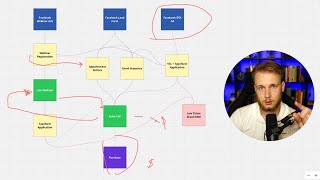
Timothy Schucker breaks down the three-part funnel that hit $418k/month in three months: weekly webinars with 2-4 hour pitches, Facebook lead forms feeding appointment setters, and video ads sending people straight to applications. He also monetizes rejected applicants with a $99/month community and $97/month CRM.
Questions this video answers
$418,000 per month (reached in about three months).
Originally weekly webinars; switching to biweekly (every two weeks).
They pitch for essentially two to four hours long.
A multi-thousand-dollar product priced between $8,000 and $15,000 (at time of recording).
Low-ticket school Community: $99/month; CRM: $97/month.
Chapters
This right Here is the three pronged funnel that took us to $418,000 a month in a matter of just three months. And I'm going to show you exactly how it works and how you can implement it into your own business. So let's go ahead and dive right in. The first piece of this funnel is the webinar. So we started doing a webinar a couple months ago. And the power of a webinar is that it essentially lifts everything else in your business. Whenever people are sitting and watching multi hour long live presentations that are packed full of like one value, but two, buying psychology and triggers that get people to want to take action with your product. If you have hundreds of people showing up to watch that every single week, that's going to bleed over into the other conversion mechanisms. Right. The other thing too, I'll make my face a little smaller here and we can kind of go deep on this is with a webinar you're able to convert some of the people from the other sections of the funnel that I'll talk about in just a second. The salespeople can send them to the webinar and then when they go on the webinar, you can ultimately get them to where they're ready to buy. So basically what we do is we run ads to a webinar. We were doing a weekly webinar, now we're switching to a bi weekly webinar. So every two weeks we're going to do one and essentially we pack up a zoom room with hundreds of people and then we pitch for essentially two to four hours long. That's essentially what it is. So the funnel is pretty simple. You run an ad saying, hey, we're doing a webinar. Then you send them to a page where they register and then there's a thank you page. But I didn't feel the need to add that on here. And then they show up to the webinar. Now we are selling a multi thousand dollar product anywhere from 8 to $15,000 at the time of recording this video. And so we end up just sending people to a sales call. So we have them fill out a type form application on the webinar. So the call to action on the webinar is not hey, go buy something, it's hey, go book a call to see if you're a good fit to work with us. So if they're qualified, they then jump on a sales call with a closer. If they're not qualified, then they're sent to a low ticket school Community that right now is 99 bucks a month. I'll probably end up killing that, to be honest. And then they also get a CRM, which is 97 bucks a month. That is going to be become like a core piece of our business as we scale. So the school is like, I think we have like three or four grand a month. Mrr. It's like barely anything. But you know, it's. We're not spending anything extra to get it. So it's. It's nice. Cool. So next piece that I'm going to show you is the Facebook lead format. So a. A lot of people hate on these. To be honest. I don't really understand why. Some of my most profitable campaigns are literally just instant form campaigns on Facebook. So what we'll do is we'll just have. We, we. I can show you guys my testing framework in another video if you want. Just comment testing down below. But what we do is we did get a bunch of photo ads that just test like different angles and different messaging. So we'll literally just put like on a black background and white text like some. An angle. Right. So it could be, for example, I'll just use an example for like realtors. It could be sell.
Two times more houses. Right. And that could literally be the entire ad just white text on a black background. And I test that on an instant form to validate and find a different angle. So then once I find that angle and validate it, then I can go and film a video. So then I'm only filming and editing videos that I know are proven. So when I do an instant form, it allows me to just test things way quicker and it allows me to have enough leads where my appointment setting team is busy. Right. So they can call these leads. They get a hold of a high percentage of them and it actually is one of our best cost per book call campaigns. So they fill out a lead form on Facebook, then our appointment setting team calls them and then they booked them on a sales call. Right. Or if they don't book, then they go into an email sequence, which is driving them to, you guessed it, a sales call. So the sales call is like the key foundation of this entire thing. Right.
Appointment setters, from what I've seen, are one of the most profitable wings of a business just because it's, it's, you know, it's a beast to manage. We have a whole setter manager and I believe at the time of recording this video we have seven appointment setters on the team. So. So it's a Beast, right? It's like a, it's a whole department of the company but that accounts for over 50% of our book calls. It's a massive, massive.
Driver of revenue for our business. So appointment setters and then they push them to a book call. If they don't book a call they have an email. We have an email sequence as well. Now the last piece of this is a Facebook direct to application ad. So what this basically means is instead of having like an instant form or an opt in or go do this, go do that we literally just say like usually we'll run a video ad for this. So it's a video ad on Facebook that then sends them to a VSL page where it's a video sales letter.
Here I'll just do VSL plus Typeform application. So then they watch the VSL and then they apply on the Typeform again. If they're disqualified we send them to the low ticket school and the CRM. So we build some MRR and if they are qualified they go to a sales call and then ultimately purchase. So as you can see, I mean this is pretty simple. It's nothing that you need to really over complicate. The biggest piece is like all three of these things play into each other and it allows us to have like multiple conversion mechanisms where some people. The main, the main driver of calls for the Facebook lead form is the appointment setters. The main driver of calls for the webinar is obviously the webinar and the main driver of calls for the direct application, just direct to VSL is people going, watching the VSL and booking. So we kind of have like three different ways in which people can book. If they prefer to book with an appointment setter, well they're probably going to become a call from here. If they like watching VSLs and book direct directly then they'll come from here. If they want to watch a whole webinar and really understand the, you know, the deep, like have a deep understanding of how the process works. Well they'll probably show up to a webinar and end up coming from there and all of these things cross pollinate. So if somebody comes on this side of the funnel here, right like if someone comes over here and they don't like, let's say they have a sales call but then they don't buy. Well hey, the closer can say hey go watch this webinar. They watch the webinar, they get to see me pitch and explain everything and then they come back down here and then they end up buying, right? Or same thing with the setter. Like anyone, the setters can push to the webinar. Some people will register for the webinar and they won't show up, and then the appointment setters end up getting them. So all of these things kind of feed into each other and really just drive more revenue. So hopefully this was valuable. I'll see you guys in the next one.