This one habit made me $1,349,134 as a 22 year old
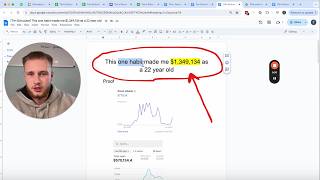
Tim Schucker credits a daily tracking habit with earning $1.3M by age 22. He logs sleep, energy, mood, focus, and productivity in a Google Form each day, sets quarterly goals on each metric, and uses the data to optimize what works. The foundation: sleep and biology first, tools and environment second.
Questions this video answers
$779,000 (on Stripe) — screenshot shown by Tim.
$500,000 (co-owned e-commerce store; 7 months).
Sold an e-comm store that did about $700,000 in revenue (no screenshot available).
Fifth place; the event added $30,000 new MRR in one month (as reported).
Oura ring — "it's like $300" (Tim's phrasing).
Chapters
Alright, now before you click off of this video, no, I'm not in Dubai. No, there's no Lamborghini. I have a blue wall and a whiteboard. But I promise you, if you stick around till the end of this video, this one habit will change your life. Right? So if you haven't met yet, my name is Tim. I've done over $1.3 million online as a 22 year old. I've actually done more than that, but I just have screenshots that show 1.3. So that's what I'm going to claim.
But yeah, I'm going to show you guys in this video one habit that has completely changed my life and allowed me to make more money in less time and have more fun doing it. So if you want to have similar results like that, watch this video. Because I guarantee you that this habit, if you actually do it and actually implement it, will completely change your life. So before I dive into what it is, basically I'm going to show you guys some proof, then I'm going to explain like why you have to do this habit and then I'm going to explain what the habit is and then I'm going to explain how you can actually implement it for yourself and do the same thing. Okay? So 1.3 mil. Here's proof. This is a payment processor called stripe, 779k on stripe. And then here is an e commerce store that I run co own with my girlfriend. Actually don't run it, she does everything on it and I spend about an hour a week managing this. This is 500k in the last 7 months because it's July right now. So yeah, I know a thing or two about making money online. Also last month, in the month of June, I came in fifth place in the school games. Alex Hormozi and Sam Oven. School games added 30k new MRR in one month. And I'm not saying this to like you know, brag or you know, circle jerk or whatever. I just want to prove to you guys that I actually know what I'm talking about and I know how to make money so you guys can actually consume this message that I'm about to give you. So cool. That's some proof. This number is actually a little higher. It should be closer to like 2 mil. I sold an e comm store that did like 700k in rev but I don't have access to the screenshot to show that. So I'm just gonna say this. Cool. So this whole habit, this whole premise that I'm about to show you guys is based off of a concept called the Power Pyramid, right? So I'll explain what that is. I'll kind of break it down so you guys understand it. And again, this is gonna be like a longer video, to be honest with you. It's probably gonna be like 20 to 30 minutes long. But if you stick around to the end and you actually implement this, it will have a massive. Like, this will be some of the most valuable 20 minutes that you spend on your business. Because this is. It's like, it's the foundation of what everything comes on top of and ultimately will have a huge drastic impact on how you do everything, right? So in order to do anything great, you first have to function properly, right? So what do I mean by that? Well, basically, the Power Pyramid is this concept that everything is based off of these fundamental things that make up your biology, your physiology, your mental state and everything else, right? So output here, this is like what you get out of your day. The money you make, the results that you actually see in your business. And everything is at the top of the pyramid, right? And just like a house, you have foundation and then you have, you know, concrete, and then you have your floor, and you can't have the roof unless you have the foundation. It's the same way with this pyramid, right? So everything kind of layers on top of itself to give you the output. That may sound weird, but I'll explain what I mean. So your output again is like what you actually get out of your day. It's the money you make in your business. It's like what you're able to put in and the results that you get, right? So all of that is based off of these other things in your life. Sleep being the fundamental bottom of the pyramid. So everything else, like, if you don't have sleep, if you don't have that foundation, none of this other stuff matters, right? It doesn't matter at all. So in order for you to have good output, you have to sleep well. You have to have a high quality sleep, right? You have to eat well, you have to have a good diet, you have to exercise, right? And get your endorphins flowing and be in good physical shape. You need to be healthy, you need to have your environment optimized, right? You need to be able to focus, you need to have tools. And then all of these things layered on top of itself is what ultimately gives you the output, right? And so basically, like, the way that this pyramid works is the things at the bottom have a greater impact on Your performance than the things that you're top at the top, right? So your tools. This is like, you know, the computer that you use. Because if you think about it, if you have like a super slow computer, you're gonna get way less work done in the same period of time as somebody else, right? But that doesn't matter as much as getting eight hours of sleep versus three hours of sleep, right? The person with the slower computer with 8 hours of sleep is still gonna get more done than the person with a faster computer with three hours of sleep. You guys kind of getting the concept. So the things at the bottom have the greatest impact on performance. And then the things at the top are like, not as important, right? But they're still very important. So this is a concept I got from one of my mentors named Sabri Subi. Recommend checking him out. I'm going to link his video right here as well on this doc, which you guys can get access to in the description down below. And he has a whole video that kind of explains how, how the power pyramid works, right? So again, this is the concept that I based this habit off of. Now that might sound really weird, but trust me, it will make sense. So basically, if you want to do anything great, you have to have your power pyramid down. You need to be sleeping well, you need to optimize your diet, you need to optimize your exercise, your environment, your focus, which is like putting your damn phone away while you're working. And your tools, you need to have good tools, a good computer, good Internet, all those things. And then all of those things layered on top will result in output, right? So in order for you to make more money, if you focus on these things, right, this will just naturally increase the output. As long as you're actually fucking working and like doing stuff during the day, the output will increase as a result of you focusing on all of these other things. And so that's kind of what I realized. And that's what led me to basically figure out this habit that I'm gonna show you guys. So basically, if you want better output and energy, again, you just have to focus on your power pyramid. As long as you're doing the right actions, right? Working on your business, putting in the time, the next thing you need to do is focusing on these things so that you get more out of the time that you're putting in, right? So basically I kind of had the realization that in order for me to make more money, in order for me to, you know, get more, more out of each day, because we all have the same amount of time in the day, right? If you're working 8 to 12 hours, like, that's. For me personally, 8 to 12 hours is like, if I do like a 16 hour day of like, focused work, it's not focus work, right? So instead of me trying to work more, I would rather focus on optimizing my work, which is basically what this whole concept is based off of. We want to optimize and get more output for the inputs that we put in, which is the whole concept of the power pyramid, right? So basically what I did and the habit that I created is.
Tracking these things so that I will improve them, right? Whatever you track will improve. So if you track your bank account and you track your finances, you're gonna start saving more money, right? If you track your sleep, you're gonna start sleeping better, right? If you track your exercise and you track your weight, you're gonna start losing weight, if that's your goal. Or you're gonna start gaining weight and gaining muscle, if that's your goal, whatever you track will improve. So in order for me to improve all of these layers of the Power Pyramid, I decided that I needed to track them, right? So I needed to basically create a habit that would allow me to optimize my sleep, optimize my energy, optimize my mood, right? My focus, my productivity, the amount of hours that I was working, my exercise, my diet, the drinking water, which is a big piece of your health, meditating, journaling, all those different things. These are like all the habits that people throw out there. Like, oh, you need to do all these things, but when you just say you're gonna do all these things and you don't have a way to hold yourself accountable, you don't actually do them, right? So what I decided to create is basically, I call it a personal intake form. And so what I do at the end of each day is I'll go in and I'll fill out this form, right? So I track my sleep with an OURA ring, right? Which is this right here. It basically will give you a sleep score. It'll tell you what time you went to bed, what time you woke up. And guys, remember again, at the bottom of this power pyramid, the number one most important thing to optimize is your sleep. So if we can get our sleep down, we're going to get more output for the inputs, right? Then if we start eating good food, we're going to get more output for the input, right? But first pillar was sleep. So I was like, okay, how can I optimize my sleep? Well, one, first, I need to start tracking it. So I got an OURA ring. It's like 300 bucks, but it's well worth it. And basically every single day, I go in and I put in how I slept, my sleep score, when I went to bed, what time I woke up, how long I slept, right? Then I rate my energy on a scale of 1 to 10. So, like, how energetic was I during the day? One would be like, I was completely exhausted, like, could barely focus, falling asleep at my desk. And then 10 is like, I'm just bubbling over with energy and just ready to slaughter the day, right? So obviously your goal is to get a 10 or higher. The next thing I wanted to track was my mood, right? Because your mood and the way you feel during the day is very important because, like, your whole life is just made up of a bunch of days. So if you're always, like, stressed or depressed or having shitty days, you're just gonna have a shitty life, right? So I optimize for mood as well. So I want to be, you know, anywhere from an 8 to a 10. As far as my mood focus. Again, one of the pillars of the power pyramid. How focused was I? Was I checking my phone? Was I jumping from task to task? Or was I, like, lasered in and focusing on work? They really moved the needle forward in my business. So I rate myself on a scale of 1 to 10 on focus, productivity score. So for me, this is kind of like, related to the output, right? It's like, how much output are you getting in the day?
And for me, I basically think about productivity is like, if I had this day over and over and over again. Like, If I had 30, 30 days of this day, like a whole month of days like this, would it move my business forward or would it just be like, working on surface level shit, Right? So productivity score. Like, if I barely get anything done, or I work, you know, three, four hours a day, and then I'm like, you know, losing. Losing my focus. That would be anywhere from like a 1 to a 4. And then a 10 is like, the work that you did was really needle moving. And you were very proud of your workday, right? So 1 to 10 on productivity, and then I'll put in how many hours that I worked on a scale or not a scale. You just put in the amount of hours you work, which I track on my calendar. I can go here, I can look at the calendar, and then I go here to time insights, and it will tell me how many hours I work. So, for example, so far today, 4.8 hours, which is the Sunday. I usually don't work on Sundays.
So, yeah, hours worked. And then I'll track. Did I work out, did I go to the gym? Which again, one of the pillow. One of the layers of the power pyramid, and then what type of workout it was. How was my diet on a scale of one to five? So a five is like, you're eating perfectly, you're on diet, you're not eating junk food, whatever. And then A1 would be like, you know, you ate pizza and ice cream, whatever. So scale of 1 to 5 on your diet, right? So I grade that. I grade if I drink a gallon of water, which I have this whole gallon jug to make myself, make it easier for me to drink water. So I just fill it up at the beginning of each day. If I finish one of those, I'll put a one. If I didn't, I. I put a zero. Right? And then also meditating, right. I've noticed that this has a big impact on my focus meditation, because it basically trains your brain to do Nothing for like 10 minutes. So I'll sit down and just like meditate for 10 minutes. And then, you know, you just focus on the breath. You try not to let your thoughts drift. And doing that every single day gives you better focus because you basically build the muscle and. And build the discipline of like, not jumping from thing to thing because you're not simulated at all during that 10 minutes. And you're just focusing on meditating, right? So I try to meditate every day. And so I'll do a one if I meditated, a zero if I didn't, for example, right? Same thing for a gallon of water. Because if you're not hydrated, you're not able to think as clearly. You kind of have a headache. And. Yeah, so I always try to drink a gallon of water and I always try to meditate. So at the end of the day, I go through and I fill out this whole form. What was my sleep score according to my Oura ring? All of the things that I just went through with you guys. And then I will also film a loom video overviewing the workday. Right? Because for me personally, like, I hear a lot of people talk about, like, oh, you should journal and all this shit. I cannot, like, for whatever reason, I can't get myself to open a journal and write something every single day. So I just make things easier for myself. I just film a loom at the end of the day. So I'll screen share my calendar and then I'll just walk through what I worked on. So, like, okay, you know, I woke up, went to the gym, whatever, and then I worked on personal YouTube videos, and then I got lunch, and then I went and worked on personal YouTube videos more. And then, you know, whatever I end up doing the rest of the day, I'll talk about it on the loom that I film. And so what this allows me to do is now I can go back throughout the months, weeks, years, and I can say, okay, my productivity score was shit on this day. What did I have to say about it? And why was it a bad day? Right? Or I can go and look at all of the 10 productivity score days and watch the loom to see what I was working on in that day and why it was such a good day so that I can have more of them. Right? There's this book called Atomic Habits that really, like, change the way that I think about things. You don't need to focus on the map, on the macro. You just need to focus on the micro, right? So the micro is like the day to day and the habits to make up those days. Whereas if I'm focusing, like, if I have a goal for the year that I'm trying to hit, if I go and attack every day trying to hit that yearly goal, I'm never gonna hit it because I'm not gonna know what to work on. But if I literally just focus every single day on getting good sleep, having good energy, being in a good mood, staying focused, being productive, working long hours, working out, eating clean, drinking water, meditating, and then I have to film a video talking about what I did for the day. So it kind of holds you accountable in that sense. If I just focus on these things, guess what happens? The output is better, right? The output is better. And since I've started doing this, the productivity and the output that I get out of each day has just skyrocketed. My health has gotten better. I feel better. Like, it's just tracking this makes you competitive and you just try to make it better. Right? So basically what this does is I fill this out every day and then it automatically goes into this.
This spreadsheet, right? So what happens over time is you start to get data about yourself and, like, how you're performing. So, for example, I can see April, what my overall average sleep score for the month of April was, right? 70. Which, you know, room for improvement.
My energy scale of 1 to 10, it was like a 7.04. My mood 7.84. My focus 7 point or 6.85. My productivity score. The average amount of hours that I was working, working. What percentage of days did I go to the gym and work out? What was my diet score? What was, you know, did I drink a gallon of water? Okay, 60% of days. And now I can see, like, how on average, how much did I sleep? How many days did I meditate? And it just builds this. This scorecard that you can then view and grade yourself against, right? So I have on a monthly, and then also on a quarterly basis, I can see what was my sleep score, was my energy, was my productivity hours, workout, all the this stuff, right? And I'm gonna give you guys the same spreadsheet so you can do the same thing for yourself. But here's where it gets really crazy and really, really powerful. And this is what has ultimately, like, made it amazing for me is you actually set goals for yourself, right? So basically, I make a quarterly goal at the beginning of each quarter. So for quarter three, I have goals that I want to hit with all of these things, right? All of these different metrics, numbers that I track. So I want to have an 8. Energy 7.8. Mood 8. Focus 8. Productivity score. Nine hours a day of work on average. And I track all of my hours. It's not like, you know, I started working at nine and then I ended working at nine. So I did 12 hours. It's like 12 hours of focus work is what you want to track. So My goal is 9 hours of focus work every single day. Workout 71% of the day. Diet score 4. Drink a gallon of water 90% of the day. Meditate 95% of days. Average sleep 7 hours and 30 minutes and sleep score 71, right? So then I make action action steps of what I need to do in order to hit that. Meditate 10 minutes a night and 10 minutes before starting work. Go to bed and wake up at the same time every day. Eliminate distractions while working. So leave your phone somewhere else and then plan out meetings prior to running them. So those were my goals, to have higher scores on all this stuff. So then what you do every day is you check your goals, right? So I'll go and I'll look at, okay, what are my goals for Q3? Where am I at right now in terms of my score? My sleep score needs improvement. My energy is good, my mood is good, my focus needs work. Productivity score needs work hours, right? And so now I'm just grading myself on all of these things. And I Can see where I'm lacking, where I need to get better so that I can dial in and focus on those things. Right? So I made a template for you guys to use this exact same thing for yourself. And I'm going to show you how you can set this up for yourself so that you can start tracking your performance and then improving it. Because the only way to get better is to track what you're doing and then improve it. And again, if you literally just focus on these things and focus on putting in the hours and having high productivity and focus on the like pillars of the power pyramid, you will make more money as a result of it. I literally guarantee if you focus on trying to rate your productivity higher at the end of each day, you will make more money. Like it, it just works that way. So how to make this for yourself, you need to basically make a Google form. So I'll show you guys again what mine looks like, as you can see here. And I just fill this out at the end of each day. I have it bookmarked in my computer browser. And so I track sleep, score sleep, start time. And I show you guys how to track each of these things. Right. These first four are going to be from an aura ring, right? We're ring right here. Energy, focus, productivity. Just make your own Google form and I'll give you guys access to the sheet so that you can basically do that. And these are all the things that I personally track. Feel free to do whatever you want, but this is what I recommend. And then you guys are gonna make a copy of this Google sheet template. Okay, Right here. Anything in red you don't want to touch, right? Don't touch those. And then the monthly scorecard and quarterly scorecard will like automatically calculate for you. So when you put all of your stuff in and just map it, what I recommend is just mapping it with Zapier in here from your Google Sheets. All of this other stuff will literally update automatically for you so that you can see all of your.
Numbers and track your scorecard basically. Right? And then basically just make a copy of that sheet, map it with Zapier, which if you don't know how to do that, just watch, watch a quick YouTube video. It's pretty simple. And then the monthly and quarterly will automatically update and then make a copy of the goal setting template, which is this right here. Show you guys how it looks and then just whatever quarter you're in. Right? So right now we're in quarter three. Lay out some goals for yourself of what you want. Your average score to be for the quarter what are the action steps you need to do to have high energy, mood, focus productivity score hours worked workout diet score gallon of water meditation all these things what do you need to do in order to hit your goals is the action steps and then at the end of the quarter you just put in your results and then you see how you did right And I guarantee you guys if you start tracking these things measure it every day just open up your your goals and compare it against what you're doing your life and your bank account will fucking improve so that is the one habit that has made me $1.3 million as a 22 year old is literally just tracking my shit and trying to improve it so again you guys can get access to all of this this whole doc so that you can make your own version of it and start doing it in the description down below and I'll see you guys in the next video. Peace.










