Watch Me Breakdown A LIVE Final Expense Telesales Call (Agent Call Review)
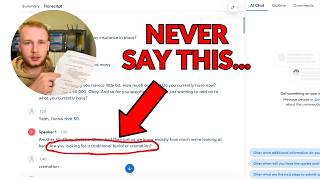
Timothy Schucker reviews a live final-expense sales call, breaking down what Ben Collins did right and wrong. Key takeaways: follow the script exactly to create curiosity, dig deeper in discovery to find the real reason someone wants coverage, and vary your tone so you sound engaged instead of flat.
Chapters
All right, what's going on, Ladies and gentlemen, in this video, I'm going to be listening to a call recording from one of the agents inside of our community. He will go nameless. You may hear his first name. And I'm not going to go into like his last name and everything. For his protection and privacy, basically, I'm going to break down this call and kind of review it, see what he could have done better, what he did well, and ultimately how he can close more deals. So let's go ahead and dive right into it. So I'm going to share my screen.
Share screen, Boom. Okay, so what I'm using is a little thing called otter AI that basically allows me to break down and listen to my call recording. Right. So let's start it here.
Hello? Hey, Richard. Hey, it's Ben calling.
All right, so first and foremost, in the very beginning.
Just let this line.
Hey, Richard.
Let that line just sit. Right. Part of the. The whole point of the intro is like this line in particular is it's supposed to create curiosity. So you're gonna be like, hey, Richard.
Then just wait for him to reply. Right. So minor thing here, but did want to point that out.
Hey, it's Ben Collins. Yeah, are you there? Hey, so just getting back to you on the request that you submitted about the life insurance plans from Facebook. Trying to see if you're trying to cover yourself or loved one.
All right, so this is not following the script exactly. What you want to say.
Is. And pull up the script. I want to say, hey, Richard. Hey, Richard, it's just been. I have a request that you sent us here about life insurance plans with no two year waiting period. How's it going? Right.
That'S gonna. That's gonna leave a little bit more curiosity and tell him exactly what you're calling about and kind of like trigger in what he filled out. Right. So try to, especially in the intro, follow the script word for word.
Both my wife and I.
All right, so this is a great sign. You got a little husband and wife action here.
What's that?
I want.
I need insurance for me and for my wife. Gotcha. For you and your wife. Okay, got it. And then, you know, just to see if I can even help. Is this the first time looking into life insurance? Yeah. Okay, and what is it you're concerned about most? Is it leaving money behind for family or covering funeral expenses?
Both.
Gotcha. Okay. And do you currently have any insurance in place if something were to happen to you or your wife? I've got a little bit she doesn't have any. Okay. She has nothing. You have a little bit. How much do you currently have now?
Probably 50,000. 50,000.
Okay.
And so for you specifically, are you just wanting to add on to what you currently have?
Yeah, another 50. Another 50. Okay, gotcha.
All right, so this is a little bit nuanced, but, like, specifically in the discovery, it's hard to script out. Exactly. So you kind of have to, like, learn which questions to ask and what to go deeper on. Right. But basically the questions in the discovery on the script, those are basically designed for you to kind of have like a framework, but you want to dive deeper into different questions. Right. And then also whenever he responds, one thing that we'll see as this call continues is the guy kind of loses engagement a little bit because we're keeping the conversation very surface level. You want to give him a little bit more feedback. So it sounds like you're really interested and really engaged, and it will also keep him more interested.
Just kind of playing with your tone a little bit more, varying it up to down. Right. And just making this guy feel a little bit more heard and kind of like you guys are, you know, you're. You're like a little more exciting and like you're excited to do your job, so to speak. Right. But basically when he talks about, oh, you know, I have 50,000 right now and I want to have another fifth, I want to add another 50. Oh, wow, that's fantastic. So just so I kind of know, like, exactly what to look at here for you and, you know, what companies are going to be available or whatever kind of way you want to frame that. What exactly is the extra 50 going to cover? What are you trying to cover with the extra amount? Right. And honestly, right here, right, if we go back here, I've got a little bit.
She doesn't have any. Okay, she has nothing. You have a little bit. How much do you currently have?
So great job mirroring here.
Have now.
Probably 50,000. 50,000. Okay. And so for you specifically, are you just wanting to add on to what you currently have?
So this is actually not a bad question, but he gives us an answer that kind of like pigeonholes us here because we honestly don't know if he's able to qualify for another 50. Right. So what may have been a better question here? So he says, I have about 50 to 60,000.
And so for you specifically, like, you.
Could have asked in what specifically, like, what has you wanting to add on more coverage instead of just asking if he was wanting to add on to what he already has. Right, because he already said that he has insurance and he already said that he wants more. So asking a question about what he's trying to cover would be better. Because if him just saying he wants another 50, it's just because he likes the whole round number of a hundred thousand. But if you can't get him an extra 50, all of a sudden that puts you in a tougher spot here. So just changing this question like so you have 50, 60,000. Okay, got it. And so you said you were looking at adding some on what specifically are you trying to cover? So I know how much to look at for you here. Right? Because now he says he wants to add on another 50 and then we go, are you looking for a burial or cremation? That doesn't really matter here if he already has $50,000 in coverage. Right. If he already has $50,000 in Coverage, the cremation's already covered and the burial is already covered. I can promise you that this guy's really just trying to leave money behind for his wife in this instance, in this situation. So what we need to figure out is why he's trying to leave money behind for his wife and what that actually covers. Right, right. Which we get into a little bit more here in this question.
But let's see, so you're looking for cremation. Are there any other things that you're trying to cover with this? So because we're, if we're looking for another 50, then we're looking at about 100,000 for you. So what are you trying to cover besides the burial?
So it's a great question about this.
My wife has extra money. Gotcha. Okay, so is it basically because you're trying to, you know, cover like lost income or. Yeah, gotcha. Okay, that makes sense.
Okay, so this is decent, but the problem is this is a close ended question, right? Just to make sure your wife is trying to cover, just to cover like lost income. If this guy's in retirement, it's not like we're going to be covering that much lost income with like, you know, $50,000. So what I, what I want to do is kind of like understand why he's doing it a little bit more. Right. And the thing about sales is it's not about the questions you ask, but it's about the answers that you get from the prospect. Right. So we want to phrase our question to get a better answer. Right. Because what we get from him here is. So you're basically just trying to cover. You Know lost income. The answer we get is, yeah, we want more information. So we need to phrase our question a little bit better. Right.
So what are you trying to cover besides the burial? This is a good question. He's saying just so. Just so my wife has extra money. Okay, yeah. I mean, that makes sense. That's. That's great of you, you know, kind of looking out for your wife, just so I know, like, exactly what to look at for you here. What is it specifically you. That you want this $50,000 to go towards? Right. And that will get him to tell you exactly what it is. Because here we're suggesting. Are you just trying to cover lost income? Right. And he says, yeah, but if we say, what specifically do you. Do you want this $50,000 to go towards now, all of a sudden we're going to get a better answer that gives us a little more information. Right. Because this is very surface level. And then also, I mean, this guy's trying to leave $100,000 behind for his wife. We want to, like, ultimately remember the reason people buy insurance is to confirm an identity. So this guy is really, like, he obviously cares a lot about his wife. He wants to leave her behind $100,000 of whole life insurance. And this guy's probably on a fixed income. Like, that is a lot of money. So we need to figure out what is the. What is he trying, like, why does he want to leave that behind? And we also want to kind of like, give him that affirmation of, like, wow. Like, that's. That's so incredible. Like, your wife is really luckily lucky that you're, you know, looking out for. That's. That's really awesome. Right, because he already has 50,000. That's a lot of whole life insurance. He wants an extra 50. He's looking for that. He wants to be known as the guy that's really looking out for his wife. And. And if we can kind of give them that a little more, we're going to kind of crack the crack. Crack the nut and get this guy talking and kind of, like, opening up to us a little bit more.
All right.
Okay. And, you know, just to make sure I'm covering my basis here. Have you ever been declined for life insurance? Nope. Okay. And, you know, if your wife has. No. Okay, great.
All right, so what it sounds like. And just, you know, correct me if I'm wrong here, so it sounds like you're trying to add on another 50,000 to make sure that you're covering for lost income, make sure that your wife doesn't have to pay for any of the burial expenses in the event of your passing. And then you're also wanting to.
So that's actually. That's not why this guy's buying it, because he already has 50,000 in coverage. Right. There's no way $50,000 is, like, for just lost income. There's probably a house. If I were to guess that would be. My assumption is, I know later in the call he mentions that he's moving. So maybe there's a house. We need to figure out what was the moment of decision where this guy decided he needed life insurance, Right. Whether somebody recently just passed away or, like, for him specifically, why did he decide he needed more? Right. So we need to find the moment of decision. Right. When did you decide that you needed an extra 50,000? Because obviously you already have a lot of coverage. Why do you want an extra 50? Right. 50 is more than a lot of my clients have. What. What is the extra 50 for? Right. Those kind of questions and like, okay, got it. And I mean, how long have you been kind of like thinking that you needed some extra coverage here? You know, for the last couple weeks. And what made you decide that? Like, what specifically made you decide that? Right. Oh, well, we just bought a house, which is my suspicion of what it actually is. We just bought a house and we just took out a mortgage. And I want to make sure that she can keep the house if something happens. That's probably what it is. Lost income doesn't really make sense because he's probably on a fixed income and $50,000 is plenty of lost income. So here we're recapping it. This is good. The biggest thing, like, Overall, just like 20,000 foot overview here is, like, with the intro, you want to follow the script exactly. With the discovery, it starts to differ a little bit more. And this is where we need to be a little bit more, like, personal and get this guy to open up. The other thing, too is with your tonality, you want to vary it and give, like, give this guy the response that he wants. Right? Like, just be a little bit more like your tonality kind of going up and down. And overall just sounding more excited to be on being on the phone. Instead of having a flat tonality. Right. You know, kind of joking back and forth with them. Just really like getting this guy to open up. Right. And a lot of that is just in your tone of voice. It's the difference between, like, all right, so what it sounds like is, you know, just correct me if I'm Wrong here. It sounds like you're trying to add on another 50,000 to make sure you're covering for lost income. Right? It's that versus. All right, okay, got it. So, Richard, what it sounds like to me here, and, you know, just correct me if I'm wrong here, it sounds like you're trying to add on an extra $50,000 to make sure, you know, if something happens to you, it's covering that lost income. So you want to have those little pauses and the up notes and the down notes to keep them listening and keep them engaged. And it makes you sound like you're more excited to do your job. Right? So here we go. All right. So just so you know how we work here, we're going to look at all these companies. Okay? This is fine.
Also, another thing, whenever you do a husband and wife, pick one first and just handle that one. Right? So I would ask this guy. Okay, so I'm gonna. I can look at both you and your wife. You tell me, Richard, which one do you want to start with? So we can knock these out one by one. Right at the beginning of the call, I'm already gonna assume that it's gonna be a deal because this guy's a buyer for sure. Right? So beginning of the call. Okay, Richard, so let's. Let's knock you guys out one by one. Well, who do you want to start with, you or your wife? Because if you try to do them both at once, you're going to go through the whole thing. You're asking health questions for him, and then you're asking health questions for the wife, and it just gets, like, super confusing. And now they're having to remember multiple quotes. So do one, get him ready to go, and then do the other. Okay, so this is fine. I'm going to ask you some health questions. And then this part, to be honest with you, you don't really need to do this. Like, this kind of just made this awkward, this whole call where you. Where you said this to get your.
Wife covered as well.
Oops.
Yep. Okay, and now the other part, too, is, is your wife nearby? Because when we get to her legally, I have to speak with her to make sure that there's no insurance fraud and that she's a real person.
Right? So now, like, now you're kind of like the enemy in. In a sense, like, not necessarily the enemy, but, like, you're just making them jump through hoops that don't necessarily need to be jumped through. Right. So you. You could have said this in a different Way, like now, it's almost sounds like you're like, accusing him of insurance fraud, which I know you're not, but that's kind of how it comes across. Whereas instead, we could have just been like, okay, Richard, let's knock out you first, and then afterwards we can take a look at your wife. Right? So we go through, and then this whole thing is not really necessary.
And then out of your. Kara, do you authorize him to go over the life insurance with me?
Right. You don't have to do that. That's not like a thing. Because you can just talk to her separately whenever you're ready to go. So I know we go through and we do health questions. This is fine. Where the call ends is actually in the middle of the health questions. So you go through and you do him and you go through his health questions, and then you go through and you do the wife before you've even given a quote, Right? So what you need to do, because ultimately what these people want is they want a quote, right? This guy wants a quote so that he can decide what he wants to do. And ultimately he wants to buy insurance, but we need to get him the quote because that's. That's why he's staying on the phone. So we're going through and we do his health questions, like the health. So here's kind of the way you think about it. The reason they're jumping on the phone is ultimately you're building all the suspension up to them getting the quote. Once they get the quote, you kind of like lose all of your leverage because the quote is again, that's what they're trying to find out. So we have to build all the value before we have to find out the need and get all of that information in exchange for the quote. Right? And so kind of like what happened in this particular call is again, you go through. We don't really know why he's buying insurance. You haven't really built rapport. Your tonality is kind of flat. And we really need to build a little more rapport, vary our tonality so that we're more engaging to talk to and then knock out one and then move to the other, right? Because this guy went through, like 10 minutes of health questions asking all about his health, and now we're like, hey, we need to talk about the wife. And then what ends up happening is you can't find. He can't find one of her medications.
And we kind of, like, pushed on that. Whereas what we could have done instead is like, okay, that's totally fine. What we can do, let's just knock out you first, and then we can look at your wife later when you can get a hold of her medications. But I want to make sure that we can. We can get you set and squared away first so you can add that extra 50,000 to blank, whatever his why is. But the problem is we don't know his why. So I'm going to pause this right here. I got to jump on a call, and then I'm going to come back and we'll listen to the end of this.
All right, so let's continue listening here. So again, we go through all the health questions. I'm obviously going to skip over that. So we go through health questions. We go through health questions for him, and then here's what ends up happening at the end, right? So, boom, boom, boom. Okay, so there's something with pain medications or something like that.
Are they prescribed, or is it, like, over the counter prescribed?
Okay.
I need to know what the prescription is, because that will dictate which company might approve or deny.
So your tonality of voice here, to be honest, kind of sounds like a little bit like. It almost sounds like, accusatory or like you're the adversary. So if you listen to any of Julian's calls, what you'll notice is he kind of like. He'll raise his voice, and it's not, like, feminine, but it's. It's more. It's less like deep and baritone when you're talking to the prospects. Right. And the reason why is you want to make. You want to. You want to sound like you're on their side. Right? So instead of being like, got it. Are they prescribed or, like, over the counter? Okay, yeah, I need to know the prescription because that'll dictate whether the company might approve it or not. You would want to say something like, okay, yeah, I mean, so I would need to know what the prescription is because that'll ultimately dictate if the company, you know, might approve or deny it. Is there any way you could get your hands on that? Right. So do you see how that sounds, like a little bit more like I'm on his side than if you just say it very flat like this.
Okay, I need to know what the prescription is, because that will dictate which company might approve or deny.
I can't.
I don't know which ones. Gotcha. Okay, so for her, I can continue for you then, but I won't be able to continue for her until we get those prescriptions. So in the meantime, we'll just continue with you.
All right, so how much longer is this going to be?
Because I got so all of a sudden now that we said we can't continue with the wife.
I think this guy's. He's getting irritated, right? That's what this is. There's nothing. He doesn't have to go anywhere. He's just getting irritated and frustrated because we've gone through like 10 minutes of health questions, right? So again.
Some bullets, some takeaways. We have to find out what the actual why is, and we have to dig deeper in the discovery phase, because this guy, like, if we get to the close and this guy tells you he needs to think about it, we have no ammo in the tank because we don't know why he's actually buying us. He just. We just have income replacement. But that doesn't even mean anything, right? We need to get on a deeper level. We need to figure out what he actually. Why. Why he actually wants a hundred thousand dollars of whole life insurance for his wife, and then also why he wants insurance on his wife for him. Right. We need to figure all those things out. But this guy's just getting frustrated because our tonality is very flat throughout this call, and we're not really building much rapport, but we've kept him on the phone for a long time, right? So ultimately we've just kind of like, we haven't really become his friend. We haven't really, like, built any rapport or any. Any value here with like, finding out what the why is this, Honestly, more so. Sounds like we're just kind of like a basic customer service rep that they're calling in. So the biggest shifts, digging deeper on the why, varying the tonality so that you sound more engaged and excited and not becoming the adversary. Right. Being his ally who's helping him get approved. Okay. Yeah. I really want to make sure that we can get something approved for both you and your wife.
Finish you, and then we'll go back to your wife. We don't want to say I can't do you, or I can't continue for her until we get those prescriptions. So in the meantime, we'll just continue with you. I would just be like, okay, yeah, no worries. We'll. We'll knock you out first, and then we can come back and figure out exactly what those are. Right. But the way that you're saying it makes it seem like you're denying him what he wants, and that's ultimately the problem. That's why this Guy gets frustrated and then makes up this excuse, why, is it going somewhere? Okay.
I mean, it's not going to take much longer, but if you want, I can go ahead and schedule for an appointment where we can follow up, so that way you're not feeling rushed here. Give me one moment.
Let me give you a call. All right, well, my schedule is actually pretty booked, so let me get you in for an appointment, so that way we can. We're not just getting started down here. Let's see, you're out, Mississippi. Right. So I have tomorrow available, or I have Monday. Which one do you prefer?
I don't know which day. We're in the process of trying to move, too, and I'm very busy moving stuff around. We were traveling back and forth, looking at homes. Gotcha. Okay, so if you don't want to schedule appointments, I mean, you can try to give me a call back. If I'm available, I'll be able to answer. Otherwise, you know, I'll just try to connect with you whenever you answer your phone. But, you know, that's why I'm trying to get you sometimes scheduled so that we can sit down.
Oops.
So, yeah, I mean, ultimately, like, the biggest problem here is we tried to do two health questions back to back. Whenever it's a husband and wife, you need to isolate and knock out one and then knock out the other. And then the tonality, digging deeper on the why. And then ultimately, just like, you don't want to sound like an adversary, you want to be the friendly person who's helping him. Right. Because, to be honest and, like, I mean this in the best way possible, the reason this guy wanted to jump on the phone is just because he got frustrated with you. Because, like, it kind of sounds like you're not excited about what you're doing throughout the call. And it doesn't sound like you're, like, really excited to help this guy. It kind of just sounds like you're going through the motions. Right. So that's okay as long as we fix it. Because the biggest thing is, again, bite. You have to empathize with the person you're talking to and realize what situation they're in. Right. This guy's on the phone. He just got called by you. He's actually very interested. Like, this guy is a hot prospect. He's gonna buy a lot of insurance probably in the next few days or within the next week. So you can call him back and just kind of approach it with, like, a different tone, a different attitude, and you'll probably get in a completely different result. If I'm honest with you, he might not even remember who you are. Call him back in a few days, just follow him up, check in on him and just approach it from a different. A different attitude. And again, like, if you listen to Julian's calls, notice how he's varying his tone of voice. He sounds like he's smiling on the other end of the phone, right? Like, literally, like when you're talking to this guy, just smile, right? Just smile when you're talking to people. Hey, Richard. Hey, Richard. Hey, Richard. It's just been. I was giving you a call about that Facebook form that you'd filled out. Looks like you'd requested information of the life insurance plans here with no two year waiting period. How's it going? Oh, great. Awesome. Well, right, and then you just run through the script, right? But you want to smile. You want to sound like you're enjoying yourself because people like to talk to people that are happy. People like to talk to people that are excited. But if your tone is flat and you're kind of like short and you sound like you're irritated, you're going to have more of these situations where people are trying to jump off. So hopefully that helps and let me know. All right, ladies and gentlemen, hopefully you got value from this video. If you want to learn more about our coaching program, when you can have us listen to your calls and break them down just like this, click the link down below in the description. You can apply to join and be in the exact same program that this agent is a part of so that you can get one on one sales support like this and have people listening to your sales calls and breaking them down so that you can get better and ultimately make more money. Hit the subscribe button, hit the like button and I will see you guys in the next video. Take care.










