Tim Bell - Assignment of contract
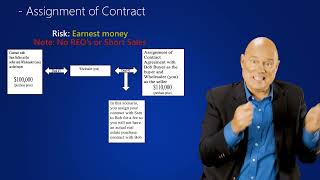
Tim Bell explains how to wholesale real estate by contracting a property with the seller, then assigning that contract to another buyer for a fee. You must list yourself as the buyer to stay legal. Banks won't allow assignments on REO or short-sale properties.
Questions this video answers
$100,000
$10,000
$110,000
Chapters
So let's go through and talk about each one of these. Alright, here's a diagram that shows an assignment of contract. We can see on the left side here that we've got a contract with Sam the seller. Again, I give names to everybody to help us keep everybody straight. Okay, so Sam has agreed to sell us his property for $100,000. In this particular example. Okay, that's the diagram that we see on the left. That left hand side there represents the, the contract that we have with Sam. We all have a date in there, a closing date, something like 30, 45, 60 days from now, something like that. But the important thing and the important distinction that we need to remember is that in that particular contract, that contract on the left side there, we are the buyer. That is our role in that contract. So we're going to actually write our name or the name of our llc, S Corp, C Corp, our entity structure, whatever. We, we're going to write that in as the buyer in that contract. That's an important distinction because if we're not a principal in the contract by writing the name, our name, or the name of our entity structure, llc, S Corp, C Corp, whatever, our company, if we don't write those in as the buyer of the contract, then technically we could be brokering this property. We could be finding the buyer on behalf of the seller for a commission. And of course, unless you have a real estate license, that's illegal in virtually every state in the United States. So there's a fine distinction there. We must be a principal in this contract. So that wholesaling is not violating any laws in our marketplace. Okay, so that's how it works. Now by the way, let's digress a little bit here. I wanted to mention just a couple of things. At the top here you can see it says that the risk is your earnest money deposit. And there will be an earnest money deposit in there. If you don't know what that is, don't worry, we'll get to that and we'll talk about that in a little while here. But the other thing that you need to note is that in this particular strategy, the assignment of contract strategy cannot be used for a bank owned property. That's what REO stands for, Real Estate Owned. It's bank owned. Why they call it that, I don't know. That's just what they've always called it, an REO or bank owned property. That's typically a property that has been foreclosed on by the bank and taken back by the lender. And now the lender owns that property and they're selling that property. Okay? We can't use the assignment of contract strategy for a bank owned property. Why? Because the bank will not see the assignment of contract as a legitimate strategy. Okay? When the bank takes back a property in foreclosure, they see themselves as the victim. They see themselves as the person who was taken advantage of. Yes. Here's the bank's attitude, the lender's attitude, those evil buyers, we loaned them money and they didn't pay it back. We're the victim here. Now it's arguable and we could teach a whole day long seminar about whether or not the bank is the victim. But the point is that is their mentality, that is their mental process. They think we've been taken advantage of here and we're not going to tolerate any hanky panky here. We're not going to tolerate anything strange, hinky, funky or weird. Okay? We've got to do it our way. Well, a bank, a lender will typically see an assignment of contract as being outside of their perspective of normalcy. It's very normal for us as investors. But from a lender's point of view, that's not considered normal, it's not considered good. There's something wrong with this assignment. That's the attitude of the bank. As a consequence, if we write an assignment clause and in our contract with the lender, they will summarily reject it. They'll roll it up in a ball and throw it away. As when they get done laughing, they'll say no, we don't do assignments of contract, thank you very much. They won't accept our offer. So we can't use this particular strategy on a bank owned property. We also can't use this strategy on a short sale property. Now a short sale property is not a bank owned property. Technically a short sale property is actually owned by the, the seller, okay? Still, however, the definition of a short sale property is the seller owes this much on the property and I am willing to pay this much. Or we'll say the market value of that property is here. So if they owe more than what I'm willing to pay for the property, we're going to have to ask the lender. Actually the seller is going to have to ask the lender to forego. And forego is such the wrong word, but we're going to ask the lender to forego a portion of the money that they are owed in order to sell that property at the lower price to get it moved in other words, the seller owes more than what the property's worth in the marketplace. And a short sale involves asking the lender for a certain amount of forgiveness. And again, that's the wrong word. But a certain amount of forgiveness of the debt, a portion of the debt that the seller owes on the property, we have to get the lender's permission to close on that, the lender's agreement that they will forego receiving the that portion of the debt that is above what I as the investor or anyone else will pay for that property. Okay? So it's important that we understand that distinction. That's what a short sale is. So the problem with a short sale using the assignment of contract and a bank owned property using the assignment of contract is on the bank owned property. Obviously the bank sees our contract and once they see that we put an assignment clause in there, they're going to summarily reject it. On the other hand, with a short sale, we actually technically write the contract and make the deal with the seller. However, if in the short sale agreement there is a contingency, a short sale contingency, in some places, in most places it's a clause or a paragraph. In some places, like California, it's two pages. Yeah, it's a two page portion of that agreement that's added if indeed it's a short sale. And what it says basically in legalese terms, it says that Tim wants to buy the house at this price, the seller wants to sell the house at this price, but we both understand that the seller owes more than, than that price. As a consequence, we need to get the lender's agreement to forego some of that debt in order to get this thing closed. So what happens is I sign, the seller signs, we both agree to this price here, knowing that they owe more, and then the whole thing gets packaged up and sent off to the lender. And then the lender typically hems and haws and drags their feet and twiddles their thumbs for four to six months and then they decide whether or not they will forego some of that payment of some of that debt. That's how it works. Okay? So you cannot do an assignment of contract on a short sale or a bank owned because on a short sale the bank actually sees the contract. And if they see that assignment of contract clause in there, then they're going to summarily reject it because again, that's outside of their perspective of normalcy. Okay, so first step on the left there, put the property under contract to the seller. Step number two, we go out and we find our buyer. In this case, we're going to call him Bob buyer. Bob buyer is most likely a fix and flip rehabber. And so Bob's going to come and buy the property. Now you can see it says here that we use an assignment of contract agreement with Bob. We don't use a real estate purchase contract with Bob like we did with Sam over on the left. Why? Because we're not selling Bob the property, we're selling Bob the agreement that we have with Sam. That's what we're selling. He takes over the rights to close on that property at that hundred thousand dollar price in our example, he takes over those rights and he goes and then closes with Sam. That's how it works. So we're not selling the property to Bob. We're selling the agreement, the contract, the contractual right to purchase the property. That's what we're selling. As a consequence, we're going to use a special form called an assignment of contract agreement. It's not a real estate purchase contract. It's just an agreement that we use to sell that contract with Sam to Bob. That's how it works. And we'll go over that. We'll go over it completely. Don't worry. If you're worried about what that is, we're going to go over it completely. I'm going to show you how to use it. I'm of course going to provide one for you so that you can do it. But I just need you to understand at this point, we've got Sam, that we have him under contract with a regular real estate purchase contract on the left. Then we have Bob, we go to Bob and we say, you know what, Bob, I don't really own this property, but I am willing to, I do have control over it. I have an equitable ownership interest in the property by virtue of the fact that I have a contract with Sam. And I'm willing to transfer that agreement to you, Bob, and let you go and close with Sam at $100,000. And all you have to do is pay me a $10,000 fee and then you can buy that contract with Sam from me. Then you can go and close with Sam. That's how it works. Now, some people might say, well, wait a minute, Tim, why would he do that? Well, you tell me why he would do it. Let's go back to our. Let's go back to our diagram here, okay? In fact, let's go back to Bob's criteria. Okay? There's Bob's criteria right there, we can see that in this case, based on these numbers, he's willing to pay 110,000 for the property. Okay, so again, we, based on our wholesale formula, you can see we've got Bob. Our maximum purchase price for our fix and flip Rehab or Bob is 110. And we have the property under contract with Sam at 100. Therefore, Bob is willing to pay 110 for the property. Why? Because it fits his formula to 110. He pays us 10, he pays Sam 100. Therefore, he's in at 110, which is, we've done decided, fits his formula. It's okay with him. It's acceptable to him. So that's basically why we'd want to do it that way. As it says in the little box there below, it says, in this scenario, you assign your contract to Sam, or with Sam, rather to Bob, for a fee, so that you will not actually have a real estate purchase contract with Bob. And therefore, since you're not selling the real estate, you're just selling the contract. There are no closing costs involved in this particular strategy, which is outstanding because we get to keep the entire $10,000 fee instead of having to pay some of that $10,000 fee in closing costs to the title company or whoever.










