Tim Bell - Buyers criteria formulas
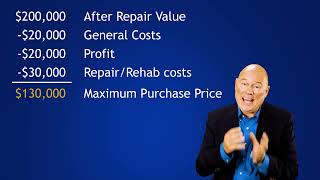
Tim Bell breaks down how to price wholesale deals for three buyer types: fix-and-flip rehabbers use the 70% rule, buy-and-hold landlords use roughly 80%, and retail buyers pay the most because emotion drives their offers. Target the flipper formula and your deal works for everyone else too.
Chapters
The first one here is our fix and flip retail. I'm sorry, our fix and flip rehabber person. Okay? Our fix and flip rehabber investor. They typically use something like what has traditionally been called a 70% rule analysis process. Okay? Now I first learned this a long time ago. I first Learned this in 1977, but it's been a long. It's been around a lot longer than that, okay? And so my first mentor taught it to me and he told me that he learned it in 1962. So it's been around for a long time. The reason it's been around for a long time is because it works. Okay? So here is what that formula typically looks like. Now we're going to go over in detail how to determine each of these particular figures to put in this formula. But for right now, I just want you to get the overview of the formula here. Okay? So what we do is we start with the after repair value. Okay? The after repair value is abbreviated arv. Basically, what it is, is, it's the definition is what price will cause a buyer to walk into that house and say, tim, I want to buy your house. Where's the contract? Where's the pen? Here's my earnest money deposit. Let's go. I want to buy your house. Okay? That is the definition of after repair value, okay? You're going to hear lots and lots of valuation terminology bandied around in the marketplace. You're going to hear market value and fair market value and tax value and appraised value and parcel value and blah, blah, blah. There's going to be all these valuations that you're going to hear. I maintain that there's only two valuations that you really care about as a wholesale investor. And that, of course, is the after repair value. And then the bottom line, so to speak, the maximum purchase price for your fix and flip investor or the maximum purchase price for you as a wholesaler. We'll talk about the difference between those two numbers. Okay? So you can see here, we've got our formula. We've got the after repair value. From the after repair value, we subtract. We subtract something for our costs. We call these general or miscellaneous costs. And when I say we, I mean we the fix and flip investor. Okay? Remember, we're looking at this deal. We're looking at these figures, this, this house from the perspective through the eyes of our fix and flip rehab or investor who is most likely going to be our wholesale buyer. That's what I'm talking about when I say we, okay? So in general costs, we're going to. Typically, those are holding costs, carrying cost, loan cost, sales costs. We're going to go over all of these things in detail. I'm going to show you not only where they come from and how to quickly and easily derive them, but I'm going to show you exactly what they are. So. So we'll discuss that later, but for right now, I just want you to get the overview here. Okay, so about 10% of the after repair value is typically allocated for those general costs, the loan costs, the. The holding costs, carrying costs, sales costs, utilities, things like that. And we'll talk about exactly what each one of those are and how to derive them and how to determine them in a minute, in a little while. Okay. All right, the next one is a profit. Now, obviously, our fix and flip investor is buying this property from us because he or she is going to make a profit. That's pretty obvious, I hope, to you. Now, traditionally, a 20% of after repair value has been the profit that most investors have built into their fix and flip formula. I will tell you, however, that in the 21st century, that may or may not be a realistic approach. And we'll talk all about that as we go along further and we get further into this particular equation. Okay, the next one there, the last one there you can see at the bottom of our little stack of numbers is the repairs or the rehab costs. Okay, how much is it going to cost the fix and flip investor to fix this property up such that it will sell at the after repair value price? We have to build that in, too. So we build all those things in there and we subtract. By the way, I know that there are some of you that are looking at these numbers and thinking, no, no, no, Tim, you don't understand my market. For example, I had somebody a couple weeks ago in San Diego, and they said, I was in San Diego, I was talking to some people about this, and they said. And one guy raised his hand, said, tim, you can't even buy a dog house in san Diego for $200,000. I. I know, I know. Okay. I was born in Los Angeles. I spent my summers in Oceanside, California, which is in north San Diego County. So I'm very familiar with the San Diego market, thank you very much. But let me tell you that I don't want you to get hung up on these numbers. I want you to get hung up on the concepts. Okay? You can fill in your own numbers in your own market. By the way, for the guy in San Diego, All I did is I say, oh, well, that's easy. Let's just add a zero to every single one of the numbers in our chart. And he looked at that and said, oh, yeah, that works. So again, don't get too hung up on the numbers. Get hung up on the concepts. Okay? You can fill in your own numbers that are appropriate for your market. Because there's some people that are watching this film that are saying, well, wait a minute, you know, the most expensive house in my marketplace is $130,000. That's fine. Other people are saying, you know what $2 million is the average house in my market doesn't matter, okay? The numbers all work no matter what the numbers are in your market. So don't get hung up on the numbers. Now, I will tell you throughout this film, I'm going to be using these same numbers. Why? Because they're simple, they're easy to see, they're easy to discuss, and it's an easy illustration. Okay? But just understand that you may have to. Well, there's no may. You will have to modify these numbers such that they work for your market. Okay? All right. So we subtract the 200. In this case, we're subtracting the after repair value from the after repair value. We're subtracting the general cost. We're subtracting some profit. Again, this is the fix and flip, Remember, that's whose criteria we're talking about. Here is the fix and flip investor. We're going to subtract their profit and we're also going to subtract the repair costs that they can see are going to need to be done on that property. And then we come up with the most important number of all for a fix and flip investor. And that is the maximum purchase price for the fix and flip rehabber. This 110. In this particular example, that is the answer to the question, how much is this property worth to me as a fix and flip investor? Okay? So again, remember, that's our, that's one of our customers that we're going to sell our wholesale deal to. And that's why we want to consider their criteria. Okay, let's go to the next one. The next one is a buy and hold landlord. So now a buy and hold landlord investor, Carl Cash Flow, he typically uses something that is the equivalent of an 80% rule. Remember, we called this a 70% rule. Why? Well, we take 10% for general costs, we take 20% for profit, and then we subtract the repairs. So if we take out 10 and 20%, that's taking out 30%. So we end up with 70%. That's why they call it the 70% rule analysis. But the buy and hold investor, he typically uses an 80% rule. He typically is going to use or she typically is going to use. They're typically going to pay more for the property. Now, we'll go over the actual rule, the actual formula that a buy and hold landlord investor should use. But I will tell you that it ends up being about something like this. Okay? You can see we've got that $200,000 after repair value. We've got $20,000 for the general cost because they're still going to have those closing costs, holding costs, carrying costs. The, the sales cost though are probably going to be less. So anyway, and then the profit, you can see we've only built a 10% of after repair value profit into this instead of a 20%. Why? Well, because that profit is for when the property is sold. Well, a buy and hold investor isn't going to sell the property. They're not planning on getting a big chunk when they sell it because they're not going to sell it. Their intent is to hold the property over a long period of time and gradually gain income over a long period of time through rental and through those four benefits that we talked about through the positive cash flow, the tax benefits, the equity build up through the equity or the equity build up through the principal reduction and then of course, the appreciation. So that's what they're counting on. So they don't need to build in as much profit as a consequence. You can see here that the buy and hold investor, Carl, cash flow, the landlord, rental property investor, they will typically pay more for the property. Okay? They're willing to pay, in this example, 130,000 for this property. They may even pay more. Why? Because their sales costs are going to be less. Why? Because there's no sales costs when they go to sell it, because they're not going to sell it. So anyway, this gives you an idea of how they might look at that property. Okay? This is the criteria that they might use. Now, the retail family home buyer, the mom and pop homeowner, they're different, okay? They may consider the after repair value, they may consider the cost of the repairs, but most of the time, in determining their price, there are what I call intangible emotional factors involved. Okay, back to our example of Sugar House. People want to live in Sugarhouse because it's considered trendy to live there. It's cool. It's chic. Yeah, you're really neat if you live there. Right. So these people are not buying based exclusively on the numbers like the other two investors are. These folks are buying partially on the emotional appeal of the area or the property or something like that. There is an emotional component as a consequence, in many cases, their consideration of how much they'll pay for the property is skewed. It's messed up, right? Okay. Also, in many cases, they plan to do the work themselves. Okay. With the proliferation of Home Depot and Lowe's and other outlet type places where people can go and buy materials, in many cases, they do the work themselves. Why? Because they want to. They want. They have that emotional connection to their property and they want to do the work themselves so that it's done just right. Now, in many cases, it doesn't turn out just right. In general, Home Depot and Lowe's have been terrible for the condition of homes in America. Why? Well, because somebody watches one of those home improvement shows. They watch somebody put tile in, they watch somebody do a hardwood floor, they watch somebody paint, they watch somebody do various different repairs, and they think, well, that looks easy because on TV they make it look easy, right? And then they just go down to Home Depot or Lowe's, they buy the materials, they put it in, and it looks terrible. Why? There's a reason why Professionals are professionals. There are a reason why they make money to install those materials because they know how to do it, okay? And they have the right tools and they have the experience and they know exactly what they're doing. So anyway, that can be a little bit of a problem with the mom and pop homeowner. As it says here, most retail home buyers only consider their ability to qualify for a loan or the amount of cash that they have available when they decide how much they'll pay for the property. As a consequence, these folks will typically pay the most for the property of the three buyer types that we've talked about. So again, to review, we've got a mom and pop homeowner, the retail homeowner buyer, who will pay the most. We have a buy and hold investor who will typically pay somewhere in the middle. And then we have our fix and flip investor who will pay the least. Okay? So a lot of people might say, well, gee, I'm going to target that mom and pop homeowner because they're going to pay the most for the property. That's fine. There's nothing wrong with that. But you have to understand the. That the mom and pop homeowner the retail family home buyer. They are the fewest and furthest between in terms of buyers for wholesale properties, that's the least likely buyer we're going to find. The next most likely buyer, as you can probably guess, is the buy and hold investor. And the most likely buyer we're going to find for our wholesale properties is that fix and flip investor. So rather than target the criteria of the buy and hold investor, I say let's target the criteria of the fix and flip investor. Okay? The fix and flip investor typically will pay the least amount of money for a property, and so their criteria becomes the target for our rule number one. In other words, if we create a deal that is a good deal for the fix and flip investor, by definition, it will automatically be a good deal for the buy and hold investor who will pay more. And it will automatically be a good deal for the mom and pop homeowner, the retail family home buyer investor. They're not really investor, but the buyer. It will automatically be a good deal for them. So we're going to shoot for the lowest common denominator. We're going to shoot for that fix and flip investors criteria. And if we can meet their criteria, then it opens our buyer pool as large as we can possibly have it, which of course is a desirable thing. So if we can structure a deal such that it's a good deal for that fix and flip investor, it will almost always be a good deal for the other two types of people that might buy our wholesale property.










