Tim Bell - Focus
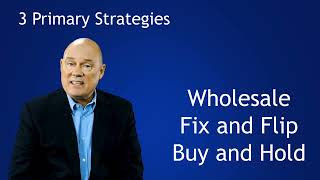
Tim Bell teaches a real-estate system focused on wholesale deals because they pay within seven to 30 days, faster than fix-and-flip (three months) or buy-and-hold rentals. All real-estate investing fits three strategies, and wholesale lets you generate income quickest.
Questions this video answers
Seven to 30 days.
About 42 days (most markets ~45 days; some as short as ~30).
Chapters
So we talked about the purpose of the training. Let's talk about the focus. You can see here that this is a little bit different than the purpose. The focus of the training is to give you the tools and the formula to build your system so that you can have a system and to strengthen your confidence in order to make offers and to generate income in your real estate investment business within the next seven to 30 days. Yes, I said seven to 30 days. Now, I feel certain that that's probably something that you're excited about. I'm excited about you making money that quickly and certainly you can do that. So that's going to be the focus of the training. That's what we're going to focus on initially. Now, I want to mention one thing. As you can see here, there are three primary strategies for real estate investment. All real estate investment comes down to one of these three strategies. Every real estate investment that you can think of, from the tiniest little house all the way up to the largest commercial office building in the world, medical buildings, parking lots, storage units, everything comes down to one of these three strategies. All real estate investment is based on one of these three strategies. As you can see here, we've got wholesale, we've got fix and flip, and we've got buy and hold. Now, occasionally I'll have people that will disagree or will argue with me. They'll say things like, well, I have some money in a real estate investment trust. That's not wholesale, fix and flip or buy and hold. Well, it actually is. Okay. A real estate investment trust is where you buy shares in a trust and then that trust usually invests your money in various different things, typically commercial projects, large apartment buildings, and various other different things like that. So actually what happens is that a real estate investment trust is really just a buy and hold strategy. It's a rental property strategy. So every real estate investment does come in one of these three categories. There are no other choices. Okay, so again, wholesale, fix and flip and buy and hold. Let's talk about what each one of these is. We'll start at the bottom. Buy and hold, as I mentioned, of course, is a rental property strategy. It's where you buy a property and then you rent the property out for positive cash flow and various other benefits that a rental landlord would create by building a buy and hold type situation. That's what I mean by buy and hold. I mean rental properties. Now, the second one here, fix and flip. That's where you buy a property, fix it up, and then resell it at a retail Basis for a profit. That's fix and flip. And of course this is what we see everybody on the real estate reality TV shows do. Virtually every one of them does this in some way or another. That's what fix and flip is all about. Where they buy a property at a cheap price, a wholesale price, a discounted price, and then they put time, effort, energy, materials, labor into it to fix it up so that it comes up to the standard of the rest of the neighborhood. And then it's sold on a retail basis, typically to a retail mom and pop homeowner type buyer who wants to live in the property and enjoy it. That's what a fix and flip is. And then of course, wholesale basically is the idea of buying a property or controlling a property such that that when you buy the property or control the property, then you would turn the property over to another investor. Typically that other investor is going to be a fix and flip investor or a buy and hold rental landlord type investor. So the wholesaler provides the properties in many cases for the fix and flip investors and for the buy and hold investors. And that of course is what you are going to do as a wholesaler. Wholesaler might sound a little bit crass, but being a wholesaler is kind of like being a drug dealer. Okay, the fix and flip investors, they need their properties to fix and flip. The buy and hold investors, they need their properties to buy and hold for rental income. And so you get to be the supplier of those properties. And that puts you in a good position with those folks. So that's how those three strategies work. Now obviously, if we go back to our focus. Our focus of course, as we said, is to get paid in the next seven to 30 days. So let's talk about each one of these strategies in the context of that focus. Okay, we'll start again at the bottom. The buy and hold investor, the buy and hold landlord investor does not buy a property with the idea of making a big profit when he or she turns around to sell it. Why? Because they're not going to sell it. They're going to buy the property and then they're going to gradually get their income over a long period of time as they own the property month to month to month, each month they're going to make a positive cash flow. So really, if we think about it, buy and hold is not going to get us paid in seven to 30 days in the type of chunks of money, the type of income that we would like to have. We might make a few hundred dollars a month, but and A few hundred dollars a month could help you. But I think most of the folks that are listening to this particular program are more interested in making several thousand dollars per transaction, not a few hundred dollars a month to start. And so that's really not where we're going to go with our focus in this particular course. Okay, now the next one is fix and flip. Now, as you can imagine, fix and flips take time. Okay, for example, if you buy a property and you. It needs work. Let's say it needs. It needs paint, it needs flooring, it needs a new roof, it needs some repairs and other different things. That's going to take some time to accomplish those repairs. So let's say it takes you a month to get all those repairs done. It's a fairly light rehab. You've got a handle on your contractors. They're working for you and they're doing a good job. They get it all done in a month. Well, now that the property's done, now we have to put the property on the market. We've got to sell it. And in many markets in America, it's going to take you 30 days or more to sell the property. Some markets it's longer than that, some it's shorter. But let's say it does take you 30 days to get the property sold. So 30 days to fix the property, 30 days to get the property sold. Now, there's once the buyer and the seller agree and once the contracts have been signed, then it goes into what's called the escrow period. That escrow period is the time from when the buyer and the seller agree contractually, the buyer to buy the house, the seller to sell the house to the time when they actually sign all the paperwork it funds and it records at the county recorder's office. That's called closing. So it usually the average escrow period in America nowadays is about 42 days. So obviously, during that period of time, what's happening? Well, they're having their appraisal done, they're having their inspections done on the property. Mostly they're having their mortgage finished. Okay. Even the fastest mortgage people take a long time because it just takes a long time to get that mortgage approval process. And so again, as I say, the average escrow period in America is about 42 days. Most markets it's 45. Some markets, the mortgage people work more quickly and they get it done in 30. But let's be really optimistic and say they got it done in 30. Well, if it takes you a month to fix it and a month to get it sold, and then a month to get it closed so that you get your check in your hand and you get your money, then that's three months you're going to be in that property. Well, clearly, three months does not fit our goal. It does not fit our focus of getting paid in seven to 30 days. And so, as I say, with these three strategies, the only one that really is applicable for our focus in this particular course is wholesale. And as a consequence, that is going to be our main focus. That is going to be our main method. That's the main thing that we're going to look at, and then we're going to start working with, because that's really where we can get paid quickly. And I know that that's what you want, and that's certainly what I want for you.










