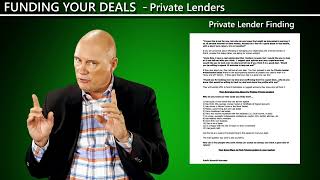
Tim Bell (speaker) explains private lenders as individuals who have access to money but are not in the business of lending (e.g., friends, family, professionals). He distinguishes true private lenders from advertised "private lenders" that are actually hard-money businesses, outlines where private lenders might source their funds (self-directed IRAs, HELOCs, credit lines, savings, stock accounts), and gives concrete example arithmetic (borrowing on a HELOC at ~3% and lending at ~8% to net ~5%). He presents practical outreach scripts to find private lenders: a verbatim "who do you know" pitch offering 5–10% returns secured by real estate for 6–12 months, and an "Uncle Bob" dialogue that asks for an opinion first and then for referrals or volunteered funds. He emphasizes never asking directly for money and using the scripts and website supplements to find and work with private lenders.
Questions this video answers
Someone who has money or access to money but is not in the business of loaning their money; they seek better returns than passive investments.
5 to 10% interest, secured by a lien on real estate, short term 6 to 12 months.
Borrow at about 3% on a HELOC and lend out at 8%, netting about 5%.
Certificates of deposit are cited as paying somewhere between 0.5% and 1% per year in the transcript.
Chapters
Okay, now we're at the top of our list. We've gone through all the various other different types of loans that you can get for your your fix and flip deals. Now we're talking about my favorite source. We're talking about private lenders. Private lenders are awesome, but you have to understand that the Internet has blurred the definition of private lenders. See, here is the traditional definition of private lenders. A private lender is someone who has money or who has access to money, but is not in the business of loaning their money. They simply want to get a better rate of return on their money than they could with other passive investments. That is the technical definition of a private lender. Now you will find if you go onto the Internet looking for private lenders, you will find that many of the people on the Internet call themselves a private lender. By definition, they are not. If someone has an ad, if they have a website, if they, if they're advertising their services on the Internet or elsewhere, they're not a private lender. They're a hard money lender acting like a private lender. Okay? They are a wolf in sheep's clothing. So again, just be aware what the true definition of a private lender is. A private lender is someone more like your mother or your dentist or your best friend from college, or that person that has a lot of equity in their home. There's lots of other different people that could be private lenders for you that are not in the business. That's the type of people that we're talking about now as we go through private lenders, we're going to talk about money sources that private lenders could come up with. So we're also going to talk about helping you think about people who might be private lenders for you. But first of all, before we do that, I want to talk about sources where private lenders may actually come up with money for you. There's lots of different sources. They might have a self directed ira. A self directed IRA allows them to invest their money in any direction they like. If you including with you, they might have a home equity line of credit. I have a friend who has a $2 million property and he owns it free and clear. And he likes his house and his wife likes his house. They don't want to move. But he feels guilty about the $2 million worth of debt equity in his house. So what does he do? He goes down to his bank. He borrows money on his heloc at about 3%. Okay. If you have good Credit and lots of money. You can get a HELOC at 3% as this video is being recorded. Okay, it may not be that way in the future, but that's the way it is now. So he gets, he borrows the money at 3% on his home equity line of credit and then he loans it out to people at 8% for fix and flip deals. Okay? So he's, so if he borrows it at 3%, loans it out at 8, he's netting 5% on his money and he, he doesn't ever have to sell his house, he doesn't have to do anything. It's a great deal for him. So that's another source line of credit. It's amazing what lines of credit some people have. You'll be shocked if you were to start investigating that and find out the lines of credit some people have. Some people have tremendous lines of credit credit cards. Some people have tons and tons and tons of money available in terms of cash advances and other sources on their credit cards. So that could be another way, that could be another place for them to find money for you. They may have a savings account, stock market accounts, mutual funds, various places. There's lots and lots of different places that private lenders can come up with money to invest with you. And in most cases, those sources of money are not paying them as good an interest rate as what you're going to pay them. So it can be very favorable for them. And then question mark can come from anywhere. There's lots and lots on different sources. So again, I want you to be thinking about that. Now. I'm going to come back and talk about the characteristics of private lenders. But before we do that, I want to talk about these four supplements that you have available to you on the website. I recommend if you're interested in working with private lenders and if you're going to do fix and flips and you're not interested in working with private lenders, you haven't been listening because private lenders are the greatest source for, for fix and flip funding. They're better than hard money lenders. They're better than any of the other sources we've talked about. Okay, so again, I recommend you do go through these supplements regarding private lenders. Now, the first one is called private lender finding. It prints out showing working with private money lenders and what it talks about. It talks about all different kinds of things. Where all the money is. It talks about various different things. Two of the most important things on here are a couple of dialogues that you can use with potential private lenders. You can use these with anybody that you know that might be a private lender. Now suspend your disbelief on the fact that you may or may not know people who will be private lenders. We'll talk about that in a few minutes. But these are the types of dialogues you could use with people who you think might be a private lender for you. Here's one of them. I know this isn't for you, but who do you know that might be interested in earning 5 to 10% interest on their money with a short term. I'm sorry, secured by a lien on a good piece of real estate with a short term return, 6 to 20, 12 months? Who do you know? Now, I recommend you use that verbatim, okay? There's a lot of power in it. Why? Because when you say, I know this isn't for you, that's you taking your hand out of their pocket. In other words, you're relieving the pressure on the relationship. You're not putting any pressure on them. You're not saying, hey, do you want to loan me money? No, that's not what you're saying at all. You're just saying, who do you know that might be interested in earning 5 to 10% interest on their money secured by a lien on a good piece of real estate with a short term return, six to 12 months? Now, if they truly listen to you and they truly internalize what you're saying and they're getting less than 5 or 10% return on their money, here's how the dialogue might go. Let's say, for example, they have their money in a certificate of deposit, okay? The current rate for certificates of deposit is somewhere between 1/2 and 1% per year. Yeah, that's terrible, right? Well, they think it's terrible too. So here's the thing. If you approach someone who has a certificate of deposit that's getting 1% per year, here's how that dialogue might go. I know this isn't for you, but who do you know that might be interested in earning 5 to 10% interest on their money secured by a lien on a good piece of real estate with a short term return, six to 12 months? Now, if they truly listen, if they truly internalize what you're saying, they may say something like this to you. Wait a minute, did you just say 5 to 10% interest? And you, you say, yes, ma', am, I did. And they say, oh, my goodness, that greedy banker down at bank of America, he's only paying me 1% of my CD. That's terrible. And now Tim's offering me 5 to 10%. That's a lot more money. I'd rather have that. And Tim, did you say secured by a lien on a good piece of real estate? And I say, yes, ma', am, I did. And she's thinking to herself, oh, my goodness, that greedy banker down at bank of America. They, when they, when I deposited my money, they gave me a little slip of paper. They just give me a piece of paper. My money is secured by some electrons in a computer somewhere. And now Tim's telling me he's going to put my money in real estate. I can see it, I can touch it, I can feel it. It's tangible. I can drive by it. It's attached to the earth, so it's not going anywhere. It feels very secure and very tangible to me. And Tim, did you say a short term return? 6 to 12 months? And I say, yes, ma', am, I did. They say, oh my goodness, that greedy banker down at bank of America made me lock up my money for five years in order to get that 1% interest. And now Tim's telling me he's going to give me five to ten times that amount of interest and he's going to give it back to me in six to 12 months. Wow. If they truly internalize what you've said to them, in many cases what they're going to say is, well, what do you mean? It's not for me. I'd be interested in those kind of, that kind of return on my money in those terms. If they say that, say, that's terrific. I didn't want to ask, but since you volunteered, okay, I'll borrow your money. You wouldn't necessarily really say that, but you get the idea, right? Okay. In many cases you're going to have a positive response and they're going to suggest that they loan you the money. That's, of course, ideal for you. Okay. One of the things you always want to remember is you never ask a private lender for money. Never ask them for money. Okay. For example, the next thing I want to go over here is what I call the Uncle Bob dialogue. Why? Because. Because you could use it with people that are close to you. You could use it with your uncle, you could use it with your parents, you could use it with good, close friends. You could use it with lots and lots of different people. Okay. The Uncle Bob dialogue sounds like this. Uncle Bob, I have a real estate deal that I believe is good, but I'd like you to look it over and tell me what you think. I respect your opinion and your experience, and I'd like you to look over my deal and tell me if you think it's a good deal. Would you be willing to spend 10 minutes to help me out? Now, did you ask Uncle Bob for money? No. You asked Uncle Bob for his opinion? See, people may be reluctant to give you money, but they're very happy to give you their opinion, right? So you're not asking for money, you're asking for Uncle Bob's opinion. So typically, Uncle Bob will say, sure, let's take a look at it. Then you go through and you present Uncle Bob. Now, I'm going to show you what that presentation looks like in a minute here. But basically you're going to go through the presentation and then once you've gone through it, typically Uncle Bob is going to confirm that indeed you have a good deal. Why? Because you do. Otherwise you wouldn't have put it together yourself. Right? And then Uncle Bob's going to say, yeah, you know what? You've got a good deal. And then you're going to say, oh, thank you, Uncle Bob, for looking over my deal and confirming that it's a good deal. I really appreciate it, but you know what? I don't have the money for that deal. Uncle Bob, who do you know that might be willing to fund that deal for me and make some good money on their money? Who do you know? Again, if Uncle Bob is convinced indeed that your deal is a good deal, he may say, see, if Uncle Bob says, well, I got a couple of buddies over at the country club that might be interested. Okay, introduce me. Okay, but in most cases, what Uncle Bob's gonna say is, you know, I'd be willing to fund that deal. That looks like a pretty good deal. I'd be willing to fund it. Thank you, Uncle Bob. I didn't want to ask, but since you volunteered, okay, I'll borrow your money. Okay? That's how it works. Okay, again, you want to go through the rest of this supplement. It talks about all different kinds of ways to find people that could be private lenders for you, different sources and different things. Make sure you read through that.