Tim Bell funding your deals 9
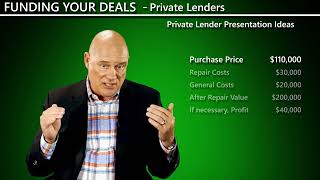
Tim Bell breaks down how to pitch a fix-and-flip deal to a private lender. Show your purchase contract, contractor bids for repairs, comps for the after-repair value, and your holding costs. Then ask for referrals.
Chapters
The next one is called private lender presentation ideas. Now, the bad news is you have to present to a private lender. The good news is you've already created and gathered together all the materials and all of the documentation you need to provide a good presentation for your private lender. Why? Because that's what you use to analyze the property for you. Okay? You need to gather that information for you to convince yourself that it's a good deal. Now, now you're just going to demonstrate that same information to your private lender. And again, this particular supplement talks about private lender presentation ideas. You want to follow that? So let's talk about presenting to a private lender. Okay? For example, here's what your presentation, the essence of what your presentation might look like. Now, of course, you probably, if you've been paying attention, you probably recognize this formula. It's just our 70% rule formula just flipped on its head. That's all it really is. Now here's something you need to remember about presenting to private lenders. Presenting to private lenders is like kindergarten show and tell. Okay? Remember that? Yeah. When I was in kindergarten, every Friday we had to bring something. We had to bring our favorite book or our favorite T shirt or our favorite toy. Or we could bring maybe your mom would bring the guinea pig or your cat or your dog or something like that. And you had to stand up for 30 seconds as a five year old and talk about whatever it is you brought. Obviously, my kindergarten teacher believed in public speaking and obviously it took with me because that's what I do. Okay? So anyway, presenting to a private lender is just like kindergarten show and tell. So let's go through how it works. Okay? Uncle Bob, I can buy this property for $110,000. That's the first line on our information here. That's the first thing we're going to show them. Now that's the tell part. I've told Uncle Bob I can buy the property for 110. The show part. I show him the contract. Uncle Bob, you can see here's a contract that I have. You can see where I've signed it, where the seller signed it. And the purchase, the agreed upon purchase price, 110,000. I have the right to buy this property in the next 45 days at 110,000. Make sense, Uncle Bob? Yes, it does. Great. Let's go to the next item. Repair cost. Now, Uncle Bob, I believe I'll be able to repair this property for $30,000. That's the tell part. The show part. I have a bid from my contractor. You can see my contractor is going to do this paint and this flooring and this repair and this sink and this kitchen and this bath and all this. And it's going to be $30,000. Makes sense, Uncle Bob. Yes, it does. Great. Now, the next item in my formula here, Uncle Bob, is the general cost. These are costs that I'm going to incur during the time that I'm doing the fix and flip. Okay. It's going to be about $20,000. How do I know that? Well, I have this documentation. You can see all I've got, the pro forma or the proposed closing disclosure statement for when I buy it. I also have one for when I sell it. I have a statement from the power company saying how much the utility bills are going to be. I have an insurance policy from my insurance agent saying how much my insurance policy is going to be. I have a statement from my staging company that shows how much it's going to cost to stage the property when I get done. And then you can see I've got an amortization schedule here for, for my lender. Hint, hint, wink, wink, nod, nod, you. That's going to show what my payments are going to be and all that kind of stuff. Right. So that's how I figure it's going to be about $20,000. Does that make sense, Uncle Bob? Yes, it does. Great. Now, my after repair value, in other words, what I'll be able to sell the property for when I get finished, Uncle Bob, is about $200,000. That's the tell part, the show part. How do I know that? Well, I've got this comp and this comp and this comp and this comp and this comp and this comp and this comp. You can see everything in this neighborhood is selling between 197 and 203. So I believe I'll be able to sell it right around $200,000. Make sense, Uncle Bob? Yes, it does. Now, the last item in our formula, of course, is your profit. Now it says if necessary, show them the profit. Okay. In many cases, you're going to find that it's not necessary to show this person the profit. Why? Well, people that have money typically are good with numbers. And if they weren't good with numbers, it's difficult for them to gather and keep their money. Right. So in most cases, as you're going through the formula, you can see the wheels turning around in their head and they're calculating it out. And in many cases when you get done with discussing the after repair value, they're going to make a comment like this. They're going to say well, if all these numbers are right and they appear to be based on your documentation here, you're going to make a $40,000 profit on this thing. And you know what? I'm going to say yes, sir, I am. Yep, that's right. Again, if they don't come to that conclusion, I may actually show them the profit. Okay. But either way they're going to figure out that indeed this is a good deal. Again, we're going to document that and then at that point you're going to talk with them about who they know that might be willing to fund the deal. Okay. So that's how you present to a private lender. Again, all these concepts and ideas are in that private lender presentation supplement. That's in the materials that are available to you.










