Tim Bell property analysis 12
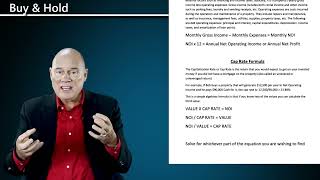
Tim Bell walks through the income-capitalization formula for valuing rental properties: Value equals NOI divided by cap rate. He uses a real example where $12,500 annual NOI on a $90,000 property yields a 13.89% cap rate, then shows how to find local cap rates through commercial brokers and LoopNet.
Chapters
Okay, so now we're going to talk about buy and hold. Again, you can see this formula, it's all the same. It's just solving for a different variable. If you remember from seventh grade algebra, if you know two of the variables, you can solve for the third. That's how algebra works. Well, here you can see we've got, it's all the same formula. We're just solving for something different. Now, these three components that we're talking about here are the value or the price. Now, of course, in our analysis process, the value or the price means how much should I pay for the property? That's what that means. That's a reasonable value or fair market value for that property, okay? That's what we're talking about when we say value. Now the other two components, the net operating income, abbreviated as noi, and cap rate or capitalization rate, abbreviated as cap rate. Those are the other two components that are going to help us determine the value on a rental property. Okay? So we're going to go through this formula. I'm going to show you what each one of these things are. I will tell you that on all rental properties, this is the appropriate formula that you should be using. Now, there are some people that don't use this formula on single family homes, duplex, triplex, fourplex. Often the valuation is based on comps, like it was for our single family homes that we talked about in previous lessons, okay? But once you get to five units more, all comps go out the window and it becomes this formula. Everything is dependent on this formula, okay? So this formula is used for the smallest rental property up to the largest commercial building in the world, and everything in between, okay? All commercial real estate investors live and die by this formula, okay? As a consequence, you need to be aware of this formula because it will help you assess, buy and hold properties. So let's talk about the components of this formula. Now, one of the items that I've sent you talks about and gives definitions about what each of these formulas are, okay? Or what each of these components rather of the formula are. So we have the net operating income. The net operating income is basically the gross income, less the expenses, that's the part in between, that's the net operating income. That's your profit essentially from that property each year. Now, you can see we've got an explanation here. It talks about the gross income, less the operating expenses. It talks about what constitutes gross income, what constitutes expenses and all that. You can read that. But basically we take the monthly gross income, we subtract the monthly expenses and I'll go through what those expenses are in just a minute here. And that gives us the monthly net operating income. Now, net operating income is always annualized. Why? I don't know. That's just the way everybody always does it. So we times it by 12. We times the monthly net operating income by 12. And that gives us the net. The annual net operating income or annual net profit on that property. Okay. Again, pretty cut and dried, pretty easy to recognize, pretty simple to see. Now, the next one, the cap rate, that's a little more ethereal. It's a little bit harder to get your head around. The capitalization rate or cap rate is the return that you would expect from your invested money if you did not have a mortgage on the property. Sometimes you'll hear it called the unleveraged or the unlevered rate. Okay, now, when I say the rate that you would expect, I don't mean the individual singular you, I mean the plural you. In other words, the investors in your market, what would they expect? See, we have to recognize that all financing is different. On all real property. There are no two properties that are financed identically. Okay? There's no two dollar amounts that are identical. So as a consequence, it gives us. It makes it very difficult for us to compare the return and to compare the prices on properties, because every property is financed differently. So what do we do in using the capitalization rate? We remove the financing. We take that out of the equation. What that does is it levels the playing field and allows us to compare apples to apples return on each individual property. That's what the cap rate is. It's a leveler. It's a common denominator. It's an apples to apples comparison tool that we use. It's not necessarily your rate of return on the property that's different, but the capitalization rate helps us decide what is a good buy and what's not a good buy. Okay, so here's the example. Bob buys a property that will generate $12,500 per year in net operating income, gross rent, minus expenses. He pays $90,000 cash for the property. There is no mortgage, there is no financing, there's no funding. He pays $90,000 cash. So we take the 12, 5, the 12, 5 net operating income, and we divide by the $90,000 cash that he paid for it. That gives us a 13.89% capitalization rate. Generally speaking, you're going to find that a 13.89% cap rate is good. Now, a lot of people Ask me, they say, well, Tim, what's a good cap rate and what isn't a good cap rate? And the answer is it depends on where you live. Now, there are two ways to determine what reasonable cap rates for the type of property you have is in your area. One of the methods is to contact a commercial real estate agent. Commercial real estate agents live and die by cap rates. They know this formula very well. They understand cap rates very well, and, and they're very well versed. In fact, if you ask a commercial agent, you know, I'm thinking about buying this six unit apartment building in this part of town and I'm wondering what a reasonable cap rate is or what a standard normal ish cap rate is for that particular part of town and boom, they'll come right off the top of their tongue with top of their head, tip of their tongue with it. They've got it right there. It's just right there. They live and die by cap rates. They know them well. So that's one way to find out what a reasonable cap rate is on the type of property that you're looking at in your area. Now there's another way. The other way here I'm going to pull this up. The other way is to go onto a website called LoopNet. LoopNet.com LoopNet.com is a reasonable but not complete attempt at a national commercial MLS multiple listing service. Okay, so LoopNet.com you can use the free function or there's paid functions with it, but whatever you like, whatever you want to do. But what you're going to do is, is you're going to go on there and you're going to click on different types. There's different types of properties. I'm going to click on multifamily. I like doing multifamily properties myself. So I'm going to click on that and then I'm going to hit the search. You can see when I pull this up, you can put whatever your city is in there. And then I'm going to hit search. And then what I'm going to do is I'm going to look for properties, okay? And I'm going to look through here and I'm going to scroll down and I'm going to find properties and you can see it lists the cap rate on many of these properties. For example, here's a property that has a 10.3% cap rate, okay? And you can see it's 34 units, okay? Now that's telling me that a 10.3% cap rate for 34 units in that neighborhood in Cleveland, Ohio, is a mediocre cap rate. It's okay. It's not spectacular. It's not terrific. It's just okay. Okay. All right. Why do I say it's okay? Well, here's the thing. It's very difficult, if not impossible, to find an outstanding deal on LoopNet. Here's why. LoopNet is used by commercial real estate agents, but no properties ever get to LoopNet until they've already been vetted out by that broker, that commercial broker, Commercial agents, other investors. See, when a commercial agent lists the property, the first thing they do is they get on their phone and they call all of their investors that are in their investor list, and they ask those investors if they want to buy the property. Well, if none of them bites on it, then they will put it in LoopNet to advertise it to other people, hoping they'll get someone else who might consider a not so great deal as being acceptable to them. So there are no screaming deals on LoopNet. They. The deals on LoopNet are mediocre at best. They're okay, see, because something that's a great deal has already been sold before it gets to LoopNet. So if you see cap rates on LoopNet, they're okay. They're average. Ish. They're probably somewhat reasonable for the area. But if you can buy the property at a higher cap rate, in other words, a lower price than what you see in LoopNet, that you can turn that into a good deal. Okay? But that gives you a rough idea of what capitalization rates should be in that particular area where you are. Okay. And again, apply these ideas to your buy and hold properties. Now, a lot of people say, well, wait a minute. How do I determine what the expenses in those things are? Well, of course you're going to ask. One of the things that I've sent you talks about due diligence that you can do. Okay? It's due diligence on a. On a buy and hold property. And you can ask for various different pieces of information that can help you determine whether or not you want to buy that property and determine what that. That net operating income is. Okay? Now here you can see on this Excel spreadsheet, we've got the. Hold on a second here. There we go. Okay, so you can see here on this Excel spreadsheet, we've got some information on here for where you can put in monthly payments, or rather monthly income coming in from the property. There's also places where you can put expenses on there. Okay? So these are the types of things that you want to look at. Again, if you're a spreadsheet person or you're not a spreadsheet person, then only modify the areas that are in the blue areas. Because if you modify the areas that are in the other areas, you could mess up the formulas, and so the spreadsheet won't work anymore. Now, a lot of people say, wait a minute, Tim, why don't you just lock the spreadsheet? And then people can't mess it up. The reason, because the spreadsheet people often want to mess with it. They want to tweak it, they want to play with it, they want to make it better, and that's fine. So I send it to you unlocked, whether you're a spreadsheet person or not a spreadsheet person, I recommend that you make a copy before you start to fill in those blue blanks. Okay. And again, this is some information that you could put in here to help you decide what, what the cap rate is, what the cash on cash return on the money you've got in the property, various other different things that you can use for this particular formula. So that's basically how buy and hold properties are analyzed. And again, one of the things I've sent you is the buy and hold due diligence form. Basically, what it's going to show you is things that you can ask for. Ask the, that you can ask the seller to give you, to provide for you so that you can know what to ask for, so that you can make an appropriate and an intelligent and rational decision on what you're looking at on that particular property. So go through that sheet. Now, I will tell you that not every seller of a commercial property will have all the information on, on the due diligence sheet. They just won't. But you certainly should ask for it, and it certainly won't hurt to ask for it. That's something you want to look for.










