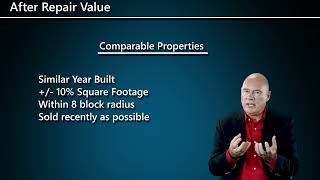
Tim Bell walks through picking comparable properties for after-repair value estimates. Keep square footage within 10-15% of your subject, find comps in an eight-block radius, use sales from the last 3-6 months, and match house style since it affects what buyers will pay.
Questions this video answers
Within plus-or-minus about 10–15% of the subject property's square footage.
Ideally within an eight-block radius of the subject property (closer is better).
Prefer sales within 3–6 months; appraisers typically will not consider comps older than six months (in fast markets they may restrict to 3 months).
Chapters
So the next item on our list in comparing properties for our comparable properties after year built is square footage. Ideally, we want the square footage to be somewhere within 10 to 15% plus or minus the square footage of the property. Okay? So say for example, your property that you're trying to figure out the after repair value on is 1,000 square feet. Okay? We would want to look at properties that are around 900, 850 somewhere around there and 1100, 1150 on the top. So we want to go in that range because again, remember, the concept of comparable properties is an attempt, if not a perfect attempt, to compare apples to apples. We want an apples to apples comparison, okay? Again, if we keep it within a relatively small square footage range, we'll typically get a more accurate comparison and more accurate comparable properties that will actually be more applicable to our determination of that after repair value. Okay? So we want to keep it with plus or minus the 10, 10 to 15% square footage is good. Rule of thumb. Now the next one, we want properties that are ideally within an 8 block radius of our property. Now if you live in an urban area where, where there's lots of properties and it's the houses are fairly close together, that can be pretty easy, okay? The challenge comes if, is if you live in a rural area where the properties are spread far apart, okay? That eight block radius can be a problem. Okay? Now ideally the house next door is a better comp than the one down the street. The one down the street is a better comp than the one three blocks over and around the corner, okay? And so on. The further you get from the property, the less likely that comparable property is to be valid in our consideration of value. Okay? Now if you are in a rural area, I suggest that you do this. Take a look at some signs of some real estate agents who have listed properties in your rural area that have successfully sold properties in your rural spread out house area and talk with them about how they came up with comps. Rural agents have different ideas and different methods that they can use to come up with comparable properties. But usually it's experience based rather than so much based on the numbers. Okay? So ideally though, we want properties that are within an eight block or closer radius as best we can get. You may have to go beyond that. That's okay. But again, remember, the closer proximity, physical proximity of the house is to our property, the more likely that comp is to be valid for our use in determining after repair value. Okay? Now the next one, we want properties that have sold as recently as possible, okay? Three to six months maximum. Okay. An appraiser will typically not consider a comp that is older than six months. In fact, in some markets where the markets are moving quickly, appraisers are restricting the comparable properties they're considering down to three months because the markets are moving so quickly that a six month old comp represents ancient history. Okay? But ideally we want to be within six months of the sold date. Okay? Again, just like the proximity, just like the radius, we want properties that have sold more recently. The house that sold yesterday is a better comp than the one that sold last week. The house that sold last week is a better comp than the one that sold last month. And so on the further back we go, the less likely that comp is to be valid for our consideration of the after repair value. Okay, now the last one on the list is the style. We want a similar style. Okay? I don't know if you're familiar with split entry or split level houses. Okay? It's basically you walk into the house and it has a landing and you got to decide do I want to go up some stairs or do I want to go down some stairs? Those are your only two choices when you walk into that type of house, okay. That sometimes they call them split entry or split level houses. Okay? In many cases, people who have lived in a split entry house or split level house do not want to live in one. Again, okay? I don't know why. For some reason they just, they rub people the wrong way in many cases. Now the question begs itself. Why do builders, if people don't like split level houses or split entry houses, why do the builders continue to build them? The answer is because it's the most economical build for the amount of space that you net at the end of the build. Okay? So it's the cheapest way to build the largest amount of space, okay? And that's why they continue to do it. So the point is that if you're comparing your split level or split entry house to Rambler ranch houses, single level houses, two stories, multi level houses, tri level houses, and other different styles, then the comparison may not be appropriate because they're not similar styles. So you want to try your best to compare similar styles because that can have an effect on whether or not someone purchases that house.