Tim Bell Property analysis 5
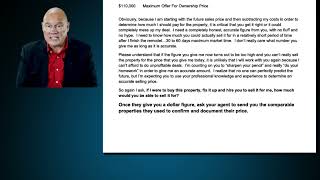
Tim Bell walks through how to get an accurate after-repair value (ARV) from a real estate agent using a scripted conversation. Ask the agent what they'd sell the property for if hired, request the comparable sales they used, and verify those comps yourself because agents may inflate numbers or mirror your suggestions.
Chapters
Okay, now here's the shortcut I showed you the long way to get to the after repair value. We talked about all the various different components you might want to look at. Here's a shortcut. Get together with your real estate agent. Remember the one that's on your team. We talked about that already. And ask them this simple question. Ms. Agent, Mr. Agent, if I were to buy this property, fix it up and hire you to sell it for me, how much would you be able to sell it for? Now you don't have to use any of my dialogues verbatim, but I do recommend that you use this dialogue as it stands, as it sits. Why? Because there's some power in this dialogue. See, when I say to a real estate agent, hire you to sell it for me, they're like garners their attention, Okay? I have two little dogs and I take them for a walk and, and sometimes we go up on the mountain, okay? And sometimes they're in chasing stuff in the underbrush. So I carry a little dog whistle with me and I blow the dog whistle. When I blow the dog whistle. If you've ever seen what happens to a dog when you blow a dog whistle, their little ears pop up and they go what? What, what? It gets their attention. Well, saying hire you to sell it for me to a real estate agent is the real estate agent's equivalent of a dog whistle. It gets their attention and it makes them see the that you're serious about working with them and about hiring them to sell the property for you when you get finished. So again, this is a great dialogue. Now I have sent you a more elaborate version of this dialogue that we're going to go over now, okay? It's called the investor to Agent ARV dialogue. Okay? And basically you can use this dialogue essentially the first time or the second time you ask an agent, your agent, the one you have on your team, who for an after repair value. And again, it's a more elaborate version of that question. Okay, so here's how it might sound, Ms. Agent, Mr. Agent. I'm considering buying this property and fixing it up. It won't be perfect, but it'll be very nice. It'll be a 9 on a scale of 1 to 10. It'll look new, it will smell new, it will feel new. And then the magic question, if I were to buy this property, fix it up and hire you to sell it for me, how much would you be able to sell it for? Now once you've asked that question, you might want to elaborate the first few Times you ask this question. Okay, for example, you could say, wait a minute. Before you answer, please recognize that I'm counting on your answer to help me decide whether or not I'll purchase this property. You know my formula, by the way, if you haven't shared your formula with your agent, it's okay. It's not a secret. Go ahead and share it with them. Show it to them. In fact, sharing your formula with an agent is one of the best ways you can flush out and determine whether or not they're an investor friendly agent. If they have any kind of a negative response to your formula, anything like, oh, I don't know if that's going to work or you can't do that, or are you crazy? If they have any kind of a negative response to your formula, you need to find another agent. Because I promise you the last thing you need in your business is negative Norman the agent, or negative Nelly the agent following you around telling you that what you're trying to put together and what you're trying to do won't work. They're your primary team member. They've got to be positive about what you're doing, not negative. So again, share your formula with them. Now, you could further elaborate. You could say, obviously, because I'm starting with the future sales price in mind and then subtracting my costs in order to determine how much I should pay for the property. By the way, the future sales price is the arv, right? Okay. The after repair value. It's critical that you get it right or it could completely mess up my deal. Is that true? Yes. See, the one keystone critical factor or flaw, depending on how you want to look at it, is you must get the after repair value right in this formula. If you mess up on the after repair value, that incorrect information flushes through the rest of the formula and you come out with the wrong number. Okay, that's not going to work. So you've got to get your after repair values right. So you tell your agent that. Now you're going to continue to elaborate in your dialogue here. I need a completely honest, accurate figure from you. No fluff, no hype. I need to know how much you could actually sell it for in a relatively short period of time after I finish the remodel, you know, 30 to 60 days, maximum market time. I don't really care, Ms. Agent, Mr. Agent, what number you give me today as long as it's accurate. Accuracy is the most important thing. Okay. By the way, never give your agent a preconceived ideas about how much you would like them to sell it for when you get done. No, do not do that. Never say to an agent, do you think I could get 300,000 if it was all fixed up? No, do not do that. Why? Because many agents are taught to mirror or mimic back to you whatever you say you want to sell the property for. That's a technique that many agents are actually taught to use. So do not give them preconceived ideas about what you want to sell it for. Let them name the figure. Okay, now, continuing with our dialogue, this next part is kind of a left handed threat. Says, please understand that if a figure you give me now turns out to be too high and you can't really sell the property for that price that you give me today, it's unlikely I'll ever work with you again. Why? Because I can't afford to do unprofitable deals. Is that true? Yeah, it's true. Tell the truth. The truth will set you free. Okay. I'm counting on you, Ms. Agent, Mr. Agent, to sharpen your pencil. Really do your homework in order to give me an accurate amount. Now, I realize you don't have a crystal ball. I realize that no one can perfectly predict the future. But I'm expecting you to use your professional knowledge and your experience to determine an accurate selling price. Again, I've used the word accurate four or five or six times in this dialogue. Why? I want to emphasize and implant in their brain the idea that we need accuracy. We don't need any woulda, shoulda, coulda. We don't need any fluff. We don't need any hype. We don't need any. Well, I'd like to get this. No, we need accuracy. That's the most important thing. So back to our dialogue here. Again, I ask the magic question. If I were to buy this property, fix it up, and hire you to sell it for me, how much would you be able to sell it for? Okay, remember, I'm saying not how much would I be able to sell it for. I'm saying how much would you be able to sell it for, Mr. Agent or Ms. Agent? Okay. Again, it puts a sense of responsibility on, on selling the property on them. Okay. And again, it also demonstrates to them that indeed you might hire them to sell the property for you at the end of your process. And if indeed you're a fix and flip investor, you very well could do that. Okay? All right. Now the last line on this handout is very important. You can see it's in larger face Type and bold. Why? Because it's very important. Now, it says, once they give you a dollar figure, ask the agent to send you the comparable properties they use to confirm and document their price. Now, when you ask the question, if I were to buy this property, fix it up, and hire you to sell it for me, how much would you be able to sell it for? You're going to get one of two answers. One of the answers sounds like this. Well, you know, I've sold seven properties in the last five years in this area. I know this area really well. You could easily sell it for 300,000 if you fix it up nice. Okay, That's a reasonable answer. If they know the area well enough to shoot from the hip and come off the top of their head with a dollar amount. Awesome. That's terrific. The other answer you're going to get when you ask the question, if I were to buy this property, fix it up, and hire you to sell it for me, how much would you be able to sell it for? The other answer you're going to get is, well, let me go back to my computer, let me do some checking, I'll do some research and I'll contact you later and give you that figure. That's an acceptable response, too. Okay? It means they're willing to go do the research. They're willing to go do their homework on that property. That's great. Regardless of whether they come off the top of their head with an amount or they're willing to go do the homework. Either way, remember, once they give you the dollar figure, ask your agent to send you the comparable properties they use to confirm and document their price. Here's something you need to realize. Comps comparable properties can be manipulated, okay? They can pick and choose different properties. So you need to make sure that the comps that they give you are indeed accurate or valid. Okay? Again, you want to look over the information, make sure that that property is as similar as possible to your property. That's critical. Why? Nobody cares as much about your money as you do, including your agent. Okay? So it's your responsibility to make sure that those comps that they give you are indeed comparable. Okay? That's a really, really important concept, a really important component to the point where if you doubt that they are indeed comparable, you can actually take that list of properties they give you, the comparable properties they give you. Drive around and look at the properties and make sure that they feel the same. They look the same, they're in similar neighborhoods, and they have a similar appeal. You want to make sure that they are indeed comparable, because comps can be manipulated by agents. So make sure that they are comparable. That's really, really important.










