Tim Bell property analysis 8
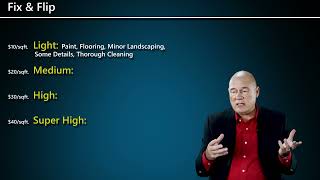
Tim Bell breaks down a four-tier rehab cost estimator using per-square-foot rules that shift by market. Kitchen, bathrooms, and exterior matter most for resale value. Use Numbeo's cost index to pick your market tier, and stop calling contractors repeatedly or you'll burn them out.
Chapters
Alright, the last item on our list for our formula is the repair costs. Now we've been through, of course, the after repair value. We started with that. We talked about how to derive that after repair value. We talked about the next item in our fix and flip investors formula, which of course we talked about initially. The fix and flip investors formula is our primary formula we're going to use. It's our primary criteria because that's the most likely person that we're going to sell our wholesale deal to. Then we went to the profit, we built some profit in for that fix and flip investor. Now we're down to that last item on our formula, that critical item, the repair cost. Now I will tell you that there are some people that will teach you to have a contractor come out and give you a bid on every property that you look at or every property that you assess. I, I disagree with that. The problem with that is if you continue to do that, you will burn out your contractors. Okay? For example, you call up, you've got a hot property, you've figured out what the ARV is, you've figured out what the general costs are, you figured out what a reasonable profit would be in it, but you're still missing those pesky repairs. So what do you do? You call up your contractor. My contractor's name is Alan. So I call up Alan and say, hey Alan, it's Tim, how you doing? Good. Hey, you know what? I got this hot property. Come on out here and give me a bid. So Alan says, okay, I'll meet you there at noon. So we go out there, he's looking around the property. Yeah, needs this. Needs new paint, new flooring, needs kitchen baths, blah, blah, blah. And he gives me a bid and he hands me the bid. Then I throw that bid amount into the formula. Okay, and, and I come up with my dollar amount. I make the offer at the dollar amount and the seller rejects my offer. Nope, we won't take your offer. Oh my goodness. Well, Tim said this would happen. Okay? So the next day you get up, you find another property, and now you're assessing it. You've got your after repair value, you've got your general costs, you've got your profit, and now you're still missing those pesky repairs. So it's back on the phone to Alan, the contractor. Hey Alan, got another hot one. Come on out here and give me a bid. Okay, Tim, I'll meet you there. So we go over there, we look around, he says, yeah, it needs that. Needs this, this, this, this boom, here's the bid. He gives me the bid. I write that bid amount into, or I put that bid amount into my calculator. I come up with a maximum offer and I make the offer to the seller, and the second seller rejects my offer on my second property. Oh, rats. Yeah. Now that will happen. Now, I will tell you, if you use that process somewhere between the third and and the fifth time that you ask Alan, the contractor to come out and give you that bid, somewhere between the third and the fifth time, he's going to stop returning your calls. In fact, he's going to block your number on the caller ID on his phone. Why? Well, from his perspective, you keep asking him to come out and give you bids, but you never hire him to do any work at that point. Now you've burned out the contractor, which means you need to find another contractor and burn him out, and then find another contractor and burn her out. And find you'll go on. You might go through five to 10 contractors before you even get a property under contract. Because remember, this is something of a numbers game. So as a consequence, I don't recommend you do that. Okay? Now, that said, you're not probably not good enough to estimate repairs on a property yourself. So I'm going to show you a shortcut. I'm going to show you a simple way to estimate repairs on the property. Okay? Now, I have sent you two different charts, two different ways to figure out repair costs using this simple method. See, as you can probably imagine, no two rehab properties ever cost the same amount of money in repairs. They're all different. Every property is different. Well, the problem with that is if we're trying to calculate those repairs, there's too many variables. There's too many shades of gray. And so I say let's simplify it. What we're going to do is we're going to categorize every property in one of four categories. It's either going to be light, medium, high, or super high. Those four categories, by categorizing each property in one of four categories, it simplifies our life and makes our assessment of the repair cost much easier. Now, I've sent you two charts that show light, medium, high and super high. One is what I call for normal markets, average markets in America, and the other one is for expensive markets. Okay? If you look at these two, you can see that they're different prices. Okay? In the normal market, we would have light, medium, high. Super High is 10, 20, 30, $40 a square foot. On the other hand, if we're in expensive market, then we're looking at 15, 30, 45, and $60 a square foot. The dollar cost per square foot goes up based on the fact that we're in an expensive market, materials are more expensive, and labor is more expensive in more expensive markets. And so we need to take that into account. Now, a lot of people say, gee, Tim, I don't know how to figure out whether I'm in a normal market or an expensive market. Well, I have an easy way for you to do that. You would go onto this website. This website is called numbeo, and on numbeo.com you can find a cost of living index that is ranked by region. Okay? And what you can do is you can see your cities. You can recategorize it by cities by clicking on the city tab there. And then right next to it to the right, there's a cost of living index. So again, you can go through and you can look at those cost of living indexes. Now, here's the rule. If the cost of living index shows 75 or higher, you're going to use the more expensive chart. If it's less than 75, you're going to use the less expensive chart, the normal market in America chart. So again, look up your city or the closest city nearby where you live by sorting by cities, and then you can figure out what that cost of living is. Again, the rule is if it's 75 or over, use the higher chart. If it's less than 75, you use the lower chart. Okay, so we're going to go through these charts. Now, I'm going to use the lower one just because that's what a lot of people use. But it doesn't matter. They both work. But I want to talk about and explain what light, medium, high, and super high are. Okay, so light. As you can see, it says paint, flooring, minor landscaping, some details, and a thorough cleaning. In a regular market, a normal market, that's $10 a square foot. In an expensive market, that's $15 per square foot. Now, the thing we need to think about is the idea of new car smell. Okay? Now, new car smell. If you've ever gone into a new car dealership and smelled that new car smell in the showroom, they did a survey, and I think it said that 93% of Americans have a positive emotional response to new car smell. 93%. That's a lot. But if you stop and think about it, what are the components, what are the constituents of new car smell? Well, mostly it comes from plastic materials, vinyl, There could be some leather smells, there could be paint smells, rubber lubricants, some metal smells, and some other things in there. Those are basically the smells and the components that make up new car smell. Well, if you think about it, most of those fumes that are coming off of that newly manufactured car are categorized as chlorofluorocarbons or other poisonous chemicals. Yeah. Wait a minute. So 93% of us have a positive emotional response to the poisonous chemicals that are coming off of a new car. Yeah. That just goes to show that marketing in America works because the car companies have convinced us that's a good smell, even though technically it's poisonous for us. Okay. Now, it's not deadly poisonous and we won't die from driving a new car, but they're not good for you. Okay. Well, just like there's such a thing as new car smell, there is also such a thing as new house smell. Now, the main components, the main constituents of new house smell are paint and flooring. Now, there can be some wood smells and some other smells involved in there, but mostly it's paint and flooring. It's the fumes that are coming off of fresh paint and fresh flooring, whether it be carpet or wood or tile or various other different types of materials that are used for flooring. So paint and flooring are the two most important things we can do on a house. Let's think about it. If we paint all the walls and we paint the ceiling, we paint the doors and we renew the flooring, we do a hard surface or carpet or whatever we're going to do on the flooring. At that point, we have renewed 80 to 85% of the surfaces in that house. What's left? Well, we've got countertops, we've got cabinets, we've got appliances, and we've got plumbing fixtures, all in windows. That's all that's left. All the rest of the surfaces have been renewed. Not only do those surfaces look better and look fresh and new, but they also smell better. Better and smell fresh and smell new. There are some people in our society that respond more to their sense of smell than they do their sense of sight. Okay. So we have to take that into account. So that's what we want to think about when we think about light. Again, paint, flooring, minor landscaping, some details in a thorough cleaning. Now, our. And again, as I mentioned before, we're always going to do paint and flooring unless it's been recently done. We're always, as a fix and flip investor, going to do Paint and flooring. That's just the way it is. Anybody who doesn't do that is really not doing their best to obtain the highest ARV they can on the property. So again, we want to do that. Now, the next item on our list is medium. Medium is light. All the above. Paint, flooring, those things, plus a new kitchen and new bathrooms. By the way, the dollar amounts are not cumulative. Okay? You can see that the dollar amount for medium is twice as much as as the dollar amount for light. That's because kitchens and bathrooms are the most expensive things we can typically do on a house. In many cases. In most cases. And so, again, we want to think about a house where it needs paint and flooring, but it also needs a new kitchen and new bathrooms. Now, there are four areas that we want to focus on when it comes to rehabbing a house. Here's the deal. Women buy houses. Men may pay for them, but in the United States of America, women are the primary decision makers on which house that family is going to purchase and which house that family is going to occupy. As a consequence, there are four areas that we need to focus on when we're thinking about rehabbing a house. Now, again, remember, we talk about a wholesaler is not going to do that. Rehab, fix and flip investor is going to do the rehab on this house. But you get the idea here. We're looking at it from the perspective of our fix and flip investor. So we need to consider those four areas. These four areas are very important. You may want to write these four areas down. The first area is the kitchen. Always make sure that you do good work in the kitchen. Focus on the kitchen. Why? Because women like good kitchens. Even if they can't boil water or make a peanut butter and jelly sandwich, they still want to have a good kitchen. The reason? Because a nice kitchen is a reflection on a woman's ability to nurture her family and her friends, to care for them, to supply nutritious food for them, to serve them, and those types of things. All women want to be good nurturers. As a consequence, whether it's conscious or subconscious, they want a nice kitchen. They all want a nice kitchen. So we need to focus on that. The second place in a house that we need to focus our time, effort, energy, and money on is, is the bathrooms. Okay, Women are, for the most part, terribly turned off by a bathroom that is not spotless. We need to think about making our bathrooms clean, bright, sanitary, spotless, beautiful, shiny, appealing, because that's what women like. Women are often turned off By a disgusting dirty bathroom. Some. So we need to make sure that our bathrooms are sparkling and perfect. The third area, the third area is a little bit 21st century. It didn't used to be this way back in the 40s and 50s and even the 60s. But nowadays in the 21st century, parents want a master bedroom. They want a refuge from the world and from their kids. And if they can get a master bedroom with a master bathroom, that's ideal, that's optimal. You will almost always recoup every penny, plus a whole bunch more if you somehow introduce a master bathroom into that master bedroom area and make the master bedroom bathroom area they call it on the real estate reality TV shows on television, they call it the en suite. Right? Okay. So if you can make a master ensuite with the master bedroom and the master bathroom right next to it, that's ideal, that's optimal. So that's really one of the things that we really want to focus on is trying to create that master bedroom master bathroom combination area as best we can. Now, occasionally you'll run into a house where it's really not financially feasible or practical to add that master bathroom, where there is just something that is obviously a master bedroom. But if you can, that's ideal. That's the perfect world. Okay, now the fourth area is a little bit counterintuitive, but if you think about it, it makes a lot of sense. The fourth area that we want to focus on in terms of spending our time, effort, energy and money on is the exterior of the house. We've got to make sure the exterior looks good. Remember, after you get done fixing this property up, what's going to happen? You're going to put it on the market. Real estate agents are going to bring their buyers by. Imagine this. Buyers pull up, they're with their agent and they pull up in the Cadillac and they look out the windows and the couple looks at the outside of the property. They turn to each other, they give each other that disapproving look. It usually involves a raised eyebrow and a frown. And then they turn to the real estate agent and say, oh, gee, we don't need to see this one. In other words, we're so turned off by the outside of the house, we don't even care to see the inside of the house. Okay. Obviously that's going to be a problem. Okay, you can talk to real estate agents and they will verify to you that if a residential mom and pop homeowner type buyer does not like the outside of the house and doesn't get to the inside of the house, doesn't matter what you did to the inside. They're not going to buy a house if they don't see the inside. They've got to get past the outside. So the outside at least has to be serviceable, at least has to be decent. They it doesn't have to be absolutely beautiful, but it does have to be acceptable to the point where they'll walk up to the front door, turn that front door knob and go in so that they can see all the lovely things that you did in the kitchen and in the bathrooms and in the master bedroom and all that kind of stuff. So make sure that you do address the exterior of the property. Okay, that's the fourth area. All right, so again, medium is light, plus a new kitchen and new bathrooms. Okay, again, remember, sparkling bright, spotless, perfect are our goals for those two rooms. Now the next category is high. High is medium. Paint, flooring, landscaping, kitchen, bathrooms and all that, plus two big ticket items. Now you might say, well, what are big ticket items? Let's think about some. A roof, obviously, that's a big ticket item. New windows, big ticket item. Siding, replacing the siding on the outside of the house, that's a big ticket item. Foundation repairs, that's a big ticket item. H vac heating, ventilating and air conditioning replacement or repair, that's a big ticket item. Major plumbing repairs, major electrical repairs, structural damage, any of those types of things. If it feels like a big ticket item, it is. When we have those big ticket items, we going to go to that next level. On the low chart, $30 a square foot. And on the higher chart, $45 a square foot. Okay. The big ticket items can be expensive, so we have to add in for those. Now, super high would be medium. All the above, plus four big ticket items. Okay, Four of those big ticket items that we just talked about. Okay. Now I will tell you that as you start to get further down in the list and it can go sideways on you really, really quickly. Okay. For example, in a normal market, new home building construction can be 60 to $100 a square foot. Yeah. Well, if you're only allocating 40 to do major repairs, you may not have enough. In an expensive market, it can go from 80 to $200 a square foot or more for new build. As a consequence, as we go further down in the list, it tends to not get quite as accurate and it can go kind of sideways on us. So again, if you're going to do fix and flips, I recommend you stay in the top area of the chart as best you can.










