Tim Bell - Simultaneous close
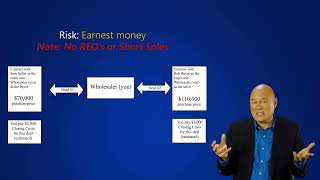
Tim Bell explains the simultaneous close, a wholesale exit where you buy and sell in one transaction at the title company. It doesn't work on bank-owned or short-sale properties because lenders control the title company. Bell walks through an example where Sam sells at $70,000 and Bob buys at $110,000, showing how the two contracts and recorder's office mechanics make it legal.
Chapters
So we've talked about the assignment of contract. That is our first and in many cases our primary strategy for exiting a wholesale deal. Let's talk about the second strategy. The second strategy is a simultaneous or double close. Now it's important to note here, as it says at the top of our screen, that your risk of course is the earnest money on this. There is a possibility you could lose your earnest money. We'll talk about that later on. But we also want to note that this particular strategy also cannot be done on a bank owned or a short sale property. The reason is a little bit different. It's not because we're putting some special clause or some special provision in our contract that talks about the simultaneous close. No, that's not why. As it was with an assignment of contract. The reason a simultaneous close will not work with a bank owned or a short sale property is because the lender on a bank owned property and on the short sale property typically chooses the title company or title attorney's office who does the closing or the settlement on this particular transaction. The problem with that is that the lender's title company or title attorney's office will typically not do this particular strategy. Again, the lender is going to see this as being strange, as being unorthodox. I have even from time to time over the years had people tell me that this particular strategy is illegal. It's not illegal, okay? It's, it's not, it's perfectly acceptable. It's perfectly fine. But there are some people that are under the impression that it is illegal. It's not. I would never teach you how to do something illegal. That would be stupid on my part and it would, you know, it's just not right. Okay? Always do things legally. Always tell the truth. Okay? But again, there are some people that have mistaken impressions or mistaken ideas about this particular strategy. So as a consequence, you can't use this or with a bank owned or a short sale property because the bank will typically, the lender will typically control the title company and their title company will be instructed by the lender not to do this type of closing. Okay, so let's talk about how this works. Step number one, we're going to put that property under contract with Sam, the seller. That's what we're going to do. Okay? Now in this case you can see that we basically have, with these numbers we have, Sam has agreed to sell this property for us in this particular example for significantly less than our previous example. You remember our previous example, we had it at $100,000 was the agreed upon price with Sam the seller. Well, in this one I've lowered the price here just to illustrate a point, and that is that in many cases this strategy is best when the differential between what Sam will accept and what Bob will pay. In this case, 70,000 for Sam's price and 110,000 for Bob's price. The simultaneous close works better when the differential is higher. Okay? We want typically a higher differential. And the main reason is because there are two sets of closing costs that are involved here. Obviously, if there is not as much difference between those prices, then it may not be worthwhile because those closing costs are going to erode some of our wholesale fee. So in order to illustrate that, I've changed the amount that Sam will accept for his property on this particular example to 70,000, which of course gives us a $40,000 differential between what Sam will accept and what Bob will pay. Okay, now first step, of course, as we said, is to get the property under contract with Sam. In our example, at the $70,000, we're going to get a 30 or 45 or 60 day closing on that. Then we're going to go out, we're going to find Bob. Now, in this case, we actually have to use a real estate purchase contract with Bob. Okay? Bob is agreeing to buy this property from us at 100,000 or I'm sorry, 110,000. Now notice, and it's very important distinction here in the contract that we have on the left side here with Sam, we. Our role is that of the buyer. Sam is a seller. And our role in that contract is that of the buyer. If we look at the contract on the right with Bob, our role reverses. Okay? In that contract on the right with Bob, our role now becomes that of the seller. In that contract, we are the seller. We're agreeing to sell Bob that property for $110,000. That is a regular real estate purchase contract. And we'll talk more about contracts later on as we go along. But again, you need to understand the difference there. Our role on both of these contracts changes. We have our buyer role on the contract with Sam and our seller role on the contract with Bob. That's a very important distinction. Again, that prevents us from being, that prevents us from being accused of practicing real estate without a real estate license, okay? Of trying to put together a buyer and a seller and get a commission for that. That's not what we're doing by virtue of the fact that we are a principal. Both in the contract with Sam and we're a principal in the contract with Bob. We are. We have a legitimate situation and a legitimate legal situation where we don't have to have a real estate license in order to do this. Okay, now, the other thing that we want to remember, too, is that, see, some people say, well, gee, Tim, you know, putting the property under contract with Bob, agreeing to sell Bob a property that I don't yet own. Ooh, that sounds a little shady to me. Well, that. The truth is, it's not. Why? Because that paperwork that you have with Bob is just paper. Until it's actually recorded at the county recorder's office, it's just paper. It's just an agreement. It doesn't have any efficacy or anything until it is actually recorded. And as a consequence of that, you shouldn't have any ethical issues with agreeing to sell a property that you technically don't own. See, here's the thing. By virtue of the fact that you have a contract with Sam, you have something that an attorney would tell you is called an equitable ownership interest in that property. Even though technically you haven't closed on it, you don't own it. By virtue of the fact that Sam has agreed in that contract on the left there to sell us his property, we have some rights in that property, even though we technically haven't closed on it and don't own it. One of those rights is to transfer that property to somebody else. So we're not doing anything unethical or illegal here. We have to realize that. Okay? All right. So again, step number one, put it under contract with Sam at a price. In this example, it's 70,000. Step number two, put it under contract with a regular real estate purchase contract with Bob at a higher price. In our example, we have $110,000 here. So we've got Sam, who will accept 70. We have Bob, who will pay 110. Obviously, there is a $40,000 wholesale fee in there. Now, the way this works is a little bit subtle. Most title companies are. Are going to want to close the deal between you and Bob first. The deal on the right there first. Why? Because if they close the other deal with Sam and then Bob doesn't show up, then they've wasted the time in the closing and the effort and the paperwork on closing with Sam. So they want to make sure that Bob shows up first. They want to make sure that Bob shows up, signs all the appropriate paperwork, and most importantly, of course, bottom Bob brings in his money, in this case, his $110,000. So here's how Most title companies or title attorneys offices will require that you structure this. Okay, so we've got those two contracts. We now have them in place. We're going to sit down with Bob at the title company or title attorney's office at about, let's say, 10:00am okay, so we sit down 10:00am on the same day with, on the day of closing, we sit down with Bob and we sign. We bring our pen full of ink, Bob brings his pen full of ink and we both sign. Now, there's something you need to understand and may or may not understand, and that is the fact that every real estate closing has two sets of documents. There's basically a set of buyer documents and a set of seller documents. We need to understand that and realize that. Okay, so what happens? I go to my title company here, I sit down with Tammy Title, our title officer, our escrow officer, and we're going to sit down with Tammy. Tammy is going to slide the, the paperwork for the buyer in front of Bob and the paperwork for the seller in front of me. Remember, we're doing our closing, our settlement on the right there. Okay. At 10am So I sign the seller paperwork, Bob signs the buyer paperwork, and Bob gives Tammy Title, the title person, or title Attorney, his $110,000. Now, he may have given her, he may give her a cashier's check or he may have had the money wire transferred the, the day before, the same day or something like that. But basically, Bob shows up with his pen full of ink and his signature and his $110,000. I show up with my pen full of ink and sign. We both sign. Tammy then puts all those documents, the buyer's documents and the seller documents in the folder. That folder is for closing or settlement number one. Okay? Now, she gathers those documents together, she puts them in a folder, she puts that folder on her desk, she shakes everybody's hands and, and we all leave. Tammy goes to lunch, we come back after lunch and there's Tammy Title at the title company and there's is there. And I'm there. I show up there, I sign in this case. Tammy slides the buyer documents in front of me and she slides the seller documents in front of, signs the seller documents. I sign the buyer documents, she takes all those documents, puts them in another folder. That folder is for settlement or closing number two. She puts those in that folder and she puts that folder in her desk and then we both leave. Somewhere around 3:00 clock this afternoon, Jimmy, who is the runner for the title company, he comes in and his Job is to take those two folders down to the county recorder's office and record those, file those with the county recorder's office and get them recorded. So basically what happens is Jimmy goes down to the county recorder's office, he takes those two files and he hands the clerk the file from closing number two, from settlement number two, the closing between me as the buyer and Sam as the seller. Then the clerk gets on her computer or his computer, and they look it up, they type it in, they look at the folder. Folder says that Sam is the seller and Tim is the buyer. They go on the computer, they type it in, they look it up, it pops up on the county record. Sure enough, Sam is the owner of that property. So then they, they stamp the documents and they record it. So now it's recorded. At that point, I own the property. Now, Jimmy then gets back in line. He takes the second folder, the folder with the closing between Bob and I, with Bob as the buyer and me as the seller. He then hands the clerk at the recorder's office the that folder. And then the clerk opens that folder. She sees in the folder that it says that Tim Bell is the buyer. I'm sorry, the seller. Tim Bell's the seller and Bob Buyer is the buyer. She goes, she types on her computer in the records, the records pop up and she says, yep, Tim Bell is the owner, has been for the last 30 seconds. And then she stamps and records that deal. Boom. That's basically how it happens. So really, with this particular deal, all you're doing is manipulating the, the paperwork such that you're technically, from a practical standpoint, you're closing with Bob first and Bob first, and then with Sam. From a technical standpoint, you're actually closing with Sam first and then Bob. Here's the thing you need to remember. See, a lot of people say, well, wait a minute, won't the clerk, Won't everybody in the transaction know who signed first? Because the notary is going to have to notarize those things, right? Yes, that's true, but Tammy Title and I are the only ones that know in which order those two things were closed. Why? If you look carefully on a notary public's signature and seal and stamp line, there's a signature, there's a date, but there's no time. There is no time that's required. There's no time log required on that notary public's signature, signature and stamp line. As a consequence, nobody knows when those two sets of documents were signed as far as the time they're both signed on the same day but nobody but Tammy and I Tammy Title and I are the ones that know in which order they were signed. As a consequence, the clerk at the county recorder's office can't tell whether I signed with Sam first or Bob signed with me first. Either way they can't tell they're recorded in the opposite order in which they were actually signed which, which is perfectly acceptable because there's no time stamp on either of those documents. That's how it works. So that's a simultaneous close. Again you may want to listen to this again and that may help you get your head around that. You may want to just kind of go over this again. The other thing is that on the information that I've sent to you that you have access to there is this diagram but there's also an explanation of how this particular transaction works and at the bottom of that diagram so you may want to check that out and be familiar with that.










