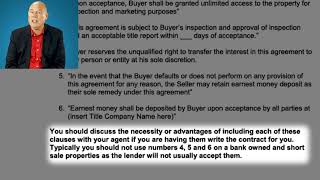
Tim Bell walks through six clauses wholesalers should add to state contracts when working with agents. Clauses 4, 5, and 6 (assignment, sole-remedy, and title choice) typically get rejected on bank-owned and short-sale deals because lenders won't allow assignment, won't waive their right to sue, and insist on their own title company.
Chapters
The next thing I would like to show you is the clauses that you can add. It's called wholesaling clauses. These are clauses that you can add if you are not. It's just not you and the seller sitting across from the kitchen table. But you involve a real estate agent in your transaction. For example, if the property is listed with a real estate agent, you're going to have to involve them in the transaction and they are going to write that offer for you. Remember we said that a real estate agent cannot use the simple 9 item 1 page contract that we talked about. They have to use the standard state approved contract. That said, just because you're using the standard state approved contract does not mean you should forego the protection of the clauses that we just talked about in that nine item agreement. So as it says here, you should seriously consider including the following clauses that are equivalent in all of your contracts or with the seller where your intent is to wholesale. Now, if you read through these carefully, you'll notice that these six items are six of the nine items that are listed in that one page offer to purchase contract that we just went over. Okay. Again, you want those same protections, those same provisions in there to protect you. It's important. Okay. Now if you scroll to the bottom of this thing, you can see it says you should discuss the necessity or, or advantages of including each of these clauses with your agent. If you're having them write the contract for you. That's when you would provide these clauses and say to your agent, I want you to put these in there. Okay. Now I will tell you that typically you should not use numbers 4, 5 and 6 if the property is bank owned or short sale. Okay. If it's a bank owned property or a short sale property, you shouldn't use numbers 4, 5 and 6. Here's why. They typically will not accept them. That's why. Okay. Number four. The buyer reserves the unqualified right to transfer the interest in this agreement to any person or entity at his sole discretion. That's an assignment clause. The bank does not want you to assign the property. They don't think that's normal. They think that's strange or odd or hinky or funky or weird. We don't want any of that kind of stuff happening on our transaction. That will be the lender's attitude. As a consequence, they typically will not accept that assignment clause. You also should not include number five. Number five says in the event the buyer defaults, does not perform on any provisions agreement for any reason, the seller may retain the earnest money deposit as their sole remedy in the agreement. Remember the sole remedy clause that we talked about in reference to the Tennessee contract and all that? Well, typically a lender is not going to accept a contract with that written in there. Why? Let's think about it. They're a lender. A lender has an attorney's firm on retainer in case they have the opportunity to sue someone over breach of contract. Well, you have to understand that they typically are not going to give away the right to sue you, which is essentially what that clause number five, that sole remedy clause does is prevents them from suing you for non performance. Okay, so they don't want to give away that right. Why? Because they've got attorneys waiting in the wings just excited to sue you and they're already paying them a retainer fee anyway. So they typically will not sign that. The other one is earnest money to be deposited by the buyer upon acceptance by all parties at. That's where you put your title company name. Typically they want the earnest money deposit and all the title work to go through their title company, not yours. Okay. Most lenders on a bank owned or a short sale property are very specific about which title company you go through. Some aren't, but most are. So as a consequence, number four, five and six typically will not be allowed on a bank owned or a short sale property. Okay, so those are those clauses. Make sure that you talk with your agent and you have your agent put those clauses into the standard state approved contract, if indeed you're having them write the standard state approved contract for you. Okay, very good.