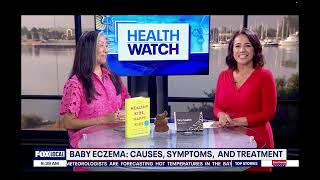
Dr. Elisa Song discusses a study showing that a personalized gut-health program reduced eczema risk by 83% in C-section babies. The approach includes stool testing, probiotics, breastfeeding, skin-to-skin contact, and avoiding unnecessary antibiotics to close the microbiome gap these infants face.
Questions this video answers
83% lower risk
Between 10% and 20% of children worldwide
One in three
A tip swab (stool/tip swab)
Chapters
Lowering the chance that your baby will suffer from a common skin condition. Next, we're talking live with a doctor about what parents can do to help prevent eczema in the early months. A new study may help give parents some tools to prevent their very little ones from developing eczema. Researchers found that babies born via C section had an 83% lower risk of eczema when families followed a gut health program in the first six months. Eczema affects one in five infants, can lead to allergies and asthma in later years. Get some insight by welcoming back to mornings. On to Dr. Elisa Song, a pediatrician and gut health expert who just completed a study on how early gut support can help prevent eczema and allergies in babies. Thanks for coming back this morning.
Thanks for having me. This is such an important topic.
You and I, seeing the video of the children who were in the NICU and are now, you know, thriving toddlers. It just those early days, weeks, months can be so critical. Parents know they can be a rodeo if we can give our little ones the best chance of health and comfort. It's so important.
It's so important in this first thousand days of up until your babies are about two to three years of age set the stage really for lifelong immune and brain health. So we want to start early.
I remember when my sons were born, you know, cradle cap, the whole, you know, the little fingernails would scratch their faces. Eczema in particular affects between 10 and 20% of children worldwide. Why is it so important that parents take action? And what can they do to help prevent it?
Well, especially for C section babies, we know that C section babies are born with a microbiome gap. Their microbiomes look different than vaginally birthed babies. And when 80% of your your immune system is in your gut, a C section baby's gut microbiome doesn't have the opportunity to train their immune system as well. So there are increased risk for eczema, asthma, and allergies, which is why we did the study, because one in three babies in the US Is born by C section. So we need a way to course correct their gut microbiomes from the very start.
So how do parents know what they're seeing in their infant is out of the norm? Could be helped?
Well, we have to look right. In our study, we use a personalized microbiome program with testing of their poop to see what was inside. And we found that we could restore the microbiomes of C section babies similar to Vaseline birth babies. And as you said, reduce their risk of eczema by 83%. Now, almost 10 million kids in the US has eczema. Right. And we need to figure out how to help parents. This could be a game changer for them.
And it's not as gross as it sounds.
I mean, it's not.
Having been through two children, the first question to your spouse says, did the baby poop? Right. As long as you're talking about it, how do parents actually act on what they're seeing?
That's right. And you know, with tiny health, it's literally you're changing the poop anyway. It's just a tip swab. That is it.
Okay. And so how do we, once we know that there could be something, we're doing better. When you talk about gut health, how do you help improve that in a baby?
There's so many ways. Once we know what needs to be corrected. Of course there's probiotic supplementation, but it's beyond that. We should breastfeed when possible. Avoid unnecessary antibiotics that skin to skin contact when you're holding your baby close to you. That makes a huge difference for the microbiome. And as they're starting solids, we really want to focus on the foods that are going to nourish their gut microbiomes. So I call them microbiome champions. These are fiber phytonutrients or color in their diets. And fermented foods.
Okay, Fermented foods for little ones.
That's right. You can start with a little, tiny, little tiny bit of kraut juice or as you know, that cabbage, just chop it up into the turkey that you're sauteing. There's creative ways to do that. Okay.
We used to do sweet potato mash all the time.
That's right.
Let's talk about eczema. Because I know a couple young ones in my life and they start out with it, it's all about creams and managing. But even once they've sort of grown out of it, the problem of eczema stays with them. Because it's such a visual issue, right? It is as well as painful.
And we want to think about eczema as a problem from the inside out. Those creams that you put on, those steroid creams, they just mask the symptoms. What we now understand is that eczema starts on the inside. You need certain nutrients and you need a healthy gut microbiome to talk to your immune system, to talk to your skin. And that's why working in the microbiome is so important. For lasting healing.
Do children grow out of it?
Usually they can sometimes. It often gets better. But that's where we see this allergic march eczema as babies, then asthma and then hay fever. And so we want to prevent that allergic march from happening by looking at their microbiomes.
Well, I don't know a parent who says, you know, I'm not going to do that for my kid. I will do everything I can. And this is, you know, though a little bit, you know, gross. It can help set your child on a path of good health. Dr. Lisa Song, it's always nice to have you back.