How This Sports Analyst Changed Tom Brady’s Game | The Assist | GQ Sports
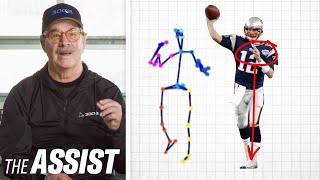
Tom House, a performance analyst and former pitching coach, explains how high-speed motion capture and a data-driven coaching model transformed Tom Brady's mechanics. He breaks down quarterback errors into specific categories like front-side elbow timing and head alignment, then shares interventions like narrowing the stance that moved athletes from 92% to 97-98% efficiency.
How did I know that Tom Brady needed a little help with his front side elbow because he was missing high and low. When you miss right and left, it's your head. When you miss high and low, it's your front side elbow. In his case, Tom House. Thomas R. House PhD Performance Analyst My two Hall of Famers are Brady and Brees. People don't realize how hard they work to get 1% better. There's a lot of technology out there. We're one of the few facilities in the world where we can actually give you a deliverable. We work with all rotational athletes, any throwing or striking sport. But me personally, NFL quarterbacks and a lot of the elite major League baseball pitchers. Rotational athletes, throwers and strikers are all the same animal. The only thing that might change is the timing of a weight transfer. Virtually everything else is the same. If you can teach hitting, you can teach quarterbacking, you can analyze hitting a volleyball. In effect, we are now helping all athletes, male and female, no matter what the age, in any rotational sport that's out there, even cricket. All right, so it's all good stuff. It's all science based, it's objectively researched. It's a deliverable that is measurable and defendable. What I found with the elite, elite, they are very receptive if they can understand what you're telling them and they think it's going to improve them. The cool thing about working with the older guys, they're in a window of trainability where they're done with their growth and they're done with their weight gain. So they're basically reinforcing the mechanical efficiencies and they got to get to their elite level and they're just sustaining that with process is what it boils down to. Anybody know what this thing is right here? It's a tester. It's a pulse oximeter. What the hell is it for? Do you have any idea at all? We're going to see what your blood oxygen level is. When I retired as a professional pitcher coach in baseball, I went up to USC and signed a 10 year deal where I was a pitching coach for five of the years and a researchist for the whole 10. And that's really when we started pulling all the pieces together that I got as a player and a coach. As we did the research on the weighted balls and velocity improvement fixing gerd, a whole bunch of studies on biomechanical efficiency and recovery, I was doing it for me personally. I had to know why. And then when I became a coach, I wanted to make sure what I gave to a kid was actually something that could help him. Not some opinion about this is what they did in my generation. I wanted it to be real stuff, and I think we've succeeded. Tom House sports started earlier this year as a way to put an umbrella over the pitching. Quarterbacking, hitting, golfing. We started off with just our eyes and video, and then we realized that there are things the human eye can't see. You can see probably about 34, 32 frames a second. But most of the activities with a quarterback or a pitcher that count take place at about 1, 250th of a second. Biomechanics, briefly, are laws of physics applied to the human body. Human bodies move, but they have to move based on the same physics that a car drives and birds fly. We've been able to identify through high speed motion analysis the efficiencies that are necessary for a kid to throw or swing efficiently. The easiest way to talk about kinematic sequencing, think of legs, hips, shoulders, arms, implement, and then the mechanics of the actual skill itself. Balance and posture. Basically, you know, keep your eyes level, hip and shoulder separation, delayed shoulder rotation, torque. We got lucky. About 15 years ago. We were doing motion analysis on elite athletes. Drew Brees and Greg Maddox. If you put their kinematic sequence at a thousand frames a second, overlapped them, except for the timing into weight shift, it was exactly the same legs, hips, shoulders, arms, implement, but the same mechanics across the board. I mean, the graphs were carbon copies of each other. And I started thinking to myself, you know what, we may be able to take that and say, see if we can help quarterbacks, everybody that comes to us. If they come for mechanics, biomechanics, they're going to get strength training, nutrition and mental emotional. If they come from mental emotional, they're going to get mechanics, strength and nutrition. In other words, we don't deal with an athlete for one leg of the performance table. We deal with all four legs. So one of the things I'm most proud of and the people that I work with underneath the Tom House sports umbrella is literally the coach tries to identify right away how athlete learns. And we tailor our information and instruction to fit that athlete's capacity. Drew initially came his offensive coordinator, he was with the Chargers at the time, brought him in for some mental emotional work. He was a little timid in the huddle and probably not as much of a presence in the locker room as he should have been. So it started off to be mental emotional, but then the last game of the season he hurt his shoulder, horrible injury. Had to go see Dr. Andrews in Birmingham. Dr. Andrews put his shoulder back together. So from that point forward, it became physical to get him back to where he could throw a football again and then biomechanical to sustain it. And it's just grown from there. We actually have a series of tests and evaluation. We call it screen test and assess for movement efficiencies. And we look at their timing, their kinematic sequencing, and then the variables that coaches teach. Balance and posture, stride momentum, opposite and equal, hip and shoulder separation, basically squaring up from front side and release point. Drew had an issue. His base was too broad so that when he took his stride, his weight shift, he wasn't generating the same foot pounds that he could if he narrowed his stance up, took a one foot stride in the time frame. So our teach initially with him was to narrow his base to get more ground force production in the time frame, to have more energy to get into the football so he could throw a long ball, not only be accurate short, but be able to throw the ball 55, 60 yards to stretch the field. These guys were really good before they showed up, like hall of Fame good before they even had anything to do with us. Drew is still playing. So what we did is we fixed small things. So instead of being 92% efficient, now they're sneaking up on 97, 98% efficient. And now that's long term health and performance. Good for the athlete, good for the organization, great for the sport. The quarterback world is like this really small little fraternity. And Drew mentioned this to this guy, and that guy mentioned this to that guy, and all of a sudden it became 3D QB and working with 28 of the top 32 in the NFL and their backups, about 50 collegiate quarterbacks and a couple hundred high school quarterbacks. So it wasn't well thought out. It just kind of happened organically. So Drew's ended up being the base and his stride length. Brady had everything good except his front side was too low and lading too quick. The fix on that basically was keep your front side basically your hand over your front foot and take a bite out of whatever burger you have in your hand. If you look at all the quarterbacks when they throw, it all looks like they're taking a bite out of their front hand. It's basically keeping all your energy going in one direction. How did I know that Tom Brady needed a little help with his front side elbow because he was missing high and low. When you miss right and left, it's your head. When you miss high and low, it's your frontside elbow. In his case, this is what you learn as you're capturing data and you're looking at it going, what are we seeing? And then you look at what the data says and what he's performing like. And he was consistently too high or too low, never right or left. We learned from baseball that that's a frontside elbow. The issues that we have with most elite athletes that are making a lot of money is that they're very reluctant to change because they're already on the elite level. But if we can give them a compelling reason to change, either through science based the research and the why, most of them change pretty quick. And the cool thing about the elite guys, you only have to show them once or twice and they get it and they'll go home and do the work. It boils down to repetition. If you're dealing with a young athlete, he's probably looking at 10,000 reps for mastery if he doesn't grow or gain any weight. We're in a perfect world right now where the technology is allowing people to identify stuff that's never been seen before. The next piece of the puzzle after identification is the solution. And that's where we have a head start. Because we started our science in the mid-80s. All the stuff that's going on right now is really cool stuff, but they're 10 years ago for me. The people I was hanging out with embraced the technology and we went down a lot of bad alleys and made a lot of wrong decisions. But we also came up with some stuff that was really, really good. People have referred to you as the quarterback whisperer, pitching guru. How do you feel about these? That's their description. I'm just a coach. If you go back to our mission statement, inform, instruct, inspire, master information, master instruction, mentor a kid, make a difference, call it what you may, we're coaches. Drew is still playing. So what we did is we fixed small things. So instead of being 92% efficient, brought him in for some mental emotional work. He was a little timid in the huddle and probably not as much. Now they're sneaking up on 97, 98% efficient. And now that's of a presence in the locker room as he should have been. So it started off to be mental, emotional, but then long term health and performance. Good for the athlete, good for the organization, great for the sport. The quarterback world is like this really small little fraternity. The last game of the season, he hurt his Shoulder, horrible injury, had to go city. And Drew mentioned this to this guy and that guy mentioned this to that guy, Dr. Andrews in Birmingham. Dr. Andrews put his shoulder back together and all of a Sudd it became 3D QB and working with 28. So from that point forward it became physical to get him back to where he could throw football again. The top 32 in the NFL and their backups, about 50 collegiate quarterbacks. And then biomechanical to sustain it. And it's just growing from there and a couple hundred high school quarterbacks. So it wasn't well thought out. It just kind of happened organically. We actually have a series of tests and evaluation. We call it screen test and assess for movement efficiencies. And we look at. So Drew's ended up being the base in his stride length, their timing, their kinematic sequencing and then the variables that coaches teeth. Brady had everything good except his front side was too low and leading too quick. Peach balance and posture, stride momentum, opposite and equal hip and shoulder separation. The fix on that basically was keep your front side, basically your hand over your front foot and take a bite out of whatever burger you have in your hand. If you look at all the quarterbacks when they throw, it all looks like they're taking a bite out of their front hand. It's basically keeping all your energy going in one direction, basically squaring up from front side and release point. Drew had an issue. His base was too broad so that when he took his stride, his weight shift. He wasn't generating the same foot pounds that he could if he narrowed his stance up, took a one foot stride in the time frame. So how did I know that Tom Brady needed a little help with his front side elbow because he was missing high and low. Our teach initially with him was to narrow his base to get more ground force production in the time frame, to have more energy to get into the football so he could throw a long ball. When you miss right and left, it's your head. When you miss high and low, it's your frontside elbow. In his case, this is what you learn as you're capturing data and you're looking at it going, what are we seeing? Not only be accurate short, but be able to throw the ball 55, 60 yards to stretch the field. These guys were really good before they showed up. And then you look at what the data says and what he's performing like and he was consistently too high or too low, never right or left. We learned from baseball that that's a frontside elbow. The issues that we have with most elite athletes that are making a lot of money is that they're very reluctant to change because they're already on the elite level. Like hall of Fame. Good. Before they even had anything to do with us. Drew is still playing. So what we did is we fixed small things. So instead of being 92% efficient, now they're sneaking up on 97, 98% efficient. And now that's long term health and performance. Good for the athlete, good for the organization. But if we can give them a compelling reason to change, either through science based, the research and the why, most of them change pretty quick. And the cool thing about the elite guys, you only have to show them once or twice and they get it and they'll go home and do the work. It boils down to repetition. If you're dealing with a young athlete, he's probably looking at 10,000 reps for mastery. If he doesn't grow or gain any weight, then great for the sport. The quarterback world is like this really small little fraternity. And Drew mentioned this to this guy and that guy mentioned this to that guy, and all of a sudden you it became three DQB and working with 28. We're in a perfect world right now. The top 32 in the NFL and their backups, about 50 collegiate quarterbacks where the technology is allowing people to identify stuff that's never been seen before. The next piece of the puzzle after identification is the solution. And that's where we have a head start. And a couple hundred high school quarterbacks. So it wasn't well thought out. It just kind of happened organically because we started our science in the mid-80s. So Drew's ended up being the base in his stride length. All the stuff that's going on right now is really cool stuff, but they're 10 years ago. For me, Brady had everything good except his front side was too low and leaving too quick. The people I was hanging out with embraced the technology and we went down a lot of bad alleys and made a lot of wrong decisions. But we also came up with some stuff that was really, really good. People have referred to you as the quarterback whisperer and pitching guru. How do you feel about these titles? That's their description. I'm just a coach. The fix on that basically was keep your front side, basically your hand over your front foot and take a bite out of whatever burger you have in your hand. If you look at all the quarterbacks when they throw, it all looks like they're taking a bite out of their front hand. It's basically keeping all your energy going in one direction. If you go back to our mission statement, Inform, Instruct, inspire, Master information. Master Instruct. How did I know? Mentor a kid, make a difference. Call it what you may, we're coaches that Tom Brady needed a little help with his front side elbow because he was missing high and low. When you miss right and left, it's your head. When you miss high and low, it's your front side elbow. In his case, this is what you learn as you're capturing data and you're looking at it going, what are we seeing? And then you look at what the data says and what he's performing like. And he was consistently too high or too low, never right or left. We learned from baseball that that's a frontside elbow. The issues that we have with most elite athletes that are making a lot of money is that they're very reluctant to change because they're already on the elite level. But if we can give them a compelling reason to change, either through science based, the research and the why, most of them change pretty quick. And the cool thing about the elite guys, only have to show them once or twice and they get it and they'll go home and do the work. It boils down to repetition. If you're dealing with a young athlete, he's probably looking at 10,000 reps for mastery if he doesn't grow or gain any weight. We're in a perfect world right now.
More from Tom




Throwing Guru Tom House Talks Tom Brady, Josh Allen, Mahomes & More with Rich Eisen | Full Interview

Tom House Baseball Pitching Mechanics (Problem Recognition & Solutions) - 1989 Pitching Tutorial

Tom House, Godfather of Pitching/Throwing Biomechanics & Founder National Pitching Association