National Pitching Introduction

Tom House's National Pitching program uses biomechanics, weighted-ball training, and mental tools to develop elite athletes. Randy Johnson and Drew Brees are among those who've used it. Steve Delabar, a former minor-league pitcher, returned to professional baseball after the program's weighted-ball protocol.
Chapters
Welcome to tomhouse Sports presentation on National Pitching where we provide comprehensive science based pitching instruction. I'm Robert Ambrose, Vice President of Technology for Townhouse Sports. It's my pleasure to bring you this presentation. National Pitching we make good pitchers. Great. National Pitching was founded by Dr. Tom House in 2004. We are dedicated to provide objective science based information and instruction. National Pitching has a national network of certified pitching coaches and we're the only board certified research based pitching organization in the world. We're hands on with more than 10,000 athletes per year and have trained more than 1000 major league pitchers, 70 NFL quarterbacks and more than 1500 PGA and LPGA Tour athletes. Some of you are probably saying national Pitching. I haven't really heard of them. Well, I can assure you the professional athletes have as most of our clients come from word of mouth from satisfied customers. At National Pitching, we focus on three privacy, health and performance. National Pitching doesn't disclose our private client information without their permission and will never talk about an athlete publicly. They can talk about us, but we won't talk about them. Second is health. We are a health first training program. Nobody throws well when they're injured. Our pitchers will throw harder and longer than pitchers in any other program, but we won't sacrifice their health to achieve it. We also provide injury prevention and rehabilitation services as part of part of our program. Finally, Performance. We have developed a proprietary hall of Fame training program. This will ensure that you pitch with maximum effectiveness and reach your best velocity. So we can also determine what your velocity capacity is. With our proprietary testing program we can tell you what your safe velocity is and also what you will throw when you complete our program. Now let's watch a short video to learn more about national pitching. Townhouse Sports.
He is a guru of throwing. He is the nutty scientist, but I believed in him and I'm very thankful that I did.
He's got a certain level of knowledge
and expectation and creativeness that he can always find ways to get me to perform at my best.
I'm just so thankful that I've had him by my side for the last 11 seasons now.
I think he's a seeker. I think he's seeking the truth.
In May of 2008 I brought this
guy two kids who had never heard of baseball, couldn't pitch, were just terrible. November 24th of 2008 they both signed pro contracts with the Pittsburgh Pirates. If he's not the best pitching coach that ever lived, I don't know who is.
Here's the pitch by Downing swinging there's
a drive into left center field. Out of here, it's gone. It's 7:15.
The highlight of my major league career was catching Henry Aarons 715th home run in the Atlanta bullpen. And that's the good news. The bad news is that's also the high baseball career. I was marginal to below average, but consistently marginal to below average. Put me in 70 ball games a year and I'll give you a.500 record and a few saves and about a.320 ERA.
Tom had a career that far exceeded as such a great teacher. His talent intellectually, for those that wore a uniform, was at the highest scale.
Never quite certain whether I'd be able to make a living playing baseball. I listened to my mom, you're gonna have to use your head one of these days. Part of the things I did with the Braves is I signed for my education if they were paying for it. I kept going to school, so I ended up getting a couple of bachelors, a couple of masters and a PhD in psychology. He knew he probably didn't have the best tools and was gonna have the longest, strongest big league career. So there was gonna be life after baseball. He planned for his future even though he didn't know what his future was. The object behind throwing the football is that you can't throw a football wrong mechanically and make it spiral. So there's instant feedback with every toss. If it isn't spiraling, you know that your elbow isn't as high on the on the plane as it should be and you're not getting extension when you take your step. If you talk to anybody that knew about me as a pitching coach when I was with the range, the only thing we did was throw the football.
It was like heresy was an anarchist. Guys throwing football on a baseball diamond was for traditional something that was unheard of.
How was I viewed? Probably as a little bit of an outlier. I don't think you can throw a football wrong and make it spiral. The guys that have the best arms on the staff all throw it just like NFL quarterbacks. So to get an athlete, get a pitcher to throw a little extra and have it be functional. Plus the football was a little heavier. The heavier football is a weight training device. So the combination of both really made it a real good cross specific drill.
And so I was open minded and started throwing football and I felt like I benefited from it.
It's nice to have a superstar that buys into what you do.
He did a lot of things that weren't traditional baseball type stuff. That he thought outside the box and just looked at it from a different perspective.
When we put in a weight room and pitchers were lifting weights, it was like, make sure no one knows you're lifting weights.
We started conditioning differently. Light dumbbells, elastic cords. Nolan saw that maybe this could help him and his career as he got into his golden years.
Number six for Nolan Ryan, I think
with his sixth no hitter, with his seventh no hitter, with his 5,000th strikeout, with his 300th win, all after the age of 40, people started saying, maybe they're onto something.
My first couple of years in the major leagues, I struggled mechanically because I was so tall. And I think Tom knew, and for some reason, he reached out to me to try and correct a few things, which was kind of unheard of considering he was the pitching coach for a different team in the same division in the same league.
We were in the Kingdome, and Nolan and I had just finished his workout. We were sitting in the first base dugout, and Randy finished his workout. And I said, randy, how you doing? He said, I'm not doing so hot. Can't throw strikes. And olin said, randy, we're going to be here tomorrow about this same time. Why don't you come by, we'll chit chat a little bit. So Randy came the next day. We showed him a few things.
Mechanically, I was landing incorrectly on my foot. I was landing on the heel of my foot, and therefore when I was landing, I was spinning. But as soon as I started landing on the ball of my foot, it was a chain reaction. And it was a small little matter of that that really turned my career around.
And about three weeks later, in Arlington stadium, I think he punched out 18 of us.
I pitched eight innings, struck out 18. People had heard that Tom had been working with me and that that was the outcome in that particular game. And I think, you know, maybe someone in the Texas organization kind of got their feathers ruffled a little bit because I went off and had such a good game.
At the end, I was actually replaced as a major league pitching coach by Claude Osteen. But it turned out to be a blessing in disguise because it gave me more time to do what I really was passionate about, and that was chase better information and instruction and deliver it to more athletes in all sports.
And my thing was, when you saw football on the baseball field, I was always wondering why he was not applying the application to those that actually threw footballs for a living. And I think he figured that out too. So that worked out pretty well.
For him.
Cam Cameron called and said, hey, look, I've got an interesting kid, Drew Brees, that I'd like to have you talk to him about some mental, emotional stuff and maybe about some nutritional stuff.
I meet Tom House in the offseason in 2004, end up having a very good 2004 season. Made the Pro bowl in my mind. I'm thinking I'm going to be the starting quarterback for this team for a long time. Going to win championships here, going to make Pro Bowls here, going to be a great player here for a long time. And all of a sudden, going into the last game of the season in which I did not have a contract that offseason, but was hoping to sign a long term deal that would keep me there forever, I seriously injured my shoulder. About the worst thing that could happen to a thrower. And I remember coming off the field just thinking, you know, not only am I not going to put a charger uniform on and I might not football again.
Dr. Andrews put him back together. And then I got involved with the rehab. We went through with what I call performance rehab, where we just started taking functional movement for quarterbacking as best we knew it. And one thing led to another and all of a sudden he's throwing the ball farther than he's ever thrown and more accurately than he's ever thrown.
There was no doubt in my mind at that moment that I was going to come back better than ever. And Tom was a huge part of that. He helped instill so much of that confidence and belief in me because I would not be where I am today without Tom Harness.
Drew Brees is one of those special people. I rate him up there with the Nolan Ryans and the Randy Johnson's because he's a quality kid that is humble and hungry, always looking to get better. And he shares with his peer group
Tom Brady, Carson, Alex Smith. I've talked to all those guys about Tom House and all the ways that he can help them, just like he's helped me.
I met with Drew last year when he was out there working out with Tom. I think it's always for all of us quarterbacks trying to find really a different way to get an edge. And when you find someone that you really like and you connect with and you can see the success, it brings
you a lot of confidence.
When you ask, why do a Tom Brady or a Drew Brees come by to work with me or us? Because it's authentically delivered, real information with no strings attached.
Stop.
Where's your arm? Outside A Little bit over, rotate it.
What do you need to do?
We try to treat them just like we treat every kid that comes through here. Unbiased information may not be what they want to hear, but they're gonna get the truth.
I'm really grateful to him.
I'm grateful for the time and energy that he spends with me. And, you know, I'm lucky to have
him in my life.
We should all be glad that we met Tom House. We should all be glad that he is who he is and the passion that he has and that he's willing to share.
Whether you're throwing baseball or football or have that motion, he probably has a better understanding than anybody else.
He was a maverick.
No doubt about it.
He was a maverick in his time.
If you're not skiing the black diamonds, you're not falling.
And if you're not falling, you're not getting better. And Tom wasn't afraid.
Guy who has always wanted to challenge conventional thought, has always wanted to take it further than it's ever gone before and really understand why things are the way they are with throwers. How can we help these guys? How can we help them be more efficient? How can we help them achieve their goals and dreams? He's there right alongside you. I mean, he is as invested and cares as much as you do. And that's what's so special about him because all he cares about is the guys that he's able to influence.
That's Tom House
in basically a pennant race. Zimmer brings me into a game. He said, I don't give a what you do. Don't give up a home run to Shambless. He brought me in to face shamlist. What happened before Zimmer got his little fat on the bench? Game over. Don't give up a home run to Shambliss. What did he put in my head? What did I do? Upper tank now. I was okay with it. I turned the page. My teammates were okay with it. What happened to the fans of Boston for the next two and a half years? Now pitching for the Sox, number 29, Tom.
Boo.
You suck.
Tom House and national pitching coaches have written many books, and Tom is widely considered to be the father of modern pitching mechanics. The national pitching advisory board contains many of the best minds in the sports performance industry. Led by Dr. Tom House, our board contains the best orthopedic surgeons, nutritionists, physical fitness trainers, as well as hall of fame pitchers and managers. Working with national pitching, you'll learn the four key performance pillars. The first pillar is biomechanics how to pitch properly to maximize your effectiveness and minimize your risk of injury. You're only as efficient as your worst movement. The next leg is strength conditioning. Maximizing your functional strength will reduce your risk of injury and improve your performance. You're only as strong as your weakest link. The third leg is nutrition, sleep and hydration. We're going to improve performance through better nutrition, sleep and hydration. Nutrition equals blood chemistry and blood chemistry equals performance. The fourth leg is mental and emotional management. This will allow you to maximize your ability to perform under pressure. Remember, elite athletes master all four performance pillars. If you think about the performance pillars in order of importance, the first and most important pillar is nutrition. It's the foundation for everything we do as athletes, and it all starts with diet. Next is functional strength. You're only as strong as your weakest link and you must be focused, functionally strong before we can master mechanics. I can't get the mechanics unless you're functionally strong enough to handle the positions you need to get into. Next is mechanics. You're only as good as your worst movement and we can't master that unless we take care of nutrition and functional strength. Finally, the top of the pillar is mental performance. The zone is only possible once you've mastered the other layers. It's not just one thing, it's everything. Working with us, we're going to train you in a way that is based on scientific principles. And when you get there, things look a little different than what you're used to. We're going to challenge you to think differently about your training. Here's a great example. Most people are uncomfortable challenging social norms and being different. This is an escalator at Hartsfield International Airport in Atlanta. Both escalators go up, yet the escalator on the right is full of people and the escalator on the left is empty. Everybody on the right hand side had a chance to go on the left hand side, but they were more comfortable following the person in front of them and going up on the right. We're going to ask you to train differently. Would you be willing to learn to throw a baseball if it made you a better quarterback? Would you learn to throw a football if it made you a better pitcher? Would you learn to throw and pitch if it made you a better golfer? At national pitching, we will leave no stone unturned to find ways to make you into the best athlete possible. Okay, let's talk about conventional wisdoms. These are things repeated frequently by enough people that everyone assumes them to be true. Let's Take an example from Outside of Sports Aircraft Black Boxes here's an article from an unfortunate incident. Indonesia stepped up its hunt for the second black box on on a crashed Boeing jet four days after scouring the sea, only yielding a single damaged box. Here's the FAA description of black boxes, which are actually the cockpit voice recorder and flight data recorder. Large commercial aircraft and some smaller aircraft are required by the FAA to be equipped with two black boxes that record information about a flight. Both recorders are installed to help reconstruct the events leading to an aircraft incident. But guess what color black boxes actually are? They're orange. So why do we continue to call them black boxes? Simply put, that's the power of conventional wisdoms. So now back to sports. Let's take a look at some pitching Conventional Wisdoms Take a look at this list. Can you pick out which of these 15 conventional wisdoms are actually true? I'll give you a few seconds to go through the list. Well, as it turns out, all the preceding teaching points or conventional wisdoms are wrong based on scientific research. It's just opinion repeated so often by so many people for so long that it's become accepted as fact. Conventional wisdom is based on what coaches think they see at 32 frames a second. Science is what is actually happening using high speed video 3D motion analysis at 1000 frames per second. When training with National Pitching, you will train based on our proprietary biomechanical model. Movement recruited out of sequence will reduce your efficiency and increase your risk of injury. You'll learn each phase of the delivery through our proprietary series of blocks block training drills and you'll master it during our training. You'll learn how to optimize the kinematic sequence. Kinematic sequencing is really just a way to describe the way the body parts are used to throw efficiently. So let's take a look at the chart on the left. It's showing the acceleration of body parts and each of those items. Hips, shoulders, elbow and hand are body segments that we're going to use to accelerate and throw the baseball. Each is a measure of acceleration on the left and then time on the bottom. So the hips accelerate to a point to deliver the shoulders. The shoulders accelerate to a point to deliver the arm accelerates to the point to deliver the hand. If each of those items essentially come out of the peak of the preceding segment, that is efficient kinematic sequencing. On the right, what you see is a player who's trying to throw with his arm. Arm only throwing is high risk will lead to injury and is very inefficient. Never will that athlete reach the same velocity potential that he would have if he correctly sequenced his body parts. Okay, let's look at kinematic sequencing a little differently. And let's take all four of the body segments we previously discussed, and now we're going to stack them on top of each other. And we're going to agree to throw and rotate everything at 25 miles an hour. Now, if everything goes together at the same time, then we throw 25 miles an hour. But what if we correctly sequence our body parts so that each segment provides velocity to the next segment? And then if we rotate each body part 25 miles an hour, sequenced properly, we throw 100 miles per hour. So great. Now you're throwing really hard, but we still have to get batters out at the end of the day. That's what pitchers are there to do. Not to light up the radar gun necessarily, but to get hitters out. So let's talk about that. Control is not walking batters. That's just throwing strikes, forcing the hitter to swing. Remember, numbers are in your favor and the best hitters only hit 40% of the time. 60% of the time, you're going to win. On average, command is throwing different pitches effectively within the strike zone. That keeps hitters off balance, produces ground balls or fly balls, and maximizes your effective velocity spreads. You'll learn to use the pitcher's weapons. First is velocity. It's the ability to change velocity to keep hitters off balance using all three types of velocity. Real velocity, the velocity on the radar gun. Perceived velocity, the velocity that the hitter sees and effective velocity, the velocity spread from pitch to pitch. Effective velocity is the most important to getting hitters out. Movement is the ability to change movement on the pitch to keep a hitter off balance. Up, down, left, right. Location is the ability to hit and change locations to keep the hitter off balance. That's your ability to split spot the ball where you want it, tunnel and spread tunnel. If you think of a tunnel when the ball leaves the pitcher's hands, you want to keep it in a tube, in a tunnel for the first four feet after release, and then after that, spread the ball to different locations. Working with national pitching, you'll learn how to move the ball both ways. You'll learn something fast, something slow, something that breaks into the hitter and then something that breaks away from the hitter. You'll learn that grip is actually secondary to the primary way we make the balls move. We have all heard that curveballs are dangerous to throw. There are some curveball grips that are dangerous methods to create the curveball break that can hurt the arm. But there is a safe way to throw and you'll learn that working with national pitching. The worst of all of the bad teaches are to turn the doorknob into release. That can honestly break the arm and shows the highest stress on the UCL and the elbow of all curveball grips. Next is hook the wrist. It's dangerous to the wrist and the elbow joint, then thumb the ball. Trying to thumb the ball through release, it creates a hump on the curveball that doesn't break much, typically hangs and good hitters will just punish that flop. The wrist through release is dangerous to the wrist and the elbow. The best curve ball is the NPA curveball. Working with our coaches, you'll learn the grip and method to throw it. And you can throw our curveball safely at any age. Working with our coaches, you'll learn to manage your diet and eat properly for elite performance and long term health. You'll learn how to hydrate properly for preparation and recovery. You'll learn that all water is not the same. And you also learn which sports drink are okay and which be avoided. Working with national pitching, you'll learn how to manage growth hormone. You'll learn to manage it through natural production of your own growth hormone through sleep cycles and diet. Benefits of growth hormone are increased height, stronger bones, more lean muscle mass, increased strength, faster recovery, higher energy levels, better mood, better cognitive function and better sleep. National pitching training process is different and we train athletes differently based on your current development window. And that depends on your neurological age. So your training age is actually different than your actual age. Here's an example. One inch of growth equals two months of regression. Five pounds of weight gain equals two months of regression. So if you're 15 years old and you grew three inches and gained 15 pounds in the last year, you're actually 14 years old and neurological age. National pitching uses cross specific training and drills. Cross specific means that as you perform the drill, you get fit and get better. We're not going to spend our time in the weight room getting stronger and then learn how to pitch. We can actually do both. An example of this are speed towels. They improve mechanics while also improving your fitness. If you've done them, you know, every day we'll do four blocks. Block one, core body temperature elevation. Block two, arm care and recovery. Block three, bodywork and block four, your patenting drills. We also do plyometric and isometric training as a staple of our Fitness program primarily using body weight and gravity to provide all the resistance needed. Many organizations will really advocate you specializing early in the sport of baseball and specifically pitching because they understand that that's the fastest way for you to develop as a pitcher. But the issue is later on down the road. We know from our research that if you specialize early in a single sport, it does result in rapid development, but it leads to reduced neurological and physical development, leads to physical asymmetry which can increase injury, leads to burnout and quitting, and limits the upside to college and rarely beyond. So here's a chart showing the effect of specialization you'll see early in the development cycle, the athlete gets much better than the average athlete, but they peak out early and then slowly they get passed in high school and college by athletes that have played multiple sports. So we have a cross sport training program which will recommend different sports for you to play in season or out of season, or different skills you can acquire to help you better improve as a pitcher. National Pitching has a weighted ball program. In fact, we are the original weighted ball program. It was developed by Tom House at USC and we also provide players with an age based throwing program. One size does not fit all. We're able to evaluate the weighted ball is thrown and give you a customized training program and was used by Steve delabar and many others to throw hard, safely.
Let's switch gears to a baseball story that's especially timely because spring training is a time when fans regularly suspend reality and dream that for their team, anything is possible in the season to come. As evidence that sometimes those dreams actually do come true, we happily present the story of Stevie delabar. Delabar is a pitcher in the Seattle Mariners organization, and although he's no kid, he's only now enjoying his first ever major league spring training camp. As our Mary Carrillo reports, how delabar got there is the stuff of which Hollywood films are made.
For every player who makes it to the majors, there are thousands for whom the dream dies long before they wanted to. They play the game until their bodies won't let them continue. Or until someone says they're just not good enough anymore. Stevie delabar hadn't made it to America's great ballparks. Far from it. He played baseball for a living in cities like Florence, Kentucky, Lake Elsinore, California and Fort Wayne, Indiana. He never climbed that of the lowest level of the minor leagues. And for six years, delabar loved every minute. Then one day in Brockton, Massachusetts, it ended just like that.
I felt A huge pop. And I said, that's it right there. So went in the dugout. It seemed like there was an alien coming out of my arm.
Delabar's elbow was broken so badly, doctors needed nine screws and a metal plate to repair the damage. It took him a while to accept the reality, but soon enough, it started to dawn on delabar that he could no longer be who he had always been.
I was out of the game. I thought, you know, I'm 27 and I'm like, who's going to take a guy who's 27, never made it above a ball.
Sodelibar made the hardest decision of his life. He retired from the game and started down a new path.
I was like, yeah, you know, this is it. I'm going to school, I'm finishing school,
Got to get on with my life.
I'm getting. This is a new chapter.
Delamar went home to Kentucky and got a real job. He was a substitute teacher at a local high school and an assistant coach for the baseball team. It wasn't the same, of course, but he figured at least he was still around the game. And just so he could teach the latest training methods to his players, delabar started an odd new strengthening program that was just beginning to be offered at a local baseball facility.
But I wanted to learn the program. 10 teach the program.
So you didn't think you were applying it to yourself, to your own, your own baseball career?
No, it was geared toward the kids.
But a funny thing happened along the way. Doing the program, Stevie delabar's arm began to feel good again. Before long, as good as ever. Delabar began testing himself, using a radar gun to measure his arm strength, and could barely believe what it told him.
I initially test, and at 89, second test was a consistent 93. I mean, I'd never been consistent 93 ever. I'm like, hey, this is legit. You know, it's, this is happening. Then I retest again four weeks later, and numbers skyrocket. 95, 96.
Here you are plating your elbow screws, holding that in, and now you're throwing the ball better than you ever had ever, ever.
And arm feels amazing.
We're sitting there going, okay, this guy should not be doing this right here. This shouldn't be happening.
Jamie Evans and Tom House had gotten word that an old broken down pitcher was thriving with the offbeat training program. They'd invented a program based on the use of weighted balls ranging from two pounds to two ounces.
Six ounce guys Six ounces, please.
House is a former major league pitcher and coach who has long been considered one of the game's most innovative teachers.
The football is a real good device to help maintain strength and keep mechanics sound.
Evans is a coach in Maryland and is affiliated with the training facility in Kentucky where delabar worked out.
The best he ever threw when he was healthy beforehand was 92. Now he's showing 94s and 95s, and I call Tom and go, okay, this is what I got going on. You tell me what you think.
I didn't believe him when you sent me whatever it was with his elbow and all those.
Yeah, yeah.
Oh, you saw the picture of his elbow?
No friggin way.
It looks like Humpty Dumpty was put back together again. I mean, it's just completely a mess when you look at it.
But Stevie delabar had become a believer. His wife, Jamie, an English teacher at the high school, started to see just where this might be headed.
And he would come home and say, guess how hard I threw. Guess how hard I threw. And in the back of my mind, I'm knowing he wants to go back, he wants to do this again. And I would just say, oh, that's great, great. You know, that's awesome how hard you threw. And I never said anything, but I knew that he wanted to go back.
And then it happened. A regional scout for the Seattle Mariners got a tip about delabar's shocking progress and wanted to come watch him throw.
I actually call our high school catcher. I call him. I get him out of school the next day.
Nice teacher you turned out.
Yeah, I get him. I get him out of school and he's pumped up, you know, he's catching me.
How well did you Throw?
I was 94, 95, 96. I think I might have had a couple 97s in there. It was a really, really good tryout.
Good enough, it turned out the Mariners took a flyer on delabar and signed him to a deal. That was the good news. The bad news, he had to go back to Single A, the level delabar had never been able to graduate from before he broke his elbow. As far as he'd come, he was still a million to one shot.
There was one point where I'd had a rough game and I'm thinking, am I wasting my time? So I had to actually sit back and think, should I continue going? Then I stringed together a few good ones, and then they said, hey, you're going to Double A. And I'm thinking, this is great stretching.
Delibi is the ultra pitcher.
Swing and a miss.
He struck him out.
August 6th. They call me in, they say, you're going to AAA. I said, sweet.
Delabar trying to close out the top of the ninth. His pitch is a swing and a
missed strike three and the inning is over.
The minor league season ended on Labor Day weekend, and right after his last AAA game for the Tacoma Rainiers, delabar was called into the manager's office for a meeting.
And he goes, well, tell me what you were doing at this point last year. I said, I was a substitute teacher. I was going to school, trying to finish my degree. I was a college or high school baseball coach. I was playing softball, and I was back home. He goes, well, that's the best part about my job, being able to tell guys like you that you go in the big leagues. And it was awesome.
When you were detailing to him what you had been doing a year earlier, I mean, it must have been occurring to you that your entire life has changed.
Yeah, and it did. First he told me, I gave him a big hug, and then I started making phone calls.
Who was your first phone call?
First phone call was my wife. I couldn't hold it together. I lost. I don't think it changes anytime I tell the story.
She was probably doing some of this too, huh?
Oh, yeah.
So I called her and I said, I'm going the big list. And she said, you know, she was so excited, she started crying. And it's something you always, you know, grow up and you expect to do,
but
when it happens, it's awesome. And then I called my dad. I lost it there, too. And then I. I mean, I probably cried all night.
As delabar's family and friends in Kentucky tried to process what was happening.
Give me a 95.
Anthony, house and Evans were trying to figure out if delabar's success was a fluke, whether their little experiment might actually be working.
96.
By this point, they'd spread the gospel of the new program to hundreds of kids at a few different facilities around the country. And they kept hearing the same thing.
Everybody throws harder and gets healthier. It scares Everybody.
Everybody.
800 plus kids. Everybody's fastball. Male, female, young, old. Everybody's fastball gets better and they're healthier. We haven't had one injury. It's too good to be true. And you know what they say about too good to be true? There's something wrong. We can't find anything wrong yet.
I'm calling her. The Dream maker.
But why? What makes this program different from all the others? Baseball coaches have been tinkering with weighted balls for decades.
Arm speed, guys, arm speed.
House himself has been trying to solve the riddle of keeping pitchers healthy for more than 30 years using fancy tools like motion analysis. House says his big breakthrough, one he thinks gave Stevie delabar's arm new life. Happened by accident. One day here at USC about two years ago, House was studying of all my sport, tennis, policing my sport, without a doubt.
We figured out that tennis players very seldom have bad shoulders, bad elbows, but very seldom bad shoulders.
Why?
Because they hang on to the racket. The physical act of serving a tennis ball and pitching a ball are very similar. So I'm thinking, okay, why are these guys healthy and our guys are not? Because they hang onto the racket.
So in the training program, instead of just throwing various weighted balls, House and Evans designed exercises where players also hold onto the balls throws. House explains. Work the front side of the shoulder holds. Work the back of the shoulder. The result they say is a stronger and healthier shoulder because it is more balanced. The kicker. Velocity goes up.
Steve delabar, the rookie warming up the Mariner pen.
The phone in the bullpen in Seattle is a blood curdling ring. I mean it, when it goes off, it gives anybody the jitters.
28 year old will take over and relieve. He was a substitute teacher earlier this year back home in Elizabethtown, Kentucky coaching high school baseball. He was also playing some slow pitch softball and he makes his major league debut this afternoon.
I'm excited. Heart starts racing. I mean it's pumping. I don't hear anything. I don't, I don't see. I mean I'm locked in.
Delabar's first pitch of the big leagues. A swing and a foul tip into the glove of Jimenez and it's 0 and 1 on Escobar. He's got a plate in his elbow and nine screws. He showed me the X rays of his elbow look like a Home Depot project. Live ball into right center field.
So I get the first guy out. That first out is big. Well, the next guy comes up and I get a, I get a strike, you know, I strike him out.
Fastball. Swing and a miss. Strike three. 96 mile an hour fastball. So two up and two down. No wonder the Mariners signed this guy. And the 02 Swift strike three. Melky Cabrera goes down swinging. So Steve Delabar, who prior to this season had never ball, makes his big league debut, retires the reuter in the ninth inning, striking out two.
I had 50 techmen, everybody from back home just, I mean, jump excited. It was, it was a pretty awesome feeling.
Three days later, the Yankees came to Seattle. And three time zones away, in the top of the 12th inning of a tie game, Delabar's wife was asleep. It was after all a school night.
And all of a sudden my phone starts going crazy. Stevie's in the game. Stevie's in the game.
Okay, okay, okay.
So I wake up and I am, I'm like, that is my husband on espn. And I just, it's, I couldn't believe it.
The Mariners and the Yankees are all tied. And right now the fate of this ball game is in the hands of 28 year old rookie right hander Steve Delabar.
Delabar retired three out of the four men he faced in the 12th and didn't give up a run. If the Mariners could score in the bottom of the inning, delabar would get the win.
You know, we come in and I'm thinking, I can get here.
This is Luis Rodriguez hitting off an inning now.
Come on, Louie, get him. And then I put my head down and later, whack. And I'm like, oh, yes.
In the 12th inning. And Steve Delabox, first major league victory.
So he goes from being a substitute
teacher to win a game against Yankees.
It sound like a real story.
No, it doesn't. And it doesn't even feel real. I mean, when we, when people ask us, it doesn't feel real, it's, this is my life.
There's a picture of all of, and I'm right in the middle of it,
I'm like, yeah, this is awesome.
It was, I guess you couldn't even written it. You know, you couldn't have written a better story.
The Steve delabar story is definitely an inspirational story and shows you the power of what's possible within our program. But just weighted balls are simply not enough. That's why we train in four primary areas and the highest of which is mental emotional training. National pitching will train you to optimize your mental performance and will teach you how to get and stay in the zone. It will allow you to perform under stress and competition to the best of your ability. We have a proprietary pitching program using the focus band to relay information from the band you wear to your cell phone that can show you your mental state as you perform deliveries. Now, some of you may not understand what the zone is and what the impact of being in the zone is in competition. So on the next slide, let's watch a short video of what it actually feels like to be in the zone in competition. Can always tell when I'm Yo J, you stink that egg.
You couldn't pitch a.
Clear the mechanism.
Oh mike.
That's what it's like in the zone. And the zone is trainable. We call it the Mushin State. Mushin is a Japanese word which means no mind in martial arts combat, if you think you die. Mushin is the mind not fixed or occupied by any single thought or emotion and you're really open to anything and it enables maximum performance without fear of failure. A lot of sports or trainers call it the flow state. And the flow state is really a state of mind that maximizes your ability to perform. It fully connects your mind and your body. If you think about it in terms of left and right brain. The left brain is the thinking side of the brain and can process roughly 40 instructions or thoughts per second. The right brain, which is the flow state, can process 11 million instructions per second. So at National Pitching we will use the Focus Band technology, which uses biofeedback to train the mind and the body to work together. At National Pitching we have a series of products, videos, physical products and books available on nationalpitching.com I recommend everybody go there and buy an online membership which gives you access to our training protocols and programs that you can do at home or with your team on the field in season or out of season. It's been my pleasure to bring you this information on Tom House Sports and our National Pitching program. Please reach out to us@nationalpitching.com to let us know how we can help you achieve your best results. National Pitching we train the world's best athletes.
More from Tom



Throwing Guru Tom House Talks Tom Brady, Josh Allen, Mahomes & More with Rich Eisen | Full Interview
Tom House Baseball Pitching Mechanics (Problem Recognition & Solutions) - 1989 Pitching Tutorial
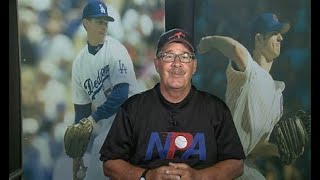
Tom House, Godfather of Pitching/Throwing Biomechanics & Founder National Pitching Association