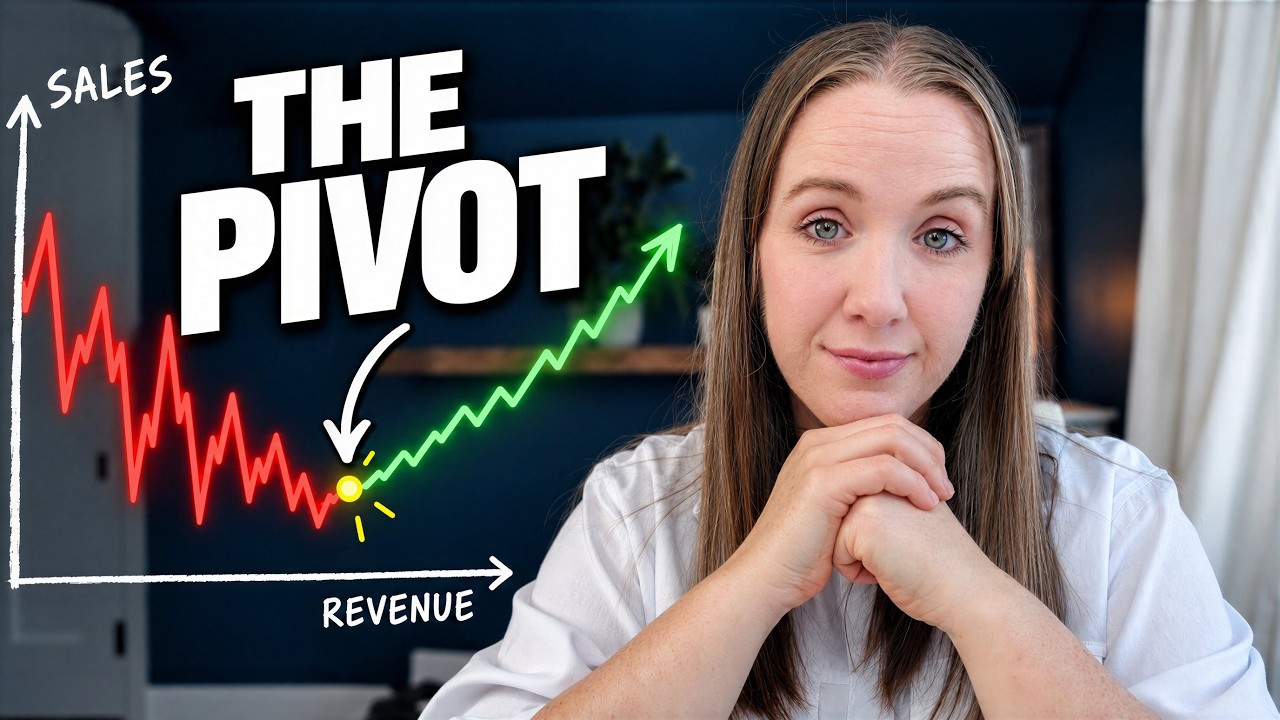
In this video Trena Little explains why constantly hopping between marketing strategies—free webinars, challenges, low‑ticket offers, high‑ticket offers—creates a "drama loop" that erases valuable data, fuels panic, and prevents real insight. She argues that the noise on social media amplifies this loop, leading entrepreneurs to chase the latest hype instead of letting a single strategy run long enough to generate reliable metrics. Trena shares her own experience of running the same webinar 40 times over a year, tracking registration traffic, live attendance, watch time, sales‑page visits, and conversion rates. By collecting these "receipts" she discovered a roughly 1 % conversion rate, generated over $120 k in revenue, and learned that a lower‑priced offer performed worse despite market chatter. She defines the numbers as "receipts" and the actionable insights hidden in them as the "tea." Using this data, she recommends focusing on 1–2 high‑ROI fixes each month, reducing work hours, and avoiding the roller‑coaster of inconsistent sales. Trena promotes her "Data Over Drama" workshop, offering spreadsheets and a step‑by‑step worksheet to help business owners systematically read their numbers, make data‑driven decisions, and achieve consistent revenue without relying on vibes.
Chapters
Every time you strategy hop, not only is it costing you money, but it's really costing your sanity. So if you are jumping from, okay, maybe I'll do a free webinar, to maybe I'll do a challenge, to maybe I need a low-ticket offer, to maybe I need a high-ticket offer, and you find yourself hopping to these different things because you feel like your sales are inconsistent. One month it's really good, the next month it's not so good, and you start to panic and figure out what can you do real quick to fix because that's your first instinct. Oh no, sales are down, something needs fixed. But when you change things that fast based on a month or 2 of data, that's probably the exact reason why you're not really sure what is going wrong. And then you don't really know what to fix to get sales back to where they were. And there's a name for that loop that I'm going to walk you through here in this video. And before I do, I would love to invite you to a workshop where I'm hosting called Data Over Drama. When you have the full story of what's going on in your business, then you can make the best decision moving forward. So if you wanna see how you can start collecting this data, get my spreadsheets that I'm using to track my metrics every single month, go to trenalittle.com/workshop and I'll see you at that workshop. That loop I mentioned is what I call the drama loop. Problem is, the second you make a change, all of your data that you've collected resets. And so now you're back at guessing what is actually working. The whole thing may not really be broken. But you changed something major and sales dip again. You're in this panic loop again, like I said, the drama loop. And I'm gonna tell you, the noise on social media makes this loop worse. And someone's gonna tell you low ticket is the move, someone's gonna tell you high ticket is the move, someone's gonna tell you courses are dead. And now you find yourself up at 11 o'clock at night trying to figure out what is the best strategy and you're buying a new course on another strategy that you're probably never going to actually implement. And the thing that you were working on and collecting data on gets abandoned before you even figure out whether it was actually working or not. And the real sneaky part about this drama loop that you get stuck in, it doesn't feel like drama. It makes you feel like you're being a good CEO. You're thinking to yourself, oh, I'm just testing. Oh, I just need to pivot. Oh, I'm just optimizing. But you're never letting anything run long enough to read that data. So you're not really testing anything. You're changing everything and starting ground zero every single time. I know this so well because up until about 2 years ago, I was in that same boat. I would do a virtual conference, I would do a challenge, I would do a paid workshop, I would do a webinar. Anytime I would do a webinar and the sales didn't hit what I expected them to hit, I would assume webinar doesn't work. I need to completely revamp and do a brand new webinar. And so I would start all over again. Started a new registration page, started a new webinar slide deck and Let me know, go ahead and type webinar below if you've built a webinar before, knowing how much work goes into that. And so what you're doing is you're creating more work for yourself to do without even knowing if that is going to work, if that is going to pay off. And so in 2015, one of the things that I decided I was gonna do was stick with a strategy and stick with it for a year. And maybe you've heard my story about doing a paid workshop versus a free webinar. I will link to the video where mention this right here, but I did a webinar for an entire year, almost every single week live for an entire year. And listen, the first webinar, great, perfect. Second time I ran that webinar, the second week, crickets. I didn't even get a sale on the second webinar. Old Trena would say, oh no, it's not working, I've got to start all over. But new Trena, who wants to get out of the data loop, said, all right, What do I need to change or tweak? What is one thing that I can tweak based on my numbers? So I'm looking at traffic to the registration page. I'm looking at how many people actually showed up live. I'm looking at how long did people stay watching the webinar. I'm looking at traffic to the actual sales page for the offer that I pitched. What is the conversion, right? Just because you don't make sales on a webinar doesn't mean it doesn't work. You've got to run it again. So I ran it a third time and I got 2 sales and I ran it a fourth time and I got 8 sales and I kept going through this process and over 40 times I was able to collect enough data to realize that I was only converting about 1% of my leads from that webinar into clients. And so for me, that gave me a lot of information. That gave me information that, hey, this topic is interesting because we're getting people to sign up for it, but the way I'm pitching it isn't converting. But instead of doing it 3, 4 times and starting all over, I kept doing it because I was still making sales. Yes, there were some weeks where there were zero sales and it was really hard to pick back up that next week and do it again, but I had made over $120,000 from that webinar doing it 40 times. So even though I wasn't making sales every week, that webinar quickly became a 6-figure webinar and was very much profitable. And I'm going to tell you a secret. If you followed me earlier in 2026, you know I did 3 webinars that snuck in a different offer, a version of the offer that I had, but I made it lower priced because I'd had a lot of comments and requests to make a lower priced option. Well, I did. And even though my conversion rates for the coaching program was about 1%, that lower priced offer was less than 1%. And so while I thought this would be the answer that everybody was saying that they wanted, the numbers showed me it is not what people wanted. And I didn't just do it once, I did it 3 times, and it was very clear by reading my numbers that it was not converting the way the original offer was. So all I had to do is pick back up that webinar that I was doing 3 weeks before and redo it and start booking clients again. Because every time you start a new strategy, you're wiping out any data to tell you whether this is going to actually work or not. So if changing everything, doing a new strategy isn't the move, what should you be doing? The first thing is you have to run a strategy long enough to collect data. Honestly, this should be a Watch What Happens Live game right now. Every time I say the word data, you have to drink or sip your tea. So the first thing, as I was saying, that you need to focus on is running a strategy long enough. And I don't mean 2 or 3 weeks. And one bad month doing something is not a trend. I told you I ran a webinar 40 times before I made a decision to switch to a workshop. Now, do I think you need to run a strategy that long? Maybe not, but you need to be tracking something, some specific numbers that are telling you what is the average. 1, 2, 3 weeks isn't an average. I would say at the bare minimum, you've gotta run something 3 to 4 months to really get some historical data to make a decision over numbers and not feelings. And if you're thinking, well, do I have enough data? Are you running a current offer? Do you have a funnel? That is the data that I'm talking about that you have got to be collecting and analyzing. And you have more importantly got to be looking at these numbers every single month for you to even decide what you should be working on the following month. The second thing that you need to do is understand what do these receipts mean. And I'm calling the numbers, the conversion rates, the sales pages, the sales, I'm calling these receipts. Because you need to be looking at that instead of how you're feeling or how you think it's going. Like I said, if I would have stopped doing my webinar in week 3 and week 4, I would have missed out on over $120,000 in revenue. So when you're looking at your receipts, I'm talking about looking at the sales that's coming in. What is the revenue coming in? I'm talking about how many people actually saw the sales page, how many said yes, what is your conversion rate. That's what I'm calling the tea, and the tea is always hiding in those numbers. Then your third thing to do is to make a move. And this is where I think a lot of business owners miss, because we are always trying to plan our week, plan our month, plan our quarter, and you're just coming up with projects and then ideas that you have. In reality, you need to collect your receipts, find the tea, and then make the move on one or two decisions that your receipts are telling you to do. And the amount of time this frees up in your business I'm going to tell you, when I started doing this process, I was able to cut my work hours down to just 20 hours a week because I didn't have 7 different irons in the fire. I looked at my numbers. My numbers told me these are 2 things that I needed to fix. I would fix those 2 things and track them each week to see, are they moving upwards or downwards in whatever direction that they needed to do? I didn't need 17 different projects. I needed to work on the 1 to 2 High ROI decisions that were going to make me more consistent sales instead of riding that roller coaster of a lot of sales one month, no sales the next, and a lot of sales, maybe medium sales. You know that roller coaster we all ride on. Now I'm telling you, looking at your numbers, looking at spreadsheets is probably overwhelming and something you may avoid. Guilty again. But the business owners, the richest girls, you know, in this online business space, are not avoiding their spreadsheets. They're turning the day that they fill in their spreadsheets like a spa day, a spreadsheet spa day, because they know the minute they fill out those spreadsheets, they're gonna know what to focus on. And they're not focusing on things that aren't going to help them continuously make money. So it relieves the stress, it relieves the overwhelm, it relieves the what else do I even focus on moving forward, and it tells them exactly what they need to do to get more sales the following month. And this is why they're never having consistently down months in revenue, because they're making their decisions on what they're gonna work on based on data and not a vibe that they're having. I have built all these spreadsheets and I'm gonna share them with you, help you fill them out, and help you make decisions based on what those numbers say at my Data Over Drama worksheet. You wanna go to trenalittle.com/workshop to grab a seat because you are going to have Everything that you need to read your numbers, make a decision, and know exactly what you need to do moving forward. In the video on your screen right now, I'm going to show you why sales being down or lower than normal may not even be a sales problem at all. So before you go completely change your sales page, watch that video next.