What will get you to consistent $10K Months FASTER? Digital Courses VS a Digital Shop
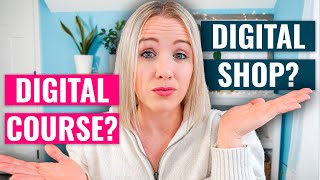
Trena Little compares digital courses and digital shops for hitting $10K monthly revenue. Courses need fewer sales but take longer to build; shops move faster but require more volume. She draws on interviews with seven-figure business owners to break down the math.
I've got to be real with you. Passive income doesn't exist. So if you want to get to $10,000 in sales each month in your business, what is the fastest and best way to do that? Is it going to be a digital shop with lots of products for people to buy or is it going to be just a signature course? I'm going to break down what I've come to find out and realize after seven years in business. In addition to working with multiple seven figure business owners during this time as well, I'm going to break this down pros and cons style. Just like I did last week when I bro down if it was easier to get to 10k months with services or courses. The first pro when it comes to a course is it can be sold at a higher price point than digital products. So you can sell a course for a couple hundred dollars. And because courses are perceived as high value, you'll be able to get that if you do all your marketing and sales right leading up to pitching your course. Courses also allow you to start generating reoccurring revenue. So if you course down into payment plans, you can count on those payment plans every single month as well. And I'm telling you, reoccurring revenue exactly what you want. I have recently on my channel been really diving into explaining the math behind making the sales that you want to make to hit the revenue number that you want to hit. In this case, we're really focusing on $10,000 a month because it just seems to be like this milestone for so many business owners. So when it comes to courses, because your course is a price point, you don't need to make as many sales to get to $10,000 a month as a digital product, which means you will need less eyeballs, less traffic to your course sales page. I really am double downing on explaining course math and really business math in general because I'm not a numbers person. But I wish I would have understood these numbers so much earlier in my business because I would have stopped focusing on the things that weren't making me focusing on what the math and the numbers were telling me. I'm telling you this is seriously, if I could go back in time, what I would change because when you break down the numbers to get to $10,000 a month with let's say a $497 course, you need to sell that course about 21 times a month. Now to make 21 sales, you need people going to that course sales page and on average a course sales page is going to convert at one and a half to 2%. That's just industry standard Your could be different but if you don't have those metrics, we really got to base it on industry standard. That means at a 1 1/2 to 2% conversion rate, you need 1050 people on your course sales page every single month to hit your target of 21 course sales to get you to $10,000 a month. I'm going to tell you it is no easy feat to get 1,000 people to your sales page every single month. We are just hitting 1,000 people on our going video sales page which actually a digital product and is a smaller price point even with the audience that I do have. I mentioned the math because the course is a higher price point, right? So you're going to need less people when we talk about pros and cons of digital products. Your mind is going to blow when I talk about how many people you need to your digital shop page or to your digital product page, whatever it is you're selling at a smaller price point. All right. Another big pro of course is it doesn't take a lot of time after you get it set up so you can create some evergreen strategies where you can create promotional content that leads people to a webinar that leads people to get pitched your course and have follow up emails to really get them in to that course. This is what we currently do. We have an evergreen funnel where people are watching our evergreen webinar and they're going through our sales funnel. Now I say it takes less time because we are still tracking people who are going through our funnel and we are personally reaching out to them at a certain part in the funnel. Especially if they click on our sales page, we want to personally reach out to them. We meaning me, I send them a loom video. I send them a video ask and say, hey, I see you've checked out Video Strategy Academy. Do you have any questions? What's kind of holding you back from joining us? Not only does this personal outreach make them trust me, make them feel like this isn't a scam they're going to lose money on, but it's giving me a lot of market research to understand what's causing them to not buy. Because that's going to tell me more of my sales argument what I need to wrap into more of my sales page and my sales marketing and my overall content in general. So while it doesn't take as much time as say a one on one service, there is still time contributed to selling an online course, it's just not set it and forget it. And another con of a course is it really warms people up to a higher ticket offer. So if you want to be a coach or you want to be a consultant, right, or you wanted to be a done for you service provider, getting people through your, your course is really going to show them your style, build that trust, make them feel connected with you. And if they want to go on that next step, they're a much warmer lead than somebody who hasn't gone through your course. We do this in our business as well. In our business model, we have Video Strategy Academy, which is our YouTube strategy course. And then we offer a discount for those students to upgrade into my coaching program, my business coaching program, 10K on replay. It is much easier to move people from Video Strategy Academy up to my coaching offer because they've already been able to see how I teach, what my style is. They've probably already been able to get results just from my course that they're ready to go next level with my high ticket coaching offer. And so it allows you to move people further up in your value ladder to again help you get to 10k months. With pros comes cons. And let's talk about course cons. It is competitive. Let's not sugarcoat it, candy coat it, whatever you want to call it. There are a lot of courses out there. There is free YouTube videos, right? And a lot of people have created crappy courses. So a lot of people are not only on course fatigue because they bought all of these courses and they never did it. So they feel guilty for buying courses and not doing them and they don't want to buy more courses, but they've bought courses that they tried to do and they sucked. So one of the cons here is really competing against that and showing how your course is going to be different and getting people to trust you and needing to do a little bit more really to convince people that your course is worth it and how you're going to help them get through it and get the results that you're promising. So it does kind of lead into that other con that it does get time consuming. When you're looking at a digital product or a digital shop, there's a lot more selling that does need happen with an online course if it's a higher price point, a couple hundred dollars, right. And the last thing that I want to happen is for anybody to put time into a course and launch it and feel like it was a failure and they wasted their time. This is why when I work with my 10 count replay clients in my coaching program, I encourage them to beta launch their course before it's even created. Basically cod pre selling. I help them create the outline of what their course is going to be and what the result is going to be after people complet complete it. And then we launch it without even spending the time creating it to make sure it's validated, to make sure people are actually going to buy it so that my clients can get cash in their pocket, make back their investment in 10k on replay and then start building their course out. Live with students in there to get feedback, to ask what's not clear, what do they need more help with, what templates do they need. And they can get that instant feedback to make their course better. They get that market research as well, asking the students and getting, getting real time feedback. So the next time that they sell it, not only do they have testimonials, but they're clearly speaking in their target audience's language because they talked to their students for the last six weeks, really understanding where they're struggling with the course and how she or he could make it better. So I don't want you to think that courses are super easy to get up and make passive income. There is time that goes into them as well. Ah, digital products. Let's talk about this next. Because I, I did go down the rabbit hole of setting up a digital shop. In fact, I think it was in 2021. I paid my brand designer McKenzie to create a digital shop for me and I have yet to publicize it or make it public. Basically I thought I'm gonna have an online shop. It's gonna do amazing. It's the next best thing since sliced bread. Well, like I said, it's still not live. But let's talk about the pros of a digital shop or a digital product. And when I'm talking about a digital product, I'm talking plates, I'm talking about swipe, copy, I'm talking about spreadsheets. In fact, I did an entire series recently here on my YouTube channel about digital products. I will link to that playlist here. Highly encourage you to check it out because not only do I talk about why you do need digital products in your business model, but ideas for digital products and really how to set up your system for selling digital products. So check out that playlist next. Digital products are usually less than $97. It is an easier sell. So your conversion rates start to go up here. Like I said, with course your Conversion rate on the sales page is around 1 and a half to 2%. With digital products, that does go up a little bit. I would look for more of a 3 to 4% conversion rate with digital products. So with digital products, there's a lot smaller cost in development. They're usually pretty easy and inexpensive to make. You don't need any fancy software to host it like a teachable or an ftf. You can create a digital product on Google Docs, Google Sheets, Canva, and it really allows you to solve one problem for one person. And when you can really hone in on that, that's when your digital product is going to sell like hotcakes. So if you can just provide templates for social media for a fitness coach, or you can provide proposal templates for an agency, or you can provide recipes and a checklist almost like in an ebook format for somebody who's wanting to go keto. Right. That is one problem for one person. Your conversion rates are going to be higher and you're going to see better results on a digital product like that. The other pro is digital products are going to be the closest that you're going to get to passive income because these do tend to sell a little bit better than courses. You can tend to see that income come in a little bit more passively because there's no back end follow up like with a course, you're checking in on them, making sure they're going through the program, seeing if they have questions. With digital product, you give them the product and maybe a tutorial video, and that's usually all you need to support for a digital product. Okay, you know, we got to talk about the cons of digital products as well because they're not all rainbows and butterflies. And one of the cons is they are seen as a low perceived value because they are on the cheaper end. We can get a little bit more jaded as will they actually solve this problem. And it can make it kind of hard to sell them. So you do need to balance what your price point is going to be to make your digital product seem valuable enough but not overprice yourself so that you're falling into like the digital course or online course range. The other con is limited scalability and the potential of cannibalizing other offers. Now, I work with my 10k on replay clients to really build out a solid value ladder and a business model so that we are ensuring that each offer we have on each ladder rung or each step in their business model will not cannibalize another one, but will complement it. Meaning I don't want you to have a digital product that seems like, oh, it's the cheaper version of your signature course, or having a course that seems like a cheaper version of your coaching program. Right. So when you create a digital product because it's a lower price point, you need to make sure it's clearly different but complimentary to any other offers that you have in your business. Because what are people going to do? They're going to default to the cheapest thing. And if they think the cheapest thing is going to solve their problem, that's going to cannibalize your online course sales. So when you're building out this model, you want to think about what is the first step that they need to do that you can create a digital product around that then possibly leads them into that next step. So for me, my digital product is going video inside of going video. I teach the process of getting started with video. The equipment, the workflow, what to say in a video. I don't talk about the YouTube strategy side of it or how to get started on YouTube, because that's what my course is. I want people to get started on video first, get my workflow, get their feet wet, and realize, okay, I can do this. I want to go all, all in with YouTube, right? Then they're ready for Video strategy Academy, the same thing with 10k on replay. While I help people with their YouTube strategy inside of 10k on replay, video strategy academy is teaching people how to create a traffic plan on YouTube, how to start generating more leads, how to start getting more views to their sales page. And then when they are ready, let's build out your value ladder to ensure you're getting those leads through your customer journey the way that you need it to be. How do we now take the offers that you have and throw fuel to the fire? That's what ten count replay does. It really jumps into the business model of things. So here we have getting started on video, here we have YouTube strategy, and here we have business strategy, right? Neither one is going to cannibalize each other, but each one is needed in the potential customer journey to get them to the top. Right? Another con of digital products is obviously market saturation. I feel like everybody and their brother has a template of some sort, um, and it's probably true for your niche as well. But you can make your stand out. Maybe you can make something for a specific niche like a health coach or a crocheting business. And all this means is just tweaking a little bit, taking your main offer, your main digital product and just tweaking it a little bit for the different niches that are out there that could really help you sell more of your digital product just by making small tweaks and saying, you know, social media templates for quilters, social media templates for wellness coaches, social media templates for WordPress designers. Right. I feel the biggest con here in digital products is is we've talked about this before. Traffic eyeballs to your shop or digital product sales page. Again, I believe the math is so important and I don't like math. Let's be real. I freaking hate math. But if we break it down so many people inside a 10K replay have had this realization on why their business hasn't been working and know what they need to do next to make it work. So let's say you have a $17 digital product. You're going to need need 589 people to buy that $17 digital product. So you know how much traffic now you're going to need to get to that page. Over 11,000 people every single month to that digital offer that digital product so that you can make that 580 some sales to make that $10,000 a month with just a digital product. This is why again it is so important to have a bigger business model in sight to know how you're going to get those offers up a ladder to turn a 17 dol sale into a possible couple hundred dollars course or coaching program or done for you offer right now before I tell you which one is going to get you to 10k months faster. You may have figured it out already, but you've heard me mention a lot here about your business model or your value ladder. This is such a critical part for any business owner to ensure their business will thrive and hit that $10,000 in sales a month. This is exactly why I created my one day virtual conference difference 10k con. Kind of like bravocon comic con. Not only am I going to be talking about how to develop a traffic plan for your business to get the right amount of eyeballs on your sales page every month, but I'm going to talk about the three strategies you need to build a consistent $10,000 a month business model and how to create a sweet spot plan. So how to create a plan in the next 90 days that you can have your business model in place making you $10,000. In addition to these three workshops that I will be hosting live on Wednesday, April 5th, I'm going to have a panel of current 10k on replay clients who I'm helping them build their business model to 10k months. They're going to be able to share with you what they've done that is working, what they've done that hasn't worked, the biggest mistakes that they make. And you're really going to be able to hear from people who are currently actively building their 10k a month business model. Plus, when you get your seat inside a 10k con, you're gonna get instant access to a private podcast that I did.
I'm making videos. How can I monetize this? I started actually selling physical products. I moved from that to being a freelance content creator.
It's not public anywhere, it's only available for 10k con attendees. But I talked to eight seven figure business owners and I asked them to think back in their time when they were struggling to get to 10k months. What was the big problem that they were having? What did they do that finally shifted their business to get 10k months and beyond and what is their best advice for current business owners who are trying to get to 10k months? These interviews have been so enlightening and I was even taking tips like I was taking notes down when I was doing these podcast interviews. We also have two special interviews as well. In this private podcast I interview my husband so you can hear from a perspective of somebody who's married to an entrepreneur who has struggled to get to 10k months and see, you know, what he has learned along the way, what he likes about it, what he doesn't like. And then we do have a special appearance for my kids, my 6 and 8 year old and what they think mommy actually does and who they think works more Mummy or daddy who works a typical 9 to 5 job. It was interesting. So make sure you get your ticket@trina little.com forward/10kcon. This is a live virtual conference, is basically like any other conference, but we're going to be on the Internet. You can join from your PJs, you can join from your bed and I highly encourage you to be there if you want to create a business model this year. So by December 2023 you're making consistent 10k sales in your business. So which offer a course or digital product is going to get you to 10k months faster. Truthfully, from what I've seen from not only the seven figure business owners I've interviewed, but I've worked with inside of their YouTube strategy, you've got to have a little bit of both, but They've really got to compliment each other so that they can feed off of each other and not cannibalize each. You also want to build your digital product to easily move people up to that next level in your value ladder like a course or a done for you service or a coaching offer. And you really want to start incentivizing people who come in at that smaller price point to go up the value ladder. Maybe it's a price discount, maybe it's a special call for those that buy your digital product and then upgrade. Having that clear customer journey is what will be crucial for turning your $17 digital product into a couple hundred dollar COR course sale. And I'm telling you getting that first person to buy that first dollar is the hardest. So if you can get them in at a toe dipper price point like $17 is going to be easier for them to go up that value ladder. This is exactly why I created 10k con so we can work through what that value ladder looks like and how you can start setting yours up today. So make sure you grab Your Ticket for 10 KCON Wednesday, April 5th get your ticket at trina little.com forward/10kcon.
More from Trena







Why Every "Business Guru" Suddenly Went All-In on YouTube (And What NOT to Copy)

