Donna Serdula: LinkedIn Make Over | The Tyler Wagner Show #1043
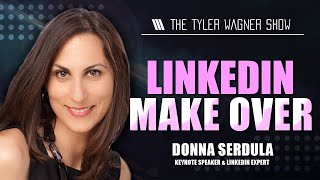
Donna Serdula built a LinkedIn consulting business by fixing the mistakes executives make on their profiles. She's worked with over 6,000 clients, 80% of whom landed new positions within a year. Common fixes: better headlines, profile pictures, keyword strategy, and ditching spammy tactics like mass messaging.
Chapters
All right, everyone, welcome back to another episode. Today we have Donna Sardula. So welcome to the show.
Hey, Tyler, thank you so much for having me.
Of course, grateful to have you on. So if you can start us off, just a little bit more about you and what you do.
Sure, I have a company called Vision Board Media, and our website's linkedin-makeover.com, which kind of always confuses people that we have a totally different domain name than our website. But, um, but I started it back in 2009, and we help people tell their story, brand themselves, you know, help companies brand their employees. And, and we do it through the, the medium of LinkedIn, you know, clearly linkedin-makeover.com.
Got it. Okay. What were you— I'm always just kind of interested in like the origin. So what were you doing before this that then kind of like sparked your interest in starting this company?
Yeah, I was in sales in a cutthroat, high-pressure, like insane quota, cold calling, like 80 calls before noon every day.
Wow.
Head in the toilet every, you know, before every sales meeting call on Fridays. It was insane.
Wow.
And I have to say, I did thrive in that environment. So don't think I'm complaining. I'm kind of boasting.
That's awesome. Yeah, wait, wait. What do you mean by head in the toilet? Like you were partying?
Like you're just so nervous that you're going to throw up.
Oh, I was like, I was like, this company goes hard on Thursdays or something.
Oh, it was a great company. My God, we had, we had beer in the fridge and like most of the, the other salespeople were almost all guys and they would have like, they had this little spittoon on their desk because they would chew the tobacco.
No way, that's awesome. That's a good culture.
It was, um, it was a bizarre culture to say the least. But you know what, they gave me so much. I mean, I learned, I mean, immense amounts during that time. And it was there that I really forged, you know, my LinkedIn, my belief in LinkedIn. I can't say my methodology, my methodology came after, but it was there where I really recognized, and this was back in like the, like 2006. So we're talking like a long time ago. That's when I started to realize that LinkedIn made a lot of sense and that it was this great tool. And almost everybody and the company, even LinkedIn, was, was, was like misusing it and misrepresenting what it really was at that time. And And that's when I said, you know, it was in 2009 that I said, I need to start my own business. I need to help people use this platform. And I want, I want to help people tell their story because the LinkedIn profile is not a resume. And this is a place where you can really use it as a professional manifesto and almost as a catalyst for life change.
100%. So as you're talking, I'm actually looking through your website right now. You have a lot of amazing testimonials and stuff. So—
Oh, I do. Well, we worked with over 6,000 executives and entrepreneurs all over the world.
So yeah, it's interesting. Similar to you, I mean, I got on LinkedIn probably— when did I get on? I think it was like 10— I think I was like 20. I think it was like 10 years ago, I think. And I just saw, 'cause the way my mind works, like with, and how I grew my business, it's all relationships, like partnerships and just collaborating with other people where we can like refer clients to each other. And LinkedIn to me was just like, that was just like the center and it still is. And I think the only thing I, and I'm not saying anything bad about it, just for me, I think back in the day, back in the day, they didn't have any like message limits, I don't think. And unless I'm missing something, I don't know. I have like Sales Nav or like I pay monthly and now I can only message 1,000 people a month, which you would think is a lot, but like my team actually like reaches out to like 2,000, 3,000 people a day. [Speaker] Oh, wow.
[Speaker] Yeah, yeah.
Like we do very, we have like a marketing machine going. So either way, I don't like that limit. That's what bothers me about it actually.
Yeah, but people on the receiving side.
Yeah, I hear you.
You know, like if you didn't have that limit, right? And everybody was like pounding, you wouldn't have an audience. People would be leaving LinkedIn because they'd be like, oh, it's all only sales.
For sure. Well, see, and that's actually what I think, it's one of the things that we teach people like, The message that we send, it just says potential collaboration. And this is only to like people that we— it's a mass thing, but it's, it is targeted, put it that way, um, that we think we could actually like refer to each other. So it says like, potential collaboration, I noticed we both work with authors, maybe there might be ways we can collaborate. That's all the message says. So I think you're right, but I think it's because most people because I still get them. I get them all the time, like the LinkedIn messages that are like this long, and they're like a direct pitch. And like that, I don't even think you should be allowed to send one of those messages, you know.
Um, but I was, I was talking to a guy yesterday and he had called me and he's like, I need, I need you to help me. I need you to redo my LinkedIn profile because nothing's working right now. Because I'm doing this great thing. I have, I think he was using Copilot. And they were, he was, we basically had a bot that was going through connecting with like thousands of people. And then immediately upon the connection, he was then sending them the salesy spammy email. And he's like, so I think it's my LinkedIn profile that's turning them off.
I'm like, You're turning them off with the message.
There's nothing I can do to salvage this situation.
Yeah, no, I don't see— I don't get it. But look, it's a mistake that a lot of people make. So look, that's what people need.
You know, sales is a numbers game too, you know. And like, there's— it's relationship building, it's all of those things. But you know, there isn't— there is a formula. How many, how many sales calls do you need to make to get the demo or to get the meeting, whatever it is. And I mean, ultimately, if you send a million messages, even the most spammiest, sleaziest ones.
Yeah, you're bound to get a couple sales.
Yeah.
For sure.
And if it's a bot doing it and you're not wasting your time. So like, I understand the background of it, but I still find it despicable.
Yeah, no, I hear it. And what's, so just because we're talking about it, I actually have virtual assistants. So all my messages are, we don't use bots. And in fact, you know more about this than me, but tell me if I'm wrong. I think there— I know there's some out there, but I think with LinkedIn now, they've caught on to a lot of those. Like, you don't want to use that. You could have your profile like kicked off or something.
Oh yeah, yeah. In fact, I was even— I was even— so, so this guy that called me yesterday, he— so we're talking about like, you know, other ways that you could, you know, use LinkedIn in a non-sleazy type of way. And he, um, I said, you know, for one, for one thing, you could, you can make really good content and, and put that out there, you know, add value, inspire, motivate, you know, that would be a really good thing. He's like, oh, I'm already doing that. I have a feed that comes in and it creates posts based upon like these, again, very spammy links and And so I looked and he had all these, like, you know, comments and likes, and he was in a pod.
Oh yeah, the pods.
Yeah, he was in one of those pods because I said, I said, this is, this is crazy. You're, you're actually, you know, this, these horrible messages are actually resulting in, in some engagement. Oh, he said, oh, that's fake engagement.
That's a pod, dude. So, you know, what's crazy is, um, I actually tried one of those pods like a few years ago. Uh, one of my friends is like, dude, it's these LinkedIn pods. Like you just go in and then everybody chimes in. And I thought it was like still like manual, but I guess some of it was bots and how I, I like a week later, I immediately got out of all of it because I noticed something. So what was happening is there was definitely bots because my profile was like commenting on other profiles automatically somehow.
Oh my goodness.
Yeah, it was crazy. I don't know how this thing was working. And what happened is there was this woman who spoke Spanish, and she did a post, and I commented something in Spanish on her post. And I was like, dude, I don't even speak this language. Like, I cannot be involved in this. This is insane.
Were you like going like to Babelfish or Google Translate? Like, what in the whole world?
Yeah, it was some crazy thing. So like, It was like, yes, my engagement was better. So it was getting more views, but not worth it at all. In the long term, for sure. Let me ask you this though, is this— I know you, you know, everything with LinkedIn, you probably are like a master at, but on the profile side, that seems to kind of be your main thing. What are like the most common mistakes people are making with their profile? Like, what are they missing most of the time?
What are they? Okay, so what are they missing? Background graphics, typically almost like across the board background graphic. If it's like kind of gray and stripey, that means you didn't upload something. So put something up there. That's important. The headline.
Yeah.
That it's the default is your title and the current company. But like, that doesn't draw anyone in. That's not engaging, you know. So we need to put something in there. I have a, um, a LinkedIn headline generator app on my, my website. So if you go to linkedin-makeover.com to free tools, you can use this generator to create a really awesome, engaging, intriguing headline. So check that out. It's free. Yeah, you can play with it. I'll tell you one thing that's— that I see it a lot, and that is it looks like the profile picture is missing, and it's because they don't have their visibility settings correctly. They have it set to just their network, and so even though a person will have a great-looking profile picture, it just doesn't show up for everybody. So that's, that's, that's like a crazy one, but I see it all the time. Most people, um, they just copy and paste the resume. That's really it. I mean, it's just the least amount of effort. Um, they're not thinking in terms of why they're on LinkedIn, what the message should be, what, you know, what their target audience wants to know about them. You know, that's really the thing. It's, it's Most— I think a lot of people don't recognize the power of the profile when it's been optimized and strategically written in a very authentic, accurate type of way. Because, you know, people check you out. You know, they want to know who they're working with. They want to know who they were just in the meeting with or who they're going into the meeting with. You know, they want to learn more. And when you really hone and you know, like create a very deliberate message, things go better. You turn up higher in search, people want to work with you.
Yeah, no, I remember keywords are a big thing. I remember trying to remember his name. I think it's Lewis Howes. When I was younger, I think he had some sort of LinkedIn, like a free class or something that I checked out. And it was basically saying, like, in your headline, like, whatever you want to show up for, like, that should be kind of like your first thing. So like, for a while there, I had like author, and like when people would type in author, like, I think I was like one of the first ones to show up. This was like, you know, like 8 years ago or something. But like, but yeah, those keywords are important. And if it's optimized correctly, you think about just like Google, like when people are searching for certain types of people, you will show up for certain things like author.
Oh yeah, yeah. The headline is super important. The about section is important. The job titles, very important. In fact, what I've discovered is if you can get your keyword into your company name, which is not easy to do because like it's not, you know, you have to actually deliberately create a company that has that, you know, that keyword in the name. But if you do, boom, straight to the top.
Yeah. Okay, so I wonder with— I'm using this selfishly now. My company is Authors Unite. So it has the name in it.
So which is probably one of the reasons why you do so well in search.
Yeah, maybe that is why because I know I definitely have— I can't even recall at the moment, but I definitely have that somewhere towards the top. I definitely have like founder of the company name there. So let me ask you this too. So with your— so it's like the profile, but then you also— how many books have you written? Because I saw on your website too.
I got a few behind me there. There's a couple. You can also see my used coffee mug. I self-published. What did you say? I'm sorry.
So that means you're working, you're drinking coffee. Or maybe you're not.
All day Chugging the coffee. Yeah, I wrote, I self-published my first book. It was LinkedIn Makeover: Professional Secrets to a Powerful LinkedIn Profile. And I did, I wrote that one, then I did a second edition of it. And it was funny when I wrote that book, my father was very instrumental. He's like, you know, if you want to be an expert, you need to have a book. You know, that's it. And I remember, and, you know, I sat down and I pounded that thing out. And I was surprised at how it did. Like, you kind of approach it, you're like, can I honestly fill like a couple hundred pages? Is that like humanly possible? And man, it did come out. It was there. And, but when he told me to do that, he said to me, he said, call up the For Dummies people and say to them they need a LinkedIn profile book, you know, For Dummies one. And I was like, Dad, no. I mean, come on, it doesn't work that way. And those authors are like really like big thought leaders. Like they don't want me. And it was in, I think, 2015, I got a call from Wiley and it was an acquisitions editor saying, we want you to write a For Dummies book on the topic of LinkedIn, LinkedIn profiles. And I was just like, my father had died years before. He had died 2 weeks after he received my book on Amazon, the self-published one that I did, which was nice. But anyway, so I get the 4 dummies and I was just, it was just like, to be a For Dummies author to me was like just huge. Like it just represented so much.
For sure. No, that's a big deal. That's definitely a big deal. For Dummies is— that's one of the biggest book brands to me. That's like, I mean, I don't know how many total books they've sold, but I would imagine it's a lot. Like when I think of like, um, like book series, I think of like Chicken Soup for the Soul and I think of For Dummies. Like that's, that's the two that come to mind. So I think that's pretty big.
Well, you know, I like— for me, if I'm in a bookstore or if I'm on Amazon and there's like a topic that I'm after, if there's a For Dummies, like say no more, that's the one I'm getting. 'Cause I know it's gonna be good quality, you know.
True.
Simplified, easy to read, really professionally written. You know, that's why I always, that's what, that's, and that I think was another draw for me.
And so for your business, 'cause you said over 6,000 people, and maybe this is a funny question, maybe 'cause maybe it's literally LinkedIn, but how do you, like, what's your normal process or like, How are you getting most of your clients? Like, is it from LinkedIn or from different avenues?
Yellow Pages, mainly.
Oh my God.
I've never heard that answer before.
Like, wow, man, I forgot that existed.
Classified section of the newspaper.
Makes sense. I need to put an ad in there.
Most, most people I think most come from Google. Google is a big one. But a lot of people just come straight from LinkedIn. You know, LinkedIn has their marketplace now. And so that is— that provides a pretty nice stream of not of business, but of prospects.
For sure. That makes sense. Now, wait, LinkedIn, I think this could actually be big for a lot of the listeners. So the LinkedIn marketplace, is that where— because I've actually been noticing notified a few times on my profile where it's like, LinkedIn somehow will know that I would be good for it, I guess, because the word author's in there. But sometimes people like post like, hey, looking for an editor.
This is a little different.
Okay. Yeah.
I mean, it might be the same, but I think it's different. So they had— it was the segment of the, of their website called ProFinder. Have you heard of Profinder?
I think I have heard of that. Yeah, it was—
it opened and the people who got in got in and we were fat and happy.
Yeah.
And they closed the door. No one, no other vendors could come in. And so, you know, life was really good. Um, I— they've opened it back up and they, they no longer have it deeply hidden in their— in the website. Now it's, um, it's more open for, you know, everyone to see. And so when you go onto your profile, you can say, hey, I'm open to work. Like, I'm— I want to get hired. But you can also say I'm open for business. So if you say you're open for business, then you have all of these categories. So you could do coaching, consulting for book authors, marketing, digital marketing, social media, lead gen, whatever it is. Yeah, you could select it. I mean, this—
they have—
I mean, that you can only fit in those categories, but they have a pretty big listing of categories. So you find which ones you are, and once you're in there, then you can create like a little profile for the company. And what happens is when, like with LinkedIn— so why resumes and LinkedIn profile writing, you know, it's such a synergistic relationship with LinkedIn, but like if you're in the jobs section, it'll say, oh, are you interested in these services? People will click and they'll be prompted to request a proposal, and those requests come to us.
Got it.
Or, but for other people, you know, like let's say someone went in there and said, oh, I need a, um, I need a lawyer. I need a mediator, I need whatever, and you type it into the search engine, LinkedIn will say, oh, would you like proposals for this?
Oh, okay, got it.
Does that make sense?
It does. Yeah, it's interesting because like, with my— with LinkedIn, like how— what I tend to do is just like every like month or two, I'll just kind of like cycle through my profile and see if they've added anything where I can like update or something or edit.
So I had a bunch of stuff recently.
Oh, really? Yeah. So like what you just said there, that's me. I might have already set this up without even realizing it because when you said that you could put in like what some keywords, I think I remember doing that and editing I think is one of them. So yeah, LinkedIn, just every once in a while I get a notification like, hey, this person's looking for an editor. So if you want to hit them up, then you can hit them up.
The other thing, Tyler, though, is within the LinkedIn feed. So a person can go and post, post, you know, like an update to go out. And but in there they could say, I'm— you can actually hit more and they have more options. Like you can give kudos to a person, you can like, there's a whole— you can create a poll, you can say you're celebrating it at work. Like there's a whole bunch of things, but one of them is ask for help. And that's what I thought you were referring to because a person could go in there on a post and say, I need help editing a book. So I thought that was what you were getting, those notifications.
It could be.
I'm not sure.
I'm not sure because, yeah, no, because like I said, with, uh, with my team and everything, it's my team and I both kind of manage my profile. So there's like a lot of messages, a lot of stuff happening. So I just every once in a while go in and like notice that stuff. Um, interesting though. I'm gonna do it.
So check, go to your profile. Everyone who's listening, go to your profile and check Open to work.
Open to work.
Or open to business. Open to business.
Open to business. Yeah, that's open to business. Um, so I guess, uh, one of the last things I want to ask you this, because I always think stories are really helpful for people to like, like really understand what can happen if they actually take, uh, this advice that you're giving and also potentially work with you. So like What from— you have a lot of testimonials. What are some of your top stories that you can share? And you can leave names out if it's— if they don't want their names in, but like where you basically came in, did what you do, and then like 2 months later the company like grew or something like, you know, do you have like some cool stories like that? None.
No, I'm tons. I've got tons. If you're interviewing me at 5 and I'm punchy I'm so punchy right now.
No, no, I love it. This is good.
We have so many and our clients come to us for a myriad of reasons, right? So we have a large stream that come in, Donna, I need a different, I need to find a new job. I need to level up. I need to get out of this environment. So it's more of those career pivoters, those job changers. You know, there's that element. And we have found that 80% of our clients within a year have a whole new position. So that I'm very proud of, very proud of that. In terms of our entrepreneurs, and when they're coming to us, they need a profile, they need the company page, you know, they need to get found, they need to stand out. And we help them do that. We help them do that. It legitimizes them and it allows them to put themselves forward and network and, you know, find those opportunities, find those investors, that type of thing. We also work with companies who say, you know, our executive team, they all look like they're looking for work because they copied and pasted their resume. Like, help us, you know, take our employees and make them look good. So that's another element of our business. It's working, you know, with these corporations and helping their employees. And that's a huge one. So for me, it's, it's, we've been doing it for so long. And how long have you been doing it for? Since 2009.
Oh, wow.
See, okay, 2009. And, and it's gotten to the point where, you know, once, once we've worked with someone, it's, they tell their friends, they tell their loved ones, it's like we're their, that secret, like, oh, you want to know why I'm making so much more money? Do you know why the business is doing so great? These are the people who can tell my— who can tell your story, who can put you out there in a manner that, you know, really gets, gets things happening.
Dude, 100%. The book stuff is the same exact— because it just like with a new LinkedIn profile, I'm sure the person like right after is like ecstatic and then they want to use it, right? So same thing with a book. When somebody comes out with a book, like you said with your dummies book, like that meant a lot to you. So when people come out with books it's like they scream from the mountaintops. And then their friends are like, who helped you with that book? And that's like kind of— so we're kind of similar in the way our businesses just generate more thought leadership, right?
It's executive branding. It's professional branding. You know, that's— I think it's— for me, what I love is when we work with people doing their profile, you may find this a very similar type of thing. But it acts as like a catalyst for a person to get really deliberate with their message and their positioning. And very few people ever do, you know, like, most people think in a very shallow type of way through life, like they're not taking these deep plunges into their soul to really understand like, what is their vision? What is their mission? What is their passion? You know, what, who is their target audience? How are they helping them like It's just not— it's just a rare thing because you start to feel kind of uncomfortable and weird when you do that. So you need an excuse to do it.
For sure.
And, you know, and that for me is, you know, it's that moment where a person goes, people are looking at me and I don't like what they're seeing and I don't want to write about myself. So I've got it. I need to find a partner who can help me. Yeah, and that's, that's when the phone rings.
No, no, 100%. Like, and literally everything you're saying is just so equatable because like writing a book, as you know, is just— it's actually like crazy.
Like, like giving birth.
Yeah, like it's wild. It's a lot. Um, and especially I'm sure that For Dummies one, like, because I'm sure that they had like criteria, maybe deadlines.
Yeah. Insane. I was writing 30 pages a day.
Yeah, that's nuts. That's too much.
It was, it was, it was, it was awesome. Again, I don't, I don't mind these things. This makes— this is what gets me excited and happy for sure.
Yeah, I think, uh, what I found, like, for my rhythm— I'm just curious because a lot of our listeners are authors or like aspiring authors too. So like my rhythm was like an hour every morning, like after I would work out, I could just one hour I'd turn off my phone, like no notifications, and I could just get— I could bang out one hour. And then I was like, thank God I'm done with that. I don't like writing really. I like to market, like I like marketing stuff. But for you, was it more like longer? I'm assuming 30 pages. You're not banging out 30 pages in an hour. I don't think.
No, no. You know, I love the morning pages routine, though. Yeah, I don't do that myself all the time, but when I'm in it and I'm, you know, and I'm just journaling and I'm just, just writing, I do find that writing becomes easier in every other way. And that's when I'm blogging and I'm, you know, writing articles. Um, you know, for me, the first— it's so funny, like, the first— so when I did the first edition, that one seemed to come out of me a little easier, but I also really cannibalized my, my, uh, my self-published one, you know, I used that, a lot of that material and re, you know, rewriting it. But, you know, it gave me a little bit of a foundation to work upon. But that one, I would just write, like, I just put time in my calendar, and I was just writing every day. And sometimes at night, you know, it would be late at night, and I'd put the kids to bed, and I would, you know, just be writing as much as I could. The second edition was so much harder. And I don't know why, because you'd think you have a foundation, you're just making changes. Yeah, it was like pulling teeth and it was so hard. Um, but man, I'm so proud of it. Like, the second edition is the one that I'm really, really proud of. The first edition, Tyler, I'll tell you this, worked my buns off. I mean, screenshots, like everything. I send it in and they're like, Donna, it's going to be published in 2 weeks. In 2 weeks, you LinkedIn changed their entire interface. No, all of the screenshots were out of date.
That's awesome.
And it was like, I felt like this stab in my heart. And I, you know, the acquisitions editor, you know, she was, she was, she's like, Donna, you know, we've got it, we've got, you know, like, we cannot rewrite this, we have to put it out the way it is. And they did. So it went out out of date.
That's awesome.
That's a good story. So I had to wait for 10,000 sales. Yeah, because once they, they print in a 10,000 lot.
Yep.
So then once I knew that we were close to 10,000, I did all the updates.
Oh, that makes sense. Yeah, yeah. No, no, you're good. No, you talk over me all you want, but I'm just— they already printed it. That was the— yeah, yeah, that makes sense. They already printed it. Yeah, they had—
it was printed, it was ready to go. And so I had to wait, and then I did an update, and they— and I— you don't get paid for updates with Wiley, but you just do it out of the goodness of your heart. So, so then, so then I, you know, I— so the second edition is, is far— of the first, the first, the first edition second printing is, is still pretty accurate. But if you have the first edition in that very first printing, it's like, it's a bookstop, a doorstop.
No, I work with publishers all the time. So no, that luckily it was only 10,000. Sometimes they print you know, even more than that. So he would have been waiting a while. Um, so here, what I want to do, I kind of want to just leave the floor to you now. And like, anything that we didn't cover that you want to share, please do. And then, uh, I know one place people can find you, that's LinkedIn. But is there anywhere else that you'd like people to connect with you?
Good one.
Instagram.
No, I'm not on TikTok. I'm not on TikTok. I speak French.
Oh, I can't even— Xanga, that was one. I might not know that one. Xanga, that was an old, old one.
That was an old one. Does GeoCities count? That's, that's really going back.
AOL instant messaging.
You know, I would say, um, visit my website, linkedin-makeover.com, and click the free resources because I've got so many awesome gems. Um, one of the things that I have there— so I've got the LinkedIn headline generator, but I also have a, um, a text formatter. So if you want to bold text on your LinkedIn profile or within like a post, you can do it because LinkedIn doesn't allow you to format anything. But this is like a— it's faux text. It's like a Unicode mapper. So you can bold, italicize. It's just a way, a great way of like really standing out.
Yeah, for sure. No, that's awesome. Yeah, I didn't even know you could do that. It's so strange how similar, like there's these things because on Amazon book descriptions, like you can't— they don't allow you to really do much, but if you have certain code You can actually like put images in your— you can do a lot of different things.
Oh really?
That's similar. That's pretty cool. Um, traditional pub like Wiley, they're— they probably just have direct access or something.
But yeah, I have no access to my Amazon page.
Yeah, that's normal. Yeah, because they, um, they manage all their clients. But yeah, if you— I mean, I haven't seen your pro— your description, but if you wanted to add some stuff, they could probably do it and like kind of make it look like stand out more, just like you're saying.
I've got to remember that. I haven't— I never even looked at it in that type of a manner where like, oh, could it be better? I'm just like, hey, it looks pretty darn good.
No, no, for sure, for sure. These are like the little— just like, you know, I've been like 11 years, you've been more than me, like 15 years. So those are the little things that when you're in something so long, you're like, you know, you can actually edit that description. So, uh, but yeah, no, thanks for coming on. This was awesome, and, um, we will, uh, be posting this next week. So thank you again, Tyler.
It was so much fun to spend my afternoon with you.
Thank you, a fellow Bucks Countyan.
Yes, Bucks County unite!
More from Tyler


Catherine Nikkel : THE STORY EVERYONE HAS BUT HASN'T TOLD : The Tyler Wagner Show #1120



Scott Ritzheimer: Bring Predictable Success to your Organization | The Tyler Wagner Show #1115


Fred Moskowitz: A GUIDE TO GETTING STARTED WITH IN MORTGAGE NOTES | The Tyler Wagner Show #1113

Mark Podolsky: From Land Investor to Full Time Success How I Made $90,000 Cash in Real Estate


Mark Podolsky: How to achieve a 300% return on investment my foolproof strategy

Mark Podolsky: How to make passive income selling raw land the irresistible pricing strategy