Dr. Andrew Hill: How To Increase Your Brain Power | The Tyler Wagner Show #1074
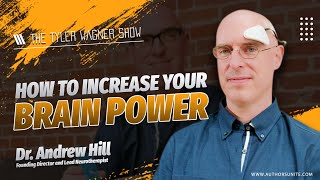
Neuroscientist Dr. Andrew Hill uses quantitative EEG brain mapping to identify bottlenecks in sleep, stress, and attention, then guides personalized neurofeedback training. A 10-minute cap session records your baseline, and three 30-minute sessions weekly can improve sleep, reduce seizures, and clear brain fog. A typical 3-month program costs $5-6k.
Chapters
All right everyone, welcome back to another episode. Today I got Andrew Hill with us, so welcome to the show, man.
Hey, thanks for having me, really appreciate it.
Of course, grateful to have you on. Uh, so yeah, if you can start us off, just a little bit more about you and what you do.
Sure, so I'm, uh, a neuroscientist that works in a functional area, basically, um, somewhere between a doctor and a coach in how we work with human resources. And the tools that I use are ones mostly of neuroscience. So some folks call this biofeedback, some call it biohacking. Uh, it's used in a therapy environment as well as for peak performance. So, um, I got my PhD at UCLA studying cognitive neuroscience, which is the sort of intersection of mind and brain. And, uh, since then I've been opening companies that do what's called neurofeedback or biofeedback on the brain and we work with folks to map their brains, find performance bottlenecks, and then usually change their brains over a few months. So I'm a professional mad scientist, basically.
That is awesome. Okay, so I have to ask you this, um, my, uh, and this is kind of a different start, it's not what I was expecting to ask first, but my uncle, I think he does, he might maybe use some of your tools or something different, but he has actually done something like you described on me and my brother before where, okay, we put this thing on her head and then he had to use this gel and like, like little kind of Q-tip thing in each.
Sure.
And it took forever to get the levels or something, right?
Yeah.
Yeah. Right. Then he asked us questions or, and he asked us some questions and then in other times we had to just like close our eyes, open our eyes regardless. And then he gave us a full report on our brain. So is that—
Yeah. You did a brain map or a quantitative EEG. So a cap on the head, squirt full of gel. Yeah, I can get one set up in about 10 minutes, but no offense to your uncle. Uh, at all of our offices, come on in, we'll put a cap on your head, squirt it full of gel, and then have you sit still for 10 minutes, eyes closed, 10 minutes eyes open, and get some resting baselines. Uh, we're measuring averages of things moment to moment, stuff that doesn't change day to day, basically. So it's not like the content of your thought, but it's more like looking at your height. You can sort of measure it and get a sense of it as it's relatively stable. And we compare all that, plus we also do an attention test, an executive function assessment alongside that. And the performance in the brain are compared to a database of people your age. We see how weird you are. We look for outliers in performance, you know, impulsivity, distractibility, et cetera, as well as outliers in your brain. And then try to model the ones that are unusual in your brain to see if they matter for stuff you're finding in your performance or goals you might have for feeling different or changing how your brain works.
So, got it. Um, so yeah, I, uh, I just wanted to ask that. So, but before we dive more into this, I'm always curious, like, what was— so when you were younger, and not like, uh, too young, let's say middle school, high school, did you have any idea that you would be doing anything like this, or was your thought of your adulthood completely, uh, different?
It's a good question. I guess in high school, I mean, I, I, my undergrad, uh, I went to UMass Amherst on the East Coast, and I started off in engineering, electrical engineering, because I was, I was kind of geeky, couldn't hack the math, so I left that pretty quickly. But, uh, probably not. I mean, I, I didn't have any real human services or people experience before college, but then in college And afterward, I started working with humans in really acute environments, you know, inpatient acute psychiatric facilities and group homes with folks that had multiple disabilities, including no language and issues with movement and communication. Just really extreme. I kept finding myself working with really extreme humans under developmental or psychiatric conditions, and I was good at it. I was really good at walking into an environment and like, settling things down in the really aggressive psych units and things without getting people hurt, without having to do, you know, hands-on intervention. So after about a decade of working in all kinds of human services, mostly inpatient psych and residential with autism and things, um, I got injured. I blew up my back working in the psych hospital and couldn't keep doing the work I'd been doing. So after a year or two of, uh, not doing exactly the same thing and doing some case management work, I went into high tech and, uh, got excited about high tech, did some sales engineering and some, you know, got into tech a little deeper than I got into it before and missed the human services thing a little bit. And, uh, for some context, the— this was right around 2000, 1999, and I— and the tech bubble was bursting and the Northeast was, you know, tech sector was falling over. So I left the tech area and went back to human services and got a job working for an autism center that did neurofeedback and was like, wait a minute, this is pretty interesting. What are we doing to these people? Why are they getting changes? I didn't know we could change. And I was seeing autism and ADHD and seizures and migraines and concussions and trauma and stuff be impacted. And I had tons of experience with all these populations and didn't think much we could do was doing more than holding patterns and being palliative and helping some suffering, but not making much actual change. And then I saw neurofeedback and was like, oh, we're making lots of rapid change in a few months for people all over the place. And it was striking enough that it motivated me to go back and get a grad, a PhD in neuroscience studying this stuff. Basically, I studied neurofeedback and attention, and I think I may have done the first double-blind placebo-controlled study on neurofeedback as my dissertation, which is kind of fun. But, uh, bit of a long-winded answer, but I kind of got here because I started working with humans, you know.
And then as an interviewer, we always like longer answers. The opposite is what we don't want.
Yeah, you got it. I'll— I'm good at that.
So, um, gotcha, gotcha. Okay, so, um, just I'm curious on this. What are some of the— I guess most— there's two parts of this. So first is like on a surprising, not necessarily like the impact that it's had, although I do want to ask that next. But for now, I'm just curious, like, out of all the work you've done and the people you've worked with, with neurofeedback and all this, what are some of the most surprising things that you've, like, discovered by, by doing it?
Yeah, um, there's, there's phenomena. Neurofeedback is a phenomenological space versus discrete diagnostic and intervention space a little bit. It's closer to personal training and how it's used than medicine. You have goals, you have assessment data, people are weird, and you iterate to get them the effects you're looking for. And you have to be very person-centric. This is why the research literature has lagged by decades, because you do different things for everyone, so it's hard to test. But you come across things over, you know, working with thousands of people, both clinical lore that creates certain effects subjectively, or stuff that you discover because you work with so many brains and you see so many difficulties. One of the first things that I discovered it. I've seen a lot of these things, honestly, but the one of the first ones I saw, um, one of my colleagues, uh, in Southern California who's since retired, a guy named Dr. Gary, uh, Schumer, did a study in the late '80s that he didn't publish until 10 years ago or something, in 2014, I think. Um, and he was doing neurofeedback alpha training on HIV-positive population in the late '80s when there was no retrovirals and it was a death sentence to have HIV, basically. And he did an active study where it was neurofeedback, a relaxation tool called cranial electrostim, which is used sometimes, or the combination of both, basically. And he found that the group that had neurofeedback or neurofeedback and electrostim had a really massive surge of T cells. And it was a really robust effect at a time when there was no treatments, essentially. And he published it really late, you know, in the field, so to speak. But I was working with somebody right when he published it who was immunocompromised and had just finished doing 25, 30 sessions with me for alcohol, for overactivation. He couldn't fall asleep without a drink. He'd been drinking for 25 years, a bottle and a half of wine every single day on the beach while he wrote for a magazine. He would go home and be like activated as the alcohol wore off, more wine, Ativan, and Ambien, get like 2.5 hours sleep and be wandering around West Hollywood, look, being disoriented with all those things in his system, never regulated for a while. And when I met him, he was this, you know, giant man who looked like an Oompa Loompa, bright orange skin and liver failure. And so when this disoriented, bright orange man's wandering around town, Gets thrown in jail. And so he went to a medical detox voluntarily and did 45 days, and they drove him from the medical detox to my office for a brain map. And his brain looked like alcoholics' brains look most of the time when there's chronic use. Binge using it doesn't do this, but chronic use does, even low amounts. We develop this activated tone in the brain where the beta waves climb in amount and the connectivity patterns get all locked up. And you get like a hyperarousal and you can't sit still and you can't stop moving and you're nervous and you can't turn your mind off and fall asleep. What you're seeing is the GABA versus glutamate balance in the brain is very tightly controlled. And if you throw alcohol in, you release tons of GABA and the glutamate rises to balance it. Withdraw the alcohol and you can't rapidly learn to make more GABA. So you get this like hyperarousal crisis. That's why you can't detox somebody rapidly without giving them Sedatives cause a cardiovascular crisis for the same reasons. But you see decades later sometimes that old alcoholics are burnt out and can't fall asleep from this phenomenon. So we successfully regulated this guy's sleep. I walked into the office 10 weeks in and he was asleep on the couch. I said to my assistant, oh, is he here for a visit? No, no, no. He discovered he could fall asleep at will and wanted to be asleep when you walked in to prove it. All right. We re-regulated that acute phenomenon that he walked in for. But a lot of the work we were doing after his severe overactivation was addressed was around creativity because he was an actor and we were doing a lot of creativity work. And then my colleague published this paper showing this manipulation you do on the brain that creates a T-cell surge. And it was like the next-door neighbor to the thing I was doing for creativity for him. There's a technique called Alpha Theta. Which is a hypnagogic nonlinear access flow training, basically. And it brings you to the edge of sleep and holds you there. So the monkey mind drops away and insight starts to bubble up and creativity bubbles up and stress drops away. I was doing a lot of this alpha theta for creativity and flow purposes for this guy. Dr. Schumer published a paper showing alpha training in the same spot brings up T cells. So this guy had really bad T cells when he first walked in, like quite poor, quite risky. And he, I showed him the paper and he ran out and got his blood tested and had T-cells that were above average. You know, that's not, that's not a permanent effect. Many things we do, most things we do in neurofeedback become permanent. You change the brain, it's now changing and it's practicing the new modes. But this is probably something to do with like the deep relaxation response that allows the system to create healing events like T-cells and growth hormone and stuff like that. So this is more of an acute effect that we were getting, I think. But folks can read the paper that Dr. Shimmer wrote, and my colleagues have also seen similar things where you can replicate a T-cell burst with Alpha training, which is kind of a cool phenomenon. I've been using that a lot the past 3 years.
Yeah.
Somebody gets COVID, it's burnt out, foggy. If, if they're right after it, I do T-cell boosting protocols and they seem to clear it faster. And if they're left with long COVID, I then work on it like it's a concussion basically, and work on that. Successfully, usually too.
But, um, yeah, yeah, no, wow, that's so interesting. Um, so I'm curious on— because as you were talking about that, um, and I, I don't have a chronic issue. I mean, I like alcohol, I don't drink it every day, but the mental part you were saying, I can definitely relate to, to that, where my— I have, in a lot of ways, it's weird, like when I'll go out, um, How do I put this? Like, my only desire of drinking alcohol, it's not even an anxiety thing. It's actually to just calm my brain down. Yeah.
So GABA.
Yeah. I'm wondering if it's a similar thing because now I have found though, just to be clear, because when I was younger, I actually would use alcohol from time to time to help myself go to sleep. But the sleep is so shitty that it's not even worth doing because what would happen is, yes, it will put you to sleep, but then you wake up 3 hours later and then you're up.
When the acetaldehyde's all metabolized and you're— Yeah, exactly.
So one thing I use that's helped is the CBD, like under the tongue, and I use like a high, high dose of it and it just completely knocks me out. But then when I wake up in the morning, I'm a little foggy for a couple of hours. So that's the downside of that.
Okay.
So I'm just curious, the reason I'm talking about this, are there any, uh, and obviously, you know, the brain mapping and everything and changing the brain, but have you come across like solutions like, uh, to just calm the brain down?
Sure. Yeah. I mean, with regards to neurofeedback, we reliably make massive change over a few months for everyone. Yeah. And we, and the things that most reliably change, the things that all brains do, the sleep, stress, and attention stuff. So sleep is a very, it's usually a big problem. But it's not usually a big deal to change once we see what's going on. Outside of the landscape of neurofeedback, we often coach people on other life hacks and things to try that can impact them. Like the classic stuff, don't eat before bed for 3 hours. People know that, but they don't often know why. And the why can help a lot in coaching. The why of it is you need to have low blood sugar and no insulin to release growth hormone at night. Otherwise, no growth hormone for you. And if you're north of 30, that's the only pulse you have of growth hormone. The only opportunity you have to get it is right then. So letting your insulin drop all the way, letting your blood sugar drop all the way, going to bed hungry basically a little bit.
Yeah.
Allows you to wake up full of energy and having shredded some body fat and gone some energy flux and deep sleep and growth hormone. But if you fill your body with energy and go to sleep with a full stomach, suppress growth hormone plus Melatonin, as it's released, as you get tired, melatonin suppresses pancreatic insulin release completely, completely. So you don't wanna throw blood sugar into your system at the end of the day as you get tired, cuz it's gonna be a much higher level of blood sugar than it would be for the same amount of carbs or sugar earlier in the day.
Yeah. So yeah, per se, this is making, so I have a doctor down here that I do like the, you know, vitamin IVs and, and all that stuff. And I, I do some peptides and one of them I I believe it's called IGF-1. And what it does is you— it's a stomach injection before you go to bed at night, and then it releases, I guess, more human growth hormone while you sleep.
Interesting.
As you said that, it makes sense now because all my other medications are in the morning. That is the only one that is at night. And that is—
yeah, it's trying to do— growth hormone is a pulsatile thing, especially once you're north of like 24 or something. You get a pulse basically that happens a couple hours into sleep and the older you get and the more inflamed you get and the more tired, the more burnt out you get, the smaller the pulse is. So if you're like 30 or 40 and you're really burnt out, not sleeping great, you got a little tiny trickle pulse that goes, and if you eat food before bed, you suppress that completely. So it ages you much, much faster. Um, but, uh, yeah.
Got it.
Some circadian stuff.
What are— and actually the why is important because as you were saying that, I was thinking about that too. Like, I've heard that before, don't eat 3 hours before bed, but like, honestly, I think I do that every night. But now that I know, like, scientifically or however you want to word it, that these are the reasons why, it's actually sticking with me a little bit more right now. Like, it just makes sense now more, I guess.
I appreciate that. I also encourage you to treat these things as experiments and things that might work for you and to play with and see what happens instead of rules. 'cause they don't feel rigid that way. You know, don't eat before bed 3 hours. Great. If you are eating before bed and you change that, it'll probably make a difference, but maybe you don't have that dramatic issue or your metabolism's pretty good otherwise and you aren't, you know, you're not getting hit by it as much. The other sort of circadian hacking rules might be more meaningful. The next one is to get up 7 days a week at the same time, fairly early, no later than an hour after the sun comes up. 'Cause the light cue, that circadian resetting is not really visible anymore in the after an hour of sunlight. So you gotta be enough in that first hour or before, early is fine. Much earlier, you know, get up in the middle of the night is fine, but you want that first natural light to be something you're aware of, even outta the corner of your eye a little bit. The third rule, and people again, don't often know this though, the why of this one, when you first get up, you don't want to go from the bed to the desk or the couch or the breakfast table. You don't want to go into a mode where you're taking energy in right away. You don't wanna go into mode where you're exerting high stress and work and output right away. You wanna do an intermediate exercise activity thing to burn off a little bit of fuel. One of the things that wakes you up is cortisol surges before you wake up and it squeezes your liver and feeds you breakfast basically. And so you wake up with blood sugar and cortisol having surged. They're pretty high. So if you hit the gym super hard and kettlebells or iron, you know, You're going to jack up blood sugar and cortisol even higher. And receptors have been pretty fit, fed with those things recently. So you can create insulin resistance and blood sugar resistance and cortisol resistance by working out too aggressively first thing in the morning. It doesn't probably cause a huge issue like depression, like you get from cortisol resistance, but it probably weakens circadian entrainment. It's confusing to the brain. So in order— don't eat before bed, get up early and go for a walk or do 5 sun salutations or something that's exertive enough to break a sweat, but not that you couldn't talk over if you had to. Basically, that's the level.
Is that the— a guy, another friend of mine down here, his name's Ben Azadi. He runs this thing called— sure, do you know him?
Yeah, I know who he is. Yeah.
Oh, awesome.
Okay, I heard of him.
He's a good friend of mine. He lives like 20 minutes away.
Oh, nice.
So yeah, he runs this thing called Keto Camp, and one of the things that he talks about, which is not— I don't even think it's relevant to the keto thing, but Regardless, he talks about the— you shouldn't have coffee the first thing in the morning. You should wait an hour. And I think the one of the reasons for that is this cortisol.
Cortisol. Yeah, yeah, yeah. You'll notice if you have a cup of coffee when you first wake up versus having a cup of coffee at like 2 PM, it's a very different experience in terms of how awake you get from it. You know, coffee in the afternoon makes you really awake because you have very low cortisol receptor occupation recently, so you feel it strongly. But you know, you might get cortisol activation first thing in the morning from, but your heart's gonna pound a little bit. You aren't gonna feel more awake cuz you, cuz you've got tons of cortisol anyways cranking through your system. So, so yeah, the, the rule of thumb would be to wait an hour and then, you know, cuz your cortisol drops.
So is it a mental thing? Like do, why do people think, is, is it like people just think they need it right away, but indeed they—
Yeah, basically.
Okay.
And it's addiction, you know, it's mildly addictive. It's not a big deal. It's not, harmful effect. It's quite healthy, mostly coffee is, but yeah, it's mostly habit addiction learning. People don't usually wake up with caffeine withdrawal. It takes about 18 hours. So, you know, they have time. Mostly habit, mostly culturalized, my guess, but I'm not 100% sure. And coffee's the number, you know, 2 traded substance ever known to man or something. So, you know, after wine, right? The thing, the things we drink to alter our states are the most heavily sought after No, actually, that's interesting, right?
So those two things—
wine is number one and coffee is number two for human trading across history.
Yeah, that's the complete opposite. That's funny. Um, or at least the way that I think it makes you feel is—
sure, that's right.
But, um, gotcha. So then with your, uh, institute and stuff, the next question I was going to ask you is, what are— like, what— and maybe you can't actually use names because I'm sure some of it's private, but What are some of the most like impactful things that you've seen? Like somebody like a transformational moment?
Sure. Well, I mean, this thing where I help alcoholics who haven't slept for decades reliably get to sleep quickly, or women who are menopausal and progesterone's fallen to the floor and they can't stay asleep, that tends to respond. Or post-COVID brain fog tends to respond. I mean, I've seen, you know, if I start giving you some of the more extreme cases, it sounds unbelievable and it kind of is. But people are variable, and the effects that happen when you train the brain are also quite variable, sometimes magical. I mean, I've seen people with no language develop language spontaneously after a few sessions or release their language. It's rare. It doesn't usually happen that way. But it's really common for a kid who's screaming and stimming and has no language and having seizures to 6 weeks in have a dramatic improvement in sensory integration. Or you take the worst ADHD kid on the planet, can't sit still and is moving and scattered and can't do his homework and is getting in trouble all the time. And on an attention test, those kids will show 2 to 3 standard deviations off the mean, you know, really bottlenecked resources everywhere. And the brain maps match that. So you see like the physiology and the performance pointing at the attention really clearly. It's really easy to see like ADHD, for instance. If you train their brain 3 times a week for about 3 months, you'll usually create 2 to 3 standard deviations of change on a bell curve. So you can take folks that are below average and bring them to typical or above average permanently in 3 to 4 months, usually in like 40 to 50 sessions of neurofeedback. So it's a very large mover, and you feel it like 2, 3 sessions, and you're like, hey, wait a minute, huh? This is interesting. I'm feeling something. Hey coaches, I'm feeling this. Great. Do it again. And it builds up a little bit more the next time. You have this like window of effect where you can evaluate what's happening and grade it. 'Cause you get flexes, you get changes in sleep, stress, and attention when you train the brain. So you're kind of trying to get the right training in. This is not like, oh yeah, go do incline presses. This is like, here's a brain with some goals and this might work. This should work. I think we're in the neighborhood. See how he feels. And then we get very subtle elicited effects after a few sessions, and you're like, hey, wait, my sleep was better last night. Really? Okay, let's try twice more. If we're on track, we'll know. And if we're not, you know, we'll not do. And so we can iterate. We don't have to be right. It's not us being doctors, we're being coaches. We're helping you, uh, drive towards goals.
So it more is like just throwing everything at the board and then just being like, hey, I mean, obviously with some direction.
Well, tailored. It's stuff that's tailored to you, tailored to your brain and your goal. And we build the starting place, but then it's iterative because yeah, two brains look the same, same goals, likely the same protocols that might work, don't work the same on two people. So you have to like adjust frequencies and sites and it's kind of like two guys that have weak lower backs and one loves to do, you know, squats for it. The other one can't and has to do like a, some, you know, some other machine to feel good. Metaphors breaking down. But the mapping is, One of the good side with the upsides of brain mapping or qEEG is it's stable map after map unless you do something to the brain. So you see the same patterns. They're hard to interpret, but they're the same for you one after the, you know, one map after the next until you start pushing on the regions of your brain and exercising it a few times a week. You start feeling things based on that. You adjust the workout, push it some more, go back and map the brain again. And so you see the changes you've created. The client gets to see their brain, brain map, their performance scores, and their subjective experience all converging towards high performance over a few months usually. So it's nice to demystify and give you control over, like, you don't need yet another expert, another doctor to tell you what's true. You can learn to read your data, learn to control your brain. So that's our soapbox, is to make you the expert essentially and thrust agency back up on you and not become your, you know, therapist per se.
For sure, for sure. So what is the actual— I think this would actually be helpful— is, um, because I mean, you've talked about in some regard, but, um, I'd love to hear it just clearly. Like, what is the pro— so say if somebody comes into your office, they have blank and blank issue, what is the exact protocol or process? It's customized, but I just mean like, sure, the whole logistics.
Yeah, yeah, yeah. So there's two aspects to mostly what we do. One is brain mapping, which is the assessment. The other is brain training, which is the neurofeedback. And the brain training can happen on electricity, EEG training, classic neurofeedback, or blood flow training called HEG, where you train the brain using infrared cameras, which is pretty fun. So there's the intervention piece and the assessment piece, and both of these can be done without coming into our offices. Actually, most of our clients work from home. And we send them gear and coaches teach you live stuff. We, you know, we could send you a cap and you could put on your head and coaches will make a little more gel in that hole. Nope, next one over as you sit there.
Okay.
You know, and then you could smoke some weed and map again and see what it does, or caffeine or Adderall or whatever, you know. So we, we do all kinds of maps, help people explore their brains because we're their gym, we're their— we're not their doctor, we're their, their lab, their mechanic, their gym, their spa. We're everything except their doctor, basically, in this in this role. I, I call it functional neuroscience. Basically, that's kind of our roles, to be the, the operational aspects of it. But map the brain initially, put a cap on the head, do a really boring attention test for 20 minutes as well, work with me a few days later to go over all your data, and I'll teach you to read it. I'll teach you to dig into your attention test, your brain maps, hypothesize about interesting features. And usually that coalesces the 2 or 3 or 8 things you really care about in terms of Sleep, stress, attention, speed of processing, brain fog, that kind of stuff tends to show up pretty reliably. So that's usually the first chunk, is looking at your brain, learning to use these tools to develop a little bit of refined perspective on what's happening. And then you would sort of prioritize your goals for me. Oh, I want to work on my sleep maintenance. That's really important. Yeah, I don't care that I'm a little distractible. That's fine. I'm a bass player. It's fine. Or whatever. You can choose your goals. That's not fixing you. Chasing goals. Yeah. And then we would build a plan that is about 3 times a week. And the technique would look like training individual locations on your head. So we don't use a cap for the training. Usually we have you put ear clips on and then you find 1 or 2 locations on your head with individual, like we help you find little cheat ropes and guides and we have live coaches that can help you place wires as well and jump on and, and support you. But the idea would be that you're gonna measure a couple parts of the brain. In real time as you, as it varies, as your brain makes different brainwaves.
Got it.
So lemme give you an example that, cuz it keeps getting a little abstract. Would you like an example in the attention or in the stress landscape?
Let's do, oh, I mean both. Hold on, lemme think real quick. What? Cuz I'm thinking selfishly now.
Sure, sure. It's okay. I'm sure there's at least half the population in of the half your listeners who have at least one of those, you know.
Let's do, um, let's do attention because I don't feel stress. Okay, let's do attention, although better sleep is always good. So whatever.
Well, the, the aspects of the brain that manage attention are also the ones that manage sleep to some extent, believe it or not.
Oh, perfect. Okay.
Yeah. So if you've seen a cat lying on a windowsill watching birds, that, that still body and laser-like focus That's a certain brainwave that mammals make. Humans make it too. It's called SMR, sensory motor rhythm, and it's when your body's still and your mind is clear and focused. It's literally the opposite of ADHD. Literally. The calm cat in the window sill has tons of it. The kid who can't sit still, looking around everywhere, can't make SMR. He's reacting to things instead of choice-driven.
Dude, that's so great.
Literally.
Yeah, dude, the cats are always like, you know, like it's this black cat, her name's Bonnie, and she will just sit and look out the window and watch birds and stuff for hours, won't move, nothing.
Stillness is SMR, and humans use it to sit still and to avoid being impulsive. And we also use it to stay asleep, and we use it in mammal brains to suppress seizures. So SMR is inhibitory tone, pumping the brakes a little bit on things internally. Failure of SMR means you're a squirrel, but you also might have seizures or can't stay asleep. So SMR is the classic sort of flavor of neurofeedback that was discovered. As impactful in organisms about 50, 60 years ago now. At UCLA, there was a scientist, Dr. Barry Sturman, who's still here in Los Angeles, in 1965 or '66 or something. And he was doing research for NASA on cats, measuring how dangerous rocket fuel was, this methylhydrazine stuff that astronauts were breathing in and feeling nauseated. So he was examining the toxicity dose-dependent curve on animals back in the '60s, you know, more animal research. And he found that of the 32 cats he was working with, 3/4 of them, 24 of them had a perfect dose-dependent curve where minutes in the chamber, airtight chamber with a little beaker of rocket fuel inside of it, they would develop symptoms, you know, neurological symptoms, drooling, stumbling, making sounds, seizure, coma, death. Perfect dose-dependent curve. But 8 of the cats— and to give you some context, these 24 cats were showing instability events, seizure events in the brain at about 40 minutes in. The other 8 cats, 2.5 hours in, were just barely starting to show anything. What's up, super cats? Come on. He remembered later on he'd used these 8 special cats that were not showing the same behavior, same response to the chemical, no seizures basically. In another experiment, 6 months ago, 6 months prior, where he stuck a chicken, a milk, a little eyedropper in their mouth and taped it in there and was squirting chicken broth into their mouth whenever they made SMR. He trained it up. He's used to operant conditioning. He was like, let's see what happens if we reinforce it. Oh, look at that. It's bigger. Cool. Put him back in the cage, doing behavioral experiments with grad students. 6 months later, these cats had seizure-resistant brains. His lab assistant was a medication-uncontrolled epileptic having tens of seizures a month on major drugs, Mebaral, Tegretol, Dilantin. They built her an auditory training machine that beeped whenever she made SMR and trained her brain off and on. She went off all meds over the next year and remained seizure-free for a year and a half or something. That's the effect. The average impact on seizures is 50% reduction in the literature. I've never seen a result that is as bad as 50% reduction in seizures. It's always really, really nice. So towards what tends to happen magically, some of the deep, really scary stuff can actually be impacted. So people stick wires to their head, they measure the brainwaves. So in case of SMR, there's a circuit on the right-hand side that's involved with knowing if you're paying attention. Basically, it's the supervisor of your attention, and it doesn't make SMR, which is a low beta brainwave, very well when we can't control our focus, when we're reactive squirrel and, you know, ADHD-like. And also when we have trouble with sleep architecture, the SMR is kind of wonky there. So you stick a wire there plus the mirror clips and measure the SMR and measure theta brainwaves as well, which is like a lubrication frequency. It's probably a little high right there. It's taking over for the SMR. You measure it moment to moment. Whenever your brain happens to make a bit more of the beta, a bit less of the theta for half a second, the computer goes, "Oh, good job, brain!" And starts applauding by making stuff on a screen move. Auditory and visual stuff happens. A car moves, a spaceship flies, beeps happen, whatever. And your brain's like, "Ooh, stuff! I like stuff. That stuff's cool." And a few seconds later, it moves in the wrong direction and the game slows down or stops. The brain's like, "Hey, where's my stuff? I was watching stuff." A few seconds later, happens to move in the right direction, the applause resumes. So the brain's hearing like, good job brain, good job brain, good job brain. Nope. Good job, good job, good job. Nope. Again and again. And the big trick is we're moving the goalposts, we're shaping the activity. So the brain's getting applauded for little runs, little trends it's engaging in over half an hour that might be bringing the beta SMR up a little higher for 10, 15 seconds, and the theta might drop for 10, 15 seconds as you sit there and concentrate or feel in the zone or think really differently and focus for a second. Your brain will get applause for that and it goes, huh, okay. After 2 or 3 sessions of that, the brain reaches for whatever is producing the increased input. So your second, third, fourth session, you're like, hey, wait a minute, I feel a little different. This is interesting. And then it wears off a couple hours later. And for training up SMR, you might feel calm a little bit and not much else. Or you might have a visit from the windshield wiper fairy who comes and like squeegees your world. You're like, whoa, it's so clear and so quiet and calm, and wow, I can focus on everything. So there's different effects, different things. And you can train alpha up and drop anxiety acutely. And you can, you know, for you, as you train SMR, you might notice something 2, 3 sessions in. You might notice some sense of internal clarity or calmness. You might not. But then you'd make a note saying, guys, I slept really well last night. That was weird. I had dreams half the night too. I never have dreams. As your sleep shifts hard under the caress of good SMR tone, it can now go to sleep and stay asleep differently. At least briefly. Yeah. You say I got a sleep effect and we're like, oh, SMR, you have sleep needs. Yeah. Why don't we do this twice more this week? Let's watch what happens. Let's see if it builds up in the right direction for you and otherwise we'll tweak it. So we're trying to elicit an effect that's reasonable based on your goals, doing simple things that are subtle and transient. It'll wear off if it's the wrong effect. Maybe we pick a frequency that's not good for you. It's too fast for you, and you would feel really focused after the session, and you wouldn't like it, and you wouldn't fall asleep that night very well, and you wouldn't feel very focused later on that day either. You'd be like, it'd be too much. You'd overdo it. Tell us. Oh guys, I felt kind of like on edge and on and I kind of wired. I didn't like it. And I, then I couldn't fall asleep. Oh, oh yeah. That beta thing we tried. Oh, it's too fast. So try half a hertz slower, 14.5, not 15. So we changed it. We, we changed your plan. Try this version and then you try it and you're like, I don't know. I didn't notice any difference. I'm still wired. Oh, okay. Yeah.
14.
Ooh, 14's nice. Oh, I was so calm and I was focused. That was weird. And so you get to evaluate, you know, it's, it's mysterious but not blind where you get to, test what's happening and go, huh, nah, oh wait, wait, I like that one. And we can tease apart the effects and then build them over time and then map your brain every other month again, basically, and watch those changes in the resting brain that you built up permanently by then.
Got it. Okay, so I have two, two more, uh, big questions for you.
Sure.
One is, um, okay, and I'll get to— we'll save my favorite one for last. It's about, uh, taking like mushrooms and stuff. I'm just curious if you've tested these with— because you said smoking marijuana and stuff, so I'm curious about that. We'll leave that as a cliffhanger.
Sure.
Before that, and if you don't want to discuss exact pricing, you don't have to. I'm just, I'm just curious about this. I would imagine, just based on so far, that this is more of a luxury thing, but at the same time, I think every person should do this. So my question for you is where are we at in the market for this? Like, yeah, is it something that everybody could afford, or is it more something that— yeah, is a— yeah, so just—
it's somewhere between those two. I mean, yeah, also in the field of neurofeedback, in the US at least, and, and there's more in the US than everywhere else in the world combined, but in the US there's some, something like 10,000 practitioners roughly who are clinicians, and almost all of them charge like therapists. And therapy rates and therapy access is really quite poor these days where you're paying $250, $300 a session and it's hard to get a therapist. And neurofeedback has to be done 2 or 3 times a week. 3 times a week is standard. So you might do 40 sessions in 3 months. And here in LA, if you, if you ask a therapist or any, any office for neurofeedback besides us, hey, what would cost for 2, 3 brain maps and 40 sessions? They quote you like $15,000 or $20,000 basically. Um, Our price on a 3-month program is $5K these days.
Okay.
Yeah. You know, and that, and that's a couple, right? Including remote, send your gear, do remote mapping, have coaches work with you live, lend you equipment, and do an arc of 3 months of neurofeedback. So you're dropping below that $100 a session rate, basically at our, at our pricing packages. But we're disruptively priced. We're basically half or less of everyone else. Because everyone else is a therapist. And so they got 20 clients, maybe the technician, and they're doing neurofeedback potentially on top of therapy. And even the ones that don't do therapy with you still treat it like therapy in terms of the relationship. It's treatment, doing it to you, you aren't informed about it, they think they know what's right. So I find that the pricing is not always the the problem in a therapy model because there's, there's this need for therapists. There's room for that, you know. The, the coach in the gym, the therapist, the coach in the field, helping them with the voluntary stuff, you know, the nuanced habit stuff. And some of the stuff we work on in our feedback is best done in a therapeutic context— trauma and, you know, other stuff that's very nuanced. You want the brain and the mind dealt with at the same time. And so a therapist can do both. Pretty amazing. But that means that a therapist is charging, you know, a lot of money. And we have an office in New York City, for instance, where the prices are the highest of any city we are in. And neurofeedback is pushing $350, $400 a session sometimes with a psychiatrist or a therapist.
Yeah.
I think that's a bit unnecessary. I also think just to, you know, I have this reputation that's developing of being a curmudgeon in the biohacking world. And here I go again. I don't think it's necessary to charge somebody $25 $50K for 5 days of alpha theta neurofeedback, which is what the peak performer programs are out there in the biohacker world. They're 5-day extremely expensive programs that are a bunch of loving kindness research and practice with 2-a-day alpha theta neurofeedback programs and Alpha Synchrony and other things that are accessible without buying the giant package of biohacker luxury. So there are the only luxury versions out there like that, like those programs I'm mentioning, though, these 1-week-long programs. That I won't name just to avoid getting somebody mad at me. But you know, it happens anyways. I don't need to like beg for it. So, right? But you know, if you want to work with good tools, learn it, move through a few months, we'll charge you $5,000 or $6,000, you know, for a few months. And it's right at the level now where it's not accessible to everyone. But it's not out of reach anymore.
Yeah, it's close.
You got needs, you got seizures, you got crazy ADHD, you got some addiction, you have some brain fog. The needs are expensive. How expensive is your undealt with PTSD or undealt with, you know, drinking issue? Those are pretty expensive. So yeah, we try to keep it as cheap as we can, but it's still a chunk of resources. We recognize that.
What is the time commitment like on a weekly—
so you said 3 sessions a week, like what's the time Yeah, about half an hour of training time, which means you're maybe sitting down for 45 minutes or so, you know, throw a couple of your clips on. If I gave you a complicated protocol in the Peak Brain way, you might do 3 12-minute segments of something where you gotta like throw some ear clips on, set the software, put a wire on. I have a protocol I love, I call Left, Right, and Center, which is left side of the brain, right side of the brain, middle of the brain. It works on strong focus, strong self-control, and then deep ability to relax all at once. You can kind of dial in that sweet spot. And that's 3, that's 3 12-minute protocols. So you're putting your clips on and one wire, 12 minutes, move the wire, double-check your protocol, move the wire, double-check the protocol.
Dude, I just thought of this, I just don't want to forget. One of my clients is Steven Cutler. Do you know who that is?
Oh sure, yeah, yeah.
Okay dude, so yeah, I was on Rian's, uh, podcast, the Flowstate guys.
Yeah, yeah, yeah, yeah.
He's, he's, um, well actually I don't know, uh, we might be working with Rian soon too because we do books and stuff. So regardless, I was gonna say you guys should connect if you're not already. I just thought about it. So you're already—
yeah, just Intentionally thus far, but, uh, Rion, of course, is here in LA and I know him, you know, so yeah.
Yeah. That's awesome. Yeah. I was just thinking, cuz I, uh, Zero to Dangerous, I've taken that course.
Nice. So it's just, it's really, I, I, we have a lot of clients who, who, uh, either go have done that program or go to that program after they work with us. So we have a nice little overlap of those folks. I'm a big fan.
That's exactly what I was thinking. I was like, you guys would totally work well together.
Yeah. Yeah. Um, big fan of those guys.
Very cool. So, um, I'll actually say this live while it's recording. I am going to become a client of yours, so I'm excited for that. My— the reason I asked the time commitment is because I have a lot of travel coming up, so I'm thinking like when I get back from all of it, February 1st is when I will actually be back in base, and I think I could commit to that. But, uh, I am in. And then what I'd love to do, if you're open to it, is I'll do the 3-month thing and then I'll have you back on again.
Sure.
Talk about it.
Yeah, we can even do a shorter— I mean, you can create impact, you can see and feel on data instructively in a 6-week So we can do a 6-week intensive with you or something, push hard. It's all travel gear. It's a laptop bag and a shaving kit size kit. So it doesn't— it's not burdensome gear to carry around or anything, but I'll have my marketing folks reach out and set you up. But yeah, yeah, I'm in. That's so sick for next year. Yeah, yeah. But, but, but no, the burden is pretty easy for training and we have a live Slack channel for every client set up 7 days a week, 12 hours a day. So after the initial instruction and handholding and teaching you all the basics, when you do run into trouble, take a photograph of your head or ask for some help, and someone jumps in and like troubleshoots or double-checks your placement. So we're trying to teach you to become your own like neurofeedback level tech, essentially. And you have decent skills in it after a few, after a few weeks usually.
Yeah, yeah, I'm excited too because my— that uncle, it's actually one of those scenarios where it was actually my dad's, uh, well, he's still alive, he's my dad's best friend from college. And, uh, so he was like an honorary uncle, right? Not any my godfather too. So, the way I'm also, I mean, I want to improve myself, but also, it'll bring me closer to him because we'll have something more to talk about now. So, I'm excited for that.
Well, if you are traveling, feel free to stop by New York City, St. Louis, LA, or Orange County. We have offices in those places. Okay. Nothing in the south part of the Eastern Seaboard. So—
Miami would be good.
I know. I think chances are pretty even we'll end up in somewhere in Florida soon because we have some partners who are in Florida that, okay, that are high-level, like, like athlete trainers for bodies, and they want us to go in and do brain work with them, it sounds like. So, okay.
So, all right. So this is the— I want to ask this now about, like, the, like, different substances, right? And then different things that it does to the brain. So one of the things too that I just thought of as well, my doctor down here as well, he does a lot of ketamine therapy for people, and he's seen, like, very good results for for, um, like depression and other things. I, I actually, in all honesty, I tried it a couple times, not necessarily with a, uh, how would— like a goal in mind, just more curious of what it would be like. And it is a wild ride for anybody that has not tried. Like, when you take ketamine in an IV, you go very far away.
Yeah, well, it's intentional dissociation to some extent. They're trying to get done, you know. So you can have a— I kind of— you're probably too young for the reference, but I think of ketamine and a couple other things shaking up the Etch-a-Sketch.
Oh no, no, I don't know what Etch-a-Sketch is.
Are you old enough?
Yeah, I'm 31, so I don't— I think I'm—
yeah, yeah, yeah, it was a retro re-release when you used it or something.
Yeah, probably.
Uh, it had a USB port for downloading the stuff. I'm kidding. Um, but, uh, the ketamine, as well as things like ECT, as well as, you know, strong— as well as strong, uh, experiences, they seem to act like a plasticity resetter. And so I think that's to some extent what's happening in ketamine. We do know some specific chemical pathways that it's acting on. But the IV ketamine is dissociative and it creates transformations in some people. But there's also now licensed in the US for use the inhaler of one half of the ketamine molecule called esketamine. And it's not psychoactively altering, doesn't knock you out, doesn't sedate you, but it causes the same lift rapid, like within minutes of major depression and stuff like that as an acute treatment. So you can get it at prescribed now as an inhaler.
It doesn't have the— what elements? It doesn't have the trippy or whatever elements to it. Just the—
yeah, it doesn't sedate you the same way. It's not dissociative.
Interesting to me because I gotta be honest, it's weird. Like, a lot of people I think like it. I actually gotta say I don't think I like— like, I would not describe ketamine as pleasurable. Some people think it's like the best feeling, or like, to me, well, it's probably about how your brain starts off more than anything else.
You know, drugs of abuse are Our drugs of choice are often based on where we start. But okay, you know, I appreciate what you're saying that you might wanna be interested in the non-psychoactive but still supporting cognition or mood. But here's the thing, I would generally wanna look at your brain and then just change it.
Yeah, yeah, agree.
Like we can worry about gap filling and spot filling and adding nootropics and adding certain things after you see what can't be done quickly generally. And I would guess that anxiety, motivation, learning, mood, deep sleep quality, absorbing information, feeling resilient under stress would be low-hanging fruit in a few months of neurofeedback. So that's awesome. If the ketamine was a specific thing you were using and I couldn't try to get at that goal, I'd be like, all right, how are we using it? Let's, you know, interleave them or something. And people do that with things like microdosing. They interleave them often and they're doing that kind of stuff. Yeah. Microdosing doesn't really show up in the brain maps, by the way.
Weird. Okay.
Yeah, most things— caffeine massively impacts the brain map. You have to be off of coffee or caffeine, otherwise you can't get a clean brain map. It's night and day difference. So is cannabis. So is Adderall. Dramatic, dramatic, dramatic, dramatic.
That's the thing too. Like Adderall, too. Hate Adderall. Like, my desire with— and I know once I become your client, we'll talk more, but my true desire is— you actually described it a little bit. It's like a mixture of, like, I— my brain is already so like all the time, like ding ding ding. So I would love to just be able to like, and then like, you know what I mean? Kind of like, um, uh, sorry.
No worries, no worries.
There we go. That's the thing when you live at the, uh, Four Seasons, you can't turn that thing off. So it is what it is. Um, but, uh, what I want to say is like to have this ability to sleep and also be alert and focused when I want to but to have a mind that is like silent, you know, and I just, my mind's just always talking to me.
We, we can give you more control over that, Jenna. There's lots of ways to do it. Neurofeedback certainly is a way. Meditation's a really powerful way to develop inhibitory tone, you know, to have more control over your internal environment. We have free mindfulness groups on Monday nights online, and if you do work with us, uh, as a brain training client, we'll give you a mindfulness coach as well who'll work with you with a few visits to develop a practice, to give you some accountability. Most of our heavy lifting is neurofeedback, but I do a lot of biohacking coaching for our clients. We have mindfulness teachers. And so all of our coaches tend to have the Peak Brain way. They drunk the Kool-Aid. They know all the things that I say about sleep and stress and attention and supplements and things like that.
So I'm in, dude. I'm drinking the Kool-Aid.
Nice, nice, nice.
I've already drank it.
We have the technology, Colonel Austin. We can rebuild you.
So, uh, before, before I let you go, I just, I'm just curious, is there anything notable? I'm sure there is, but I guess in the short time we have left of like, have you had sessions with people where they did take like, uh, uh, not a microdose, but maybe a higher dose or—
Yeah. Heroic, a macrodose. Yeah. Yeah.
Like what happens to their brain? Is there anything you could share on it? Just as— Yeah.
I have not seen extreme dosing of, of psychoactives like psilocybin. I haven't seen that actually. Actually in real time. And I would— and I have seen people after doing experiences like that, shamanic level stuff, sweat lodges, Burning Man, tons of psychedelics, and 99 times out of 100, the brain on the far side of the experience looks identical to the brain before the experience.
Wow.
I have seen one person who did, uh, psychedelic MDMA and psilocybin-assisted psychotherapy in a, in a 2-week intensive and changed his brain as if he had done a year of intensive work in a bunch of modalities. It was really amazing. So it can work, but mostly it's a state distorter, not a trait changer.
Gotcha. Interesting. I would not have guessed that. That's very interesting.
Now, on the flip side of that, when you exercise the brain with neurofeedback, when you train it you abolish tolerance for stimulants and for cannabis. You reduce tolerance for alcohol to some extent as well. So if you're using that stuff a little out of control, using too much Adderall, use too much weed, and you start training the brain, suddenly you ramp back on your use because the same amount is too much. So you start rocking back.
Same with alcohol too?
Yeah, it's not quite as profound of an effect of reducing tolerance, but more importantly with alcohol because, you know, weed and those sorts of things aren't especially addictive psychologically. There's a little bit, you know, there's some tolerance, but they're not habit-forming per se. There's no real true addiction. But alcohol is dramatically addictive physiologically and psychologically and everything else. More importantly, the alcohol is— you can train down the inability to turn off your sleep, to turn off your mind and fall asleep, the inability to settle down when you're feeling uncomfortable inside and can't tolerate how you feel. The cravings for alcohol can be directly addressed with neurofeedback. So So for alcohol, it's not just the tolerance, it's the fact that we're rebuilding all the damage, that GABAergic, you know, lack that creates glutamatergic tone, and that we're working on the acute stuff, the impulsivity, the anxiety, the body pain, the can't fall asleep, the cravings. All those things creep back up. All the reasons you use alcohol are right in your face when you aren't using it. Plus you have withdrawal and irritability and stuff like that. So for alcohol, it's a complex picture. Great tool. But cannabis people, half the people who you, who do neurofeedback who are heavy weed smokers quit without, without being asked to just quit. Few weeks in, they're like, I feel great. I don't need to smoke my weed. They stop. Teenagers stop smoking weed half the time. It's pretty amazing.
Yeah.
But the rest of 'em who don't stop smoking weed are using a fraction of it for a while, for 6 months to a year before they build their tolerance back up. Tiny amounts.
Maybe you could speak to this, and sorry if you have to— I know we only had an hour allotted.
No worries.
But I'm now— as I'm sure you get this all the time, I'm very curious.
So yeah, sure.
So for some reason, okay, when I was younger, I would smoke weed like every day, and I— and it was the best thing ever. Like, I— yeah, it would actually give me that feeling that I was like, I could do anything with— like, I would be in this just mellow mood. I could communicate— like, everything was like perfect flow. Now I don't smoke weed. I probably smoke weed maybe 3 times a year now because every time I smoke it now, I get extreme anxiety. Everything in my life comes to the forefront. I think about everything that's going on and it's hell. So I'm just curious, is there any reason you could think why that?
You're throwing disinhibition into your brain and a young man's brain is fast and juicy and hot and powerful. And an older man, a matured brain is a little stressed and a little bit unrested. And that's what you're feeling when you drop away the inhibition. You're feeling, you know, you're more sensitive to that. You're probably a tiny bit dysregulated in stress and sleep, and the weed exacerbates it versus, yeah, releasing natural power and creativity and silliness and whatever else, you know.
Yeah, okay, gotcha. Yeah, I'm just curious because it's literally opposite, dude.
It'll probably change again.
That would be great.
It'll probably change back. No, it probably will in another decade of— especially if you're low use. And pro-healthy, at some point your dopamine system and your liver both will conspire to make weed like it used to be.
That's awesome. I can't—
neurofeedback thrown in the mix will accelerate that process dramatically. So you might get like young man's experience, you know, like, ooh, I'm high again, and not just stoned, you know.
I really—
yeah, we'll see. And more— yeah, and we can look at your brain on weed and figure out where it's making you anxious, which circuits are being cranked up if you want.
Yeah, that would be, you know, dude, that, that's worth the price of admission in itself.
I'm just saying, fun experiments we can do. This is the point. We're not your doc. We're not here to tell you what to do. We're here to help you demystify this sucker and take control of it and gradually become your own expert, become your own neuroscientist, essentially.
Yeah.
Oh, that's our, that's our goal.
Thank you, man. I, I want to leave it to you now. If there's anything we didn't cover, please share. And then where can people stay in touch, like socials, websites, You know anything?
You bet. So yeah, please do check our socials out. Peak Brain LA is most of our socials because our first office was LA, but we're all over the place. And as you folks may have heard, you don't need to be near our offices to work with us. One important thing is we're giving all the podcast listeners a discount on either a full brain training program or the brain mapping membership if you're near the offices. I mentioned the cost of programs about $5,000 or $6,000 for the 3-month program, but we also have a if you're near the offices, New York, St. Louis, LA, and Orange County, it's a once-a-year fee for unlimited brain maps to use as a tool. And that is normally a $500 club membership, but it's cut in half when you're referred in, like from podcasts like this one. So folks are in LA or in New York and have that luxury, $250, and you can map your brain a bunch of times, learn about it, see what weed does, see what Adderall does, and have a tool to track your own personal transformation. So we try to make this very useful in terms of understanding yourself. But yeah, check us out, Peak Brain LA on socials. The main website is Peak Brain Institute, which depending when this podcast drops might be, I have a new one coming out in a couple of weeks. So we'll be dropping brand new websites, lots of educational content, lots of research articles we're working on summarizing. So Peak Brain Institute for the web presence.
Perfect, dude. Thank you again. I really enjoyed this. It was awesome. I love this.
My pleasure. Thanks for having me. Appreciate it.
More from Tyler


Catherine Nikkel : THE STORY EVERYONE HAS BUT HASN'T TOLD : The Tyler Wagner Show #1120



Scott Ritzheimer: Bring Predictable Success to your Organization | The Tyler Wagner Show #1115


Fred Moskowitz: A GUIDE TO GETTING STARTED WITH IN MORTGAGE NOTES | The Tyler Wagner Show #1113

Mark Podolsky: From Land Investor to Full Time Success How I Made $90,000 Cash in Real Estate


Mark Podolsky: How to achieve a 300% return on investment my foolproof strategy

Mark Podolsky: How to make passive income selling raw land the irresistible pricing strategy