Dr. Matt Grzesiak: How To Learn A Language Fast | The Business Blast Podcast #930
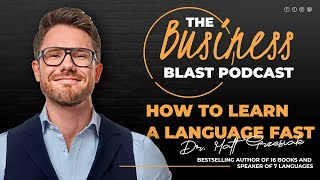
In this episode of the Business Blast Podcast, host Tyler Wagner interviews Dr. Matt Grzesiak, an international trainer, consultant, academic lecturer, and polyglot. Dr. Matt shares a memorable personal story about meeting his wife through a communication exercise, emphasizing the importance of treating everyone with respect because you never know their future significance. He then discusses his core philosophy that a better future requires healing the past—addressing unresolved childhood issues, inner‑child work, and forgiving rather than forgetting. Dr. Matt outlines his "four pillars" of business success: marketing, management, finance, and soft‑skill/psychology competencies, and stresses learning from more knowledgeable people. He offers advice to his younger self: focus on the big picture, ignore naysayers, and have learned Chinese and Arabic earlier. The conversation moves to language acquisition, where he explains psycholinguistic principles—prioritizing high‑frequency vocabulary (500‑800 words), learning useful phrases, and speaking early rather than over‑studying grammar. He defines happiness as a triangle of authentic relationships, self‑congruence, and competence in a skill. Dr. Matt recommends the book Toxic Parents for emotional catharsis and shares his favorite Einstein quote about great spirits confronting mediocre minds, linking it to the need for rebels who challenge blind conformity. Finally, he provides his website (drmattofficial.com) and social media handles for listeners to connect with him.
Chapters
All right everybody, welcome back to another episode of the Business Blast podcast. I'm your host Tyler Wagner. Today I have Dr. Matt with us. He is an international trainer and consultant, academic lecturer with a PhD degree in management, master degrees in law and psychology, and fluent in 7 languages. I'm still trying to figure out English. He's got 7. Unbelievable. And author, and he's also an author, gets better. He's an author of scientific publications and 16 bestselling books. So welcome to the show, man.
Thank you, Tyler. Thank you for having me here.
Of course, man. Grateful to have you here. Very excited for this one. So the first question we ask on this show is, what is the best story from your life that has an underlying valuable message?
Well, There's many stories I could tell you, but the first that came to mind is connected with how I met my wife. So it was March 2008, and I was walking down the streets in Mexico City just after a course full of communication techniques, because this is what I was doing at that time. I was teaching a group of Mexicans how to use communication skills in everyday life. And there's this guy, his name is Edgar, and he says, 'Could we basically use this technique to— use these techniques to get to know a person you see in the street just like that?' And I go, 'Of course you could.' And he says, 'Well, well, could I do that to meet a girl that I am truly attracted to?' And I say, 'Yeah, sure. I mean, it's psychology, right? You can use it wherever you want.' And he says, 'Perfect. Can you make a demonstration?' And then I was like, 'What do you mean by that?' Right? And he says, 'The there is this girl passing by and I would like you to talk to her. So for the sake of it, I think I was in this educational mode. I treated it as a, you know, simply an exercise. So I talked to this girl that he pointed to with his finger, and 10 years later she's still my wife. So this is by far one of the most romantic Hollywood stories one could imagine. But this truly happened to me. And this, this taught me a very valuable story and the lesson that when you meet a person, you never really know how important they're going to be for you in your life. So maybe this person will be your wife, maybe this person will be your husband, maybe this will be your business partner. You can never know who this person will turn out to be in your life. So you should always treat people with respect, with dignity, and always have that in mind. Maybe this is the most important person of my life that I'm talking to right now. So after that situation, I have always had this in my mind, and I always try to do my best to treat people with this respectful attitude, thinking you never know what's gonna happen, so let's just go for it. Maybe this is my another wife sort of story, you know.
Absolutely, dude. That's wild, dude. That's like the coolest story of finding your wife that I've ever heard. That is just Like, what? That's amazing. So yeah, I couldn't agree. Yeah, once that happens to you, you look at everybody a little differently, I'm sure.
Yes, sir.
So the next one I got is, what is the most valuable piece of information we should know that's within your expertise or industry?
Well, there's many things that I do, and honestly, this is probably one of the most difficult questions because I need to select some information, and there's so many aspects that we could focus on. But a general concept would be that if you want to create a better future, you need to deal with your past first. Most people think about, because we all have plans, because we are motivated, and there is this huge culture of success everywhere where we live right now. So everyone wants to get better and make more money and be more successful and look better and so on and so on. But my message and my learning has been that if you want to create a better future, you first need to create a better past. And it usually surprises people because they think that past is something stable, it's not dynamic. Things happens and we cannot come back to it. But it's not the point of what happened in the past, but how you treat it. And there's many demons that all of us have. We usually suppress them. We don't want to come back to what happened before, our relationships with our parents, situations at school, situations with our friends and so on that were not necessarily unpleasant, But one would be very surprised how deeply it is ingrained in our psyche and how it influences who we become later in life. So my recommendation and my very important message would be, if you want to create a better future, you need to look back into your past, clean it, take care of what happened there, talk to your inner child and make sure you're okay with everything that took place so that you forgive, not necessarily forget, but you take feedback and free yourself from what happened before, then the future will really be created rather than being a repetition of the past, which in many circumstances is what unfortunately happens to people. They want to achieve something, but they don't know that there's something holding them back, and it's some parts of their psyche which are still broken and need to be repaired and need to be understood. That's why this is, this is something that I would definitely focus on. Hmm.
Yeah, man, that's huge because I think, you know, I feel like I've heard it so many times, like, forget about the past. So you're saying you actually have to like fix your past, you know what I'm saying, and be okay with it.
Yeah, I totally go along with that because I noticed that what's holding people back from creating a future is past, because for them, in many situations, future is repetition of what happened before. So they are bound to choose the same romantic partners, which and go into relationships which would never work. They are bound to procrastinate and so on because of the things that happened in their past. So I say repair it first and later think about future and then it's gonna be easier. You cannot really forget it. It's deeply inside your brain, right? So you simply need to confront it. Repair it. Repair it and you'll be fine.
Got it, okay. And then what is your best piece of overall business advice? So not necessarily industry-specific.
Well, I would say that you need to constantly, constantly learn from people who are more clever than you are and think about 4 areas and focus on 4 areas. Firstly, you need to do marketing because you need to get your message out there. Secondly, there's management because you need to know how to organize the processes of the group that you are motivating, leading, controlling, verifying progress, planning, and so on. Thirdly, you need to take care of finances. It's always a crucial aspect of any kind of business. And finally, add some soft skills to it, which is broadly understood psychology or social competences, emotional intelligence, communication skills, and so on. So if you have that 4 pillars, then business should be working fine. There's people who are very good in marketing, but they don't understand the relationship mechanics, and then they lose employees. There's people who are very, very good in management, but unfortunately they don't know how to get their message out because they're not so skilled in marketing. So I figure out that Entrepreneurship and business is all about these 4 aspects, and once you master them, you will definitely be better off. And you should always remember to learn from better people. You don't need to reinvent the wheel. Probably someone has already done it, maybe not in the same field but in some other, what you want to achieve. So once you meet the person, talk to them, convince them to teach you, become a modest student, then you will, uh, after a certain amount of time, get where you want to get.
Got it. And then if you could give your younger self one piece of advice, what would that be?
Well, I would tell myself to focus on the bigger picture, uh, and definitely not worry about what others are going to say. And it's actually shared because we always say we should only focus on what we think and what the nearest and dearest are saying and forget about naysayers and haters. But it's easier said than done, right? I see how I was worried about what others were going to say, how I was going to be judged, how people from Facebook that I didn't even know about would react if I was gonna get a thumb up or maybe some criticism. So this took my energy away. This was toxic attitude towards living because you're basically trying to sell yourself as a green dollar banknote, but you're not. You're yourself and you'll never be loved by everyone else there is. So if I had known that, and I say known that kinesthetically inside my body rather than know it cognitively, I would have accelerated faster. Definitely I would have given myself advice to learn Chinese and Arabic also. I'm doing Chinese right now, I'm getting better at it, and if I had known it 10 years ago, I would have entered Chinese market faster, and it's the biggest market there is right now. So I can see how, because I focused on other languages, I focused on Spanish, I focused on Portuguese, I focused on German. I was successful in these countries, but Arabic language and Chinese language, whoo, that would have been a totally different adventure when it comes to scale and size, Tyler. So this is my advice to myself.
Dude, it's still unbelievable that you're able to learn. Do you have, um, Do you have like any tips on that? Like, how are you learning all these languages? I feel like that's hard.
Well, see, it's all about the dynamics of how the language operates. It's— and you need to understand what you're learning. There's a discipline which is called psycholinguistics, which teaches you how to learn a language. To give you an example, Spanish has probably around 2,000-3,000 words that people use in 90% of situations. But overall it has more than 100,000 words. But it's nonsensical to learn 100,000 words if statistically they're irrelevant. I mean, like the word beehive in English. I mean, statistically you're not using that word even if you know it, right? So you need to firstly know what to learn and master around 500-800 words, vocabulary items that are constantly repeated in everyday life situations. Once you get that, you will understand and be understood in around 80% of situations. And this is already enough to control the current of the river, right? Then you are not supposed to learn grammar. You're supposed to learn the phrases which are useful in a very practical context, which would be, for example, transportation or health or emotions, social interactions, food, restaurants. This is what we do when we travel. This is what we do when we talk to people. We usually express our emotions and we need to know how to do that rather than think about contamination of air in Cambodia in the 1970s because nobody cares, nobody talks about that. Definitely we should firstly talk and later try to understand. This is how children learn. See, this is interesting that we adults firstly want to master the language without speaking it because we don't want to make a mistake. I mean, if child was thinking this way that they don't want to make a mistake when they learn walking, they would never basically start walking. So we need to speak, speak, speak, and once we do that, then we will be corrected. So we shouldn't worry so much about mistakes, and definitely understand that the language we learn and pick up at school is something totally different than the language we use in our everyday communication, because school is teaching us to pass examinations. That's how they assess our knowledge, they grade it. But in reality, you will never be graded by someone you talk to if you're a nice, pleasant, open-minded person, but your grammar is incorrect. I mean, nobody's going to marry you. I use this example, and it's really funny. Imagine there's this guy walking down the street and he sees a beautiful girl and he thinks, oh boy, I would like to approach her, but what if she doesn't decline the verbs properly, right? What if she makes a mistake? People don't care about that, Tyler. People really don't worry about that. And it's way easier than one could actually think because firstly, the list of vocabulary items is relatively short. Secondly, most of them, if you learn the language from the family that you already know, is quite similar. Example would be Spanish, right? Motivación, producción, acción. This is production, motivation, action. This is Basically the same thing. You just need to see that once you Spanish your English a little bit, then you can master the language. It's a different story with Chinese though, but mostly the languages people want to learn come from the same linguistic families, which means they are basically very, very similar.
Dude, that was the best answer ever. Yes, I feel like really confident now going to like learn another language. So that's like That's good.
Perfect.
So my next one, I'm excited for your answer on this because you said psychology, which I think is related. So in your opinion, what is the key to happiness?
Well, it's probably— you could dwell on that question in different philosophies, religions, and all kinds of systems because everybody seems to have an answer. But you said in my opinion, so the first thing I would say is authentic relationships. Authentic, I mean, when, where you would be loved and where you will love someone, where you can be truly yourself. That's the second factor, which means you say and do what you think and feel. It means being yourself. Otherwise, people go, they go into a certain personas, they put on a social mask, which is of course necessary to function in everyday public life. But we need to have someone in the background whom we can really and honestly connect with. So that's what I would say: authentic relationships, being congruent with yourself, right? And being competent in something, which means being successful, no matter what it is. If it's public speaking, if it's running an amazing show like yours, or writing a book, or being an athlete, just be good at something because this will basically pump up your self-esteem. This will make you feel good about yourself. This will make you stronger. So once you have that triangle of authentic relationship, being yourself, and, uh, being competent in something, then I, at least from my experience, think you will be a happy person.
And then what is— so I'm sure you've read a ton of books. So what is the best book that you've read, and what's the number one thing you learned from it?
Oh boy, this is probably the most hard question, right, that I could ever get considering how many books I've read. So basically what I did, I was scanning my mind thinking, so what's the most important thing? And there's so many that came to mind, psychological books, even the Bible cropped up, right, and so on. But the one that has been stuck in my mind is Toxic Parents. By Susan Forward and Craig Buck. This is an amazing book that in its times was very, very important because it opens up the passage to all children who would basically right now be adults to talk about toxic situations from their childhood and free themselves from, and the title says it's all toxic parents. So it's very cultural that we idealize our parents, that we say we should love them, we should worship them, As a matter of fact, these are just regular people, just like everyone else, with their pros and cons, advantages and disadvantages. But many people feel pressure to love their parents, to accept the way they are, to forgive. And sometimes, simply, parents made mistakes. So once you understand that, that your parents are just regular folks, maybe sometimes very eloquent and intelligent and sometimes not really, then you can free yourself as even an adult child from them and this way stop repeating the mistakes that you would have to repeat if you didn't really cut this umbilical cord, metaphorically speaking, right? So that book was very, very important for me because it helped me release certain guilt I had and simply see my parents as they are with positive and negative aspects rather than only idealizing them. So it was, I would say, emotional catharsis that I felt after reading this book. Highly recommend it. It's an amazing book.
And if you were, just before I get to the next one, how many books do you think you've read if you were to guess?
I think it goes into thousands, maybe. Yeah, that's sick, dude.
That's so cool. I'm in like a couple hundred right now, but thousands, that's another level.
Well, you know, it's a question, maybe accelerated learning course and then it'll be better, right? Yeah.
The next one is, what's your favorite quote and why?
Okay, this is Einstein's quote, right? Albert Einstein's quote and I love it. Let me quote it. Great spirits have always encountered violent opposition from mediocre minds. The mediocre mind is incapable of understanding the man who refuses to bow blindly to conventional prejudices and chooses instead to express his opinions courageously and honestly. This quote has been a game changer for me, firstly because it freed me from the concept of one day, someday, I will achieve a stage where people will love me, will accept me, will like me, and so on. Then I understood that this is never going to happen, right? And I noticed that the adventure of trying to convince people who don't really take care of you and don't are simply not the persons that you should be trying to convince or you should be trying to impress is a loss of time. So I understand that simply certain people will not be interested in my message, will not want to learn from me, and no matter what I do, no matter how handsome or clever I become, no matter how many PhDs I will have or languages I will speak, simply they will still, for whatever reason, dislike me, hate me, or whatever. So they simply have different minds. So this is also connected, this quote, with understanding that if you really want to achieve something, probably you're going to break certain rules. Probably you will be a rebel, go against the currents, because most people, and we know it from research, do what others do. I mean, 70% of purchase decisions when people go shopping is based on what others will do. So they don't really ask themselves a question, what do I want to buy? They rather go, what did John buy? Oh, John bought that, so I will have the same thing. So I understand that most people simply follow blindly the rules, but certain rules are stupid and they need to be broken. We still live in the world, in reality, where people are abducted, where there's wars, there's political conflicts all the time, The US has never been polarized as much as it is right now. People are discussing and quarreling the way they shouldn't, so I think that we need more rebels, we need more individuals, we need more people who are going to confront stupid rules and say, "Let's change that because we are not supposed to blindly follow them." So that's why this quote inspires me so much.
Good. Thank you. Thank you for coming on. Uh, last one I got for you. Where can our listeners best, uh, connect with you? And like your website, Instagram, whatever it is, where can they best find you?
Sure. Uh, it's Dr. Matt Official, so it's drmattofficial.com. It's a website. It's how they can find me on Instagram or on my Facebook. Uh, there's quite a few hundred thousand people there, so I can always invite with open arms, uh, all other learners and students who are interested in psychology, in self-development, and some profound change that I can offer to the best of my knowledge.
Perfect, man. Thank you again for coming on.
Thank you for having me.
More from Tyler


Catherine Nikkel : THE STORY EVERYONE HAS BUT HASN'T TOLD : The Tyler Wagner Show #1120



Scott Ritzheimer: Bring Predictable Success to your Organization | The Tyler Wagner Show #1115


Fred Moskowitz: A GUIDE TO GETTING STARTED WITH IN MORTGAGE NOTES | The Tyler Wagner Show #1113

Mark Podolsky: From Land Investor to Full Time Success How I Made $90,000 Cash in Real Estate


Mark Podolsky: How to achieve a 300% return on investment my foolproof strategy

Mark Podolsky: How to make passive income selling raw land the irresistible pricing strategy