Drew Neisser: Simplifying B2B Marketing | The Tyler Wagner Show #1021
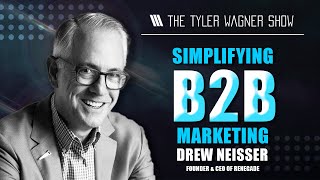
Drew Neisser built Renegade into a B2B agency that survived recessions by simplifying marketing. His CATS framework breaks strategy, ideation, execution, and measurement into one process. He shares how Panasonic named the Toughbook and why branded mugs work better than logos.
Chapters
All right everyone, welcome back to another episode. Today we have Drew Neiser with us, so welcome to the show, man.
Hey, it's really amazing to be here.
Grateful to have you on. So I want to, um, there's a lot we, we can talk about. You have multiple books, uh, your latest one is Renegade Marketing, but Before we get into all that, like, how would you introduce yourself? Can you start us off there?
Sure. So if you're looking at my LinkedIn, I mean, if you were looking at this on Zoom, you would see Drew in parentheses Renegade. And if you're looking at the video, you're going, wait, this guy is 64 years old. How can he call himself a renegade? So I've run an agency called Renegade since founded it in 1993. And I have been an ad guy for my entire career, but I've been an ad guy that never wanted to do ads. So, that was one way that made me a renegade. Another way that made me a renegade is that I've always believed that marketing could actually save the world. And it's just been something that I've thought about a lot and thought about how marketing could actually be a service. And my first book speaks to that a little bit. And my second book really takes it a lot farther. So anyway, renegade, yes. In the B2B world, being a renegade means just don't be boring. But in 4 years ago or so, I identified this issue that I was seeing that was really bothering me, which was B2B marketing had gotten ridiculously complicated. We did research in 2019 and 2020 among like a couple hundred CMOs, said, is it getting a lot more complicated? Yes. Is it getting more effective? No. So linking and looking at those things, we tried to break down what was causing the ineffectiveness. And through that process, we developed our own process for simplifying B2B marketing. And that's where the book came from. There's a little bit of a pivot here in the middle of this thing. I finished the book February 2020. I thought, great, I'm done. But I wasn't quite done. It needed some proofing. I was still getting a story or two. Pandemic hit. And I said, full stop. I gotta make sure, one, that the book is still appropriate and relevant after the pandemic, or at least in it. Number 2, Renegade. I had no idea where Renegade was going to go. And 3, I got an idea for another business because the way I think is every problem is an opportunity. And so, that set up another business. So anyway, as it is, here I am, I'm starting not only— I've got Renegade and the new book, but I've got this new company called CMO Huddles, which is like the sort of, I think, the culmination of a lot of years of effort.
Awesome. Okay, there's a lot to talk about.
There's a lot to unpack there.
I geek out on marketing, so I love marketing. So let's start closer to the beginning. So how long have you been running Renegade for?
So we started as a division of Dentsu in 1993. 3 Japanese people, myself. Our goal was to get some Panasonic business, and my idea was simply Hey, Dentsu, the world doesn't need another advertising agency. As long as you don't care what we do, then we'll go for it. And sure enough, we ended up being Panasonic's guerrilla marketing agency. We built their first website, we created all these cool programs, we named the Toughbook. We were one of their largest vendors up until for 15 years. It was a good run.
Yeah, that's awesome. And so before that, and then I wanna go deeper into that, but before that, what were you doing? Like, say high school, college, did you think you would be doing anything you're doing up to this point?
So, in college, I pretty much narrowed down that I was either going to be in advertising or film. And so, I thought advertising would be the easier one to get into. I was right. And so, about 2.5 years into the advertising business in California, working for a national agency, but in a small town and, you in California. I said, all right, I'm either going to do one of two things. I'm going to go to film school or I'm going to move to New York and really learn the advertising business. So I screwed up both my applications to UCLA and SC, which was a sign to me that it was advertising all in, and moved to New York. I got a job at JWT and really relearned the business and then ended up at Chiat/Day where it was a super creative agency and learned brand strategy and But the funny thing about my career is all the way through it, I was a pain in the ass. And I was a pain in the ass because when I was initially an account guy, I had lots of ideas that didn't have to do with advertising and people weren't really listening because this was in the era of the 30-second ad. When I went to Dentsu initially, it was really just, well, this will be different. It's Japanese. It's got to be different. But I was looking for a way to be in the business but not have to do ads. And ultimately, when Renegade came along, that was it. And I got a chance to buy Renegade from Dentsu in 2008. And so, it's been my company for 13 years.
And then what is the main thing? So, Renegade, how would you describe Renegade? What is the main thing that it does? Yeah.
Well, so we've had about 5 lives. When you have a name like Renegade, the good news is you can pivot. You know, we started in guerrilla marketing and that was great. It was a lot of events and experiential, very cool street team stuff. And giant tours and kind of cool things. But then when the first recession came along, that was the first budget to get cut. So we made a quick pivot to social and content early on. We were a very early social agency and good, that was expected from Renegade. But the thing that happened to me in 2008, I bought the company out We had a client who stiffed us for $500,000 and 70% of our business walked out the door. So that was a crisis mode. And so my way out of that was starting to interview chief marketing officers. That was sort of the brainchild as well. I can make a lot of friends. I don't know if we're gonna get any business, but make a lot of friends. And so since then, I've interviewed over 460 chief marketing officers and that has sort of led us through a very interesting path.
That is so— like, all right, so I just have to relate to that, like, because obviously I do this podcast, I've interviewed almost 2,000 people on this, and like, there's not necessarily a specific niche like CMOs, right? Um, but when people like ask me like how I've gotten to where I am, my best way to describe it is like, it wasn't necessarily planned, but it was like, I've just read— as I've read a lot of books and I've interacted with a lot of people, built a lot of relationships, and and like a lot of data has come through this brain. And inevitably when you do that, it's almost like your brain works it out itself. So I just think people might be consuming the wrong data, you know? So, but if you build 2,000 relationships, that's just podcasts alone, read books, then naturally your brain just starts to notice trends and like you figure stuff out. So with interviewing that many CMOs, My whole point to saying that is like, maybe you didn't think like, oh, this is gonna turn into a business or this will like turn into money, but inevitably all that data has definitely helped you pivot and like, you know, gear your business in specific ways, I would say.
Oh yeah. And I, you know, I had advice to my younger self, it would have been start interviewing early. It's just, you know, I admire you for being able to do it at a younger age. I don't know if I had the, experience or composure or curiosity at the time at your age to do it. But I will tell you that the greatest part about being an interviewer is the learning opportunity. If you're a curious individual, it's just, and you have Vulcan mind melds with these, that's a Star Trek reference for someone. But you really do. And I feel like those case histories that I've heard from all these CMOs become mine. And like that they become things that I can share with a client. And even though we didn't necessarily do that work, it's the understanding and the insight that you gain from it. So yeah, I mean, in truth, I don't know if I would start out a podcast today without any idea of where I was going with it and how it would pay out, but I didn't. I literally had no idea. And after 100 interviews before the podcast, someone said, Drew, there's a book in there. And that's how I got to book number 1, not because I I wanted to write a book, but I didn't really have an idea for a book. It's just someone said, write a book. You got 100 interviews, figure it out. And that's how I got to the CMO's Periodic Table. This next last book that I wrote in the last 4 years, I had a problem to solve. And so, the great thing about that was with 4 years of interviews to support that, I could keep— now the podcast became a source for solving the problem I was trying, getting more information and data. In order to do it. So the podcast and the book worked a lot better than say the first 6 years of interviews that I did, where I was just learning, right? Which is cool. But now the last 4, it's been much more focused. It's been all B2B, it's been on various aspects of B2B so that when we got this book out there, we knew that it, you know, the process worked, that we had a lot of interesting case histories, there was a story to be told. And again, it's like the exact opposite of my first book. My first book says, here are 64 really interesting people who on a specific element, CMO's periodic table, you go figure out how to do the marketing. Like you take the best 8, off you go. This one is, here are the 12 elements, figure it out. And you should be able to figure it out because it is spelled out. Step by step with really fun stories.
Got it. So yeah, let's actually, let's dive into some of the meat of the book. And I, just to echo what you already said, like that's really what it is, is I think I'm just so curious. So I kind of, in a funny way, I view the podcast as like a triple win, right? So it's a win for me because I get to learn. It's my favorite way to learn. And then win for the interviewee, they obviously get in front of a bigger audience And then the audience wins too because they learn from our conversation. So it's just, I think if you think you'd like to do a podcast, you should do it because we're all gonna win if you do.
And I agree. I will say, so a couple of things. So I had done a lot of interviews before I did a podcast. I had to record 30 podcasts before I got to 5 that I liked because I'd been doing them a certain way to come up with a story that could run in a Fast Company or an Ad Age or media post or whatever it is. But a podcast is very different, right? It's a different beast and, you know, you really have to be conversational and I've already talked way too long. So, I'm going to shut up.
No, no, no. This is how I like. So, just I'll go on a little bit more because it might help some people listening is like in my 2,000, around 2,000 interviews, the first 1,000, I actually asked every guest the same question. Okay? And then, what happened is, It took about a year, year and a half to get there. These were very short interviews. And then, I woke up one day and I realized, I was like, I don't like my own podcast anymore. That's what it was. I was like, I'm not having fun because it was so robotic. So then, I maybe kind of like your— how you say your books are like the opposite, not that you didn't like your first book, but my way of viewing it was, okay, let me try the other way, which is longer form, like an hour long, and and just open conversation. I didn't come into this with any set question for you. I just like, I had the background on you, obviously did some research, but like, I just want to let it be what it is going to be. And that to me is more fun. So yeah, I think just like you're saying, pivoting, like try things out and then you'll see kind of where you land.
Yeah, it's funny. I've had 3 approaches with the podcast. I used to do all the research in advance, sort of write up what I thought we were going to talk about and then pray the story would come. But given that my audience is really other CMOs and I know that if they don't get value out of an episode, they're not gonna listen to another one. I now do a half an hour pre-call and in that pre-call, the job is to find the story. And because, you know, have, and you know this, but if you just interviewed the same people every time and let's say you just did marketing books, it's harder and harder and harder like Douglas Burdett. I am up amazed that he can keep doing it and find interesting things in his podcast because he's interviewed hundreds of authors on the same topic. Anyway, I agree with you on this one thing is the people who ask the same questions, while it's easier, it's too predictable.
Yeah.
It's too predictable. And it's too easy as a guest to prepare and give a rote answer. That's why I don't give my guests in advance of the script because when the two times I did that, They were reading their answers.
Yeah, not good.
Not good. No, that doesn't make for a good show. But if you're, you know, if you're really conscious, and this is what I think about the audience, I am sort of start with, okay, what's going to be of value to the CMO who's working out or driving somewhere? We're going to get to a show that they'll have an aha moment. And that's my role in this while the story is unfolding, is to make sure that those aha moments are clear and I punctuate them, right? Just in case they missed it. Because sometimes you can have a conversation and you might miss the big thing. And that's sort of, I think, the role of the host. But it's funny, I am now rejiggering my show again. And the last 2 episodes have all been in the CATS framework, which is what is the framework for my book. And I'm now focused on that.
So can you tell what is the CATS framework?
So the CATS framework is courageous, artful, thoughtful, and scientific. And that actually, after I wrote the first book and I had the 64 elements and podcasters would say, Drew, so what are the traits of a CMO that really matter? You know, what are the— because 64 is way too many. So how do we boil it down? And so we sort of started to think about this CATS, which is again courageous, artful, thoughtful, and scientific. And the more I got into it, the more interviews I did, the more it became true. So for this book, it's literally divided into 4 sections: courageous strategy, artful ideation, thoughtful execution, and scientific method. And the reality is there is no way any CMO can be successful without going through those stages in one form or another. And so courageous strategy basically says less is more, like clear away the clutter and you got to dare to be distinct. If you won't, and here's a factoid that you'll love. We interview these folks in the study I already referenced. We said, how is your product or service different from your competition or distinct? 60% said, yeah, our product or service is distinct. Said, is your marketing distinct? 40% said it was distinct. And I'm like, screaming when I saw those results because that is the job of the marketer. There is always a way to make your brand distinct if you put the energy into it. So courageous, but it takes courage because otherwise you're just like everybody else. You have the same color, you have the same promise because you look at what your competition is doing. You say, I can— it's like in high school where you got to wear the same shirt and the same clothes. We went to an event the other day and it's like 9 out of 10 of the Gen Z boys were wearing not plaid shirts, but, you know, whatever the— anyway, a type of shirt. They were wearing the exact same shirt because that's what those kids at 22, not wanting to stand out, just being a cool kid, was a flannel shirt. Exactly same plan. It was a uniform. You don't want that for your brand. You don't want to be the plaid shirt among the plaid shirts. So that's— anyway, that's courageous strategy. And then we get to these other 3, and I'm happy to go through those, but I'll pause so you can Process.
No, if you can, I'd love to go through those. And then one of the things, um, as I was looking at your book in the book description that stood out, and you said the aha moments. So, uh, I think one of the aha moments I'd love the audience to get is one of your bullet points is to define your company's purpose in 8 words or fewer. Um, so I think that that's could be a quick takeaway, but if you want to finish the CATs first.
No, and I love that, and that's under Chapter 5, Perfect Pithy. And so I'm going to tell you a story which is hilarious and sort of self-aggrandizing in a little bit, but pardon me for this one. So, the best tagline, tagline, not purpose-driven story statement I've ever written in my career was for Family Circle. And it goes like this. First day, first meeting, first 5 minutes, they start talking. And I wrote down 4 words on a pad of paper. And the words were, where family comes first. It's just a great line. It tells the story. It's got the magazine. It has a position. And they were lukewarm to it at first, and they tested it against some other things. And eventually, it was the only one they could trademark. So for 19 years, it was on the spine of the magazine. Literally, it was on the spine of the magazine, "Where family comes first." When they bought that tagline, we said to them, and this is long before Seth, Start with why. Said, you know what? This is a lot more than a tagline. You have a chapter in your magazine called Family. Put that first. Become the family-first organization. Have the best family policy. Do a research program on what it means to be a family. Have a symposium on a global level on family. Own that idea and own the idea of family first. And they said, thanks, great, and continued to do their business the way they did. And by the way, I don't blame them because we weren't engaged to drive purpose for their organization. We were engaged to come up with a short-term promotion. So now cut to, you know, 13— God, that was 18 years ago, more than that. Cut to 2021. The idea of a purpose-driven story statement to make life easy is you get one promise and then you make it real. So case in point, case paper, case history in the book is On the Case, case paper, On the Case. And just to have fun with it, we put on the, on their logo. Wait, what? We messed with their logo. We put on the case, right? So it's literally embedded. There's a little pun. There's a brand that has a sense of humor. Now they have employee programs and awards for what it means to be on the case. They have customer programs and they have outbound, and it all hangs together. And so, everything they've done for the last 4 years is about proving what it means to be on the case, which is reliable, resourceful, and responsive in a humorous way, because they're all about dad humor and dad jokes. So, they're a joker brand. Anyway, the difference between where family comes first and on the case is both are great lines, both are very clever, One is a tagline that existed and the other drove the business. And that's what exciting to me is when you come up with a very simple idea that can hold all your marketing together, life is, you have a chance to build a brand.
100%. No, that's awesome. And I think people, and you're probably the best person to even say this to, like people learn and share, I think the most when it's through some sort of story. Like, that's like in our nature. Um, so I don't know, I think I— whenever I interview someone too, that's one of the questions I typically ask is like, can you tell us like one of your biggest like failures through story and then biggest successes? Because I think it's very spreadable and it's how people learn. So that would be my next question for you, except I already did.
I mean, where Family Comes First was a success that wasn't— I mean, you know, it's— if there's a famous baseball player, uh, who had 61 home runs and they gave him an asterisk, Roger Maris. They didn't count it. They didn't want him to beat Babe Ruth. And I put an asterisk by that tagline because it was a great tagline that could have been. It could have been something. Look, all the stories in the book for the most part are things that worked out.
Oh, okay. That's fine.
And there are a lot of them because I do agree with you that Theory is useless without backed up with actual practical real-world situations. So people remember one of the stories I tell early on, we actually had the opportunity to name the Panasonic Toughbook. We named it, came up with Toughbook. And when you have a name like that, it's like the promise is built in. So how tough is it? Well, when we introduced this at a trade show on live TV, the first model that had been flown over from Japan, we ran a 3-ton Hummer over it.
Oh my God.
On live TV. And you can imagine the engineers were in the back sweating like bullets. And he opens it up and he turns it on and it works. And it was this incredible, hello world, here is Toughbook. And that's the kind of story that I love to tell because it took tremendous courage to take that chance. But And it allowed them to build a brand against one word.
Yeah, no, that's incredible. Yeah. So let's go a little deeper into like the meat of the book. So Renegade Marketing: 12 Steps to Building Unbeatable B2B Brands. So in the, you know, without having to go through like every step, I guess, what would, if somebody reads the book, Right. What would they get out of it? You know, obviously we can tell from the subtitle and title, but also like if you were to pick some or highlight some things that people could learn just from this interview alone, what would those be?
Sure. I mean, the first thing is this CATS model, because you've got to have your strategy in place. Duh. You've got to be thinking about your artful ideation and making sure you're making your brand look and feel and sound different from your primary competitors. Thoughtful execution is the part that I think would surprise people in terms of, I don't look at marketing as a series of messages. I like look at marketing as a series of actions that make your promise real. And I think that's really important to distinguish because a lot of people think about, they put together messaging grids. I've got 9 personas in the C-suite that I've gotta target. And so I'm gonna have a different message for each one. What we think about is, What are the actions? What are the things that you could do, like an ROI calculator for the CFO or a security analysis by a third party for the CISO or this case history that the CEO will be able to use to go to his board of directors, things that really are of value. And so we call that sell as selling through service. And that's the idea. And to me, that's when marketing becomes amazing is when you do things that are literally of real value. And a great example of that is Small Business Saturday. I mean, American Express wanted to give small businesses a way of competing between Black Friday and Cyber Monday. And so in 6 weeks, they came up with this idea and they put it out there. It's lightly branded American Express, but they gave all these tools to small businesses. They told consumers that if you shop at a small business, we'll give you $250 credit on your Amex card. They created ad kits. They did all these things that we would call service. That doesn't sound like marketing, does it? It's brilliant fricking marketing.
Yeah. No, no, I love that. And actually, it's interesting. There was a book I read a couple years ago and it said that one of the best ways to market, and this is what like a marketing department should also look at, is the customer experience itself. Right, so it's like companies have marketing budgets, but they don't have customer experience budgets. And if you do, I mean, talk about a referral mechanism, like that, that would be the way. So it just kind of reframed my mind a little bit of like, it's just, it's not always about just like getting new customers. It is about how can you make the experience of your current customers so outrageous that they share it with all their friends and then you get more clients.
Well, I'm so glad you mentioned that because one of the things that my book does is it flips targeting on its end. So most businesses put 90% of their dollars in acquisition and then a little bit in retention and then almost nothing in employee marketing. And I turn it on its head and say target number one, and don't stop until you've done something meaningful, is employees. And that's first row because If you are actually doing something substantial that you're changing, right? You're changing the way you service. Aetna has a new promise, and Aetna then goes and spends 6 months training their customer agents so that when you call and say, hey, I'm having knee surgery, they know to say, oh, well, when people have knee surgery, they also need PT. Would you like us to give you a list of the PT providers? They just switched your whole experience, right? You thought you were coming to get approval. Instead, you got value add. So employee training and reorienting as part of a new marketing program is huge. Then customers. And here's an interesting thing. It's funny. I'm reading Dan Gingiss's new book called The Experience Maker. And he talks a lot about what you talk about, which is it turns out that companies have what they call customer success departments. You know what those are? Those are upsell departments. Those people are incented to sell more stuff. They're not incented to deliver an NPS score or any kind of just referrals or anything like that. And so you really need a customer experience department or a customer department in B2B because that's one of the chapters of my book, Cultivate Customer Champions. And in B2B, it's a little trickier. But you know you've been successful when you build community, when you have a community of people who will show up, whether it's virtual or in-person, and support and want to be part of it and identify with your brand. They'll wear your stuff and wear that logo with pride, right? That's when you know you have customer champions.
Yeah. I actually rereading them now. I'm rereading, do you know ClickFunnels, Russell Brunson?
I've heard of it.
Yeah, it's like a software company, and he has a trilogy of books, and I'm rereading. And that's one of the things he said is actually they made shirts, right? So people would become a customer, and then they'd send the shirt, and it cost them like $15 each time they'd send the shirt with shipping plus the, you know, everything included. And, uh, something like their, um, department, uh, finance department or whatever came, was like, hey, it's not really worth sending these shirts. Like, our acquisition cost now is is going up because of— and then he's just like, no, like, trust me, it is worth it. And we're gonna continue. And now they've sent out like over 150,000 like shirts to people, and it's like a movement now. And he thinks the shirt is like definitely part of that reason.
So yeah, it's funny, in the book I talk about premiums and the value of it, and I think sometimes some brands overestimate and they put their brand way too prominently Or somebody doesn't want to wear the brand, but they like the gear and they just throw it out. So when, for CMO Huddles, which I haven't talked about yet, but when you become a subscriber, you get this cup. And the cup says, you can read it, it's World's Greatest CMO. It doesn't, this part of the logo is reminiscent of, that's the square that goes around the CMO Huddles logo, but doesn't have CMO Huddle on it. Doesn't need to. You don't always have to put your brand name on it for the premium to remind them of the experience. And I tell a story in the book about that. And that's just one little thing to be thinking about because I know, look, we all get a lot of stuff at a trade show. How much of it do you actually wear? How much of it do— and that, you know, there aren't that many brand names that you want to put on you, but that doesn't mean you didn't want the gear and you didn't want to— you didn't like the company, So there are sometimes ways like I did with a cup to sort of make it reminiscent, helpful, meaningful, something they want to keep and hang on to, but it doesn't have to have your name here.
100%. And actually, so there's a guy on YouTube I watch and he has a thing called Mug Club. And I think the mug is such a genius marketing because I didn't really fully think about it for a while. And I watched his videos for years. And then I thought about it and I was like, Well, that's a normal glass, but you have the mug. So it's almost like in a couple different ways. One way is if it's a really nice— if it's a nice mug that they use often, like literally they are reminded of you on an almost every morning— or let's just say they have other mugs. So like couple times a week. Okay. They're reminded like, okay, that in itself, if that's not worth $10 or whatever it costs you to print and ship that mug, I don't know what the heck is like that is amazing. And then if they're doing an interview and they're sipping, like I'm drinking tea, that's just black mug. But if had, you know, then it would be in the interview and people could see it. So it is a mug, fascinatingly, is one of the best things you can send your clients.
It's hilarious, but you got to be careful about the logo and how you do it and so forth. Yeah, yeah.
There's more to it. Yeah.
Right. And it's funny because I tell a story in the book of a person who I worked with, Carrie Koenig, who sent a warm fuzzy blanket and just a— and it didn't even have her brand name on it.
I love that.
Every winter, you know, it's cold, we're watching TV, we're snuggled with the dog and my wife, we've got a movie going, and we pull this warm thing up and I think of Carrie. Yeah, it doesn't have her name on it.
Yep.
No, that's a renegade. That's part of this thinking is when you do something, so much of the stuff that marketers do is in their own interest and not in the interest of the prospect, and it becomes self-defeating. So a lot of what you find in, in renegade marketing is It's like employees and customers first on everything. So whether if we're looking at content, which is a big part of everybody's plan is, how much are you just talking about yourself and your features and speeds and fees? Because if you are, you're wasting all of our time. Are you advancing the conversation? Are you making me smarter? You're telling me a perspective. Are you showing me research? Are you doing something that is valuable that your CEO would enjoy reading? And so much of this stuff is, quantity, quantity, quantity, crap, crap, crap, crap, crap, and it doesn't get any juice, but I've got a content calendar, I've got to fill.
Uh-uh.
So if you put it through the litmus of I'm proud, I want to show this to my CEO, that's one, and I would have any customer that would read this would get value out of it, that's a high bar, but that's where we are with content. And again, it's the lens of It is a customer-centric, employee-centric perspective. Not a new thought, but it's a little bit new in B2B because it's become so mechanized. You know, 9 personas, 29 channels, 17 DSPs, and we gotta get a different message to each of them. And so it just becomes about moving pieces around and A/B testing on clicks. Not gonna sell a $1,500, you know, $15,000 system because someone clicked on a banner ad.
Yeah, no, 100%. It's a great point. And like, the blanket might be better than the mug. I really like that idea.
Again, it was within her brand and it was consistent with her brand. That was the key part of it. It wasn't just random. I mean, her whole thing was inspire fire. And so, Hey, this is the thing you can use by the fireplace. So there was a connection to the brand.
Got it, got it. Yeah.
And that's part of this.
Buy like a software and then they send you a blanket.
Yeah, no, that does make sense unless we're talking about, you know, if you're an insurance company, it's blanket coverage. If you're—
oh, there you go.
Right, we could do— we can find a way to connect it, but then there's got to be some thread. Bring it through.
You buy a car and they give you a blanket.
Yeah, that's like, uh, the air conditioning does a little Strong. Sorry.
Um, so there's, there's two more things I want to make sure, uh, we, we, we talk about, um, in our time here. So one, uh, one of your— the last bullet point, and then I want to go into CMO Huddle and learn more about that.
Sure.
But it says drive perpetual growth by creating a culture with metrics, marketing technology, and experimentation. So one of the things I think like new marketers And most people, why they never get to, we'll just call it an advanced marketer, is they don't measure things correctly, right? So they'll do a Facebook ad and then they'll get some clicks, maybe some opt-ins, and they're like, oh, but I didn't make money, it's not working, whatever it might be. So what are the, and I know there's a lot of different metrics, I'm sure, but like, what are you measuring and what do you say in the book that could help people?
Right. So with, in B2B, and this is again, because we're building off the things in, in the scientific method chapter, you know, 10 is measure what matters. And so I want to have every marketer have a metric for employees in terms of their overall satisfaction with their job and some other measure in terms of the health of the brand. One measure is pride. Am I proud to work for this organization? Great question. We recommend that every CMO— it costs nothing— field an employee survey day 1 they get the job. Day 1. By the way, we put the entire survey in the book.
Oh, that's awesome. Yeah.
And so, you do that because you can benchmark it because a year from now, what you want to see is I want to see improvement on these measures. And it could be pride. It could be understanding of the value proposition. It could be understanding the message. Whatever it is that you want to measure, that's one easy thing to do that costs nothing. And your employees will thank you because you said, oh, you care about what I think. Wow, you're a cool CMO. Thank you. Thank you, thank you, thank you. The last person never asked their opinion. So that's part 1, employees. Easy to measure, easy to track. And by the way, if you have high turnover and if you want to, that's another way of looking at it is if we can reduce turnover or increase the number of, so recruiting is a big issue right now. You make 6 offers and you only get 1 acceptance rate. If you could get that up 2 or 3, It dramatically changes things. So you could measure that as a measure of, we'll call it employee brand health. Okay. Then we talk about customer health, not just— and I don't dislike net promoter score, it's just useless. And it's useless because it's just a number that doesn't tell you anything relative to— it doesn't tell you how to solve the problem. It doesn't give you— it might give you a point in time, but I think you really have to think about brand health among customers in a very different way. You You can look at it lifetime value, you can look at it on referrals, but real action. Don't tell me you'll recommend the brand. What I care about is the 10 people who do recommend the brand. If you have 10 people, that's real, right? NPS might be real, but it's not real. So you gotta get a real measure there. Then you have the all-important acquisition number, right? Ideally, you do have metrics that help you figure out how much it cost you to acquire a customer, or at least you have how much does it cost you to get someone into pipeline in B2B, right? Someone that is really high-quality lead. Then the last area, and this is something that is missed by, I gotta say, about 70% of B2B brands, brand health. Do we have awareness in the market? Do people know who we are? And the salespeople will tell you because they'll be knocking on the door or sending an email or calling someone and And they won't know who they are. And they go, yeah, that's the 10th person in a row who didn't know the name of the company. So that's hard. It's a hard thing to do. So brand health is really an important area. And in the book, I give you lots of ways of measuring it because I don't care what it is necessarily, as long as you are systematic about it and you get agreement with your CEO and board and CFO. And by the way, all of this is dependent on a head of marketing going to their CFO and saying, I want you to help me work on metrics because I'm gonna ask you to defend my budget. So we're gonna agree on what marketing can and can't do. We're gonna agree on the key areas of measurement. We're gonna develop these things together. I just give a sort of, I give 4 boxes and I give examples, but in even those examples, they're blended numbers. Well, what you put in a blended health metric is sort of up to the business.
Mm-hmm. God, no, that's really helpful. Okay. And then what I want to do kind of with this last question, and I kind of want to leave the floor to you. So, you know, tell us a little bit more about CMO Huddle, like your newest project. I want to learn more about that. And then after that, you know, where people can get the book, website, and all your socials and everything.
You got it. Okay. So at the beginning of the pandemic, this was a moment where I went, Oh, okay. I have no idea whether Renegade will survive this because none of us knew what was going to happen with the shutdown. We didn't know what every client do what they normally do in a recession, which is cut their budget by 50%. Would Renegade have— and we were doing a lot of branding projects, and would that be considered a luxury? I thought probably. So in mid-March, right after the shutdown, uh, I started to think, well, What's the plan? What are we going to do if the shit hits the fan? And I said, well, I don't know, but I'll tell you this, it's going to be as bad or worse for every CMO that I know. Let's just start gathering them. And April 1st, we had what we call a huddle. It was like 7 CMOs. Between April 1st and October 1st, we met 55 times. And along the way, a number of CMOs came on, all B2B, And we talk about the pressing issues of the day. And now by October 1st, it was a real business. It was clear it was going to be a real business. So we set up a subscription business where B2B chief marketing officers get a certain number of things. They get huddles, they get one-on-ones, they get some PR exposure. The whole thing is designed around what do they need to succeed? Can we be a force multiplier and help them find some shortcuts to do their job better, and ultimately make the world better. And so it's been incredibly gratifying. We have about 90 subscribers at this moment. We're beta testing the B2C. We literally had our first beta today for B2C. And it's just the most gratifying work that I've ever done. And it's a culmination of, if you say, gee, Drew, what'd you get out of 460 CMO interviews and 260 podcast episodes? Well, the answer is CMO Huddles. I never saw it coming.
Yeah.
But the payback and the sort of wow, that's for me at least is sort of all this knowledge now to be put forward. So anyway, that's CMO Huddles, cmohuddles.com. In terms of the book, you can find, we have a microsite at renegademarketing.com, funny enough, or you can just go to renegade.com and you can find the book and you can find stuff about the agency and our newsletter and all these other good things that we do to support that. And because you are doing such a great job on this show, I would ask any of them to, anybody listening, hey, send me a note on LinkedIn, Drew and I are on LinkedIn, or send a note back to you. Thank you for, on LinkedIn for what you do. Because I know how much work it is to pull together so many shows. It's amazing.
Thank you so much, man. I appreciate it. And thanks for coming on the show. I personally learned a lot. So thanks for coming on.
My pleasure. Thanks. Good luck.
More from Tyler


Catherine Nikkel : THE STORY EVERYONE HAS BUT HASN'T TOLD : The Tyler Wagner Show #1120



Scott Ritzheimer: Bring Predictable Success to your Organization | The Tyler Wagner Show #1115


Fred Moskowitz: A GUIDE TO GETTING STARTED WITH IN MORTGAGE NOTES | The Tyler Wagner Show #1113

Mark Podolsky: From Land Investor to Full Time Success How I Made $90,000 Cash in Real Estate


Mark Podolsky: How to achieve a 300% return on investment my foolproof strategy

Mark Podolsky: How to make passive income selling raw land the irresistible pricing strategy