Drew Thomas Allen: The Civil Rights Movement In America | The Tyler Wagner Show #1028
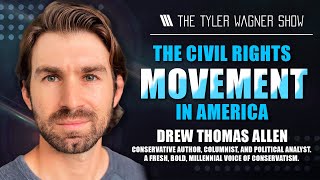
Conservative author Drew Thomas Allen discusses his path from acting and fashion to political commentary, arguing that the Democratic Party manufactures crises to position itself as the solution. He outlines his book Uncommon Sense, which advocates for individual liberty, school choice, and limited government based on founding principles.
Chapters
All right everyone, welcome back to another episode. Uh, today we have Drew Thomas Allen with us, so welcome to the show, man.
Hey Tyler, it's good to be with you. Thanks for having me.
You too, grateful to have you on. So if you can just start us off a little bit more about you and what you do?
Yeah, so I'm a, I'm a conservative author. I'm a political analyst, which may be foreign to some people, you know, it means I talk about politics and the issues of the day. So on radio shows throughout the country, TV, and then I'm a columnist too. So I write a lot of articles that are mostly, you know, viewed in conservative circles out there. And so that's kind of, that's kind of what I do today.
Got it. So with the show, what I like to do is, is kind of start with the origin. So let's just say maybe like middle school, high school, that, that area, like, did you see yourself doing anything that you're doing now, or was your vision, uh, way different?
Yeah, yeah, that cracks me up. I— no, no, if you ask me, if you ask me, I'm 34, right, Tyler? So If you asked me, you know, 14 years ago, absolutely not. 10 years ago, absolutely not. I mean, this kind of just happened. And, you know, in terms of anybody taking anything from my story, even if they don't agree with my politics, what they could take is that, you know, I have a very peculiar life experience here. You know, I was educated in an all-male college prep school in Dallas, Texas, kind of one of these elitist institutions, if you will. And I went on to Pepperdine University and actually had an acting scholarship. So, actually, my focus for many, many years was laser-focused on, I just wanted to be the best actor I could be. Okay? I got that to pay for my school. And then when I graduated from college, I actually moved to New York City because there's a saying in the film and acting world that theater makes you good, TV makes you rich, and film makes you famous. And so I was very focused on being good and I love the craft of acting. So I moved to New York and a year after being there, you know, I had representation and I was auditioning. That's mainly what you do as an actor, working a little bit, but I was doing temp work on the side and I had a temp agent who'd become a friend of mine. And he called me one day out of the blue, Tyler, and he said, hey, I got this rich friend. He'll pay $1,000 a week for you to basically live in his brownstone $6 million house in the West Village. And I was thinking, all right, this is a pretty good gig. I can rehearse my lines in my pre-war apartment with my 6-foot-7 roommate that takes up most of the apartment, or I can live in this $6 million place and rehearse my lines there. So, so long story short, this is just how life works out. So I go to this interview, and we joked later, I was interviewing to be the pool boy. Okay, you can understand the meaning because it was the president of Marc Jacobs at the time, Robert Duffy, who I was interviewing with, and I was interviewing for for the house cleaning job, okay? And long story short, I'm sitting at this table, I don't know, there's 10 people around this table, maybe all personal assistants. I don't know anything about fashion. Abercrombie Fitch was the highlight of my fashion life in the past.
Me too.
You too, so you understand. And so I wasn't nervous, but he asked me to talk about myself and I just said, hey, I speak Italian, which is true, I speak Italian. And so he said, well, would you wanna live there? And I said, yeah, I mean, I'd love to have a house there one day. He said, well, how about next month? And then it just went silent. He looked to an assistant. He said, get Susie on the phone. Somebody dials the phone, hands it to him. And the next thing I know, he's on the phone saying, hey, I've got this adorable kid. He's perfect for the Milan job. We're coming to the office. And so just like that, I got up. Thank God it wasn't like some sex trafficking ring or something like that. But I get up and I go with this guy with his driver. Drive to Spring Street, and I'm signing paperwork to work for Marc Jacobs. Literally a month later, I was in Milan, Italy. I didn't know what my job was going to be. And I ended up being a store manager. Okay. So I opened the first retail store without any retail experience. And, you know, and that's part of what we do in life, right? It's sink or swim. And I was thrust in this situation. You know, I enjoyed it. Ultimately, I ended up coming back to LA and acting again. I ended up getting into screenwriting. I managed a couple of the Marc Jacobs stores along the way. And I started a film production company and produced movies. And so, my career never took shape like I really wanted it to. I was around other very successful people that people would know now who had more success than I did. And I was frustrated at the time. I had a little bit of a victim mentality, I think, for a while, thinking, you know, why isn't this happening for me? You know, I've done everything right. I know that I'm a good actor, but the opportunity hasn't been there. And so, long story short, I was working really diligently on a biopic about my cousin who was a golfer. His name was Byron Nelson. Okay, he won 11 in a row back in 1945. He was a legend of the golf game. And I had had conversations with people and that was my focus. I was so focused on making this movie and things just kept falling apart. And finally, I just realized, look, I'm going to relinquish some control. And just, I'm going to see what happens because maybe I've been so myopic and, you know, I've had such tunnel vision that I can't see what opportunities or what is meant for me. And so 2020 with the elections and things like that, I lost a lot of lifelong friends. I'm not here to be a baby about it, but it's just the reality because I'm a conservative. I've never changed. I've had these friends my whole life and they told me they couldn't respect me anymore. Okay. It's just, that's what happened in the political climate. So I got really active. I had, you know, I'd always been studious, I'd always loved history, I'd always written a lot. And so I put all that energy and everything into writing a book called Uncommon Sense. And then through my writing endeavors, I didn't even pursue this. Someone I knew, knew a publicist, and recommended me to this publicist. And so he had read some of my material, some of the political things that I had been writing, some of the articles. And then we started working together. And then fast forward nearly a year, and I've been doing this for quite a while now, doing radio interviews, TV, writing about these issues, researching this issue, these issues, and then doing my podcast, The Drew Allen Show, to just talk about it more extensively in an hour period. So that's the short, long version, Tyler Wagner.
Yeah, no, that's perfect. That's why— that's what I wanted. So what is like the overarching I guess, theme of what you write and talk about on your podcast? Yeah, let's start there and then we'll get more detailed. Yeah.
Yeah. So I think I try to explain to people— let me preface it this way. I've been a conservative my whole life. But if you think about the things we just talked about, working in fashion, living in Milan, Italy for 2.5 years, working in Hollywood, those are not conservative circles. They're not conservative bastions by any means. I've always been an outsider in that world, but I've also been exposed to the way those individuals think, the way they perceive the world and politics. And so I've had a front row seat to their thought process, where they're coming from. And also I've been forced to debate these people and formulate very, very sound, coherent arguments to make my own case. And so I've kind of taken that experience and, I look at the lens of what's happening in America today, which I don't care if you're a Democrat or Republican, you should be very, very worried. You know, things like inflation, for example, they don't discriminate. It doesn't matter if you have a D or an R by your registration, you're equally screwed. All right. These issues are going to affect everyone. And so what I have tried to do is, one, people misunderstand what conservatism is. They don't understand what I represent. You know, I mean, I joke about being the pool boy for Mark Jacobs. You can imagine that, that I have. And it doesn't matter. I hate to even have to say this, but I've worked around gay people my whole life. I have many close gay friends. I don't care. But people would say, oh, if they don't know me, oh, Drew's conservative, he must be a homophobe. He must be this kind of phobe or that kind of phobe. And so I'm trying to explain to people what conservatism is and to get us back on track to what makes America the greatest nation in the history of the world. It's not accidental. It's not accidental. It's based on values and a particular ideology and philosophy that we've embraced— constitutional rights, unalienable rights, you know, the belief that we have autonomy and independence, individual rights, not collective rights. And so what I've seen is the indoctrination of not only so many of my friends, but so many other people that, especially in our age range— you know, I'm 34— So I just want to get the message out and try and get people having a conversation again, and hopefully just get through to people on certain points, because we're not going to agree on everything. I understand that this is a nation of over 300 million people. But the problem is, we have, we have factionalism right now. So, so nobody can have a rational conversation and look at things about what's best for the country, what are actually solutions to solve it, because You know, if you're a Democrat, you automatically have to believe this way. If you're a Republican, you automatically have to agree this way. And so, you know, it's, I mean, look what's happening with Dave Chappelle or anything like that. I mean, it's insane how polarized we are.
Yeah, I mean, look, when you get to a point where people are literally taking comedic lines and saying that they're wrong or right, that in itself is inaccurate. Like, it's not, a comedic line is not meant to be a yes or a no. It is literally what it is. It's, it's, it's for a laugh. So even just going down that path is crazy to me. But so there's a lot of questions coming up for me. I'm loving this conversation with you. So like, first, um, what I see as being the biggest issue right now is— so I'm like, um, I'm a fan of like Steven Crowder, uh, Ben Shapiro. Like, those are the guys that I watch a lot. And although I like them greatly, and I'd say it's even more from what I see of Shapiro, he's willing to debate others, but I feel a lot of times what's happening on both sides is they, like a lot of the videos you see is they're like making fun of the other side, like how crazy like the left thinks or how crazy they're. And when in reality, I feel the only way to solve this, whatever this whole mess is, is we have to be talking to each other more instead of just being like, okay, that idea is stupid and here's 20 reasons why, and let me make a funny— so I guess having said all that, it's just background. In your mind, or how would you describe conservatism? And then secondly, what do you— how do you see the nature of what I just said and how to maybe solve that issue? Because I just feel like we're fighting back and forth, but we're not sitting at a table together and actually trying to solve things. So that's my piece.
Yeah, yeah. I mean, you know, I try to explain and define conservatism every chance I get, especially on my own podcast as well. And so, you know, I appreciate the opportunity. I mean, conservatism to me is the founding ideology of this country, okay? You know, when George Washington was president of the United States, the first president, we did not have factions. We didn't have political factions. There were not parties. As were developed later on. Everyone's allegiance was to this country. And even George Washington would say— he said in his farewell address, uh, you know, when he took, took the initiative to step down and set the precedent for, for presidents only serving 2 terms, he said, look, you know, yeah, we may have slight differences, you know, between the— and he was talking about regionally at the time, northeast, southwest— but at the end of the day, what unites us is so much stronger. We all have to be patriotic about this country. And look, we're all united by common manners, common culture, common religion at the time. And these things he could not emphasize enough about the well-being and health of the nation going forward. We can't allow ourselves to be divided based on, you know, at that time it was obviously based on where you lived. And so, you know, conservatism is the belief in unalienable rights. It's the belief in a constitutional system, because remember, we are the greatest nation in the history of the world, and we are a revolutionary idea. I mean, prior to 1776, everyone who ever walked on this earth lived under some sort of king, some emperor, some type of ruling elite. And so the idea before the Constitution was written and these brilliant men was that, look, the citizens are slaves and those in government are the masters. And we flipped that on its head and we said, no, we reject that notion. We the people are actually the master. We have independence. And it's actually the government who are the servants. And remember, our founding documents limit the power of what the government can do, not what we can do. Okay. And so, what this unleashes is independence. It gets rid of this idea that we have to depend on the government for everything, this victimhood, this mentality of dependency on something else. That doesn't serve anyone well. I always bring up the Chinese proverb, right? If you give a man a fish, he'll eat for a day. But if you teach a man to fish, he'll eat for a lifetime. What I, as a conservative, want for every person in this country is to learn how to fish. OK, but there are those in politics today who want to give a man a fish time and time again, and the reason is not because they want to be some benefactor. The reason is insidious. It's because they want that person dependent. They want to enslave that person by not teaching them to fish and having them depend on me for their meal. And so we do have this slave state emerging. And what we have today is antithetical to the founding of this country. It rejects everything that's made this nation great. And this is what I try to explain is about what the Democrat Party really represents. And look, I'm not a special pleader for Mitch McConnell and many people in the Republican Party. The problem is there's a new war between Washington, D.C. and the American people. But if I'm going to target one party right now that is all in for authoritarianism and totalitarianism, it is the Democrat Party. It's undeniable at this point. And I study the text of Saul Alinsky's Rules for Radicals. I read it twice a year. But so many Democrats, friends of mine, very good people, have not read those books. You know, they believe this myth that, oh, the conservative is bad, the Republican Party is bad, but the Democrat Party wants what's best for everyone. It's not true. And they express it. They state it explicitly. They're not even hiding it anymore. And so I just want to wake people up. And then you had a second question, and you have to remind me, Tyler Wagner.
No, no, I will. And actually, before we get to that, though, because the question is kind of like, how do we solve it? But I want to hold off on that for a second. Because another question came up as you were talking. And it's like, do you— so I actually watch a lot of Alex Jones too, Infowars. I am a fan. I know he's very controversial, maybe the most controversial guy ever, but like, uh, he's, he's right most of the time. So whether you think he's crazy or not, it's one of those situations, in my opinion, where truth is stranger than fiction. Um, and he just talks about that 3 hours a day, basically is what it is. So regardless, um, do you think that the Democratic Party— and obviously it wouldn't— I don't think it would be the whole party, but people in gov— like, is it evil intent Or do they actually think what they're trying to build is better for the people? And to me, I feel from watching Alex Jones as much as I do, it seems like evil intent. But like, I almost am just like shocked. I'm just like the decisions being made by like Biden and stuff are, in my opinion, so poor that I'm like, you can't actually think that's a good choice. So it must be evil. But I digress. And I'm just curious, like, which one do you think it is, ignorance or evil intent? It's got to be one or the other.
Yeah. For those who are actually making these policy decisions, those who are in positions of authority, it's evil intent. For your average Democrat voter, they're just misguided. They believe the lies that they're told. But, you know, I'll give you a perfect example. If you want to look at what happened in Afghanistan when we left Afghanistan, Statistically, it's impossible that you could make the wrong decision without intentionally doing so every single time. You would think you'd get at least one thing right. I mean, we left over $800, you know, we left billions of dollars behind in arms, right? In terms of our weapons, our aircraft, our guns, ammunition, all of it. So we left that behind, which is stupid. I mean, obviously, logically, if you're going to ex— I mean, you know, a third grader could develop a better strategy. Hey, we're gonna pull out of this country. The Taliban's closing in. Should we like leave the guns behind or should we like get them out before we pull our troops out? I mean, a third grader would say, we should probably get all of our stuff out. You know? [Speaker] It's crazy. [Speaker] And then on top of it, you know, the next thing you would do, of course, logically is any Americans who were left over there, knowing that the Taliban were gonna take over, because we know in the private phone calls, we know he was, We know that Biden knew all of this. The Taliban was gonna come in and they were gonna wipe the, you know, those who were defending Kabul in these areas out. They didn't have a chance, stand a chance. And so, you know, and then so we leave all these Americans behind and then it just gets worse and worse decision by decision. And then we try and secure this airport, except we haven't gotten any of the Americans out. And then we say, well, you know, it's their job to get to the airport, except the Taliban's hunting these people down. And then we have, you know, nearly almost a dozen, you know, Americans who lose their lives in a suicide attack. And then we find out that they actually knew who the suicide bomber was gonna be. And they decided apparently not to take him out and not make the drone strike. But then we go to get revenge and we kill, you know, nearly a dozen innocent Afghans, including 7 children who were putting water in the car, who actually worked for a California aid organization that had nothing to do, but we were lied to and told they were ISIS, K planners, high-level planners. And so we were lied to again. I mean, it is insidious at this point. And who benefits from that situation? Well, China's friendly with the Taliban. Look, we, we cancel pipelines in this, in this country to destroy our energy independence and increase energy prices here while we help Russia get a pipeline. It's absolutely insidious. Everything the government is doing is to bring about the destruction and ruin of America. And embolden our enemies. And look, I say, look, how do you comprehend, for example, if you're going to try and say Ted Bundy, gosh, like, can you comprehend Ted Bundy? Like how or why somebody would do what he did? Or Adolf Hitler? Like, I can't comprehend it as a good, decent, moral human being. But we don't have to understand the why. We never will understand the why, because we aren't wired that way. We just want to build careers. We want to take care of our families. We're not focused on every day, power for myself, subjugating somebody else. We will never understand it. What we do have to do is recognize that it's taking place and stop it.
So, okay, that would lead into like how to solve it. So yeah, I guess that would be my next question that I want to dive into your book. Like, what do you think would be the way to potentially— but see, if they have evil intent, then like that makes it a lot more— then they're not even wanting to have the conversation. So, so yeah, what are your thoughts on that?
Well, this is very, very challenging. I, I think at the end of the day, what I usually say is, you know, if you think back to Ronald Reagan, you know, uh, master communicator, when he won election and then reelection, I mean, he pretty much Let's just say he won all 50 states essentially, right? He lost one state against Walter Mondale. But the point is, he was certainly one of the most popular presidents in American history in terms of the electoral makeup, because he was great at explaining what was wrong, for example, with Jimmy Carter's policies. He was great at articulating why we were suffering, what was the cause, and then articulating what his solutions were and what the benefit was gonna be to the average American citizen. And that's where we've lost ground, is we have not articulated ourselves. We've allowed ourselves to be defined by another party, miss, you know, and it's incorrect, but we've also, I mean, look, do you think John Boehner or Mitch McConnell have ever converted a single Democrat voter to the Republican Party?
Yeah, nah.
Never, never. They make me not wanna be associated with the Republican Party. So, so this is the challenge, you know, and you have people like Rush Limbaugh, who of course is controversial if you get out there and talk to Democrats, but he was extremely effective, right? He was great at simplifying things and explaining them. And so when we have an education system, look, I know people who've raised somebody who's relatively conservative, they go off to college, and they've told me the kid comes home after 1 or 2 semesters, and they're a Marxist. Yep, this is, this is the reality of the situation we face. And we have not fought those battles. We've relinquished those battles, because I think a lot of Republicans, conservatives, we just want to kind of live and let live. But the problem is the other side doesn't want to live and let live. They demand obedience. I mean, look at it with the COVID vaccines and everything else like that. I mean, look, if I sit here and say, I don't care, get the vaccine or don't get the vaccine, That's not good enough. It's no, no, everyone has to agree with me or we have to annihilate you. You know, you make a transgender joke, you're done. We're coming for you. We wanna destroy your life, your career, everything else.
Yeah, it's, yeah, on the vaccine. And well, we'll see if this stays on YouTube now. But the logic behind all that to me, is just fascinating. There is no logic, actually. That's why it's fascinating to me, of like, if I have it and then you don't, then I should be worried because I have it. I don't know, I can't do— the math doesn't really add up there. But no. So, okay, so then you write this book, Uncommon Sense. So what, um, give kind of like an overview, what's the book about in general?
Yeah, so It's inspired by Thomas Paine's book Common Sense, you know, which he wrote in the Revolutionary War days. And my purpose wasn't the same, but, you know, his purpose back then was to change people's opinions to be for the war against England. All right, that was his purpose. And he called it common sense. All these things are common sense, what's happening to us. But my point is, what was once common sense back then in terms of, you know, rebelling against excessive taxation, against tyranny, you know, for freedom, all the constitutional stuff we talk about. Well, that was common sense, but now it's gone. I mean, we've got people that champion censorship, that champion the silencing and destruction of their enemies. If you disagree, we want to get rid of your First Amendment right. We want to come for your Second Amendment right. You know, so my point is what once was common is now uncommon. And so Uncommon Sense is my effort, actually. It's pretty emotional. It's pretty visceral in terms of the writing style. And it's honestly quite desperate because I live in California. And I started writing that book, I think, November or so of 2020. Obviously, the election stuff was going on. California, Gavin Newsom, our emperor here, had decided to lock us down for the 50th time.
Our emperor. That's not even funny, but—
Yeah. And I was ticked off. I was so frustrated and angry, especially when I was sitting here looking at things like, for example, you know, apart from the French Laundry incident, you know, he shut down, he banned outdoor dining at restaurants and they had to go to carryout. But the cities themselves actually shut down whole blocks of street, of a street, and put out outdoor dining tables and encouraged the citizens of the town to get their food to go and seat themselves at unsanitized tables. And I just said, how am I the only one outraged by this? You're going to die if you go and sit outdoors at a restaurant where they can sanitize and do all the crap that you want them to do and force social distancing and force masking between bites, whatever it is. But then you said, how can you as a, as a county then set up outdoor seating with no supervision whatsoever and encourage people to seat themselves out there and eat their food? And so I was driven to madness. And so, so, so, you know, all this stuff combined with all my friends who were Democrats, who basically told me they can't respect me anymore. You know, I just tried to lay it out. I tried to use a lot of analogy and metaphor to get through to people. You know, like we were breaking up the class of citizens early on. Now we're doing it based on vaccination status. But even early on, right, it was about those employees that had jobs that were more important than others. And so, you know, he had these two classes of citizens. And I was saying, this is unbelievable to me. Like, how can you people who still have jobs, you're a doctor, for example, you're still making your $250,000 a year. And you're here championing and telling people that have a bookstore or have a restaurant, like, screw you, shut down. Like, you know, what if that was you out there? Just because you have a job as a doctor, you know, you're considered necessary, and this person's considered unnecessary and thrown out to the street? You know, basically the government invited these people into the castle walls to have dinner in the dining room and feast. But they were on the street once before too. And they're looking down on these people who are starving, impoverished, losing their businesses and smiling. And it's like, can you guys have an ounce of compassion and just think about these individuals and what the ill effects are going to be? So there's a lot of, a lot of commentary like that. You know, I got into history in this country in terms of racism, the civil rights movement, how the Democrat Party has lied and convinced people that they're the champion of Black Americans, even though, for example, they condemn them systemically to poverty because they won't allow them to choose their own schools. They condemn them to the crappy school in the hood that they go to, and they oppose anyone who wants to give them the chance to go to a private school with vouchers or whatever else. And so I try to lay out the argument to get through to people who've just built up this wall in their minds that's, hey, if this is not coming from a Democrat or CNN, I'm not listening.
Yeah, dude. So a couple points there. One is there's actually an interview with Lil Wayne, the rapper, right? And they asked him like, do you— and forget, don't anybody listening, don't quote me exactly on this, but it was something along the lines of like, they asked him like, do you think racism exists in America still or something? And he's like, he basically was like, what is racist? Like, look at me, like, look where I'm at. He's like, No, you can make it as a Black American in this country, like, look, like, I'm richer than most white people. So like, and he literally said something like that. I was like, okay, that's interesting. And did you want to say something on that?
No, I think it's a great point. And it's, you know, those type of comments make me so overjoyed, because we've all been saying this. And it's so true. Only in this country, I mean, to your point, if this country is so racist, you know, the left tries to take what I'm about to say and say, oh, that's just a trope. But if this country is so awful, why do we have 60,000, a caravan of 60,000-plus immigrants trying to come here again?
Yeah, yeah, great point. And actually, just to end the racism thing, in my opinion, like, we had a Black president for 8 years. So I'm like, I don't know what else to say about that. Like, that's pretty much the nail in the coffin for me. And look, I'm not saying that there isn't, like racism exists for sure everywhere, but I don't think it's like a foundation of our country in its current state. So here's one thing I'm curious about because I've experienced some of the same things. You were saying some of your friends, I think you used the word like they were even like offended and they stopped basically wanting to associate with you. Why do you think that was? Like, what was it exactly? Because they knew you were a Republican before, right? So like, what, what was it, Trump? Or like, what was it exactly that made them literally be like, I don't want to be your friend anymore?
Well, it was, it was the news media. That's what we have to talk about. That's, that's how powerful they are as an entity. Uh, I wish that wasn't the case, but it is true. I mean, for 4 years. I mean, look at all the lies. This is what's amazing to me too. We were told Russia collusion, you know, Trump stole the election, even though Hillary Clinton claimed in 2016 that— she still claims the election was stolen from her. And so, you know, these people have no, no moral qualms whatsoever, right? It's just one-sided. But anyway, you know, the Russia collusion, and then we go to quid pro quo and the impeachments, and we're going to get him for this, we're going to get him for that. He's evil, he's racist, he's misogynistic. There was never any evidence to back this up. And in fact, I could point to numerous Democrats who actually do fit that bill. You know, whether it was Ralph Northam, who was seen, you know, previous governor of Virginia, who was seen in either blackface or the KKK attire. I mean, if that had been Donald Trump, I mean, he would have been destroyed. But Ralph Northam gets a pass. But Donald Trump never did any of those things. Donald Trump's never done anything close to as offensive as what Hunter Biden, for example, has done. With the images on his laptop, with the way he's treated women, using the N-word to his lawyer in text messages time and time again, he gets a pass. And that's not even talking about all the corruption associated with it. And so anyway, unfortunately, the left in terms of their media, which they control— CNN, NBC, MSNBC, Rachel Maddow, Donald, all these people— I mean, for 4 years straight, they ginned up this outrage towards Trump, they convinced a portion of the population. And I had a friend tell me, Trump is Satan. Satan. And so, you know, they believe this stuff. And that's what's astonishing. Very brilliant people, by the way, you know, I have a high level of education. Most of my friends went to Harvard, they went to Stanford, they went to Yale, they went to these elite institutions, which frankly, if you graduate from one of those institutions, you're dumber than if you hadn't gone. That's just my opinion. But not to offend everyone who went to an Ivy League, but you know.
Yeah, yeah. Did Shapiro go to an Ivy League?
He did. You know what I say though about these people, you know? When it comes to like the conservatives and Republicans, you've got people like, yeah, Ben Shapiro, who's Harvard educated. You've got Ted Cruz, right? Who also has a Princeton degree, law school there, I think. You know, we can't fool ourselves into thinking that any amount of credentials will qualify us to be— to get respect from the left. People need to get that out of their minds. You know, it doesn't matter if you go to Harvard as Ben Shapiro, it doesn't mean anything if you're not a Democrat. And so it's important that we don't waste our time trying to seek these credentials. I mean, look at the COVID argument. You've got brilliant doctors who have counterpoints to the vaccine, counterpoints to X, Y, and Z. I mean, look at those doctors that early on, they said that hydroxychloroquine and zinc were effective treatments against COVID. And they got smeared, their videos got shut off of YouTube. And it turns out, of course, they were right all along. But they smeared those doctors and said that they weren't real doctors. That's what they do to people. They attack the credentials and attack your credibility.
Yeah, that's what's fascinating to me about the vaccine in general. It's kind of like one of those things when someone wants you to do something so bad and they keep pushing it so much. It's kind of like, okay, what is your motive here? Like, something's not— like, why do you want me— like, the flu vaccine, the normal one, you don't want me to get that one this bad, or any— even any other one that I've ever heard of, like, even ones that are way more serious. Like, I've never seen something so just, um, like, on the media, just like a craze, like, this is a must, there is no— and now they're putting harder restrictions on travel. I just saw an article like today or yesterday or something on that for people that aren't vaccinated. So here's a question for you though, and this is probably what your book really details about, is to people like me and you, like, I feel a lot of the things we're saying are common sense. And I, I am very— I'm a very curious individual, which is why I do the podcast. And like, that's why I want to talk to someone on the left that like disagrees with everything that we're saying. And so, and I'm sure you've had these conversations. So my question is like, what are, what is their argument? Like, 'cause I don't even get it, you know? And that's the question. Like, I'm like, we're just saying like, look, you should be able to decide yourself what you do. That's kind of what America is based off, like individualism. And you want like the government to tell all of us what to do? Like, is that really what you want? Like, look at history. Like, that's not what you want. So either way, like, what is their argument? Because I don't even know what it is.
Yeah, well, they don't really know what it is either, and I mean that sincerely.
Okay, that makes sense to me then. Okay.
I actually, actually went on a podcast, and I was kind of blindsided because I thought I was coming on with somebody who was kind of friendly. Um, the, the host of the show— I won't mention his name, he's a loser anyway— but, uh, anyway, I go on the show, and, um, we had talked before on the phone about what we're going to talk about And he was very curious that I was not. And I don't care. I'm not vaccinated. Okay. So we have a conversation and, and so we have a friendly conversation. And then I get on the show and he's got some kind of like 20-something-year-old Marxist communist on there with me. And the two of them kind of attacked me together for not being vaccinated. He actually called me anti-intellectual for not being vaccinated. And so I never even had an opportunity to present a case because he would cut me off when I tried to make a point and so on and so forth. But I'll give you the perfect example about how insane this argument is. Firstly, you know, the CDC very quietly in the middle of the night changed the definition of what a vaccine was, right? It used to, you know, create immunization, and now it creates protection against a virus. Those are very, very different terms. You don't get a booster shot for the measles, okay? You don't get a booster shot for smallpox or something like that. That's a vaccine. So I would actually even question how you can call this a vaccine because it doesn't cause immunity. So they've changed the definition. So now they can say, well, it's a vaccine because it creates protection, unless, of course, you're Colin Powell and you are immunocompromised, in which case you can be fully vaccinated and still die from COVID But that's the group that actually really needs protection. It's not me. It's not you, Tyler. It's, it's people who are obese. We know that 78% of the hospitalizations were amongst the obese. And we know that if you're immunocompromised, you're at risk as well. And so Colin Powell, to me, should have been a really big wake-up call for Americans who are all in for this vaccine, because he's actually the person that we want this vaccine to protect. And it couldn't protect him. And, you know, the arguments changed, too. You know, they talked about efficacy rates. They were near 100% many, many months ago. And now they've dropped down, you know, steadily, 90%, 80%, 70%, 60%, 50%. Now you need a booster shot. Okay. And the argument was always this, remember, and this was insane. This was irrational. You don't get a vaccine to protect other people, you get a vaccine to protect yourself. That's always been the understanding of any kind of treatment, any kind of vaccine like that, you protect yourself, not someone else. And so early on, they decided to say that actually getting this vaccine is about protecting someone else, right? But then you get the vaccine and you need someone else to be vaccinated to give you full protection. Except that early on, they said if you got vaccinated, you know, it reduced the symptoms, right? So it didn't protect you, just reduce symptoms. And then we learn out, you can be, learn, you can be fully vaccinated, you can both get the virus and transmit the virus. So why can't we just have a rational conversation about this? The argument early on was it reduces hospitalization in the individual, but what's the difference if you have natural— there's no conversation about natural immunity, for example. There's no conversation about any of these things. It's just, it's just tunnel vision. Everyone has to be vaccinated. But, but why? I can still get COVID. Well, it reduces your chances of being in the hospital. Okay, I don't, I don't understand. Like, the, the goals keep, keep moving. What do you, what are you talking about now? I need a booster shot?
Multiple boosters now, right? Like, that's— I think they're saying now, and even Pfizer came out, I think they want to have you take a pill every day or something. It seems like a big money grab to me. And what it really looks like is kind of like that— I guess it's an analogy or like the, the frog in the boiling water. And it's really crazy. And I feel lucky that I'm in Florida, right? Like, let's just say I like the politics here a little bit better. But to just be like where I'm at and just witnessing this, watching Alex Jones and kind of just looking at it and just watching it progress, like you're saying, like new, new rules, and they just keep inching closer and closer and closer. And I sit here and I'm like, besides having interviews like this, I don't really know what else to do about it. Like, all we can do— and this is what I believe, like, kind of what you said you're doing— is just try to wake people up. And that's what Alex Jones is doing too, Steven Crowder, Shapiro. It's just like trying to just say, hey, look, this is what it seems like to me. Here's the common sense. Take it or leave it, but I hope you take it, you know. I really hope you take it.
Exactly, exactly. Well, Democrats just don't understand, sadly, that The Democrat Party is not designed to solve problems. Their actual future and their livelihoods depend upon creating problems so they can run as the solvers of those problems. So they actually create these crises, and then they step in and present themselves as those uniquely qualified to solve it. You know, for example, why would they oppose school choice or a voucher system in minority communities throughout this country that are forced to go to schools that have terrible illiteracy rates, that actually are going to condemn this minority student to failure? Why would we not come in as a common-sense solution and say, hey, if you're a parent who really wants your kid to get an education, we want you to get out of this community. We don't want to condemn you here forever. We don't want future generations to have to suffer in poverty like this. Your son or daughter can go to a private school. They can go to the school where, you know, the politicians' kids go. You know, that's, to me, seems like a very fair situation, a very fair solution. But the reason they oppose it is because they want a permanent underclass. They want to expand the welfare state. And this is human nature. People need to understand that what we're experiencing in this country today, it's not some kind of soft socialism. It's communism. It's Marxism. That's where we are. And if you listen to the words of this administration, or the real president behind it pulling the strings, which would be Barack Obama and his administration, I'll give you a perfect example. 74 of Barack Obama's White House aides serve as aides to Joe Biden. Murthy, the Surgeon General who is serving in this administration for Biden, well, he was serving in the last 2 years of the Obama administration. Okay? So you actually do see these policymakers that are just taken from the Obama years and planted in the Biden years now. And I just think that they made a miscalculation in 2016. They never comprehended that Trump could ever win. I think that they fully expected Hillary Clinton to win and to kind of finish the job that Barack Obama had started, and it set them back. And so that's why we see them doubling down now, really trying to force this agenda down our throats, because I think they know too, as sad as it is that even 37% of American people apparently support this administration, that's too high for me. Apart from that, you know, the American people are not a communist Marxist majority. It's just not the case. And we're going to see very closely with this, this race in Virginia between— who am I trying to say right now?
I don't know. I wish I could help you there. I don't know.
No, I'll come up with it in a second. It's a big race right now. Glenn Youngkin and whoever's running, whatever. But, but, you know, that race is very, very important. You have Barack Obama stumping out there as well. And I don't know why people don't— I'm a curious guy like you. I don't have all the answers. I just ask questions. Why is Barack Obama so invested in these policies and this agenda? I've never seen a former American president get so involved in politics. Usually, you're supposed to kind of go into the shadows and let your, you know, whoever's in office you know, run the country. That's just kind of how it works. But we've got Barack Obama really moving forward and putting his face on these things. And I think a lot of it is a lack of humility. It's arrogance. He's trying to protect his own agenda and what he's doing. And, and the secondary part is, I think they're afraid that, you know, if Youngkin, for example, wins in this election in Virginia, it's going to hurt their chances of pushing forward and justifying you know, this $3.5 trillion Build Back Better plan and so on and so forth. So they really want to have a victory here so they can come back and act like they have some kind of majority consensus to force this agenda through. And that's why they're fighting so hard now.
So, so a couple of things. I want to share a quick story with you because I think you'll find it somewhat humorous. So I was in Florida. You know, there's a lot of Republican spots. Obviously, I think it's mostly Republican, but Miami is Democratic mostly. So I was actually, I remember the night of the election, I was at a viewing party and there was like hundreds of people there, okay? And like lots of girls there, like a lot of people there and all of them, like it was assumed, right? Like everybody thought Hillary was gonna win, okay? I even thought that too. Like I was just like, I hope Trump wins, but like, it doesn't look good, right? Or whatever. So the night goes on. As soon as it was announced, okay, it went from like shock to— I have never seen more people— they cried. People were bawling their eyes out through the city, just went like dead. Like, it was crazy. I've never seen anything like it. So that was an interesting night. Um, so that's just like a cool house. I've never seen more people cry. It was like a funeral. It was bad.
Yeah.
So that's that. And then, so lastly though, my question is like overall, kind of like solving this in a sense, not just solving it, but like where do you see this going? Like what's your prediction? Like do we end up like full commute? Like do you have a lot of doubts or do you see like a light at the end of this tunnel?
Well, I have to be an optimist on this just because the alternative— I don't know, I'd rather, I'd rather, and I mean this, I'd rather die than live with the alternative. I sincerely mean that. I think that I'm a realist, though. I really am. Things are going to get worse before they get better. We have not hit peak madness or peak suffering. We're not there yet. Inflation is just getting ramped up. Um, and this administration, I mean, Biden's only been in there for less than a year, and so look at the damage that's been done to this country in just 10 months or so. And best case scenario, we win back the House and Senate in 2022, so we've still got a ways to go. And I, I think that my concern is that we have a Republican Party that really doesn't seem invested or willing to fight as a whole. They're playing defense, and I understand they don't have majorities, but that's not an excuse not to bring the message to the American people and try and use this time to do what we're talking about— educating and informing and letting people know what our solutions are and connecting the dots between Democrats and the policies that are actually oppressing the citizens, just like California, right? We've had over 10 years of a one-party state ruled completely by Democrats. You don't have a Republican fingerprint on a single piece of legislation out here, and California is a disaster. It really is. Um, and you can't point to a Republican for that. And so it's about connecting the dots though, right? People who flee here and go to Florida, for example, and they vote for Democrats— I mean, how insane are you? It's Stockholm Syndrome.
I don't get that either, man. Like, we saw so many people from New York come down here. Like, I've lived here 6 years and my— and what's funny, I actually lived in Encinitas for 6 years before this. So, right, San Diego, North County, you're probably familiar. Yeah. And like, I got out before all the madness, so I didn't really see, but it's so crazy to me, like, arguably the most beautiful state, it has just been just shit on. I don't know how else to put it, like, it's terrible. And I've seen all these New Yorkers come down to Miami and I have conversations with them and they are still Democrat. And I'm like, but you just left the Democrat area. It didn't work. And now you're here and this works and you're trying to rebuild the thing that didn't work. Again, no logic. I can't relate to that.
No, it's the definition of insanity. But it's a religion for them. Look, you know, I sit here and I'll criticize Republicans all day long. I'm a conservative, and I believe in this country and the Constitution foremost. If you don't live according to those guidelines, you're in my radar.
Okay.
But Democrats view things differently. They're not really willing to criticize the party so much. I mean, I'll criticize— I mean, I despise George Bush at this point, for example. But do you think there are Democrats out there who will openly say, oh, I despise Barack Obama? No, they still think he's the greatest president in American history. Because they look at it like a religion. And, you know, connecting the dots, for example, I did a TV interview the other day, or a couple interviews, I don't know what one of the issues I was talking about was the supply chain crisis. And that's self-inflicted. The country actually has California and our policies to thank for this disaster. It's not to say that there wouldn't be some issues. I mean, when you shut down an economy and interfere with the free market, You're going to have issues like this because you've interfered and intervened. But this could be solved if we had a state that wasn't Marxist. I'll give you an example. The average salary of the dock worker down there in Long Beach, Los Angeles, California, those ports, $171,000 a year. Okay, to unload these crates and whatnot. Okay, whatever. But they're union jobs. And so they have a limited number of people. We're actually one of the few ports in the country that didn't operate 24/7 because the unions don't want to pay on top of the $171,000 a year annual, you know, salary. And so you can't bring private entities in to add hands and make it more efficient because the unions and laws here prohibit them from coming in unless you're a union worker. So it's all about controlling the union. In addition to this, There is actually a report out there that ranks the efficiency of the ports around the world, and Yokohama, Japan is number 1 in the world. Los Angeles and Long Beach are something like 338 and 334. So third world countries have more efficient ports than California.
Fascinating.
Yeah. And the reason is they won't introduce any kind of automation equipment. Because they don't want to take any jobs away from the union. So of course, it's slow going. We've got regulations on vehicles as well. So you don't have as many vehicles available because, you know, for example, you know, they're going to phase out, you know, carbon-emitting cars by 2035, which don't even exist yet. So no one's buying the infrastructure and buying more vehicles because those will be obsolete, you know, in a number of years when you're looking at this type of investment. And so here's my point, though. I talked to a Democrat the other day here in Napa Valley where I live. And he's like, this is so great. Our governor is actually— he's doing something to solve the problem at the port. He's great. He just passed a piece of legislation. I said, oh, really? Did you read the legislation? No, but I know he's doing something about it. I said, well, what did the legislation say? He said, I don't know, but he's fixing the port. He's doing something. I said, you know what he passed? He established a task force to identify the root cause. It solved nothing. Nothing's gonna happen. You know, and the thing too is like these unions in the Build Back Better plan, that $3.5 trillion monstrosity that has nothing to do with infrastructure. Guess what? So the unions here in California, they actually prohibit buying and using any kind of automation equipment, right? So in the Build Back Better plan, any of the funds that are actually allocated to go to infrastructure at the ports— well, guess what? There's a piece in that Build Back Better bill that says prohibits any funds going towards buying automation equipment at the ports. The unions own this guy.
Wow, that's crazy.
That's how our country works, folks.
Yeah, no, it's— and you know what, as you were talking, what kind of came up for me— have you read 48 Laws of Power? Have you heard of that book? Okay, so, so one of the things that I can't remember what the law is exactly called, but it's basically like if you want to, uh, like kind of build a cult or some sort of like religion, what you do— one way to do it is to just oppose the other side completely. And it seems to me, and I think they're doing a lot of other things, but a lot of people that I know that voted for Biden, and these are friends of mine, and I'm still friends, like, that's what I think is interesting about both sides. If you voted for Biden, I'm actually, I don't agree with the decision, but I'm not gonna be like, you're not my friend anymore. In fact, I wanna almost get closer to you because I would like to have a deeper conversation to understand why, and either way, I would just love to have the conversation. But regardless, their vote wasn't for Biden, it was against Trump. And I think that's what the media and everything created. Their whole religion is just like anything but Trump, and that's all it is. So it's like, okay, well, if Trump's the one running and it's like avoid Trump, well then just, you know, you have to vote for the other. So I don't know, it's interesting. I think that's part of the influence that they're using.
Yeah, and that's a great point. You know, I would just say that what I don't understand yet is I understand that people had the Trump derangement syndrome, it was anybody but Trump. But the Democrats act like they were running Jesus Christ or Mother Teresa as their option. Joe Biden was not a superior alternative to Trump. I mean, Donald Trump, look, I've told people to the Republicans who are like, oh, I can't deal with Trump. I'm like, look, focus on his policies. But if you didn't watch the news and how the news portrayed Trump, you would not arrive at these same conclusions. You know, that Trump's so bad, mean tweets. Yeah, he was a little bit crass and this and that. But you know what he didn't ever do? He never went out like Joe Biden and talked down to the American citizen. He never told them things like, if you want to, if you got a problem with me and you want to come for the government, you're going to need like nuclear weapons and F-15s and tanks. I mean, Comments like this, Trump actually respected the country. And think about it. I mean, he could have shut down these investigations, it would have been lawful for him to do. You know, he really did love this country. And I'll say this about Trump, too. He's lost money since he left office. You can't say the same for any Democrat. Look at Barack Obama, look at Hillary Clinton. Look at even Joe Biden. These people have used this office to become rich, you know, rich beyond any American's imagination. While this imagination—
that looks like Pelosi is like, oh boy, she's really milked it.
She lives down the street from me.
Really? Dude, you should get some stock tips from her. She's pretty good at that.
She's got the nicest paved street in all of Napa Valley. I'm pretty sure it's always pristine. Those tax dollars at work.
Oh my gosh, dude, that's crazy. Um, well, dude, so look, I've really enjoyed this. I want to leave the floor to you. Um, if there's anything we didn't cover, please do, um, uh, please share. And then also let people know book, website, socials, everything. And in the future, you know, when it makes sense, I'd love to have you on again. New book, new articles, whatever it is. I enjoyed the conversation.
Oh, me too. I mean, honestly, it's just— this is really a pleasure for me, you know, here on the left coast. I gotta say, you know, I can talk a lot to you because, uh, I'm starving for any kind of, uh, Instead of talking in my microphone to an invisible audience that I try to feel out there, you know, this is actually a face, you know, that isn't trying to stab me in the back. So that's nice. But no, I, you know, yeah, I write weekly columns and people can, you know, have a website. I think actually the best place, I've got a couple websites, but, you know, drewallen.substack.com, subscribing there is probably the easiest. And then, you know, I do my podcast. I do it once or twice a week. It's The Drew Allen Show. Where I just talk about a lot of these issues like we're talking about today. Um, and then, uh, you know, I post my articles on there as well. And then I, you know, I actually quit posting the radio stuff. I do like, I don't know, some weeks I do 8 to 10 radio interviews a week, and I just, I don't even have time to archive it anymore. You know, if, if you're in Missouri, you know, you hear me for the day and that's it. But I don't know.
That's awesome. Well, thank you again for coming on.
Hey, thanks, Tyler Wagner. Anytime, brother. It's great to be with you.
More from Tyler


Catherine Nikkel : THE STORY EVERYONE HAS BUT HASN'T TOLD : The Tyler Wagner Show #1120



Scott Ritzheimer: Bring Predictable Success to your Organization | The Tyler Wagner Show #1115


Fred Moskowitz: A GUIDE TO GETTING STARTED WITH IN MORTGAGE NOTES | The Tyler Wagner Show #1113

Mark Podolsky: From Land Investor to Full Time Success How I Made $90,000 Cash in Real Estate


Mark Podolsky: How to achieve a 300% return on investment my foolproof strategy

Mark Podolsky: How to make passive income selling raw land the irresistible pricing strategy