Filip Keuppens: Pickle Juice Power | The Authors Unite Show #1001
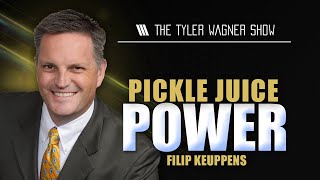
In this episode of The Authors Unite Show, host Tyler Wagner interviews Filip Keuppens, Global Vice President of Pickle Power (also known as Pickle Juice Company). Filip recounts how a casual recommendation led him from a hybrid background in sports and CPG distribution to his current role, describing the company’s evolution from a modest $250k operation to a rapidly scaling business serving NFL training camps, Olympic delegations, and thousands of retail locations. He explains the scientific basis of their flagship product—a proprietary acetic‑acid (vinegar) blend that targets the neurological pathway of muscle cramps, detailing its simple ingredient list (water, salt, vinegar, vitamins/minerals) and the importance of precise formulation. The conversation covers recommended acute dosing (45‑60 min cramp‑blocking window), target users ranging from elite athletes to anyone experiencing nocturnal leg cramps, and the company’s unique grassroots marketing model that relies on unpaid brand ambassadors, event sponsorships, and charitable partnerships rather than paid media. Filip outlines future product extensions into CBD and beetroot‑derived nitrates to boost VO₂ max, while noting current capacity constraints pending the launch of a new facility that will quadruple production. Personal challenges are also discussed, including a devastating ice storm in Texas that destroyed his home, disrupting his routine and prompting reflections on resilience, delayed gratification, and his involvement in coaching rugby and cycling. The interview concludes with details on distribution (≈10,000 stores, direct‑to‑consumer) and where listeners can find more information.
Chapters
¡Hola! All right everyone, welcome back to another episode. Today I have Philip Kupins with us. He is the global vice president of the rapidly expanding Pickle Juice Company. Where they've developed the only product on the market scientifically proven to stop muscle cramps. So welcome to the show.
Thanks, Tyler. It's good to be here. Thanks for having me on.
Of course. Grateful to have you on. As a pickle lover myself, I'm actually very excited about this interview. So first question I really have for you is, um, and I'm going to assume the answer is no, but I'd love to still find out like where the connect happened. So When you were younger, did you ever think you'd be involved in the company Pickle Power? And you can answer that, and then how did you end up getting involved in it would be the next question.
Yeah, man. I mean, obviously everybody grows up wishing they were a professional athlete, fireman, soldier, police officer, or pickle peddler, right? So that was right on the list. So no, so Obviously, that wasn't where I thought I'd end up. My background is kind of a hybrid combination of the sports industry and large CPG distribution. And I sort of, to be completely honest, fell into this role through a casual recommendation of a friend that I ride motorcycles with. And he said, hey, my dad's got this thing going on. We wanna take it to the next level. And I went and checked it out. And the company, while having a really great product, didn't have a very clear go-to-market strategy at the time. So that was about 5 and a half years ago when the company was doing about $250,000 in sales. And we've just been blowing up since because we sort of, So shift to strategies a little bit, reformulated the product. Obviously it's got nothing to do with pickles. Pickle Juice is a trade name, but we changed the product to make it more in line with our target consumer, made it organic, got some lot of testing and certifications done to validate that this wasn't some random snake oil. We did some education-focused strategies that differentiated the product from the pickle brine in the jar, and it's been a pretty wild ride. As a matter of fact, the last few weeks we've just been getting some really cool orders from different NFL training camps, multiple Olympic delegations. So the fact that it's being— that it's now been accepted and being used at the highest levels is a really, really humbling one, and kind of cool too.
Yeah. So what exactly is in it then? Like, or what's that process look like of how you're creating it? I guess without giving away the full secret of it, I guess.
Yeah. So for years we've been led to believe that muscle cramping is a physiological phenomenon, right? So when you talk to 10 people about muscle cramps, you'll get 12 different answers about whether it's caused by dehydration, stretching, you know, some people tell you to eat a banana, some tell you it's electrolytes, but the reality is the root cause of a muscle cramp is neurological in nature rather than physiological. So when we get a cramp, it's actually caused by the brain's response to a physiological trigger, which could be one of any number of things. Essentially, the brain is saying, hey, there's something wrong with that muscle group, let's try to pulsate it and affect sort of like a massage from the inside out. At some point, the ability to— the release signal can't keep up with the engage signal, so you're hyper-engaging the muscle. We use a proprietary grain of acetic acid, which is a fancy word for vinegar blend, that is received by and interpreted by the exact same neural pathway. So the reason we're so transparent about how that works is because the— it's not just any old vinegar. You have to create a very specific range using a very specific formula that no one's been able to replicate. People have tried to reverse engineer our product and have failed in doing so. So we're pretty transparent. I mean, our ingredients are just water, salt, vinegar and vitamins and minerals. That's it. But it's the, the secret is in how the, how the vinegar interacts with the nerve receptors.
Got it. Okay. And actually now I'm on your website and I see the ingredient list now. Um, so how, like, does, who should be taking this? And then how, what is kind of the recommended like dosage? Like, is it, is it somebody who works out a lot and they're taking it like every day or?
Yeah, it's a great question because, you know, we just talked about the neurological component of this product, which means that it doesn't really work like a supplement, right? So it's not like you taking your daily vitamins or whatever else. It's, if you're using it strictly for its muscle cramping properties, you'll take it, you kind of have to work backwards from the cramp. Because from the time you take the product, it'll block those cramping signals for about 45 to 60 minutes depending on severity of the signal, exertion, cause, whatever. So while it sounds weird to predict a cramp, a lot of team-based athletes are kind of know if and when they're going to cramp up, meaning, you know, You know, athlete A knows that in the second half of the game he tends to cramp up. So we would tell that athlete to take it at halftime or keep it on standby and use it acutely when you get the early signals of cramping, that kind of pre-cramp twinging, so that you can block that signal before any sort of physical fatigue or damage, temporary damage is done by the muscle actually going through that microtrauma of cramping. Itself. So you want to take it backwards. We have a lot of people that take it at night that get nocturnal leg cramps. Um, as a matter of fact, about 50% of US society, um, currently or does or has suffered from muscle cramping. So it's a lot more common and not just with athletes.
Okay.
So really it could be just anybody who's having muscle cramps, basically.
Correct.
Okay, got it.
And I guess like, what's your overall— for the marketing side, like, what are you doing to really expand this? Because it does seem to me that— I mean, obviously it could be for anybody that has cramps, but like people that are very into fitness, obviously people that are still in sports, like connecting with like major league sports, that could be a real big way in. And then, you know, once people, kind of like Gatorade, I think, kind of like once people see the major league people do it, then like it could kind of spiral down, you know?
Yeah, so that's exactly what the model is. However, we take kind of a unique approach to it because for us, it's really important that that message be genuine and authentic. So we don't do any paid media or advertising. We rely strictly on word of mouth. We, we, so we have kind of a hybrid model between traditional CPG, mission-based, and, and a grassroots style where we have about 200 brand ambassadors that are very vocal on social media that just love our product and they use our product and scream how well it works from the mountaintops, but none of them are paid. So we work only with in-kind. We also do— we sponsor about 300 to 400 charity sporting events, participatory sporting events a year by donating product for aid stations at charity bike rides, runs, ultra runs, things like that. We've got a partnership going with Spartan, which is pretty cool and a lot of fun as well in the obstacle space. So, and then the traditional CPG is where we focus our distribution on both brick and mortar and direct-to-consumer sales, but we try to keep the price point consistent and competitive so that we're not squeezing out independent retailers And that's kind of, and then obviously our mission-based stuff, we were very actively involved in trying to help bridge gender pay gap in sports and working with charity causes and things like that. You know, we do a lot with the MS Society, American Diabetes Association, and others. So that's kind of how we spread the word. It's a little slower And we obviously have to have the confidence to release a narrative, but we feel that's more genuine and authentic.
Got it. Yeah, no, that makes a lot of sense. And then do you think, like, is it just sticking to this one core product or do you think you'll branch out into making like other products that do maybe similar or like complementary products, I guess I would say?
Yeah, it's a great question. And actually we've got about, We've got a few products that are pretty much ready for the market, but the reality is that we just can't keep up with the capacity because our core line has grown so rapidly that we've had to delay the introduction of some of our other products. But we're planning to get into the CBD space. We're also looking at using nitrates that are found in beetroot to increase VO2 max in athletes. So we consider ourselves not really a pickle juice alone company, if you will, but we really view ourselves as, you know, a functional beverage organization that's rooted in hyper-functionality and science. So we, we really look at a lot of different things that, from the perspective of an ingredient. So that's why we look at CBD. We think that's a really fascinating product that if presented to the market well and professionally can really help a lot of people out. So to answer your question, we are looking at different things and we're really hoping to bring some of this stuff to market as soon as we finish the rollout of our new facility, which is sort of in, the home stretch. We can see the finish line of the new facility being open. And once that's up and rolling and we can get out of some of our, um, inventory constraints that we're facing, then we'll be really excited to launch some new stuff.
Got it.
Got it. Um, and actually, so I know a lot of people in the CBD space. So if you want any introductions just from like an informational standpoint, let me know. But, um, so this is actually cool. I just noticed this on your website too, on the Who We Are. So 2001, and now, and then it goes all the way to 2020. So this has been like a, it's been a long process, man. This is awesome.
Yeah. Yeah. From, from '01 to about '15, it was, it was kind of exploratory. And, you know, I, I don't want to discredit the folks that were working on it back then because they did, they They made some huge leaps and strides and set a strong foundation, but it was really more of like a, it felt a little bit like a side hustle. It wasn't that, but it was very specialized, regionalized. There weren't, there wasn't a national, let alone global distribution network. So really in '15, when, we'd made some strategic shifts and really invested in getting a facility and making our own products and things like that. That's when things really took off.
So what about, I guess, like you and with Pickle Power, like during— what's a typical week look like for you from a work perspective? And then I want to start to dive in a little bit into your personal life.
Yeah, you know, it's like any business, you know, you come in and everything runs super smooth with no problems ever and you're not stressed out and you, you know, just punch the clock. Just kidding. It's the exact opposite of that. Yeah, I mean, it's pretty chaotic at times. You know, we really try to be embrace the mantra that the phrase "that ain't my job" doesn't exist around here, right? So you might be a sales manager one day and packing bottles the next. That's just the nature of rapidly expanding mid-sized businesses. And that makes it exciting. It gives people an opportunity to really showcase their talents and abilities. It allows us to build a culture that's that's real, where, you know, everybody's got a voice and everybody's opinion matters. But in exchange, we don't have that sort of routine, right? Because there's always something new coming up that has to be done, and people are torn and pulled in different directions. But I'm incredibly fortunate that I have some really, really great people working working with me. So that's kind of where it starts. But man, I don't even know how to describe a full day. We usually get to the office sometime between 7 and 8, and we're here until about 5 or 6. And every day is different. It really is. We start the week with our Monday all-hands calls, and that's where we kind of go through the blocking and tackling as well as strategic directional stuff. You know, one day we're working on getting a new certification, the next day we're trying to get into new territory. We've got a sales team that's always pursuing new doors, as we call them, new avenues of distribution. We've got, you know, our marketing folks are working on all of these events and making sure they're covered and getting people there, responding to people on social media. You know, our logistics team is making sure the product is accounted for and going out the door. Our production team is literally trying to set up and launch a new facility that's going to quadruple our manufacturing capacity. So there's a lot going on, which is fun and exciting. Never a dull day.
Mm-hmm. Now, on the personal side, like, do you have a, like, morning routine or anything like that? Or what's that look like?
You know, it's fascinating because I've been reflecting on that because my routine has been pretty significantly disrupted because we had a big ice storm in Texas a few months ago that demolished my house. I'm still not back into the thing. So between— I've been living in hotels and rental homes for a while and it's been really disruptive, which I've noticed has impacted my focus, my mood, and my ability to really perform at a level that my company, the company I work with, and both in structure and people deserve. And it's been something that I'm trying to rectify because I'm not out riding my bikes anymore. I try to stay involved in cycling to stay fit. I coach rugby as well. And it seems like I've been in a very reactive state of mind rather than a proactive planning state of mind. And I don't think that's allowed me to be as switched on or on the ball, if you will, as I'd like to be or as the people I work with deserve me to be. Hmm.
Yeah, no, that makes sense. And I, I'm the same way, man. It's interesting. Like when I, whenever I travel or I'm just like out of my normal environment, I, I still like, I'm, I'm the type, I still get it all done, but it's, it's like harder. And I'm, I'm like very extreme with things. So if I miss like one day of running, then that could turn into like a week. You know, so make sure I don't ever miss now.
Like, I—
even if it's like I'm on it— I was just in France speaking at this event and it was an 8-hour flight to get there. When I landed, last thing I wanted to do was run, but I was like, I already know, man.
Especially with that overnight flight, right? You get there first thing in the morning, you're like— my, my, my Euro jet lag strategy is like try to stay awake as long as I can, don't nap, try to get to evening time.
Yes.
And you're like, you know, yeah, I can imagine. Like, you're like, okay, I'm here. You know, I feel like grungy after that flight. Now I'm going to go run.
Yeah.
It was a tough choice to make, honestly. But yeah, it's something where I think just from, I don't know, I guess you just call it trial and error. Like, It's that thing where it's like, I always know it's like I'm doing it for my future self, like my hour away self, because I know afterward I'll be happy I did it. And if I don't do it, then I'll be happy in that very moment of laying in bed and, you know, passing out or whatever. But like, um, but then later I'll have regret. So it's just like, how, how can I avoid regret? Right. And that's normally what I choose now.
Yeah. It's the analysis of delayed gratification, right? There was a big study involving how people park their cars, and they find that people who practice delayed gratification, meaning doing something, something less desirable now that yields more desirable results at the end, tend to be more intelligent and more structured. And I think there was a study involving what people who back their cars in versus people who don't back their cars in as a very rudimentary way to assess the concept of delayed gratification. So according to that study, you're more intelligent than people who wouldn't have gone for that run. I'll take it.
I'll take whatever I can get. That's awesome.
So are you still like, still to this day? Because I have a lot of friends and tell me if I'm wrong, because I thought, I think you said you were outside of Dallas, but I have a lot of friends that are in Austin. Is this the same ice storm that like wiped out people's power and stuff?
Yeah, like there was— I mean, this was like the whole state. The, um—
oh, okay, it was the whole state.
Yeah, the essentially the grid failed. And yes, okay, um, it was, uh, yeah, it was a big thing. And, um, I didn't even know there was a problem at my house because I was, I was staying in the office on an air mattress because I figured, well, we had power and water and we've got a shower here. So, you know, some of my— a lot of our— the people we work with have kids and families and stuff. And I was like, well, as long as we got power and water here, I'm gonna make sure I'm here and people can come here if they need it to be like a place of sanctuary, if you will. So yeah, I was sleeping on an air mattress. My house was was flooding for about a day before I realized that I had a few burst pipes. It was not a pleasant sight to come home to.
No.
Oh my God, man. Dude, yeah, it's like, I see, I've always, I rent and I've always, I mean, I'm 29 now, so I guess, I don't know, some people buy homes before that, but I've been renting for a while now. And like my parents, they still have the same house that my brother and I grew up in from like 3rd grade onwards. So, a long time. And last time I visited home was like a month ago and the air conditioning unit broke and the bill was like $22,000. And I was like, this is why, you know, there's good things about owning a home, but there's also those things where like when you rent and that stuff happens, it's all, it's on the owner, you know, you're like, dude, you gotta fix this.
Yeah, yeah, well, yeah, we're— I think this one's gonna run us close to $100K.
Yeah, like, I just personally, I don't want— it's not funny at all, I'm just saying, like, I don't want to wake up to a $100K surprise. Like, I prefer not. But again, you know, the other side of it is, like, I live in Miami Beach, and all the prices of, uh, real estate down here have like doubled. So it's like, you know, who cares at the end of the day about a $100K thing if your house equity doubles?
Well, that's just it, right? It's for me, it's— I view it as an investment that I'm using while it's appreciating. So as long as the financial decisions are made solidly and I get that $100K back out of it, it's Yeah, then it's fine, right? As long as I'm paying less than the appreciation of the house, less than I would be laying out for comparable amenities in rental, I'm all right with it.
Now, when are you—
is there a timeline? Like, when are you going to be able to get back in?
I don't know.
I think it's going to be about like they're finally doing construction now and they're finding more issues as they do. It's kind of like, I wish that house had this the, you know, like in a car when you're, when you were younger and you had your first car, if something went wrong, you just turn the radio up. I need to find the house equivalent of that. Like what's, what's the radio for a broken house? Like what can I turn up? But yeah, I think, I think like a month and a half or so we'll be, we'll be back in there. So that'll be cool. And then hopefully get back in the routine, get get my headspace back where it needs to be so I'm not, you know, offering a compromised product to the people that are depending on me to do my part to help this organization run well.
For sure, for sure. So one of the last questions I want to ask you then too, so like in your free time, I'll say, like what do you, what do you enjoy doing? So obviously you said biking and then, you know, work a lot, but Yeah, how do you kind of wind down, I guess?
Yeah, I'm still pretty involved in rugby. I played it for a long time. I guess now I'm going into my 29th year of being involved in the game. So it's been represented, you know, more than 3/4 of my life almost. So That's something I'm still involved with as a coach for the Dallas Rugby Club, which happens to be the largest post-collegiate level team in the country. We're affiliated with a pro team. We've, you know, loaned players to other pro teams. So that's kind of fun. It takes up time, but it's a labor of love kind of thing. I'm also serving on various boards in that capacity and some other capacities. And I used to ride my bikes a lot, but I haven't done that since the ice storm thing. So that's kind of how I'm spending most of my time, really. Got it.
And then is there—
and then feel free, the floor is yours, share anything you'd like.
But is there anything about PicklePower that I didn't ask that you would like to share that we may have missed?
No, I mean, I think we kind of covered it all. It's an exciting time for us. I think, you're going to see us be a lot more available in the market and more aggressive about going into the market, both domestically and internationally, once our new facility is fully up and running. So it's, it's, it's an exciting— it's another really exciting milestone for us that we expect to have complete, you know, by the end of the month. Unfortunately, like probably a full quarter behind schedule because the ice storm affected everybody around Texas. And, you know, when you need plumbers and electricians and everything in the commercial space and people are not able to take showers at their homes, it's, you know, it becomes more difficult to get those folks. And it's crazy because the supply chain for that stuff, like stainless steel pipes and hoses and stuff, it's really difficult to find things that you just took for granted in the past. So unfortunately, that slowed things down. And, you know, we've had to work with a lot of our distributors and vendors and customers, and they've been incredibly supportive and patient with us to work through these, these short-term inventory and supply chain issues. But, you know, we can see the finish line, like I said earlier, and it's going to be really, really exciting second half to the year and going into next year for us. So stoked.
Awesome.
And then where can people, like social media and website?
Yeah, so you can go to picklepower.com. There's actually a store locator at the bottom of the home page there, but you can find us in about 10,000 different retail stores in the country. So everything from Walmart to your local bike shop and running shop and to your local grocery store. I mean, we're, we're pretty broad-reaching anymore. Um, and if any of your listeners go have a favorite bike or running shop that's not carrying it, um, we're always looking for new distribution channels. So hit us up if you're looking for a product and you don't see it where, where you want it. We're always happy to work with additional retailers anytime.
Perfect, man.
Well, thank you again for coming on the show.
I really appreciate it.
Yeah, it was great. I really appreciate you having me.
More from Tyler


Catherine Nikkel : THE STORY EVERYONE HAS BUT HASN'T TOLD : The Tyler Wagner Show #1120



Scott Ritzheimer: Bring Predictable Success to your Organization | The Tyler Wagner Show #1115


Fred Moskowitz: A GUIDE TO GETTING STARTED WITH IN MORTGAGE NOTES | The Tyler Wagner Show #1113

Mark Podolsky: From Land Investor to Full Time Success How I Made $90,000 Cash in Real Estate


Mark Podolsky: How to achieve a 300% return on investment my foolproof strategy

Mark Podolsky: How to make passive income selling raw land the irresistible pricing strategy