Jack Storms: Cold Working Glass Sculpture | The Tyler Wagner Show #1041
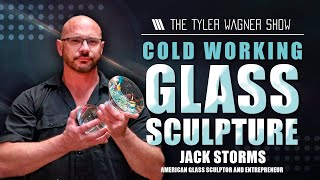
Glass sculptor Jack Storms uses a cold-working technique to grind and polish optically clear glass into diamond-like sculptures without heat. His pieces shift appearance with light and viewing angle, with a typical cube priced around $15,000. He built a custom glass lathe at StormWorks Studio and recently explored NFTs paired with physical work.
Chapters
All right everyone, welcome back to another episode. Today we have Jack Storms with us, so welcome to the show, man.
Hey, how you doing? Thanks for having me.
Of course, man. Uh, so if you can just start us off, uh, tell us a little bit more about you and what you do.
Well, I'm a glass sculptor. I've got a place here in Miami and I've got a studio in LA and I split my time between the difference between the two. And so what I do is I take large blocks of glass, optic crystal, and then I cut them into smaller parts, re— you know, reform them back together, sculpt them as a larger piece. It's called cold working. It's really unique and in the art world because 99.9% of the glass that you see in a gallery, it's all gonna be manipulated with heat. But this is all manipulated cold. So that's a very specific technique that I've had to master over the years. And it's a lot of fun and you get to make stuff that looks like big diamonds.
[Speaker] Okay, wait, that's interesting. So let's dive a little deeper into that. And then I wanna hear about like some of the cool pieces that you've made, but So the difference with this and other— like, I guess, don't they call it blowing glass? Is that—
is that mostly because, um, uh, boys blow glass and men sculpt it?
I knew something was coming there. I really did.
I felt it. Yeah, that, that's my favorite joke, but I like to have a running head start if there's, uh, you know, some good, you know, some strong some big glass blowers in the, uh, in the room.
No, I was just thinking because I actually— I know a girl from my high school, her name's Julia, and I think she actually— I think she works at like a head shop. So she blows glass, but she makes like, like bowls and bongs. Yeah, yes, she— and that's blowing. So, but, um, my reason for even bringing it up though is just to understand like the difference. So is, is blowing glass with heat, or is that also a different method? As well.
Yeah, it's a— there are probably about, you know, there's a dozen techniques on how to manipulate the shape and texture and overall properties of glass. There's— but there's only one way to do it cold, and I do it cold. So with, if you're talking heat, you could put it in a kiln, you could hit it with a torch, you could do what they traditionally call blowing it out of a furnace. Uh, you know, there's some torch stuff. There's, you know, there's a lot of different ways you can manipulate with heat, but there's only one way to really do it, uh, cold.
And how does it— you may have said it, but it was just, um, I didn't understand exactly. So what is the technique, or is it kind of like secret? Like, how do you do it cold?
It's called, uh, it's called a lapidary process. So basically, the way that they, uh, shaped and smoothed stone for Egypt is still what we're doing today to get something flat. So it's called the lapidary process, where you, you get a flat, completely flat surface, and then you grind a piece of glass over it using water and a grit until it mirrors that surface that is flat. Now you got two flat surfaces, right? And so now I've got that flat surface. Now what I do is I smooth out that, that flat surface, and then I go from flat to smooth and from smooth to polish. Once I polish it, I can laminate it to another piece of glass and And depending on the types of glass that I'm working with, you can either see the seam as a mirror or the seam becomes invisible, and then you can start cutting across it. You can start to, you know, implement all kinds of other cuts that you can then, you know, start to manipulate and reshape and put back together.
Interesting.
Okay.
Now, how did you— or maybe when you were younger, maybe this comes from like parents, but what were you doing like before this and how did you get into it?
So, you know, one of my first influences into, you know, wanting to be creative with my hands was hanging around my dad's shop. My dad had a lathe shop, you know, so he just turned all kinds of wood and, you know, make some really cool stuff. And that was fun. So I got a degree in art, minored in art history with a studio emphasis, and I did it in a place called Plymouth State College up in New Hampshire. So I was a little upset with my school because, you know, here I am thinking like, you know, a couple dozen thousand dollars into my education. And, you know, around senior year I was like, hey, do you guys have like a jobs program or, you know, what? They were like, no, no, you are completely on your own. So I, so I, you know, I'm having a panic attack. I've got a degree in art. Minoring art history with a studio emphasis and a nice pat on the back out the door. You know, so I'm like, okay, maybe, you know, I'd better get really serious about, you know, using this degree, you know, in my life, you know, and monetize it. So I started really just doing a lot of research into, you know, where was the money, where was— where were the, you know, because art is— there's no art without money. So where are the resources going? Where, you know, what are the trends? What are the things, you know, where are people collecting? And so I found out from other research that, you know, glass was the medium that was attracting the most attention and had a lot of room to explore, but no one was working with this type of glass that I saw, you know, on the back of a cover. And it just like was a cube that looked like all these diamonds. And I looked up the artist and the artist actually lived right down the road. I actually knew his son, independent of you know, that's crazy.
What a coincidence.
I was like, hey, hey, Dad, that's cool. Uh, does he need help? I'll be right there. And I really was. And so once I touched a piece of glass and I was working it on the stone, and I was like, you know, because there's no— there's no easy-in process. It's just like, okay, this is how you work a piece of glass. And it's, you know, it's, it's a stone— it's a metal wheel that's spinning around with grit and water, and here you are taking a piece of glass that's you know, $40,000, $50,000 in value to a client, and you're like, okay, put it on the wheel and start massaging it over, you know, like, it's, it's pretty nervous. It's a pretty nervous, uh, thing you're embarking on. So, uh, but there's no way around it. You got to get in there, right? Because some of the mistakes you learn are because you knocked off a corner, and because it's so jarring, it's very rare that you make that mistake ever again. Yeah, because it's like, you know what I mean? Like, I mean, how many times— like, if you can imagine, like, you know, cleaning, like, a pistol and you're being really sloppy and the thing, you know, goes off right past your ear, you know? Yeah, it's so shocking, so jarring that you're— you're— unless you got a death wish, you're just never doing that again, right? Because it's just like, you know, it's just like it— like, when you make a mistake like that, it goes like— it reverberates in your You know, right in your gut. Yeah, it's the back of your spine. You're like— so, uh, but even after all that, I knew it was what I was going to do with the rest of my life. And for the next 2 years, I ran the studio, uh, and I tried introducing, you know, concepts that I had learned in school. He, uh, you know, he's a talented artist, but he came from a place where he was, um, a philosophy major. So he'd make something that was shiny and then, you know, give it I'll, you know, want to talk about it. And I wanted to make things that needed, you know, that were visually its own statement, right? You know, they don't— like, there's, there's nothing— it's like, I'm not going to, as an artist, tell you what it means to you because I'm going to blow your brain.
Yeah.
You know, with how beautiful I can make this thing, and then you tell me what it means to you. You know, that's what I wanted to do with my art. So I wanted to incorporate the natural ratio into things, and I wanted to invent a lathe, and I wanted to do all these things. And he just, like, you know, he had an aesthetic and he had a path. And at some point, you know, I just got the urge to really go out there and make my way. So after 2 years, I started my own studio, StormWorks Studio. And the first thing I did is I, you know, made that lathe. So now I can turn bottles, and I can turn beautiful eggs, and I can just create, you know, some really beautiful vase shapes, amphoras. You know, I can get— I can really like play around with the positioning of the pieces that I put on the lathe and come up with some really beautiful abstract pieces. But no one on the planet's doing that. So it's very rare in the art world where where you can say that you are unique. No one does what you do because everybody plays off each other. It's natural, you know. That's why there's three great masters of Impressionism. There's, uh, Monet, Manet, and Cézanne. Well, you know, which guy was knocking the other one off? You know, which, which guy is the real master? And which— like, they're all masters, right? So like, I'm not trying to, you know, say one thing or another about, uh, you know, people playing off each other, but No one else has a lathe. No one else creates those shapes on the planet. Yeah, so that's one thing I'm like really, really proud of. Um, and then incorporating those Fibonacci, uh, those golden ratio, uh, uh, sequencing that you see everywhere in nature and putting that into the artwork. Uh, I was really proud of that because there's no such thing as a straight line in nature, yet as an artist you're trying to make that connection with someone to hopefully depart with their hard-earned, you know, cash and give it to you and trade for this thing that you've worked on. So, you know, you're relying on a connection there, uh, you know, because art is a, is an emotional, uh, experience. And, um, and so, you know, by, by incorporating this natural ratio, it, it actually just draws people right to it. So I've taken I've taken, you know, this, uh, this art where it relies on the straight line, you know, every— everything on the inside has to be a straight line. There's no such thing as straight line in nature, and still create a bridge where you create something that looks like it's naturally created. And it wasn't— it wasn't just somebody, because it's very technical, it's very precise, but it doesn't look like someone pressed a button and it came out of a, a mechanical chicken.
Yeah, like a 3D printer. Yeah, yeah.
I was picturing doing the egg.
What came first, the chicken or the egg?
So for me, that was like a really, you know, those are two, you know, technical achievements that I really came up with that I was, uh, really proud of, and I still enjoy playing with those things today.
God, no, dude, that's awesome. So, um, question for you, because we were talking about NFTs very briefly before. Are you considering, like, is that what you're kind of looking at a little bit, is maybe turning some of these into NFTs, or—
Oh, absolutely. Uh, so, you know, I think the NFT market is under some stress right now, and a lot of the stuff I saw coming, um, you know, in my opinion, you know, it's just me talking, but, you know, you're not really setting up a good, uh, you know, uh, platform when you've got a no-name artist that's that no one knows, that is backed by a bunch of VCs that go and push it and push it and push it and push it and push it, and, and after the greater fool sales theory, um, and then expect there to be a vibrant marketplace, you know. And, and that's what I think we see with Bored Apes. That's what I think we see with, you know, a bunch of this other stuff that, uh, you know, it's just been, uh, too much too fast. And, uh, you know, I've been wanting to get into the NFT space for a long time, but with it being so turbulent and, uh, you know, me being so busy with the studio, I think that I'm in a really good position now because I've really got like only like, you know, I've probably made like 100 NFTs and I haven't promoted them at all. I just kind of keep them, you know, on, on, uh, I got some on Tezos and I got some on uh, on, uh, OpenSea. But what they are is they're so like— they're— as far as like what I've done in the past 5 years, I'd say I'm most proud of this and the jewelry that I came up with in the last 5 years. You know, those two things right there. Because, uh, what happened was I was on— I was doing a live presentation on Facebook. And so what I usually do, Facebook gives me like a 2-hour block where I can put something on a pedestal, line up my camera, and then just walk away and let someone see that there's a live feed going on and they get to see this, you know, picture of a, of a piece turning at a 1-minute, uh, uh, ah, yeah, on a pedestal, yeah, on a rotating base, right? So it's just sitting there and just, you know, enjoy it, you know, relax. So I was getting all that set up and I actually hit the kaleidoscope filter and I was like, oh, I saw it on my screen, everybody saw it on their screen, everybody started freaking out, you know, wondering what the heck they were looking at. I was freaking out, but I killed the feed immediately because I was like, I want to play with this, because it was the most beautiful thing I'd ever seen represented of my art that I'd ever seen on a screen. So in real life, when I take a photo or a picture or any kind of video, um, the eyeball is always supreme because, you know, it's, it's, it's a, you know, there's two orbs, right? So you get like a, you get that, you get a real I mean, by definition you get 3D, right? But when you take a regular picture of a flat picture, that's like the, the palest reflection of what that piece looks like in real life, right? So I'm not used to seeing something on the camera face— I'm on the camera screen— that actually like blows away what I'm looking at in real life. But when I hit that kaleidoscope filter I was just like, it was just like the most beautiful thing I'd ever seen represented of my work on the screen before. And what's really crazy is, um, they sync up to, uh, EMD music. Uh, they, uh, uh, they're— if you, if you just sit there and watch them, there's just no other kaleidoscope out there like it. Yeah, because the material counts, you know. What are you using for material for the kaleidoscope? And I've got one of my pieces, right, for the kaleidoscope.
Yeah.
And then it's reflecting light, it's reflect— it's casting, uh, uh, colored shadow, it's refracting. And all those refractions, those cast colored shadows, those reflections, those are all being pulled into the— to the, uh, kaleidoscope generator. And it's just becoming like this big huge mandala churn of like, you know, they really need epilepsy uh, warnings. I love that stuff. Like, like, did you ever see that, uh, remember when in Japan they had that cartoon that caused epilepsy?
I, I, I don't, but I've heard the story.
I know it's urban myth, right?
Yeah, yeah.
So when I first heard about that contemporaneously, I, I looked for that thing forever because I was like, all right, let's see, let's, let's see the magic. Let's, let's You know, let me see if I can do the stutter step, you know, on the carpet, you know, because of this thing. And, uh, so, um, so I, I, I push the limits of this. And, um, and every single one of these, uh, every single one of these, you know, this NFT content that I've been developing as a kaleidoscope, uh, they're all individual and they're all unique. So they're as unique as— so I've done single pieces and collected them as a kaleidoscope, or I've done a series of like 4 or 5 sculptures that are on that turntable that create a kaleidoscope, and just every single one is absolutely different and just, you know, jaw-droppingly beautiful. And, um, so, you know, but, you know, I think that's the old model. What I'm going to do, I think, now in the future is I'm going to just do those for fun and then start really pairing my NFTs so there's a physical piece backed by it, right? Because I think right now is, you know, I think there are people that are still interested in the platform, still interested in the technology, still interested in the potential of it. But, you know, there's been a lot of scams, there's been a lot of quick easy money. And so, you know, as an established artist that actually has some real intrinsic value behind, you know, what I'm doing, I figured that this is the, the right time to really come in and, uh, and for sure and, and push the— and, and push what I'm doing with the NFTs a little bit more this year. Hopefully.
Yeah, I know, I like that, having the physical thing backed by it. Uh, just curious, if not, no worries, but if it's convenient, do you actually have— I'm not asking you to set up the spinning thing, but do you have like any of your pieces nearby? That you can— yeah, yeah, I think that'd be cool because I'll put this up on YouTube actually so people can see it. And for the audio listeners, you're missing out, so you won't get to see it.
See what we got here. Can I still make—
oh, maybe because it's within—
oh no, they're—
oh no, it's still you.
Yeah, I still— I gotta—
it might be because it's in Zoom. That might be the, uh—
oh, there we go.
Oh wow, that's sick. Oh nice, dude, that's freaking sick. Okay, that's what I'm—
that's what I'm known for right there. That's my My bread and butter right there.
Nice.
That killer.
Yeah, that's awesome.
So when sunlight hits it, it just goes— it was pretty, uh, yeah, that's some damage right there.
Yeah. Oh, that's cool. Yeah, because the way it does that, it's kind of like depending on the angle you look at it, it's a different piece. Right, because it looks different from every way you look at it.
That's why when someone owns one of my— you know, like, look, I don't want to slam anybody else that does, you know, any type of art, but, you know, let's say you're going to take a painting or just a regular standard bronze sculpture, uh, in 20 years, the person that has that, they're still going to be in love with it for the same reasons they went home with it. True. With my work, they're going to have all those elements, all those times of discovery along with the original reason that they went home with the piece. So, you know, what you have is a compounding of a, you know, romantic relationship where you're creating all these moments of discovery where you're like, oh my God, I didn't see that. I mean, you can have the piece for years and change the lighting a little bit, or, you know, go to another room where the sun like hits it across the, you know, its face just slightly differently at a a slightly different angle and you just see, you know, a whole new world open up. And that can happen anytime owning the work. I mean, just look at it.
That is awesome. Yeah, like that angle, like you just see like for what it is, which is nice. It's cool. And then as soon as it like diagonal a little, you see them like shoot through. That's awesome.
And it doesn't—
yeah, honestly, I've never seen anything like it. So that's sick, dude.
Yeah, so as a kaleidoscope, and I'll send you a couple of the kaleidoscope tracks that, you know, the content that I've developed for them, because they're pretty fun. Because, you know, what I'll do is I'll send you the tracks with no music because I don't actually own the music. When I send them out with music, that's just like to demo it, you know, to show that it syncs up.
Dude, that's it. So how much— and we may have talked about it before— how long does one of those take you? Is this like 2 to 3 months for this type of piece, or something?
About 2 to 3 months. But what I'm always doing is I'm always, um, I'm always, uh, you know, doing the preps for the, for the next piece. So, so when I take an order, you know, I'm usually like, you know, I could even be 2 weeks away from some— from finishing a piece that normally would take, you know, 2 months. Because I've, you know, gotten all the prep work done on, on a lot of these, uh, pieces right here.
That is cool. And I'm just like, how much do one of those go for? Like around—
I think this guy's about $15,000.
$15,000? Gotcha. Yeah, makes sense, dude. It's freaking amazing.
Honestly, it's a lifetime, you know, interactive piece of art that it just— like I said, it just never stops It never stops tweaking the eye. It never stops pulling you in. It never stops demanding your attention, you know, no matter what's going on in the world. This thing's always just saying, hey, hey, hey, enough, dude.
No lie, like, and I wasn't— because I had never— I hadn't seen it, right? So when you had said that, like, you did lives and people would just, like, watch, at first I was like, I was like, that seems a little weird, like, people just watch this thing for— but I am— I have been literally looking at this and I'm like I am drawn in for sure.
Hold on one second. Let me see if I can actually like, um, yeah, this is cool too, dude.
This is like the first like truly like interactive podcast I've ever had.
Like, this is pretty cool. Yeah. If you want the real interactive experience, you guys, uh, you want to do the studio tour. I'll walk through the studio, show you, show you guys everything I do.
Dude, I'm that— yeah, I will definitely come to the studio. Are, are you like downtown Miami or like around there? You're obviously—
my gallery that I'm setting up is down there, uh, but, uh, I'm, uh, uh, my studio is like— I'm in LA right now.
Oh, that's LA. Sorry. Okay, I thought you were in Miami right now. Gotcha.
So this is, uh This is the glue room. This is where I put things together. Okay, and working on some Bitcoin love right there.
There we go, the BTC.
You got the orange dichroic for the Bitcoin, right?
Nice.
So this is going to be a pendant.
Got it, got it.
Just like that bad boy.
Nice, that's awesome.
And then, uh, over here we got some, uh, some Bitcoin more theme stuff right going here. But this is a— this is the lead that I put together where what I do is I cut down— they come in sheets that come like this. Yeah, and they'll, you know, they'll be 3 feet, 3 feet long. You cut them down into smaller pieces, grind the top of the bottom, and now that I've ground the top and the bottom What I can do is I can now laminate them together with pieces of glass in between, and then what I'll do is I'll add some color. Got it. All right, once I have it like that, what, uh, what happens is it'll have color in here. So these are all different pieces of glass. So then what I'll do is I'll cut it down this way and open it up. See if I think I have a piece right there. Is there? Oh, there we go. Yeah, so this, this guy right here and this guy right here get turned into this. See, these are the old pieces right here. 1, 2, 3.
Got it.
So, and they're the, uh, the pieces of glass that go in between. And then you can see that I put the color in Right, so now I'm going to make sure when I hold it sideways there's color that way. So now what I'm going to do is take another piece of glass, put it in the middle, and then laminate it together with the color, and then that will give me cubes like this.
Oh nice, okay.
So this has been cut from something like that. Yeah, do you actually have the old pattern right there. See?
Yeah.
Let's pull from there. So, so what I'll do is I, I get a whole bunch of chips, and then once I've got a whole bunch of chips, I'll start to see— this doesn't all come from the same log. These are from 2 different logs right here. And then I've got all these from all these other different logs. So I'm always coming up with new cut patterns, with new, uh, color patterns. These are all new right here. And this right here is going to be one of my new cores.
Nice. Yeah, that stuff's awesome, man. What's on the, on the wall opposite of you, right? I see like designs on the wall. What's that stuff like on the other side? If you, uh, yeah, that, or no, that's just your, that's just your, uh, thing. I thought those were big pieces of glass or something. I was like, that looks sick.
Now what I do is I, uh, I do do a When I get inspired, like, I've got notes all the way around here, you know. I mean, all this stuff is like, you know, formulas and, oh, just all kinds of crazy stuff. So when I, when I get, uh, when I get inspired, I'll start, you know, just drawing wherever the hell I am.
Well, those formulas— so, so college wasn't a complete waste, right?
Not a complete waste. It was, it was up there though, you know, because there was really probably about like 10 classes Oh yeah, I dropped out of college, so I feel like— so this is where I do most of the damage. Uh, this is a casting table, so this is where I, I'll put down a whole bunch of pieces face down on this, uh, casting table, and then, uh, I'll pour— I'll put a ring around them, and then I'll pour plaster in. And what that does is that fixes the pieces flat against here, and then what it does is they get fixed in this plaster right here, right? So now what I can do— I think they turned off all the water on me. Everybody just took off.
Uh, okay.
Water. So now this is a, uh, look, this is a grit table right here.
Oh, this is sick, dude.
And so now it grinds all those faces down all at the same time.
Got it.
And then it goes over here where it does the same thing, just a finer grit. And then it goes over here where it goes to a polish.
Okay.
Right? And then if I have any more polish, then I put them in these guys right here to finish up the little polishing I have. So, uh, this is where I do all my hand shaping, all my hand sculpting, you know, because not everything's flat. There's a lot of, uh, exterior bevels. Uh, same thing there. That's the, that's the, uh, the hand polish. This is that metal wheel that I was talking about that you have to put on those really expensive pieces. And it's, you know, it's, it's freaking metal and it's turning around and it's just grit and water and you're just sitting there, you know, still even to this day, I know that it's not a big deal to put it on there, but I still get a little nervous when I do it. This is where I cut all the pieces apart into smaller pieces. This is an example of some of the bigger glass that we get in. That's about like 85 pounds right there, all that glass. It's, uh, 4 inches thick, 22 inches across, and it was as big as this table as far as its length, but I've been chopping down on it for quite a while. Yeah, slowly but surely getting into smaller pieces. And so, uh, again, this is where we do more, uh, more grinding. We do fine cutting right there. Big black dog walking around all nervous all the time.
That's awesome.
And this is where we grind everything down on the— this is what we call Blanchard grinder. So this face right here is completely flat, you know, with all the circles on it. And then this head comes down and makes this surface flat as well. So, uh, it's called a flat, flat surface. I'll flip it over, uh, once I've got this, uh, factory flattened, and then just trim up the bottom right there. Now I've got two factory surface, uh, faces that are parallel perpendicular. I can cut it down the middle, open them up like a sandwich, go back to grinding them, and now I've got two pieces that when I put them back together again, they're, uh, they're going to be, uh, uniform. So the rip comes right down the middle. This is for a piece that I'm doing called the Crow Mama. So this is only half of it, but this will be— this gets, uh, ground. This gets ground and polished and laminated, uh, up this way. And then there's going to be two more that go this way that make one whole cube. Yeah, that's a big gnarly piece. Got some jewelry pieces right here. Just a couple martinis I'm working on.
Nice. Oh, that's— I like that too. That's cool. Yeah, so dude, that's awesome, man. Yeah, definitely in Miami, that'd be cool to do like a live tour too. Oh, that's—
yeah, and that's just an example of how it never really looks as good as it does in real life, because this thing's popping in real life and it looks like it's just very ho-hum. Yeah, there we go. Now some of the color is coming out. Yeah, we have to keep the right angle on it, but the eye is just so much better at catching up to stuff. So this is a little repair we got going on here, but someone just went oops.
Oh no, somebody dropped it.
Someone dropped it. So comes here to get fixed. And then this is, uh, this is one of the logs that I'm talking about that I, that I'm always working on. But I cut this guy apart, inserted another piece, and laminated it back together again. Now it's 5 inches across, 5 inches, uh, to the top, and then, uh, 10 inches in length. And now I'm going to start cutting it up into smaller pieces and reassembling it. Got it. And then here's some more Bitcoin before it goes together.
Now when somebody— how does that work if somebody breaks it? Do they pay you to fix it, or is it like a lifetime warranty or something?
Oh, they paid me to fix it.
Oh yeah, I would imagine so. Yeah, I think so. Yeah, I would hope so, because what happened—
I work hard enough on them that if I didn't break it, I don't want to— I don't want to pay to fix it, you know.
What's the— what's the story behind that, that it just, just fell off a thing or something?
Or sometimes they hear a story, sometimes they don't hear a story. I, I tend not to ask in case it— because one time I asked, it was a really horrible story, and I was like Um, I didn't mean to do it.
Yeah, I'll stay on. I'll just fix it.
And I'm very sorry, you know what I mean?
I was like, very sorry, it'll be $5,000.
Yeah, yeah. So I just, now I just, uh, if they tell me, it's, uh, I'm always curious, but yeah, yeah, I hear you. Not that curious. Um.
Um, okay, cool, man. So yo, I definitely— we should schedule something for Miami. Um, and, uh, yeah, dude, I pre— that was really cool. I've never done an interview like that where we just like got to see the whole thing. So for the audio listeners, I just want to make sure, definitely go to YouTube to check it out as well, because for the audio, you're definitely not going to get the full experience. Um, and yeah, man, anything else that we didn't cover that you want to share?
I want to leave the floor to you. And then like website, it's like, where can people stay in contact? Uh, everything's pretty much @stormsjack. Um, as far as like my social media tags, on, on Twitter, on Instagram, on, uh, Facebook. Um, and then, uh, jackstorms.com. And then I got a Shopify with my pendants and my jewelry, and they can find me by Jack Storms. Just Jack Storms and you're gonna bump into me.
Okay, cool, man. Thank you again, dude. That was awesome.
I appreciate you coming.
More from Tyler


Catherine Nikkel : THE STORY EVERYONE HAS BUT HASN'T TOLD : The Tyler Wagner Show #1120



Scott Ritzheimer: Bring Predictable Success to your Organization | The Tyler Wagner Show #1115


Fred Moskowitz: A GUIDE TO GETTING STARTED WITH IN MORTGAGE NOTES | The Tyler Wagner Show #1113

Mark Podolsky: From Land Investor to Full Time Success How I Made $90,000 Cash in Real Estate


Mark Podolsky: How to achieve a 300% return on investment my foolproof strategy

Mark Podolsky: How to make passive income selling raw land the irresistible pricing strategy