Jeremi Suri: This Is Democracy | The Tyler Wagner Show #1065
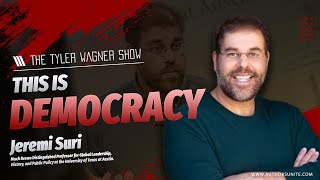
In this extensive interview, host Tyler Wagner talks with historian Jeremi Suri, Mack Brown Distinguished Chair for Leadership in Global Affairs at UT Austin, about his personal journey, scholarly work, and ideas for improving American democracy. Suri describes his immigrant, working‑class upbringing, the role of mentorship and networking in his path from Stanford to a tenure‑track professorship, and his prolific publishing record, especially his latest book Civil War by Other Means. The book argues that the American Civil War’s aftermath created enduring institutional mechanisms—voter‑suppression laws, gerrymandering, campaign‑finance rules, and a racially biased criminal‑justice system—that function as “war by other means” in today’s politics. Suri critiques contemporary voting restrictions rooted in the 1870s, explains how gerrymandering skews representation, and calls for constitutional amendments to protect voting rights. He discusses broader reforms: limiting campaign money, using technology for transparency, instituting a public‑service requirement for citizens, and improving tax‑spending visibility. The conversation also touches on systemic racism in institutions versus individual prejudice, the legacy of drug‑law sentencing disparities, the debate over reparations versus community investment, and the philosophical underpinnings of capitalism versus communism. Throughout, Suri emphasizes historical awareness, civic optimism, and the need for honest dialogue, urging listeners to engage with his upcoming book (Oct 18, 2022) and his podcast This Is Democracy.
Chapters
Alright everyone, welcome back to another episode. Today we have Jeremy Suri with us and he holds the Mack Brown Distinguished Chair for Leadership in Global Affairs at the University of Texas at Austin, where he is a professor in the history department and the LBJ School. He is the author and editor of 11 books, most recently Civil War by Other Means, which you can see in the top right corner if you're watching the video, America's Long and Unfinished Fight for Democracy. He is also the co-host of the podcast, This Is Democracy. So pumped to have you on, man.
It's great to be on with you, Tyler. I'm a big fan of your show.
Thank you, man. So first question, and I kind of normally start interviews this way 'cause I'm always curious, is when you were like younger, did you foresee yourself being where you're at now at all? Or is it completely different than what you had thought I guess, uh, your career would be in life in general?
Well, it is very different from what I thought I would do when I was young because I'm the child of immigrants. I grew up in a very working-class family in New York City, went to public schools, and no one in my family had ever really had a college degree. Certainly no one had a PhD before. So even though education was valued, I need to give my family credit for always valuing education. It wasn't like I had role models of professors or intellectuals, you know, in my family. Uh, I did have a sense though early on that I wanted a career where I would be to be in the world of ideas, because I was always just fascinated. I was always a reader. I was always someone who wanted to learn about other societies, other cultures. But I thought I was going to be a lawyer. And I was fortunate enough to go to some good public schools and then get fellowships to go to a good university and beyond. And I initially thought, you know, I like to talk, I liked ideas, I like to read and write, I should be a lawyer. And then when I was in college, when I was at Stanford, I happened to have some extraordinary history professors. And they became role models for me. In fact, some of them are still close friends of mine to this, to this day. So I was fortunate to have good role models at the college level.
That is awesome.
Yeah.
So to go a little deeper than I'm curious, because you said like you were always like with ideas and stuff. So do you think it's something that like obviously things can be learned, but like, do you think it's more something you're born with? If you go down a path of more like, like, I think some people like to think and other people don't like to think, you know what I mean? So that's like pretty general, but any sense on that? Like, I don't know, I'm just curious.
Yeah, you know, I think, uh, it was in part because of my background. So my father's an immigrant from India, my mother's the child of immigrants from Russia, and ideas were all around me because these were cultures that were clashing in my household. And I saw how important different cultural sensibilities, different ideas about the world were, even if people didn't articulate them. So I think I was exposed to that early on, and my belief is there probably is something hardwired into some people to think one way versus another way. There are some people who are, I think, are hardwired to do things with their hands, and they do amazing things. Think of Michelangelo, right? And then there are people who are hardwired to be writers, you know, the Toni Morrisons of the world, right? So I do think there's some hardwiring, but I also think those initial years, You know, what you're exposed to early on probably shapes your brain in really important ways. And because I was not in an intellectual environment, Tyler, but an environment where ideas clearly mattered, because that was why my family had suffered so much, right? I mean, that, that was something that was front and center in my consciousness.
Got it. Okay, interesting. So then, um, how did— or how did everything play out? So you went to college, and then what— what— where did your career go from there? And then, you know, obviously it came kind of full circle, and then you became professor. So what was in between between there?
So I was fortunate when I was in college, I had some great professors and I went to graduate school, eventually got my PhD from Yale, and I was hired to be a professor actually at the University of Wisconsin. So I was, I was very fortunate. I went right from being an undergraduate to a graduate student to being a professor. And so I never— I loved universities so much I never left them. That's another way of thinking. That's amazing. Thinking about it, most of my graduate students who have become professors usually did something else before. Like, you know, they graduated from college, went and taught in a high school somewhere, did Teach for America, Peace Corps, stuff like that. I didn't, I was the rare person who went straight through, but I found my love in college and desire to do this work. And I was fortunate enough to have, honestly, it's not that I was smarter than other people who didn't take that path. I was fortunate to have people who opened pathways for me. I think mentorship is so important. And as educators, it's our, role to educate people, but as well, it is our role to open doors for them, to be pathway producers for them.
Yeah. And on that, just curious, and maybe there's not a percentage, but I'll ask it in that way because I'm curious. So like, you know, in college, I think you learn a lot, obviously, but also it's relationships that you build. Totally. Or would you maybe say it's both are equally as important, 50/50?
Yeah, I think it's 50/50 because the thing about networking, I mean, there are ways to be crass about it and we've all met people like that. And networking, when it really works, you're learning a lot. I mean, some of the people who I lived with in college who are still friends of mine, even when we were out having fun, even when we were out having beers underage, right? We were talking about— I was learning. One of my best friends, he's still one of my best friends, he came from a relatively rural part of Wisconsin. I came from New York City. Becoming his friend was an education for me on the world. I feel I understand the world differently from those family members of mine who have spent their entire lives in New York City. Because of my friend Dylan.
Yeah, I agree. That's why traveling too— and actually, your, uh, perspective there would show— I mean, traveling, uh, to a place, you can learn a lot. But also, just even becoming friends with somebody that's from Wisconsin and you're from New York City, such different environments, you learn so much from just people. And I think that's one of the biggest things is like, you know, even if the hometown you grew up in or city and you love it and you want to stay there, I think that's great. But travel outside of it so that you can— just so that you can experience and really understand that the whole world is not like your city or your town.
And do the networking. Do the work of meeting people. You know, there are too many of my students now I see, you know, they take a trip somewhere, but they just hang out with people like themselves. You know, you can go— this is what happens now with my students. They travel to Paris and they text all their friends who are in Paris who are also traveling. And they just hang out at a bar in Paris, they might as well be in Austin.
Ah, great point.
Go and meet new people, meet new people, live with new people.
Yeah, no, you're so right, man. I— and you know, when I travel now, I was talking, uh, with somebody else about this recently. It's like, whenever I travel, you know, you start out kind of in the touristy part of a place, but then from there, my first question is always like, okay, where are the locals? Like, that's where I want to go. Like, where are the locals? Let's go off the beaten path and like I was— oh yeah, I was talking about Czech Republic because I went to Prague and like Africa. I did all these when I was younger. I did a travel abroad in college and that was one of the things is in Czech Republic, in Prague, there's like this main kind of center area. There's a guy on a horse statue.
Oh yeah, yeah, yeah, I've been there.
Yeah, yeah, it's like that main area, but then it's Wenceslas Square, I think.
Something nice.
I think that is— yeah, if you walk there like 20 minutes uphill or like to the side, that's where the locals hang out. There's like small bars and stuff.
Totally.
That was the— I mean, look, the touristy spot's cool, but if you go and you like have a couple beers with the locals, that's the real stuff, you know?
That's that. And it, you know, it's actually pretty simple, but you have to get yourself out of your comfort zone. You can't go in a big group also. I mean, so many of my students, when they travel, they travel as, you know, a group of 10 people. You're not going to meet anyone that way. You got to travel in like 2 people, 3 people maximum, right? And as you say, go to a neighborhood off the beaten path. I love it. Find a local kebab stand. Find, you know, find—
dude, I I ate that every night because I remember I was like 19 or 20 when I was over there and like kebab, it was like, uh, it was like a €5 coin or something. And, um, that was all I could afford. So yeah, yeah, there you go. It tastes good.
So you had that just for dinner? I was eating that for breakfast.
No, I, I can only afford one meal a day.
You needed to save your money for beer, right?
Yeah, yeah. Well, yeah, I, I could afford unlimited beers but only one meal. Somehow I found the money for the beer. But so I wanted to— before we dive in more detail to this particular book, like, so you've written and edited 11 books. Can you tell us a little bit more about— so like you've actually authored 11 books yourself and edited them, or tell us?
Yeah. No. So I've— there are 5 books. This is my 5th book that I've written myself. And then the other 6 books are books where I was part of a team and we wrote different chapters. And in some cases, or I guess in those 6 cases, I was the editor who pulled together the chapters, including my own. So for instance, I did an edited volume on the history of diplomacy. How has diplomacy evolved over time? I did a chapter on Henry Kissinger. Other people did chapters on other people. And then I did an introduction and brought it together. But the actual publishing and editor, I don't do that stuff. I have a, the publisher does that.
Gotcha. Gotcha. And just, uh, like who is the publisher or maybe this latest book?
Yeah. So I've used different publishers for this one. It's Public Affairs, which is great. Um, I've had wonderful editors. I've worked with a lot of different trade presses and university presses depending on the book. And that's the advice I'd give, right? Find out what your book is about and then find the press that's correct for your book. There's no one press that publishes everything. And so this book is a book about history and public policy. Public Affairs is a really big publisher that does a lot of good books in this area. And I was lucky that they were willing to take mine on.
So with this current book, Civil War by Other Means, what, uh, Tell us a little bit more from just the title, and then I wanna dive a little bit deeper into what it's about.
Yeah, so there are two elements to the title. One is obviously the word, the phrase civil war, and I don't think we're in a civil war, but I think there are elements of civil war behavior that we're seeing today in our world, and that are not necessarily new to our world. And so that's one element of it, strife, partisanship, division. And then the second part, by other means, really refers, if I were in an academic setting, I'd say to Carl von Clausewitz, this great German theorist of the 19th century who said that war is all politics by other means. And so what we're having here is not politics by other means, we're having war by other means, which is to say it's not that people are out killing each other on battlefields, fortunately not for the most part, though there is some of that happening. It's more that those conflicts have seeped into other forms of behavior. That are more legitimate. That's part of what happens in a courtroom, right? You could see a courtroom as war by other means, right? You have two elements that are coming at, they can't agree. And so they've shown up in this place and they're performing and trying to persuade a judge or a jury of what they think. So the real point of the title, bringing those two things together, is that our democracy has long had elements of deep division and conflict in it. And they show up in some unusual places, not just the normal places we see them.
Got it. And then what, um, I guess I do want to go deeper into this one, but are, are your books kind of all covering like these type of topics, or are some of them completely out of this realm?
Good question. Uh, every one of my books is different. I hope so. I promised myself long ago I wouldn't write the same book multiple times. No people— I know people who have done that, and it's really annoying. I'm not going to do that. And I'm lucky I have tenure, so I can write whatever I want, right? So I, um, every book is different, but of course there are themes, you know. Everyone has their their shtick, as my Russian-Jewish grandmother would say, right? So my shtick is I'm really interested in 3 things. I'm interested in politics. I'm a political junkie. I'm interested in history. So I'm less concerned with following every FiveThirtyEight poll. I'm more interested in the history of politics. How did we get to this president? What did other presidents do? And then I'm interested in how that history and politics coming together can inform the way we think about our world today. So what does it tell us about our world today? And so this book is one version of that, but I did a book on the 1960s that was about that too. I did a book on nation building and how we've thought about nation building, a book on Henry Kissinger. So every book of mine has been politics, history, and then how does that inform today, but different subjects within that larger space.
All right, I love that. Okay, so that opens up a lot. So that actually, the connection with history and politics It's, I mean, it's very logical now that you said it to think like that, but I've never actually really pieced those two together before and like sat with it. So that already has kind of changed. So my next question, I feel like logically would be, so what historically, if you were to name a few highlightable things, led to where we are now, do you think, right? Like that's the next natural question.
So for this book, I have a very, I have a very particular argument about that. I think it's less the actual Civil War. It's what happened after the war in the 10 to 20 years after the war. And my proposition is that the battlefield is only phase one, and you can win the war and still lose the peace. In fact, the winners of wars often lose the peace because they think they've won and they're tired and they want to go home. But the other side doesn't think they lost. Welcome to Iraq, for example, right? And that's part of what happened after our Civil War. So the Union, Lincoln side wins, Slavery ends, and that's significant. That is huge, right? We don't wanna take that away. But there are many elements of the Confederacy that resist the Union and continue to resist by other means, and they prevent the change that we would've expected in a democracy. Biggest example of this is voting. We are a democracy today that inherits the voting laws from the 1870s. In Texas, they were written then. And we are a democracy that has some of the worst voting laws in the world. It is harder to vote in the US than it is in most other democracies. For example, in Germany, you don't have to register to vote. In Germany, you have multiple days in the year you can vote. And this is Germany, right? This is not a bastion of democracy until recently, right? In Texas, where I am right now in Austin, Texas, as of yesterday, if you didn't register to vote, you cannot vote in November. You have to register a month in advance, but I could go right now to a store and buy a gun. So it's easier to get a gun than it is to vote in Texas. Those voting laws, Tyler Wagner Wagner, go back to the 1870s. That's what we're dealing with, right? That's a malformation. Why did that happen? Because those who lost the Civil War in Texas, they had to end slavery, but they still didn't want Black people to vote, and they made it harder for them to vote. Now they make it harder for young people to vote. I have undergraduates, I have 300 undergraduates. I guarantee you it happens every semester. Next week, a whole bunch of them will come to me and say, "Professor Suri, I wanna vote for the first time. I'm 18. How do I register to vote?" I'll say, "Sorry, you can't do it." Isn't that horrible? Isn't that horrible?
Crazy. I didn't know that. So wait a second, but that thing, so as of yesterday, was there any like, I can't imagine there was, was there any like notification to people?
Oh yeah, there's some, and I was notifying people and people, but look, Tyler, I have 300 undergrads, right? Most of them are freshmen. They're 18, 19 years old. Right? Do you know 18, 19-year-olds who do anything a month in advance? Did you do anything a month in advance when you were 18, 19 years old?
Try to stack up as much beer money as I can. Exactly!
It's not their fault, but the law intentionally does that, just as 50 years ago it had all kinds of other requirements. It used to be in this state you had to pass a literacy test, but only certain people had to take the literacy test. Guess who? Right? You had to identify the number of beans, jelly beans in a jar when you showed up to register to vote. My point is back to your great question, right? These are rules that were enabled by our system in the 1870s because the families that were in control of these communities recognized that with the end of slavery, there were new potential voters who would kick them out and they didn't wanna be kicked outta power. No one wants to lose power. So they created institutions that limit access to power in our society and we evolve as a democracy where some people have access to the ballot box and others don't. And the only way we're gonna change that is if we go back and understand that history so we can undo it.
So question, and without, hopefully without looking like I have no clue, but I, that's why I like interviewing people that I don't know the topics that well. So it seems is who, who would not want to, like, why has the law not been changed? Like who doesn't want to change it?
Well, right now, that varies over time. And most of these laws were put in place by Democrats in the 1860s and '70s. Now the Republicans like them. So our governor, Greg Abbott, who's up for reelection running against Beto O'Rourke, I'm sure many people have been following and seeing some of this race, he doesn't want more people to vote because most new voters, you know which way they're voting. His voters are the older voters.
Ah, interesting. I feel like, and I could totally be wrong, I thought that, wasn't it? I feel like when Trump was running, he wanted to make it easier to vote. Maybe I have it completely backwards.
He wanted to make it harder for most people to vote. He did want to make it easier for certain, in some certain communities. I mean, this is, this is not actually an ideological issue though. It's very simple, right? Those who feel more voters are going to go their way want more voters. Those who feel more voters are not going to go their way don't want more. This is just simple power. But we need institutions that aren't captured by that. Our institutions should let everyone vote so that we can do this. There was a discussion of that after the Civil War where my book begins. And the idea was to create an amendment different from the 15th Amendment that we get. And that amendment would've said what our First Amendment says about speech. No one should take away your right to vote once you're 18 or 21, whatever year we wanna give. For that. But there's no such amendment. In fact, the 15th Amendment instead says you cannot deny someone the right to vote based on race, but you can still deny it to them based on all kinds of other things.
Hmm. Okay. So I have a big— I feel like you might have an idea about this, so that's why I want to ask you this. So it's a very big question though. I feel like— so I've had a lot of conversations with people in the political realm and we highlight a lot of the issues, but I'm curious, like, and one of the biggest issues is that, like, in politics, kind of what we're talking about now, is that people do things for their own benefits, right? So, and politics, it's really supposed to be about the people. Like, you're a public— well, I don't know if it's necessarily public servants. I don't know all the right terms and stuff, but regardless, if you're in politics, the hope would be that you're, you know, doing it not selfishly, like you're making decisions for the people. But obviously that is not the case. So is there, well, not, I shouldn't say it's not the case, it's just, it's not always the case. Is there a solute, like how could we set up the political system so that it actually runs the way that it should run? Like, can you—
So yeah, so this is, it's a great question. It is the question our founding fathers asked. This is what James Madison is writing about in Federalist 10, Federalist 51, and elsewhere. And Madison's very clear. He says, if men were angels, we wouldn't need government. But men are not angels. Women are too, but men are particularly greedy. Let's be honest, right? And they will always want to hold on to power. That doesn't matter whether you're on the left or the right. No one wants to give up power. No one wants to give up status. Once you're king of the hill, you don't want to go back down. Once you fly first class, you don't want to go back in the economy class seats, right? You want to go to the back of the bus, right? Now, we've all experienced this, right? So you have to set up a system. That doesn't privilege anyone and forces people not to be able to hold onto power too long, forces them to give it up and creates checks and balances. Checks and balances. You wanna make people do the right thing in pursuit of power. Don't assume they'll do the right thing and give up power. Have them do the right thing in pursuit of power. So what would that mean in our society now? That there actually are some ways we could think about this that are pretty straightforward. If we made elections not about money, If everyone had the same amount of money when they ran, let's say you tomorrow, Tyler, decide to run. You've got a great podcast, you've got this huge following, you decide to run for Congress, right? But you're not a— as far as I know, you're not a millionaire, right? Let's say we had a rule that said everyone gets to spend X amount of money. That would give you a fair chance to run.
Yeah, yeah, I, I like that. I think that would be good.
So we need— we, we have to have enough people who say, you know what, I don't trust the people who are in power to be in power forever. We need to set up a system that doesn't give anyone an advantage. That would be one way to do that. The rich people then don't have an advantage in the election. You've gotta go out and convince people to vote for you, not buy your votes. That's a good incentive structure. Same thing with gerrymandering, right? Gerrymandering is perfected in the period after the Civil War to today, to the point where, you know, the elected officials are choosing who their people are rather than people choosing them, right? But if we got rid of gerrymandering, which we could, Let's say we had a constitutional amendment said no gerrymandering. We're gonna have expert panels that create 51-49 districts. We want every district to be as close to even Ds and Rs. Then let's have a real race, right? And then the person who wins is the one who can convince 5% of the other side to come their way. That would be a much better system. The reason we don't do that, it's not because of Republicans or Democrats, is because you have entrenched power on both sides. That doesn't wanna give up. The people who have been elected under the current system don't wanna change it. Yeah. They collected the money under this system. Why would they change it? We need people, you and I, your listeners. That's why I write this book. It's why I'm here. It's why I do these podcasts, my own podcast, yours. People need to say, no, this is enough. Those who are not in power, I don't mean radicals, I mean ordinary people, and say, we want a system that actually is designed as Madison thought, where no one would have an advantage. Where it's a true competition.
I feel like with tech that could actually be solved. I don't know exactly how it would be, but because I— even with what you said with the money thing, right? Like, you know, I feel like there could probably be ways that people could hide it, but with tech it's very— it's hard to hide things. Well, it's easier to hide some things with tech and harder to hide some. So I just mean if there was some sort of thing that you know, all the people running had to openly show what's happening on, like, maybe that's the blockchain that could actually help solve this or something.
Um, I'm all for transparency. I think it's a great point. So much of, um, what happens in our world, it's not a conspiracy. People are not that smart. But what it is is that, um, the reality is hidden so you don't see what's really going on. I mean, and that's And I think if we had more transparency, it was easy. So you could just Google the candidate and it would come right up who all their donors were. You know, that would be so powerful.
What are you— oh, okay. Another question I want to— all right. Oh my God. So, all right, now I'm getting excited because there's a book called The Creature from Jekyll Island. Have you ever heard of this book?
No, I haven't.
It's about like the tax system. So I'm assuming you— I mean, you're not like an accountant, but I'm assuming just from a political standpoint, you maybe know some stuff with taxes and stuff. So like, Overall, what are your— like, I would love— okay, what I want to say is like, I would love to see where my tax money is going. I think that would like to transparent. Now, I would like for my taxes to be less as well, but if I actually saw where they were going, I would maybe be more open to the percentage that is being taken out. So do you think that that's something that like at some point maybe would be instilled?
Absolutely. I'm all for that. And I think we should do that. Yeah, yeah. And we could do it tomorrow because as you say, we have the technological mechanisms. This happens a little bit at the local level. So I get a property tax bill. Property taxes are super high in Austin, by the way. People think Texas is a low-tax state. That's wrong. There's no income tax in Texas, but we have very high property taxes, right? So I pay my high property taxes every year. And when the bill comes, it's itemized a certain amount for the public schools, a certain amount for the city government, a certain amount for the county. It doesn't tell me exactly what the city and county are using it for, but at least I see, you know, where my money's going. And for example, even though there are problems with our public school system, I have two kids in public school. I look at what I spend on that and I realize my kids have been able to get a pretty good education in public school. I'm a product of public schools. and it's far less than what I'd spend if I sent them to private school. For sure. And so that makes me feel good. That doesn't mean I think everything's being done right with the schools, but this is what you're talking about. We should have, when we pay our taxes, uh, the first thing we could start with is tell everyone, you know, on average, this percentage of your tax is going to national defense, paying for soldier salaries, maybe members of your family. This amount, right, is going for roads and bridges. I, I, I think we could start there. We could get more fine-grained. But let's just start there.
Yeah, let's just start there because I think that would actually make it so much— well, I don't even think, I think we could both agree that 100% people would be more comfortable, uh, with that, right? Because it's like, and especially at these higher brackets when you're like 40, and I mean in California if you're at the highest bracket plus the state, you're paying over 50%, you know. And I know there's like loopholes, realist, like, and you know, I don't know how all those work, but yeah, I know of them. So it's like Okay, but if you're paying over 50% of what you make, it would be nice to at least know maybe like what road is being built, or at least knowing it is a road. I don't know, anything.
I totally agree. I think people should know where their money is being spent, and I think if they knew, for the most part, they would, uh, it's not that they would still like paying taxes, but they'd feel better about where they're at because most of the stuff our tax money is going to is actually good stuff. Stuff. We don't realize, we take for granted that the roads are there. You know how expensive it is to maintain? And our roads should be even better than they are, but you know how expensive it is to maintain our roads? The interstate highway system comes out of our federal taxes. Yeah.
Um, so yeah, I want to ask this question. This is a little maybe edgy, so just let me know. I'm actually a little afraid to ask it. We'll see where it goes. Go ahead. Oh, well, I want to ask, so I've been talking to So, okay, in the US today, like, and I think forever it's been this way, like racism is the biggest thing. So, and I want to make sure I'm wording this correctly and I have very good intentions to be very clear. I'm just curious based on all of your research and stuff, what your thoughts are. When I, for example, I'm actually, I'm dating a girl from Vietnam and I have friends from my travels all over the world and it's literally 100% that my friends in other places, when they visit the US, they always say that where they're from, it is way more racist. And it's not just black or white, it's just racist against anybody but themself. But in the US, it seems like it's so highlighted. Like, if you watch any of the mainstream news, they seem to like highlight that and make it seem like America is so like— it almost like it's like more racist than any other place. But then if you talk to the people in the other places, they say, no, America is not even racist. Like, everywhere. So I'm curious, out of all your research, history, and all the data that you have, do you have any take on that?
Like, yeah, I have. I think it's a very fair question, by the way. I think we have to ask these questions. It's the role of your podcast and other conversations. We should be talking about this over the dinner table because you're not the only one to think that and ask that. So I think you're right, um, that there's no reason to believe Americans are more racist than others. I don't think we are. And it depends, of course, where you go, right? And it depends who you're talking to. These are generalizations, but We are certainly, I will say this, in our day-to-day interactions, I can say as a historian, we are less racist now than we were 30, 40 years ago. 30, 40 years ago, hell, I'm 50 years old, right? So 40 years ago when I was growing up in New York City, people used the N-word all the time.
Wow, that's so cool.
It was acceptable. I mean, I grew up playing basketball in New York, not just white people, black people used the N-word, right? It was common to do that, right? And I'm also Jewish and people would say, oh, people make all kinds of jokes about Jews and all sorts. So, and that stuff now it still happens, but it's not acceptable. You wouldn't do that, right? Yeah. So, you know, and if you were in a room and someone was using the N-word, you would tell yourself, this is not someone I wanna be my friend, right? So we are less racist than we were, okay? That I think is fine, is fair. And that's been a lot of progress and we deserve credit through our education system, by the way, in part. For that, right? And more people know about slavery and the history of slavery than they did 40 years ago. So there's a lot of progress in the world. The problem that we have in the United States, and it comes back to my book, is that, uh, of course it comes back to my book because it's on my mind, uh, and I like to sell books, but also because it's on my mind. Um, so many of the racist attitudes from the past are embedded in our institutions. I would argue our institutions are more racist than we are. It doesn't mean they're completely racist, but they're more racist than— let me give you the most obvious example that I'm sure most of your listeners know. Our system is, of all the systems in the world, of other democracies, it is the one that imprisons the most Black people. And there's no reason to believe that Black people in the United States are more criminal-like than those in other societies. In fact, they commit a very small proportion of the crimes in the US. Under our drug laws, for example, if you were caught selling inexpensive marijuana or things like that in certain parts, in certain communities, you had a mandatory minimum sentence, often of 4 or 5 years. But if you were a white kid in a suburb who was selling cocaine, you'd get a slap on the wrist.
Yeah, like, uh, into our structure, disorderly conduct, 400.
When I went to Stanford If you were caught by a Stanford, a California police officer on our campus with drugs, you were not gonna be put in jail. You'd get in trouble, but you would not be put in jail. But if you were in East Palo Alto, yeah, who's in East Palo Alto and you're selling drugs, they're gonna put you in jail for 3 to 5 years. This, anyone can look this up, just Google this. And that is, do I think the cops, the police officers are racist in that case? No. Do I think the individuals are? No, but it's built into our system. Why is it built into our system? Because when these institutions were created, they were created by people who were more racist. Other societies have that too. I've spent a lot of time studying France and Germany and Britain. They had, of course, racist institutions, but they have adjusted their institutions. They have changed their institutions in ways we haven't. Why have we not? Because we don't know our history. Germans know coming out of World War II, anyone educated in Germany in the '60s knows they have antisemitism as a problem in their society, and they hunt for it in the institutions and they change the institutions. Too many of us deny that this is a problem in our society and we don't fix it. Our criminal justice system is racist. The police are not. Police officers, I have many of them as my students, they're not racist. They're less racist than the police officers a generation earlier, but the system The way sentences are given out to people for drug crimes is racist. You're more likely to go to jail if you're a Black drug dealer than a white drug dealer. Anyone who Googles that right now will see that confirmed in 25 different sources.
That, that is an amazing message. And just if that message got out, just that right there, that could prevent so much stuff. Like, because if you think, I mean, there was so much stuff with like people like saying they don't even want cops anymore like that because they're or— and it's for various reasons, but that racism is one. So it's actually more of a foundational problem in the system than just cops. So two things on that. One is, um, is there— because it's so crazy to me to think that like marijuana is pretty much like legal now, at least from a state— I don't know if it is federally, I don't think, but like state. So are there people still in jail that were put in jail for weed? Yes.
Yeah. So, so, uh, President Biden just issued an executive order a couple days ago that will allow for anyone in a federal prison to be released. But there are still people in Texas, there are thousands of people in jail for being marijuana dealers. You don't, you couldn't get arrested in most places for using marijuana, but for being a dealer.
Okay, got it.
Which means you're the kid in high school who's selling it. That's what it means to be a dealer, right? The kid who's selling it at high school, right? It doesn't mean you're a gangbuster, right?
No, no, definitely, definitely not. I don't want to out anybody, but I'm like thinking about when I was younger and like—
Your friends, you're thinking about friends of yours.
Yeah, yeah, they were just normal kids.
I mean, and my guess is if they— if those friends of yours who were normal kids, friends of mine too, if they were white, I'm almost certain they're not in jail for this. If you know some who were Black, the good chance they or someone they know— here's another point, More Black men in prisons in the United States than in college.
Wow, that is crazy.
I didn't— again, again, it doesn't mean that the people putting them in prison are racist. It means the system is doing that. Another example of this, right? About a third or so of those admitted to top universities in the US are the children of those who have been admitted to those universities and the children of children. Now, some of that is genetics. But some of that is, what is it? It's that these old families preserve privilege. That's a kind of racism too, isn't it? Right?
Yeah, you know, or what's that called again? The thing, not respirations.
Affirmative action? Oh no, reparations, reparations.
Yeah, yeah. And I, at first when I heard it, so yeah, I wanna say on it, these are touchy topics. But what I wanna say on that, at first when I heard it, I completely just disagreed with it. But then I watched this video And this guy kind of described it, and he's like— the way he described it, it did make sense. Now look, I don't know if there would really be a way to do it that it would be— that it could actually work. But the way he explained is he's like, look, 100 years ago there was racism. Your white grandparents, they owned the farm. My grandparents worked on the farm. So regardless, that farm was passed down generations to you. And nothing was passed down to us. And when he kind of showed both sides, I was like, okay, when you put it that way, yes, you are certainly at a disadvantage. But then I just don't know if reparations is the solution to that.
Well, the way I think about that, again, it's as a historian, right? I don't think we should give cash to anyone. Yeah, I don't think giving cash payments to people is usually a good idea. I don't think, you know, I don't want anyone to give I give a lot of cash to my kids, I worry what's gonna happen, right? So I don't want cash to be given to people. What I want is this, I want us to invest in communities where people are growing up in environments that give them a disadvantage, not because people are racist around them, but because of the historical legacy. I'll give you the example of Austin, Texas, which is not unique at all. There's a part of Texas that in the early 1920s, African Americans were forced to move to. They were forced, they used to be around different parts of Austin. There was actually a very a very prosperous part of Austin with a very prosperous Black community called Clarksville. It's now a really trendy area in Austin. All of Austin's trendy, but that area in particular. And because of the law, African Americans were forced to move to the east side of Austin in the early 1920s. There was an actual city plan that they had to do this. That you can imagine, that part of the city got far less money for everything, for infrastructure, for water, for schools. And those who grew up in those communities, they didn't build, they didn't get the advantages that those had with better schools, better water, etc. Do I think the families that grew up there, that their grandchildren now should get cash? No. But I do think those communities should get an infusion of effort to improve their schools, rebuild the water supply, give them better living environments, and give them a chance.
I, okay, so that, I think that is the solution because I think like So I live in Miami now, but I grew up in Pennsylvania, like an hour north of Philadelphia. And when you go into certain neighborhoods, like in Center City, uh, Philadelphia, like it's almost— it almost looks like certain communities, it's almost like they're designed to fail. Like there's, there's literally like a liquor store and I don't even know, like there's just like a liquor store, 7-Eleven, and it's just like these certain communities, they, they don't have anything that is healthy in close vicinity of them. So it's like, whereas the neighborhood I grew up in, it was like, you know, there was Trader Joe's and stuff. And so when you even just look at it that way, it's almost like— and when you're older, it's harder, I almost think, to see, because— but you have to think about when you're a kid, you're only— your whole life is kind of like the couple streets that you— and so the couple streets that you see every day from ages 0 to 10 is liquor store, people selling drugs on the corner, 7-Eleven. To you, that is what life is. Like, there's nothing. And that— so either way, I think, like what you're saying, not to the individual, but more so let's actually build up these communities and, and it with healthy opportunities in them or something.
You gave the best example, which is food, right? Um, most of these bad communities— I'm sure this is true for Center City— there are what people call food deserts. They don't have healthy food sources. They don't have good grocery stores. I don't mean Whole Foods, doesn't have to be fancy, but I mean whatever, you know, in Texas the big grocery chain is H-E-B. They're great. Uh, Publix in Georgia, you know, whatever it is, right? Um, cities should work to get good grocery stores in these communities, help them subsidize them. That's a reparation cuz then those kids growing up there have access to inexpensive healthy food. Rather than the convenience store or bodega where they go in and they're eating Twinkies. Yeah, actually get healthy food. That's— that makes such a difference in a kid's life.
It does. Um, okay, so one of the last topics I want to talk to you about is like laws in general. So I listen to, um, I listen to a lot of Joe Rogan, obviously a lot of people do, um, Lex Fridman, Tim Ferriss. Those are like my top 3, uh, podcasts. But Joe, uh, one of the things he talks about a lot of times, which I agree with, is like, basically, if you're not hurting anyone else, then you should— and you're an adult, you should be allowed to do it. I almost think that the legal system should— and obviously you need details. I'm not saying that throw the whole law book away and just be like, hey, no harm, no foul. But like, what I am saying is, I think that it's— I almost feel like it's a lot of the laws are like, not necessary. So based on history, and like all the data points that you have, what do you think about the legal system in general? Could it be simplified to basically just like, hey, as long as you're not hurting anyone else, do whatever you want, almost. Like, what are your thoughts on that?
I mean, I think the legal system, of course, can be simplified. And many of the complexities we have is, again, back to our discussion, it hides different things. But we do live in a world where many of the things I do, even if they don't harm someone else, have a big effect on your life. Right? You know, so do you really want people, you know, playing loud music who live next door to you at 2 AM? I mean, when you're 18, you don't mind, right? When you have a baby, it falls asleep. You know, I'm okay next door if they're playing at 10 PM, 2 AM, come on now, right? You know, so I think the legal system, I would not put it as Joe does that I do anything I want unless it harms someone else. I would put it more this way, that we create some pretty clear expectations for what citizenship means. And within those expectations, then you get to do. I'm a believer that actually there should be a public service requirement. That everyone should have to serve their country for a year. I don't think you have to go into the Army. I think going in the Army is a noble cause, but you don't have to do that. You could go be a teacher somewhere. You could go work as a nurse. I think that— I'm a historian, right? Most societies until the 20th century, including our own, did that. They had some public service requirement. Why? Because first of all, that's giving back to your community. Second, it forces you to value public service. And third, it forces you to be with people different than yourself. I wrote a book about Henry Kissinger. He was a German-Jewish immigrant. You know how he learned who Americans were? When he was drafted into the Army in 1942 and he was taken from an Orthodox household in an Orthodox community, sent to South Carolina to live with non-Jews. He was the first person in his family who had ever lived with non-Jews. It changed his life. He says it's the most important thing that happened. So I'm for saying, yes, we want to— our bias should always be to the freedom of the individual. But let's create some consistent expectations of what you as a citizen do, that what it means to be a patriot. I don't want to hear you talk about how you're a patriot. I want you to sing about it. If you want to, you're fine. That doesn't make you a patriot. Makes you a patriot is you're living by a set of expectations that serve everyone's interest. One of them could be public service, right? Another one of them could be that you vote. I think everyone should vote and we should help everyone to vote.
Yeah. I really like that. And I actually think that goes into a whole nother conversation, which maybe I have you on again for that. But to touch on it quickly is like, I think, so capitalism, I am a fan of it. And I think it's the best thing that we've come up with thus far. I believe there'll probably be better altercations or alternatives in the future, like variables. But obviously, I think better than communism, it seems from historical—
Absolutely. The history shows that. Absolutely.
Absolutely. So based on that though, I do think one thing though that I think capitalism, where it goes a little, sometimes a little bit too far in that direction of like, it feeds into this thing of like anything to make more money. So I think that with capitalism, what could kind of balance that out is having those like public service requirements. If that was instilled, I think that that would kind of, bring appreciation to people to do things not just for the sake of money, right? And I think sometimes in capitalism, it's almost like, um, the competition isn't who can help the most people. The competition is whose bank account is the highest, right? It gets a little dicey, uh, but it's better than communism, right?
And capitalism as a system works because it gives people incentives. But the whole point is that you should be incentivized to do something that is good for you and good for others. That's the whole point. Capitalism is not a license for selfishness. That's not what capital— if you read what Smith— Smith was a moral philosopher, Adam Smith, right? He's not talking about a license for me to do whatever I want and get whatever I want. No, it's that I am part of a system where I'm figuring out ways to produce more for more people, and then I get rewarded for doing that.
Got it. Okay. Okay. So this is good. I actually— so I didn't know that that was actually the root of it, but do you think— and maybe I'm reading it wrong, but I don't think most people know that. Like, I think most people look at capitalism because, I mean, in fact, you know, the people that actually would disagree with my statements that, you know, probably haven't read a lot of history, that think communism is a better solution, they think capitalism is like evil, right? They're like, capitalism is evil. Like, the rich get richer, the poor get poorer. Like, there's no— and when in fact communism is actually— makes that even worse, actually, because the poor don't have it.
Well, capitalism is not something that was invented by Americans or invented by Europeans, right? Um, go back centuries. Yeah, in China and elsewhere. So capitalism is a very natural form of behavior, but our system is designed to move resources into things things that produce more for more people and to reward people for doing that. If, however, you're moving resources just to make yourself rich and you're not producing more for more people, you're gaming the system. You're actually not acting as a capitalist, um, because the whole idea— it's why it's called capitalism— is that capital is being invested to make things for more people. That's, that's why it's capitalism.
Ah, interesting. Okay. I think majority of people do not really realize that. That's interesting! Cool! Alright! I'm glad I brought that up! So, one of the last things I want to say, I kind of want to give the floor to you. If there's anything we didn't cover that you would like to share, please do and then, you know, let people know. I know it looks like the book's coming out in like 6 days. So, where can people get it? Your website? Socials? Excellent!
Excellent! So, I'll just bring up one point from the book that actually covers a lot of what we talked about. You anticipate a lot of where this goes. You know, my book argues that the most important thing we can do as a society, as patriots, as people who love our country— I love my country. My parents are immigrants. I wouldn't be alive if the United States hadn't taken them in. So no one loves their country more than me. But it's the same way I approach my children. I love them, but I'm always trying to make them better. It's my job to encourage them to be better. It's our job to encourage our country to be better. And what I point out in the book is that there are experiences and things that happened a long time ago that none of us are responsible for that happened after the Civil War. We talked about voting in terms of the ways in which violence is used in our society, who's included, who's excluded, the way resources are allocated, all sorts of things that we live with the effects of today. And if we honestly diagnose those issues out of patriotic incentive and patriotic motivation, we can make some changes that make everyone better off. In our society. I gave you one already. Let's have a constitutional amendment that says that every citizen above the age of 18 gets to vote and no one gets to mess with that. Uh, let's do that. Let's not have voting on Tuesdays, which makes it hard for some people to vote. Let's make voting a weekend affair or make it a national holiday. There are all kinds of things like that that we can do. We don't do those things not because anyone is being bad today, but because of decisions made at the period I point out in my book at the end of the Civil War, we can go back to that moment and we can fix things. And that's what history's about, learning from the past. I'm an optimist. I believe that's the most American thing to do if we give ourselves a chance. That's why I wrote this book, to get beyond Democrats versus Republicans, to make it more about a historical mission that we can come back to.
Dude, I love that. And then so best place though, like website and stuff, how can people see it?
Yeah, so the book will be available on October 18th. And it'll be available everywhere. It should be in every major bookstore. You can get it, of course, from any independent bookstore. Please try to help them out if you can, but otherwise Amazon, barnesandnoble.com, etc. My website is jeremysuri.com, J-E-R-E-M-I-S-U-R-I, all one word, dot com. And there you can find out much more about the book. You can also find out places to buy it. Our podcast is linked there, or you you can just go right to our podcast. This Is Democracy is the name of the podcast. And I'll just mention, uh, you know, every podcast has its own thing. You have a great interview structure, Tyler. Our podcast, we have an interview structure too, but we open every episode with a poem, original poem written by my son. He's a 17-year-old poet. He's now the poet laureate in Austin. And, uh, the point of that is our discussions will have like, you know, famous policymakers and stuff on, But our idea is to have young people, ordinary people, asking them questions. And my son plays a role in that, bringing a younger voice. You know, I think it's so important in our society. It's also why I write books, why I love coming on your podcast, Tyler, to get conversation going. Let's, let's start talking rather than yelling at each other and let's start talking across areas. There's so much we can do when, when we start talking.
Couldn't agree more, man. Thank you again. I really appreciate you coming on.
My pleasure. I really enjoyed talking to you, Tyler Wagner.
More from Tyler


Catherine Nikkel : THE STORY EVERYONE HAS BUT HASN'T TOLD : The Tyler Wagner Show #1120



Scott Ritzheimer: Bring Predictable Success to your Organization | The Tyler Wagner Show #1115


Fred Moskowitz: A GUIDE TO GETTING STARTED WITH IN MORTGAGE NOTES | The Tyler Wagner Show #1113

Mark Podolsky: From Land Investor to Full Time Success How I Made $90,000 Cash in Real Estate


Mark Podolsky: How to achieve a 300% return on investment my foolproof strategy

Mark Podolsky: How to make passive income selling raw land the irresistible pricing strategy