Jimmy Coleman: How To Be A Magnet
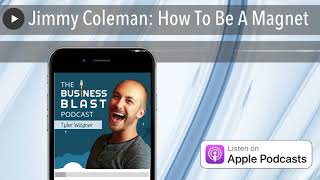
Jimmy Coleman, a partner at Mako Medical Laboratories, left college to sell Cutco knives and built a framework for salesmanship that moves from vendor to consultant to business partner. He tracks three grand goals: spiritual growth, peak physical fitness, and financial success, and credits his morning routine and the poem "Man in the Glass" for keeping him grounded.
Chapters
All right everyone, welcome back to another episode of the Business Blast podcast. I'm your host Tyler Wagner. Today I have Jimmy Coleman with us. He is a partner in the fastest growing startup in North Carolina and founder of the LinkedIn Lead Challenge, where he teaches professionals "How to Turn LinkedIn Connections into Profitable Leads." So welcome to the show, man.
Yeah, man, thanks for having me.
Of course, grateful to have you on. So Jimmy, the first question we ask on this show is what is the best story from your life that has an underlying valuable message?
Hmm. I think a good place to start with that, 'cause there's a lot of stories, but I think a good place to start is when I graduated high school. And I actually started my first thing out of high school was selling Cutco knives. And man, it was cool because after like the second week, I was like, I was working so hard and I was just like so motivated that I was forgetting to eat. And so that's a question I ask people a lot of times, like, have you ever worked so hard where you forgot to eat? Or like, have you ever experienced that? That feeling like Christmas morning when you're 8 years old on an ordinary day. And so that was a very formative time for me. And I actually liked it so much that 2 weeks into college, so I was working so hard, enjoying myself. And then I went to college and I got sat in a desk for hours. And talked at, and I didn't like that. It was a completely different feeling. And so after 2 weeks of college, I left and I told my parents I'm leaving college to sell knives full-time. And you can imagine that scared them. It worked out though. I became— I broke a lot of national records as far as sales performance goes. Within 6 months, they moved me up to the head office in Virginia, where I'm originally from. And I had built and led a sales team of like over 80 people at one time. And out of over 600 offices, we were the number 2 office in the country. And so, we definitely like rode that train for 3 years and then eventually went into some other things. But yeah, I think you're kind of asking for a lesson that I can kind of pull from that. But there's a lot that can be pulled from that. Part of it is just that like, you know, not one person's path is definitely the same. It really opened my eyes to my entire life. What the plan was going to college for 4 years and then doing a normal job or whatever. But that was like the first time I significantly went off the track that I thought I was going to be on. And the plan that God had for me was completely different than what I originally had for myself. That's, that's led to so many other things. And my girlfriend now is— and we've been together for a long time— she's always asking me like what the plan is. And now I just tell her I don't know. But like, I'm content with it. And just knowing that me doing my part— and that's the other big lesson I had from that too— is I could look, look at myself in the mirror every single day and know that I was giving it my best. And I didn't really worry about my decisions as much because I knew I was working my hardest and I had the faith, you know, to put all the other worries aside and just put it in God's hands. And so, you know, that's a big lesson I learned from that too, is like, if I hold up my end of the bargain, everything else will work out.
So yeah, man. Yeah, dude, way to listen to what you wanted to do, man. Most people, it took me 2 years in college before I listened to myself and dropped out. So 2 weeks sounds better than me.
Less debt, man. I got a full refund. I quit so fast I got a full refund.
Yep, I didn't get a refund, I'll tell you that. That's awesome. So the next one I got for you is, what is the most valuable piece of information we should know that's within your expertise or industry?
Sure, well, and you announced, so Mako Medical Laboratories is the fastest growing company in North Carolina for actually the past 3 years in a row. No other company's ever done it 2 years in a row, so we're, We're the big shots right now, and I'm a partner in that company. And then as you know, I also am creating my own course on LinkedIn, teaching people how to create leads on LinkedIn. And we've actually implemented a lot of the things that have helped us grow really quickly onto LinkedIn. And so, but it's not gonna be, my tip is not gonna be so specific to those two things. It's just a general concept that works. The concept is there's really like 3 levels of salesmanship. So on the very bottom level of salesmanship, you have a vendor. A vendor in the medical industry is someone that usually like a doctor says, in order for me to give you my time, you have to feed me. They're putting you in that box where you're like, you're not valuable enough for me to even learn something from. So I need you to pay me in order for it to be worth— no, not pay me, but feed me in order for it to be worth my time. And that's, that's where we try to get our entire sales team. So like, Mako, fastest growing company, people want to know what all the tricks we have up our sleeve. And that's really more of a mindset with that. We never want to be put into that vendor box. How can we go to maybe the next level, which is more of a consultant? So a consultant usually is someone who leans on their expertise. So if a doctor is in front of them, you know, it's funny, in laboratory space, pharmaceuticals, medical device is one of the few industries where the person that you're selling something to knows more about what you're selling than you do. But you can change that if you can get yourself to a place where you're more of a consultant and you're a subject— excuse me— a subject matter expert. And whatever it is that you're talking about, like, you know more about than the doctor does or whoever the decision maker is, and they can lean on you for advice on these things. They enjoy having you around them because they always learn something new, and they know that they just trust you as an advisor to them. A lot of financial advisors try to get to this place, but then don't really go much more beyond it. The third level is where you are— it can get kind of split into two, actually. It's whether you're more like a business partner or even like a celebrity status. It's like, you know, how— so on the celebrity side, just to spend a short bit on that, like, if I was LeBron James selling knives, like, I would have done a lot better because I'm LeBron James. Everyone knows who I am, celebrity. Everyone wants to buy knives from LeBron James. He just makes a tweet or whatever and he'll crush it. But, um, on the business partner side, it makes more sense for the average Joes like us, is, um, how can you be in a place where your clients have more to gain from partnering with you than you have to gain from partnering with them? And the question that we're always thinking about is, if I'm, if I'm trying to sell something to someone, like, what do I, what do I have to offer outside of what I'm selling? Am I more resourceful than just the product or service that I'm selling to them? And so, like, something that we've done at Mako was we found out that independent physicians are, you know, in a really hard place financially because the hospitals are buying out their businesses or taking all their leads, which are their patients. And so we made some political connections for independent physicians. We actually held an event where we had the Lieutenant Governor of North Carolina, the Deputy Insurance Commissioner of North Carolina, the lobbyist for our company, and had about 40 to 50 independent physicians out at a nice hotel conference room. We paid for the food and just introduced the two parties and showed that, like, hey, we have connections to the people that can help save your business. Like, we can talk about the labs and stuff like that later, but let us show you that we can be a resource. We can be a true business partner for you outside of just selling you our services. And so that is a concept that has really shaped the growth of our organization. And if anyone else is trying to do it, then it'll work for them too.
And then it could tie in, but what's your best piece of overall business advice? So not necessarily industry-specific.
Hmm. Business advice, not industry-specific. So I might need to come back to that one.
Okay. No, no problem. I mean, what you kind of already said does apply. So, you know, I mean, it kind of does tie in, but let me know if it comes back. The next one I got for you is if you could give your younger self one piece of advice, what would that be?
You know, something that— so I speak at a lot of like college campuses and high school campuses and stuff like this. So this is a question that I actually have to ask myself and I get asked on a regular basis. And, I usually end up sharing whatever is most relative to me at the time. It's funny, when I was in high school, I never read books. I SparkNotes the entire time. I don't think there's one book that I read in high school. And, I just hated reading. I found out later I'm most likely dyslexic, which explains a lot. But, Something really changed when I found audiobooks. And I also found books that weren't being shoved down my throat. It was more about the things that could help me become the best version of myself. And when I started finding books and information out that would help me become the best version of myself and really were just more in line with who I wanted to become, I became obsessed with it. So, I think a part of it is just getting, like finding the knowledge much sooner I think another part is incorporating habits much earlier on. I think that's something that I've noticed over the past couple years is I've been much more steady on a day-to-day basis. I can have very high highs and very low lows just by the way that I was created. And there's ways to channel that into something very positive. But I've also noticed where people become medicated because that's the way that their brain works. And if they're not incorporating habits every single day, Every single day, Tyler, I wake up, I smile. I force myself to smile as soon as I wake up. My face isn't really awake, so it looks funny, but I smile and then I thank God that I'm alive and I just say a bunch of positive things, whatever I can possibly think of. Then I roll out of bed, do 20 jumping jacks to wake myself up, use the bathroom, brush my teeth, I already have my— and that's the other part too, is not just focusing on what the habits are that morning, but what do you do right before you go to bed? So, my gym clothes are already ready. The bag of clothes I'm going to wear after I shower at the gym are already ready. And I just pick that stuff up. My water is already in the fridge. Run out the door and then go to the gym right across the street. Work out. Have a game plan of what my workout is already going to be. Shower, all that. Then I have a checklist of what I'm going to eat. Here's my other thing. I realize I'm never going to like vegetables. I don't say never very often, but I'm probably never going to like vegetables. I still need those things. Understanding that I need to drink Athletic Greens or my buddy's coming out with something like that, but just some sort of drink that I can get all the vegetables into a mix and just drink it like a shot glass. If I were to incorporate habits much earlier on, I would have been much more consistent and steady. My confidence would have been on a different level. I think that it's very true that there's people who get really inspired by something and then because of their inability to be consistent just based off the way that they're created and what's going on in their minds, they lose a lot of momentum on those off days and those off days can turn into 1, 2, 3, 4 days in a row and then they're back to square one. So that would have been huge for me.
Yeah, man. Habits are enormous, dude. And I can relate with the audiobooks, man. I listen to audiobooks like crazy, so I'm with you there. So the next one's kind of going down a little bit of a different path, although you kind of, I think, touched on the answer a little bit in your previous answer. In your opinion, what is the key to happiness?
Yeah, definitely got that one. It's making progress every single day, and to me it's in 3 areas. The areas are becoming a saint, making progress towards becoming a saint every day, and they're all big goals. That's the other part too. So making progress towards becoming a saint every day, making progress towards becoming the fittest man on earth every single day, and and making progress towards becoming a billionaire every single day. If there's a day that goes by where I didn't make progress in those 3 areas, then I don't really feel as if I'm my full self. I don't really feel complete that day. And so, it's one day at a time. And happiness, as you know, is a state of mind. So, you really have to take it one day at a time. And I've been able to boil it down to those 3 things. As I become a father and stuff like that, I'll have subcategories for maybe the sainthood thing. I'll be able to say being a good dad, that's my branch off of being saint-like, if you will. But, I think that for me, it's making progress every single day towards those three things. And, the other part too is those are the most magnetic people in the world is something I found out. The people who are obsessed with their spirituality, extremely grounded, people who are obsessed with their fitness, and people who are obsessed with their financial success are the most magnetic people in the world. It's the people that I've noticed that people want to spend the most amount of time around because it helps them become a better version of themselves.
So absolutely, dude, I agree with that. So the next one is, what is the best book that you've read and what was the number one thing you learned from it?
Hmm. It's tough. If people want to reach out offline because I got a good list now. But let's focus on— there's a book that most people I've noticed aren't really talking about. It's by a guy who's now a friend of mine because I reached out to him after I read it to let him know how much it meant to me. But it's called How to Get a Meeting with Anyone, and it's by a guy named Stu Hynek. And I think that, you know, this is really big for me because I did a lot of the groundwork to make sure that I was motivated enough to take massive action, but I also wasn't exactly sure what direction to go with it. And so it's literally a how-to book. So think about, and this is true for anyone, even my girlfriend who's in nursing school, we found out that there's people in her life that if you get in front of, there's always like, like at least a top 5 group of people. Where if you have the opportunity to get in front of them and build a relationship with them, it would completely change the game. It would change your life forever. And so figuring out who are those people and then finding out what is it going to take for you to get in front of them. And I love that chase. And part of it, again, it goes into how-to. It goes into like cool things you can send, something that a guy sent to Steve Jobs to get a meeting with him. You know, think of what would you have to do to get a meeting with Jeff Bezos if your life depended on it? What would you have to do? I mean, and you're doing things like this right now. We were talking about how if you have a podcast, if you have a platform you can invite someone to, it gets really creative. This is a book where it's not motivation, it's implementation, which actually was one of the most motivating parts of this because now I know what to do with all this motivation that I have. That book fired me up. He's actually coming out with another book here soon. And he also has a podcast too called Contact Marketing. So I love that book.
Awesome. And then what is your favorite quote and why?
So, tell you what, let me— so there's a poem actually, it's called Man in the Glass. And this is definitely my favorite. You could just call it a quote, I guess, but Man in the Glass is And it's a few paragraphs, so forgive me, but it says, "When you get what you want in your struggle for self and the world makes you king for a day, just go to the mirror and look at yourself and see what that man has to say. For it isn't your father or mother or wife whose judgment upon you must pass. The fellow whose verdict counts the most in your life is the one staring back at the glass. He's a fellow to please, never mind all the rest." For he's with you clear till the end. And you've passed your most difficult, dangerous test if the man in the glass is your friend. You may fool the world down the pathway of years and get pats on the back as you pass. But your final reward will be the heartache and tears if you cheated the man in the glass. And so that's just look at man in the glass. And it kind of goes back to what I was talking about before with me just knowing that If I can look myself in the glass, look at myself in the mirror and know that for sure, like full integrity, I'm giving it my best, I don't have anything else to worry about. I have faith that like whatever happens after that is what's supposed to happen. Things aren't happening. If I can get that approval of myself in the mirror, things aren't happening to me. They're not even happening because of me. Everything is that's happening is happening in my best interest. And so that's my favorite quote.
Yes, man. Dude, thank you so much for coming on. This was an awesome episode. The last one I got for you before we let you go is where can our audience best find you online?
Yeah, so obviously LinkedIn. And so just Jimmy Coleman on LinkedIn. And yeah, that's just a good place to start, I would say.
Perfect, brother. Thanks again for coming on.
Thanks, man. The podcast you just heard was made using Anchor. Ever thought about making your own podcast? Anchor makes it really easy for anyone to get started. It's a one-stop shop for recording, hosting, and distributing podcasts. Best of all, it's 100% free. Sign up now at anchor.fm/new. That's anchor.fm/new to get started.
More from Tyler


Catherine Nikkel : THE STORY EVERYONE HAS BUT HASN'T TOLD : The Tyler Wagner Show #1120



Scott Ritzheimer: Bring Predictable Success to your Organization | The Tyler Wagner Show #1115


Fred Moskowitz: A GUIDE TO GETTING STARTED WITH IN MORTGAGE NOTES | The Tyler Wagner Show #1113

Mark Podolsky: From Land Investor to Full Time Success How I Made $90,000 Cash in Real Estate


Mark Podolsky: How to achieve a 300% return on investment my foolproof strategy

Mark Podolsky: How to make passive income selling raw land the irresistible pricing strategy