Kirk Cooper: The Path To Entrepreneurial Greatness | The Tyler Wagner Show #1037
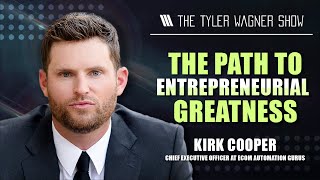
In this episode of The Tyler Wagner Show, host Tyler Wagner interviews Kirk Cooper, founder of Ecom Automation Gurus and author of Scratch and Claw: The Path to Entrepreneurial Greatness. Cooper recounts his journey from high‑school teacher and coach to full‑time e‑commerce entrepreneur, describing early missteps with private‑label inventory, a pivotal switch to dropshipping, and the rapid scaling of a virtual‑assistant (VA) team that now exceeds 500 members. He explains the mechanics of creating profitable Amazon stores—product research, buy‑box acquisition, listing optimization, customer‑service workflows, and review‑generation tactics—while highlighting common pitfalls such as Amazon policy changes, account suspensions, and over‑extension. Cooper shares client success stories, including his own parents’ $136k net profit, and outlines the six‑step framework he uses with clients to grow stores to six‑figure monthly revenues. The conversation shifts to his book, its structure around entrepreneurial traits, and the personal challenges of convincing his family to support the transition. Finally, Cooper discusses future directions, notably faceless YouTube channels and other passive‑income digital assets, emphasizing a long‑term focus on scalable, hands‑off revenue streams. The interview blends practical e‑commerce advice with personal motivation, offering a roadmap for aspiring entrepreneurs seeking passive income.
Chapters
Alright everyone, welcome back to another episode. Today we have Kirk Cooper with us. He is the CEO and founder of Ecom Automation Gurus and is also the author of the best-selling book Scratch and Claw: The Path to Entrepreneurial Greatness. So welcome to the show, man.
Hey Tyler, thanks for having me, bud.
Of course, grateful to have you on. So, um, I like to kind of start off from somewhat close to the beginning to see how we got to where you are today. So before you were doing this e-com automation guru's business, what were you doing before this that led you to start this? Or like, what was that transitional period?
Oh, for sure. I was a high school teacher and coach, so not on the entrepreneur or entrepreneurial path. I've always been wired as an entrepreneur, always have had the desire to really get in and pursue it full-time. But when I got out of school, when I got out of college, I came from a family of teachers and coaches. And it was just kind of, as they say, in your blood, and knew that I had a great appreciation for all the teachers and coaches that were in my life. So, I kind of got drawn into going back and getting my master's and getting a teaching certificate and going on to be the head track coach and coaching football and golf and do all that stuff while being the department coordinator in the health and physical education department. So not related to what I do now, but it was what motivated me to get into what it is I do now. I kind of burned the candle at both ends, if you will. I was working a lot of late nights and really forging my way and my path and creating my own personal e-com store. And once success was found, kind of had the light bulb that, hey, you know what, I just gave myself another form of employment slavery. I have now two jobs and one of them requires 7 days a week. And that was the e-com business. So I ended up building out a team, training modules, courses, and built out a VA team, which today is now over 500. We help people make money passively in the e-commerce space.
Got it. Okay. So essentially, so you're a high school teacher and then, you know, I'm assuming you like the job, but maybe the money isn't what you wanted. And then you come across this, this starts to become profitable. And then instead of doing both, you transition. So you're not a teacher anymore, right?
That's right. Yeah. After 2019, I officially got out all in all.
Got it. And then, so it seems, you know, this scaled like pretty quickly. So over 500 virtual assistants that are helping with your business here. What was the first, like in the beginning, was it a straight success or like what did that look like your first couple Amazon stores? Right.
Yeah. So initially it was, I mean, YouTube University. I was trying to find out how to go about, one, opening a store, two, how do I source product? I got into actually purchasing physical inventory and branding, you know, private label type items. And I fell on my face initially. I thought I was about to, you know, cough up and lose about $18,000, $19,000 before really understanding how, you know, I could take a step back, adjust, optimize my listings, improve the listing photo quality, and really how to get it out there and run, you know, pay-per-click ads and all that stuff. I quickly pivoted though out of that model and got into more dropshipping, and that's really what catapulted and launched me into where we are today. I was running a, you know, a store that was doing $50,000, $55,000, $60,000 in revenue a month, which is not a ton in the grand scheme of things, but knowing that I was only running the business from 8, 9, 10 PM till 1, 2 AM every night, and that I couldn't take a night off because I had to respond to messages, I had to fulfill orders, I had to do future product research. It's a lot of work that went into it. So it, it got me to a point where I was like, hey, if I could hire a couple guys that can— I can train over a course of time how to do this for me, and I could step back and let this run passively, that'd be incredible. And it got to the point where I had 6 guys, it was running 24 hours a day. 7 days a week, 365 days a year. It was doing triple, you know, eventually quadruple the amount of revenue every month. In turn, was making just as much of an increase on the net margins. And I was able to pay those guys handsomely while also making more money for me passively, removing those, you know, those chains, those cuffs, and kind of gaining my life back. And at that point, We decided to grow it and scale it, bring on 10 clients, do this for them. Then we got to 20, 30, and we started to build it out. And that's when I realized, you know, I can still help people. I can still motivate people, teach, coach. It doesn't have to be in a school system. And my time is going to be rewarded, you know, far more than the $60,000, $65,000 a year I was making as a teacher. So it was almost a no-brainer. It was a no-brainer.
Got it. Okay. So let's look at like what goes into creating a successful like Amazon store. So I know, because I did some research obviously before the interview and on your website, it kind of walks through like, I think it's 6, yeah, 6 things that you go through when somebody becomes a client of your guys. So before we actually go through the process, like, is there, can you name some of the products? I know I'm not trying, maybe you can't give away like your secret sauce, but like, some of the products that consistently work? Like, how are you discovering these?
Right, yeah. So we have different softwares, we have different systems that we implement for our product research and in our listings. And when we're dropshipping, that's what 90% of our clients that come to us and want a passive income stream, that's what they choose to do is dropship. So that's kind of our, you know, our bigger, you know, piece to the pie here. But we scraping, so we're scraping supplier sites, figuring out pricing. We're scraping Amazon's platform to figure out where current buy boxes are, where the trends are, where it's going, where it's coming from. So a lot of this is created off of data and analysis, 100%. So it's not just, you know, at random. And by doing that, we know that by running these stores all day, every day, we're able to compete for these listings. So once we get in there and we're able to be buy box eligible, we know that we can compete for those buy boxes. And more often than not are going to have the opportunity to win them and own them for a longer period of time, which in turn drives up the revenue and which in turn with proper research drives up your net margins. So it is software-driven, but then there's a lot of manual movement and that's where such a large team comes into play.
Got it. And then you were saying with your, one of your first stores, so there's just a lot of like customers, like when you do it on Amazon, because I've actually never sold, like I do a lot of books, books, like, yeah, but not an actual, like, I guess, product besides a book. So is there a lot of, like, messaging of, like, customers, whether they like or dislike? And that's— is that a lot of the manual work? Like, you have to respond on time or Amazon will, like, penalize you or something?
That's right. Yeah, it's a big piece to it is people are going to make a purchase before it's ever shipped out. They might be like, oh shoot, you know what, I found something different, or I don't need it anymore. So they're sending a message. We then have to respond to it within 24 hours is kind of the icon that Amazon gives you under 24 hours or over 24 hours. So you really try to hit that mark. People, when they receive their products, you know, it's, it's retail. So people are going to want to return the item, or it could show up damaged. And again, it's not a product we've ever touched. So it's coming out of somebody's warehouse and on some shipping delivery truck. And if it comes damaged, people are going to come to the store, store owner, account and they're gonna ask for a refund. So then we go over, get the return labels, and then we bring over that PDF file, send it to the customer so they can print it out, throw it on the box so it can be returned free of charge. So there's just a lot of just, you know, being on top of it and being present. And then the biggest piece to it is constantly optimizing the listings. If you just let a listing just sit and it's not, it's not being managed or optimized, it can then at that point go stale and then you move down in the buy box rank, and then therefore you start losing, um, sales revenue, you know, and, and you start losing the opportunity to make money. So you constantly want to be in the game, and that's the difference between my 4 hours that I put in at night to moving over and having it run around the clock with a team of 6 to sometimes 10 or 12 doing different facets, you know, a group doing product research, um, managing the inventory. Right? We have a group doing our order processing. And then we have that same group also is on the backend handling the returns. And then we've gotta make sure we're order tracking, 'cause people always come back and say, hey, can I get an update? Can I get an update? So we gotta make sure that we're putting in tracking numbers when they're supplied to us from certain suppliers. So you're constantly just following it from point A to point B on a mass amount of different orders.
Got it. Okay. And then any— and then I think it would be good to just do an overview of the process. But for like getting Amazon reviews on the products, do you have any like tips or tricks for that? Because I'd imagine anybody who has a product, especially books, like everybody wants reviews for their book. So maybe it works in a similar way. Do you have any advice there?
Sure.
Yeah.
When we're dropshipping, we're dropshipping brand name products. So we really aren't incentivized on the side of getting reviews for the product specifically, but for when we do inventory-based— that's FBA, Fulfilled by Amazon— we're doing an inventory-based model for our clients, which we do. Just a smaller percentage of people choose to do it. There are strategies, you know, putting in, putting in cool little, uh, uh, cards or flyers in there. Um, we've put in there and we've done giveaways before. Hey, you know, if you leave— and you don't say, hey, leave us a 5, you know, 5 out of 5 star type review, you just say Hey, if you could give us some feedback, leave us a review, you know, we can throw out like a bonus gift, like dry erase markers, or depending upon what it was we were selling. So there's different ways to incentivize the customer without saying, hey, you know, we're fishing for a 5-star review. We just want a review because that's the no-no in the Amazon game, is basically telling them what to put and then incentivizing it with like a freebie giveaway, which then our team also is managing to fulfill that as well. So, there's a lot of little things that go into managing each store.
Got it. So, let's kind of go through the process, just like an overview. And then, I think what I always like to do is like kind of talk about your testimonials and the stories because I think people remember and learn the most from stories. So overall, I know, not to like read right from your website, but it's a 6-step process. So, I guess my question for you, And again, without you just like reading it, obviously, you know it like the back of your hand now. So like if somebody were to try to do this on their own, like what would you tell them? Like what's step 1 to like the final step of like, let's say your store doing $100K a month or something?
Yeah, I mean, just like anything, my recommendation would be is get in and don't overwhelm yourself. You know, if it's just a couple products that you go in and you properly go in and research those, and you can do this manually. While we have different softwares to do this, people can go, and this is how I started, was just manual, getting on supplier sites, finding product, okay, seeing if that same product's being sold on Amazon. Okay, cool. All right, I know Amazon's going to keep 15%. All right, so if it's selling for $100, Amazon, I got to sell this for at least $85 to break even, or You know, I have to be able to get that product for, for less than that to make a margin. So you start kind of moving through and playing with numbers, uh, yourself. You build out a spreadsheet, find 1, 2, 3, 4, 5 items on the dropship, you know, model there. And essentially you're coming in and you're piggybacking off of listings. You're not going in and creating the wheel. This listing is already on Amazon. You're going to go in and basically jump onto the listing there. And at that point Making sure that you're able to come in and optimize the listing and make sure that your inventory management's right. So you don't want to put, you know, 100 units of something in there, but start with maybe 5. You don't want to get into trouble where you go to bed and you wake up and you've had 45, 50 sales and the supplier doesn't have 45 or 50 units. And now you're giving yourself an extra job. You've got to go out and properly cancel orders, which is a pain in the butt. But again, when you built out a, you know, a large team, it's part of the, part of the process. So starting small, get in there and just, just get in the game, learn, learn the trends and what to expect from Amazon and their requirements, and just pick up a sale here and there until you feel comfortable in expanding your, you know, your reach and your listings. But yeah, you can start it without any type of software. It's all manual.
Okay, awesome. And then actually, before we get to the testimonials, because I'm always just curious and I think it makes for a good story, have you And maybe it's, uh, obviously now, like, you guys have this very turnkey, so I'm sure this doesn't happen now, but in the beginning, whether it was you, one of your clients that maybe didn't listen to your advice, or others that you know of or something, like, what are some of the biggest failures you've seen with people trying to do this and maybe some, like, mistakes to avoid?
Yeah, absolutely. And the biggest thing here is we're not selling on kirkcooper.com. We're selling on amazon.com, so it's their platform. They have their own terms of service, their own requirements, and that can get, you know, that can be pretty touch and go. For years, you know, you could work through the process and the systems without, you know, much headache, without much pushback. But as this evolves, Amazon puts in more and more restrictions. They're incorporating more and more AI and just incorporating bots to the point that it's hard to get a person, an actual person on the phone when you have, you know, questions or, or need to inquire about something with your business that is partnered on Amazon's platform. So some of the biggest failures are, um, you know, Amazon will put a review on people's accounts. They want to go through and ensure that you're not, you know, phishing or scamming their system. They get scammed all the time. People open up, uh, you know, virtual bank accounts, virtual offices, and purchase an aged account, and they go in and do a bunch of fake sales to try to get to their first payout. And they get that first payout, and then all these customers are like, hey, where's my product? Where's my product? Where's my product? Amazon catches on, they're not sending anything out, and then they shut the account down. So this happens to people who are honest and doing honest business. So that's a— that's probably the biggest failure in the marketplace, is that you got to stay on top of, you know, your business and, and be, uh, conservative with the way you grow and scale it and understand that there is, you know, high reward potential. There are also risks in working on a third-party platform like Amazon. So I'd say the biggest thing there is people can get tied up and overwhelmed and have funds being held, and if they're relying on those funds to pay bills, you know, that's why this is a nice passive additional stream, you know, for many people.
Got it. Okay. And then any uh, like your favorite success stories and like maybe like where they were before and then after working with you guys, where they are now?
Yeah. When we have a variety of people that have worked, you know, just, just kind of your run-of-the-mill everyday important roles in life and in jobs. I mean, teachers, um, you know, we've had doctors, we've had lawyers, we've had, you know, people that, that work in retail and they're just looking for a way to have something to call their own, because these are businesses. It's their business and we're just a contractor. So at the end of the day, it's their LLC, their bank account that's receiving the funds. We're just making a percentage of the success that comes from it. So a lot of people that have scratched and clawed and put everything they, you know, they've had into a business opportunity to try to make that additional income We have a bunch of people that, you know, making an extra $500, $1,000, $1,500, $2,000 a month is life-changing. And we also have people that have, you know, in November, December, January, this time of year, fourth quarter, where they, uh, they have the potential to make $20,000, $30,000, $40,000, $50,000, $60,000. So there's a large variety. I like to talk about my parents, you know, my parents when they got into this space, um, just because my dad again was a high school teacher and coach. He, he's retired now. So both my parents, you know, they've, they've done well for themselves. But they invested in, in a store with us in their second year with their store operational, they made $136,000 net out the door. That's life-changing to add that to, you know, their retirement income and, and what that, you know, gives them when you've kind of grown living within your means and within the income that you've been essentially, that you've created for yourself. When you have an additional $100,000+ I mean, that really opens up a lot of opportunities for people. So, you know, there's been a lot of people like that, but I could actually see it and feel, you know, that total appreciation because I see my parents all the time, you know, frequently. So it's cool. It's cool to see that a passive opportunity can change lives like that. And that's what we're in the business for is to literally help people win. And in turn, we're going going to win. Win-win opportunities are incredible.
Oh, 100%. You know what? I love that you say that because there's a book actually, it's called Never Lose a Customer Again, I think is the title. And basically what it talks about is like a lot of companies, they focus always on like a marketing budget when part or a huge part of your marketing budget should actually be focused towards your customer experience because your customers become your marketers.
Oh yeah.
And that's the way I think like in the book business. And so I want to talk about your book next, but like I've been doing it 11 years and what I always tell people, the beauty of it is like we really just focus heavily on getting our clients the best results possible. Every time they launch a book, all their whole network hears about it. And then we get 3 more clients from every client that we launch, right?
Like, oh, exactly.
Yeah. It's really just It's not like we're not really doing Facebook ads that much, like nothing like that. It's just like we have— we just deliver a good experience and then we get clients from that. So it seems like you do similar things.
So, oh, that is 100%, you know, this arena, because we run ads, but I'll be honest, there's months where we don't even get a new deal from, from the ad spend that we put out. There's months we get a couple, but the quality— and I'm sure you can speak to this as well— is the quality of the client that you get is is so much higher when it's coming from a current client who's had a great experience and great success. And when they send somebody over, just the relationships that you build, you know, I'm in a bunch of business deals outside of my own, my own company with quality people because they're, they're experienced investors and they have awesome opportunities and they've had great success with me and they present other things to me. And it's, it's just really cool how the network of, you know, business really works when you have a good product.
Yeah, no, agreed, agreed. So, um, so speaking to that, like a lot of— due to me being in the book business for as long as I have, a lot of our audience are people that are either authors or aspiring authors. So with your book, um, to start off, like just overall experience of writing, publishing, marketing it, like, um, any— not just advice, but I'm just curious of the overall story of like how it came to be and, and why you did it and things of that nature. Yeah.
So I don't know. I guess as kind of growing up and you learn to read and you go through the process of so many different classes in the school system where you have different types of books, book reports, and you always go through those books. And if it's never crossed your mind, like, wow, man, like you just assume that the name on that book that you're reading, that person is wildly famous. And, and, you know, it's somebody you want to aspire to be. So I've always had that kind of that thought process when I've read different books as I've grown up and kind of maneuvered through life. And I kind of put it as a bucket list item, you know, unofficial, not written anywhere, but in my mind that, you know, someday I'd really love to write a book, really, really love to write a book. But who wants to read a book from, you know, a high school teacher and coach, you know? So when this kind of started to formulate and my side hustle really kind of came to be and I finally felt like, you know what, I have a pretty cool story to think that I went from, you know, going, coming out of college, I went to the University of Kansas and then finished my, I was a collegiate pole vaulter, so in track and field. So finished my eligibility at Colorado State University, went on to be a teacher and coach. But knowing that I've always kind of had that entrepreneurial spirit and drive and just had to find, you know, where my space was going to be. I just thought it'd be really cool to kind of bring my story and be able to tie different stories and different experiences and different traits of a successful entrepreneur and tie it into a book. Because I think that's probably the biggest piece to the puzzle for most people is how, how, how do you do this? And if I can bring my story, I guarantee that it can correlate and cross-communicate with different people and in different industries. You know, how to potentially light the fire under them to start working on something on the side and hopefully free yourself from that 9 to 5, find a way to create the time freedom that we all, you know, desire, which in turn comes from having some financial freedom so you can afford life but not be tied to a desk. So it's been incredible. Yeah, absolutely incredible. It's been a dream come true. And the process of doing it was a lot of fun, a lot of stress too, because you kind of get to the point where you're halfway through and you have writer's block and you're like, I can't finish the book if I can't get through this. But it comes together. You got to find your time that you can sit down and really be creative and think about different ways to correlate. And for me, I just started a list of traits. So, in my book, each chapter is a trait of a successful entrepreneur. So, relentlessness and competitiveness. And I use each of those to then elaborate on different stories and experiences to really bring it and explain it to, to that individual that's, that's looking to, to break out of that 9-to-5 rut.
Okay. So what's like your, what's like your favorite story from the book or one of the favorite, maybe it's hard to choose one.
Yeah. I don't know if I specifically have a kind of a favorite story on it. I mean, one that always is going to pop in my mind for the rest of my life though, was I was still teaching. I was still coaching, getting up, doing my thing passionately, you know, leading my track team and, and, you know, all the things that are really cared about while Ecom Automation Gurus is in full swing and I'm having wild success. And, you know, I've got different positions hired out so that the business was being run during the day while I'm still teaching and coaching. Have some awesome people on our team that handle that. But going to my parents and my wife, for that matter, I wasn't super public with any of this because my fear was, what if I fall on my face? I don't want them to not trust me or believe in me on my next opportunity, my next venture. So, I kept it in silence, which is super cringy to think about that I didn't share this with anybody, but it's like, I wanted to make sure that this is going to be wildly successful. And when the time came, I spoke to my dad, my mom, and my wife, and basically said, hey, I'm not going to be going back to teaching next year. And boom, blindsided. Because again, my dad's like, what about, you know, PERRA, which is the Public Employee Retirement Association. And not, you know, that's what essentially he lives off of now, in addition to his businesses that we run for him. And he's kind of freaking out thinking like, are you sure? Like, you have— I mean, we haven't even heard about this. So I felt like I had to explain myself and show my financials and show all this stuff for them to even believe that I had something going on. So to convey that to them and for them to finally kind of be like, wow, you know, it was kind of a jaw-dropping moment for all of them because it was just This is what I was. I was a high school teacher and coach. And that's kind of what you just assume you're going to do for 30, 35 years and punch your last ticket there and make your, you know, earn your pension and live life that way. But I'll never forget the conversation. It was scary because I, you know, they just kind of looked at me like I was stupid until I could really explain myself.
Got it. No, that's awesome, man. I can relate to that. I feel like I dropped out of college the second year I was there. And that's when I wrote my first book and I had to have kind of like a similar conversation with my parents where I was like, hey, like I have this thing that's like going, it's kind of starting to work, like, and I can see it, you know, blowing up soon. So hopefully you'll support me in dropping out. And luckily, you know, very supportive and everything worked out. But it's definitely like an interesting, and just like you, so I like, I was very avoidant of dropping out. I wanted to drop out pretty much after the first 6 months of Party. And I was like, all right, this, I don't, I don't want to be here anymore. But I waited because I think it was like an ego thing. I was just like, what if I fail? And I had all these thoughts of like, if I fail, then I'll have to tell all my friends that I had to go back to school. I'll be older than everyone in my class. And it was like all these things that really don't matter when you, as you get older, like you think back and you're like, dude, I don't give a shit if people think I failed. Like, you know, I know what I'm doing. So, but like, when you're younger, I don't know, it's just a way bigger thought process.
It's exactly because you're coming more out of that phase of where you're dependent on your parents. You live with them going to high school and middle school and growing up, and you're just freshly out of that stage. And for me, it was still like I had to get their approval, when in reality, I think there's a lot of people with the personality type that's just like, you know, screw this, I'll do what I want when I want. But I still had that where I was like, I, I need my parents to approve of this, which You know, in retrospect, probably really didn't, but I still felt I did. And it was tough. It was a tough conversation because I couldn't get enough out quick enough for them to just like cool off and just trust that I have, you know, some merit to this and that there is something going on. So I had to literally spend a bunch of time that night, which nobody probably was planning for, to explain myself and explain this business and explain the model and, you know, how many clients we have. And look, this is the success that we're creating. And you know, why don't you come over and, you know, open up an e-com store and let me manage it for you and show you that, you know, what we can do. And that's kind of how it all turned out. And that was at the end of the school year in 2019. And yeah, I, at that point, I just didn't end up going back the next year. And, you know, things have been great. Honestly, things have been, been really great and don't regret it one bit. And It's been awesome. Yeah, it's been really cool. Yeah.
So, really, kind of like last question for you, and then if there's anything we didn't cover, I'll leave the floor to you, but chapter 27 in your book, it says Playing the Long Game. And I don't know if this is necessarily what this chapter is about, but just based on seeing that, my question is like, where, like, what's next? And what is like your ultimate, like, playing of the long game? Like, where do you see yourself I don't want to say— it's hard with technology. Like, in 10 years, we could like all be in the metaverse and it's all over.
So who knows?
But like in 5 years, let's say, like, where are you really trying to take things?
Oh, absolutely. So I mean, we're constantly evolving. So I know within the title of our company, Ecom, so, you know, alluding to e-commerce, but we've already expanded into YouTube, right? That's our latest and greatest opportunity is We're creating faceless YouTube channels that are bringing out popular, highly searched content to people. For those people that sit down and just binge-watch YouTube and they're into tech or they're into Bitcoin, different forms of crypto and celebrity news and just the goofy funny channels, we create faceless YouTube channels with 10 to 20 videos a month and we run full SEO on them and we get people monetized. And We make people money passively with a 110% digital asset in YouTube. You know, these channels can be sold. So people are making anywhere from, you know, a couple hundred bucks a month early on to $10,000, $15,000, $20,000 a month passively because we're using our team of content writers, content creators, voiceovers, and again, getting a piece of the pie with them along the way. So we're evolving, you know, I mean, e-commerce, still love it, still make people a bunch of money with it. And As long as e-commerce continues to grow and, or just even maintain where it's at today, that's going to be a long play in itself. But I'm an investor. I'm somebody that's always looking for something new, the latest and greatest. And that's another service that we offer. And then me personally, I'm continuing to invest in other people's opportunities, other investments, and just trying to grow, you know, my net worth as passive as possible. Everything I do right now is all passive-based income. I don't want another job. I don't want to, you know, commit myself to anything more than the business that I manage and run, and really the people that I employ underneath it that manage and run it for me. I just want to look for passive opportunities because this will be something that I can pass on to my children. Is, you know, I want them to go to school and, you know, if they're athletes and they want to compete in college and stuff, awesome, go for the experience. But at the end of the day, I'm not doing what my degree was. So, you know, how much money was thrown into that whole process? Luckily, I had athletic scholarships, but you can change a lot of lives and most importantly, your own life if you commit yourself to it. And that's, I think, going to be the biggest thing that I pass on to my children is that, you know, look how easy it is to make money and you can make a bunch of it if you have the right network and you know where to find it.
Yeah, no, I love that, man. Um, and yeah, that's a whole nother rabbit hole. Maybe we'll have you on again. But I think college— I don't know how old your kids are, but probably by the time it's, uh, time for college, I feel like college is going to be irrelevant in like 10 years or so.
There's— yeah, 6, 5, and one will be 3 here in January. So they're—
I don't think they're gonna go. I don't even think it'll be an option at that point, but maybe.
Gosh, yeah, it's It's wild for sure.
So, but yeah, man, so really enjoyed having you on. I want to leave the floor to you. If there's anything we didn't cover that you would like to cover, please do. And then let people know where they can find you, like, uh, website, social media, book, and anything else.
Yeah, no, absolutely. I honestly, if people want to check us out, and you know, we, we do strategy calls with people all the time, you know, there's no, no cost to it. We want to just have high-quality individuals that are looking to to make money and team up with us and, you know, kind of hear us out on what it is we can do. So you can find us at www.ecom— that's just one M— ecomautomationgurus.com. ecomautomationgurus.com. Check out my book. You know, I'm not going to become a— it's not going to be a million-dollar, you know, revenue stream for me by any means, but I do, you know, I do appreciate all the reach that I've had from people that I don't know that have reached out and told me how easy of a read it is and just the content in there and how they're able to implement in their lives, that, that means, you know, more to me than I could ever, you know, ever tell. And also you can find me on Facebook, just find me Kurt Cooper on Facebook there and reach out and say hello and would love to have the opportunity to do business with you guys.
Perfect, man. Thank you again for coming on.
Awesome, buddy. I appreciate you having me.
More from Tyler


Catherine Nikkel : THE STORY EVERYONE HAS BUT HASN'T TOLD : The Tyler Wagner Show #1120



Scott Ritzheimer: Bring Predictable Success to your Organization | The Tyler Wagner Show #1115


Fred Moskowitz: A GUIDE TO GETTING STARTED WITH IN MORTGAGE NOTES | The Tyler Wagner Show #1113

Mark Podolsky: From Land Investor to Full Time Success How I Made $90,000 Cash in Real Estate


Mark Podolsky: How to achieve a 300% return on investment my foolproof strategy

Mark Podolsky: How to make passive income selling raw land the irresistible pricing strategy