Kyle McDowell: Begin With We | The Tyler Wagner Show #1061
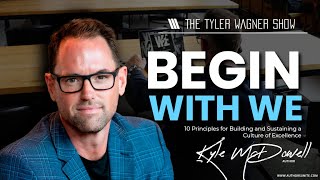
Kyle McDowell turned around a toxic 15,000-person organization at Maximus by reframing every core value as a "we" statement. His 10 We principles shift culture from results-only to people-first, where leaders lead by example and employees feel empowered and cared for.
Chapters
All right, everyone, welcome back to another episode. Today we have Kyle McDowell with us. He is a best-selling author, inspirational speaker, and leadership coach. And Kyle is widely known for his inspiring approaches to transforming business executives into real leaders while reshaping corporate culture. So welcome to the show, man.
Hey, it's great to be here, Tyler Wagner. Good to see you.
You too, man. Great to have you on. So a lot of times how I like to start these off, because I'm always curious on when you were younger and where you like saw your life going and then where you ended up, is it at all what you envisioned or completely?
Not even close. Okay, not even close. Yeah, no, man, so many— for so many years I aspired to be a news personality. I wanted to be the next Dan Rather. Maybe I'm dating myself. And if it wasn't going to be Dan Rather, it was going to be on ESPN doing sports. And I realized the opportunity to make a decent living right out of college in that field is not very high. It is a grind until you make it type position, and then you may never make it. And at that point, frankly, I had already spent a few years in corporate America and kind of started to see myself advance. So I would have had to take a pay cut right out of college and I thought, man, I kind of like this standard of living I already have. So I gave up on the dream of being a news personality and off I went into corporate America.
Well, now it's kind of cool because we're doing this podcast and I don't know if you're going to do your own podcast someday or maybe you already have one. You can create your own kind of channel, you know?
That's right!
That's what I love about YouTube and Rumble and all these other networks, I guess you could call them, is you don't need to go through a big media, uh, place anymore. You can just do it yourselves. Is that what you would want to do, or, uh, you know, I gotta—
I've got a lot going on already. I mean, ultimately, I think I'm going to set up a podcast, but at the moment, I'd rather just join guys like you and do yours.
All right, fair enough. Yeah, get a little taste of it. You don't have to—
that's right. Yeah, put my toe in instead of jump all the way in.
Yeah, that makes sense. So with, with your book, and I guess, and then we can dial back, but culture, from my perspective, it's— and actually, we should just say the name. So you wrote a book, it's called Begin with We: 10 Principles for Building and Sustaining a Culture of Excellence. So I would consider you like a culture expert. And I was telling you this before we hit record. I know one of my good friends, he runs a company called Culture Matters. I'm going to connect you guys. I I think culture, it's starting to become more used or like a buzzword almost. So for you, like, how do you, like, I guess the question would be, because it's such a big question, but how do you like define what a good culture is? Or like, let's start there and then maybe get into more detailed environments of how you've helped companies become better culturally.
[Speaker] Sure, yeah. Well, I think, so you asked what is a good culture? So let me start by just kind of using my definition for culture in general, because what one might define as a good culture, another might say is toxic. So in general, I boil it down very simply to say culture is simply the environment in which we work. It's just the environment. You know, culture over the years has gone from kind of a nebular word that no one ever talked about to something that kind of transitioned into a negative word, like, how's your culture? To something that is much more front of mind to a lot of people lately. For a variety of reasons. But what makes a culture good in my mind is everyone is in a position, everyone on the team, everyone in the organization is in a position to be their very best. They are empowered, they are inspired, and they are cared for, and they care. So if you can enter that environment where those around you, not just the boss and not just those that you pass in the hallway on your way to grab a cup of coffee, The team with whom you work day in and day out, they genuinely care about your success and you genuinely care about those. And it's obvious. It's not words on a wall. It's how we treat each other and how we behave. That's how I would describe a good culture.
Yeah, I love that. And what's interesting is I think, and I'm remembering like something from what Gary Vee said in one of his things is like he likes to promote in his like company culture is like to take risks. I feel like a lot of company cultures, they, they make the employees scared to try things because— whereas what you want to do is almost promote, like, they call it like an intrapreneur now or something. It's like you're an entrepreneur within. But as we were talking about before, like, a lot of small businesses, they don't have like a mission statement, values and stuff, because when you're small, you don't necessarily need it. Although I'm sure it would be helpful.
Sure.
You really need it. And tell me if I'm wrong on this, but I think you really need it when you get bigger because it's the only way to keep an organization in alignment from like the number 1 person to the 200th person. Without that vision and values, it'll become unstable, right? Like that's—
I think we're done here, Tyler Wagner. You nailed it. No, you nailed it. I mean, it's true. I got a good friend of mine says new levels, new devils. And by that, I think that's very appropriate for this conversation because if you have an organization of 10, 15, 20 people, that's pretty grassroots, right? You're able to kind of call a spade a spade, and you can be really direct with one another because in many instances, those organizations, they were created with those people at the same time. So they haven't taken on tens of thousands of employees like I've been fortunate enough to lead. And the new levels, new devils thing is absolutely true. And you kind of intimated this, the bigger the organization, the more trouble is potentially around the corner. And that trouble can take a million different forms, but it's just harder to wrangle. The more people you have, it's harder to get that big group of people on the same page with how we're going to treat each other and those we serve. You also mentioned something, Tyler, if I could just capitalize. You said something about the bigger the companies get, the people inside end up being afraid. And I would say apathetic in many ways. And I love your opening question. Think about when you first entered the workforce. You entered with, I would imagine, a sense of optimism. You were eager. You were encouraged. I mean, you were the eager beaver, right? I know I was. And I was literally called that in one of my first early corporate roles. But over time, I think it's safe to say many of us, if not most of us, we lose that sense of optimism. We lose that energy. And why is that? That's a great question. Why do we lose that optimism? Because I think over time, Bosses, not to be confused with leaders, bosses create an environment where I'm scared to take risks. I'm scared to put my neck out because I'm going to get reprimanded. And out of that kind of apathetic approach comes no innovation, it comes status quo. So that's why I think you're absolutely right. The bigger the company, the more opportunity for culture not to be its strongest asset.
Yeah, and I was gonna— the next question I was gonna ask you, because you have led, like you said, tens of thousands of people. So what was like, um, not to ask the typical, like, what's a typical week look like, but more so in a detailed way of like, what did a typical week look like from a leadership role to keep the culture good with tens of thousands of people, right? Like, what were some of the consistencies that had to happen and I guess like how was that culture created in your scenario?
It's all about the people, man! It's— and that sounds so incredibly cliché but it's true! In my career and I spent nearly 30 years in corporate America, the last dozen or so leading 10,000+ people in each role, it's all communication and people! It is— Look, I care a lot about results. Results matter a whole heck of a lot. Driving a big profit and making our organization grow and returning money to our shareholders is obviously very, very important, but I just happen to believe that's secondary to people. If you approach every single day with your focus on empowering, inspiring, and leading in an authentic way, those around you rally. You create a gravity that people want to follow. And then the results just come that much more easily if you're aligned culturally. So my emphasis has always been on the people. And that's essentially what drove me to write the book. I told myself for the first probably 20 years of my career, I could gradually feel myself becoming more and more disenfranchised with corporate America. And I guess it was around year 20, 22, I realized It doesn't have to be this way. It shouldn't be this way. So I told myself, if I'm ever given the opportunity in a role that has the autonomy to really drive massive change and do it exactly the way I want to do it, I was going to do it very, very differently. I wanted to be the leader I never had. So I took on a role in 2016 that had some opportunities, we should say, in the culture area. It was a bit toxic. Yeah, that's diplomatic on my part. Good way to put it. In many ways, it was toxic. There was a lot of silos and picking up on something you said a moment ago, there was a lot of fear. People were genuinely afraid to think. And I mean that. So afraid to think outside the box. Why do we do it this way? Well, Kyle, we've always done it that way. That's the type of response I would get a lot. So I took this role and I had about 15,000 employees. And I guess it was about 60 days into the role, I was to meet with the top 40, I guess it was 40 or 50 leaders in that organization. And Tyler, the night before, I was in Lawrence, Kansas. The night before, I had no idea what I was going to say, but I just knew it was my opportunity to really put my stamp on something and do it the way that I know, or I thought at least at the time, would be different. And it would create a real, almost a family of sorts. Yes, in an organization that size. So I'm in my hotel room the night before in Lawrence, Kansas, laptop in my lap, blank PowerPoint. What the hell am I going to say to this crew? And about 3 hours later, I was staring at 10 sentences with no preplanning. I had no motives prior to this. Each of those statements or sentences started with the word "we." From "we do the right thing," and I'm sure we'll walk through them all the way through all 10 of these. And I ended up with 10 statements all starting with "we." And it occurred to me that would be this collective group of statements would be the principles that govern how we treat each other first, because I'm just adamant. If we're high functioning behind the curtain, if I treat you well and I look out for you behind the curtain, we are so much better positioned for success externally for those that we serve. So I'm not that creative. So those 10 principles ended up being called the 10 We's because each of those sentences, as I mentioned, start with the word we. I shared those principles the next day with those 50 leaders. I got some looks of disdain. I got some looks of uncertainty. A couple of folks were kind of excited about it. And I said, listen guys, and by the way, the entire presentation was in black and white. And that was purposeful to say, these are black and white. If you cannot subscribe to these principles, then I don't think you need to be a part of this team. And slowly but surely, I could feel the momentum change and I could act. And it got to the point, Tyler, where I would literally hear people reciting a "we" in a meeting. One I would hear routinely is "we number 8, we challenge each other!" And I would hear it in meetings, conference calls, even one-on-ones, even directed towards me before an uncomfortable challenge would come because nobody loves challenge. Most people don't love challenge, especially in the corporate environment. I started to hear before a challenge was issued or someone was going to be a little bit antagonistic towards someone, they would say Hey, we challenge each other, right? Just to kind of lower the energy in the room so people would not be so defensive that someone was being called out for their work, right? So that's the other byproduct of having these principles is they establish kind of a cultural currency and that currency has the same value for the intern all the way to the CEO. And I was adamant when I rolled these principles out, I was so adamant to say, guys, these are how I'm going to treat you. I will hold you accountable to these 10 principles but more importantly, you got to hold me accountable to those 10 principles. Like, you have to make sure I'm walking the walk and I'm telling you now and if I don't— if you see me not walk the walk, grab me by the ear and say, dude, you're not delivering! You're being a hypocrite because I need to hear that because I'll tell you and there's something called the leadership gap I talk about in the book where I'm not allowed to behave any differently than you as your leader. We are on the same Same level, same page. Right. So if I expect something out of you, you should have that same expectation as me.
Yeah. And see that it's funny because we're very much on the same page here. That's what I was going to say. And I'm not trying to relate everything back to Gary Vee. It just came to mind.
There's a lot to relate to Gary Vee though. I'm with you.
It seems there is. Well, it's that thing where it's like, and he would even say that he like works like more than his like employees. Regardless of more or the same.
Yeah, yeah.
The whole thing behind it is like, I think there's this misconception a lot of times with people. They're like, oh, once I'm the boss, then I don't have to work as much, or that's the problem.
That's exactly right. That's the problem.
Yeah. And really, if you— to actually have a good culture in your company, it's not just about, like, in my opinion, just creating these values and these, um, like 10 we's like you did, but you actually have to put them in action and show Yes. And if your employees, like, if your employees see you working just as hard or harder than them, natural, I think just natural psychology, they're going to mirror that, you know, like, that's just kind of—
look, man, if you know members of the team care about you, care about your success, care about your matriculation through corporate America, and that feeling is vice versa. But more importantly, if you have that same relationship with your boss, that's now your leader, not a boss. If you can sense and he tells you or she tells you directly, Tyler, I care about you. I want you to do well. I want you to perform well. I want you to find the next promotion, even if it's not on my team. That shows I'm more invested in you rather than I am in the outcome, because if I invest my energy and care into you, the outcomes will come. And you nailed something and this was not pre-rehearsed obviously, but of the 10 we's, the second is we lead by example, right? Because I feel the first one is we do the right thing always. Literally, it's the second sentence is one word, always. Because with that foundation, everything else is kind of positioned for success. And if we can't agree that we're going to do the right thing, we could We can disagree on the right thing and that's okay! We should have that conversation but if we are grounded with that foundational number one belief that we will do the right thing, everything else kind of falls into place and the second way is we lead by example and too many times, I'm really big on this statement, you know, be the boss that you wish you had or be the leader that you wish you had and leading by example is probably where most leaders fall short and when they become bosses, is they see this behavior that they loathed in their boss, but when they get that promotion, they replicate the same behavior, right? So somebody has to break that cycle, right? Somebody has to break that cycle and I'll give you a really quick story about that. So number 2 is we lead by example. Number 8 is we challenge each other and when I first joined— the company's name is Maximus, by the way, where I rolled out the 10 Whys to begin with— there was a member of my team that was not on board. She just challenged me at every turn, man. I'll never forget, I asked her for a spreadsheet of some data once and she sent me a screenshot of it. Well, if you've ever worked in Excel, a screenshot is nothing like working in Excel. I couldn't go to the cell. I couldn't look at the formulas. I'm like, "Come on, man. What do you—" She was purposely challenging me. Had I reacted with an iron fist and banged my fist on the desk and kind of raised my voice, the classic boss response to someone kind of trying to get under your skin, I'm not leading by example. I'm not doing we number 9, which is we embrace challenge. I'm being a boss. She's challenged me intentionally, whether she would admit it or not. She's challenged me. And if I react in a way that is anything less than endorsed by those 10 principles, I'm now a hypocrite and everything else is a house of cards. Parenthetically, she's one of my closest friends now, 6 years later. True story. Yeah, that's awesome.
And I, as you were talking, I'm realizing this more and more too, because— and I won't say the company in this interview, but like my dad, he works for, I think it's a Fortune 50, like very large company. And then a lot of my dad's friends do. And I remember growing up and just, I, I heard so many stories growing up of like just the culture in a lot of these big organizations is very off, like It's— it almost is like— it almost seems that— and I don't— it doesn't seem this is intentional, but from all the things that I've heard so many times, it almost seems like a lot of times the employees are like almost competing against each other, but not in a healthy way. Absolutely not. Like, they, they will like try to point out negatives in others to make themselves like— or basically anything to keep their job and upgrade, even if it hurts the team. All day. I just don't see how that can— but I do think that some companies are just so profitable, like a Fortune 50, like that big. It's almost like they— I mean, they could fail, but they have so much cash reserve that like—
You are spot on, man. And that's why the whole concept of we was so important to me. We, not me, right? Because the truth is there is enough spotlight for everyone. There's enough to go around and what happens I think and it's— look, we're in the society today where I comes before me pretty much everywhere. We got the iPhone, the iPad, everything I is cool, right? And then we don't subconsciously just— we don't forget that when we walk into the workplace. So we're focused on what I can do, my achievement, my promotion, my raise. We're focused on those things but as a leader of people, If you maintain that focus and it's all about me and me getting promoted and me taking on the next role, I'm doing that at the expense of my team. So if a leader can transition that thought process, that paradigm from I and me to we and he or she invests the time, energy, the caring and they're authentic about it and they inspire and empower their team, there's no way you can't be— you won't succeed. There's no way because you've shown them that you're in it for them, not in it for you, and everyone wants to be led by someone with that level of authenticity. You're absolutely right though. The bigger the company, the more toxic and the more competitive, and you said you're not sure if it's purposeful. I'm here to tell you, in many cases, it is purposeful. It is absolutely intentional that someone will sandbag someone else. Someone will be in one meeting talking about You know, taking one perspective, go to the next meeting but the flavor of that meeting has a different perspective of that same topic and they shift immediately. They're not authentic. They're not true to themselves and that just creates this hypocrisy in this environment that you never know who you're dealing with and let's not forget, right? Corporate America has its own set of vernacular, has its own set of— like when's the last time you came home and said, "Hey honey! Did you get that deliverable done today?" No, you don't. Nobody speaks like that. Right? Right. So we, when we enter the workplace, we are the work, the workday. It seems to me that there is a bit of cloak and dagger in some ways, a bit of Jekyll and Hyde in other ways, but rarely is it as authentic as it could or should be. Yeah.
And see, that is very toxic because it's the right word in every meeting. If you're not sure if that person at the next meeting is going to like backstab, maybe it's a little strong, but, or switch their thing, then how could you ever be honest about your, like, eventually what ends up happening is the way everybody would end up acting is in accordance to just pleasing everybody in that current meeting. So true. And then you never have any growth at all because it's just all a lie actually.
It's all a lie. So true. Well, think about it. Anything in life is the result of a challenge. For overcoming one or more challenges. Pretty much everything in life and the workplace is no different. But if you're not allowed to issue challenges and you are asked to drink the corporate Kool-Aid and subscribe to this vanilla way of doing things, everyone's going to agree with each other, but they won't behind your back. And no one will have the courage, which is a very important word in corporate America. No one will have the courage to surface new ideas, to be innovative. So, you're looking at a status quo sandwich. There's just nothing better to be— there's no benefit to speaking your mind. There's no benefit because you're going to get your wrist slapped or worse, you'll be asked to go do something else. Yeah!
And I just thought of something too and which in that toxic environment would be very difficult but imagine if there was a way because like you were saying, it's like it's so ingrained in us now all about I and even if you think about like getting a job, right? You come in and you show your resume, which is like all about what you can do or have done. And I'm wondering if there, if there could be a way where it is like focused around we, but from the beginning. So not even after they get into the organization, but rather to be hired, your resume is not about what you've achieved, but what you've helped others, or, you know, or something like that.
No, I love that.
Framing is actually correct the whole way, like, through.
Yeah. And there are ways to evaluate and kind of assess or observe that— assess or observe that. It's like, how many people have you promoted? How many people on your team— like, a question I often ask when I'm interviewing candidates is, how would your team describe your leadership style? Or how would your team describe you as a leader? And you get mixed answers, a lot of happy talk usually, but I just so firmly believe that if all of my energy— well, not all, I would say 95% of my energy is geared towards making the people around me better than they were the day before. There is absolutely no way we're not positioned for success. And it pays itself back over and over again. You have a choice, right? You can really focus on the people or you can focus on results. It's hard to be really focused on both. If you focus on results only, there's a chance, a pretty high chance you might achieve those results, but at what expense? You could alienate and kind of beat up the team in the process, or you can focus on the people. And I'm convinced, and I've seen it, it's not theoretical, the results will come. If you pour your energy, your heart, your soul, everything into your leadership, your people feel it, they see it, they recognize it, they work harder for you, and the results come naturally.
Yeah, and 100%. And that's how I'm seeing it too, is like, imagine the two different scenarios. So You focus on the results, you get the promotion because, like, you know, let's just say you, you got the results, so you got the promotion, or you focus on the people and then your whole team actually wants you to get a promotion, right? Like, so you get a promotion because everyone around you is saying, yes, like, he deserves that. Like, or— that's right, that's right. That way is certainly better, uh, I would say.
Yeah. Hey man, I'll tell you a quick story. When, um, So when I was at Maximus, again, where I rolled out the 10 Whys, I can say with— it will sound arrogant, but it's not true. It's not arrogant. Others will vouch for me on this. We turned that program around. We turned that organization around. Not me, we. Because they were hungry for a leader to be authentic. They had had some toxic behavior prior to me joining. But here's the story though. So I was there a few years before I left to take on another role. And man, when I left, as it's typical for me, if I'm going to make a major announcement, if there's something that needs to be communicated widely, I'll get all the right people either on a conference call or in a room depending on the environment. So when I was going to announce my resignation, of course, I'd already run it by my boss at the time and he was aware and I said, listen, Tom, I'm going to pull the leaders together and have a conversation on a conference call. Tyler Wagner Wagner, I bawled. I cried like a baby on that phone call because we had forged such a relationship and they cared so much about me and I cared so much about them. I felt like I was abandoning them. But they, to your point, they were excited for me. They were happy for me, nervous about the road ahead. Kind of parenthetically though, I've been gone since 2019. They just had me back to deliver another we keynote about a month or two ago. So goes to show you the impact that was had and that they all felt that I'm still connected with those folks. They were the big— actually, a lot of those people were a big driving force for me actually to write the book.
Okay, got it! So, a question I have for you. So, have what you instilled from a cultural standpoint in that organization, the new or the person that's now in your place, obviously they have their own flair but has that kind of roadmap stayed in the general sense?
Like— It's still there. As a matter of fact, when I was— I flew to Arizona to deliver that keynote, I participated in the WE Awards. So twice a year, they still deliver WE awards. If you're observed or caught doing something that exemplifies any one of the WEs, someone else can nominate you for that and there's an award process. So we are— so I rolled them out in 2016, 2017. We're 2022 now and they're still in practice. And by the way, the leader, the guy that did assume my position, we're friends now as well. We emailed back and forth just today because he runs other programs inside that same company and he's keen to have me come do the same thing for some of those other organizations.
Yes, yeah, you definitely did it right, man. That's— that, that all is just in such alignment where like the new leader is— you're in contact with them, they're inviting you back. Like, it's not— it's, it's like healthy challenges. Like, you've been— that's right, not competition. It's not win or loser. It's like, it's literally a win-win-win, like, in every direction. And it's—
it has to be authentic. And, and I'll tell you this, the team there I'm very, very proud of many of the promotions that took place while I was there and since I was there. I feel like I played a role in that. The leader that's in the place in my chair today is one heck of a guy and he had an opportunity to say, "This is garbage! I don't believe in this stuff. Like, we're putting my principles in place." He did none of that because I feel like when the team recognizes that you're authentic, you're genuine, you really care about their success, boy, will they work a lot harder for you.
Oh, without a doubt. And actually, again, it's— I see something in that, like, the fact that, that the new leader potentially was able to remove his ego of wanting his own rules. That's exactly right. Yes, it is actually very powerful for others to see that, like, hey, he really— and I'm just saying it's a he, right?
It is a he.
Yep. He, he really cares And he cares so much that he doesn't even care that it's his name or your name.
That's a beautiful thing. You know what I mean?
And that shows that you care even more, right?
My man, I even pulled him aside when we were in Arizona and I said— he wouldn't mind me saying his name. I said, Lou, it takes a very confident man to do what you're doing because he assumed basically my leadership team, the folks that reported to me, he did not make one change to the 10 W's. As a matter of fact, he is evangelizing them throughout the rest of the organization now. But what an egoless, selfless move. Move. And I told him directly, I said, I'm not sure if I would have been as egoless as you are. I admitted it, which I guess is part of being egoless to be able to admit it. You know, there's some irony there. But so we had a great talk about that and you're absolutely right. It says a lot about him as a leader to be able to embrace someone else's principles.
Yeah, that's awesome. So I want to ask, as we're winding down here, I want to ask this is tell us a little bit more like why you decided to— and I think we know why, but like, what's next for you? So you wrote the book, and then what are you— and you're doing talks, but just tell us a little bit more about what the future looks like.
Yeah, man, as cliché or as corny as it must sound, I'm on a mission. I really am. I'm on a mission to evangelize these principles because I'm convinced they work. I'm convinced they provide a foundational set of beliefs that everyone can rally towards and align around. And then of course, results speak for themselves thereafter. So I'm on a mission. When I left the last role that I was in, I had an opportunity to join another organization very, very shortly thereafter. Big role, big money, you know, huge scope. And I was at a crossroads. I had to ask myself, do I want to go back into that fray and lead a turnaround, which has been a pretty consistent theme throughout my career, is turnarounds and in kind of cultural transformation, or do I want to take these 10 principles that I believe in so strongly and try to evangelize them to hundreds, if not thousands of organizations around the world? And I chose that path. So it is now— it is my life's purpose. I genuinely believe it's my life's purpose to evangelize these principles and share them as widely and as far out as anyone will listen. So that can take on a variety of mediums. As you mentioned, I'm doing a lot of speaking. A lot of podcasts. I'm very fortunate to meet with guys like you to get the message out. So by any means necessary is my approach to get these principles and this message out because I believe a life without fulfillment from the thing that we do more hours a week than anything else in our life, our work, is a life wasted. Why should we dread doing what we do every day? Now, I'm not naive. We've got bills to pay, right? It's called work. It's not called fun. I'm not naive, right? We're not going to jump out of bed every morning and be excited to go to work, but we shouldn't dread going to work. We shouldn't dread and always wonder if— is what Bob said in the hallway to me what Bob really thinks? Matt said this to me earlier today. Should I be worried about what Matt meant by that? That type of undertone of insecurity, apathy, disengagement, fear, those things should never be associated with the one thing that we do more often than anything else in our lives and that's work. So I'm on a mission to create environments that people can actually be their best. They can be their true authentic selves, warts and all, you know, be okay and be comfortable with their lack of perfection because they know people around them will pick them up. So, that's the goal for me for the next— well, for the foreseeable future. That's my next chapter.
Dude, that's awesome and I agree. I've actually— ever since I was young, I always thought about— and I guess I'm still young. It's funny, whenever I say that, people are like, "Dude, you're still young." Yeah, yeah, yeah!
Slow down!
Yeah, yeah! But what I mean is like, work is so much of your life. So, I think if anything, If what you're doing at the minimum makes people's careers more enjoyable, that would be worth doing it just for that reason alone. You know, because it is the majority of your life. It's crazy. Yeah.
It's, you know, I love delivering good results. I love hitting key performance indicators. I love delivering. I love making money. I love delivering value to shareholders. But it all pales in comparison to my passion for developing great leaders. It really does. And what I found, by the way, with these principles is You know, I did a lot of research prior to taking on the task of writing the book, and part of that research involved getting feedback from people that I'd worked with over the years. And I would say 8 out of 10, maybe 7 out of 10, talked about how these principles affected and changed how they view their personal lives, how they interact with their family, how they view— one fella mentioned it influences how he raises his kids now. And the beauty of that is, it's not like, why should we have the set of principles that only apply to the workplace? Likewise, why should we behave and have principles that only apply outside of the workplace? You're asking me to be two different people and that's not authentic. So if I can be the same person in and out, I get it. You know, there are limits, right? We can't— there are things outside of work we can't do inside of work. But if we hold true to the principles that make us who we are inside and outside of work, I truly believe most people in corporate America today spend an inordinate percentage of brain power just trying not to get caught, just trying to stay off the radar, stay out of the boss's crosshairs. If we can do away with that wasted energy, imagine what we can accomplish if we're focused on really delivering great results for those we serve. As a leader, those I serve are my team. If I'm on the team, those I serve are the external client.
Couldn't agree more, man. So what I want to do now, I want to leave the floor to you. Like anything that we didn't cover and you want to share, please do. And then Let people know, like book, website, socials, like where can everybody stay in contact with you?
Yeah, you bet. You know, I would just encourage everyone to align around a set of principles in the workplace. They don't have to be the 10 Whys. They don't have to be anything that I've shared today or anything within my book. The point is principles are so important because they are, by definition— let's nerd out for a second— a principle by definition is a foundational belief. It's a truth. It's we hold this to be true. So while mission statements and corporate values and all those things are very, very important, they don't speak to the employee on a very practical level. They don't speak to the employee on a relatable, every single day. Like, we challenge each other. Like, that's something I heard, as I mentioned, regularly. If we can align around a set of foundational beliefs, then the principles will enable the values, which will enable the mission statement. So if I would encourage— if I could encourage anyone listening today or watching today, It is lead with a principle-based foundation. That is how you get people to rally. Now, just as important is you have to live those principles, right? You have— you can't just— they can't be words on a wall. They have to be observed every single day. So, and then I guess right closely right behind that, something similar or related to what I mentioned earlier, and that is someone has to break the cycle. Someone has to break the poor leadership cycle that we've all been exposed to. Throughout various points of our careers and it should be you! And who is you? Anyone listening is you! Take that task and accept that challenge and break that cycle! If you're interested in anything I've said today, please pick up the book. It's available wherever books are sold. It's called "Begin with We: 10 Principles for Building and Sustaining a Culture of Excellence" and you can find me on all my socials at @KyleMcDowellInc. And my website is also kylemcdowellinc.com.
Perfect, man. Thank you again for coming on.
I appreciate it. Oh, the pleasure's mine. Thanks, Tyler Wagner Wagner.
More from Tyler


Catherine Nikkel : THE STORY EVERYONE HAS BUT HASN'T TOLD : The Tyler Wagner Show #1120



Scott Ritzheimer: Bring Predictable Success to your Organization | The Tyler Wagner Show #1115


Fred Moskowitz: A GUIDE TO GETTING STARTED WITH IN MORTGAGE NOTES | The Tyler Wagner Show #1113

Mark Podolsky: From Land Investor to Full Time Success How I Made $90,000 Cash in Real Estate


Mark Podolsky: How to achieve a 300% return on investment my foolproof strategy

Mark Podolsky: How to make passive income selling raw land the irresistible pricing strategy