Laura Gallaher: Benefits Of Making A Culture Better | The Tyler Wagner Show #1029
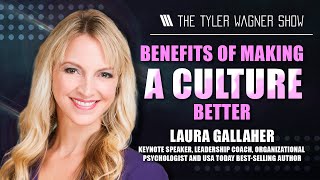
In this episode of The Tyler Wagner Show, organizational psychologist Laura Gallagher discusses the nature of organizational culture, describing it as an emergent property arising from shared beliefs, interactions, and behaviors. She explains why culture is hard to pin down, using the analogy of sugar’s taste, and emphasizes that culture lives in the heads and hearts of people. Gallagher recounts her work at NASA following the 2003 Columbia disaster, highlighting how cultural factors—particularly a lack of psychological safety and normalization of deviation—contributed to the tragedy. She describes the process of observing behavior, the Hawthorne effect, and the importance of leaders fostering openness and self‑awareness. The conversation introduces her "green‑line openness" framework, which categorizes withholding, half‑truths, and manipulative communication, and stresses the role of self‑disclosure and self‑accountability. Practical tools for leaders and individuals are shared, including journaling, gratitude practices, the "8‑second pause" between tasks, batching work, and building downtime. Gallagher talks about her book, The Missing Links: Launching a High‑Performing Company Culture, the accompanying multimedia website, and how they use short videos and QR codes to extend the book’s content. She notes that most of their clients already have decent cultures, so their work moves organizations from good to great. Regarding authorship, she highlights the benefits of co‑authoring, external accountability via a writing coach, and allowing drafts to be imperfect. The discussion also touches on self‑trust, referencing Gary Vaynerchuk and Benjamin Hardy, and explains how treating oneself with the same accountability as others builds self‑acceptance, which underpins effective leadership and personal well‑being. The episode concludes with information on where to find the book and Gallagher’s social media channels.
Chapters
Alright, welcome back to another episode. Today we have Laura Gallagher with us. So welcome to the show.
Thanks for having me.
Of course, grateful to have you here. If you can just start us off, tell us a little bit more about you and what you do.
Well, I am an organizational psychologist, so that's all about understanding, explaining, and even predicting behavior at work. And my company, Gallagher EDGE, works with leaders to help them create really effective cultures so they can get their edge, achieve together, and enjoy the journey.
So how did you— culture, we were talking a little bit before I hit record, it, it's something that I have a friend that helps organizations with it, so I have some understanding, but it's such a huge like scope that— yeah, how would you even describe it, I guess, uh, in a simpler form? Like, what is it?
Okay, you asked for simple, but can I give you— can I give you our very geeky definition and then break it down? Okay, okay. So culture is an emergent property of organizations, and that emergent property comes from the common interactions, common beliefs, and behaviors of the humans. So emergence is the first part. And the way that we love to explain emergence is like the taste of sugar. The taste of sugar, that's an emergent property. We all know what sugar tastes like. And I am not a chemist. I did fine in school with chemistry. It's not my expertise. But we also know that sugar, sucrose, has the elements of carbon, hydrogen, and oxygen. Right? So I can't ask you though to lick each of those things, lick carbon, lick hydrogen, lick oxygen, and then sum it up in your head and tell me what sugar's gonna taste like. In fact, if I use some of those same elements, I can create something that tastes very different, like gasoline. And so one of the reasons why culture is challenging, and we describe it as emergent property, we can't take elements of an organization, break them down into their individual pieces and parts, look at them individually, sum them back up and go, "Cool, we've done it." We have to be able to understand the interactions. And then most of those interactions are actually what is happening between the people. So, in organization, leaders can do cool stuff like have a ping pong table or Bagel Mondays or potlucks. Like, they can work to create experiences, but it's always going to come down to what are the beliefs and the behaviors of the human beings in the organization? So, the extra challenge with culture is that it really lives between the ears of the people, right? It's in the heads and hearts of the humans. And so, that's why culture feels like big and abstract and nebulous. It's kind of like a smokestack, you know, you can't really grab it. You have to be able to understand like what is influencing this and really focus on the emergent properties.
Got it. Okay. No, that's definitely helpful. Still tricky, I'd say.
Well, and yeah, I mean, and that's really, that's why we wrote the book that we did because, do you want me to give you some of the background on that?
Yeah, yeah. And it like, I think, isn't it like, it's like 400 pages. It's like a stock book I just saw.
It's a little bit on the longer side. And Tyler, you, I mean, okay. So here's part of what happened too in our writing process. It might seem long, the cutting room floor though, oh my gosh. So, we ended up cutting a lot out of this book because we did want it to be reasonably digestible. It's maybe on the long side, but we actually created this whole website to go along with the book and we have all of these like videos, like these 5-minute videos where we just take the concept and we explain it and people can actually like take assessments. So, we made it like a much more interactive thing because we didn't want the stuff that we cut out of the book to just disappear. We wanted people to really have the tools to understand how to make these ideas real within their companies. And so, we made it this whole like multimedia experience. So anybody who gets the book can just use like the QR codes, they get access to the website, and then they get to see some of the stuff that we cut.
Yeah, no, because everybody learns different too. So I, I like when there's a book, and I think this would be one like that, um, like, have you ever heard of Jordan Peterson before? Oh yeah, Rules for Life. Okay, so he's one of my favorite authors, and then a lot of people that he learned from, like Carl Jung, Friedrich Nietzsche, like there's I will listen to them like slowed down, and I'll read it as I listen. If they have videos that went along, I would also do that too, because I used to just be an audiobook person. But with that type of content, for some reason I'd find myself on like a 2-hour walk listening to Carl Jung and then get back, and then I'd realize not one thing.
Nothing stuck.
No, no, nothing. I was just like, I think he was talking about dreams or something. Either way, you got to slow those ones down.
Yeah. And repetition is useful too, right? So like, there's obviously there's overlap, so, you know, people can read it in the book and then if they go and they use the QR code and they watch the video, there's some overlap, but people love that, right? Like our brains are like, ooh, familiar information. And like we light up and we're paying more attention actually when it's something that we know.
So yeah, I think it's actually key to just highlight for a second, like Two things on that. Like, I definitely recommend reading books like more than once because I've found every time I've done it, I always learn something new that I missed. And also, depending on when you read it, like your life experience up until that point, the book could be like completely different because it's kind of an interaction between you and the content.
You can never sit in the same river twice.
Yeah, yeah, that's cool.
Yeah, exactly. I believe that wholeheartedly.
Uh, so let's, uh, because the NASA story obviously in your bio and on the website, like, that's— and in the description of the book, can we start there and then kind of lead into the book from there?
Absolutely. Yeah. So I began my career with NASA, and the reason that they hired an organizational psychologist is, um, many people will remember the 2003 accident, which was Columbia. People often think about Challenger first, which was actually in the '80s. And since we are at least partially on video, hopefully people look at me and think, no way was she old enough to be hired after Challenger, because that's— I've been accused of that before. And I'm like, no, no, I was very little then. But Columbia was the accident that NASA had with the shuttle program when the vehicle was reentering the Earth's atmosphere. And so it wasn't quite as memorable for folks. Most people weren't watching it at the time. And I won't go deep into the technical stuff. There was a piece of foam that fell off of the external tank during the launch, and it hit the vehicle, and they weren't sure where. The investigation revealed that it had actually hit on the leading edge of the wing, which was not nearly as strong, and it created a hole. And so that hole in the wing allowed a lot of the gases and all of the heat during the reentry process to break the vehicle apart. And so NASA lost all 7 astronauts. But what was really the reason why they ended up hiring me is because they said that culture at NASA was as much to blame for the accident as the piece of foam itself. So, I don't know about you, but when I hear that, when I hear about a literal life-and-death kind of tragedy and culture is to blame, I get an idea in my head about that culture. Like, I picture toxic behavior, I picture disengaged people, overbearing managers. Like, it seems like, "Oh, man, it must have been a disaster." But only a couple months before the accident, NASA was rated the number 1 place to work in the federal government. It had the most committed and the most engaged people. So, it really raises that question of like, "Well, what the heck is culture then?" Like, if you can literally have rocket scientists, some of the smartest people in the world, They're the most engaged, the most satisfied with their jobs, but culture's to blame? Like, what is culture then? And so, my business partner, Dr. Philip Mead, was asked to lead the culture change initiative at Kennedy Space Center, and he has a PhD in industrial engineering, so he had some foundation for it for sure, but then he discovered there's this whole field of organizational psychology. So, he hired a few of us to come on board, and we actually formed a team at Kennedy Space Center to pay attention to culture and help transform, create psychological safety, and work with the leaders. They could really have not just a good culture, but an effective culture.
So let's go deeper into that because I'm curious, like, how did you— what does that process look like? And like, one thing that comes to my mind would be, are you in part of that process? Are you kind of like a fly on the wall in the beginning where you're just like watching the way that people are interacting and what's going on. And then you can kind of see where the issues are and then kind of fix from there.
So the Columbia Accident Investigation Board, or the CAIB, that's the acronym. NASA loves acronyms. I mean, NASA in and of itself is an acronym. So the CAIB report, in all of their investigation, they were reporting out on some of these fundamental issues and challenges. And so a lot of that that happened before I was actually working there with NASA. But Dr. Philip Mead did actually create things like, here are the behaviors that we need to see from leaders. And if we don't see these behaviors from leaders, then we've got a problem. So, there was definitely an element of observation, which is tricky in and of itself. I'm sure you're at least somewhat familiar with that whole like Hawthorne effect. Have you ever heard of that study? So, for any of your listeners that don't know it, they were looking to see like what is the impact of different lighting on productivity. And they found that brighter lighting increased productivity and dimmer lighting increased productivity and keeping the lighting the same increased productivity. And so what they realized was, oh no, people just being watched, that's what increases productivity. So the Hawthorne effect means simply by observing something, you are likely changing it. And so that's always one of the challenges, but there was this effort to really pay attention to what are the behaviors, especially the unintentional ones, that are taking away the sense of psychological safety that we need for people to be able to have the conversations that are hard to have. Like, what a lot of people don't realize, and this is part of what we talk about in the book, is how vulnerable it was for any of the engineers to really speak up any more than they already did about their concern about this foam strike because the powers that be at NASA had previously said, foam hitting the orbiter is not an in-flight issue. Like, it's called normalization of deviation. The foam falling off of the external tank had been happening for years. It had hit the orbiter lots of times before and it had never created a safety issue. It was something that they had to deal with when they were getting the orbiter ready for its next mission. So it was like already decided This is not an issue for us to pay attention to right now. And so they were already putting themselves out there to say, hey, I know we're not supposed to worry about this right now, but we're a little worried about it right now. And it was like, oh, well, what do the data say? Well, the data say that it could be anywhere from completely acceptable to catastrophic. So we don't really know. So NASA had a mantra of like, in God we trust, all else bring data. It's like, it's crazy vulnerable for these engineers to stick their necks out more than they already did to say like, hey, we're really worried about this. And so, psychological safety and really increasing the self-awareness of the leaders around how their behavior affects psychological safety, that was a key part of our whole initiative.
Yeah. So, it seems, and I think this is kind of what you were saying, but just attempting to simplify, like, Um, is like helping a company with culture. A big part of it would be to help people feel comfortable with saying things that— like, I think people a lot of times they avoid conflict. This is something I got from Pearson, and he's like, he's like, if you think something today is bad, you bury that thing for 20 years and you see how bad it is 20 years from now. And that's so true. We'll do that with avoiding conflict. Conflict. So I would imagine helping a company culture, a lot of cultures, or lack thereof, I suppose, or I guess regardless if it's good or bad, it's a culture, I guess.
Right.
But due to fear, or that would probably be the leading thing, is that the employees or the people in lower positions are afraid to speak out.
Yeah.
Because that initial conflict, but if they were to, it would be better overall for everyone, even though a little awkward in that initial phase of it. So is that kind of part of it?
Absolutely. Yeah, that's a huge part of it. Yeah. I mean, so we highlight that culture is from the inside out. And as an organizational psychologist, of course, I always end up fixating more on this part of the work that we do, which is really helping the human beings in the organization understand their own behavior. Like, all humans know that feeling of like looking back at a conversation in hindsight and being like, mm, I don't think I handled that very well. You know, getting like being short with somebody, snapping at somebody, being sarcastic or passive-aggressive. Like we all have those moments where we're like, yeah, that was probably not the best. And most of us don't actually stop to really pay attention to what was driving that behavior. Like what was triggering in me that that's how I showed up in the conversation and And most importantly, how can I change my whole mental model so that I feel like I have more control over my own behavior? When we can start there and really grow the self-awareness, then people start to notice the earliest signs of what you're describing, like, ooh, fear is causing them to just back down from this argument. They don't actually agree with you, they've just withdrawn. Or the opposite, where people maybe start to yell at each other, like, You can be right and defensive. People are only going to pay attention to the fact that you're defensive. So, if you're yelling at each other, you're definitely not communicating very effectively. And so, really helping the leaders understand first and foremost, what is leading them to behave the way that they do and how can they be as flexible as possible in their behavior? So, that's like the inside-out part. That's the self at the core. And we always start all of our work with our clients in that self space. Because we can't even have really productive conversations about what do we want this culture to be until we have truly ensured that team knows how to effectively communicate with each other in a way where everybody is showing up as their full self.
What do you think of this? Because this was kind of life-changing for me, is, uh, like, of omission. So is, is omitting something a lie or is it not?
So yeah, we think yes.
Yeah, I think so.
Yeah, we think yes.
Yeah, I think there's levels to it, right? Meaning like you wouldn't necessarily want to say every thought that pops in your mind. Like if you're like driving down the road and you like look at a car and for some strange reason you're like, damn, that's an ugly-ass car. Like you don't need to pull the person over and be like, yo, I had to—
I gotta tell you this.
Yeah. But like, so I guess I'm wondering, have you thought about the spectrum of that? Like where does it end?
So yeah, this is one of the first things that we actually teach our clients. So we call it openness and we specifically call it green line openness just because of the diagram that we draw to help people understand communication. We basically explain that there's 3 to 4 different ways that people lie or that they're not fully honest. One is just full-on withholding. Like I'm not telling you. Even though that's usually something that people do, not with that kind of sassy attitude. Normally they're doing it and they tell themselves like, well, I won't say anything because I don't want to hurt her feelings. Or they withhold because they're like, eh, I would say something if I thought it would do any good. Okay. So there's the withholding piece. Then there's this thing that we call the squiggly line, which is like, it could be what you're saying, like a half truth. Like, I'm only, I'm just going to say like parts of this, or I'm just going to spin it, this is crazy manipulative. This is actually somebody being like, I'm going to say to you the things that I think I need to say in order to get you to feel the way that I want you to feel. Like it's hyper manipulative. And people don't think it is. People think that they're doing it again, because they're so nice, you know, and they don't want to hurt feelings. So it's usually like you're saying, that fear of conflict, that conflict avoidance leads them to do all of these things that they think are very effective. And they're not. They actually all damage trust. So the reason why people get stuck is they don't understand that true openness and actually creating that psychological safety means I don't need to just spout off every opinion that shoots into my head because some of those are going to be very defensive statements. Me being more honest with you is actually more about self-disclosure. Like instead of me saying, Well, Tyler, you're just a jerk. Because most people know that that's not a very effective way to approach it. What I could tell you instead is, hey, so I notice that sometimes when we're in conversation, I actually back down because I feel like you don't necessarily want to hear what I have to say. And I'd like to see if we can change that pattern. So it's a more vulnerable thing to be like, hey, here's what I'm noticing. By the way, I'm self-accountable. I'm not saying like you make me feel this. So we teach people about openness, which leans very heavily on self-awareness, openness, self-awareness, plus self-disclosure. People have to understand what's going on for them in order to engage in a way that's not like guarded and defensive, which creates that unhealthy conflict.
Got it. Okay.
That was like my nutshell version. I often teach that in like a 30-minute—
No, no, no, it's perfect. I geek out on this stuff. Yeah, I think it's a lot of fun. So like in the book, so I don't know if we've named the title of the book yet. So it's called The Missing Links: Launching a High-Performing Company Culture. Do you have like, I think people learn the best through stories. So obviously the NASA story is huge. Are there any other stories, maybe in some cases you can't name the company name for whatever reason it is, but of like where the culture was like very poor and then you guys stepped in and it like, like what were the benefits of making the culture better? I'm sure you have.
Yeah, so we definitely talk about stories. I love stories. I am absolutely a storyteller. And here's one of the weird things about our work. I have never worked with an organization that had a horrible culture. And if you think about it, it's because who are the leaders who are going to hire a freaking organizational psychologist? Like, You know what I mean? Like, who's going to hire me? And it's actually the pretty forward-thinking, people-focused leaders. They're the ones that they already understand conceptually that culture matters. For the most part, they believe in the value intrinsically of developing their people. They just, they've hit a spot where they're like, things aren't working the way that I want them to and I don't know what to do. So, it's like sampling bias, right? Like, the kind of companies that are going to hire us to come in and work on their culture For the most part, they already have a pretty good culture. The ones who have like a terrible culture are the kind that don't even give me a second glance. And yeah, I've had to have other people remind me of that cuz I have, um, this really beautiful view of the world most of the time because I get to work with such awesome people. I get to work with such awesome people who, who get so much of this and want to learn and want to become more self-aware. So we have lots of stories. But they're not usually like, well, it was a total disaster, you know, and now it's utopia. Like, we don't have any of those. What we have are a lot of stories and examples of where these interactions between people are being affected by these internal sources within each of them, as well as external sources and helping them like better understand the— that whole emergent property thing. So we walk through like all the missing links. And we're geeks, so we back it up with science as well as stories.
Yeah, no, that makes a lot of sense. Like, somebody who's even aware of bettering their company culture, probably due to that awareness in itself, probably has a decent one to begin with. So yeah, that's the point.
Yeah, most of them are going from like good to great, you know, like that whole Jim Collins thing. Yeah, they're just leveling up.
Um, I don't think we covered this, and normally I start the interview out, but I, I think because the topic, I was really curious. So Like, what were you doing before all this stuff? Like, how did you get involved in even like this way of thinking? Like, what was the launch pad, I guess, is the question.
Nice, I see what you did there. So, well, are you asking what was I doing before NASA?
Yeah, and like even your, um, interest in this stuff. Like, I, I typically find like it'll be— it's like one book or like something in someone's life that like even got them interested in these types of things or even thinking in this way.
So yeah. So yeah, this is, um, this is one of my favorite stories to tell actually, because, um, this is where I get to really practice what I preach, where I lean into my own vulnerability and let the world know how human I am. So before NASA, I was in school. I was actually still working on my PhD throughout my first couple of years there. So NASA was my first full-time job. So picture that, I'm like 24 years old and they're like, hey, like you get to go consult now with the senior executive service director of engineering who's leading 700 people. Have fun. Like that was, you know, that was how I got started, which was great. I had an incredible amount of autonomy and it was really fun. And long story short, I built a really solid reputation with my internal customers where I was being this internal consultant and coach. But I did like lots of 360s, you know, like 360 assessments, a lot of those in my own development, partly because of the office that I was in at NASA and partly because I just wanted to keep learning about myself. And I did a 360 assessment at one point where I got feedback from my peers, so people who did the same kind of work that I did inside my own department. Who felt like I would at least sometimes engage in intellectual bullying with them. And I was like, oh no, like, that's exactly the kind of behavior that I am here to stop. You know, that's exactly the kind of behavior that if leaders that I am coaching and consulting with were doing, like, that would be taking away from the psychological safety that I am here to create. And it was a really upsetting and humbling experience. And I did this 5-day program called The Human Element. We reference it a few different times throughout our book. It's influenced our thinking on culture very significantly. And it went really deep into all of this self-awareness stuff. And it just like shook me to my core. Everything that I thought I knew about myself got flipped upside down and it started this whole journey for me, which I literally have tattooed on my wrist. It started this whole journey for me of recognizing that self-awareness is something that's never done. And like we were talking about before, you can never sit in the same river twice. I am always going to find ways that I can be more effective. I'm always going to find ways that I am taking away from psychological safety without meaning to, without realizing it. And so, it was just this very like, you know, I can have the PhD in organizational psychology and I'm still human. So am I doing my own work from the inside out? And I think that was what really like jumpstarted my fascination with going super deep with folks to help them transform their behavior. I mean, I've still got a lot of who I used to be, but like 15 years ago to now, I am— I'm genuinely proud of how much I've grown and how much I've been able to shift how I show up, especially in difficult conversations and hard situations.
Got it. So I want to— this is a selfish question because one of the things I find with myself is like my, uh, so here I'm gonna try to work this correctly. So it's like, I've— you definitely are intelligent, so, but like, do you also seem like you have the ability, like you're sharp, like you have the ability to kind of turn it off and turn it on? And what I'm currently experiencing is that my brain like never stops going when it comes to business, every— like So have you found through maybe self-awareness or other methods, maybe it's meditation, like what's your practices or rituals that you're doing to maybe balance it out? Maybe I'm reading you completely wrong, but you seem somebody that your brain's just kind of always like clicking. So yeah, have you found a way? And I'm asking because I would like—
because you want to know. So you're talking about like turning off your brain in order to what? Like to rest or to be present in a conversation or—
Rest. I find presence. I mean, with an interview, like, because I do have some notes, so I'll bounce back and forth a little bit. So it could take me out of presence a little. But if it's like a meeting and there's no, like, talking points that I definitely want to cover, I'm very good at presence. But it's more like nighttime. Even though my body's tired, my brain never is tired. Or I don't know, or maybe that's not true. It's just like, it's always going.
It's always going.
Yeah.
Yeah.
So I'm curious if you—
I do. Yeah. I have a couple of things. Um, and I'll give you one that's very tangible and then I'll give you one that's a little abstract and you can experiment with both of them. One of them I'm sure you've heard before, which is the power of journaling. So if you give yourself time, have you done that yet? Like journaled at night before you go to sleep? Yeah.
Like gratitude journals I've done.
Which I love. Gratitude is an amazing tool. Um, and if you find yourself like your brain is just spinning on all cylinders with all these different ideas, partly it's probably because you don't give yourself a lot of downtime during the day. And so it's like, oh, finally, we're not actively like in an interview, you know, or editing a podcast, like think, think, think. So that might be one thing to consider is how can you build in a little bit more downtime during your day? But the other thing is, in addition to gratitude journaling, let yourself actually write down the thoughts that are spinning in your head. It does a couple things. One is it actually gets it out of your head, which theoretically could stop some of the spinning, but it also slows down your brain. Like if you just let your brain think, it's gonna think faster than you can even say the words. You know, your brain is gonna be able to spit out thoughts much faster than I can speak, even if I'm speaking really quickly. Your brain can do that. When you write down your thoughts, you are forcing your brain to slow down so you can get the words on the page. And this does a couple things. One, slowing down your brain, that's part of what you're trying to do. And two, it actually allows you to look with more intention at what you're thinking/writing. Because sometimes we get like, we spiral and we spin. And we can actually, like, we blow past the very thing that our brain is trying to solve. Like, your brain's trying to solve something, but it's moving too quickly to even know. So if you allow yourself, and actually probably, like, make yourself, write down those thoughts and be patient to do it, you might find that when you stop writing and you lay down and go to sleep or whatever, that it's easier. So that's, like, the tangible thing. Here's the abstract one. Give yourself permission to think about it tomorrow. It sounds goofy, but like you can literally say, cause your brain is also part of what I think is happening is it's like, you might forget this. Like you might forget, think about it now, think about it now, think about it now. Right. Which is part of why writing it down is great. And the other part is like, you know what? This is, there's a little bit of fear, probably go Hey, thank you. Thank you for working so hard. I appreciate it. I know that you want what's best for me. I'm going to go ahead and give myself permission to come back to this tomorrow. So thanks so much. And I will talk to you then, like, whatever, like find your own language. And you know, I know it feels goofy, but giving yourself permission can actually be the thing that puts you over the edge of, okay, I'm actually more relaxed now.
Yeah, no, I think You nailed it for me because I, what I was going to say too on top of that, because it goes with exactly what you're saying, is I'm the type, like I email myself from my notes in my phone. Like literally, I don't want to over-exaggerate. It's probably like 40 or so times a day is pretty accurate.
Oh, wow. Okay.
So it's just because I have, but I think you're right because I'm like thinking about my schedule. Do you know The 4-Hour Workweek by Tim Ferriss? So one of the And I— it's a very good concept, but I'm realizing now in this conversation that a little more balance might be not a terrible thing— is I do batching. And so like the way I'll do is like all my interviews are one day, and then like tomorrow is all my like sales calls. I'll be like 30 calls in one day, and then my whole calendar for the rest of the day is just white, just wide open. But maybe like, you know, an hour lunch in between interviews. Or something and breathing for a second.
Like, give yourself a second. Yes. And I would say, Tyler, experiment, experiment and see what works with you. Like, pay attention to your, to your energy. You know, I mean, we all have things that drain us. We all have things that, that give us energy and there's not one right solution. People are always gonna share what they have found to be amazing for them and it's not a one-size-fits-all. So yeah, I would say experiment with it and see what you notice. See what feels better and see if you're getting like the calming down. Can I give you one more?
Oh, please do.
Okay. So I work with a lot of extremely busy leaders and I'm using like air quotes as busy, just because it's like, everybody's busy. If they tell me they're busy, I'm like busy and like busy doesn't tell me anything. Busy and excited, busy and exhausted. What's going on? They're all so busy. So I'm like, look, you have to, well, you don't have to do anything. But you might want to, you might want to choose to practice, just like I might do a couple pushups, you can do a little mental pushup for your brain where you do something that I just call the 8-second pause. So when you finish a meeting, I, well, I don't know about you, Tyler, but my go-to habit is like, I'll finish a meeting, I'll finish a call and I'll be like, okay, end. And then I'm immediately like looking at email, I'm looking at Slack and I'm like, onto the next thing. Yeah. You too.
When I'm going, I'm going, going.
Yeah. Email, next email. Yeah. We're like cartoon characters. Right. So you want to pattern disrupt just enough to build the muscle of slowing down. So the 8-second thing is like when we finish our call today, Tyler, if you want to, when you end the call, just take 8 seconds. It's about enough time to take a deep breath in. And out. And then go to the next thing. And you don't have to do it between every single thing, but you could do it between every meeting. You could do it maybe after 15 minutes of doing email, like experiment with that. But that's something that it takes some discipline to build it as a habit, but it makes it, it's actually very helpful, not only for slowing down your brain at night, like when you'd really like to be sleeping. But it also helps during like difficult conversations, like we were talking about. When I've trained myself how to allow my brain to just slow down a little bit, I'm less likely to react and more likely to respond. So it's just a really good practice.
Yeah, no, I can see in the beginning that it being— well, I could just plug it in my calendar, but at some point that would become a habit. That's kind of funny to plug in like an 8-second thing in your calendar, but I mean, that's how bad it is.
I want you to do it.
I don't even know if they go into the second.
I don't think so. If they do, let me know.
We need you. Um, so that's cool. Okay, no, all very helpful. I appreciate it. Um, last thing I just want to touch on, uh, and then, uh, if there's anything you want to share that we didn't cover, please do. Um, a lot of our audience, due to the business that I'm in, they are aspiring authors or already authors. So just curious of like so far your overall experience, like How did you write the book? What did you find helpful? Any tips in that space?
So, um, yeah, two answers pop to mind immediately for this. One is having a co-author was very helpful. And so maybe that doesn't feel like an option for everybody, but I know that, that it helped me get unstuck a lot. So part of the process that we used is we divided up the actual chapters. So we each took the lead on, on, you know, half of the chapters. And what I would do in the writing process, because sometimes I would feel stuck, I would feel my perfectionist brain kicking in. I'd just be like, oh, I just can't get this paragraph right. But when I knew that I was going to be able to share it with my co-author and get his input, then it allowed me to move through it faster. I'd be like, you know what, maybe it's at the 75%, 80% mark, and that's cool. Like, it's okay. I'm going to keep going. So It's something that I guess I would say anybody that's listening, could you, if they don't have a co-author, I would say, give yourself permission to write the 75, 80% level the first time around. So you don't just get stuck in one spot. But for me, having him, having his insight, having somebody to bounce his ideas off of was very helpful. Um, the second answer that popped to mind really quickly was external accountability. So we actually worked with a writing coach for about 4 months and we met with her every week. And so it was like, if we didn't have those meetings with her, there are so many times that I would have been like, oh, I'm not gonna write it this weekend, I'll do it next week. Like, I would have made— just, I would push it off. I would have procrastinated so much. But that external accountability, knowing that we had a meeting, we always made sure to have like a new chapter or a fully rewritten chapter ready to share with her so we weren't wasting those coaching sessions. That helped a ton. I don't think we would have gotten it done as quickly without her.
Interesting. All right. So I, because I just do love this stuff, I have to ask this now. Um, so what do you, have you ever heard of Gary Vaynerchuk before? He's like a big— okay.
Oh yeah.
I follow him pretty closely. And one of the things that, uh, and don't like quote this for anybody listening, but something along the lines of this is like, he'll never let someone else down. So like accountability. And I found that in my life as well, where like I, I've gotten better at it the older I've gotten. Like I, I very rarely let myself down now, but I still do sometimes. Like everybody— but I will like never let another person down. And if you know that, it can actually be like a superpower with the way you position your, your life in a sense. So I'm curious, is there— do you know any like Is there some psychology behind, like, have you read anything about this or?
Yeah.
Yeah.
I mean, this really is about like self-trust. I like Gary Vee's stuff. I think it's good. Dr. Benjamin Hardy also has some really great content about this. He's written multiple bestselling books and he talks a lot about like building trust with yourself. Basically. So, and I, I talk about relationship with self all the time. That's self-acceptance. It's actually one of the missing links that we talk about in our book. Self-acceptance is core to making literally everything in your life easier. And so relationship with self means basically, what if I did treat myself with the same kind of compassion and accountability that I would somebody else? And you actually start to elevate your own self-worth and your own self-concept. And so the more I build trust with myself by saying I'm going to do something and then actually doing it, the more I do that, the less I feel like I need anybody externally. And so there's— it's obviously like there's a lot I could say about it. It can be deep, it can be very deep. But I would say that anybody can build a practice even little by little of honoring themselves, setting an intention, saying, I'm going to do this and then do it. And if you're like, I'm going to, I'm going to do this. Like, no, you're not. Do you feel how you're not committed to it? Like be 100% and do it for you and picture your relationship with yourself. Just like you picture your relationship with somebody else. Would you be like, maybe like you want to go to the gym at 6:00 AM tomorrow, right? Like if it was your neighbor or your friend, and you made that commitment, would you bail? Most of us say no. And so it's really just about honoring yourself in that same way, because the same impact happens to the relationship with self that would happen with that other person. They'd be like, man, you're such a flake. And that's the self-talk that starts that actually makes you that much more likely to flake again the next time.
100%. Yeah. Okay, that was really helpful because I never compared them as the same. But in a sense, they actually are the same because I am— even though it's me looking at myself, I still am myself. It's not like I'm imaginary or something.
Right, exactly. Yeah, your relationship with you matters. How you treat yourself matters. Pay attention to like your inner critic, for example. Yeah, most of us have a pretty loud inner critic. Mine has calmed down quite a bit because I've built a relationship with her and I've taught her to Let my champion voice also like get the microphone from time to time. But yeah, pay attention to how mean you are to yourself sometimes and see if you can't shift that too. All these things really just help you elevate how you feel about yourself, which has everything to do with how you show up in the world, everything to do with how productive you are, how well you sleep, how much you take care of yourself in terms of health, how you engage in relationships and conversations. Always comes back to relationship with self.
Hmm. Okay. I love this. I feel like that is a good thing. I feel like I came full circle. So that's— if there's— I want to leave it to you. If there's anything else you want to share, please do. And then let people know websites, socials, social medias, and then where they can get the book.
Yeah. I think I'll just let people know again, like, if any of this stuff that I've talked about feels interesting or useful, or you want to better understand your own self-awareness and relationship with self. That's what a lot of the website stuff gets into, like really teaches you how to do that. So if you get the book, get the book and go to the website. Like we made it free for you if you have the book. So get on there. It's a lot of really beautiful introspective tools that have been life-changing for me. And then what else am I supposed to do, Tyler?
Oh, anywhere. So if website's the best place, that's fine. But if you like Instagram, LinkedIn, wherever you're most active, and then Where's the book available as well?
Yeah, so the book is available on Amazon and also Barnes Noble. And as far as social, we're on like all the social platforms, but we're probably most active on like Instagram. So you can follow @GallagherEdge, or if you want to follow me directly, it's @DrLauraGallagher. And I like to post stuff about self, so it'll be, it'll be a consistent theme.
I will be following. I'm excited. Thank you again for coming on the show.
Thank you, Tyler Wagner.
More from Tyler


Catherine Nikkel : THE STORY EVERYONE HAS BUT HASN'T TOLD : The Tyler Wagner Show #1120



Scott Ritzheimer: Bring Predictable Success to your Organization | The Tyler Wagner Show #1115


Fred Moskowitz: A GUIDE TO GETTING STARTED WITH IN MORTGAGE NOTES | The Tyler Wagner Show #1113

Mark Podolsky: From Land Investor to Full Time Success How I Made $90,000 Cash in Real Estate


Mark Podolsky: How to achieve a 300% return on investment my foolproof strategy

Mark Podolsky: How to make passive income selling raw land the irresistible pricing strategy