Laurie Schloff: SMART SPEAKING | The Tyler Wagner Show #1101
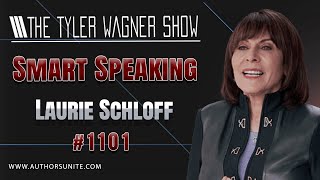
In this episode of The Tyler Wagner Show, host Tyler Wagner interviews Laurie Schloff, a presentation and communication coach and author. Laurie explains how her early interest in speech and communication led her from a career in speech pathology to decades of corporate coaching, helping leaders and teams become better presenters, meeting facilitators, and overall communicators. She discusses her three books—Smart Speaking (a collection of 60‑second strategies for modern attention spans), He & She Talk (gender‑based communication advice), and the children’s book 20 Twinkling Stars (a tribute to the Sandy Hook victims, with proceeds supporting gun‑violence prevention). Laurie shares practical coaching frameworks, emphasizing a strong message built on examples, experiences, editorial opinions, and evidence, as well as the importance of oral image, non‑verbal presence, and audience interaction. She provides case‑study examples, such as coaching a shy, non‑native‑speaker executive to run effective meetings. The conversation also covers the publishing landscape—advances, multiple language editions, and the shift toward ebooks and audiobooks—along with Laurie’s view on the future of physical books. Finally, Laurie describes her firm, Partners in Communication Inc., its services, and provides contact information, while discussing potential collaboration with Tyler’s publishing‑coaching business.
Chapters
All right, everyone, welcome back to another episode. Today we have Lori Schlof with us. So welcome to the show.
I am delighted to be here, Tyler Wagner Wagner.
Grateful to have you on. If you can start us off, just a little bit more about you and what you do.
Okay, well, I am a presentation and communication coach. It's not a huge field, but it's a very rewarding one. So I work with mostly because of my years of experience, leaders or potential leaders in corporations and also teams to help them to be better presenters, meeting leaders, human beings working on their communication style. And also one of my favorite things to do is to help people get ready for big talks and conferences. That's very rewarding because you work with someone and they start out very average and they end up being great.
So how did you— my first question is like, what were you doing before this that then led you to get the idea to start doing this?
Oh, I was a child. So I was always very interested in the combination of speech. You know, excelled at public speaking, being in front of people. That I was also interested in communication and then also interested in helping people. So that was the combination. I started out in speech pathology, helping people who had problems, and then I realized I really liked working with adults who were ambitious and motivated and sort of shifted. My background in speech pathology really helped shift more into working in the corporate world.
Okay, got it. Got it. So this is like in your whole adult— unless I missed something there— in your whole adult career, this has been what you've been doing?
Decades. Yes, for decades. In fact, speaking of books, so I wrote my books way back in the '90s. Then I was raising my family and I got too lazy. I've still written like blogs and short pieces, but my claim to fame in terms of publishing I was very, very lucky. This was, this was at the time where, you know, they gave you big bucks for writing a book. So the name of my book is that is very well known is called Smart Speaking. And someone yesterday told me it was kind of ahead of its time because it's called 60-Second Strategies. And at that time, no one really talked about ADD or short attention span. But each chapter in the book, Tyler, is only like 2 pages long and it's different topics like what do I do about nervous How do I control my speed? How do I begin a conversation with someone? So all sorts of really cool topics that people think about.
Oh, I love it. And I'm actually curious just because I'm in the book industry. I've been doing it for 13 years now. So I know it's definitely changed a lot. Who was your— so you actually got like an advance? Like you got—
oh, yes. A big one for the time. So, so you'll, you'll recognize the name of the publisher. So first it was in hardcover with Henry Holt, and then it was bought up by Plume.
Yep.
And Plume put it into paperback, and it had, I think, 3 different versions of the paperback. And not only that, I was really excited, Tyler, it was published in German, Chinese, and one other language I forget. Maybe Spanish, I forget.
Oh, that's awesome. Yeah, no, it's so difficult nowadays to get advances. Like, you have to have like millions of followers. Like, I know, but most of the time—
hey, listen, this is one advantage of being old. But I know you help people get their books published, which is really great because so many people have great things to say. And, you know, I'd like to work with you if I wasn't so lazy, but I actually have a few ideas for books.
So, well, yeah, no, maybe we'll make it happen. And the idea with, and I'm not trying to sell anything right now. It's funny because we're, but the idea with our stuff actually is that it's, we try to do everything done for you. So we try, we're actually for the lazy person.
Oh, really? Great. Well, I still have to write it. Like, for example, I want to write a book about my field. There's no book about corporate communication coaching. And I don't see it as a, like, a textbook. I see it as more like a booklet. Do you do things like that?
Sure. Yeah, for sure.
Yeah.
Yeah, definitely, definitely. Like smaller ebooks or pamphlets, stuff like that.
Yeah.
So here, a question I have for you is because a lot of our audience is authors and then, like, aspiring authors, and most of our clients are people that want to increase— well, maybe I shouldn't say most, but a majority or a good handful, let's say, They are people that want to increase their speaking careers.
Yes, they do. It's a way to— way to get out there.
Yes, exactly right. So the kind of formula, if you will, is, you know, somebody say they want a successful speaking career, they write a book, become a bestseller, they leverage that, and then they do talks based on the content in the book. But the first thing is you need to actually be a good speaker to have a long career in that, right? Like maybe you'll get a couple of gigs from the book in the beginning, But if you're not good, it won't actually, you know, uh, it won't progress.
So, yeah, and here is where a coach comes in. Now, are there people who are naturally good? Yes, but even those people— for example, right before I talked to you, I talked to a guy who's going on the speaking circuit. Now, hardly anyone could do that, meaning he's been sought after by a speakers bureau and he's going to get huge bucks. But what Boy, he's a good personality, good speaker, but he's all over the place. You know, he really needs a coach to rein him in and shape his message. So my tips for everyone, number 1 is have a good message. We teach people lots of different templates for organizing their thoughts. Use what we call the es, which are examples. Experiences. So you will find authors, for example, talking about their characters or reading a paragraph from their book. Don't read too much because that could get boring. Editorial means opinion. Give opinions and thoughts. And lastly, evidence. People like hearing facts, statistics, research. So if you combine those different elements and appeal, Tyler, both to logic and emotion, you will be more appealing as a speaker. The more range of emotion you have, the better. I might also say, as you begin your speaking career, remember that there are several different parts to presenting. One is the message itself. Second is your oral image, how you sound. Third is nonverbally. How do you, how do you look? How do you come across? And fourth is your listener interaction. You don't have to wait to the end of your talk for the Q&A. You can do it during, just like— because as you said before when we were talking before the show, uh, people like hearing dialogue and people interviewing others and Q&A as opposed to just one person talking.
Of course, of course. Yeah, no, that, that's definitely for sure. And then as far as, as far as getting public speaking gigs, what have you done? Because it seems you've done a lot of corporate gigs, and then I'm assuming, you know, some bigger public stages. Like besides writing the books and having success there, what have you done to get those like bigger speaking spots?
So my field, the field of communication coaching, involves coaching people, but it also involves running programs and workshops. So 98% of my public speaking has been helping people to become better speakers. And of course, I have a shtick and a routine, and I'm sought after that way, mostly through word of mouth. Sense for a speech person. So I'd say for all your authors, you gotta, gotta be visible. Find a way to be visible. I'm sure your company, Tyler, helps with the visibility, but also social, social media people help. And of course, a coach like me can help people to have a good message so that people really want to hear from you too.
Yeah, absolutely. It's kind of funny. I was like, me and you together with a client that wants to be a public speaker would kind of be the dream team.
You seem like a great guy to work with.
Yeah, it would work perfectly.
Right, exactly. Yeah, it's an interesting— yeah, doing both at once.
Yeah, no, absolutely. And yeah, they could actually— the services could be delivered simultaneously. So yeah, maybe that's something we'll—
I love ideas. Yeah, or yeah, certainly it's not too early when you want to write a book to think about how am I going to get myself out there. So that is something that can go right into the mix.
So I want to, um, because I saw on your website actually you have two other books, and maybe you have more, but the ones on your website, I see three in total. Um, so I'm gonna go kind of one by one. Uh, so for He and She Talk: How to Communicate with the Opposite Sex, tell us a little bit more about that. And do you have any tips for that? Because I think for a lot of guys and girls, this is a difficulty.
Yes, well, of course, this is an age-old topic, um, that When I wrote the book in the '90s, this topic was hotter than ever before because some of the popular books like Deborah Tannen's book, You Just Don't Understand, about how female and male communication is different, and Men Are from Mars, Women Are from Venus, or I forget, maybe I mixed it up, but John Gray was out. And so my book was, it was up there too. And the book is written very much like the first book, Smart Speaking, where it's divided into short chapters like, my partner says I never listen to her, or he says I keep complaining, and I give some solutions to everyday problems. So, Tyler, if you have a particular problem, I'll try my best. No, I'm just teasing you.
So yeah, I have a lot of problems.
People at all ages do, let me tell you. So I'm, you know, I want to say older, but I have friends who are dating after a marriage, maybe two marriages. And believe me, they have very similar issues to people in their 20s and 30s.
Ah, interesting. Okay, okay. Got it. Got it. Well, I guess maybe let's go through— or here, let me ask this. What are the most common that you find communication errors between man or— yeah, male and female? Like, is there a few that you'd say are like the most common and then how to kind of solve them?
Something that's been noticed and written about. You can tell me if you think this is true. That males tend to be maybe more solution-oriented, where males might just want to be heard, and it can create frustration. Like, I don't need you to solve my problem, I just want you to listen to me. But males may feel like they do have to solve something.
Yeah, I can relate to that. I think that that's 100% accurate, definitely. Um, yeah, 100%. So, and then to solve that though, as a guy, you know, instead of giving a solution, just kind of sit there and nod.
Yeah, hey guys, guys, that's a lot easier, okay? You know, yeah, with the solution. Now of course, you know, no one's all black and white, all male, all female, but I, I'd say also ladies You know, if you're with a guy and you want him to just listen, say it, you know, just listen to me. Or if you want him to solve it, just say, can you give me some advice on this? So I guess we all, no matter what our gender is, etc., we just have to be more clear in communication. Just more say what you mean and I guess mean what you say. But I think, you know, we're all vulnerable, especially in close relationships. So we sometimes feel nervous about expressing the way we feel, and we've got to do it diplomatically. Like, I think another problem that happens in close relationships is anger, expressing anger in the wrong way, as opposed to saying— I know it sounds a little bit corny, but it's much better if I say, Tyler, I'm really upset about this, as opposed to Tyler, you're such a jerk. Sorry, Tyler.
Yeah, no, it's all good. I've heard that before.
Yeah. And that's called— and that's called the— very funny— that's called the I message, the pronoun I. Like, take responsibility for your own feelings. That's— that is very, very helpful in life.
Got it, got it. And yeah, I think it— yeah, if we could be more clear, that would really solve that. It's just a lot of times, because, you know, I think we assume things a lot of times, right? Like when a girl— let's just say the example you gave before, when a girl is explaining something to a guy, she doesn't think to say first, like, hey, I'm just telling you for you to listen. Like, she never would say that. Um, but if she did, you know, then the guy would be able to be like, okay, I'll, you know, I'll turn my brain off, I'll just listen. Like, I won't try to solve this. Um, you know, and it's not a complete turn off of the brain, but you get what I mean. You're not like—
yeah, it's a different— it's a different mode.
Yeah, yeah. So But that would be kind of— it's just hard to remember to do that before you speak because a lot of times you're just in flow, just having a conversation. But so the last one, I don't know how relevant it is to our audience, but more for younger age people. But so how did you or what made you decide to write the children's book? 20.
Oh, okay. So the name of that book is 20 Twinkling Stars, and it's a lively, upbeat book. However, it has a sad history. So after, um, 20 first graders were killed in Sandy Hook, Connecticut, at the school in 2000, I think it was '14. I don't know, a lot of people wanted to do things. People, some people did art, music, and I just, this children's book came to my mind. And what I did is I learned about the kids. Who were killed, and I learned about some of their interests. So one kid just loved art, and another kid loved animals. And I don't name the kids. I have 20 stars because 20 children were killed, and there's 20 different characteristics that are in this children's book. So there's an art star, there's a music star, there's a taco star because one of the kids loved taco. And each star has a little poem or a little story and beautiful illustrations. And I have to say, it's a great stocking stuffer or gift for the holidays. And all the proceeds go to an organization to fight gun violence.
Oh, that's amazing. That's awesome. I'm glad you did that. Yeah, that's, that's very cool. And maybe some of the listeners, you know, that have children, maybe they'd be interested in grabbing it.
Oh, that would be great. Yeah, 20 Twinkling Stars. As far as—
so another, because I feel like people learn best from stories. So, and obviously, you might not be able to share specifics of the company or the people's names, but can you share maybe like 2 different scenarios where individual or company, they came to you, they had, let's just say, communication issues, and then after working with them, you know, something great, like they landed a deal, got a speaking, or like something happened. Happened, um, because then people I think will really understand the work you're doing, right?
Right. Okay, yeah, well, I'll talk about someone who I like very much that I'm working with now. She has a pretty big job, like, as a director of, let's just say, accounting in her firm, and she's sort of in a lucky spot because her boss will be leaving or retiring and really wants her to succeed her. However, she doesn't think she's quite ready for prime time because she's a little shy in groups. She doesn't always give a point of view because of that shyness. She also is a non-native speaker of English. You can totally understand her, but she's a little self-conscious about that. So the way I work with an individual, we call it executive communication coaching, is first I'll assess what are their strengths and needs, maybe speak to people who know them well and come up with a goal plan and then work on the goals together. So my sessions are very active. So I might teach a skill. Let's say I taught her some skills in running a meeting well and facilitating people's engagement. She then would practice it that week and let me know how it, how it went. So she is an example of someone doing great. She is really doing great. She's just so You know, she's just so motivated. Motivation to improve really means a lot, as you know.
Absolutely. Or sorry, go ahead.
No, motivation to write a book means a lot because that keeps you going.
Yeah. No, it's— I think with a book, you really like having an accountability partner or person or coach, however you want to word it. It's, it's super important because the thing with a book is for most people, it's a side thing. Like, it's not their main thing. So just, it's so difficult to stay on track, right? Because, you know, you're raising a family, you have your job, or you're running a company, and then the book is like something you normally try to squeeze in, like in the morning or at night.
Yeah. Yeah. And it takes, it takes men, you know, you do have mental energy involved. So, you know, it's, it's very common to meet people who say they want to write a book. It's very common. They really have some great ideas. But it's the execution and the time and the energy. I don't know. What do you find?
No, I agree. There was actually— I can't remember what year it was, but there was a study in the New York Times that said, like, 80% of Americans believe they have a book inside them.
Oh, wow.
So, you know, and I'm sure there's got to be an age group with that. I don't remember them providing, like, an age range, but I would assume they measured, like, 18 and up. Yeah. So, yeah, I mean, that's a lot of people, but then I wonder the percentage that actually do it. It's probably less than 1%, you know?
Yeah. Yeah. It's, it is interesting that it is such a common dream.
I know. Yeah. And it's so crazy too, because everybody in the industry that helps people with books, because I know a lot of others in the industry, how they got into it, it's very commonly the same story. It's they wrote a book. To do something else, like, you know, say become a public speaker. And then what happened is after they wrote their book, a bunch of their friends and people started asking them how they did it. And then they realized that this was like a more lucrative or like a business that they could do, you know. And then they kind of fall into the business of helping other people with books. So it is weird how like much of a common dream it is. Like, you know, 80% is pretty high.
So I have a question for you. Do you think now that books are less physical and, you know, that there's a lot of ebooks and stuff, I wonder if that'll change. Yeah.
You know, I was talking to a guy. He's 76. He's been in the industry since he was in, like, his early 20s. So, like, so I was, I was very curious to ask. I actually kind of asked him a similar question to this. And, well, it was funny. His answer didn't really provide any help because he just said, he just said, I'm along for the ride and I'm going to die soon, is what he said. Okay, that's actually what he said. It was kind of funny and I was like, okay, no worries. But my answer to your question is this, is that I think that anybody who's 30 or over, and I don't, I'm not saying exact, but just like an average, if you're 30 or over, you still have kind of like this respect or this like good feeling about physical books. Like you still enjoy that format, but if you're under, let's just say if you're under 18 right now, like you kind of grew up in the iPad culture and like, you know, you've had a phone since you were very young, most likely. So you're like glued to the screen. So I do think that we still have a good couple of decades, but I do think at some point, unfortunately, the physical book format might kind of die out. So yeah, that's what I think. I mean, they'll be around forever, right? But as far as it being like a desirable way of digesting a book, I think it's going to become just fizzled out.
I think you're so right. We're definitely in a transitional time.
Yeah. And with audiobook, like, I do mostly audiobooks, actually, because with that, and I don't think you actually comprehend the information as much just because I feel like there is something to be said about, like, visual. But when it's just audio, you know, you can run on the treadmill, go for a walk or whatever it is. So you can, you know, kill two birds with one stone. Yeah, when you're reading, you really gotta sit down and that's just your only focus activity. Um, so we'll see what happens. But you know, in 30 years, who knows, like books will be like, you'll be able to like bring up a projector or something and have a 3D, the author like speaking the book to you in front of you, you know what I mean? Like something crazy.
Um, oh, absolutely. And maybe you can have like, um, an actual hologram of a person reading it to you. Any person you want, your, your dead mother. I hate to say that, but okay.
No, no, for sure. I mean, hey, honestly, I think people would pay for that because, you know, you get your mother read your children's books. So it's actually not a terrible idea. But so yeah, I guess, what are your— with your company? How long have you been running this, like Partners in Communication?
So it's kind of funny. So years ago, when I was a speech pathologist, a friend and I started a company, Partners in Communication. Then I connected with a company I'm still connected with called the Speech Improvement Company, and that lay dormant. Now I'm connect— still connected with them, but I started my own company kind of late in my career. So I'd say 8 years ago. And brought back the name because I always liked Tyler Partners in Communication. It's actually Partners in Communication Inc. Inc. My daughter said, oh my God, it's long. And I like it because it's my spirit of wanting to partner with, with other people, you know, with the coaching and projects and also that I'm partnering with my clients. So I love the word partners.
Me too. Our whole business is built off partners, so we're similar in that way.
Yeah, exactly.
So here's, I guess, my last question for you is if there's anything we didn't cover that you'd like to cover, please share it. And then also let people know how to stay in contact, like your website, book, social media.
Sure. Well, I guess the main thing is we don't want to underestimate the importance of being a good communicator. Number 1. Number 2, I think working on communication, presenting, anything related to speaking is a great idea because there's a huge association between being a good communicator and success in your career. So never underestimate it, even though we were kind of talking since we were 2 years old. There's, let's face it, different levels. You know, we all know that we go to a meeting, there's a good communicator, and then there's someone who's putting us to sleep. They don't call it a boardroom for nothing. So I got a laugh out of you. Okay. So I like it when people visit the website or write to me. So my, my name, Laurie, is L-A-U-R-I-E. So Lori at Partners in Communication, Inc. That's the tricky part,.com. Lori@partnersincommunicationinc.com. And the website's kind of fun, as you can see, kind of colorful.
And actually, it's a very nice website. I like it a lot.
Yeah, we just had it updated. I'm really happy with it and happy to let people know. I'm actually partnering with the person who did the website on a few projects. So happy to introduce you.
Oh, great.
Yeah, no, she's fantastic. So, and I love, I love phone calls as well. So that number, it's a Boston number, though I'm based in Florida right now, 617 571-0944. 617-571-0944. And I like phone calls because, you know, usually people are talking about communication, so that's— adds to communication. And then I usually try to arrange like a short Zoom call with people to get to know them and see what their needs are.
Oh, that's perfect. Well, look, thank you very much for coming on. I really appreciate it. And who knows, maybe there's a partnership brewing.
So I bet partners in communication. Alrighty. Okay, take care. Thank you so much for having me on.
Thanks for coming on.
More from Tyler


Catherine Nikkel : THE STORY EVERYONE HAS BUT HASN'T TOLD : The Tyler Wagner Show #1120



Scott Ritzheimer: Bring Predictable Success to your Organization | The Tyler Wagner Show #1115


Fred Moskowitz: A GUIDE TO GETTING STARTED WITH IN MORTGAGE NOTES | The Tyler Wagner Show #1113

Mark Podolsky: From Land Investor to Full Time Success How I Made $90,000 Cash in Real Estate


Mark Podolsky: How to achieve a 300% return on investment my foolproof strategy

Mark Podolsky: How to make passive income selling raw land the irresistible pricing strategy