Mark Monchek: CULTURE OF OPPORTUNITY | The Tyler Wagner Show #1102
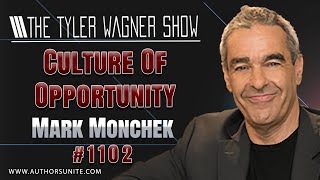
In this episode of The Tyler Wagner Show, host Tyler Wagner interviews Mark Monchek, Chief Opportunity Officer of Opportunity Lab and author of Culture of Opportunity: How to Grow Your Business in an Age of Disruption. Monchek explains how his personal history of disruption (Holocaust‑survivor mother, fire‑damaged home, etc.) shaped his entrepreneurial mindset. He contrasts companies that thrived during the 2008‑2010 crisis (Airbnb, Uber, Etsy) with those that collapsed (Nokia, Blockbuster) to illustrate the power of a "culture of opportunity"—a mindset that challenges the status quo and embraces change. The conversation moves to the impact of AI on writing and ghostwriting, where Monchek argues AI can amplify top‑tier writers while displacing mediocre ones. He then delves into the psychology of entrepreneurs, linking childhood trauma, the need for control, and the shift from control to influence, collaboration, and interdependence. Monchek shares practical frameworks such as the Archimedes lever metaphor, the E‑Myth distinction between business owners and true entrepreneurs, and the concept of "borrowing an audience" for marketing. He describes Opportunity Lab’s Conscious Growth Community, which aggregates emerging consciousness‑based leadership practices, and outlines his ongoing marketing tactics for his book, including podcasts, college lectures, and audience‑borrowing partnerships. The episode ends with contact information for Opportunity Lab and a brief recap of the key takeaways.
Chapters
All right, everyone, welcome back to another episode. Today we have Mark Monchek with us. So welcome to the show, man.
Tyler, my pleasure to be here.
Thank you for joining us on this one. And if you can just start us off a little bit more about you and what you do.
So I am Mark Monchek. I am the Chief Opportunity Officer of Opportunity Lab, and our mission is to support sustainable business growth through expanding consciousness. And we do that through strategy, leadership, and culture. So you and I met, Tyler, back in 2017 when I launched my book, Culture of Opportunity: How to Grow Your Business in an Age of Disruption. So as we remember back in 2017, we thought that was a disruptive time. And how little did we know about what was still to come and what's coming, you know, every single day, right? So We thought we knew a little bit about publishing. We thought we knew a little about digital media, social media. And I just feel very grateful to you and your company Authors Unite because you took our book to number 1 in Amazon, you know, for nonfiction business books. And, you know, our book was really resonant back then because we really talked about how important it is to think about a culture of opportunity rather than a strategy that's fixed in time. So when I started thinking about this book, which was back at the beginning of 2009, right? We were just in the apex of that very worldwide financial crisis that happened in 2008 and continued on up until probably 2010. And if you remember back then, it sounds like ancient history, right? but there were companies, right? Like AIG, like Washington Mutual, like Nokia, like Blockbuster, like Bear Stearns, like Lehman Brothers that were number 1 or number 2 in their markets. And literally within the course of a year or less, they were either wiped out and no longer in existence, or they were a shell of their, of their former self. So I don't know if you guys remember a Finnish company called Nokia was the largest maker of handsets in the world, more than Apple, more than Motorola, more than Samsung. And now they are a tiny little company that does global digital mapping, no longer make handsets, no longer in the mobile communication business. So then you had companies like Airbnb, like Uber, like Lyft, like Etsy, Facebook was only 4 years old in 2008. Now, these companies skyrocketed through the worst economic times ever. And why did some of these companies drop out off the face of the earth and others rise? Well, because they had a culture of opportunity and they were willing to challenge the beliefs of the day, right? So the companies that failed were no longer willing to bring in outside opposing ideas. And the companies, let's say, let's look at Airbnb. Back in 2008, if you asked the average person, would you rent your home to somebody that you never met and maybe would never meet? You go, you are out of your mind. That's absolutely insane. But these founders of Airbnb knew something that the public didn't know, and even the investors didn't know. It took them a while to get investment, but look how it's taken off. And how it's changed the whole world right now. And now you have cities like New York City which are trying to restrict Airbnb because they're competing with the hotel market and they're competing with affordable housing. I'm not going to get into that whole issue, but the point is that in order to have a culture of opportunity and grow over long periods of time, you have to challenge the status quo.
Yeah. You know, I was actually just going to ask you that about the Airbnb stuff is super interesting. We don't have to— The whole podcast doesn't have to be about that or anything, but it is interesting where, you know, I think they were having super growth, but now a lot of these cities are, I don't know how it's happening, but there's laws being passed where they can't, like in New York City or something, like sometimes they're getting banned. Is that, that's what's happening?
Yeah. So let's, let's talk about that in terms of the context of change. Not, not specifically highlighting Airbnb.
Right.
Yeah. So when the pandemic hit, Airbnb stock went plummeting down. And people like, I'm not gonna go in somebody's home. But what happened once the vaccine started coming out and people started traveling again, Airbnb skyrocketed because people wanted to be on the move. And as it was more and more acceptable to work anywhere at any time, people were living in Airbnbs for a week, for a month, for a year. And they were living in the country in places where they didn't even know existed before they found it on Airbnb, right? So yeah, Airbnb has some challenges because it is upending our understanding of what you do with— what does a home actually mean? Where are you living? So yeah, I think Airbnb will meet the challenge. But yes, there's always resistance to change when you come up against the hotel industry or the fact that affordable housing is a legitimate issue. So it is an absolute issue that some Airbnbs are taking up what would be housing stock on the market, which is, you know, which is a whole nother issue. But the whole point here is you have to be ready for change. And change is really part of life, right? So the idea that we think about resilience is that you're resilient and you bounce back to the way things were is actually not the right way to think about change. Change should actually make you a better, stronger person. And actually, you should be changed by change. Not wanting to go with the flow of the change and wanting to go back to where you were before the change happened, because that's actually not the way the world works.
Yeah. And you should probably, I mean, if as, as best you can, like part of your planning should be planning for, like, for example, in my industry, um, and, you know, luckily we're more on like the book marketing side. So I, I don't really see that being that affected, but as far as like writing, you know, like ghostwriters and editors and stuff. The new AI ChatGPT, like, I know there's a lot of ghostwriters I know that are terrified right now because they're like, hey, now people don't really need a human. They don't need to pay somebody to write the book. They can just throw in stuff in ChatGPT. It'll pop out an outline, pop out a rough draft, and then you need a human to like edit it, but it's still cutting the job in half. And it's not as good as a human maybe, or in some ways maybe it's better and worse. But I just know from being in the industry, so I have a pulse on it every day, a lot of writers are terrified of this AI stuff.
Yeah. So let's look at AI because that obviously is a very, very critical change factor. So if you're a ghostwriter or if you're a copywriter, if you're in the business of the written word, AI can empower you to the next level or it could take your job. So it's gonna take the job of the people at the bottom of the market because It'll do a decent job. But where it will help people is if you're an amazing ghostwriter, it'll help you work faster and better. You will, first of all, be able to structure the AI. So AI is as good as what you give it. So if the more specific you are, the more you treat AI as a persona, as a human being-like thing, and you give it very specific contextual information, it will give you a much better result. And even still, you have to fact check and you have to edit it. So for a really good ghostwriter, you could become great and you could actually become more prolific because you could do way more with that technology support, right? But if you're a mediocre or not so good one, you're probably not gonna be needed because the great ones are gonna do way more with that technology and not need as many people in that field.
That dude, that was like the best way I've ever heard that explained. Cuz what's interesting about that is it seems like AI, what it'll do then is it'll just add more separate, like, it's kind of like, not to relate it directly to politics, but what came up for me as you were talking about that is it's kind of eliminating middle class, right? So, and just, but view it in, in ghostwriter or writer world. So it's, there's no more like mediocre writers. It's just like the mediocre and below get wiped and the top ones improve and they can do more speed, like more in short time. So they can handle more clients and then there's no need for the bottom anymore. Right. So that's interesting. I don't know. I just hadn't thought about it like that. So I normally it's the first question I ask, but the Airbnb thing kind of caught my attention. So first question I actually have for you, or second, is before you were doing all this with Opportunity Lab and everything, what were you doing before that led you to this?
All right. I'm gonna go way back to the origin story of how I became an entrepreneur, right?
Okay. That's what I actually wanna know. So that's good.
Yeah. And, and so you, you'll, you'll, you'll understand, Tyler, as you get to know me better, that the book Culture of Opportunity, How to Grow, How to Grow Your Business in an Age of Disruption comes out of my personal life being basically DNA'd by disruption. So I was the product of two parents. My mother was a Holocaust survivor. My father was a physician who had to study in Europe, in Vienna, because of a Jewish quota. So they were born into disruption and they had to live through incredibly disruptive times. The, the Great Depression, the war, the Holocaust, the Cold War, and all that. So I was born into a, a disruptive family. Everybody in my family, Tyler, was an entrepreneur except my parents. My father was a doctor. My mother was an artist. So disruption was in my DNA. My parents had a very, very troubled, rocky marriage. So my brother and I had to deal with lots of disruption every single day. I got married and I thought, okay, now I'm stable. I've got a beautiful wife. We're going to buy our first home. We bought our first home and now we're going to be able to stay and really have a stable life. Well, guess what? 6 days after we move in, somebody actually tries to burn this house down. Almost kills us. And not only that, they came in after a couple of days and they stole stained glass windows, fireplace mantels, bike, like microwaves. So we moved back into this house in the highest crime period in New York City history with no heat, no hot water, no electricity, no windows, no alarm system. So you want to talk about disruption? Literally every day was a fight for survival. We were urban pioneers in our own home. So that's when I became an entrepreneur, not by intention, but by disruption, right? So I was managing a $150,000 insurance contract to be able to rebuild my own house. I couldn't afford a general contractor. So I, my friend and I, basically, we did the general contracting. We hired the carpenters and the tile layers and the painters and, you know, the plumbers and electricians. So that was my first entrée into entrepreneurship, even though I was born into it. But that was trial by fire, let's say.
Yeah, literally. Okay. And then, so I'm assuming though, you know, okay, so you said the insurance thing, but as far as like companies and stuff, I'm sure you've had some big successes and probably some failures. So what happened?
So that first business was basically contracting my own house. And out of that, I started doing coaching and consulting and understanding, you know, what businesses needed. So my first part of my career was actually as a psychotherapist focusing on entrepreneur psychology. So I had entrepreneurs in my practice. That's cool. And having been born into an entrepreneurial family, I was always fascinated with Why do some entrepreneurs succeed and others fail? Why do some succeed, they get to a point and they plateau and they can't go any further? Why are some successful but extremely unhappy, some unhappy but extremely successful? So understanding the psychology of entrepreneurship helped me then become an entrepreneur myself. And then I started, you know, my consulting and coaching company back in the, you know, 1980s. And I've been doing some version of that all along. And This year, we started a new division called Conscious Growth Community, where we're bringing together what I'll call next-level consciousness practitioners, people who are doing healing and leadership coaching and somatic work. And even in the psychedelic community, there's an amazing amount of healing work as well as conscious work happening in the psychedelic world. We believe now people want high impact, high return on investment, and they wanna go fast but also deep. So there is a whole lot of new methodologies that are coming out now that we're, you know, that we are aggregating into our community that will give people high impact and it will give a higher return on investment. People can't spend 5 years changing themselves or changing their business. They need to do it faster. But we also don't believe in being superficial. So we wanna make sure it's fast, but it's also deep and continuous.
Got it. Okay. Well, okay. From that, I had like 20 questions, so let me organize this in my head. I think the first one I want to dive into is if you have any more detail or insight on what you were talking about, those entrepreneurial levels, like what makes somebody an entrepreneur, what stops them at certain points, what makes they're wealthy and unhappy. Can you dive a little deeper into that and like what you've discovered from all that?
Absolutely. So I wanna define my definition of an entrepreneur because we use the word entrepreneur sometimes synonymous with somebody who owns a business. I think of it as two different things. So if you own a business and you're owning that business, your purpose is to have a better job and make some money and have a decent life. That is a business owner. To me, an entrepreneur's job is to create freedom for themselves and their family and make an impact in the world that makes the world a better place as a result of their business, right? So entrepreneurs wanna scale something so that they are not, the business is not dependent on them every day. If your business, the value of your business goes up and down in the elevator when you leave the, the, the business and you go on vacation and nobody's minding the store or somebody is, but they're desperately waiting for you to come back, that is not what I consider an entrepreneurial business.
Dude, I, I just wanna say something real. It's literally so wild because that's really the point that I'm at right now is I am like hiring more people and figuring out how, and I, I've been able to eliminate most of the things that I used to do. I've been running it for 13 years now, actually the company. So it's been a while. Uh, or I should say I've been in the publishing business for 13 years. Maybe the company's like 12, but regardless, I'm literally at that pivotal point that you're talking about, just like figuring out now how do I take that last extra step and completely pull myself out? Because if I go away for a month, it would be a problem. It would definitely be a problem.
So there, there is a classic book that was written probably about 25 years ago called The E-Myth. The E-Myth, by Michael, Michael Gerber. And really, he says that people who start businesses have what he calls an entrepreneurial seizure. You know, they really are, they're fed up with their job and they want to have more control, more freedom and make a decent wage. And they become what they think is an entrepreneur. But really what they are, are business owners. Nothing wrong with that. And business owners is important. But to be an entrepreneur, you really have to be able to engineer yourself out of the day-to-day business. So the more you can work on the business, not in the business, the more you will create an entrepreneurial company that will be able to move up and create value without you having to be in that business every day. And that takes time. Sometimes it might take a decade or two.
Yeah. Yeah. No, no, I hear you. And it's, it's so interesting. It's just like every new level we get to, it's, it's almost like It's funny because, you know, when you like look at companies from the outside, everything looks super clean, right? Like, just think, let's just say Apple, right? Nice clean logo. But on the inside, you know, they're building stuff like some of the phones they make don't work right. And then they, you know, when it comes out to the public, it's perfect, right? Or almost perfect. So it's, it's just funny when you're running a business yourself, you know that. And what I mean by that is my experience of scaling this company is like everything's going great, crash and burn. And then everything's going great, crash and burn, everything's— and it's every new level I get to. And when I say crash and burn, it's not the company, it's just like myself. I mean, like, I'm like, I have all the freedom. We get to the next level, I am working 60 hours a week, you know, and then I have a bunch of freedom again. I figure it out and then I'm working 80 hours, you know, it's just constant, like in and out.
So let me comment on that because that, that is a very common experience for entrepreneurs. It's also a common experience for everybody, whether you own a business or not, because, you know, when you have a child, you know, when you go back to school, when you change jobs, when your parents are aging and sick and dying, these are all areas where people start to crash and burn because they really just start to do whatever's in front of them and they can't take a step back because it doesn't feel like they have the time to do that, right? So one One of the things that we do, Tyler, is, you know, back in 10th grade, in 10th grade geometry, I learned one thing that I remember out of 10th grade geometry, but it is the thing that actually is one of the most important concepts in my life. So Archimedes, a Greek mathematician, said, give me a lever and a fulcrum and a place to stand, and I can lift the earth. So for listeners, think about the earth as your life, your business, your world. And if you can step back, right, whether you do that in meditation or in exercise or in brainstorming or envisioning or however you do it, it's very important that periodically, I'd say once a day at least for 5 or 10 minutes, once a week for half an hour, once a month for a couple of hours, you step out of your day-to-day life and look at where is the point of leverage where I can move my life or my business to the next level, right? So you have to get out of the day-to-day, be quiet in your mind, and then figure out where do I put the lever in the fulcrum that I can exert some leverage to move my life or my business forward. And that creates momentum. So you can't work on everything. You have to work on a few things, right, that really will move the needle. But you have to know where those things are, right? And in order to do that, you have to have a place to stand. And that's what we do with our entrepreneurial clients is we help them step back with our help to say, alright, let's look at your world of your business. And where is it that you need to exert the resources to move that business forward? And that's a very, very key principle that we really, really see how much, how well it works.
No, that's huge. And I think, you know, I, it's, I'm glad I'm getting like a reminder. Sometimes, you know, you have these practices, but then you don't You just forget about them, right? I was actually doing that for a while and I've realized recently, cuz I've just been so busy, I have not taken really much time to look and just, just really look at it from a different, not even different point of view, just actually look at it. Cuz when you're so much in it, you're not looking at it actually. So that's great advice. But so can you go a little bit deeper into those, like, I guess psychology, like I think you're, Perspective on things is like super rare. And like you said, psychotherapist, is that what you had said earlier?
That, that was my first part of my career. Yes. Yeah.
So psychotherapist and entrepreneur, like I actually don't think I know anybody else that has that like combination of skill sets. So that's really interesting. So I guess from all the people that you helped with that and all the entrepreneurs that you've had discussions with, what are, I guess, what are the most common bottlenecks that you find, whether it be scaling or their happiness? Like, what do you most commonly see happening?
The entrepreneur struggles with the idea of control, right? So a lot of entrepreneurs, right, become, they become entrepreneurs because they had a childhood trauma. I actually have a podcast, several episodes of the podcast and an article I've written called The Hidden Trauma of the Entrepreneur. So if you look back into the childhoods of many entrepreneurs, they were traumatized by painful marriage of their parents or because they were a victim of racism or sexism, or they had some kind of sexual violation or emotional violation. And they wanted at all costs to have control of their lives. So if you're working in a corporation, you don't have a lot of control. An entrepreneur has the illusion of, hey, I can control, I make the decision, so I'm in control. And you know what? When it's a small business, few employees, you can have a lot of, not control, influence, right? But once your business gets to start to scale, you cannot control everything. You have to then focus on building the systems and hiring the people that will execute those systems properly and have a strategy which goes beyond your ability to do stuff. So you have to let go of control and move from control to influence and also from influence into collaboration. Right? So what we're seeing in the world at large, and particularly with entrepreneurs who are struggling, they struggle, they go from I to we. So it's no longer I am the owner. No. We are doing this together. I have to rely on other people. So the concept of interdependence is key. Competition to collaboration. So entrepreneurs are very competitive, also often come from a military background or a sports background, and they have to compete. Well, guess what? Competition is a very limited way of thinking because it's a, it's a very limited, finite skill scarcity mindset, right? So you have to actually collaborate, and sometimes the person who is working with you smarter than you and better than you in certain areas. And you have to be humble enough to say, hey, I like your way better than mine. And then going from scarcity to abundance. Scarcity is not enough money, not enough time, not enough talent. Abundance is, yeah, there's everything I need. I just have to figure out that I, number 1, that I deserve to get it. And number 2, that I need to get it together with my team, not by myself.
Oh wow. This one's really hitting home, dude. This is wild. I like this. Yeah, the control thing. I actually think, I think there's a book, isn't there a book called like The Entrepreneur's Dilemma or something? And it's basically, I think it's a, I'm assuming you know of it, but it doesn't, I shouldn't assume that, but I've heard of this book and basically I think the whole premise of it is like, you know, you can only get so far by yourself, right? And then you, you, get into entrepreneurship because you want control. And then to get to the next level though, you actually have to do the exact opposite. So what got you to, let's say, low 7 figures or whatever the number is, you could control most things or micromanage. But if you want to get to 8 figures, 9 figures, you have to actually just let go completely of control almost, which is very difficult for somebody who wants to control something. So do you know of the book? I'm just curious. Or have you heard of it?
You know, there's a famous book called The Innovator's Dilemma, which has a little bit of a different concept. It's really about innovation in corporations. But the E-Myth, the one by Michael Gerber, has a similar, you know, a similar theme to it. So going back, Tyler, to the psychology of what we're talking about, a lot of what we study is what we call the ego. Of the entrepreneur, which is very tied to your identity. So your ego is how you think of yourself, you know, the way you get your self-worth. And if you get your self-worth by being the smartest, being the richest, being the handsomest, being the most successful, that is a very individualistic, very isolating way of seeing it. If you get your gratification by loving people, by helping people grow and have opportunities, by collaborating and allowing people to do things that maybe they can do better than you, by admitting your mistakes and really allowing people to grow and see that they can do something that maybe you could never do. That's a whole different way of looking at the world, right? That's the interdependent sense of the world rather than the independent sense of the world. And it's a fallacy there is no such thing as an independent entrepreneur or independent person. Nobody can say they ever did anything worthwhile by themselves. You can't even go to the bathroom by yourself because you're dependent on a toilet and a plumbing system in order for you to go to the bathroom. So unless, unless you're in the woods somewhere, and even then, you know, you're dependent on something that you're going to, you know, So another—
this is all super, super helpful. I'm so pumped to put this out there just because we do have actually a large audience, just because of the business I run of authors and aspiring authors. Can you tell us a little bit more just about your journey of writing the book and then like maybe what you've— like, I know we helped you with the Amazon Bestseller thing, but, you know, we didn't help you write it or publish it. I don't think— I think you did that stuff with somebody else or on your own. So what was that like? And then what has it been like, you know, after we worked with you? And I'm not saying any credit for Martin. I'm just asking you, like, what have you done after that to continue marketing it and, you know, use it, I guess, for your business?
Well, let me talk a little bit about the perspective and the consciousness of the writer or the content creator, because I learned so much in writing this book and the subsequent to the book. I've written dozens and dozens of essays and articles and done a lot of podcasts. I have my own podcast. With a co-host called The Other Side of Potential. What I didn't understand when I wrote the book, and I'm doing it very differently now, is how I— what I'm trying to say, what I want to say in the book, which is also true in the podcast and in any kind of communication, is not necessarily the way that the reader or the audience wants to receive it. So in other words, I started really getting feedback from my listeners, from my readers about how they perceived what I was writing. And I understood a couple of things. Number one, the reader wants to go on a journey. If the most successful books, the authors take the reader on a journey from where the author brings them at the start to the end, and the, the audience or the reader is better off for taking the journey and they know why they're taking it and they care about taking it. Because somehow the author has made them care about themselves and care about the subject matter, right? So I now am very, very conscious about how people read and consume content. Right now, people have a very short attention span. They used to say you have an attention span of a goldfish. Well, the average human has an attention span of 8 seconds. The average goldfish has an attention span of 8.5 seconds. So Goldfish now have a greater attention span than we humans do. So what does that mean is that you wanna talk in short, very, very concise sentences. It's okay to have longer sentences, but there's a rhythm to the writing. And so the rhythm has to actually resonate with the reader and the reader has to know why they're taking the journey. So I'm much more aware of those, the reader's experience, not just my own experience of what I wanna write, but I wanna write for the reader can actually have an enjoyable experience.
Got it. And then as far as, have you done any other forms of marketing for the book?
Well, mostly podcasts and college appearances. So I've done a lot of guest lecturing at, on, on colleges. So a, a lot of colleges have bought the book, you know, for their classes. So I teach at the University of Maryland. I teach at George Washington University. I've taught at NYU, at the New School, at Yeshiva University. And I find that students, even though the book is 2017, it still resonates with them because it is my own story, but it's also the story of some companies that they, they've heard of. And it's also got some very, very practical tips. So having practical tips that people can then go out and use the next day is also another thing that I think makes it helpful for, for folks when it's a bus— you know, when it's a business book or a how-to book.
Yeah. And I, I love that idea. It's funny when I, my first book I did when I was like 19 years old. So yeah, that's why it's 13 years. So it was called Conference Crushing. And so it just goes back to what you're saying, the collaborative mindset. I think I've always just kind of like intuitively, I guess, had that. And what I would do is I would reach out to conferences and colleges, right? To like try to partner with them. So for the conference, they could give it to all their attendees. Because it's about, it's basically about how to network. And then for it's, and it's a 70, 80-page little guide. So I thought it'd be perfect for college. So instead of trying to go after the direct reader, I was always trying to just build relationship and partner with people that had a lot of those readers. And I think that that way of, you know, marketing or whatever you want to call it is just so much more effective, you know, than just trying to run Facebook ads at one, you know what I'm saying? And I think that's what a lot of people get caught up with in marketing and why it doesn't work for them. Because they're not, they're not kind of seeing the bigger picture. Collaboration is the best way I've ever seen to scale something. So, yeah.
And a brilliant concept. We call that borrowing an audience, right? You say you're borrowing the audience of the conference organizers and it's a win-win because they get something that they can give valuable to their participants and then you get something which is access to their audience.
Exactly. Yeah. Well, look, I, I want to, I guess last question for you is if there's anything we didn't cover that you want to share, please do. I think if I can be on time next time, maybe we can do a part 2. I, I appreciate you being so chill about that. So apologies. But yeah, if there's anything we didn't cover, please do. And then please let people know like where they social media's website, where can they stay in touch and the book too.
So the, the book is on Amazon. It's It's an ebook in Kindle form and it's a print book. It's called Culture of Opportunity: How to Grow Your Business in the Age of Disruption. Our company is called Opportunity Lab. You can reach us as opplab.com, O-P-P-L-A-B.com. We have many recordings of my podcast appearances. We have a lot of free essays and some really, really excellent content. And you can reach us directly at Discover @opplab.com. O-P-P-L-A-B dot com.
Perfect, man. Thank you again for coming on. I appreciate it.
Uh, it was
More from Tyler


Catherine Nikkel : THE STORY EVERYONE HAS BUT HASN'T TOLD : The Tyler Wagner Show #1120



Scott Ritzheimer: Bring Predictable Success to your Organization | The Tyler Wagner Show #1115


Fred Moskowitz: A GUIDE TO GETTING STARTED WITH IN MORTGAGE NOTES | The Tyler Wagner Show #1113

Mark Podolsky: From Land Investor to Full Time Success How I Made $90,000 Cash in Real Estate


Mark Podolsky: How to achieve a 300% return on investment my foolproof strategy

Mark Podolsky: How to make passive income selling raw land the irresistible pricing strategy