Nazariy Bobelyak: The Rabbit Hole of Trading | The Tyler Wagner Show #1070
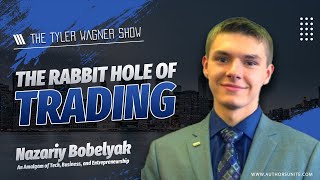
In this episode of The Tyler Wagner Show, 28‑year‑old Forex trader Nazariy Bobelyak shares his personal journey from immigrating from Ukraine to the United States, studying finance, and working in various corporate roles before discovering a passion for trading. He explains why Forex attracted him—low entry barriers, free real‑time data, and high leverage—compared to stocks and other markets. Nazariy discusses the prevalence of trading bots and courses, arguing that most are ineffective because sellers would not profit by using them themselves and because widespread adoption would erode any edge. He introduces prop‑trading firms and their challenge‑based model as a way to trade with capital that isn’t his own, describing profit splits and the ability to scale equity without the emotional burden of managing other people’s money. The conversation delves into the risks of Forex leverage (30‑x in the US, up to 500‑x overseas), the importance of risk management, and the pitfalls of over‑trading and losing money on bots, courses, and poor strategies. Nazariy recommends concrete learning steps: start with the free Babypips.com curriculum, understand basic terminology, decide on a trader style (long‑term, short‑term, scalper) based on personal emotional stability, and consider building or commissioning a custom bot only after mastering market fundamentals. Throughout, he emphasizes that consistent profitability is a gradual process, that drawdowns are normal, and that he currently trades only his own capital while planning to possibly manage others in the future.
Chapters
All right everyone, welcome back to another episode. Today we have Nazari Bobalak with us. He is a 28-year-old Forex trader who is on the pursuit of financial freedom for himself and his family. So welcome to the show, man.
Yeah, thank you so much, Tyler. Thank you for having me.
Of course. And just for people listening, just, you know, we reached out to him and we're very curious on Forex, so it's going to be focused around that. But before we dive into that The first question I like to ask a lot of times is, what were you doing before this that led to Forex becoming your main thing? So when you were younger, obviously you probably didn't even know about Forex when you were younger, but did you think you'd be doing anything like this when you were younger? Was your view a little bit different?
Yeah, it kind of just happened, but more so from an interest in business as a whole. I mean, I can walk you through the whole story. I'll try not to make it super long, but I came here to the US from Ukraine. Which is currently in a little bit of a conflict. But anyway, I came here at like 7. So it's been a decent amount of time. My family came here after the fall of the Soviet Union. So after that, you know, for them, success and career achievement was like the major thing that you were supposed to achieve in America because you're in the land of opportunity. So, you know, growing up, money was always kind of a point of contention because you're an immigrant, you don't have too much. So since this was a point of contention in the household, I think around high school time, I was like, I got to figure out a way to make enough money so that I never have to worry about money again. And that's a similar thing amongst a bunch of people that are on podcasts and are doing money, making money online, doing things like that. So throughout high school, I dabbled in a bunch of side businesses, done affiliate marketing, did the early level dropshipping. It wasn't as big as it is now. Did all that, and then I even started dabbling in some trading. Most notably because there's a lot of personalities on the internet for trading. So you kind of see it and you're like, your eyes light up. But nothing really. I didn't get a lot of traction because I was still super focused on school and I was like, maybe my parents are right. Maybe I have to pursue this career and the path that they expect me to follow because they must know something that I don't because I'm still young. So because I was interested in business as a whole, I went into business school. Finished with a finance major, chose the finance major because it, you know, it kind of gave me the, I had the expectation that there was going to be a variety of jobs that I can do. It's not as cut and dry as like accounting, because if you do accounting, you're going to be an accountant. That's it. Or like a doctor, you're going to be, you're going to be a doctor, some kind of doctor, but a doctor. But in finance, you could be, you know, you could invest in, invest, invest in like stocks somewhere else, do investment banking, you know, variety of different things. So after I finished all that, went to work at a variety of different jobs in a variety of different fields to try to kind of like experiment from the energy business to wealth management. And it kind of like, I realized that the way that finance was painted to me wasn't exactly what I was expecting. I was expecting like a really like kind of an environment where you were more focused on trading and investing and It turned out to be a lot slower than that, a lot more desk-based, a lot more boring in a sense. And it also very much focuses on big cities, which I'm not extremely a fan of. So you gotta live in New York, you're gonna have the high prices, or Philly, Chicago, one of those. If you're outside of that, if you're living in the suburbs, good luck getting one of the high-profile jobs. So after that, after getting a little more perspective, getting a little bit older, And I started reminiscing about the previous things that I was doing online. I'm like, maybe there was something to this. Maybe I gotta try this again. But nothing appealed to me as much as trading at that time, because I realized that I have to have some kind of an interest, some kind of a passion in this for it to be successful. None of those things that I mentioned earlier are easy, even with affiliate marketing, whatever, like your business, whether it be ebooks, selling physical books, you gotta love it. So after, after, after I found that, like, passion in trading, I'm like, that's it, I gotta do this. I'm getting older. Let me try to get this, you know, income freedom that I'm, that I'm searching. So I became more serious in the endeavor. I mean, fast forward a few, a few years, um, I was still working my jobs while, you know, doing this, but I've been able to, like, replace my job income with the income from trading. I'm still learning and growing and, you know, trying to get that true financial freedom that I seek, but at least it's getting there. And I know it'll take me more years, but, uh, you know, going into the rabbit hole of trading and like coming out and seeing how it like truthfully is has been both like enlightening and like, and, and empowering for me personally, because it's given me a little bit like a, you know, motivation to like keep, keep at it, keep succeeding, and that there's a different, uh, there's a different sphere to life than just the whole college and like going down the career path.
For sure, man. Yeah, and I— so I actually dropped out of college, so I can relate to that. Um, there's definitely different paths. So I'm curious, okay, so one of the first things I think comes up a lot is that like trading, uh, for example, like I have a Vanguard, uh, like I invest in just like index funds and stuff like that, and I have a Vanguard advisor. And one of the first things when I hopped on a call with him is he's just like, don't trade. That's what he said. He's like, do not trade, like nobody can beat the market. Like it's so— and obviously some people do beat the market. So that's not actually true. But I think for most people it's easier to just put it in an S&P 500 thing and just, you know, whatever, 8% over time, I guess, is the thing. So my question is like how you've been able to replace the income. You still have some work to do, but like what was those first few years like? Did you get burned a bunch of times? Did you lose a bunch of money or like Let's start there. And then how did you kind of figure out, I guess, a methodology that seems to be consistently— like, do you think you figured it out to that point where it's like consistent?
I'm, uh, I'm getting pretty close. I mean, I still have periods of drawdown. I think it's natural to have that. But, uh, it's been a little— for me, it's been a little bit of a mix of, uh, like physical trading, like you doing it, and a little bit of using bots to trade too. It's been a little bit of a mix with that, but I don't think I have the holy grail. I don't think— I mean, I can't make like a million bucks at this point. It's nothing like that. It's definitely not like it's painted on social media. But to answer your question, so I kind of started just— I saw how fast it's painted online that you can get rich with this and how it doesn't take that much work. It's so accessible. All you have to do is start an account, you know, especially with Forex, you kind of have to jump over less hurdles than you do with stocks. And crypto's a bit accessible now, but when I started, it wasn't really, you know, it wasn't really there. It was in its like infancy. Yeah. But stocks, you know, to trade, at least in the US, you need $25,000 to trade more than I think 3 or 4 times per week because they have a pattern day trading rule. So you already have to have a decent chunk of change. Um, and other— for other markets, futures or whatever, you need to have— you need to pay for live data. You might have to pay for platform fees. For Forex, everything's kind of accessible to you. You download— you download the platform, your data is free, it's all live, it's all in real time. All you have to do is press the button. I mean, deposit money and press the button. Um, but that's not really— that's not really how it is. So I started— I started Following people on social media. A lot of people sell courses, a lot of people sell bots. It's definitely there because there's a market for it. Everybody wants to figure it out. A lot of those things, 99.9% of the bots are all garbage. 100%. If someone is selling a bot, they're not using it themselves to make a million bucks. There'd be no reason why they'd be selling it. It just logically makes zero sense.
Um, whoa, wait a second. Hold on, let's dive a little deeper into that because I don't— I didn't think too deep into it. Like I told you before the interview, I talked to some people about this, but because it just had that— like, I had just like a gut, like, don't do it yet with this. So I didn't think so. But basically you're saying the logic is if their bot was that good, then they would make more money just using it themselves. Why would they sell?
Yeah, why would they be selling it? Like, the fork— especially in Forex, the Forex market has 5, like, I think it's $5 trillion of turnover, which is like the amount of trading that institutions do, governments do, because you have to transfer money into other kinds of money because of imports, exports, whatever. I'm not going to go too deep into economics, but like, there's a massive amount of volume going through, much more than there is in the stock market. So if your bot was able to generate such high returns, All you have to do is just let the compound effect take place or find outside investors. People will throw money at you if you show them good results, like actually good results, especially even like individuals that are in these high net worth, like high net worth individuals already investing money with the major corporations such as like Vanguard, as we were talking before, like if they can get a higher return than that 10% or 9% or 8% of the S&P per year, they'll throw money at you. So these people can easily accumulate wealth. If that thing is 100% working, they shouldn't be selling it for $100 online. And then there's also another logical thing aspect that goes into effect. So for one, they wouldn't be selling it if it was super successful. For two, if it is super successful, the more people that get their hands on it, the less successful it'll be because everybody will be following the same strategy online. If too many people follow the same strategy, it stops working. That's why hedge funds never, never, never share anything that they do, for example.
Ah, now wait, wait, why would it— in Forex, why would it stop working? And I'm just super ignorant to this stuff, so that's why I'm asking. Like, I mean, it stopped working.
It might, it might not necessarily, because there's, uh, the percentage of the total market that is retail traders, people like you and me, is very small. But regardless, Technically, if enough people got their hands on it, it would stop working. Because let's say a currency pair is going up and your macro tells you to buy, but the macro also tells all the other people to buy. Well, then they're going to drive the price up. And then essentially what happens is whoever gets to the market first because of their internet connection, whatever, gets the dibs on it. Everybody else will start coming in later. So that's kind of how high-frequency trading has come up with Wall Street and stuff like that, because they all figured out a similar thing to do. But whoever gets to the market first in terms of milliseconds, they get the better return.
I just thought there's a movie out that I watched. It came out a couple of years ago, and it's about this pipeline thing that they—
Yes.
And because it helped this one company gain a couple of milliseconds, but then it added they made, I don't even know how much, many millions or something like that, or billions or something, just because milliseconds of leeway time or whatever. So is that what you're talking about?
Right? Essentially. But I mean, if enough people get their hands on it, the strategy will stop working because everybody will drive the market up at the same time. The reason it all works is because everybody is buying at different times, doing different things. And when you're buying a currency, someone else has to sell it to you, essentially. So there's always somebody on the other side of the trade for sure.
So I've seen from conversations I've had, I've seen a lot of different models. Well, here's first question. Do you— are you only doing this for yourself right now, forex, or do you offer to help people do it too?
Right now I'm doing it for myself mostly because I don't think I've built the, the wealth of knowledge and the track record to manage other people's money. It's a lot of a different— it's way different to manage someone else's money in terms of stress, in terms of responsibility. It's one thing whether you lose, it's a different thing whether this person— I mean, if they're extremely wealthy, you might not feel so bad. And I don't want to say that negatively, but if someone is a retiree and gives you their last $50,000, that's just horrible if something were to happen to it.
Yeah, dude, I just watched the, uh, Madoff Netflix documentary. Oh my God, that was nuts, dude. Sorry, that's just like—
that's just heartbreaking.
Yeah, yeah, that's— I was like, this is— you know what's crazy though is that I do think that— and I would be very clear before I say this, I am not saying like Madoff was like, uh, a good guy or something. I'm just saying this, I don't believe that he understood the magnitude Even though he knows the numbers and everything, like, I don't think his headspace was actually, like, realizing how devastating the effect for the people were. I think it was just like he got literally caught up in this, like, cycle and he didn't know how to get out of it. And he, like, knew it would crumble one day, but he just, like, kept pushing the inevitable down the road to avoid conflict. Like, I don't know if you watch Jordan Peterson at all, but But one of the things, he's a psychologist, right? One of the things he says is he's like, a lot of people avoid conflict, but the problem is if you do it for too long, it becomes something way bigger down the road. Whereas if he would've just had that first, if, if you watched it, it was that first like 30K or something he lost of the first, if he just addressed that, then it never probably would've happened. Right? So it was like avoiding that initial conflict. Led to 30 years later billions of dollars.
Yeah, it's basically, basically a snowball effect at that point.
So again, I don't— again, he did obviously wrong and it was bad, but it's just like, I, I— a lot of people think that like he was like had— he's like evil and like he was trying to hurt people. I just didn't quite get that. I, I don't think that he was. I just think that he was in a bad situation, it was his fault, and he shouldn't have done— I feel bad for everybody, But I just don't think he was up there like, oh, I'm going to make all these people poor. I don't think that's what he was thinking. But who knows? Maybe he was. So my question to you is, okay, let's actually dial back a little bit. So will you potentially offer that in the future once you feel more knowledge with forex?
I think I will. There's also another, especially with forex, there's also another realm of possibility to generating wealth where you don't necessarily have to take the money from people. From individuals, let's say. You can take it from corporations. A lot of, uh, a big thing that's popping up now are called prop trading firms. They've existed before. They exist physically in like New York City, for example, like physically, physical businesses with offices, but they mostly focus on, uh, trading stocks. But there's a lot of virtual prop firms that are popping up now where they offer these things called challenges, which is essentially they give you a demo account. And I'm sure you've, uh, You've kind of looked into it, like you can, you got a practice account. If you practice account, they tell you that you can't exceed these kind of parameters of risk and you have to make us X amount of percentage in this month that we're giving you this trial. You pay for the trial, they give you a play money account. If you fulfill their terms, they give you real money and they return the fee that you paid for the trial account. So they're basically testing you, see how good you are, and they'll give you money back. And then once you get the full account, you can trade it. There's a profit split, something like 70/30. They take 30, you take 70 home, and you trade their money and you can build up equity. You can build that account to higher levels of capital. And that's what people do. There's a lot of people now doing that to build up a lot of equity that's not their own money and not other people's money. So it kind of like removes a little bit of the emotionality behind it because that corporation's giving out to a lot of people. So it's not, you know, your mom-and-pop shops that have very little capital like we were talking about.
Yeah.
With 70% take-home, you can just invest it into additional, uh, challenges at other prop firms. There's a lot of them now, um, and you just kind of stack up the accounts, build equity, make a few percent or whatever, uh, like be very low risk, make a few percent. But if you end up stacking like a million dollars worth of account value, 2-3% is actually decent to live a normal life for sure.
Okay. And obviously one of the funny questions would be like, what is the process? Or how do you do it? Yeah.
So I guess let's return back to that first question you had. Did I lose money? Yes, I lost money. I went down rabbit holes. I followed people's, I, you know, but definitely bought bots. None of them worked. If you want to make a bot work for yourself, like an actual robot to trade for you, you got to make it yourself and or hire a coder and do an ins— I mean, you gotta, you have to understand the market first. So firstly, you'd have to like actually know how things are done with the forex trading in order to then instruct that person if you're not a coder yourself. To, you know, code this for me. Then you test it with data. If it doesn't produce any results, you go back, scrap it, do it again, and do it again, and do it again, and do it again. And eventually you get something out of it that's not what's being sold online, and that is specifically tailored to you, and that it can make money in certain markets. But nothing will ever work 100%. That bot that's making you money right now, with something like COVID that happened, markets shot up, it could completely fail in those months. So there's nothing ever perfect, but But that's how you do it with the bots. In terms of losing money, lost money on courses, lost money on bots, lost money on just trading because I was overtrading and not putting enough thought into it. To start to learn the best, to like to learn Forex, I think there's a few steps that you could start. Reaching out to people on actual like LinkedIn to just get their, people that have those prop firms, in their bio that they're actually trading could give you a little like leg up on what process and people they've been following. But first of all, like when you're just starting, babypips.com is a forum for forex trading. They have an entire course of like the basics, like how does price move, how do the— how do the brokers work, um, you know, what you should do, like what do all these indicators mean, like all this stuff. So babypips.com, like, start on that course. You, you, you go through the whole thing, you'll finally understand what people are talking about when they use like the terminology and stuff.
Yeah.
After that, uh, you have to decide what kind of trader you're going to be. You're going to be long-term? It depends. That, that all depends on emotionality and what kind of person you are. So can you hold the trade for a long time? Can you hold it overnight? Are you going to be nervous? Are you going to be able to sleep if it's a lot of money? So you have to decide whether you're gonna be long-term or short-term or like a scalper where you just wanna like get in and out in during the day. Then like you're all done, you close your, you close your laptop or whatever and you go, you know, do whatever you need to do for the day. So you gotta see what kind of like per— you gotta be like emotionally, um, they kind of understand yourself like stable.
Yeah. Or yeah, just actually understand if you are stable enough. Now wait, what would be the difference between long? So I actually didn't even know Forex could be long-term because I thought it was all short. It's just like all these micro trades on currencies. So is it— what's the long-term view?
The micro trends like move the market the same way that people are constantly trading stocks in it, and they move day to day. But when you sign up for a Forex brokerage and you start doing this, you can initiate a position. Like, you know, let's say you're buying it You're buying a currency in anticipation that it's going up. You can hold it for days, weeks, months. Every day though that you're holding it, you pay a little bit of a fee because they're letting you kind of borrow the position. So yeah, you accumulate fees every day because that's what the broker does, but you can hold it for a long time until it reaches your target and then sell off. Or you could just do it like trade for 5 minutes for little micro moves and do that. The problem with forex is that, and a lot of people don't talk about it, is that there's a lot of leverage that's used in forex. Leverage is like the borrowing of money. So you only need to deposit a little bit of money to play with a lot of money. And usually the leverage can range from like 30 times to even overseas, if you're not in the US, like 500 times your initial amount. Crazy. The little micro moves, like usually what people do, like the people that start, they're like, okay, I like went through baby pips, I'm good, I understand the terminology. I saw some like guy's strategy online on some forum, I'm gonna do it. And then all you do is deposit like $1,000. You initiate a really high position because you can, because you have the leverage to do so. And then it moves against you or some kind of news hits, like a news event hits, like unemployment rates or whatever in the US, it moves against you a lot and you blow your whole account instantly.
Oh my God, that would be so crazy, dude. 500x, dude.
Yeah, it's basically a 500x. Yeah, I mean, the US caps people at 30x, but, uh, I mean, there's overseas brokerages and stuff that do even more than that.
Isn't even 30x pretty wild?
Yeah, that doesn't— like, that doesn't exist in stocks or any of the other markets. Like, uh, you know, futures, uh, options have leverage, but not like that.
So, and I'm assuming though they do vet, like they have to vet the— so say if like you log into an account, they, they would vet how much like capital you have in a sense, right? They, they don't just give you 500x or—
I mean, no, it's, it's 500x off of what you put at, what you put up.
Yeah, for sure. So if you put $1,000, just so I'm understanding, so that'd be like $500,000 you could trade. Is that right, or am I, uh, I'm bad at math, by the way. So just everybody listening, let's say, yeah, yeah, yeah, yeah, yeah.
I mean, that's, that's correct, but let's say like, let's use 100 for, for simplicity. If it's 100x, yeah, $1,000, you'd be able to trade $100,000 of currency. So essentially, if it's a big move, something happens in the market, you're just, you know, you traded at the wrong time, wrong place. If that, that position you open up, it's at $100,000 and it moves to, uh, $99,000 because of whatever fluctuation in the price. Well, then you lost your $1,000. They closed— they closed your account. You lost the whole $1,000, and that wasn't even technically a big move. It's not like you lost 50%. All you lost is like 1% of the thing, and you're gone.
More from Tyler


Catherine Nikkel : THE STORY EVERYONE HAS BUT HASN'T TOLD : The Tyler Wagner Show #1120



Scott Ritzheimer: Bring Predictable Success to your Organization | The Tyler Wagner Show #1115


Fred Moskowitz: A GUIDE TO GETTING STARTED WITH IN MORTGAGE NOTES | The Tyler Wagner Show #1113

Mark Podolsky: From Land Investor to Full Time Success How I Made $90,000 Cash in Real Estate


Mark Podolsky: How to achieve a 300% return on investment my foolproof strategy

Mark Podolsky: How to make passive income selling raw land the irresistible pricing strategy