Zachary and Josh: CEO Watchlist Making Investing Easy To Understand | The Tyler Wagner Show #1014
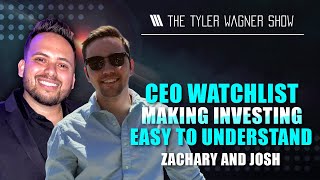
In this episode of The Tyler Wagner Show, hosts Tyler Wagner interviews Zach Treby and Josh Kiley, co‑founders of the financial education platform CEO Watchlist. The conversation begins with their serendipitous meeting during the pandemic—Zach, a PhD‑trained rehabilitator with a family background in investing, and Josh, a TikTok creator—who combined their skills to build a year‑long, Discord‑based educational program. They detail the program’s structure: daily live market classes, weekly recap calls, a curated watchlist, e‑books, and a community chat. The duo explains their investment framework, emphasizing identification of durable businesses, large economic moats, and supply‑chain analysis (e.g., cell‑tower owners, warehouse REITs). They discuss the merits of passive S&P 500 investing versus active stock selection, noting that most retail investors underperform the index. Josh outlines his swing‑trading approach, the importance of aligning trades with personal risk tolerance, and the use of public insider/CEO disclosures (via sites like OpenInsider). Zach shares his long‑term bias, citing pandemic‑era trades in tech, healthcare, and infrastructure, and stresses the role of stimulus in market rebounds. The hosts debate inflation versus deflation, with Zach arguing that massive money printing guarantees inflation and that cash holdings erode value. Crypto is explored: Zach is a strong pro‑crypto advocate, allocating a majority of his portfolio to Bitcoin and Ethereum; Josh is more cautious, noting volatility and risk. They also touch on the challenges of scams impersonating their brand and the importance of authentic community engagement. Throughout, the interview blends conversational, instructional, and enthusiastic tones, offering actionable insights for new to intermediate investors.
Chapters
All right everyone, welcome back to another episode. Today we have Zach Treby and Josh Kiley. They are the owners and founders of the online financial educational company CEO Watchlist. So welcome to the show, guys. Thanks.
Thank you. Thank you.
Of course, pumped to have you guys. So I actually, I believe how we connected, I reached out to you, Josh, I think, because I saw you on TikTok and then I went to your Instagram. That's how it happened, right?
That's how it always starts. Same thing, same thing, another day. Yeah, but yes, yep, you reached out to me. I want to say you reached out to me on Instagram, which is funny because that's the best way to get a hold of us at this point. So many messages on TikTok, so you hit it right on the head.
Oh nice, you know, and it's funny too, I don't know why I always do that. I never reach out on TikTok, but it's where I see most people. I think like a lot of people, because TikTok, if I'm like in between calls or something, it's like 15 minutes and I just go on a freaking, uh, a tear or whatever, like 300 TikToks in like 15 minutes. And then, but I kept seeing your stuff and I was like, all right, I don't know what this, what this guy's doing, like, but this is This is interesting. So I'm going to reach out to this guy. So I always like origin stories to start. So like, how— what were you guys doing before CEO Watchlist? And then like, how did you even transition into it?
So Josh was in school, I believe, right? You were studying financial. You were getting your degree in that. And I was pretty much just chilling because it was the pandemic. So I mean— I wasn't doing anything. Uh, uh, I got my doctorate in, uh, uh, rehab— rehabilitation. So that's what I did. But finance and investing was always a part of my life. Um, my dad was a big investor, my grandfather. So my whole life I learned from them, and I've been doing it since I was 18, you know. So it's been, what, 12, 12 years now? I'm 30 now. So it was a big part. And I mean, I just was online one day And I mean, there wasn't much to do. Everything was closed during the pandemic. So I was online and I was just scrolling through TikTok like a lot of people, and I found Josh. And so I ended up going to one of his forums that he had on Discord, and it's like a chat room type thing.
Yeah.
And yeah, I just saw people talking in there and stuff, and I was just giving out advice, like free advice, like I would normally do. And people ended up like DMing me and asking me for help. So I would get on these phone calls and just get calls with people and give them like free advice and like talk to some of these people for an hour, 2 hours, just for nothing, no pay. Like I was just a random guy online, just giving out my knowledge I learned from my dad and from personal experience, just to kind of help out a bit. And I guess word got back to Josh. He reached out to me and we ended up talking for a while and I was helping him out with the Discord. And then I was like, you know what, let me create my own Discord. Let me create something where I can teach people. Because in the past, I had taught— when I was in school, I taught people physics, anatomy, pharmacology. I mean, I taught a multitude of subjects just to help friends out and stuff that I learned over time. And he was like, no, don't do that. Look, I already have this in place here, right? I have the infrastructure down. You have the, the knowledge of teaching this stuff and the experience with it. Let's just combine it and do it together. And so that's kind of how we created— and I took my business model I learned from a mentor of mine, and I took his business model for teaching and kind of applied it to Josh's infrastructure of following what CEOs are doing. And that's how we created more of an educational company to really just teach people about financials and investing in the stock market.
Got it. Okay, so it's kind of like you really kind of fell into it in a sense, right? Because it was all— it was more just like fun for you to like help people, and then you guys connected and you're like, oh, well, this could actually be a business. Like, it wasn't really planned, I guess you could say.
Yeah, yeah, yeah. I mean, it was kind of just all fell together. I mean, that's the beauty of online, right? You know, social media, you just meet people and You click and then all of a sudden a business forms out of an idea. And for us, I mean, we were lucky it ended up just taking off. I mean, we put in a lot of work. I mean, I was doing what, Josh? Like 14, 16-hour days, 7 days a week, just on the phone morning to night. Josh too, just building out this business for the first like 3 months and ended up just taking off from there.
So Um, I have a lot of questions. Okay, so what is— let's start with the business. So what is the actual business? Like, what do you guys currently— obviously you guys give away amazing free content, and then that people get a lot of value from that, and then they would go to your website. And then what do you guys offer like on, on the website?
So we're an educational company, right? So really what we're here to do is kind of like you would go to college for a class. We offer the same thing. So the biggest thing is, is our target audience is new investors to the market, up to maybe like intermediate. Um, I've gotten people that called me and just to do like a consultation type call, and they have 20, 30 years experience in the market, more than even myself. And I tell them, I'm like, look, to be honest with you, our program isn't going to be a fit for you. I mean, you just, you know, the basics, right? You're, you know, the basics. This really isn't the right program for you because What we're teaching is the basic fundamentals of technical analysis, fundamental analysis, and just giving our experience that we've had over the years. So it's just kind of a program. So what you get when you sign up is it's a year-long program. We did a ton of competitive research. We see people that charge a couple hundred dollars an hour, a couple hundred dollars a month. It's just wild. So we try to take that average and put it for a full year. So, so what we do is we give them full-year programs so they don't feel rushed because a lot of people have jobs and stuff and they only have times on the weekends. So they get a full year in our program. And then what we do is Monday through Friday, we have a class every morning at 9:30 AM where Josh gets on. It's a private class that he livestreams, goes through the market for the day, what he's doing in the market, teaching the fundamentals and technicals of it, as well as taking questions and answers. That lasts about an hour. Sunday nights, we have a conference call at 9:00 PM Eastern Standard Time, where we cover the next week, again, taking questions and answers, and just teaching them and interacting with our class. Then also, you have access to Josh's watchlist, and just a bunch of other resources we put together. Josh put together two eBooks that he has out in there, as well as a different resource library and just chat rooms that people can interact in.
Wow, that sounds incredibly valuable. I feel like a lot of— I don't know your guys' space that well, but there seems to be a lot of touch points there. Like, you're getting direct access to the both of you, and it's not just like one-off, like, oh, pick— like, because I've seen the Discords. I just turned 30 as well, so Discord's even a little bit— I don't know how to use it, I'll put it that way. My little brother does, he's 24, and, um, I've seen other kind of communities that sound kind of like this, but they don't have the one-on-one at all. And because they just will kind of put in the chat and they'll be like, hey, buy this, you know, but there's not like question and answer and like the one-on-one time. And obviously, uh, seeing what the whales are doing— I'm using your terminology, um, you know, I haven't seen that before, like the actual, which is in your name, CEO Watchlist. So To go back even a little bit further, I'm curious, like, what did your dad and grandpa teach you as like the fundamentals? And then I'd love to, you know, go into the business more and see, you know, what the audience can learn, but what was like the root stuff that they taught you? Oh man.
Well, when it comes to more fundamentals and technicals, I mean, one of the biggest lessons my dad taught me early on was look at, Think of the companies you know, that you see day to day. You see the Amazons, the Apples, and these are things you interact with on a daily basis. I mean, take a majority of people just in your building where you live, or just walking down the street. What are they holding in their hands? 99% of them are holding an iPhone. They don't have an iPhone, they might have a Mac, or they have AirPods, or they have some type of Apple product. So we know that's huge. Apple's a huge company. I'm just going to use Apple as an example. So when we find a company that's major on the S&P 500 or even the Q's, right? Well, look at who supplies them. What else interacts with that type of company? This is a little trick I do. So who supplies their chips? Who supplies the products for them? Who do they work with? For example, 5G is a big play coming up for the cell phones, right? They're transitioning from 4G to 5G. So what am I looking at? The cell tower companies. Because that's infrastructure in the ground that you're going to need. That's going to take on, that's going to charge more, that has the ability to charge what they want. And that's not an easy market to get into. I mean, what they always told me was look for the markets that have large moats. And for people that are watching that don't know what that is, a moat is basically like, think of like olden days, there's a castle and they have water around the castle and they draw a bridge. If you have a thin moat, people could just hop over and invade the castle and take it over. The larger and the wider the moat is, the harder it is to get in. So a market that has a large moat is very hard to pierce and get into. So cell towers, very difficult. There's 3 major ones, SBAC, American Tower, and CCI, Crown Castle. So I own all 3. I love those companies because I have the infrastructure in place to to support some of the most major companies out there. So let's say Apple falls off and Samsung takes over. Well, they're still going to need those cell towers. I win no matter who the player is. Guess what? Your satellites are the future. They got to connect to the ground at those cell towers, right? So they always taught me, figure out what will always win, even if a certain business model goes under, and look at the biggest business models See who supplies them, see who they work with. Another perfect example is Amazon, one of the biggest companies in the world, right? Well, their warehouses, their infrastructure, and their real estate is a lot done through a company called Prologis. And they're a real estate investment trust. You can invest in them through the market. And guess what? Their stock chart, straight up. So opportunities like that, this is stuff people don't think about. That I always go into, and that's when you have to do a deeper dive into the companies. And if you understand that, you can really find some gems.
Gotcha. So on those ones you just said, you're, you're obviously like very long-term, that you're not trying to like buy and sell real quick and like doing that. You're just like, I know these are going to be here 100 years from now, or it's very likely, unless—
Right, right, exactly. Again, we never know where a company is going to go. You can make a good guess, right? You can make a good idea that Amazon, Apple will probably still be here 10 years from now, right? So I assume the infrastructure behind them will also be here 10 years from now.
Got it. That makes sense. So what are your thoughts on this? And then Josh, I want to talk about the whales a little bit, but I read a book, it's probably a few years ago, and it's like a little red book and it's called The Little Common Sense Book of Investing. And it goes along with like Warren Buffett. He just says like, The average person should just like play the S&P 500, just like every month a dollar cost average put in there. What are your thoughts? I love what you just said. That makes complete sense to me. I never thought about it that way. Um, like I have stock in Apple, but I never thought of like who supports Apple. Never thought of that. So that's genius. But what are your thoughts on that S&P 500 theory or whatever you call it?
So I, I agree with Warren Buffett. Most of the time. So obviously he's gotten older, and, um, I think, I think he's stuck in his ways with a lot of things. So I don't agree with everything he does. I think the younger generation coming in is definitely hitting the mark better. Um, but he's absolutely right. I mean, statistics show it. It's not an opinion thing. I mean, I, I'm a data guy. Ask Josh, like, he'll laugh about it because everything I do is calculated, logical, based on data and statistics. So the stats are you don't beat the S&P 500 a majority of times. So for the average Joe, right, if you have a full-time job, you can't watch the markets every day, sometimes it's better to just put your money in a broad-based ETF and earn that 7% to 10% a year on average because there's a phrase, I'm sure you've heard of it, Josh knows it, Time in the market is better than timing the market. And so basically, it's just shown over time that if you let your money sit in there, then trying to time the, the lows and the highs and try to trade them, you tend to perform better than the average trader. So again, it just depends on you, because this is a perfect example with our program. We have people that are 18 in our program and people that are up to 60, right? Very wide range. And some of them are coming in and they're planning on retiring in a year or two, and others have 40, 50 years till they retire, right? So I mean, the younger you are, the more risk you can take on because you have a longer timeframe to earn it back. The older you are, you probably don't want to take that much risk if you're planning to retire in a year, because let's say COVID, that wasn't expected, right? But look what happened. No matter your stance on it, I mean, it crashed the markets. The things shut down. So if you're planning to retire 2 years ago and you had all your money in the market, well, that crash happens and then you're like, what do I do? Do I sell out? Do I take a 40% hit on my money? And now I got to wait another 5, 6 years till I retire. What do you do? Because we got lucky, the market rebounded quickly, but a lot of past crashes it didn't. So you never know when the market's going to take a hit and for how long it's going to take a hit for. So it just depends on the individual, I would say.
Yeah, I remember that, man, because like with our business, we, we do a lot of high-end ticket stuff. So it's not very subscription-based like your guys, but it'll be anywhere from like a $60K to like a $300K like item. So we, you know, we have a lot of leads that are coming through, and during that period we had the same response for like a whole month or two of like, dude, like, I, I can't, I can't invest in your thing anymore because I just lost half of my net worth overnight. And I was just like Okay, like, I, you know, makes sense. Um, but no matter what, as long as you— you're saying as long as you kind of hold out. Now look, I don't, I don't know how long 2008, uh, stayed or whatever, but this was a quick rebound luckily. But at the most, historically speaking, you'd have to hold out, you know, what, like 3, 5 years? But as long as you don't sell, you're okay basically.
Yeah, and it depends the market. I mean, if you look back at the housing crisis, like you said, 2007, 2008, You have some stocks that took 10 years to recover and other ones that took a year. So I mean, it just— look at the banks. I mean, the banks are a perfect example. Some of them still haven't recovered. I mean, Citi, Bank of America, like all these major ones, I mean, they still struggle to this day. They're not back at their old highs they were. So it's not just a cut or dry. It also depends on what sector are you in, you know?
Got it. Okay, so I think this is actually— I think this interview is going perfect. So it's like now we have the fundamentals And then I feel like, Josh, you come in and you're like, looking— I— we could talk about Nancy. I want to talk about Nancy Pelosi. Let's just do it. So like, how, um— well, first, as much as you're willing to share, because obviously, you know, you guys have, um, you know, something that people pay for to see. So like, what— how do you do it? Like, how do you find out what Pelosi or someone else is going to buy?
It's not so much that that's what people are paying for is that type of access to information, because that information is available to anybody. I mean, you could go look that up right now if you wanted to. There's tons of financial disclosures, and legally they have to report what they're buying. That's just part of being in Congress. That's something that they're required to do. Some people though, what the concerns are— I'm going to start with the concerns because this is what a lot of— when I look at my comments and stuff like that, in, in my videos that I make, some of the biggest questions I get are, what about the trade delays? So even though I see that Nancy Pelosi bought this stock today, when did she actually buy it? That's a concern. Did she buy it 5 years ago? Did she buy it 2 years ago? Did she buy it yesterday? So the trade delay can be a big problem because if she buys at a much different price and it's already taken off, then there's no point in me also getting into the trade. This goes for anybody. This could go for not just people in government, but I also like to look at people like regular CEOs, multimillionaire, billionaire CEOs. What are they buying? The whole concept is following success, following what rich people are already doing. They're rich for a reason, right? There's the 1% of people who hit the lottery, and those people are dumb. They're dumb rich. But we're looking at smart rich people. Those are the Pelosis, and I just saw a congressperson who is worth $60 million, just bought a crap ton of stocks. So there's tons of free websites you can look at out there. And it really kind of depends on the type of person you want to research. If you want to go more of the corporate route, CEOs, CFOs, things like that, my favorite website, which is free, anybody can go access it right now on Google. It's called Open Insider. So if you just Google the words Open Insider, it's probably the first thing. I mean, I've sent them so much damn traffic that they're probably going to be number one, no matter what website or what search engine you're looking for. Oh yeah, I've never been sponsored by them either, just a little side note. But, um, that's where I get a lot of my information when it comes to the corporate side of things. So CEOs, CFOs, directors, vice presidents, things like that. Um, now what's important, I want to put a little caveat on all this stuff that I'm doing because I don't want to give the assumption that just because somebody else is buying something means I'm automatically going to go in and buy it myself. Because remember, Just because somebody bought something doesn't mean the trade makes sense for me. My type of— my style of trading— Zach was earlier, he was talking about kind of longer-term investing, and he's talking about real wealth building, invest value investing, those types of strategies, which are perfectly valid. But there's also many other trading styles. So there's the shorter-term trading styles, which are like core trading, swing trading, day trading. Then there's like micro trading, which is pretty new, but that's like fractions of a of a penny and you're just trying to get pips at that point. So those are like Forex guys, stuff like that. So I mean, I remember talking to this girl and she said, "Yeah, my average trade is like 2.5 minutes." I'm like, "I don't even know how you do that." But there's different styles of trading. Me, my personal favorite and the one I've specialized in, the one I've had the best results in is swing trading. So that's holding a stock from 2 to 10 trading days around. So it's shorter term. So what I'm looking for are very specific things, and it comes down to a lot of technical-based, like chart-based properties. So looking at physical graphs and predicting price movements based on something called price action, the way that the price moves in relation to how people feel about the stock. So you're reacting to other reactions, that's what you're doing. So if I— the problem with that though is if I have the mindset of swing trading and then I have a CEO who just bought a million dollars worth of shares in a company I don't know if he's swing trading. For all I know, he could be holding that stock for the next 10 years, so he doesn't care if he's losing money in year 1, year 2, year 3, because he knows 10 years from now, if he's the CEO of the company, he has the vision, he knows the employees, he knows the customers, he knows everything about the company, he knows in 10 years this thing's going to be successful and they have a bunch of deals coming up, they have a bunch of business coming in. I mean, he— of course he's going to buy stock. He knows that it's going to be worth way more down in the future, but he might not necessarily be swing trading that. Does that make sense? Yeah, so I have to make sure that with that, that, that trade that they're getting into fits with my style as well. So I'm gonna go use that as a starting point. I found some amazing trades doing this, but I also have to analyze them on my own to make sure that they make sense.
Got it, that makes sense to me. So you definitely— to be able to do the type of trading that you're talking about, you have to remove emotion, that's for sure, right? Because I think that's where— that's really hard. I think that's why a lot of people get messed up, um, with this stuff. And that's what— well, and that's why joining your program would be amazing, because as long as the person's logical enough, they could just remove the emotion and just, you know, be with you at 9:30 in the morning and kind of understand. But is that where most people get tripped up with the swing trade and even shorter? Because it's just—
yeah, but I mean, to be honest with you, Tyler, it's impossible to remove emotion from anything. I mean, that's like sitting on— that's like going to Orlando to Disney World and trying to sit on a roller coaster without feeling that gut feeling in your stomach when the thing when the roller coaster, it's about to go off, you can't not feel that. That's just part of being a human. So the whole paradox, the whole problem to trading is that you are a human. And when you start losing money, and I mean, it might be you, and the thing is, is you might start trading with maybe like what I did when I first started trading ever, when I, back in high school, I started trading with 1 share. And when I got good at that, I started trading with 2, and then I would double that to 4, then 10, and then 20, and 50, 100. The more money that you're putting into your investments, the more emotion that's going to be involved. So if you're putting $100,000 into a trade and you lose 1%, I mean, that's not a good feeling, and that could cause people to make mistakes very early on. So it's important to learn the fundamentals and the structure and have your whole strategy and be confident that your strategy will work out, just as long as you're outweighing your losses with your wins. That's really how you become consistent. You have to be okay with taking losses. You have to be okay with going through pain, literally like the worst type of pain that you could imagine. You have to be willing to sit through it. It's like a very insane concept if you think about it.
[Speaker:TYLER WAGNER] It is. And I guess you're correct, right? Because like, and that's probably why I invest, you know, more the other way because I just don't look at, I don't look at the market and stuff. Like I just do dollar cost average once a month. Put in money. And I guess when I put it in that once a month, I might take a peek, you know.
There you go. Well, let me ask you this, Ty. I have a question. I hope it's not too personal. Do you invest your own money or do you use a financial advisor?
I invest my own.
Okay, okay. Well, that's— I would say that's the biggest problem is people either they don't— they're not competent enough to do it on their own, or if they are, they're scared, right? They want to give their money to somebody else. I mean, this is why you see 90% of the trading volume every single day comes from institutions. Institutions, because most people on average choose to give their money away to a fund or to a financial advisor or something, like just pool their money and then they go invest it for them, and then they take their fee or whatever, because most people believe that they can't do it on their own. And that's kind of the message that they've been pushing for the last 50 years, financial advisors, banks, things like that. They want you to think trading is hard, and it is hard. I'm not going to sit here and say that trading is easy, but it's not It's not like you can't do it. It's not like you can't sustainably manage your own money. And, um, I remember me and Zach, we were wanting to set up some, some of our own like IRAs and stuff like that. And I think there was banks who wouldn't even work with us because we wanted to manage our own money. I mean, literally, they don't want you to do it. So if that's why we want to step in this space and show people what to do, because in reality you can, you can do it.
Yeah, you know, it's interesting. I, I actually, um So one of the banks I bank with is Wells Fargo and they like pulled me aside. This was like a year and a half, 2 years ago. And they were like, hey, you know, you should let us manage your money and we'll take like 1.25%. And although the 1% doesn't sound like a lot, it just, in my head, I just started thinking, I'm like, dude, the IRS takes 40%. Like you want 1%, I got merchant fees. I'm like, Dude, this is adding up to be like 70, 80%.
And you're paying the 1.25% if you lose or if you win. Even if you went down, you're paying the 1.25%. So it doesn't matter which direction you go, they don't care, you know?
Yeah. And I didn't— there was just something about it, um, you know, like, I don't know where banks are even gonna be, like, with— I don't know what you guys think about crypto and stuff, but like, I— so for me, it's a dollar cost average I got it from that book that I spoke about earlier, S&P 500, some real estate, and then Bitcoin, Ethereum, and then a tiny, tiny portion is like those risky altcoins. But like, I just believe real estate's here to stay, S&P 500, Bitcoin and Ethereum. I'm not 100% sure, but they make sense to me enough that I've like, and they have a big of a market cap. So to me, I can just set it and forget it. But what you were talking about, my biggest emotional rollercoaster is when— because I got into Bitcoin, Ethereum 2016, and I had been every month putting in. And I think it was 2017 when this occurred. The Bitcoin went up to $20K and then went down to $3K within like, I don't know, it felt like within 2 days. I'm sure it was like over a month or something.
But like, I remember that.
And I was on GDAX trying to time it. And then, dude, I don't even recall what happened. Like, I would like You know, I had bought before, obviously, and then I like sold some at $17K, and then it kept going lower and lower. And like, I don't know, it was just— it was like traumatizing. Now this next cycle, I'm just kind of sitting back. Every month I'm still putting in, but I'm not— I'm not worried about it. Like, I think it just took a big hit yesterday or something like that, I heard. Um, yeah, actually, like, what are your guys' thoughts on, on crypto? Do you guys look at, at that at all, or, or more like the traditional stuff?
I, I love crypto. I know Josh, Josh isn't a big investor in crypto, but I am. Um, so again, kind of like Warren Buffett, him and, and Charlie, uh, uh, don't like crypto. Charlie really doesn't like crypto.
I saw that in their meeting or whatever.
Yeah, he made a very firm stance against it. Um, my thing is, right, even if you don't have the knowledge on it, the one thing is, is You should always be open to learning about anything, whatever it is, right? I love— and this is separate from it— I love talking to people about controversial topics because I love to learn what everybody thinks and how people work. Because when you understand other people's viewpoints, you can understand how to interact with people better and where— how that's going to shape the environment you're in, right? The biggest thing— and this goes back to kind of something my dad taught me as well— when it comes to investing, the money moving into the future is going to come from the younger generation, okay? Our generation is right in the middle of it, right? We're kind of like right in that range of 30 to 50. That's probably like right in that middle area. But the people younger than us are really going to dictate the next 20 years of the market. What are they doing? What are kids— kids are on iPads right now. They're, they're minting NFTs. They're talking about crypto, they're doing all this tech-based stuff, that, that's where the future is going to be in my mind. So not only does the youth like it, right, but also you have major corporations and even cities and government getting involved. When you start having government intervention, that's because they realize it's gotten to a point where it's so big, it's kind of hard to stop at this point, that you kind of have to start getting involved with it or it's going to leave you behind. Even if you don't know crypto, start researching it. If you're not comfortable investing in it, you don't have to, but at least look into it and don't neglect it. Because me personally, I'm a huge fan. Like you said, most of my money is in Bitcoin and Ethereum. I would say about 60% of it is, and then 40% I have in some other major companies I believe in that people just aren't looking at that much, or I've looked into the technology behind it and I really like it. So I'm a big fan of crypto. I think it's kind of the Wild West right now, so you have to understand it's a huge risk, huge, and there's going to be a ton of volatility, but that's why there's no rush to get in. Like, I think if you get in now, you're in a great spot no matter what over the next 10 years. I think 10 years from now, crypto will be higher than it is today. And I really don't think there's a bad entry point right now. It's just how greedy do you want to get with it, and how low do you want to see it to go when you go kind of all in? So for me, that's around $30,000 for Bitcoin, $2,000 for Ethereum, and anything below that, I'm just backing up the truck and going all in on it.
Nice. So this, I'm going to say this because I think it'd be useful for the audience, is do you know of Pomp? I don't know his full name. Pomp, he lives in Miami actually, and I watch him on YouTube. Do you know who I'm talking about?
No, no, I never heard of him.
He's a big— here, I actually, I want to look it up because I feel like you might— Anthony Pompliano.
No, I don't think I know him.
So he, this is what he said. He has 95% of his net worth in Bitcoin, right? And he said the reason he believes that that is the best way to do it, he believes in the gold and global, that it will become the global reserve currency. But he said he's talked to like billionaires that have all their money in stocks. They think he's crazy and he thinks they're crazy, right? So then he made a joke and he's like, well, we equally think we're crazy, 95%, like it's equal. And then he's like, the younger generation, like you were talking about, they think I'm conservative, right? Because the younger generation's messing around with all these little coins and like, you know, whatever. So he's like, I'm right in the middle. I just think that's where you want to be. Bitcoin is kind of the bridge between the older hedge fund and stuff, and then the younger crazy altcoin that goes from a fraction of a penny, or what's the one, Shiba or something?
I don't know. Shiba Inu and Dogecoin.
Yeah. Dude, the freaking 18 to 24, they're in that one.
Right.
I don't know. I thought that made me really think. I'm like, I don't know, I like that.
So yeah, and it comes down to an individual risk tolerance, right? Everybody's going to be different. And this goes back to even our business. Like, the problem is, is a lot of, a lot of people in the same space as us, there are a lot of young guys, okay? And I'm not going to name any companies or anything like that, but the problem is, is what I would see is I would do a lot of competitive research and go into the Discords and other things like that and see what they were providing. And it was all cookie cutter. It was, this is what you do, this way you do this, and you send out the same thing to everybody. Obviously time management for them, that's great, saves them a bunch of time. They can just push it out. But the problem is everybody isn't the same. Like you said, you got the 60-year-olds that don't trust crypto, you got the 18-year-olds that are all in on it, and then you got people right in between. How are you going to tell them to do the same thing, right? It doesn't work that way. It really has to be customized and take each individual into account and their individual risk tolerance and their goals with it. Because not everybody's going to have the same timeframe, not everybody has the same financial situation, and not everybody has the same risk tolerance. So crypto, very high risk. All my risk asset money is in crypto. I don't do any risky stocks right now. All my stocks are pretty much long-term. I think there's very few that are short-term, and even those are solid companies. I took all my assets for risk threw it all in crypto, and I have some cash on the sidelines. I think I'm sitting on 20% cash right now, 20% to 30% cash to take advantage of it, because I think the stock market's overvalued. I think the crypto market's a little high right now. I think it has more room to run down with volatility. So I have money on the sidelines ready to go into both areas, and that's what I'm waiting for. I'm just waiting for a little bit of a drawdown, and I'll be all in again, 100% invested.
So, um, what are your guys— well, I want to first— I want to ask you this, Josh. So when you're doing these swing trades, is it— when you like get a big win in a swing trade, what is your next thought? Is it to do another swing trade, or is it to put that like winning money into a more long-term thing and like preserve your win? And then, you know, try— you know what I'm saying? Like, or What's your overall kind of plan with that?
Yeah, I got you. Um, I think that it really just depends on the person. If you're asking for me personally, I found that there's basically two types of investing. So there's like the wealth-building strategies, which is mainly what Zach's been talking about this whole time, and that's just building, you know, we're talking tens of thousands of dollars if not hundreds of thousands of dollars we're trying to generate with that type of strategy. With swing trading and short-term stuff, that's more income. right? So like swing trading, we're looking at making a $400 trade, a $500 trade, a maybe like a $1,000 trade, right? So that's income. That's not real big money, that's just income. So people looking to do more full-time trading, career trading, stuff like that, that's the type of stuff that you'll find them doing, more short-term stuff, because that produces income. Now if you want to do wealth-building strategies, that's something completely different, but you can use both strategies simultaneously. That's what I do. I mean, I don't have a— I don't— I'm not buying a lot of stocks for the long term right now because, I mean, our market's all the way up here. It's been up there, and we're seeing— I think I looked at this chart that I have, this indicator that I use on one of my paid charting softwares— under 40% of stocks right now in the total stock market are trading above their 200-day moving average. Under 40%. That means, you know, literally less than half of the total stocks out there aren't even trading above, um, a 200-day moving— that's a major moving average, is one of the most watched indicators of all time. That's, that's not good, right? When we're pushing into all-time highs and there's less and less stocks that are participating in those all-time highs, that's fragile.
Oh, I see.
Okay, what I'm saying, so I'm not necessarily looking to go long-term in anything right now. I would much rather wait for the market to essentially pop, come back down, so then I could start buying long-term. I mean, Just ask Zach what he did this last pandemic crash. I mean, he went in heavy with some of these stocks. I mean, what were some of your biggest plays in the pandemic, Zach, just out of curiosity?
Um, wow. I mean, one that everybody knows is DraftKings.
Um, yeah, that's—
I ended up buying DraftKings at like, I think, $18 or $20 a share. I think now it's at $60. Um, yeah, I mean, that's one. I mean, I bought a ton of stuff that went way up, but I went heavy in tech and healthcare. So the pandemic, I mean, I had some of the greatest returns I've ever had because of it. Yeah, I mean, just all the technology, AMD, I was buying in the double digits, now it's hit the triple digits. So I think that's up over 100% now, that trade. I was buying those cell towers, like I told you, which are way up again. And then I also bought some safe companies because I didn't know how long it would hold out. Healthcare is always a safe place to go. Some of those were major hits for me. I think it was Eli Lilly, Dexcom, a couple others, I can't remember the exact names of them, and then semiconductor stocks. I said AMD, but Nvidia, Qualcomm, LRCX, Lam Research, a bunch of tech, a bunch of tech because I just figured tech would do well during the pandemic because everybody's stuck at home. I was avoiding all the hospitality and travel stocks like it was poison on fire. Um, and even that's something kind of how we talked about 2008, how the banks still haven't recovered. People don't realize, I mean, you could see cruise lines struggle for 5 years to get back up to those levels. You don't know, right? Yeah, you see tech hitting all new time, all highs, right? So I mean, different sectors of the economy perform differently. So you have to know what's causing the crash and what you're getting into is solid, that it can hold up its value. Because plenty of companies could have gone under if the Fed didn't get involved.
Oh, I know, right? Like, I think, yeah, if the Fed didn't get involved in the airlines and the cruise lines, they would be done, right?
Well, even more so the stimulus. I mean, forget getting involved. They didn't— they They didn't really target specific companies as much as their just broad stimulus package. I mean, they just, they put it out for everybody. I mean, you, me, everybody was just, you get money, you get money, like that Oprah meme, right? Like everybody gets a piece, right? Throwing out millions of dollars here and there. So I mean, when you throw out that money, then this is the thing that a lot of new investors don't understand because most people got in this past, the past year, 2020, right, into the market. So they're new, they've never seen a crash before, right? They've never seen it happen. Um, we didn't have that back in 2008, right, when we had the crash back then. The government said, good luck, you're on your own, pretty much. And a ton of companies went way down and stayed down. So we didn't have the support we had this time. And that's why as soon as that stimulus was announced, you can look at any chart It was like a straight line up, and every investor that had experience in the market knew that in March, that was the bottom. There was no doubt in people's minds. So if you, if you understood that, you made a killing. Yeah.
And that was because you're saying, because so everything tanked and then they announced stimulus.
Exactly.
Okay. And then you knew because you had experienced this before, you're like, okay, well, they're putting money back into the people's hands. So it's okay, that's very logical. Okay, I like that.
Well, that plus everybody— what was everybody doing during the pandemic? Everybody was home. What else were they doing? I mean, everybody flocked to this one thing because government's giving them money, they're funding their trading accounts. And number 2, you can— if you have an iPhone and a debit card, now you can trade. I mean, back when I started in high school, there was a trade minimum. You had— I opened up an E-Trade account and said you had to put like a I don't know, like $800 minimum in there. You had to, you know, you couldn't do it off of your phone. You had to do it off a computer. That was only until later where you could do that. So the accessibility is huge now. I mean, that's why so many people, you see these young guys getting, I mean, people under 18 now are trading now. They're not supposed to be, but they are. And this is because you can come, I mean, I have people, this guy messaged me yesterday. He goes, hey, I have $20, which should I invest in? People like that. So it's real. I mean, the accessibility is huge, the free time. Played a big part. I mean, I would say that's one of the major differences between this crash and 2008 is in 2008 people still had to go to work. I mean, great, a lot of people lost their jobs, we understand that, but it's not like this whole lockdown situation where you were literally forced to not go outside and you had nothing else to do.
So this, this might be out of your guys' expertise, I'm not sure, because I don't, I don't know the financial markets that well, but what do you guys have any thoughts on like inflation and deflation? Because the, the reason I ask is because obviously we've gone through a very high inflationary period. And I don't know who it was, but I watched this YouTube video recently saying that they're expecting a deflationary period soon where the US dollar is really going to strengthen and then the stock market, real estate, crypto, everything else is going to tank. So they're just holding cash right now. So do you have any—
Yeah, that's going to be completely opinion-based depending on who you ask. I think people that expect deflation, no offense to them, I disagree completely. I am a huge inflation believer. I mean, I'm all on board. It's not even like 99%. I'm pretty much 100% on board with inflation hitting hard. And so that's the reason why I am so hesitant to even have cash on the sidelines.
Point.
Right now, like I told you, I have 20%, 30% cash. I hate that. I hate that feeling. I want it all to be in the market because I don't want to lose a single dollar to inflation. I mean, it's not even— I think there's so many things. It's just funny because it seems so obvious to me, and I don't know how people say the opposite. I've heard the arguments for it.
I disagree with it. [Speaker:ROBERT_LEONARD] Honestly, that's why I wanted to ask you guys too, because I'm like, they just printed— I heard, wasn't it 30% of the total supply has been printed in the past, like, I don't know, 6 months or a year or something, or 2 years? So it's like, how are you getting from that equation to deflation? I don't understand.
It's just, it's, it's very simple, right? You have all this new money that flowed into the market, right? You got all this money out there, okay? That obviously decreases the value of the dollar, right? Like anything. If I, I know sports collectibles are big right now, right? Let's say there's a 1-of-1 Michael Jordan signed rookie card that has perfect grading, and this is like the gem, right? His rookie year playing, it's autographed by him, it gets a perfect 10 out of 10, it's authorized, and there's only one in existence, right? That card's going to be worth anything because there's only one of them and it's a very rare sought-after thing, right? So it could be worth $10 million, $15 million, $20 million, wherever somebody's willing to pay for it. But that's because there's low supply and high demand. Let's take the US dollar, for example. When you print a bunch more US dollars, there's trillions of dollars out there, and you just keep printing and printing and printing. Well, that increases the supply, and the demand would have to increase at that exponential rate just to keep it even. But you saw people performing the same jobs, earning the same amount of income, everything like that. So it's going to lower the value of it, just like anything. You know, you put more diamonds into circulation, it's going to decrease the value of a diamond, right? It works with anything like that. So that's just one reason for it. But I mean, you can look at history. I mean, when, when my dad was a kid, uh, when my grandfather was a kid, what were they paying? They're paying 5 cents for a chocolate bar, right? If you had held that 5 cents in cash, could it buy you a chocolate bar today? No, right now it's $1, $2. So the value of that actual holding on to the currency didn't go up over time. The US dollar has just gone down over time. I mean, what would be the catalyst to make it move up? It's not like we had any. We printed a ton of money. That's a catalyst for it to move down. So you would need a major catalyst to get that to move up, and I just don't see it happening. So I'd rather be invested in something that can fight that inflation and be invested in stocks, crypto, whatever you choose to be, real estate, whatever it is.
Okay. And then just to kind of, you know, put the nail in the coffin there, do you see like theoretically like anything right now that could make it deflationary? Or you just can't even like fathom it?
Like, I can't fathom it. It would be such a small chance in my mind. That I couldn't even comprehend the value of the dollar going through the roof, that it would be better to hold cash than be invested. I just, I don't see that, how that's possible. I can't comprehend it.
Got it, got it. Um, so yeah, guys, I want to kind of leave the floor to you. Um, if there's anything else we didn't cover that you want to cover, please do. And then, um, let people know website, socials, um, and obviously I think Did you already— you just hit 1 million followers, I think?
Yeah, yeah, we just hit a million on TikTok. 1 million over there.
So yeah, I'll leave the floor to you guys, but I really like— really valuable. I personally learned a lot, so I appreciate you guys coming on.
Oh yeah, I had a great time talking to you as well. I mean, all our socials are the same. It's CEO Watchlist, no spaces, no extra letters. It's funny because we've actually had people that I mean, so many fake pages that copy our name and change one little thing. They'll put a little line at the end, an underscore, they'll add two Ts in there, or they'll do something. They copy the exact picture, they'll copy our exact videos, post them right after we post them, and they're scamming people out there using our brand. We've reported them to all the social medias and they just don't get taken down. So you have to be very careful. I mean, our thing is just CEO Watchlist, nothing else. That is our only way to do it. It's Instagram, YouTube, uh, Facebook, and obviously TikTok, which is our biggest following of a million people.
Got it. Okay. And sorry, Josh, were you gonna say something?
Uh, no, I was— that's literally exactly— just took it out of my mouth. Oh, okay.
Yeah, I'll kind of leave it like just to speak on that quick. I, I always find it odd, like, the scammers, because I'm like, it's like, it takes time and effort to scam, you know? So I'm like, why don't you just build something yourself? So I don't know, I think it's unbelievable.
And they have scammed people. That's the sad part. We've had people reach out, and I've had— I've gotten on the phone with them because they're so angry. They're like, they think it's us. And so I'm like, look, just double-check the account that did it. Look at the name, and then look at ours. And they realize, and I give them my phone number, I'm like, call me, let me talk to you. I feel horrible because they're scamming through crypto, so you really can't trace it. So it's really difficult. But I mean, Josh, Josh is great because he does these live streams, these free live streams, like twice a day. He's doing them right now on Instagram. Um, I think you're doing them at what, 4 PM Eastern Standard and 10 PM Eastern Standard? And it's an hour live stream. He's giving out free info, going over charts, going over stocks. I mean, it's a great thing if you just want something free to attend. It's basically a free class twice a day, Monday through Friday.
Perfect. Yeah, that's awesome. I will definitely say, you know, for all the listeners, definitely follow them. Their free content is incredible. Um, so yeah, thanks again for coming on, guys.
Thanks for having us, man. And we'll— I'll see you when I get back to Miami.
That sounds good.
More from Tyler


Catherine Nikkel : THE STORY EVERYONE HAS BUT HASN'T TOLD : The Tyler Wagner Show #1120



Scott Ritzheimer: Bring Predictable Success to your Organization | The Tyler Wagner Show #1115


Fred Moskowitz: A GUIDE TO GETTING STARTED WITH IN MORTGAGE NOTES | The Tyler Wagner Show #1113

Mark Podolsky: From Land Investor to Full Time Success How I Made $90,000 Cash in Real Estate


Mark Podolsky: How to achieve a 300% return on investment my foolproof strategy

Mark Podolsky: How to make passive income selling raw land the irresistible pricing strategy