016: One Arm, No Legs, No Limits with Nick Santonastasso
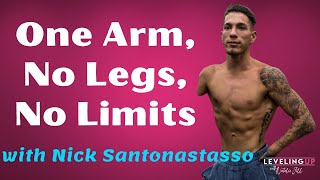
Natalie Jill interviews Nick Santonastasso, a bodybuilder born with no legs and one arm due to a rare genetic disorder. Nick talks about his mindset shifts, emotional struggles, and how he became an athlete and motivational speaker despite his physical limitations.
Hi, I'm Natalie Jill, fat loss expert turned high performance coach. When odds are stacked against us, how do we shift and create everything from nothing? How do we level up when we aren't feeling it yet? Or we've had a big setback? On this podcast, I'll be talking to some of the most inspiring and courageous men and women on this planet who at their worst, learned how to achieve success greater than they ever dreamed possible. Leveling up and creating everything from nothing. When Nick Santana Sasso was conceived, he was given just a 30 chance of surviving birth. He was one of 12 people in the world at the time that was born with Han heart syndrome, a rare genetic disorder. Now, despite being born with no legs and just one arm, Nick today is a bodybuilder, internationally known public speaker, and Internet sensation. You see, Nick had some amazing parents, and they taught him early on that the world would not stop for him. And it was this way of teaching that made Nick fiercely independent and competitive. Nick has continued to aim higher and higher, knowing that every day he lives is considered a medical miracle. He's made cameos on TV shows like the Walking Dead, and he's become a social media sensation, gaining more than a million followers on vine in less than a year alone. Most recently, Nick decided to become a competitive bodybuilder, showing he can achieve physical greatness no matter what his situation. In 2017, he won the third place in the men's physique novice category in his first competition at Iron Bay Classic. Now Nick is sharing his experience with people all over the world as a keynote speaker at schools, universities, nonprofits, as well as Fortune 500 companies. He's using his challenges to inspire others to push way beyond their suffering and live a life that has no limits. Nick already helped to inspire giants in today's world, such as Dwayne the Rock Johnson, Tony Robbins, and Gary Vaynerchuk. Join me today and learn from Nick exactly how he continues to level up and create everything from nothing. Hi, everyone. Today I am here with Nick Santinostas. Did I pronounce that right, Nick? Because that was my biggest first question.
That was right on.
This guy is so amazing. Nick, thank you so much for being here. I was so excited to talk to you. I don't even know if you know this about me, but okay, so I started in fitness, which I know you do a lot in fitness now, but my slogan has always been excuses or solutions. You decide. And when I learned about you and I started hearing your story, I'm like, okay, he needs to Be the face of my slogan for real. Because just looking at what you've accomplished, how you changed your mindset, you've literally, like, conquered the world, and you could have had every excuse in the book. So thank you for being here with me today. I cannot wait to interview you.
You got it. I'm grateful for the opportunity. I'm ready to get in some good conversation. So, yeah.
Awesome. Awesome. Okay. So for those of you that don't know who Nick is, who you've been hiding under a rock, he's somebody you definitely want to follow, because, my gosh, Nick, take me back. Like, Nick was born, you were born with something that could have been an excuse that everyone would have accepted and would have. Could have gotten in the way of your life. Can you take us back to that? Like, tell me what was happening when you were born.
Yeah, absolutely. So I'm 22. I was born on May 20, 1996, and I was the fourth child. And so I'm the baby of the family. And so basically, when my mom was pregnant with me, she went in for, you know, a regular ultrasound. Everything was fine. She went in for another ultrasound. Everything's fine. And then she went in for a late ultrasound, a late checkup. And they, you know, they sat my parents down. They started, you know, they pulled up the baby on the screen, and they started looking at the screen with this puzzled face. And my parents are like, you know, what's. What's. What's wrong? You know, what's going on? And they said, well, from the looks of it, it doesn't. From the looks of it, it doesn't look like you're, you know, baby's limbs are being developed. It looks like he's missing his legs. It looks like he, you know, he has one arm. He might have a cleft palate. And they just started, you know, listing all these. All these things about me. And in that moment, my parents looked at each other and, you know, thankfully, and so grateful, they looked at each other and said, you know, like, we're gonna see where life takes this. You know, we have no control. We're just gonna, you know, put our. Put our faith in whatever we would put our faith in and see what. What happens. And so they classified me with Hanhardt syndrome. And that was. That is a super rare genetic disorder that either leaves the babies with undeveloped limbs or undeveloped organs. And so at the time of my birth, I was the 12th baby in medical history that they. That they've ever seen to happen to. And out of the 12, eight of them passed away due to undeveloped organs. So. So, you know, the babies are born and they can't breathe on their own, they can't eat on their own. They hook up to machines that they later on pass away. And so, you know, they told my parents that you're, you know, your son has about a 30% chance to live.
Wow.
You know, my parents did the right thing, and that's focusing on the 30 rather than the 70. Because focusing on the negative will never serve you in any situation, so you might as well focus on the positive.
Yeah. I mean, right away, you can tell who your parents are by just that statement like that. They focused on that. I mean, it didn't even enter their. Their minds that that wasn't what they were going to.
Yeah, yeah, absolutely. And, you know, there definitely was, you know, your world comes crashing down. Right? I mean, it wasn't all just like, oh, we'll just move on. You know, there's definitely, you know, my mom and dad, you know, stayed up at night, you know, didn't know if I was gonna, you know, live. And that's really hard as, you know, parents and I don't even know what they could go through. And so I was born, and they immediately did test on my organs, and my organs came back 100% healthy. The only thing that was affected were my limbs. And so, you know, my mom said one of the first things, you know, she realized wasn't like, you know, the, you know, the disability, whatever you want to call it, but I had a full head of hair and, you know, beautiful face. And she was like, oh, my God, you know, that's a beautiful baby. And so super grateful for the way my parents raised me. They're the superheroes. So from the earliest of ages, they, you know, my parents sat me down in the most polite way and said, you know, Nick, the world's not going to stop for you because you're born like this. And, you know, you're going to have to figure out how to do each and everything your way, Nick's way. And so what I mean by that is, you know, like I said in the most polite way, my parents would sit me down, or they. They'd sit me down and put clothes in front of me and say, okay, Nick, you know, you got to figure it out. Or, you know, they put my. Or they put me in my high chair and they put, you know, a utensil there with some Cheerios and say, you know, Nick, you got to figure it out.
So the same age that a toddler would be learning to eat or learning to do things. They started going into that. So, so it sounds like, right, like when a two year old's learning specific things, they were doing the same thing to you, not treating you any differently.
Yeah, yeah, exactly. You know, they, they were, they promised that they were going to raise me just like the other kids and, you know, see what I was capable of doing. And so, you know, with, with the utensil and the Cheerio thing, I finally realized that if I flicked the spoon off and I started licking my finger and eating Cheerios that way, that it was much more efficient. And so, you know, by my, and I always tell people, by my parents putting these trials, these tribulations and these challenges in front of me at an early age. One, it got my mindset in the rhythm of, okay, it's not can't, but it's how, you know, and how am I going to run through this barrier? How am I going to break through this, you know, this wall? And that's the same approach we all need to take in life because life gets hectic and we have challenges and we have trials and sometimes it overwhelms us, but we need to take a deep breath and you know, sit back and say, okay, well, it's not cant how, you know, what approach am I going to take? And you know, it's crazy because actually the majority of not only entrepreneurs, but humans, they start with can't. You know, that that's one of the things that we tend to do is start with can't you tell someone you're going to do something? And they start listing all the reasons why you can't do that. Well, that's not really empowering. So why would we do that? That's like shooting yourself in the foot at the beginning of a race. And so, you know, we need to start listening the reasons of how and why and why we can accomplish things. And so, and at any point in this, you know, just cut me off because, you know, I have, I just.
Yeah, no, I love it. I love what you're saying. I have so many questions, like I want to know when did you first or did you even realize you were different because, because the way your parents were talking to you, did you even, did you, did you know, do you remember that first memory that like, I'm different. I want to know that. And I also want to know, did you, when your parents were doing that to you, which was, which is amazing, did you take it as this is helpful or you did you feel Hurt. Like, this is mean. Like, what was going through your mind when you remember that?
Yeah. So to be honest, I guess I was born competitive. And I was, you know, I was born, like, you put a challenge in front of me, and I'd sit at it for, you know, as long as it took me until, like, you know, I got it, or I absolutely, like, okay, I need help, you know, so I'd give my, you know, my all on trying to find, like, you know, like I said in a solution rather than excuse. And so I'd sit there and I. And still to this day, like, there. There are some things that I'll just sit there and I'll challenge myself with. And I know that if I use both of my limbs to do it, I could do it, but I'll try to do it with one. Like, I'll always just, like, I'll just try to push myself. And so from the Earl, like before middle school, I don't think I realized too much. I was different. But the one thing I realized that now that I look back is I looked at a. Like a preschool picture of me, and it was a Christmas picture, and, you know, we all had Santa hats on. And then when it got to me, I had my. My left. My left hand shoved up in my hat. And so from that, from looking at that, I guess I didn't like the way my hand looked. And so I guess I did realize a little bit. But, like, to be honest, I don't really even remember any thoughts of, like, me being like, oh, wow, I'm super different. You know, I was just. Yeah, you're a pure kid. I had. I had a great school system. I had a great support system. And you know, to be honest, like my parents, like I said, I just. I got beat up with my siblings. Like, I just didn't realize anything.
Wow. So. So you thought. You just thought, this is normal. This is me. This is who I am. And that's what, you know.
Yeah, that's all I. That's all I knew. And then I got into middle school. And I think we can all agree that middle school and high school are probably the most judgmental times of our lives.
Oh, yeah.
If you have kids, your kids lives. And so going into middle school was kind of like a big slap in the face for me. And, you know, I realized, you know, I never got bullied. I want to make that clear. I never got bullied. But there was always, you know, there's always name calling, right? There's always teasing. And so I realized you know, the kids teasing. I realized that, you know, that I. Even. Even though I had an aide in school and an aide pushing me around and sitting with me in class, that although I wasn't any slower mentally, kids, you know, you know, thought I was slower. And, you know, I realized how different I was. I realized that I was in a wheelchair. I realized that, you know, I saw kids riding bikes, and I was like, why can't I do that? You know, I. I realized all these little things, and I was just a kid. That was. I finally realized, and it sunk me. I got to this place where, you know, I thought you were either born with confidence or you didn't have it. I thought, you know, that I was just so. So different. Like, it was like, I didn't. I didn't realize I was different. And then I realized I was totally different. It was just, like a big change. And, you know, I just. I was at this low point in my life. I got to the point where I was. I guess I was depressed, but I was just talking about this, that in my family, I was always the glue. I was always like, you know, that positive. That positive person. And, you know, energy is contagious. And so I was that positive person in the family, and I was that positive person in school. And the teachers always, you know, thought I was positive role model. And so I would put this mask on and pretend I was happy because I knew that it would affect other people, and I didn't want, you know, other people got it in some low place.
Yeah. So does that affect you? Like, that is. I can see how that could be a mass. Like, everyone's saying, oh, wow, look at Nick. He's so positive. This is amazing. Look at him. But he's so positive. It's like all of a sudden you start feeling like you have to always be positive, and you can't share when you're. When you're not.
Exactly. Yeah, I felt. Yeah, I felt that, you know, I didn't. I didn't want to express any of my negative emotions because, you know, energy's, you know, contagious. And I knew that people look. Looked up to me, right? And so it got to the point where I was just, like, I was out of shape. You know, I was out of shape, and I didn't have any confidence. And here I am, you know, like, in this victim. In this victim mentality of, like, why, you know, why me? That was one of my biggest questions. I was pissed off at the world. Whatever made me, whatever was going on. I Said, you know, there are millions of kids, there are millions of adults that are born, and, like, why do I have to be born like this? Why do. Why do I have to go to the challenges? Why can't I ride a bike like normal kids? Like, why do I have to sit in a wheelchair? Like, I. It just. I'm so pissed off at the world.
How old were you around this time, nick?
This was 14, 15.
Okay, so high school time. Okay.
Yeah. Yeah.
Because I would imagine at this time, I mean, this is like, kids are learning to drive. This is, you know, so that. That's. They're getting into sports. And then the girl thing, I mean, isn't that. I think it's when boys start liking girls. Right?
Yeah. Yeah. I'm glad you brought that up, too, too. Because before. Before the podcast, I said everything's, you know, there's nothing that's off limits. So I'm glad you brought that up. And so, yeah, I was just, you know, not confident in myself. And it got to the point where I didn't want to look into a mirror. You know, I didn't want to go outside. I didn't want to go in public because I just. I hated myself. Like, I hated this body. And it got to the point where I did starting having, you know, these. These suicidal thoughts and that, you know, that I don't want to live in this body anymore. And I think, like. Like you just mentioned. I think one of my biggest triggers, I guess you could say, for like, getting so, like, lost and so dark, and my thoughts were girls.
Yeah.
So, like, you know, that, like, you know, you're a dude. Like, you're a guy in middle school and high school, and, you know, no one, you know, the girls didn't mess with me, you know, no one. I mean, in a friendly way. Right. But when you're looking for, you know, female energy and you're looking for someone to love on you, and you don't have that. I mean, you know, my parents like everything, you know, I had. I had great family, you know, that loved on me. But, you know, you want.
No, but I know what you mean. And you got the hormone. The hormones start happening. There's a lot. There's a lot of things happening. And I would imagine, you know, I sometimes I see. Yeah, this. I always wonder about this. Like, people. It's almost like they look. They don't look you in the eye or they look the other way because they don't know what to do with somebody that looks different than them. And I would imagine that feels very isolating and lonely too. Like, like you just said, the girls, it wouldn't look or they wouldn't connect or. I mean, that I would imagine that would feel lonely.
Yeah. Yeah. I mean, yeah, right? Like, that's. Believe, like, believe it or not, like, that's a big, that's a big focus for kids, you know, like at, you know, middle school and high school, right? Even on the girls and, you know, you're like trying to impress the guys and everything and. Yeah, so, you know, here I am and just like, I just like felt like I have no shot, you know, like no shot at this stuff. And that would really, that would really put me, you know, into a dark place. Because as humans, we're the only species that could figure thought and piss ourselves off and totally that can think of thought and make ourselves happy. And so. And as humans, when one bad thing, like one bad thing goes wrong, we tend to stack and we tend. And we tend to just like start picking out all the, all the bad things, you know, all the, all the flaws, everything, like you name it. We start to like stack things. And so, yeah, I think, I think girls was one of the bigger triggers in my life that, you know, they didn't, they didn't mess with me. But, but on the brighter side, on the brighter side, I'll bring some good into this. When I was, I guess When I was 16, I had my first girlfriend and she was, I'm not gonna lie still, she was, she was pretty hot and pretty good looking girl. And so, you know, I went to my, my winter formal and brought her out. And you know, that was, you know, that was a little step into my confidence. But other than that, I was at just a super low point. I was at a super low point in my life. And I'm trying to find something that is gonna dig me out of this hole, right? And the one thing that I want to express people is like, no one, no one else can save you but you. And I realized, and I realized that I'm in this hole, right? And I'm like, oh my God, you're putting on a mask and you're in this state, like, Nick, what are you gonna do to dig yourself out of this hole? Because like, the only person that can make a drastic change in your life for, you know, physically, mentally, emotionally, like, you have to do it for you. Like, people can support you and they can say things, but like, if you want to dig yourself out of a rut, like, no one's gonna come and Save you, You know, you have to do it for yourself.
Yeah, I have. So. So first. Well, I have a lot of questions now, right now too. So how did you, like, were you bottling all these emotions? Was there anybody that you could talk to? Like when you had the girlfriend, did she know how you felt? Did you have, did you talk to your parents about this or were you always putting on that front of I have to be so positive?
I, I did, I did just keep this positive outlook. And you know, I would. You know where I'd cry? I cried the shower. Because you never know.
Wow. So you hit it. You see how emotions. But you hit it.
Yeah, I'd cry in the shower where, you know, you get out and if they asked me, you know, why are your eyes red? Oh, I got soap in my eyes. You know, like, I would high. Yeah, now that I think about it, it's wild. But yeah, I just, I would like, I'd cry in my room when no one's around sometimes or I'd cry in the shower. And you know, I had good days too. Like, don't get me wrong, it wasn't all dark. Like, you know, I had great days. But you know, the days that when things really hit home or you know. Yeah, I would hide it because like even still to this day, you know, I know that just by simply me being in public and smiling can change someone's life.
Nick, you're so humble. Like, listening to you about your, about how it's so fun, it's so amazing listening to you talk. Like you, you just exude this. Like, I'm going to be positive and I'm going to be a solution oriented, which I love that you. It's. But I'm just thinking like all the. Especially dealing with what I deal with, fat loss. I. The women that just hate their legs because they have cellulite and they can't leave the house because of that. And I'm thinking, like, I want to shake them right now. Like, see that this kid, like what he was going through at age 14 or 16, he didn't have legs. And he is still telling me why. They're still positive, they're still positive. And I just, I just, I'm completely amazed by that. Did you. So you're crying within your shower alone. Did you ever get to heal that? Any of that emotional trauma or are you still dealing with that?
Yeah. So you believe it or not, and this might sound wild, but now that I think about it, I think where I, where I let my emotions go and I felt equal was playing video games because, believe it or not, like, I. I play. I play. I played Xbox competitively, okay? And no one knew I was playing with two fingers in my chin. But I'm, like, still to this day, I'm a very good video game player on Xbox. Like, and people don't believe it. I'm gonna start streaming it and showing people. But, yep, there. There. I felt equal and even better because I was, you know, beating up kids that, you know, like, on Call of Duty and stuff. And so I played a lot of video games when I was younger and that. And, like, that was my thing. Like, I would just, like, go into that world especially, you know, and so, like, there was a world where, you know, no one knew what I looked like. You talk over Mike. No one knew that, you know, the situation got going on and I was better than people. You know, I was beating people. And so I guess I let a lot of my emotions out playing video games and kind of got lost in that world. Yeah, that maybe was a cope.
No, that's amazing. It's like a great equalizer. I've never thought of it. That's. To see. See any parents listening? Video games are not so bad. There could be.
There could be some definite benefits in moderation, like. No, Fortnite's taken over, but. Yeah, but my. My real. My real change came from. From wrestling. And so wrestling saved my life. And so when I was a freshman, my best friend Dan. We're still best friends to this day. He wrestled his whole entire life, and his freshman year, he decided to be a bowler. I don't know why, but he decided to be a bowler. And so I tried out for the bowling team. He was like, nick, you can. You can do bowling. All you got to do is roll the ball down the lane. You get to eat cheese fries after. It's, like, really, really easy. And I'm like, oh, man, I'm in. You know, I'm Italian. I'm all about food. And so, you know, I soon realized that bowling. Bowling wasn't for me. And I wanted to, you know, push myself even more. And so my older brother, who's about six years older than me, he wrestled for that same high school. And I'm from New Jersey, so wrestling's like, you know, football in some places, it's like, you know, religion. Wrestling was, like, so cool. And so I always looked up to wrestlers. And when I got into my sophomore year of high school, all my best friends were stud wrestlers. And they were like, nick, you know, you always try new things. Why don't you try wrestling? And I said, I can. My arm. And what I mean by that is. And then I know this is going to be audio. What I mean by that is my right LIMP was about 5 inches longer than it is now. Right below your elbow, basically. And so my bone was growing faster than my skin. So it was very pointy. It was like your finger, but super sensitive. And I couldn't really touch it on things because the bottom line is, if I would have hit my arm hard enough, my bone came through my skin. And so there wasn't much skin there. And so I was like, you know, I can't. I can't wrestle my arm. And then, you know, I marinated to my, you know, I marinated on this thought to myself, and I was like, man, if I could. If I could be labeled as a wrestler, you know, I'd be labeled as an athlete, let alone a wrestler. I'd be with my buddies, you know, we'd be just like, you know, studs. You know, I wanted to be that. I wanted to be an athlete. And so I came home one day, I waited for both my parents to come home, and I said, mom and dad, you know, I want to be a wrestler. And they supported me in everything and anything I wanted to do. And. But this was a little bit different. And my mom was like, oh, no, Nick, you know, God forbid you hit your arm. You know, wrestling, the most physical sport, you know, you're gonna hit your arm, like, what are you gonna do? And I said, can we cut it off? They said, what do you mean? I said, yeah, can we, can we cut it off? And they're like, first off, Nick, the correct word is amputation. You're so aggressive with your term. The right word is amputation. I said, yeah, so, okay, well, can we, can we amputate this? And they said, is this something that you really want to do? And I said, yeah. And that's what I always tell people. Like, whatever you're focusing your energy on, whether it's being a better husband, whether that's being a better mother, a better father, a better businessman, building a business, whatever it. You need to, you need to give it 110% effort or you're literally selling yourself short. So, like, right now, if you're listening and you, you know, you deserve to be great. And, you know, you deserve to do great things. Like, why would you hold back?
Like, the question is, did you cut your arm off? Would you cut your arm off for it? Yeah, yeah, clearly, because that's. That's huge. Like.
Yeah. What are you willing to do? You know? What are you willing to do to pivot? And so, you know, I persuaded them. And so my sophomore year, we scheduled the amputation, and so what they did was they lasered 5 inches of my arm off, or my, you know, my limb off. And then they did a skin graft. So they pulled extra skin from, you know, higher up on my arm and pulled it over the bone so I had some cushion. And I remember telling the doctor, I'm like, doc, if I wake up and I can't beat someone over the head with this arm, we're gonna have a problem, because I need it. I need it to be physical. And so, you know, I woke up from surgery. They did an amazing job. And I always say I was the happiest kid that just cut his arm off. And I, you know, I went back to school, and I was so pumped up to tell everyone. You know, people are like, dude, like, what'd you do? I'm like, I amputated my arm. They're like, why? I said, I'm gonna become a wrestler. And, you know, you know, some people laughed, and some people were like, you know, Nick, let's. Let's be real, you know, like, let's be real. How are you gonna become an athlete, let alone a wrestler? And, you know, the thing about that is we're always gonna have outside noise. We're always. We're always gonna have, you know, the haters, the naysayers, you know, and sometimes it's even tougher because it's your family, your friends, and not. But, you know, in some people's situations, yeah, you know, we all experience the outside noise, but we all have the same choice of whether we're going to let that outside noise affect us or drive us. And so all of that stuff in my life, you know, all the hating, all the teasing, I use it as fuel. And so, you know, I told these people, I said, you're right. I'm not going to become a wrestler. I'm going to become a varsity wrestler. And, like, you know, like. And maybe it was that, you know, the one thing I didn't mention was when as soon as I was born, the doctors basically handed over a list of my parents and said, all right, here's all the things your son won't be able to do. And my parents, you know, threw that list away. They're like, all right. Like, no, thanks. Like, cool. You may be a doctor, and you may be a Professional. But you're not going to put limits on my son.
I just love your parents attitude and I can completely see how this was contagious on you. And I mean, kudos to them and for just being that example and just focusing on what's possible versus what's, what is not. Because, because Nick, it's so crazy because anyone would have understood if your parents went down that road of can't. If you had been in that, everyone would have given you sympathy and you could have been a victim and they would have understood. And it was. But like look how big your life is because of that change of state, how you changed your mindset because of that.
Yeah, it's wild. And just, just to plug in, I, I push my mom to write a book on their, the parents perspective on how they raised me. And it's finished and it's gonna get released sometime, but not yet. I don't have a date yet. But I just wanted to tease that a little bit. Yeah, I think, you know, that even provides more value than some of the things that come out of my mouth because you know, especially from the parents perspective, I think we can all agree that like there are a lot of ungrateful kids getting raised. You know, parents are just having a hard time instilling the right right, you know, not even like, like the right, what is the word?
You know, the right values, the right.
Attitude values, the right habits too. Yeah, that's what I was going to say. That instilling good habits into kids, you.
Know, so what's so interesting to me is, you know, I know you've heard and I've said it. Many people have said it. You know, you focus on your vision, not, not the how, the how or for your old self. And I find myself as you're talking going, but how, but how, but how did he wrestle? But how did he do this? And it's like you've never even brought up that you ever thought of a challenge other than the pain in your arm. Like there is no. You don't even think of the how. You're just like, this is what I'm gonna do.
Yeah, that's a perfect thing to touch on it. Just like. Yeah, when I, when I wanted to become a wrestler, the only little bump in the road was the fact that my arm hurt. It wasn't the fact that I had no legs in one arm because I knew that if I worked hard day in and day out that, you know, if I worked hard enough it would make up for my lack of limbs. Like, if I busted my butt, like, this wouldn't matter. Yeah, it's wild.
So what is everyone else's excuse? My goodness. Like, this is just incredible. So I want. Have you. Have you ever had doubt, though? Like, has there ever been a time where you're like, I just. I can't. I'm not even gonna go for this. I'm not. Or do you just. Anything you want, you decide you're gonna make it happen?
Yeah. So there was a point. There was a point in my life, I was probably 13 or 14, and probably around that time where I saw kids riding their bikes, and I was like, man, I want to do that. And so with my case, I, you know, I asked my parents, I said, I want legs. You know, I want prosthetic legs. And with prosthetic legs, the amount of quad you have determines how easy it's going to be. And I don't have much quad. I have some quad, but I don't have much, so it's going to be difficult. So we finally found a company that was able to fit me for legs. And so I started off on little stilts. And so they didn't have knees in them. They were just stilts to train my quads and get my body in shape. And like I said, I wasn't an athlete then. I was kid out of shape. And then finally they put me in the big legs, which were seven and a half pounds each. They had, you know, they had knees and everything. And, you know, I started walking with the bars, and I started walking with a walker. And what I. What I didn't realize at the time, which now I know, but I didn't realize at the time was, like, how much goes into a human walking. And so by you guys being born with legs like your. Your abs, your obliques, your lower back is already, you know, develop by you riding around as a kid. And so me, I didn't have my. My abs developed. I didn't have my lower back strengthened. I didn't have my obliques to keep me upright. And so when I got into my legs, I could not walk without a walker. It was like the one thing I was like, oh, my God. Like, I can't. Like, I can't. Like, this is so hard. And so I didn't realize that it would take working out and stuff. And, you know, I remember I wasn't in shape, and so I kind of put them to a side because it was slowing me down. I was like, all right, like, I run around regularly. I run around faster than with these legs on, like, I don't need them right now. And so that was, like, the one thing, you know, one thing in my life. I was like, oh, my. I can't do this. And so that. That, you know, I was like, all right, I'll put it to the side and maybe come back to it. You know, that's why my parents said, you know, like, you'll maybe try it later.
Yeah. But it's interesting because it's not. If that's a. You decided you couldn't do it for very valid reasons. Not because. But as far as, like, goals, I don't think there's anything you said I want to do and I won't. Like, like the wrestling. And then even you're with fitness right now and being a motivational speaker and just everything you. You've. Other than the physical stuff. Like, I like the legs and the arm hurting and wrestling. It sounds like you just. You decide you want something, and you have a vision and you don't. Nothing gets in your way.
Yeah, I. Yeah, I'm just. I'm very. I'm very competitive with myself, and I'm very hard on myself. And like I said, I'll push myself to the extreme to see if I can accomplish what I want to accomplish. You know, I get. You know, I'll leave it all out on the mat, like, wherever I am.
And so do you ever have those bad days now where you still. Where you go back to being like, how you said as a kid when you would feel sad or, you know, the crying? Does that ever come up as an adult now?
Yeah. You know, I tell people, like, I may look like Energizer Bunny, but we. We all have our low days. And so I had a. I had a low day. So my birthday is May 20th. And so this past May, we were in Miami for my 22nd birthday. And maybe, you know, an interaction with a female didn't go the way that, you know, maybe expected, or she said something that kind of like, you know, put me in some mood. So, like I said, with humans, one thing goes wrong. We tend to just stack. And so, you know, this one interaction didn't go the way planned. And I got back to the, you know, where we were staying, and I was just in this low mood. The guy's like, you want to go out? I'm like, no. Like, and just in this very dark place and, you know, the thoughts that were going through my head were like, okay, like, you're not attractive, and your girls don't like you. Because of this and that. And, you know, we just started stacking them and the, and the key to this, for people listening, when you're in a slump or when you're in this stage and you're having a low day, is the biggest key is self awareness and realizing you're in that state. And so what I mean by that is when you're in this low state, embrace the feeling that you're having. Realize that you don't feel good, that the thoughts are going through your head, are negative, your physiology is probably down. You know, your shoulders are slumping, your voice is, you know, talking low, and you're not in your peak state. And so basically are we. We're not allowed to curse on here, right?
You can curse. Go for it.
Basically, no rules. The long story short is you have to sit in your shit for a little bit. Mm. You have to sit in your shit. You have to sit in your shitty situation and realize like, okay, this is how I feel. I don't like feeling like this. And now I, I know what it feels like. I'm gonna embrace this and then I'm gonna take myself out of the situation. And you need to realize that the only person that could take you out of that situation is you. Through your own self talk. Like, you have to be your biggest cheerleader. And so, so here I am. And, and, and then I realized, you know, instead of saying, you know, I'm disgusting, I'm not confident where all this stuff, you know, I, I switched it with. I am confident. The girls, you know, the girls that don't want to talk to me, this is my, my situation is an authentic filter and it filters out the people that I don't want to hang out with anyway. Like, you know how empowering that is. Like that. Yeah, like, and, and that, you know, that that was one of the biggest shifts for me with girls is realizing like, oh, if a girl doesn't want to, you know, mess. Mess with me because of this, then that's not the type of girl I want to be around anyway. Like, you know.
Yep, absolutely.
Yeah, that's super empowering. So, you know, that's just the. A little taste of how self talk and positive affirmations can empower you.
So when these, when this happens, because anyone listening can relate to, I call them self imposed stops. Like these things. This, this voice in your head that's like, at you all day long telling you the negative stuff that you just literally let yourself feel it and hear it. And as you said, sit in your own shit. And then you change it into positive affirmations and tell yourself that you almost like have to trick your mind out of it into what the truth is.
Absolutely. Yeah. So, I mean, yeah, so for that, that's, that's the key out of that. And just to wrap up, you know, how I found my why were wrestling is my senior year I came out as the 106 pound varsity wrestler for my high school. And that was, you know, that was probably because when I went in my junior year, I was a JV wrestler and I looked at my boys and I said, guys, you need to beat me up, like you need to pick me up. You need to slam my face on the mat as many times as you need be. Because if you hold back on me, I'm not gonna know how to become the best wrestler I could possibly be. And that was the same approach that my parents took. Right. If my parents coddled me and babied me and did let me fall on my face, would have got slapped in the face with reality at, you know, an early age.
How did those boys react to that? I mean, were they, did they embrace it? Was it hard for them?
Oh, yeah, no, my boys are, my boys are ride or die. You know, they beat me up, I got my butt kicked, you know, for sure. And, and I didn't let people, you know, I didn't want people to hold back on me. You know, I always want to be treated, you know, treated, you know, equally. And so yeah, there was, that was a very emotional time. You know, there was, there was, you know, training sessions where you would have four guys in a circle and one guy would be in the middle and that guy has to get a certain amount of takedowns or else he can't get out of that circle. And there was times where Nick was in that, that circle for 45 minutes getting his butt kicked because I couldn't get out of it. And you know, I got to the point where like, you know, I sometimes I would break down and cry and you know, but I'd get back up and, you know, maybe crack a smile to my friends and, you know, that energy is contagious and it was kind of like a mute mutualism, you know, mutual benefit. If we could just, you know, smile when we're getting our butt kicked, you know, that it's like, oh man, like we know, whatever, like, let's just get through it. And so my, my senior year I was, I was 106 pound varsity wrestler for my high school and I was 2 and 17 my senior year, but that was two more wins I got the previous year. And that's what we call winning progress. And, you know, as long as you're moving forward in any area of your life, you're winning, it's just about a little bit progress here, here, here and there, you know, But I'm very competitive, and I knew that I wasn't good, and I didn't understand why there was gymnasiums packed to watch me wrestle. I didn't understand why I would get standing ovations when I lost. And then one time I came off the mat, and this lady come up to me, and she was crying, and I'm like, oh, man, you know, what did I do? And she got down on my level, and she said, nick, I want to thank you. And I said, you know, for what? What did I do? I just lost. And she said, my daughter's over there on the sideline, and she never wanted to do a sport. She never wanted to do an extracurricular activity until she saw you out there, you know, doing this stuff, like. Like, you know, trying your best on the mat. She wants to try all these things. You. You motivated her. You changed her perspective. You pierced a barrier that I couldn't as a parent. I want to thank you. And I'm like, you know, I kind of. I was like, oh, my God. You know, did that really just, like, happen? Because when you really look at the situation, I was on the mat for myself. I was on the mat trying to dig myself out of a hole when I was helping others, you know, get out of their hole. That's when I realized, like, imagine if I focus my energy on helping people and trying to, you know, change their lives, that that would. All that. That, one, it would be fulfilling. And two, you know, that. That. That might be my.
Why, you know, that's incredible. And all because that's. Yeah, that's. I can imagine that would have a huge epiphany. So, first time realizing you're actually there for somebody else, you're actually helping somebody else. It's not about just us. And maybe that's not what it's about. I love that.
Yeah. Yeah. And so I. And then. And then, you know, I realized that the things that I thought were the most negative about myself, the things that I thought were the most disgusting about myself, turned out to be my biggest empowerments and my biggest tools of influence. And that's kind of where, you know, it comes into, like, embracing your differences, embracing your authentic self, and, like, you know, regardless of what hand Life has dealt you with that. Like, yo, we got to play this hand to the best of our ability.
Yeah.
So that was a very empowering, empowering moment for me. And that, you know, you know, you know, got my confidence meter, you know, filled up a little bit. And at the same time, that was when the app vine came out. Are you familiar with?
Yeah, of course, yeah, yeah.
And so vine came out in 2014. That was my senior year. And for those listening that you don't know, vine was an app that was released and you can only post six second videos, so you had to be as creative as you can in six seconds. And everything that I do now, you know, everything that I do, I always have a purpose. I always have a message that I want to bring. And so with Vine, I wanted to create an outlet where, you know, people can look at the phone and see a video of me and go, wow, you know, look how happy Nick is. Maybe I could be a little bit more comfortable in my body. Because as well as we're doing this podcast, there are millions of kids and adults that feel that same way that I did in middle school. You know, they don't feel like they're good enough, they don't feel like they're pretty enough, they don't feel comfortable in their skin. And so, you know, I wanted to empower people. I wanted to help people. And so, you know, I was thinking of something that would go viral, something that's never been done before. And I'm sitting with my buddies in this little group and I said, guys, you know, is there anyone that's. That has no legs that's crawling around Walmart pretending to be a zombie? And they said, you know, no one. And I said, you know, that's a good idea. I said, that's never been done. Let's see if we could do that. So I put fake blood on my face, I put fake blood on my clothes, and I set out to my local Walmart in New Jersey, which I'm not allowed in that Walmart anymore. I've been kicked out.
Oh, my gosh.
And, you know, we were looking for a victim, and so we found a guy that was heavily invested in the bounty paper towels. And so I said, pull out your phone. And I come running around this corner like this. And I was crawling and I was like, you know, this zombie sound. And he was like, oh. And he. And he threw the paper towels at my face. And I got this amazing reaction.
Oh, my gosh.
I apologized to him and, you know, I got the video I remember on the way home, I said, you know, if this reaches 500 kids, you know, 500 kids are adults, right? And they can feel empowered off this, then, you know, that's all I want.
Yeah.
I posted the video that night and I went. It was a school night, so I went to sleep for school. And I woke up the next morning, it had over 80,000 likes and over 80,000 revinds it like, wow, it's a popular paid divine. And I gained like 50,000 followers in a day on Vine. And I went to school. Yeah, I went back to school and people like, dude, like, what's going on? Like, you're the zombie king. And I was like, oh, my God, what did I get myself into?
That's hysterical.
Yeah. And so there was news articles, you know, all over, you know, from China, Europe, you name it. And the one article that stood out to me the most was New Jersey Teen born with Disability turned into a Positive. And you know that that's all I wanted, right? That's all I wanted people to see was like. Like I said, regardless of what hand life has dealt you with, whether you think it's bad, what do you think it's good, you gotta roll with it. Like you. You gotta roll with it. And so that. That was just like a wild time for me. So, like, I was that kind of turn. I turned like a bit of a celebrity in school, you know, and even in other schools, like, I'd go to wrestling matches and the cheerleaders would be rooting for me and not their own person. It was wild. I was taking pictures of kids all over. Like, that was a huge. I need to talk about that more. You know, in other. In other interviews, I never even mentioned that. But, like, that was a huge boost in my confidence. And the one thing that I think people didn't like was the fact that I kept my same friend group. You know, there was a lot of. There was a lot of, like, people trying to jump on the Nick bandwagon and I just kept it real. I was like, you know, like, if you didn't mess with me, like before this, like, I'm not gonna mess with you, like now. And so.
So now that now I'm celebrity and you want attention, but where were you all these years? Yeah.
Yeah. And. And so, you know, the girls, like, want to take pictures and stuff, and I'm like, yo, this is stupid. And so like my senior year, I. I sat in the lunchroom, you know, at the lunch table by myself. Because I didn't. I didn't like, sit with groups. I didn't care, like, if people wanted to sit with me, they sat with me. And so, like, you know, people come and go. And then, you know, I moved myself to the library and just kind of sat with myself and. Because, you know, there was so much fake going on and I was like, yo, I don't. I don't ride with this. And still to this day, you know, I still keep in touch with all my. All my high school buddies, you know. Yeah, sorry, guys. But some are more nerdy than the others. I have some, you know, jock friends and nerdy friends, and they're all the same friends. Yeah. Switched up. And so I think that people. People that, that, you know, didn't. That tried to jump on the bandwagon and didn't get on, say I switched up, but, like, I pretty much stayed the same.
It's that. It's them. They were trying to get in. And you saw through that. Yeah, absolutely.
And so, you know, to tie the vine up to the vine thing up, you know, I posted a bunch of funny videos, which you guys can Google Nick vine compilation, and I gained a million followers in under a year. And this led me to getting hired by Fox to scare Norman Reedus, the main actor of the Walking Dead in Tokyo, Japan, which, you know, that video is out there. And you know that this is just a prime example of, like, when you start focusing on others and serving others and trying to make people laugh and make them, you know, smile and try to change other people's life that, you know, that's. The universe rewards you with amazing opportunities.
Yes. Yes. Focusing out. And that's amazing because so many people, you know, are. Stay in their own head about what? About them. About everything's about them. And you're right. As soon as you focus out and realize that we really are all connected and we're here for a bigger purpose other than ourselves, then your. Everything starts to align. You're. You're absolutely correct about that.
Yeah. Yeah, it was wild.
Are you. So when people. When you are out and about and you meet a stranger, what do you want from that? Do you want. When do you, like, when strangers treat you like everybody else? Do you want them to be asking you why? Like, what reaction. Do you ever get tired of it being that I had this. I'm born with this, and I'm more than that. Or do you.
What.
What is the reaction that you want from people?
Yeah, so it's funny. It was a. It was definitely a gradual, like, now I react differently Right. So when I was younger, I would get pissed off when, you know, little kids stared at me or, you know, even adults stared at me. And my siblings were very protective and would, you know, like, lash out at people and. But now, like, now that I really like life, life's all about perspective. And so now I realize that, like, if a kid's looking at me, he just. You only know what you know. So if you've never seen a unicorn and you see me, like, and so you're gonna be like, oh, well, what is that? And so, you know, now I much rather have, you know, parents come up to me, you know. Now, parents, parents, parents teach not to stare and point, right? They should teach to go up and introduce themselves and ask, what's your story?
Yeah, I love that.
Because kids, kids and adult, you only know what you know. And so if you've never seen a man with no legs of one arm, even an adult, you're going to be like, oh, like, oh, shit, what is that? You know, like, that's different.
But Nick, before you evolved and said, like, you said as a kid, you didn't. You wouldn't. Like, if somebody came up to you years ago, before you had evolved and asked that, would you have been offended by it or would you have. Have shared then and been like that they were asking that.
Yeah, I would. I would feel. Yeah, I would feel a little bit weird. And, you know, I didn't. I didn't like it. You know, I felt uncomfortable because maybe. Maybe at that point in my life, I was trying to block my mind, like, block my mind off from the fact that I was different. And, yeah, like, people are like, oh, you know, what's. Like, what happened? You know, like, that's like, there's a certain way to go about things, right? Like, you can come up and be like, oh, what's your story? Or like, someone comes up, he goes, oh, what happened to you? Like, that's like, I don't like that. Oh, what happened to you? Like, oh, like, what happened to you? You know, Like, I, you know, go.
Like, yeah, it feels defensive. It feels very defensive. Yeah, it's the tone. It's the tone and the intention behind.
That question you bring me. Yeah, it's the energy you bring me, right? So if you come at me, you're like, what happened to you? I'm like, whoa, what happened to your face? You know, like, you know, don't treat me with that energy or respectful energy, you know? Yeah, so it was definitely like, a gradual learning experience. Right on how to react and how to, you know, understand other people's perspectives.
Yeah. How do you react? How do you feel about other people now and their excuses? Like, like, like I mentioned, you know, in the fat loss space, I hear the lady that complains about her cellulite or whatever, like, how does that roll right off you? Do you get in deep discussions with them about. Really, are you talking about your excuses or what? What goes through your mind when you hear other excuses now from people?
To be honest, I feel like, so, like, I'm never trying to belittle people. I'm never trying to talk down to people. And I, you know, I try not. I don't get angry when people. Excuses. And honestly, like, when people say excuses, I'm kind of passive because I feel like they're ready for me to come out and say something to them in like a negative way. And I'm just like, yeah, you know.
Like, you don't want to even go there.
Yeah, yeah. I leave it. Yeah. To be honest, like. Like, yeah, if. If someone's in a room with me and they're sitting here and they're complaining, like they should be self aware that like they kind of.
Yes.
You know. Yeah.
Then it's really an issue. Like, you really are that absorbed in your own stuff right now.
Exactly. And I don't think it's my job to be like, well, you know, just like, you know, I'm just like, I'm good, you know, unless they ask me for help. You know, if. If it's like a passive conversation and I hear someone like bitching about something or like, you know, I'm just like, all right, like, that's rough, but I'm gonna move on. And like, not pretend I heard that, you know, because I feel like people are ready for me to jump out and be like, whoa, I did this and this and this, which I'm not like that, you know. Yeah, like that. And so I just kind of like, chill.
Got it.
Unless people ask for help. Right? Unless people like, Nick, you know, this is my limiting belief, like, can, you know, unless people ask for help, I'm. I don't go out of my way to be like, oh, well, you know, I don't have excuses and you know, like, I'm good. To be honest, I'm good.
Yeah. Nick, how do you. I mean, I know that you have really mastered mindset and staying in that positive. And of course you're human, so you have your moments of doubt and you've learned things to self regulate and to empower Yourself back to that thing. But how would you suggest that somebody that is really like in there living in their own shit and hasn't been able to get out of it, would you have any first steps for them? Like what would you suggest that they do to start turning the corner and being positive?
Yes. Perfect. So the majority of times it's confidence issues and it's confidence. And when I say the word confidence, I'm going to dive deeper into what it is because some people may have a different term for confidence and a different perspective on what it is. And so confidence, everything. And what I mean by that is it's your relationship you have within yourself. And so so many people are trying to, you know, amend relationships with other people and build relationships with other people when they really need to work on themselves and, and they're not giving theirselves enough, you know, enough self help. And so when you're in a slump, do one thing. Do start with one thing. It could be little, it could be big, but start with one thing that you know is going to make you into a better human being that day and you're going to be a better human when you, when you wake up the next day. And what I mean by that, it could be little things like reading a couple pages of a book and you learn something new. Like you're like, man, you know, I learned something new today. I'm, I'm smarter than I was the day before. Or say you wake up, you know, 30 minutes. Say you wake up 30 minutes earlier every day and you set that goal. Like let's put it this way. So how to build confidence is setting up little micro goals and keeping your word within yourself. So what I mean by that is say you're going to eat healthy five of the seven days you do it. You not only physically applaud yourself, but you mentally applaud yourself. You say, good job Nick. You know, you did this good job Natalie, like whatever it may be. And then you continuously do these little micro goals and you continuously keep your word within yourself and you build a relationship within yourself. And that's what confidence is. Confidence is having a relationship with yourself that's so good that you don't care what anyone else thinks of you. And so you know who you are, you know what your work ethic is, you know, your self integrity. So you know when you say something, it's going to get done and that makes you feel good. And as humans we love the feeling of progress, we love the feeling of progression, we love the feeling of moving Forward. It's like a hot. And so especially for, you know, the entrepreneurs, the go getters out here, like, if you're in, if you're in a slump, do one thing today that you know is going to move you forward. Because we love moving forward. And like our darkest times and our lowest times, even for me are the times where I'm sitting around and not doing anything well, where maybe I'm, maybe I'm stagnant or I'm just like an unproductive for too many days. You know, there's always good days to be unproductive. Let me tell you that. Like I love balance and I love, like if I'm, you know, touring for a month, like I'll come home and not do anything for two days, you know, I'll just chill. Yeah, but, but you gotta do, you gotta take that first step and do something that makes you feel good, makes you feel better about yourself and you know, it's just gonna make you into a better human being. And maybe it makes you a better, you know, human being in your industry or whatever you're focusing your energy on whatever you try to build your business on. And so you have to build that relationship within yourself that you know who you are and you know, your self integrity. Because then like, you know, Natalie can come up to me and call me a name and it's up to me whether I think that's negative or positive. It's just like, all right, well, yeah, you know, I know who I am. Like, that doesn't affect me. And so it's kind of like emotional invincibility too. It's just like, you know, you know who you are. So like no one's opinion matters.
Yeah, no, I love that. So that brings me to my next question about. So do you, do you ever care what other people think anymore?
I'm working on it. Right. So we're always, we're always getting better and you know, I'm always mastering this mindset thing. And my friend Hal Elrod, I don't know if you know how with Miracle Morning, but he's a good friend and mentor of mine and you know, he talks about emotional invincibility and it's like he totally changed my way on judgment. So I've totally eliminated judgment from me. So like say you came up to me and called me a name. Well, I can't judge you for that because I don't know if I walked in your shoes and lived your life that I wouldn't call me that same name. You have no idea. That's just like. That's just like someone that, you know, killed someone. We could take it to extreme. Someone that killed someone. You can't really. I mean, you could go ahead, judge that person, but you don't know yourself that if you were in that man's body and you went through his whole entire life and been what he threw, that you wouldn't pull the trigger on someone. It's just like you don't know. You don't know that you would act that way, you know, and so even now, you know, in public, like, I work on emotional invincibility, so I used to like, hate. I'm very in tune. I'm very in tune with, like, people staring and stuff, right? Because I've been born in this body. But like, if someone like, you know, gives me a dirty look or looks at me a certain way, well, you know, maybe they're having a rough day or they just don't. They don't know. And I can't judge them for that. So I just. I just laugh, you know, I just laugh and just let it roll off because, like, they don't know me. I don't know them and I don't know what they've been through. And I don't know if they're having a bad day or their mom died or like, you don't know, like, who cares? Yeah, and that was huge for me. Like, this only happened like a year ago, that stuff. Like, it used to be like, I used to be like a little bit more self conscious in public and think, you know, care about what people say, but everything's a muscle and everything's, you know, a muscle and you just continuously work on it. So.
Yeah, it's like, because you're right, everybody has different model of the world. I mean, just like you would have been an entirely different person had your parents, you know, done everything for you or, or treated you badly or whatever it is. Like, so you're right. Everybody has a different set of circumstances that makes them who they are and why they act out and do the things that they do. Which is incredible and very insightful that you are able to see that. With that, I'm curious. I want to know how you spend your time and I also want to know, like, who's in your circle. Now, you mentioned you're still friends with your high school friends and those original people. But, like, who do you level up with? Like, who do you. How do you. What types of people do you look for? And then how do you spend Your days perfect.
So, yeah, I was just talking about this before the interview. You know, how we're all like, once you level up and you're on a certain frequency with people, like, everyone's connected, like everyone knows someone up on this level. And so I, you know, even in business and everything that I do, I'm here for longevity and I'm here for win wins. I'm never here to be like, oh, what can I take from this person? What can I get out? I'm always trying to provide value and that's what we do best as, you know, entrepreneurs. We provide win wins. And so I look for people that, you know, are kind of on the same vision and our core values align. So, like, you know, that people are down for contribution and they're down for love and they're down for joy and, you know, are kind of on the same frequencies as me. And that's the type of people that I want to do business with because I know that they're good people. And so now, you know, in the world of personal development and me breaking in, it's just like, you know, some of my mentors that, you know, Ed Mylett's my mentor and my good friend Jeff Hoffman, he's the one that created Priceline and created the kiosk in the airport. He's a billionaire. You never know. And he's, you know, a mentor of mine. And you know, I speak at events with, you know, I just spoke at an event, Thrive in Vegas. And this was my first event where it was like all the top dogs, like Eric Thomas was there, Tai Lopez, like everyone was there. And. But the thing I want to touch on is like, if I never believed that I was, that I had the ability to hang with those guys on stage, I wouldn't be there. And that goes back to me being my biggest cheerleader. If I never believed in myself, I was just, I was just on stage in New York with Deepak Chopra, Jack Canfield, Steve Forbes, and like, if I never believed in myself and if I never thought I could hang, I wouldn't be there. And so, you know, I level up with people that are just on the same, on the same mission. Right?
Yeah.
All about contribution and how I spend my days now is, you know, it's funny. So my buddies who I moved to Tampa year ago and you know, life guided me to my team that I have now, Rapmir and Don, these are the guys that I live with and they given up their full time jobs to, you know, create a speaking company with me. And travel the world. And so in, in my spare time, when I do have spare time, you know, I, I love food, to be honest, so I love going and trying different foods and everywhere that I travel. So I love just experiencing the culture in different places. I love like wild conversations, like, I love like, like consciousness, like expanding conversations, like talking about things that the, you know, the normal people that they just go through life and they don't think about. Sure. I just like spending my time with like dope people, like amazing people and.
Connecting and learning and, and having deeper conversations than just the complaints too.
Yeah. And just like, like, not like no gossip. Right. Just, you know, in depth conversations and connecting with people on a deeper level. And it's funny because like I'm 22 and to bring up the girl thing again, I'm 22 and it's pretty difficult for me to have a conversation with a 22 year old girl because like, you know, there's. They're still talking, you know, they're still partying and you know, like, like their life is like, what's going on Thursday, Friday, Saturday and Sunday. And you know, I'm like, I was in, I was in high school and I was like, well, when do girls think financial freedom's hot? And like. Yeah, you know, like I was, I think I was a little way ahead mentally.
Yes, you are.
You know, to be honest, I do better with older women. Like I attract a lot of, you know, older women that are in like, you know, 25 and up. Like, you know that, like those are the people that I can connect with.
Because I love that you're calling 25 year old women older. I'm here. I'm 47, so watch it, watch it. Yeah.
Older than me.
Older. Older. Okay, that's good. Older than you. 25 is definitely not older.
Yeah, age is just how you feel, you know.
No, I know.
Number is just a number. So I'm not calling you out. I'm just saying people, people have been on the earth a little bit longer.
Yes.
People that I can connect with, you.
Know, Good recovery, Good recovery.
I got you.
I hear you.
I hear.
So, okay, final question for you and then did I ask everybody? No. And I know you talked a lot about confidence, but I want to go a little bit deeper there. So somebody's either starting out like they've got their own self imposed stops of like why they can't do things, you know, whether it's a rock bottom or just they've never believed that they could create everything from nothing. So they need three steps, three action steps they can take today. What would those three things be?
Yeah, so first one, always have a vision that pulls you and so you know, you need to, you need to start envisioning what you want your life to look like and why you're doing what you're doing. So like, why are you building your business? Is it to give more money to charity? Like, what is that one thing that is going to pull you and get you out of bed when you don't want to get out of bed?
Yeah.
Envisioning your life and what you want it. Second, start writing down things you want to. Start writing down your goals. And with goals, I have a different way of goals. You know, you can write down your smart goals, which are, you know, you have your time limit on them, but also write like wild goals, like. Right, right. Goals that are like, you know, that they kind of scare you. And so, because if you know, say, say you're trying to make a hundred million dollars this year and that's your goal and you make, you know, let's say whatever you make, you know, that's a big number. $100 million.
I was gonna say. I like that gold. I'm gonna put that on mine. That's good. Go with it.
So say, say your goal was to make $100 million and that's what you were shooting for and you fell short a little bit. And say you're at $70 million. Well, if you started your goal at 20 million, you would have never hit that 70 million because you would have been, alright, I hit my goal. And so better to kind of shoot higher than what you expect. So if you fall short, you're still higher than what you thought you could accomplish.
It's a different way of thinking. I like that.
Yeah.
So you still have a win. You still have a win.
Yeah, yeah, yeah. And so step one, envision, you know, why are you doing what you're doing? Envision how you want your life to look and start, you know, always thinking about it. Start writing. Start writing out your goals. And then third, I would say reverse engineer your goals. So basically start from the top like you already had it done and then map out, map out the steps that you need to take. Because clarity is power. When you, when you have a game plan, you know, it's much easier to get to the, the treasure. Right. If you, if you're, if you're driving a sailboat and you don't have the X on the map and you don't know where you're going like, how are you gonna get there? Yeah, it's good to set goals, but you need to set steps. And these little. Take it in little steps, right? So you don't, like, you know, freak yourself out. Just reverse engineer goal and be like, well, I need to do this, and then I need to get this to this, and I need to do this before I can do this. And just clarity is power. And clarity is also going to make yourself, you know, more confident, more comfortable that you can accomplish it, because you break it down into little steps that your mind can wrap around.
Nick, that is huge. These are great, actionable steps, and I love them. I could literally talk to you for hours and hours and hours. I want to know so much more. And we're out of time here, but I want to. Where can people find more? Where can they hear you speak? Where can they get. You mentioned a book coming out. Where can they find more if they want more of you?
Yes. So my website is booked. Nicksanto.com. so it's B O O K N I C K S A N T O dot com. And that will have all my thing, you know, all my. All my stuff on there. You know where you can find me? My Instagram is just Nick santinostasto. It's the Nick with the really long last name. You'll find me and my book will be released. By the time this is out, my book will probably be released. It'll be on Amazon and it's Victim to Victor. How to overcome the victim mentality to live the life you love. But if you type in my full name or you type in Victim to Victor, it'll pop up. I'm shirtless on the COVID so you'll click on it. It's kind of like clickbait. And so that is where you can find me and all my socials and, you know, I'm excited to release this book to the public.
You're awesome.
My mom's book's coming out too.
Oh, yeah? What's your mom's book called?
Born to Break the How I Raised My Son in a Disabled World.
Oh, I love that.
Fire. Fire.
Awesome, Nick. Thank you so much.
You got it. I'm grateful for the opportunity. Thank you for having me.
Thanks for leveling up with us today. Please share this episode if you found it helpful so others can join in. And don't forget to hit that subscribe so you don't miss out on future shows. And if you would leave me a five star review, I appreciate those so much. I read all of them. And it's how I know that I'm giving you information that you find valuable and come interact with. Interact with me over on Instagram @nataliejofit. I read all the direct messages and comments over there. Make it a great day. Creating everything from nothing.










