034: Making Your Disability Be Your Greatest Gift with Sean Stephenson
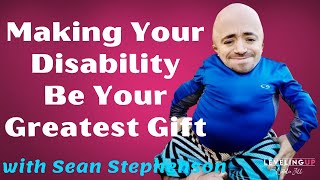
Natalie Jill talks with motivational speaker Sean Stephenson about turning his disability into strength. Sean shares how he overcame self-doubt and adversity to build a life of leadership and personal growth, and what he learned about resilience along the way.
Hi, I'm Natalie Jill, fat loss expert turned high performance coach. When odds are stacked against us, how do we shift and create everything from nothing? How do we level up when we aren't feeling it yet or we've had a big setback? On this podcast, I'll be talking to some of the most inspiring and courageous men and women on this planet who at their worst, learned how to achieve success greater than they ever dreamed possible. Leveling up and creating everything from nothing. Three feet tall in a wheelchair, Sean's fantasy as a child and a teenager was just to blend in. Devastated when he was turned down for multiple jobs that he viewed as normal jobs, a mentor pointed out to him that his disability was actually a gift and that he was meant to share his story and lead and inspire others. When he realized this, his world began to change. You see, Dr. Shawn Stevenson was predicted not to survive at birth because of a rare bone disorder that stunted his growth and caused his bones to be extremely fragile, fracturing over 200 times by just the age of 18. Despite all his challenges, he took a stand for a quality of life that has inspired millions and millions across the world. Over the past 24 years, his powerful message has been heard at live events in nearly all 50 states and in 16 countries. Sean has presented at hospitals, universities, prisons, and to companies such as Nike, Whole Foods, Zappos, Walmart, and Sharp Healthcare. He shared the stage with US presidents, billionaire business moguls, celebrities, and His Holiness, the 14th Dalai Lama. Shawn has appeared on everything from the Oprah show to Jimmy Kimmel. In addition to online videos with tens of millions of views, the Biography Channel even produced an hour long feature on his life called the Three Foot YouTube Giant. Join in today and learn exactly how Sean Stephenson has repeatedly leveled up and created everything from nothing. Sean, I am so excited to interview you because you're just such an inspiration. I know you've been in the motivational speaking space, you coach, you do all these amazing things, and everyone knows who you are. You've got this big brand online. You're just incredible. And you have this just amazing journey and story behind you that has made you. And you're such a perfect example of somebody who's created everything from nothing and continually leveled up. So I'm very fortunate to have you here today. Thank you for being a guest and talking with me today.
Thank you for having me.
So, Sean, take us back because your life could have gone in a lot of different directions. Take us back to your first memories, like, how did you become who you are? Today, who are you before all of this?
Well, I believe that I was pretty young when I figured out that I was meant to lead the masses.
Okay.
I was in high school, and I had lost student body president in high school, and that was devastating. And I felt like, what's the purpose of going on living? And, you know, dramatic teenagers. And then after that, it all worked out perfectly because then I ran for this group called Boise State, and I ran for governor, and I got elected out of a thousand guys. And then from there, I went on to get elected to Blaze Nation, where I got to go to DC US Capitol and meet President Bill Clinton and then later work for President Clinton. And it just started to grow, where I was like, wow, you know, people are listening to me, and they look up to me and they want to know my story. And so when I was in high school, I got turned down. Some people know this, but I got turned down and rejected from three different side jobs that I was trying to apply to get some extra spending money in the summer. And one was at an electronics store, one was a chiropractor, and one was at a. A limo company answering their calls. And I got turned down by all three. And I thought, how the heck am I going to make money if no one wants to hire me? And they all blatantly. This was the early 90s, and, you know, the Americans with Disabilities act had just passed, but people weren't really enforcing it, so that people were blatantly discriminating against me because of my disability. And I'm like, I got to get a job. And so finally, a high school guidance counselor came to me and said, sean, what if I paid you $75 to go speak to a school about what it's like to have a disability and $75 when you're in high school? As a kid in the early 90s was a lot of money. And I was like, heck, yeah, I'll try that. And, you know, I've been people my whole life had stared at me. Being three feet tall and in a wheelchair, you can't even leave your house without being looked at. And so I'm like, well, let's start getting paid for being stared at. And so I did that first speech. I fell in love with making audiences laugh and cry and taking them on emotional journeys.
So it's interesting because the Disability act wasn't in place yet, so you were trying to fit in to, like, just normal society just in a job, and it almost like, you're not. You weren't working with Your disability, it's really a gift if you look at it that way now. But it was that person that recognized that it's actually a gift and said, hey, why don't you come speak into that and talk about it? And that was like your lucky break, because it's almost like you can't hide it. You can't hide the disability, but working against it was not helping you.
Yeah, Well, I would even go far as say, thank God that I was not allowed to do something normal. If I was allowed, let me just paint a bleak picture of what life could have looked like for me. Okay, if that electronic store had said, yeah, we'll let you be a salesperson. And by no means am I poo pooing anybody who wants to take these kind of jobs. But I would have just been selling TVs and stereos in a little job. I probably would have gone on to college and then maybe done something small. I think I would have continued to play small because I would have just said, well, I. I want to be accepted like everybody else, so let me just get a normal job, have a normal life. Because when you're 3D tall in your wheelchair, your fantasy is blending in. You don't want to stand out at a young age. Yeah, you feel like you're. You're forced into everybody looking at you. And thank God that I didn't get my normal goals achieved. That instead I spoke to that school for $75. And then a week later, another school called and said, hey, we heard you did such a good job. And then after that, I think it was an insurance company called and said, hey, we'd like you to speak. And then a prison called, and then a hospital called. And then all these different people started calling in, and I. I made my first little threefold brochure and got a business card. And I thought, wow, this is pretty cool. I'm getting $75 an hour. And then, you know, I was able to scale up to $500. That was a big jump to go $75 speaker to $500. And I'm so grateful for mentors because I would still be in the grade school market, you know, which was fine. And that was a great place to cut my teeth. But I'd still be making 500 to $1,000 a speech, speaking to auditoriums of two to 300 elementary students if it hadn't been for mentors that said, look, the masses need to hear what you have to say.
And they sure did. So take me back a little bit to As a kid. When you. As a kid, you knew you had this gift or disability as you looked at it, and you mentioned something, you said that it was a fantasy to blend in. It was a fantasy to blend in. How? Kids growing up, were they supportive of you? Did. Were they making fun of you? Like, what were you up against? And how did that start shaping you?
So this is going to surprise you, maybe, but because I. I received people asking me this question before, and people always think that, oh, did the kids tease you? No, the kids were never my problem. It was their parents. Really? Yeah.
How so? What were the parents?
Parents would step in and they. They met. Well, I think they had good intentions, but sometimes naivety and ignorance can really be hurtful to somebody. And so the parents would step in and say, we don't want to have Shawn over to our kid's birthday party, because what if he gets injured when they're using the pinata? Or, we don't want Shawn hanging out with our son because our son needs to be getting exercise and be on his bike, and if he hangs out with Sean, he's just going to play video games and stay inside. And so, like, I heard parents in other rooms tell my parents why their children couldn't hang out with me. Wow. And to this day, you know, that still sometimes chokes me up, you know, thinking back about little Sean or younger Sean, I should say. And, you know, thinking back about how, like, when you discriminate against somebody because of their sexual orientation or their skin color or their whatever, like, that is clearly racism or sexism. Right, right. But when you discriminate against somebody because of their physical ability, you feel like you have a valid reason. And so then all of a sudden it becomes, well, of course we can't have Shawn in the musical, because what if he gets hurt on. Near the scaffolding? Which was one of the things that I didn't get in the initial wave of the musical because there was scaffolding. And my parents said, look, that's on Sean and us. And that's why school has to let Shawn in, because you can't just put him in a bubble. So it was really all about navigating adults as a kid. Much harder teachers. I had one teacher, and again, I think these people met. Well, I don't think they were malicious, but I had a teacher say to my parents, with me in the room, wouldn't Sean be more comfortable going to a school with his own kind? And I just remember thinking, I didn't understand then how hurtful that Was, Yeah. Saw how that impacted my parents and how they had to be ferociously protective and say, look, that is not an acceptable way to go about treating our child.
Now, did your parents talk to you that way? Did they tell you this is not acceptable? Did they coach into that or did they ignore it? How did your parents handle that with you directly?
Well, they handled it by saying, look, Sean, you're going to have to be. I was raised Christian and so my mentality was always, this is the cross you have to bear. Right. And my parents were like, this is cross you're going to have to carry like you are going to your whole life. You are going to have to be an educator. You're going to have to re. Educate people how to treat you. And if you don't speak up for yourself, no one's going to. You know, I remember being in France when I was A little kid, 8 years old, on vacation, and the waiter turned to my parents and asked me what I wanted to eat. And I remember welling up with tears thinking, why can't people ask me?
Yeah.
And my aunt pulls on my shirt and she says, shawn, you better speak up. You need to interrupt that conversation and say, I can order for myself.
Yes.
And so I did, and later was kind of shocked by it all. And that's been my whole life. People will still oddly, oddly, oddly. Here I am a world traveling, pretty well known human being and people sometimes still turn to my wife and at a restaurant and say, what might he have? Wow. Like, hey, dude, I'm going to be paying the bill here, so you might want to.
Yeah, and I tip you too. So you be careful.
You have to, you know, and I speak to women and, and minorities of all issues is you have to be willing to educate people without bitterness in your voice.
Yeah.
It would have been so easy for me to say, screw you, world. If you're not going to treat me like a human, then I'm not going to be n. Yeah.
These powerful lessons I'm hearing though, from your parents was that they taught you early on about not having a victim mentality because they could have easily said, these people suck. They're wrong. This, you know, treat my son better that they put it back on you like, okay, you get to speak up, you get to take ownership, you get to educate. And I love that your parents did that for you. And I have a feeling that has a lot to do with how you formed your beliefs later on.
I mean, the metaphor my parents always use is rule with a velvet hammer. So like you need to be soft but have some weight behind it. You cannot. You know, just because they're like. In 1990, they passed the Americans with Disabilities act, which gave people with disabilities lots of protection. However, I've learned that just because there's a law there doesn't mean it's going to be enforced. And that means you have to be the one that enforces it. I can't tell you the number of times I've gone into buildings where, you know, it wasn't accessible, even though it was a brand new building. Yeah. Or people would just come out and, and, and discriminate against me for certain applications of things, and I'm just like, this is unacceptable. And then I now have to go get the lawyer to enforce the law.
Yeah, yeah. But if you're not speaking up, it's like, who is? So your parents had a good point there about taking that leadership role.
Yeah. I was the first person in my elementary school with a disability, and they, the principals and the teachers were so scared that they really fought for me to go to this other school where they were just all kids with disabilities. And my parents were like, no, Sean is going to be mainstreamed. And now people don't even think twice about that. But, you know, in the early 80s, that was a big deal. Yeah.
No, it really was. Now I'm curious about. This is a question I've been wanting to ask you. So when kids. Even then now, maybe it's changed over the years when a kid stares because kids are so naive. If a kid's looking, what's the right response from a parent? And what do you want a kid doing? Do you want kids asking you? Do you want them looking the other way? Like, I think there's a. Nobody ever goes to the source to ask. There's just this, like, I see it happen all the time. Like, Like a, A parent say to a kid, stop staring. Or like, what's the right thing to do?
Yeah. I've always wanted to write a book on this issue and then just sell it to the parent. Right. In that.
Yeah.
You're like, hey, here's a book called how to Handle this Awkward Moment. But, you know, here's the thing. Kids, they're more curious than anything.
Yes.
And I, I can always tell how good of a parent they have based on how the child interacts with me. If the child comes up and says, you know, I'm curious. Why are you little? I know that that's probably good parenting because the kid's not afraid to interact.
Yeah.
The Kid's not afraid to ask. The kid doesn't feel sorry for me. They want to just know what's going on.
Yeah, they're just curious.
Just curious. And the worst thing a parent can do is, is scold that child right in that moment because it creates this awkward moment for me. Awkward moment for this child who's forming and, you know, imprinting their experiences for the rest of their life at that age. And so, like, some parents will actually literally come over, put their hands on their head, turn the child's head away from me and not even look at me and walk away. And I'm just like, oh, my God, do you realize what you're doing to that child?
Yeah.
So whereas if a parent says, no, no, it's okay, go ask him a question. Or they'll say, sweetie, why don't you ask him in a more polite way? Or whatever.
Yeah.
You know, as long as the parents is modeling a. A loving, gentle, compassionate side, the kid will usually be very normal about it. My response has always been, hey, you know how there are little dogs and there are big dogs and they're like, yeah. And I sound like a little dog. Yeah. I love it. And then as soon as a kid sees me as a little dog, they're like, well, that makes sense. And then we're done. We're done with that. And then they want to know what my favorite color is. Yeah, I heard a spongebob or whatever. Right. And the parents are so pivotal in how they respond to that moment.
Yeah.
If they create a space where kids feel safe asking.
Yes, I hope the parents are listening to this because this is something nobody really talks about. It is important. It's very important because our, how we act to our kids is shaping them forever. So what we teach them, they model.
They watch what we're doing more than what we tell them.
Yes.
You can tell them all you want and all your long winded lectures to them, but then they're just going to watch how you handle it.
Yeah.
You know, and that's what I've seen my whole life.
So, Sean, you had some amazing people in your life. You had parents that handled things well. You had these mentors and people that really saw a gift in this and got you really educating more people and speaking and coaching and doing more and more of that. Do you still struggle with it being a disability or do you look at it as a gift now? Like, what's your take on you now?
Well, people ask me, they're like, you know, what's your number one Challenge. Right. Like what do you. And my disability is like usually the last thing on my mind during the day.
Okay.
I think about scaling my business, getting to the next level and helping my customers and creating bonds with my team and all of that. You know, I have entrepreneurial challenges. My disability is faded into the background now. There's this great equalizer called money.
Yep.
And you know, I'm of the opinion, and I mean this, this is humbly as possible. When you have money to release, remove stress and when you have money to remove the struggles of life, you are given more of the gifts through your abilities and reach than if somebody had a perfectly normal body. You know, I would much rather have a disability and a, an impact and a flowing income than a great body not knowing how to survive.
Yes. And I would imagine, I mean, you tell me, but because you have clients and you speak to people all over the place. But when somebody's complaining of why they can't get something done, you, you probably, I would imagine you look at them like, are you crazy? Like, look at what I've accomplish. Do you feel like that or do you not feel?
I don't see it that way. So I may feel that way on the inside, but you can't come right out and hit them with that because their brain's not going to compute it.
Okay.
It's more of I've learned, asked questions. I've learned to get the person through questions to see, is that mentality serving you? Is that mindset going to help you, you know, solve your problem and you know, by asking questions. And then I might share, you know, a common challenge that I'm having and then pace them a little bit and then lead them out of that thinking, yeah, I can't just shove my life into their face, you know, like, I work out every day.
Okay.
I love exercise. I bought a fitness company. I believe in the importance of taking care of your health, nutrition. And yet people will tell me all day why they can't work out. I'm over here thinking, listen, I can't go into a normal sized gym because most of the equipment is not built for my size. So I can build my own gym out of everyday household items. My chest press is bicycle pumps.
Yeah.
But I had to find something, right? And it's this mentality of the only disability is one's refusal to adapt. If you refuse to adapt, you're far more disabled than I am. If you won't adapt in business, you're going to go out of business. If you're not Going to adapt in a relationship, it's going to fall apart. You're not going to adapt with your body, you're going to die. Like, I can't tell you the number of times that I have had to change the environment, change the thinking, to adapt to the new circumstances that have recently arrived.
Yeah, yeah. No, it's. That's really insightful, all of this. You mentioned as a kid, you knew you were meant to lead, you were going to do big things. Like, did you always have a vision that it would be this? Or what was your original vision? Like, what did you want to be originally?
Well, it's still shifting. You know, I. I'm not even sure what this is at this point because I'm. I'm adding new goals and new interests to my life. But when I was younger, I wanted to be a stand up comedian.
Okay.
And, you know, here we are. I think I wanted to do that when I was 10. And I'm now about to turn 40. So 30 years later. I've done something recently that I'm really proud of, and that is I went back to my childhood dreams.
Okay.
And decided to start honoring the little kid in me. Oh, I like that. I started doing comedy. I started going and booking myself at comedy clubs and doing stand up comedy. I went back to when I was a teenager and said, what was my dream car back then? And I went and bought it.
Oh, what was that? What was the dream car as a kid?
Yeah, I wanted an Escalade. When they came with a Cadillac Escalade, I thought that was the coolest thing ever. So I went out and bought a Cadillac Escalade. And so, like, now I feel one of the things that I'm really proud of in my life is I'm honoring the younger version of myself.
Oh, I love that. That's such great advice, Sean. Because, you know, a lot of times when I lead seminars, I ask people to go around and like, what did you want to be as a little kid? I love asking that question. And people's faces light up and they say things and people giggle. Like, people want to be a superhero. They wanted to be whatever it was they wanted to be. But you see this whole energy shift in people talking about what they wanted to be as a child. And then somehow along the way, we get other people's opinions. We have hardships, we have all this stuff sort of happen and we forget our whole dream. We forget our dream. We start living this different life. And what you're doing is actually great advice for everybody. Like why don't we go back and honor that little kid?
Maybe I don't have to be a full time standup comedian, but if I do it just to honor that younger self. And I enjoy. Every month I do one comedy gig that is an energetic, almost like a past life, totally version of me. I'll tell you a quick activity that I do that I think might be of interest when you're doing seminars and things. I make people pull out a notebook and write down all the mean things that they sometimes say to themselves and their internal dialogue, if you will, when they're in a dirt. And then what I do is I ahead of time at my assistant email everybody that's going to be at the conference and they have to send off a childhood photo to our office and we print them out and then we hand them out to everybody and we get them into groups and we make them read those mean things to that childhood picture.
Wow.
And everybody gets emotionally affected by it.
Yeah.
Ties. All of a sudden you're thinking, why am I being mean to this little kid? And you see that that little kid still lives inside of you. The unconscious mind. It's been said that the unconscious is somewhere between a five and seven year old child and your unconscious mind is still with you.
Totally.
And if you are not kind to that little kid, it will cause self sabotage and all kinds of challenges. It's like why? Why is it that we can set a goal and then do the opposite? Well, it's because that little kid inside of us is hurt and it needs to be loved and connected with to get on the same page with us.
Such great insight. So true. And I love that you're honoring that little kid right now that you went back and got the car. The stand up can be all of it. It's just, I mean, just even you sharing this, I can feel a different energy shift. It's like, it's pretty cool. And I think everyone should go back and relive, you know, make those dreams come to fruition. That's amazing.
Yeah. So the last thing I want to say about that, I reread my goals every morning.
Okay.
And some of my goals are so big I have no idea how I'm going to do them. And you know, this is why I share this piece that I had never heard really anybody else talk about. And that is, I think it's more important to have a goal than to achieve a goal. Because achievement is in the past, it's done, it's over. When you have a goal, you have Something to get out of bed for. You have something to work toward. People oftentimes will live longer than a medical prognosis if they have a goal that they're trying to achieve. And that's just one goal. And so I reread my goals because they inspire me. And one of the things that I've wanted to do since I was a little kid, I went to school for it, but I haven't done anything with it, was to produce a movie. And this year I started writing the screenplay for it. And I don't know if it's something that I'm gonna do. It's just an independent film that I'm gonna fund, or is it something I'm gonna sell to a production company? I don't know. And I don't know how it's gonna look or how it's gonna do, but I need to honor that because it's coming from somewhere special.
And I believe it's going to happen, because I know you talk about this, but when we say focus on the overall vision and the goal, the how kind of reveals itself, but when we get stuck on the hows and why it won't work or why it can't, it doesn't go anywhere.
Yeah.
So I believe that's going to happen for you.
Making decisions. My. My wife, Mindy and I, we own a company together. And, you know, we talk on a daily basis about how just go do something. Like, just go do something, make decisions, and if it turns out that you don't like how it goes, make a new decision. And if they don't like how that goes, make another decision. People are so paralyzed. They're trying to figure out their whole life before they take a single step in the right direction. They're trying to avoid all rejection and pain by mapping out 10, 20, 30 years in the future. Like, oh, what if I do it this way and I do it wrong? It's like, no, it's not how it works. You need to go do something that then you find out it didn't go the way you wanted, so then you can adapt and change and try something else. And try something else. You know, when I started my speaking career, you know, at that young age in high school, I had no idea, no idea that I was going to share the stage with US presidents and the Dalai Lama and give me 20, $30,000 of speech. I had no idea, idea that was in my future. I just knew that that day I was getting paid $75 to go make an audience laugh, cry, and Rethink their lives. That's all I knew. And I have that mentality still today is like, you know, I'm going to San Diego tomorrow, I'm going to drive to speak to a conference. And all I know is my goal is to get in front of that audience, get them to laugh, get them to cry and to rethink their lives. And who knows where that speech will go or what those people will do with the information. I just know. One foot in front of the other.
I love that, Shawn. So basically what you're saying is you have intention. Like you know what your intention is and that's all you're clear on, and that's all that matters. Like, I think so many people, you get so stuck. Not you, but people get stuck in the gap of like the how, the steps, the process, and then it stops them.
I think everybody gets stuck. I mean, let's, let's be clear to your listener right now that the experts and the gurus, you love listening to their podcasts, watching their documentaries, going through their products, they all get stuck. Yes, they still get stuck. They still are in relationships. They're like, what the hell am I doing? Or they're in business moments where they're.
Like, I have no idea how this.
Is going to turn out or where's the money going to come. I just listened to M. Night Sharmalat, the producer of movies. He was talking about how his most recent movie split, which was a huge success. He said I needed to mortgage my house to pay for it myself because I knew I didn't want any other person putting their opinions into this movie, so I needed to fund it myself. He's already a huge success, but he had to take a risk on himself all these years later. I think that the common misconception is you make it in a career, you make it in a guru state, and then it's easy sailing from that moment on. Just because you have a public presence or you have built up some cash, doesn't mean it's now smooth sailing.
Yeah, thank you for saying that. That's true too. I really glad you shared that because I think people get into this comparison zone like they think they have to be this all or nothing. And you're right. Everybody, no matter how successful somebody appears or is, they still are human and have those days in those moments. So thank you for sharing that. Speaking of those moments when you have self doubt or you're. I'm sure you have those days. Like you said, you have those moments of self doubt. How do you Shift yourself out of it. Like what are some steps that you take to get yourself back on track and to focus on your intention and what you want to do.
So self doubt, this is going to be surprising, maybe to you. It shows up every day for me. Every day. I don't think I get many days in the year where there's zero self doubt. It's something that I've never found fully ever goes away. I think it's the brain's way of trying to survive. Saying, hey, play small, don't stand out, that could get you hurt. You know, you may not survive if you do this. And so the self doubt is really some kind of like low level immature survival mechanism. But you have to rise above that because none of the good stuff is in your comfort zone. All of the good stuff is outside of your comfort zone. And so that means what I have to do is I have to get back to my self care list. I travel around, I've got it right here with me now with a notebook. And it's a graph paper notebook. And this is probably one of the most important tools in my life. If my house was burning down, I would run in, I would grab this, okay? Not my laptop, not paint me photos, I would grab this notebook, okay? It is my self care list. And on it I track every single day these activities. And I don't do them all, but more of these things I do on my list. And it's both my when life works and when business works list. Things like workout, hydrate, restful, sleep, journal, hygiene, groom, reading, meditating, organizing and cleaning, connecting with my wife, smoothie, juice. Did I mentor somebody? Did I get mentored? Did I watch an inspiring video? Did I spend time with friends? Did I go out in nature? Was I on a podcast? Was I networking? Did I have a sales call? Did I review my goals? Did I write my list? Did I hunt for a keynote? Did I map out my day? Did I collect money today? Did I ask for a referral? Did I study something about business or money? Did I showcase in front of an audience? Did I interact with my Facebook group? Did I swing for the fence and do something scary? Did I love myself today? And you know, when I go through this list, I check the things off as I do them and I find that the more on this list that I do, the better I feel. And so then I mark down at the end of the day, what did I score in my overall mood at a 10. And here's what I found. I started this at the beginning of this last 2018. And I have been tracking every single month. And then at the end of the day, I write down, what did I score myself in my mood. And it's fascinating. It is always, always, always higher moods are based on how many of these things.
That's really, really brilliant because it's so basic, but nobody's really actually taking their steps to do it like that. And I like that you said graph paper, so you can literally, like, check off everything. So you basically make your own little checklist. You can't skip a day. It's like your own. You have to check it. And I think it's brilliant because, you know, I interview a lot of people about their morning routines and I ask them that question and, you know, people share their morning routine and I'm always like. But I don't believe that happens every single morning. I bet that's great. But, like, does it really happen every morning? And the checklist helps hold you accountable because now if you don't feel like getting out of bed and you just pick up your phone and start scrolling social media and you haven't done your list and you don't feel good about things, you're very clear why.
Well, that's why for me, I created this last year in 2017. I was in a dark place and I was really lost. I was scared. And I thought, you know what? You're the only one that's going to pull you out. You have great friends, you have an amazing life, but you are the one that's going to have to pull yourself out of this slump. And so that's when I was like, the cure to insecurity is self care. If you take great care of yourself, your insecurities don't have a stronghold over you. And so I started mapping it out January 1st, beginning this year, and I just started tracking it every single day. And it's amazing. The days that I. And I can even tell you, I can look through and tell you which were the strongest months for me. And then I can tell you why. You know, most people, their mood is some kind of magical ghost. Like, I have no idea why. Today I feel good. And I took the guesswork out. I made it a mathematical formula because for me, if you don't have the metrics on something, how are you ever going to improve it?
Brilliant.
It doesn't matter if it's calories, macros, finances, your mood. If you don't have a metrics, how can you improve?
Now, Sean, do you find yourself going to this list sometimes to, like, to shift you out of the mood. Like, okay, I'm feeling this way. So I'm going to go pick some things to do on here.
Absolutely, absolutely. And sometimes I'll try to even kind of cluster them. So I'll go into the gym, I'll put my headphones on, and I listen to inspiring videos. And then after the workout, I'll text one of my mentors and ask them how their day is and how I can serve them, or I'll put out a Facebook post and reach out to my community and love on them, you know, whatever. I got to do a cluster the things. Maybe on the car ride home, my commute, I'll listen to an audiobook, whatever it may be. And I just got to get those little wins under my belt because, let me tell you, you don't get to control the outside world much. I don't get to control the economy. I don't control the weather. I don't get to control how people think about Sean Stevenson. But I do get to control what things, these little activities that I can do to feel proud of myself, feel good, create momentum. You know, I've learned from one of my mentors that you need momentum in business more than anything else. If you don't feel like you're making momentum happen, you're not building up steam, you're not getting progress, you're feeling lousy. Yeah.
Wow, this is. This is gold right here. I love everything you just said. I'm implementing that self care list right away. I feel like I have my gratitude. I have idea of the things to do, but the way you just laid it out makes so much sense. And it needs literally a checklist and graph paper. So I'm implementing. I'm going to copy that. That's grades. Thank you for sharing that. Do you ever worry about what other people think?
Only every day.
Only every day.
You know, here's how the worry has evolved, though. I used to worry about what strangers thought about me.
Okay.
And that is a waste of time because strangers don't know you personally at all. So their opinion of you is strictly through the pictures that they are painting in their own mind. They've never spent time with you, they've never held your hand, they've never hugged you. They have no idea what you really like. So that was one phase that I had to get out of because, you know, I've reached. And we, based on the rough numbers that we put together with social media, I reached over 300 million people. Wow.
That's a small number. Right just 300 million now.
That's over 24 years, right?
Yeah.
You know, so with that number of people, I can say I don't even know 50,000 of them personally now. And so if you start looking at the percentage of the people that know me versus that I know, that was a big shift to think about. Like, wait a minute, why do I care so much about people that I. That I don't even know personally? And then the next thing is, do you need to care about people whose lives you want nothing to do with? Because let me tell you, if somebody is negative and mean and troll mentality, do I need to care what they think? If that's not at all the kind of person? No.
Why is that, Shawn? Like, that's like a recurring theme with people. Why do people care more about what strangers think or people with as a plant's profile picture on their social media? Why do we care about what they think versus actual people?
I think this is. I come from more of a scientific background. Okay. So I think all this has to do with the evolution of our brain. I think our brain. We're social creatures that used to survive in tribes for way longer than we used to live in individual homes by ourselves or with one person. We used to survive through tribes. And if you weren't liked by the tribe, you could be left to starve or die. And so I think there's this huge long term memory in our cellular system that is saying if you aren't liked by everybody or if you aren't liked by the tribal leaders, you're going to get thrown out, you're going to be cast aside and you're going to die. And so it's very, very primal. And yet, you know, there's a lot of primal things. You know, you don't. Most people don't use their appendix. Right?
Right.
We can't find a use for the appendix anymore. You can even live without it. But at some point it was important, probably, or whatever. But like, that may be a part that we no longer need. I personally think with time our insecurities are going to evolve. We're gonna, we're gonna care less about what other people think because we will have more time under our belt and this could be hundreds of thousands of years, but we'll care less about what other people think because we don't need them to survive as much. So I think that's a big part. But then lastly, there are people that I care about what they think and here's who they are. There are people that have what I want and who have lives that I admire.
Okay.
Because. And it's both of those things combined because there are people that have what I want that I don't want to emulate them. And, and there are people that I admire the way they live, but they don't have anything that I want. You know, they might be a good person, but they aren't playing big. You know, I want to go after learning from and getting the opinions of people that have what I want and that I admire because their advice is usually cool. I have a few people in my life that have never given me pat advice that have told me, hey, your head's up your ass, Shaun. You need to clarify, what are you doing with your, your value system now? What are you doing with your ethics? What are you doing with your day to day thoughts here? And they will call me out and I care about what they, they have what I want and I admire the way they live.
Yeah. And that's really good advice too, because a lot of us, a lot of people go around getting advice from people that really don't matter or they don't have a life that we want to live. So it's interesting that we let those stay in our gap and hold us back caring about those. But I'm glad we spoke into that because that's a very common theme. Like especially people going for goals. You notice that they'll be so excited about a goal, they'll post about it, let's say, on social media, they get a negative response and they give up their whole goal.
Yeah. And that's why sometimes it's important. I think there's a time and a place to share your goals. I have one friend that does these secret long term projects and he's one of my best friends, but I am. He doesn't tell me, he doesn't tell his family, he doesn't tell anybody. He works on them privately. Okay. And I asked him once when he, he finally came to me with this big project. He's like, I've been working on this for 15 years. Whoa, holy cow. He shows it to me. I'm of course blown away. It's amazing. And I said, why didn't you feel the need to share this? And he said, john, if you would have just even turned the corner of your eyebrow up at me thinking that I was crazy, that would have decimated me to stop.
Yeah. So that's interesting. That's an interesting perspective. But what do you think about. Some people need that accountability of telling somebody like, if you don't ever tell anyone about your goal, you may never go for it.
So that's why I think you need to share stages.
Okay.
Because he wasn't done with his goal. It's. He's still working on it, but he had it stabilized enough that if I raise. Raised my eyebrow, it wouldn't matter. He had enough steam underneath. Yeah, that's the key is you. For instance, let's take health. You've got a background in helping people with weight loss. And if you are massive morbidly obese, Right. And you tell all your friends, I'm going to lose weight and you're hundreds of pounds overweight, people are like, yeah, you've said that before. Right? And people are just like, you condition them not to believe in you.
Yeah.
Oh, you need to get some traction under that goal. You need to, you know, hit that gym, change out that diet, shift out that mindset, make that, you know, shift where all of a sudden you start seeing the inches going down, you start feeling like it's time to buy new clothes, you start to see the results, then you tell people you're working out and it doesn't matter because you now know you're on the right track.
Yeah, that's a very valid point. That's. I think about even just going back to this podcast. When I was starting this podcast, I had a lot of people say, oh, it's too late to get in the game, don't do it. And I started having self doubt. But then I'm so passionate and purpose about it, once I go that it doesn't matter what someone says. So I get what you're saying.
That's very underneath it all. Underneath it all, whether it's starting a project, you know, getting into a workout routine, starting a business, whatever it is, there is one thing that will trump everybody else's opinions. Results.
Yep.
If you go and get results, everybody thinks you're a genius. One of my mentors said, sean, you're crazy until you start making money. And I'm like, what do you mean? He's like, because if you go tell somebody an idea and they're like, there's no way. And I've had this, I've had business partners in the past, I would tell them an idea and they're like, there's no way. Look at, there's this risk and that risk and this risk and the moment it made a couple hundred thousand dollars, then all of a sudden it was a brilliant idea. Well, that's a great idea. And it's because results speak louder than anything. Go collect results. And no one's going to argue with the result. Like who is going to argue with somebody who has now already produced the evidence? It's already here. Sorry, sorry. You don't believe in what's here right now, but I do.
Oh, this is so good. This is so good. I have so many more questions for you and I'm going to narrow it down so I don't keep you all day. Okay. The questions I've got to ask you, I want to know, like, who do you personally surround yourself? Like, what types of people are in your circle?
How.
Talk to me about that. Like, what types of people do you look for? And do you, do you actually get people out of your life when they're not the right people?
Yeah. So there's two questions there. I'll answer the second one first.
Okay.
And that is I'm constantly pruning the garden.
Okay.
I have a model that I think is really going to help you and your listener. And that is I look at your people you hang out with. They are like on a sporting team with you. And you're gonna have stars and then you're gonna have bench players and then you're gonna have people you cut from the team. And I can tell you that they cycle through oftentimes and there'll be times in your life where you will have somebody and they're a full on star and then all of a sudden you run into friction with them, they run into friction with you and you say, you know what? Time out. It's time you go to the bench and you're not off the team, but you're not playing right now. We're not going to talk for a while. I love you, but this isn't going to work. So you and I need some space. And then if you find that in that interim they get their life together, you guys are able to work it out, then you start them again and they're starving and that's awesome. Sometimes they're so darn toxic that you cut them from the team. You say, you know what? The bench was not far enough. You need to get further away from me and you have to cut them out of your life. Now I will say this. There are these rare occasions where somebody you cut from a team, years, years and years later, you draft them again, you bring them back onto the team, maybe you bring them first as a bench player and you try them out again and you see, have we made any changes in the years that we've been a part, and then if they. If it's a lot better, then you start them again. But I'm constantly having to think about who are my starters, who are on the bench and who has been cut from the team. And I'm talking about friends, lovers, family. You know, it is a very, very touchy subject to bench a family member or to cut them from a team because our biology says you can't do that. But let me tell you, if somebody's toxic, I don't care what role they have, they're impacting your destiny. One negative downer that is horrible can derail your destiny. Absolutely. That's unacceptable. So, yes, I'm constantly having to prune the garden. I. I've been benched on people's lives. I've been cut from people's lives. I recommend it for people with me, to them. You know, there are times where I need to be separated from somebody else because we become a crutch to each other. And then you asked, who do you surround yourself with? People I pay. Oh, I found that the people that. I'll put it this way. The people I pay or get paid by, because the people I get paid by are raising their hands and they're saying, I want to get better. I want to. I want to improve. And I'm going to give up this fun set of fun tickets, which is what I call money, and I'm going to give up this set of fun tickets in exchange for what you know, and your tutelage. And so I hang out with people that pay me, and then I also hang out with people that I pay because I say, look, I want to bend your ear. I want to learn from you. I want to be around people who are willing to give up their fun tickets to be in a select group of people. So the majority of the people that I hang out with fall into three categories. Either I pay. They're my mentors and peer group, or my employees, or they are my students and my apprentices. I find that if there's not usually a money exchange, it's oftentimes a drain long term.
But what about. Would you say about friends that, like, do you have friends then? Or do those friends become those people that are paying you or that you're paying?
It's usually. And sometimes they become both. I have people that I pay and they're paying me. I don't. If I track my peer group and. And I used to be afraid to talk about this because it sounds almost shallow, but it's not I don't think I have anybody really, really close in my life. Then I'm not paying or that isn't paying me.
Okay, well, what about your wife? How'd you meet your wife?
I'm paying my wife. We're in business together and she pays me. She's in business with me. So we're, we're making money together. There's a money exchange. Interesting. Money is an interesting thing because it's something that we all secretly want, but we're afraid to say it. We're afraid to say it. But you know what? All money is, is it's raising the hand that I'm committed to something, I'm devoted to something, I am heading in the direction of something. And I'm willing to give up my hard earned energy that I put into this other thing. I'm willing to give you that physical embodiment of that energy which is that money. And this is something that hit me this year that I was like, wow. The biggest drains on my life are people that somehow I'm not in some type of commerce with and countries that are in commerce with each other. Don't go to war. Yeah, historically, why would you go to war with somebody that you are living with? Yeah, it's like you don't pick fights with somebody.
I don't think I've ever looked at it that way. This is a definite eye opener. Interesting. Okay, Sean, final question. Because I'm otherwise, I will go all day with questions. I have so much I want to learn from you. I want to know if somebody's listening right now that's in their own personal rock bottom. So maybe they've lost the business, they've had a financial hardship, maybe they have a new disability or they're living with a disability that they have. They're stuck on, you know, they're stuck in victim mode and they want to start shifting and leveling up and creating something from nothing. What are three pieces of advice you would give them so they can start shifting that.
Number one, you have to get a self care list.
Okay?
And your self care list is going to be customized to you. And the best way to come up with your self care list is look at in health, wealth and relationship in your past when your life was working best, what were you doing then that you're not doing now? And go back to that. Human beings are notorious for stopping what works. So you have to go back to what works. That's the first thing. Get a self care list and stick to it. The second thing is how can you make your life bigger than just about you? What is something much bigger than you? Because if your life is just wrapped up in you, you will either burnout or you'll lose connection to, like, the purpose of why you're here. And so find something bigger in your life. Who are you here to serve? Who are you here to be a guide for? You know, I used to say, who do you want to be a hero to? But now I've changed my opinion. Not who do you want to be a hero to, but who do you want to guide as heroes? Like, who do you want to guide as the hero? And then the third thing I would say is be ruthless about the environment you keep. And I don't mean ruthless in a. In a malicious way, I mean meticulous way. Make sure that you surrounding yourself with an empowering environment, if you have to pack up and move. I used to live in a cold climate, and I hated it, but I thought I didn't have a choice until finally one day Mindy and I were talking and she's like, you don't have to hate winter. We could just live in a warm climate. Let's do this. So we packed up and left. And that shifted so much of my quality of life. And so you gotta have an empowering environment where you live, who you spend time with, you know, what information are you consuming? I've decided about four years ago, based on a recommendation of a mentor. I'm not listening to a single stitch of news. I don't turn on the news. I don't listen to the radio. I don't listen to news. And you know what? I still know what's going on on this planet because I'm connected to human beings. But I don't need somebody else pumping negativity into my brain at all for me to survive.
Yeah, I love all of this. Yes. John, this has been so incredible. Okay, where can people get more of you? Where can they find you? Where are you most active? Where do you want them to go to learn more?
I would say let's start. If you like listening to me, why don't you follow my podcast?
Okay.
Listen to I. I help people create a lucrative speaking career and get message out there. And I also share personal life success strategies. So go to the Sean Stevenson Show.com and you can put that in a link somewhere. The Sean Stevenson Show.com and you can follow my podcast there.
Amazing. I love it. And where are you most active on social media? Which platform?
I would say Facebook. Okay, so the Sean Stevenson so facebook.com the Sean Stevenson Awesome.
You are great. Thank you so much Sean.
You bet. Thanks for having me.
Thanks for leveling up with us today. Please share this episode if you found it helpful so others can join in. And don't forget to hit that subscribe so you don't miss out on future shows. And if you would leave me a five star review. I appreciate those so much. I read all of them and it's how I know that I'm giving you information that you find valuable. And come interact with me over on Instagram at nataliejlfit. I read all the direct messages and comments over there. Make it a great day. Creating everything from nothing.
Sam.










