056: How to Consistently Perform at Peak Levels with Todd Durkin
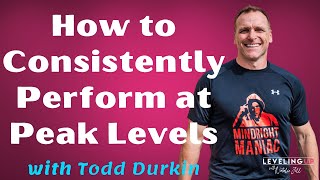
This is a YouTube video titled "056: How to Consistently Perform at Peak Levels with Todd Durkin" featuring a podcast-style interview recorded in March 2019. Natalie Jill, a fat loss expert and high performance coach, hosts the conversation with Todd Durkin, a renowned coach for elite athletes. They discuss Todd's personal journey overcoming injury and addiction, his coaching philosophy, leadership principles, and strategies for maintaining high energy and gratitude. The content is motivational and focused on personal development and peak performance.
Hi, I'm Natalie Jill, fat loss expert turned high performance coach. When odds are stacked against us, how do we shift and create everything from nothing? How do we level up when we aren't feeling it yet or we've had a big setback? On this podcast, I'll be talking to some of the most inspiring and courageous men and women on this planet who at their worst, learned how to achieve success greater than they ever dreamed possible. Leveling up and creating everything from nothing. Today on Leveling up, we're gonna get our minds right today because you're about to meet my good friend, Todd Durkin. Now, Todd works with high profile clientele of elite professional athletes, including NFL MVPs, Super bowl champions, Olympic and X game gold medalists, and many other champion athletes. He's a two time personal trainer of the year, named as one of the top hundred most influential people in health and fitness for the past four years. And he is a life coach to some of the most successful CEOs and leaders in the world. But most of all, Todd's a friend who has personally impacted my life. I've read Todd's books, I've trained with him, I've listened to his weekly messages, and I reach out to him as often as I can to get my energy and mind right. I wanted to know how Todd got to work with the elite as he does, how he stays so positive and energetic all of the time and what makes him tick. Join in today and learn exactly how Todd Durkin levels up and creates everything from nothing. Today I've got my friend, Todd Durkin. I'm so excited to have you, Todd, today. I've been dying to talk to you and having to have you on leveling up, creating everything for nothing. So thank you for being here.
It is so great to be here, Natalie, to dive into today's session.
Yes, yes, yes. Okay. So, Todd, so people see you online, they see you're this big brand. You really are. You work with all these major athletes. I mean, my gosh, you are the person that the high elite athletes go to to level up their life. Like you are the person behind them always. And you're such an amazing coach and you've got such a great online presence and you work with all these great companies, but I know that's not always who you were. In fact, you were a very different person at one time. And I'd love to dive into that a little bit and understand a little bit more about who you were before the Todd Durkin we all see today and now.
Yeah, well, thanks, Natalie. And, you know, it's interesting, you say I'm a big brand now. I don't look at myself like that. I certainly am very much a work in progress. And yes, we've grown a lot here in the 19 plus years I've had my gym and that, but it really stems back all the way. I was the youngest of eight kids and am. And my father and mom got divorced when they were just. Well, I was five years old. And I think that had a lot to do with my upbringing because when you're five years old, your parents go through a divorce, and you're the youngest of eight kids, you kind of, you learn a lot about survival and hard work and that stuff. And I was the lunch ticket kid growing up, and we didn't have a lot of money. And having lunch tickets and being embarrassed because of that was something that got ingrained, I think, in my DNA at an early age. And to this day, I'm still very much driven by working hard and rolling up the sleeves and getting things done. But in having five sisters out of the eight, five sisters also taught me a lot about empathy and about love and about, I think, just being a better man and what it takes to be now a husband and a father. And I have one daughter and two sons. And you look back at life regardless of how old one is. And I think you look back and your childhood certainly ingrains in you a certain work ethic, a certain attitude, a certain personality. And I think everyone's got a story, a unique story, and just part of my story. Help me create who I am today and what I do and why I do it.
Okay, so take us back a little bit more. Like, how did you even get into the space of helping athletes? Where did that come from?
Well, I always wanted to be an athlete, and I was an athlete. But my dream when I was a kid growing up with no money was I wanted to be a pro football player. I wanted to play in the NFL. I was a quarterback. And I knew that for me, football was going to be a means to get a college education. So I got a college scholarship. I grew up in New Jersey. I got a college scholarship to William Mary in Virginia. And I didn't make it to the NFL immediately. What happened was after college, I went overseas and played in the World Football League. And it was there that I suffered a debilitating back injury, three herniated discs, spinal stenosis, and degenerative back disease. It left me motionless on a football field in Aix en Provence, France. And I was 25 years old, and I remember thinking at that point that my dream of playing in the NFL was now definitively over.
Wow. I mean, I can't even imagine what that's like, because that was like, literally your only plan, right? I mean, I imagine that's what you were going to do. B.
It was my only plan. I mean, yes, I already had my degree in kinesiology, and I had been to massage therapy school because my oldest sister of five, Patty, who owns a day spa, had encouraged me in my off seasons to get some hands on training with massage and body work. But my plan was to play in the NFL, and I trained for that. That's what I dreamt of. And life threw me a major curveball. And it was during this time that over the next five years, I literally went down this path to try to heal my own back pain. Because in going through this, what happened was, you know, I was hooked on Vicodin, and they told me I needed surgery, but I was convinced that I was going to try to do everything possible to not have surgery. Not that there's anything wrong with surgery. And as you know, Nat, when we need it and we've got to get it, we've got great surgeons that can do it. But at that point in my life, I knew that I had to discover a new dream and create a new dream. So I lived in 13 different cities in five years, going to study under gurus and healers and doctors and osteopaths and physios and trainers and reiki healers. And you name it, I tried it. It was all in the name of healing. I mean, I just wanted to heal myself. And you're probably thinking, well, how does this really connect to you working with pro athletes today? And I didn't understand that at the time, but all that was for me was it was preparing me for what was about to occur. Because in one of those stops, I was back in New Jersey at my sister's baseball, and I ran into a guy named Michael King. Michael King, at the time was the producer of Oprah Winfrey Wheel of Fortune in Jeopardy. And Michael said, I hear. Hey, I hear you, you're an athlete and that you just ended your football career and. And you have a back injury. He said, I have a back injury, too, and I'm trying to get out of. Out of pain. He said, would you be willing to work with me? I was like, well, let me check my calendar. Of course, I've got nothing else on the calendar. Because my dream was just Shattered. I've been living all over the place, and I was kind of like a vagabond who had just overcome, you know, being on Vicodin, and I was still in pain. And. And next thing I know, I'm living in Malibu, California, at Sting's beach house, and I'm living this, quote, dream life, training all these Hollywood celebrities and that. But, Matt, I'm sure you can relate to this, and I know your story as well, but I had an opportunity there to work with some amazing people. And on the outside world, all my friends were like, oh, you're so lucky. You're living in Malibu and you're working with all these great people. But deep down inside, I wasn't happy. Something was telling me that's not where I was supposed to be in my life. And on the outside world, it was like, man, literally, I'm in the colony in Malibu, California, living the life. And something deep inside was saying, todd, this isn't where you're supposed to be.
I want to know more here, but there's not a question that I keep thinking of. And I'm like, okay, I got to ask him. I got to ask him. Got to ask him. You've kind of skipped over this whole Vicodin addiction, and I want to know more about that, too, because that helps you in your story. Like, first of all, you said it a couple times like, I was addicted to Vicodin. How long? How did that happen? And was that still going on when you were going through this?
Yeah, good question. Well, it happened because when I had my back injury, you know, two helmets to my spine and literally left me with a nurse, having to come to my condo twice a day to shoot me up with painkillers and anti inflammatories. In France, I couldn't move. So for five weeks before I could even fly home, I spent over there rehabbing. Really got addicted to Vicodin there because of my back injury. And as I'm living all over the place, I still was on Vicodin, and fast forward, still on Vicodin. When I met Michael King, I was still on Vicodin. And you're like, how does this relate? Is because I believe that one of the reasons now, in hindsight, looking back, of how did you overcome the Vicodin habit? One of the reasons why I went from my roots, which I grew up in New Jersey and was there in New Jersey when I met Michael King and moved to the west coast, was that I was introduced to a man while in Malibu named Dub Lee. Dub Lee trained directly under Ida Rolfe and Moshe Feldenkrais and a guy named Tanuk Roshi, an energy healer. So Ida Rolf created Rolfing and Moshe Feldenkrais created Feldenkrais Movement Therapy. And Dub Lee was a direct descendant of all these folks. He combined Rolfing, Feldenkrais and energy work into one type of work called Zen Body Therapy. And I heard he was doing a workshop in Los Angeles, so I took that workshop, and it was there that I actually was able to overcome my Vicodin habit. Because what he did was he worked on. To talk technical. He worked on my psoas muscle. Psoas. Psoas muscle. And my hip rotators. And he said, todd, this is where all physical, mental, emotional, spiritual pain is kept in your body. And when he was working on my psoas, I had this massive anxiety in my body that I never experienced before. And I wouldn't say it was physical pain. It was this anxiety that I wanted to crawl through my skin. It hurt so bad. And I was like, I was kind of reliving my injury, and he invited me to breathe through it and told me that he needed to work on this to get through it. And over the course of the next several weeks, worked on me. And what happened was I started to feel this really serious flu coming on. This symptoms that included vomiting and diarrhea and all this flu. And I called him up, I said, hey, Dub. And Dub was like in his 70s. He's a gruff old man, and he's like, I'm like, dub, I can't make the next workshop. I'm sick as a dog. I've got the flu. And he said, no, no, no. He says, you don't have the flu. You have what's called a detoxification going on. I said, what are you talking about? He said, well, you just told me you feel like you're puking metal and everything else. He goes, that's all the junk you've been putting in your body for nine plus months on that. So he goes, you need to get your tail over here. And he became a mentor of mine because I learned at that time that everything that we put in our body, anything nutritionally medicinal, anything that we put in our body is stored in our body. It's stored in fascia. Fascia is the connective tissue that's enveloped around every bone, tendon and ligament and organ of the body. And when he was done working on me, I was pain free. I got off my Vicodin habit and I learned something about the power of fascia and how healing it is on many levels. And the interesting thing is when I was done with those 10 sessions, I got off the table and I started to do this like skipping movement and I said, dub, Dub, I feel great. I think I could go play football again. Dub Lee, who was like in his 70s, literally backhanded me across the face and said, no, dodo bird, your time has come. You're no longer a football player. It's time to spread this message across the globe. You are no longer that man that you had the dream to play in the NFL. I want you to discover a new dream where you can serve more people than you ever could have as a quarterback. Wow. It was there. It was there that I discovered my dream was no longer to be a pro football player, but it was to dive deep inside my own spirit, my own soul, and to say, God, what do you have planned for me that I can use this as a vehicle to go impact more lives now? It took another powerful.
I mean, do you remember that being kind of like a life defining moment or did that take a while to sink in? Like, did you know when that was happening? Like, this is that defining moment ever I'm changing or was that a process?
It was scary because I didn't know it was a life changing process. I just know it was fearful because from the time I was 5 to 25, I had one dream and it was to play football. And now all of a sudden, someone just told me, literally smacked me across the face. It's like I almost needed someone to physically smack me across the face to like, give up the dream. Like, yo, dodo bird, your time has come. Give up the dream and create a new one. I can hear his voice in my head to this day of like, you don't have to be defined by just one dream, you can create another one. It was scary. I didn't know at the time what that would lead to. I just knew it was time for me to do some more soul searching and that it was going to be okay and that I could create a new dream. And I. And that maybe my second dream or my new dream would be even bigger than the first.
That's so cool. And what's coming up for me right now too is two things. I don't even know if you've put these together here, but the power of somebody believing in you and also giving you permission. It's like he gave you permission and he believed in you. So that makes sense if it just completely empowered you to make a different direction.
That is exactly right, Natalie. I mean, I needed that like anyone else needs it. And sometimes you just need someone to come in and speak something in your life, whether it be a coach, a mentor, a friend, a family member, a counselor, to come in and to free you up. And I needed that. And physically I needed it. And I also needed that mentally to hear that of, like, your second dream is going to be way bigger than your old dream. So that was the beginning. That was a transformation.
That's incredible. So that's making sense to me now. Like, I'm getting really clear on why that's how you actually train people. Like, I. And I had the. The fortune of being able to work out with you and learn from you. And I went to Todd when I was having my back recovery. And you do have this way of, like, pulling out from people and empowering them and getting them to see the bigger picture and giving them permission to go for it. So it' like, I feel like that's a big part of where you got that from.
No doubt. It significantly impacted my life and my career. And when you ask, like, well, how do you work with the athletes you work with? Interesting enough when I opened up my arms to the pain, because my sister Patty, who's always served as a mentor to me, she said, todd, stop fighting the pain. Embrace the pain. Embrace the journey. So what I did was I started to say, okay, let's use this process as a learning tool to go deeper into this. And as I embraced the journey of living now and seeking out other people who could help me, like Double E, that led me to eventually, not only to LA and meeting Michael King and then Dub Lee. It also led me to graduate school in San Diego, where I met my future wife and also led me to open my gym. And when I opened my gym, I had the same kind of feelings of fear of, like, the unknown, of not knowing how to run a business. I had no money, no clients, and no business plan. Not a good way to start a business. But what happened was in that second year of business, I became the sports massage therapist of the San Diego Chargers. And it was there while doing that work that I had now learned, because Doug was my mentor, I had learned that I was now sharing it with an NFL team.
I never knew that about you. And that's really. That's actually interesting because that's another theme that I've heard with coaches and super successful coaches. They started in a role that maybe some people feel as grunt work. Like you're Massaging players, like that's the talent in itself, but it's something that maybe you didn't see yourself doing at one point, but that's what led you into something great.
I had a lot of grunt roles like that. It was that same time I was, I was volunteering 1500 hours as a athletic trainer to try to get my, what's called atc. And I remember shooting water bottles, water into football players mouths. Oh my gosh, like thinking, what am I doing? Like two years ago I was the athlete getting, you know, getting water. Now I'm shooting water bottles into these folks, I'm taping their ankles and I'm like, man, life is humbling. And so I went from that and at the same time I was, you know, became a massage therapist. And you know, yeah, I look back and I'm like, okay, got a plan for me. And I'm glad I was open to doing those things. But I also realized what I didn't want to do in life. By doing some of those, quote, grunt work things or those, those jobs I thought I might be interested in, I learned out what I didn't want to do as much as what I did want to do also.
Yes. Okay, so how did you end up getting like, I mean, you trained Drew Brees. Like, how did you end up getting those people to train at your gym? Like, how did that happen?
Honestly, it was because of the role of the San Diego Chargers. Because what happened was in my end of my first year with the San Diego Chargers, a guy walks up to me and he says, hey, my name is Ledanian Tomlinson. I'd like to see if you can help me at the end of the season. I hear you do not only massage therapy and body work. I hear you do something called functional fitness. Ah. I'm like Ladanian Thomason. This is like, this is the first round pick of the San Diego Chargers. This is the superstar. And here he is approaching me saying, hey, I want to take my game to the next level. So I'm now again nervous. I'm like, of course I could help elt. I'd love the opportunity. So he says, I'm going to call you at the end of the season and we can get started. So literally the day after that season ended, it was a Monday. They plan a Sunday on Monday. He calls me up, he says, hey, I'm ready to get started with my off season training. I think, wait a second season just ended yesterday. And he's like, I need to get better. And he had an incredible first Year and here he is. So we schedule appointment for the next day and next thing I know LT is coming through the door. And this is, you know, Mr. Everything. He's the new, you know, talking to town in San Diego and, and a great guy and a star running back. And he's coming to Fitness Quest 10. I'm like nervous as heck. I'm still a green trainer. I don't know a ton about, like, even though I was an athlete and I wanted to play at that level, like I was still green as far as training these guys. And he's coming in, I'm like, what am I going to do with him? What am I going to do with him to help his game out? And the first thing I did was say, okay, lt, take off your shoes. We're into a barefoot balance test and we're going to see how balanced you are between your left side and your right side. And he does that. And on the first leg on his left foot, he balances and he touches for one minute, he touches the ground and gets back up 32 times. I'm like, Dang, that's pretty good. LT Great. Let's go to your right side now and do the same thing. For 60 seconds, I want you to balance on your right foot, touch the ground, come back up, and how many can you do in 60 seconds? And on the right side, he does 23. And a light bulb goes off in his eyes because he did 32 on one side, 23 on the other. I said, ladanian, when you're running a football, what side do you like to cut to? And I can see him close his eyes and he kind of rehearses that. He likes to cut over to the right, meaning he pushes off his left, meaning he just did 32 on the left side, he did 23 on the right. He doesn't like to cut off the weak, the foot that's weaker, the side that's weaker. I said, imagine if we can get both hips equally balanced so that when you are coming upon me as a defender, if you can cut equal and opposite both ways, how do they stop you? Now light bulb goes off. And that was the beginning of a nine year relationship with the Danian Tomlinson, who just got enshrined in the hall of Fame last year. And you know, in the athlete world, it's very much word of mouth. I owe Ladanian a ton of credit because just a couple months after that he brought in Drew Brees and Drew was a young, young quarterback again. It was his first year in the league just finished his first year and he brings in Drew. And I've been now Training drew for 17 years, and it's been an incredible ride. But in that world, as long as you're doing great work and you develop trust. And I'm now not only their trainer and coach, I mentor a lot of them and try to motivate and inspire them in all aspects of life, not just football.
Yeah. So, Todd, okay. Did you ever have. Because I know somebody listening to this is like, okay, that's so cool. That how you got in and you got those opportunities. Did you ever have that imposter syndrome of like, why are they choosing me? Did that ever go through your head and how did you shift yourself out of it if you did? Or maybe you never had that.
I never had like, why is this happening to me? It was more of, how is this happening to me? Right. It was never like, you know, why is this happening to me? It was more of just like, man, like, I wanted to be there. I wanted to be the athlete. And all of a sudden I'm getting to work with dozens, and now, years later, hundreds of different world class athletes in all different arenas and sports. And now I'm having an opportunity to mentor them, not only train them in the physical realm, but also in the mental and the mindset, which I'm a big mindset coach in the spiritual side, I'm a man of faith. And like, I've seen a lot of these men and women I coach go through a lot in life way outside, just like the gridiron or the field or the ice or the baseball diamond, but like, in life. And I treasure that role. I'm so grateful that all of the things I just shared about going through the hard times and the hardships and the trials, the tribulations, I didn't know at the time why it was happening. Now looking back, it was all part of the plan and the preparation for me to do what ultimately was my divine purpose.
Wow, that's so cool. Okay, so one thing I notice a heavy theme of with you, and I know this from training with you, and just being around you is two big things when you have a huge, huge sense of gratitude. And I'd love to know where that started. And you also have this really, I call it a bizarre ability to be seriously the Energizer bunny. 247 people think I'm the Energizer Bunny. You are truly the Energizer Bunny. I've never seen you off. You could walk into your gym at Any time, and you're, like, on fire. I want to know about those two things. Did you have to talk yourselves into that? Were you born that way? How do you have some of that?
Let's start with the most important thing, the gratitude part. Honestly, like, I get choked up even thinking about it. Because sometimes I say, why me? In the sense of the blessings that I have in my life. Not the things, but, like, the people in my life is. I'm extremely, extremely grateful for what I do and why I do it. And there isn't a day that goes by where I'm not grateful. I am very intentional about that because I realize in my life that anything can be taken at any time, including people. I've lost some really close friends in my life, clients, good, dear friends of tragedy, of addiction, of disease. And it's given me a different perspective on life, about just how much we have to seize every day and that we don't want to waste time. And I realized that being in a state of gratitude keeps the perspective so that when things go wrong or if you get thrown a curveball, that it could always be worse. The sun's coming up tomorrow. And that state of gratitude is just. It keeps me humbled. It keeps me balanced on that. And I literally, every day, gratitude journal, I write down who and what I'm most grateful for. And it keeps me. It keeps my mind right. It keeps my mind right. Which, which, you know, the second thing you share about energy and. And mindset is my energy comes from that state of gratitude. People like, oh, you always like that. Are you always on fire? And the truth is, no, I'm not.
If you don't believe you, I've never seen you not like that.
But. But here's why. Because early in the morning is like my solitude hour, my holy hour, I call it. And I am not on fire. I'm like stirring the pot in the morning. Like, for me, as a man of faith, like, I'm journaling. For me, I'm in the Bible. I'm praying. Like, I have to spend at least 60 minutes every day nurturing my body, mind, and spirit. Now, that includes working out. That includes my quiet time in writing time in prayer time. But for me, like, that time is the fuel that will get me through the day. The days I neglect what I know in my heart and my mind, I need to do. If I don't do my early morning routine, I'm average. I am average. I'm not on fire. But when I get my morning routine done and I'm getting my quiet time. And for me, the quiet time and the journaling time, the prayer time is all intermingled as part of my routine.
And.
And then I get into my. My home gym and get after it with no one around, and really just like, I'll listen to a podcast like this Natalie, or I'll listen after that, I'll listen to some music. I get, like, that's my time to just get fueled up and fired up, and then I'll go pour into other people. So the energy is actually, like, I'm ultimately, like, I'm an optimist, and I'm a positive person. I have to work on that to make sure that I don't go down the rabbit hole of just thinking I'm going to wake up and be on fire and that, you know, life's going to come to me, otherwise I'm going to get my tail kicked.
Yeah. So when you don't do your morning routine or you do have those off days, and you. You probably obviously feel very different. How. What do you do? Do you. Do you then just kind of leave and go create that time, or do you. Are you honest with people? Like, how do you shift yourself back into that if you've skipped your routine?
If I skip my routine, it's. I recognize, number one, I don't have the same poignancy in that day. And sometimes, like, if I'm training someone or working with an athlete, like, I've got it in the beginning, I got to fake it till I feel it. I got to literally, I got to put it on. And all of a sudden, usually five, ten minutes into it, I start feeling it, right? I start getting it and getting that energy because of the environment that I've created here at Fitness Quest 10. You know, between the music, between the people, between the vibe, it's all the environment that you're in, whether it be your home, your office, your gym, or everything counts. Everything counts. Your colors, the sound, the music, you know, how you feel. All of that is going to affect your. Your. Your mindset. And your mindset, you know, is an important aspect. What's between your ears of how you're thinking, how you're acting, what you're doing, the. The action steps you're taking. So for me, it's literally just like, if I don't get that in, it's. I got to fake it till I feel it. And then usually for me, the environment that I've created and fostered here at the gym, I can feel it pretty darn quick. And I'll start to get into it. But you know, Sean Stevenson talks about your WLWL When Life Works list. When Life Works list is when you were, when life was at its best. What were you doing? Who were you training with? How were you acting? What were you listening to? Where were you living? And can you replicate that on a regular basis? Because that's habit. And how do we create habits and then know that, hey, if it involves me Getting up at 5am or 6am or 7am or whatever time you get up, you gotta replicate success. What happens is when you start to get success, you get a little lazy with your habits. Yes. And then all of a sudden you're like, man, I'm not thinking with the same clarity. I don't have the same edge. I don't have the same hunger or that. It's, how do you keep that edge to continue to work as a high performer? And these are the conversations I have with the Drew Brees and the Darren Sprouls and the Modanians of the world is like, listen, you could be an MVP in the league, but how do you stay hungry or someone like yourself, Mali, a high level, you know, high performing entrepreneur impacting millions of people. Like, how do you keep that edge? To me, it always comes back to your WLWL when LifeWorks list, what were you doing and how do you have the discipline and the focus to continue the practices and the habits to do what you know you need to do when you really sometimes don't want to do it?
That's so good. I never really thought about like that. And I did interview Sean Stevenson, so I know what you're talking about with that list. And it's, it's, it's so powerful. And you're reminding me that I get lazy with it. When things are working, you're right. Like you, things start working and you start getting off your routine. It's like, things are working. I don't need to do that.
Well, that's human nature. And that's why anyone that's listening to this podcast right now, and that's, you know, kudos to you for even having this. Because we talk about leveling up, it's, you know, calling people out and saying, you know what? Yeah, you know, I got to get back onto that. If that's the one nugget you get out of this is, yep, get back to your best routine, your best practices, dial them in. And if it means you reach out to Natalie or myself and say, I got to amp it up. Because when you're held accountable by a coach or a trainer or anyone else. Now all of a sudden, you start getting back to doing what you know you need to do in order to get the results that you want to get.
Yes. Yes. That's so good. So good. It's funny because I same thing with you. I keep a gratitude journal every day, and I also at night write in there and I say, what would have made today better? And I noticed a theme that every day I was saying the same thing that would make the day better. And then it's like a light bulb. Like, okay, well, duh, why don't I just do that thing? So it's interesting if you start really paying attention to that.
No doubt.
Okay, so your clients, they love you. And I, as a client of yours for quite some time, can speak into that. Your energy is super contagious. And then something else I noticed about you and I'd love for you to speak into this is as long as I've known you, I have never, ever, ever once heard you complain or gossip about anyone, ever. Not once. Never. Like, my back hurts. Never. Like this person. Never. Is that a rule you have? Like, how did you. You never do. That's very rare that I see that in a person.
It is a rule. I don't even think I've ever shared this with you, Natalie. But I have 13 rules of my life, and the number one rule is be the most positive person I know. And these rules govern me. They guide me. I have them written and printed out next to my home computer. But to be the most positive person I know, when you read the book the Four Agreements by Don Miguel Ruiz on that, it's, you know, there's some great rules there. But I just complaining and gossip do nothing to help me or anyone else. And one of our rules and core values at Fitness Quest 10 with our 42 teammates is we have a no gossip policy. It's cancerous because I believe what you tell yourself in your mind is a really, really important thing. Because if you start to think it, you start to say it. And I have a saying that says the way you think and what you think is what you talk. And when your thoughts become your words, your words become your actions, your actions become your character, your character becomes your legacy. All because of what you think. Because you know when you think it, you say it, you say it, you start to do it. So how do you change the way you think? So if I have something that comes up negatively in my mind, which, by the way, I do Anyway, it's human nature. We have thousands of negative thoughts a day. I will not permit myself to come out and gossip about someone else. Because remember this rule. If someone's gossiping to you, they'll gossip about you.
So true. So take me through that process. So, like, okay, let's. I'm just gonna throw out an example because I was curious how you do this. So a client is upset, doesn't pay. Stop paying. Like, something that's negative, that happens. How do you, like, work through that? Because if you're not gonna talk about it, you're not going to say to a staff member, you're not going to spread it. Like, what goes through your mind? Like, you feel wronged or something's happened and you have that tendency to want to talk or vent or gossip. Like, how do you stop yourself? And what do you shift it into?
I first get out the boxing gloves and I start hitting things really hard. No, but, like, if something. Let's call it, like, business wise, something like that goes through, like, I will have a meeting with my team and I'll talk about what went wrong, and I'll say, here's the situation, here's what we need to do, and if that requires me to pick up the phone and call that person, I will. And it happened recently. Here at Fitness Quest 10, we have a new policy that took place, and I have a client that doesn't agree with the policy. And I heard that he was behind my back gossiping about the new policy.
Okay.
And it would have been easy to say, you know, badmouth this person and everything else.
Yeah.
So I did the right thing. And that's always sometimes the right thing. And the hard thing aren't always the same thing. So I picked up the phone, I called him, I said, hey, I understand you have a problem with our new policy at Fitness Quest 10. And, you know, he did not expect that phone call at all. But what I realize is when you have a phone call, a live conversation or a phone call is the most effective way to communicate versus hiding behind a text or an email. Yeah, Emotion. You lose the emotion when it comes to a live conversation. And if that's a staff member, it's a teammate on that. The best way to communicate is live or over the phone, not via text or email. Which is part of my other rule is I don't turn on my phone the first hour of the day, and I turn off my phone an hour before I go to sleep because I don't want to be reading emails and texts before I go to bed because I'm going to read something I don't want to read and it's going to affect my sleep or you'll react, or I'll react and it's going to bother me. And next thing I know, I can't go to bed or in the morning. If I do that before my morning routine now, my mind has already turned on the work, and I would say either, you know you're going to dominate the day or the day is going to dominate you, and you've got to choose to do that. So for me, it's just the communication with the team. Like, not if things are going to go wrong. When they go wrong, how are we going to react to them? It's doing the right thing constantly and just making sure that, like, it's not gossip. If you have a meeting, say, hey, here's the situation. We've got to deal with this and here's the right way to do it and whatever that takes. And again, the right thing and the hard thing often aren't the same thing.
Yeah. And I swear, if you look up leadership in the dictionary, that is you. I'm totally in awe of how you do that. I've watched you do it with your trainers, with your gym. I think it's incredible. So you really haven't mastered it. I'd love to know what some of your other rules are. You said you have a bunch of rules. What are they?
I do have a bunch of rules. And one of them is besides being the most positive person you know, it's, you know, not to turn my phone on first thing in the morning. That. That's a rule. Because that rule, if that rule busts out, then I'm in deep, deep trouble. Yep, I do that. Part of it is treating my body as a temple. And I have sub rules within that about getting a massage at least once a month, some months, every week. It involves my workouts, it involves how I tend to my body. Another one is my social media policy for me goes back to complaining, gossiping. I will not fight or I will not fight or complain with anyone, live or online. So, like, if you have a hater, like, I'm not gonna. I'm not gonna even invest my energy in an energy vampire who's. Who's, you know, going online on social media, whether it be on Instagram, Facebook, YouTube, whatever, and hating. I'm not going there. I'm not gonna invest my precious time and energy in someone that's hating.
Do you just ignore it or delete Block on. What do you, how do you handle it?
I just ignore it. I don't, I don't block many people like I, I'm fine if they want to cast an opinion, just let it go.
Don't give it energy.
I'm not giving it energy. I'm not even going there on that stuff. Another one deals with leadership because you mentioned leadership in leading both at Fitness Quest 10 is just being a heart centered leader. I believe a level five leader leads with emotion. And I always want to make sure that I can slow down enough to listen to my people more because I'm very fast paced and it's hard for me to actually slow down sometimes to.
I can't relate to that.
But it's in truth. So when I, the more I study on leadership, it says like, how could I be a heart centered leader where I'm listening to people. And part of what I do in my rules is one of my rules is to do what's called my W legs every Sunday. And this is a leadership tool is my W legs. Every Sunday is I sit down every Sunday, typically takes about 20, 30 minutes. And I write out my wins from the last week and my losses from the last week. Like what went well and what didn't go well.
I like that.
And then my A from W lags, wins, losses is aha moments from the past week. And the aha moments are things like, I really enjoyed the conversation with my daughter McKenna in the car talking about the, you know, the father daughter dance coming up or something. Aha moments are those light bulb moments that go off in a week that it actually forces me to actually slow down and reflect upon the last week of like those moments that created some wow. But maybe I didn't really appreciate at the moment. And I literally write down my aha moments and the last one is my goals, my goals for the upcoming week. And here's what I do, and this is the leadership part, is I share my W legs with my entire team. So all 42 teammates see my W lags and, and I asked them to share their W legs as well. Now what's most important in the W legs for me is I often read the aha moments in their W legs. I mean, read everything. But the aha moments often get personal. And that allows me from a leadership level to connect with someone about something that's going on in their life. So when I see them, maybe they didn't get a project done last week or we had a, you know, a scheduled post, didn't go off as planned or we. We had a misspelling in one of our social media posts, which drives me nuts. Like, that's all part of business. But, like, really what's important is if I have a trainer or coach who's got a daughter who's got something serious going on, I need to connect with that coach or that trainer about how her daughter's doing. And that's where, like, to me, I slow down enough to read anyone that submits their w legs to me and not just talk business about, hey, what are the goals this upcoming week? So those are a few of my 13 rules.
And so good. Todd, I never knew you had these. And I mean, I've witnessed all this with you. I mean, even just training with you, I can't think of a where you didn't ask me about flops or Brooks or my move or whatever.
Like, you always love it.
You're really good at knowing whatever's going on in people's lives and truly listening. And your energy is fully contagious. Like, I legit, you are the best trainer in the world. Like, I feel fortunate that I even got to train with you. You.
So here's what I call. I call it contagion. And I made that word up. Contagious. Contagion is contagious enthusiasm. And I believe that if I am contagious with positivity, that if I was training you today, that you're more positive. And when you go on a podcast or you write your next book or your next program or you have a new group of women coming into San Diego that you're going to impact, I believe that I touched you in a way that I know you're going to impact millions of people. If I do the same with Drew Brees and Darren Sprouls and anyone else I happen to trade, including grandmas and grandpas and everyday fitness enthusiasts, then I believe that I've done my do, do share to create the impact that I want to create in the world. So to me, contagion, it's like your body, mind and soul are all contagious and they'll catch the disease of each other. So you want to make sure they're all positive. You don't want a positive, you know, you don't want a negative body, mind, or spirit.
The other thing I really admired in you is it doesn't matter who you're training, whether it's Drew Brees or just random person off the street, it doesn't matter. You are that same person to them. Like, you don't have a favoritism. I mean, maybe you do secretly, but like, you cannot tell working with you. You treat everybody the same. You empower everybody with the same amount of energy.
It's funny you say that because a lot of people say that, but honestly, like, if I had a group of all pro NFL athletes training next to a group of grandma's grandpas, the athletes are the one that often say that group is the one that fires them up because they see them working their tails off. Wow. I learned a valuable lesson 19 years ago when I started Fitness Quest 10. No money, no clients and no business plan. And I had a woman named Donna Dickinson hobble up the steps and she became my first client. Three times a week she'd come in and she had that 9am slot Monday, Wednesday and Friday. And like Donna Dickinson, she was the one who allowed me to survive in the beginning and she ultimately became someone who mentored me. But here's the deal. When Ladanian Thomason wanted to start training with me at 9 o' clock on Monday, Wednesdays and Fridays, I said, hey, I'm sorry, I've got someone in that spot already. Can you do 10 o'? Clock? And I learned a valuable lesson of I call it train the Joes like the pros is like the Donna Dickinson of the world who was a grandma at the time. And Donna still trains 19 years later with me. I have a scholarship in her name that goes to a fitness quest and teammate who best exhibits the humanity and the spirit and the community service as Donna has is like, I treat everyone the same because it doesn't matter if you're a 10 year old boy or girl who desires to be great or you're a pro athlete or you're a regular fitness enthusiast weekend warrior, you're a grandma, your grandpa, everyone who comes in wants the same thing. They want to feel better, they want to be better, and they want to be the best they can possibly be. So why would I train an athlete regardless of their status, so to speak, or how many Facebook followers I have? Who cares? Like, they want the same thing. They want to be great. So I'm going to pour into that kid like, I am going to be the Donna Dickinson of the world, as I am a Drew Brees of the world. So I feel that way. People like, why don't you have an athlete performance only facility? I'm like, why would I ever do something like that? Like what life's all about, it's about being you can be and like, you know, doing it the best you can. And going to make a difference in the world. And that's what fires me up.
It's so funny because I. When I reach. I reached out to Todd because before I knew Todd from speaking, we been at some events together, but we didn't. I didn't really know you. And when I was recovering from dealing with my back injury, I was like, who's the best trainer in San Diego? And I remember reaching out to you and you were like, super booked. And I was like, I don't care what it costs. I don't care when I have to come. And it was like, you're like, I would have paid 10 times the amount. You're like, too bad. Like, this is. I've got. I'm booked. I'm.
This.
You don't make. Except you treat everybody the same. And it's amazing. I think it's incredible. I've learned so much from you about leadership, about empowering people. I just think you're such an incredible role model. I love everything.
Well, I love your attitude. Whenever you show up to train, you always bring the attitude that's necessary to get better. And that's a testament to you as well, because, I mean, you know that as a fitness trainer and coach and person who just desires your best as well. Like, you've got to show up and do the work. You've got to make sure that you show up and you. You work your tail off. And it doesn't matter if you're a pro athlete or you're an everyday business, you're a trainer, your coach, you got to show up, and you always have done that as well.
Thank you. I can't say that I always have, but I'm glad you view it that way. I've definitely had my days, but thank you. I have a couple more questions for you. Okay, so one, how did you. Because you've got amazing trainers at your gym, too. It's not just you. I mean, it could have just been you, but you have amazing trainers. How do you get that energy to be contagious with them? Because it seems like you literally hire the best. You've got people that really model in your footsteps around that. Did you set out, like, specifically? I have the standard. That's what I'm looking for. I know there's a wait list for people to chain at your gym, to be a trainer at your gym. Talk to us a little bit about that because people get scared about how do they duplicate what they do.
Yeah. And that was one of the best lessons I learned. Early on, because of the way I grew my business very organically. What happened was in the beginning, one of the mistakes I made was I sold myself all the time because I didn't have any clients. So of course I was just selling me because I needed to get busy. And I started training the Donna Dickens of the world. And before I knew it, I was doing 45, 50 sessions a week and I was completely booked. And then I was like, okay, I have a problem here. I can't even grow the business because I'm just training all the time, 12 plus hours a day, five and a half days a week. And I hired my first person and I had to start selling them and my system more than even me. So that was a huge shift in the way I even sold Fitness Quest 10. And training again, this is 19 years ago now with so many great trainers. A lot of my time is spent in training the trainers on just becoming a great trainer. Here's the thing, there's a lot of good trainers out there and I believe it's my job to help make them great. So how do you become a great trainer? I think that's leadership. Because there's more that goes into training than just the physical aspect of training someone to be stronger. There's a whole mindset component, there's a whole mobility, flexibility component as well. And part of my job now is to lead trainers from good to great and to help make them extraordinary in their gifts, what they want, yet still fitting into our mission to impact our clients lives positively every single day.
So good. So good. Okay, I do a final question for you, Todd. If somebody's listening to this right now and they're in their own personal rock bottom, like maybe they just found out they can't play what their dream is anymore, or maybe they're dealing with that addiction that you, you once had, or their injury or whatever their personal rock bottom is. What are some things you would tell them to do right now? To start leveling up and changing their mindset so they can create everything from nothing.
Adversity is opportunity. Adversity is opportunity. That if you're going through any trials and tribulations, any challenges now, that you have to view this as an opportunity, that you will get better, you will get better, you will get through this. I recently, just a few months ago, I had a knee surgery. I had a partial knee replacement. It was some of the toughest few weeks and months of my life. And I've had a lot of challenges, but I kept my mind right on that. This is going to provide me a new opportunity to feel great again and to get through this again. And I attacked my physical therapy like I was attacking anything else I wanted to be great at. And you got to get through the tough times. And one of the things I always say is, the sun's going to come up tomorrow. The sun's coming up tomorrow. And when you realize that any challenge that you're going through, and whether it be, you know, you're a high school boy or girl and you just had an ACL injury and you've got to overcome this, or if it's your dream was just shattered because of an injury or because you just couldn't get to where you wanted to go, that there's always other opportunities that will arise. And that if you tap into your whispers, not your shouts, if you tap into your whispers, that's where profound wisdom is found. So that requires you to sit down and get some quiet time and call it what you want. Meditation, prayer, quiet time. But to really listen into that spirit that's speaking and to say, how can this trial, how can this challenge, how can this adversity I'm being faced with right now, and maybe it's a divorce, maybe it's a bankruptcy, maybe it's an addiction or your spouse has an addiction. Like, how can I use this as an opportunity to get better and stronger? How can it deepen my faith? How can it open up a box of opportunities that will help me fulfill my divine purpose on what I want to do? So for me, that's what I do to get my mind right when facing adversity or challenge. And if anyone out there today is this, I always remind myself is, it could always be worse. Yeah, always be worse. That gives me perspective of, like, hey, listen, like, I know it's bad, but it could always be worse. I'm going to permit myself one hour to feel sorry for myself. I'm going to get my butt to the gym, and I'm going to work out, and I'm going to sit down. I'm going to create a game plan on what it's going to take for me to get out of this hole, what I'm going to do. And ultimately, at the end of the day, you got to be courageous enough to make the decisions, the choices, the choices that are necessary to change your situation. Because it does come down to you ultimately choosing that I can get out of this. If you're a victim, okay, you're going to play the victim's role all your life, and you'll be a victim or you play the victor's role. And a victor's role is the choice to say, here's what I'm to do to make sure that I make the decisions that are necessary and take the actions that will put me in a position in business or life or as a mom or as a dad that will allow me to do what I'm supposed to do. Oh, I love, love, love, love this.
You're so good. I miss you. I need to get back in your gym and train with you just because of this conversation. So what that I moved. I'm driving to go back. Todd, this is awesome. Okay. Where can people find you? Obviously, if you're in San Diego, you have to go check out his gym, Fitness Quest 10. It's incredible. In Scripps Ranch. And then where are you most online? Where can they find you? Where do you want them to learn more? You've got a great newsletter. Tell us about that.
Yeah, I think a couple things. I think just go to my website, Todd durkin.com that has all the information. If someone wants more motivation, inspiration in their life, I do this free. I call it mind Right Maniac videos. Every Monday, you can go to doseofdurkin.com doseofderkin.com, it's free. Sign up and you'll get these videos. I send my athletes, my clients as well. So that's a good place. And I love Instagram. I love Instagram. I love social media. I monitor my time on social media, but I love to put out content that is going to hopefully positively impact the world. So those would be a few places, Natalie.
And then if you are a fitness professional, you got an incredible mastermind and group. Can you just speak a little bit about that?
Yeah, sure. 12 years in running strong. I just had our 12th annual retreat. I actually had Drew Brees and Steve Weatherford speak at that as well. It was so deep, really, what the Mastermind is about. I started that after I read Think and Grow Rich from Napoleon Hill. It's a place where collective minds can come and get better on not just business, but on leadership, on marketing, on training, and of course, on personal growth. So that's where I invest a lot of my time and energy outside of Fitness Quest 10 in growing other fitness pros that want to get the most out of life and out of their business.
How can they apply for that?
Just toddurkinmastermind.com toddurkinmastermind.com is where all the information is there.
Amazing. And I spoke at that last year and you have a great group.
So you killed it, man. You were a great group. You were the talk of the town. You know, we attract some great people at that, some passionate folks. And again, I just love spending a lot of time. We have live retreats and we have monthly coaching calls and ongoing things. So thanks for the shout and now thank you for what you do. You know, it's not easy to put out the podcast that you put out and all the great content. I know because I see you when you're training here, the amount of time and energy and sweat and blood and tears, like even in your live events, when you have people coming in to San Diego. You know, I thank you for what you do, for making the world a better place, because I know what you do. I know it takes the support of Brooks and your family as well and the difference you're making for these people. Because let's face it, it's not easy to step out and say, hey, I want to make a change and I'm going to invest in coming to spend a few days with Natalie or I'm going to go to her program or I'm going to do this. But I know one thing, anything you do is always done so, so well. And I always want to be part of it, too. Because you just said.
There you are with that gratitude again. Love it. Thank you. Thank you.
It's the truth, though. It's the truth.
Thanks for being on, Todd. I appreciate it.
All right, Natalie, thanks so much.
Thanks for leveling up with us today. Please share this episode if you found it helpful so others can join in. And don't forget to hit that subscribe so you don't miss out on future shows. And if you would leave me a five star review, I appreciate those so much. I read all of them and it's how I know that I'm giving you information that you find valuable. And come in a interact with me over on Instagram @nataliejofit. I read all the direct messages and comments over there. Make it a great day. Creating everything from nothing.










