165: Back Pain, Back Surgery, and the LESS Procedure with Dr. Choll Kim
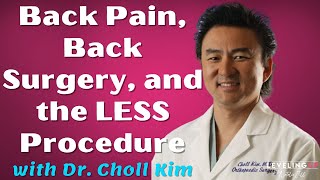
Natalie Jill talks with spine surgeon Dr. Choll Kim about her back pain and minimally invasive laser endoscopic spine surgery. They cover what causes back pain, when surgery makes sense, and why insurance often won't cover the LESS procedure even though it means faster recovery.
Hi, I'm Natalie Jill, fat loss expert turned high performance coach. When odds are stacked against us, how do we shift and create everything from nothing? How do we level up when we aren't feeling it yet or we've had a big setback? On this podcast, I'll be talking to some of the most inspiring and courageous men and women on this planet who at their worst, learned how to achieve success greater than they ever dreamed possible. Leveling up and creating everything from nothing. I've been really looking forward to this special episode all about back pain injury and solutions for it. Now, many of you know, if you followed me on social media and other places that I have had years of dealing with back pain as many of you have years of it. In fact, most of my workouts, actually all of my workouts that I used to create in fitness were all based around around how to strengthen your core so you can avoid feeling the problems with back pain. Many of us, as we age, we get something called degenerative disc disease. It's very common. If you were to do an MRI on most people in their 40s, 50s and beyond, you would see some form of degenerative disc disease. Now, whether some people feel pain or don't notice it at all, that's all very individual. And I spent years in the fitness space where working on how do I strengthen my core and my glutes so I don't feel the pain of degenerative disc disease. Now I've had two surgeries on my back. Many of you know my story behind my disc rupture. If not, I'm going to share it in this episode more. But today I have my surgeon joining us, one of my favorite humans and a top surgeon in the world, Dr. Cho Kim. And we're going to be sharing my journey, my story behind this, and also where he fits into the equation and how he's just literally changed my life and my relationship around pain. So a little about Dr. Kim and as a side note, I could go on for days about his credentials. I'm not going to do that right now. But the main things to note about Dr. Chol Kim are he graduated cum laude from Harvard Medical School. He completed his fellowship training in complex spine surgery at the Mayo Clinic. In addition, he is double board certified by the American Board of Orthopedic Surgeons and and the American Board of Spine Surgery. So he knows his stuff, y'. All. And he is an internationally recognized expert in the field of computer assisted minimally invasive spine surgery. He's trained and he continues to Train specialists throughout the country on the safe and effective application of state of the art techniques using image guidance and navigation technologies that are minimally invasive. And this is the type of surgery that I had. So join in today and learn exactly how Dr. Cho Kim leveled me and many other patients up today. On leveling up, I've got a little bit of a different topic for you. We're going to talk about back pain and I'm going to specifically share my journey that I've gone through. And I have a Special guest today, Dr. Cho Kim, who's one of my favorite people. Not just my favorite surgeon, but one of my favorite people on the planet. Thanks for being here today, Dr. Kim.
Thank you so much for having me. And I'll give you that five bucks later. That was super cool.
So I want to give you all a little background first. Then I'm going to completely switch over to interviewing Dr. Kim about this. But you know, back pain is so relevant, so many people experience it and it's amazing. As I started sharing my journey on social media, the amount of messages and comments and questions that came in, it was really unbelievable for me. So if you are not personally suffering with back pain, you probably know somebody who is. So this will apply to that as well. And if you're just suffering from pain in general, I think this will be informative for you today. But to give you a little background on my story, almost three years ago, I always had back pain. It was something I always had. And MRI showed that I had something called degenerative disc disease, which most people, especially in middle age and Dr. Kim can concur or deny. Most people show some signs of that as we age. Right. Is that accurate?
It's very, very common. It is like the treads on a car tire that you can't ever replace. And with time and activities, it just tends to wear out. For some people, those discs wear out faster than others. There's a genetic component as well as an environmental component. But at some point in your life, somebody, you're going to develop back pain and hopefully it won't be severe. But for many of us, that back pain becomes debilitating.
Now, what I learned from him at the time when I first was going down this road is that some people could have very similar MRIs and one person will feel a lot of pain and the other one doesn't. And there's really not a lot of rhyme or reason to why someone experiences a lot of pain and somebody else does not. But for me, I was managing it. I was learning corrective exercises. I was working around it, and I was managing it until it ruptured. And I, very specifically, I was on set filming, and I was doing some pretty hardcore workouts for nine hours, and it ruptured. And what Dr. Kim told me is that even though it ruptured on set, it could have ruptured outside of that. It may not have had that might have forced it along, but it may have ruptured regardless. Is that true, Dr. Kim? Did I hear that right?
Yes. The reason being that in all the years that I spent taking care of patients, a lot of people don't really know of a specific activity that caused the rupture. It will just happen spontaneously. They may notice symptoms getting worse and worse and worse over time. And then all of a sudden, something happens with very minimal effort or activity, and they develop severe sciatica like you did. So it's not like an instantaneous effect like breaking a bone. It's a process that occurs. And then something happens where that disc, instead of this hovering about to squirt out, it actually squirts out like the jelly, jelly donut.
And I'll tell you with me that day, I'll never forget it, because I was on set, I was in more pain than I've ever been in my life. It felt worse than labor pains to me, and it was excruciating. And I couldn't. I didn't understand what was wrong. I didn't know. I. And the next morning I woke up and my right leg was not working. I had something called foot drop, and the pain in my back stopped. But I had this really weird feeling and pain down my right leg and in my piriformis. I got myself back to California, went to the chiropractor, did all the other things, called my friend who's an orthopedic surgeon, he ordered an MRI, and he said, you need surgery. You're going to Dr. Kim. And that's when we met first.
I distinctly remember that whole event because you're blessed with having some really good doctors behind you. Because that doctor called me personally on my cell phone, and he told me who you were and all the history. And he made sure I looked at your MRI that night, I think, and you had a very large disc herniation. And the reason why it's so painful is imagine you hit your funny bone over and over and over again. You know that feeling when you hit your funny bone? There's no pain like that. And nerve pain is just direct. So I can always tell when somebody has a disc herniation, I can't remember if this was you, but most patients with that would. I'll walk in, and they'll be sitting, leaning to one side on what I call the sitting on one butt cheek sign.
Yeah. Oh, yeah. That was totally me. And then I had that. And I had that foot drop starting. And I'll never forget what you said to me. You said, you can wait. However, every day that we wait to remove this rupture herniation, you risk permanent nerve damage, and you risk losing control of your bladder. When you told me that, it was like, get me in surgery right now.
Okay, I am really glad you brought that up, because what's funny is we probably talked about a lot of different things, and those are probably two things that I may have mentioned on the side. But for you, that's the thing that you really remember. The reason why I want to bring that up is that we have to keep in mind that even though you have a really bad disc herniation and a foot drop, we don't necessarily just rush off into surgery because the body has an unbelievable. And after all these years, I'm still so surprised at how well the body can accommodate, heal, and deal with all these things that life throws at us.
I just heard you might lose control, and I was like, sign me up. Get me in.
That's not the main reason to do the surgery, but, yes, that is, like a remote risk. That's probably the risk that you probably remember. But the main reason was that we needed to get you back to your level of function and your life again. You couldn't work. You can't. Obviously. You're like a professional athlete, really, in many ways. You can't have a foot drop and do some of the things that you do. So it was a question of how important is it to take on the risk of surgery when you have a deficit that's going to affect your function and quality of life. So say you were much older and you had a totally different lifestyle where you didn't really have to use your legs that much, and you came with a foot drop, then you probably wouldn't be a great candidate for surgery, because what's the upside of getting that better when you take into account the risk of surgery? Because even though surgeries are safe today, it's still like driving on the freeway. Every once in a while, you're going to get into a car accident. You just can't help it. So.
So the question that's come up, what's interesting Is. So what I had then was called laser endoscopic spine surgery. It's the first time I'd ever heard of it. It was super minimally invasive. He went in the procedure then was like less. I think it was like an hour long, an hour and a half maybe. He removed all the ruptured disc. We had a cool video showing it. And I was instantly out of pain and my right leg started to heal. And it he relatively quickly. Over the course of a year, it was getting better, every day a little stronger. And I would say in fast forward, I probably have about 98% of my. Of my leg function completely back. But what came up was about a year after that procedure, because we didn't do anything to fix the missing disc or fuse anything together. We didn't want to do that. I started having a lot of pain on the other side. A lot of pain on the other side. And I did all the things prp, I did physical therapy, I did chiropractic. I did. I did all the things natural wise to do while visiting Dr. Kim every few months to check on things. And ultimately we came down to some choices that I could either live with the pain, which was getting to be like a level 9 or 10. I mean, I couldn't sit, I would sneeze. It was. I was texting him like, I'm dying over here. But option one was live with the pain and take medications. Option two was go in and do an aggressive spinal fusion, which I'm going to. We're going to. I'm going to ask him about right now in a minute. Or what I did, which was another laser endoscopic. So I want to back up Dr. Kim. First question that is coming up for people. Like, when you have a surgery like the first one I did, what are the chances that you need another one? That's my first question.
Relatively low. I would say that it's probably less than 5% of patients need a second surgery after the type of surgery that you had to begin with. But the reason why you had a disc herniation in the first place is because the disc is abnormal to begin with. And when you do a surgery that involves just removing the herniated disc, like a microdiscectomy or a laser endoscopic surgery, you're just making sure that the nerve is free and that that fragment is removed and prevented from irritating the nerve any further, but the disc itself from which that fragment came from is still abnormal. And unfortunately, this is one of the tissues that for some reason the body does not know how to heal. So you still end up with, in the end, a disc that's degenerated, that's been injured before and now has had surgeries. So it's not a normal disc. And you develop something called discogenic low back pain.
What does that mean?
That means that instead of a piece of the disc squirting out and pinching a nerve that's going down your leg, it is basically like a joint pain where the disc that acts like a shock absorber between the two bones above and below and you have multiple discs. Just in the low back you have five mobile discs that acts like shock absorbers between these coke can looking pieces of bone called the vertebral body. Like any joint, when the bones get too close together and they grind back and forth or the forces on it are abnormal, your body notices as pain. And then there's a whole inflammatory process that we can talk about later. But it's a mechanical thing where it's like an arthritic knee or an arthritic hip, but it's in your back and that can cause pain. And it can also then in turn irritate the nerve going down the leg from just inflammation.
Not with me, I was getting hip pain. That was where it was showing up. There's a lot of hip flexor hip pain.
I think in your case that was a lot of referred pain. Referred pain is like this weird pain that you get in your arm when you're having a heart attack, for example. You ever heard of that? The way your brain maps out its sensory pattern, it doesn't necessarily know that it's coming deep inside. Same thing happens in your back where people notice it in their butt cheek or their posterior thigh. And sometimes it comes across in front of the groin. So that's like referred pain from the joint itself. And it's very possible that it's also irritating the nerve going by it that provides for your body the sense of pain and something's not right or discomfort in that area because just the inflammatory process can irritate the nerve.
Yeah, so that brings me to a lot of questions here, because for one, do you think a lot of people are walking around feeling something where there's not actually the injury or the problem? Like, are there a lot of people thinking they need to treat their hip or, you know, something else and it's actually their lower back?
Not a lot, but a fair number. And I spend a lot of time trying to make that distinction. So yes, it's very important to make sure that the Pains that you're having is coming from a specific anatomic location that helps the treatment a lot.
Interesting. And then what can you talk about? Like, there's a lot of different options. When you have degenerative disc or you have a rupture, you have a bulge or a herniation. How do people know, like what, what is a disc replacement? Like why would you do or not do that? Like why not replace the disc? Or what is a fusion? Can you talk about sort of the different levels of things, the surgical, the surgical routes for back pain?
Yeah, I mean, aside from the laser endoscopic technique, which is, you know, relatively new technique, and not many people know how to do that procedure. The more standard procedure is to do what we call a reconstruction. So you have, for example, an arthritic joint and every time the two pieces of bone move next to each other, it causes pain. So the kind of the rudimentary way to deal with that is to fuse those bones together so they don't move anymore. It's no longer a joint. That continues to be to be the mainstay of treatment for this type of problem where non operative treatment doesn't work.
And before I forget, yeah, I would also, I want to know like the pros and cons of doing something like a fusion.
There's a lot of pros, but there's a lot of cons. And what I wanted to make sure everyone understands is that the vast majority of people that have degenerative disc disease and severe low back pain are best treated non operatively.
Okay.
Portion of patients. If I had 100 patients with pain like yours, I would say, and yours is kind of unique because you're in such good shape, you're so healthy, and there's not much more that we can do non operatively. Even in that group of patients, we may only operate on a small proportion of them. Really keeping in mind you hear about the surgery a lot, but the vast majority of people should not be having a fusion surgery unless you've legitimately tried everything. And that is really the best choice after trying a bunch of non operative treatments that are less risky. Because that surgery is a big surgery. Even if you do it minimally invasively, it's a major operation. It's the one that involves usually cages and probably screws and rods. And if that surgery doesn't go well, things can go bad.
So the example you gave me, which really landed for me, as you said, it's kind of like driving 100 miles an hour on the freeway in a sport Car like, it could be great and fun and amazing unless you hit something and then it ruins your life.
Exactly. So I have a saying. Some of my happiest patients are my lumbar fusion patients that had discogenic low back pain. Guess what? Some of my unhappiest patients are the same thing. Same thing. Because if you do the surgery on the right patient, it's a home run. But if you do that surgery on the wrong patient and you have a complication, it's one of the worst things that can happen because A, they still have severe pain, and B, now you have a secondary problem which can be severe. So undergoing a fusion operation, you have to take with very. A very high level of caution. And I would get multiple opinions and ask around a lot before undertaking something like that.
You also had told me when I asked, you know, what are the risks and if being healthier helps and all, and you had told me, maybe I heard it wrong, that being healthier helps everything, but that there was really no guarantee that an athlete could have a bad result, or somebody that you predict is not going to have a great result can have one. So you said that there. Did I hear that correctly? That there was really no way to completely predict if someone's going to have a great result or not?
Yes, it's true. But we can kind of take some generalized averages. A healthy patient is more likely to have a good result than somebody that has a lot of medical problems, and especially patients that are really what I call unhealthy or unfit. So, you know, health is. That's why I love all the things that you do. It's about fitness and being fit. That's not just strong, but it's about being healthy. And it deals with our body's inflammatory system and it deals with Earth's gravitational forces. Those are the two big things that we have to fight in terms of spine problems.
Talk about disc replacement for a minute. Like, that doesn't seem like that's as common anymore. And what's the thought process behind that? And to me, it would make logical sense. Like, you don't have a disc or it's completely diseased. Why would you not just replace it?
The main reason is that no one is as good as. We can never do as well as what we already have. Our intervertebral disc. If you were to, like, take that as an engineer and analyze it, it is one of the most remarkable pieces of tissue ever invented because we cannot replicate an intervertebral disc. So if you look at a disc replacement Device. It doesn't look like a rubbery shock absorbing thing. It looks like two pieces of metal with a hard piece of plastic in the middle. And it's designed to be a motion device like a knee joint, like bends back and forth and has motion, has sliding surfaces that allow for motion. Right. If you look at a disc, you can tell that's not what the design is for. A disc is for shock absorption. And all the current disc replacement devices today are very. They look very much like knee replacements and have very little shock absorbing function. Because every time we try to do something like that, we encounter something called fatigue failure. It's like when you take a paperclip and you break it by bending it back and forth over and over again.
Okay.
We use some kind of hydrogel or silicone or rubbery device, and you start loading it over and over again. After about 10 to 50,000 cycles, it starts to break apart.
Wow.
That's why a disc is so miraculous, because it undergoes millions upon millions of cycles and very slowly degenerates. Anything else that we can make cannot last that long. I mean, I'm talking about. We've looked at every material that we have available to us in medicine, and they're all falling apart. So the first problem is that there's a significant design difference between what a dish should do and what we have currently available. And then two, you cannot have any deformity or instability or problems with anatomy to do a disc replacement device. When you do a fusion, you just stop motion. When you put in a disc replacement device, you have to reconstitute the overall anatomy, including the alignment and the stability and all those things. And we can't do that in most of our patients that need this type of surgery. So the number of patients that are good candidates for disc replacement surgery goes way down. And then there's a whole set of insurance issues that I don't know that you want to get into that also affects decision making. Like if an insurance company says, you can't, we don't pay for a disc replacement device. We won't pay you. We don't pay the hospital, we won't pay anybody. How often is it that we're going to be able to do that procedure on somebody?
Yeah. For the record, and I've been very public about this, you know, my procedure was not uncovered by insurance, not by my insurance, and it would have covered the fusion, which was so interesting to me. But I chose, I'm very much of the opinion to not let insurance dictate my treatment. I think it's very important for the patient and the doctor to look at what's the best treatment option. And for me, that's what I chose.
Yep. Unfortunately, I mean, a lot of us are lucky that we have that choice, but at some point, we have to make it so that this is available for everybody. So that's my 2020 resolution. To try to figure out how it is, I could reach out to insurance companies and just say, amazing. This is not. We've been doing this for. I've been doing it for 18 years. I have so much data on my own. There's so much data out there. I just think we're speaking to, like, the doctors are speaking a different language than the insurance companies. We just need to find a common language, because if it's ripe for the patient, it's better for everybody, including insurance companies.
So it's a broken system. Can we talk about the laser endoscopic for a minute? Because you all. This is really fascinating, and I've got a bunch of questions I'm going to ask him because I'm going to repeat some questions that I've been getting from people. Dr. Kim, it's pretty funny. So the laser endoscopic, just to be clear, I had, like, literally one day of downtime. Like, we had the surgery. I was under anesthesia. The next day, I laid around. I took a couple of painkillers. I didn't like them. They made me nauseous. The next day, I was, like, moving around, walking around. It's like, I didn't have anything done. It was the fastest recovery ever. Can you talk about why that's such a fast recovery and what that's about?
Yes. I mean, first of all, people vary in terms of the recovery. Some people, most people are like you, but there's a few people that recover longer because of their body's inflammatory system and what have you. But it simply boils down to the amount of collateral damage that you do in the process of getting to the surgical target site. What does that mean? The area that is abnormal in your spine is, like, tiny. It may be the size of a pea. Yet when we do traditional surgery, the surgical corridor may be the size of, like, a coffee cup, a big hole. Now we're getting that hole smaller and smaller so that it looks more like a tube, like the size of a roll of quarters. But even that is way bigger than the size of a piece. So if you can get to the surgical target site that's tiny, through a corridor that's tiny, that greatly decreases what we call collateral damage. And a lot of the collateral damage is what causes you to have pain and disability after surgery. And that's basically what we call the recovery period.
Oh, my gosh. So it's not the actual, like, removal of what you did. It's. It's the getting into it. That's the cutting open is what is causing the issue, because you're going through muscle and bone, whatever else.
Is that what it. Okay, that's a bit of a generalization, but by and large, that's the biggest difference between open traditional surgery and minimally invasive surgery. What happens at the surgical target set is virtually identical. It's everything else that we do to get there. If you just compare those two, there's a massive difference in terms of recovery, pain, even infection. Because when you have a lot of damaged tissue along the surgical corridor, they're more. It's more. More vulnerable to getting seeded by bacteria and then developing an overwhelming infection. So there's a lot of advantages. It's just technically very difficult because you're just working through a tiny little space, like. Like building a ship in a bottle. It's like a skill that you have to develop.
Yeah, that was my next question. So it seems like a lot of surgeons don't do this. Is there. Is there a reason for this? Is that it just seems like a lot or not.
There's probably a few reasons, but this procedure has been around for well over 20 years, and there's been a lot of advancements, but there's very few surgeons in the world that do the surgery well. And that's because it's a very technically difficult surgery to learn how to do well. Whereas, like, the equivalent surgery, like a microdiscectomy, it doesn't take that much practice to get really good at that surgery. It takes a lot of practice to get really good at endoscopic surgery because the spaces are smaller. You have only 2D visualization. And we're not used to working like that. Words. Surgeons are like anatomists. We need to see what we're doing. We're like construction workers and carpenters. We like using our hands. We're not like video gamers. This is like playing a video game. So it's very difficult.
It seems like this is a big part of your practice now, though. This is like, you have really. You're super skilled in this. This is your. This is your thing right now.
Because I've had a lot of practice, so I happened to be at the right place at the right time, I guess almost 20 years ago, where I thought to myself, this would be kind of cool to learn how to do. And I didn't know any better. And I just. And I had a lot of luck. And I'm very kind of an ocd, I guess. So things that are tedious and meticulous, whereas for some people, it's just annoying for me, I get a kick out of it. So it was, you know, a perfect storm. And then once I got really good at it, I've been trying to teach other surgeons how to do that surgery, and I immediately realized this is a really difficult surgery to teach somebody how to do. So I think every surgeon can learn how to do this surgery. Well. We just have to figure out how to get them to that. What we call the learning curve number.
Yes.
If it's 100, it's really hard to get a surgeon to adopt a procedure that takes them 100 tries to get better at.
I think it's important for people to hear that, though, because that's where it might come in handy, getting other opinions from doctors. Because if your surgeon is not trained in something or that's not their standard of care, they might be jaded on what they're offering and what they're. I mean, it might. It just. They can't help it, I would imagine, because some surgeons aren't even going to offer it as an option because that's not what they're skilled in yet.
Yep. I think that happens the majority of the time. And then a significant portion of the time a surgeon has tried to do this surgery because it's been around for a while, and there's tons of interest. We have. We have so many labs and instructional courses, and I've taught many of them. Every one of those are just packed. People are standing room only. There's so much interest in it. So I suspect a lot of people have gone back to their hospital, have tried to do the surgery, and have not had a good result, and they poison the well after that. And once you do something that doesn't go well, it's really. It's. It's really difficult to go back to.
I get that. I get that. I want to shift a little bit into that aftercare because people were freaking out when I was showing some workouts after, and I kept saying, my surgeon cleared me. He said it's okay. He told me I can bend and twist, and I'm not talking about extreme stuff. I didn't run, don't worry. And I haven't jumped, done anything like that.
But didn't you do like, 10 ring pull ups?
No, that was the first surgery. That's not this last one? No, I waited on that, so. But this last one, let's just talk about a few days after. I was bending and walking and moving, and he told me I could. You said, let pain be your guide. Go slow. But you were not of the mindset of do not bend or twist for six months. And a lot of people messaged me that, oh, my gosh, my PT would freak out. And I just stuck with, but my surgeon said it's okay, and so did my physical therapist. Can you talk into that? Like, what makes a patient be able to or not able to? Is it procedure specific?
I'm really glad you brought this up, because I still struggle with this. And I think it simply boils down to the fact that we've all been trained to try to normalize everybody into, like, one big blob. They're all the same. Everyone takes six weeks to heal, and everyone takes three months to be able to lift heavy weights. And everyone needs six months to start playing contact sports. I realized over the course of practice that a bunch of patients that don't listen to what I say and just do whatever they want, they do way better than my nervous Nelly patients. And then there's some patients that need a lot more than six weeks, and I'm badgering them, and they're feeling like they're doing something wrong. And I eventually came to the conclusion that everyone's a little bit different and that really, we should be doing what I call precision customized medicine. So somebody like you, you don't need that much time to recover because your body is in a healthy state. Your body's inflammatory system is relatively normal and dampened because I would say 99% of the American population is in a heightened state of inflammation. Separate issue that you know much more about than I do. And two, remember gravity. If you're lean and fit and you have good muscular coordination to deal with the effects of gravity, just standing up and leaning over and grabbing something, then your recovery is going to be way faster than if you're somebody that has all kinds of inflammatory disorders on tons of medicines and you're way overweight. And more importantly than just your weight, the muscles that allow you to stand up on earth aren't that strong or coordinated. Yeah, that patient's gonna take a lot longer to recover. So my motto is, let pain be your guide. It's not perfect. And let patients recover at the pace that they're naturally allowed to Recover. And when I started doing that, I noticed a huge difference. I have some patients like you that get better so quickly. It's shocking. Yeah, I wanted that. And through that, like, when I take care of elite athletes, you're one of them. I want them to get back to activities and sports as soon as possible because it's their livelihood.
And I appreciate that you take that stance and you told me, like, let pain be your guide and all that. And I will. Like I told him today before the call, like, ah, I feel not the pain I had before, but I feel a little bit today. And I. But I could relate it back. I'm like, okay, well, did I push my workout a little bit more? And then I know, okay, back off. So. So I am listening to that at heart. But I love that you let us be free to trust our bodies and move because that's why we're having the surgery. It's not. So we just never move again. Now, you said earlier, you said surgery is not for everyone. You don't recommend it all the time. You want that as a last resort. Can you just speak a little bit into things that you feel people should try before they're rushing into surgery?
First thing, get a second opinion. Because just think about how we buy everything else. I mean, we hardly ever buy something without comparing with other things. So we should do the same thing with our doctors. Not necessarily right off the bat, but when something major occurs, like I'm thinking about a surgery, so that's the first thing you should do. And then the second thing you should do is ask, have you tried other options that are. That kind of fit this. This balancing act between the potential benefits and the potential risks. So surgery's high potential benefits, but relative to other things, high potential risk. Driving 120 on the freewheel would be a good example. So before you get there, you want to do a bunch of things that will hopefully make you better. And the way I think about it is that there's two things that we need to conquer. The first thing is our body state of inflammation, because you can. Like, if you had an arthritic knee, I bet you you noticed that there's some days that it's more bothersome than others. Some people think it's the weather. But a lot of it has to do with our body's state of inflammation because the body can dampen arthritic joints so that you don't really notice that they're bad. And then two, we have to deal with gravity. So most people think, like, I don't do anything. Well, as soon as you stand up, you're lifting for me, about £150. If you've ever lifted a big suitcase that only weighs 50 pounds, you know how much that weighs. You need to have the muscular strength and coordination so that when you just lean over to pick something up, all those muscles are acting like the world's greatest back and neck brace. Multitude of, you know, fibers firing in a coordinated way to dampen abnormal loads and distributing all those loads. So what does that mean from a day to day thing? You want to have a lifestyle that has low inflammatory mediators and you want to be really like physically fit that's not just skinny, that's just not strong, that is flexible, coordinated with a good cardiovascular system, et cetera, et cetera.
Yeah, this is interesting. So, and I will share that the reason I was able, I was in major pain for a year and a half before this last surgery. And what changed my level of pain on day to day? So if I was like say call it a level nine, I could get it to like a five or six. But that's significant. That's a big difference. Was anti inflammatory diet. So when I would eliminate sugar, dairy and wheat from me, that totally made a difference. Eating that way adding in supplements like turmeric and fish oil. So if I was consistent with those things and hydrating, that made a big difference. Also. I want to speak into the pain cycle because it's and I'm curious your thoughts on this. I feel when we're in pain, me included, what happens is I'm in pain, so now I don't want to move. So now I don't want to move and I'm depressed that I'm not moving and now I'm going to eat things that I don't are not necessarily the best healthy foods. And it just keeps this vicious cycle going. When, when I would just go walk and it would say okay, it hurts, I don't want to walk. But I would go walk and move through the pain. It would lift on a lot of levels just by moving through it. So I think that pain cycle, what I decided about that was that I had to force myself to break that pain cycle every day or I would just stay literally in pain and it would consume me.
That pain thing is one of the most mind boggling phenomenon that I've ever encountered. That and like you know how gravity changes time. But that's how big of a deal the way we deal with pain is because there's so many levels starting with the way our brain processes information. But your example is probably most closely related to the kind of pain that people get, where their muscles start to tighten up and in a way, become a cramp. The people that have this severe debilitating pain where they can barely stand up straight and catch their breath, the best thing you can do is go out and walk around and try to activate those muscles. Because it's sort of like having a calf pit, calf cap, sorry, a calf cramp, but in the powerful muscles of your back, which are much more painful. But we can go on all day about all the different strategies that we use to decrease pain, and it'll be different for everybody. But one of them is to break the cycle where the muscle gets tight and starts to cramp up and spasm. And then two, to try to figure out a way to decrease your body state of inflammation. And then the third thing that is much more cerebral is the way we kind of process pain signals and deal with it in terms of what we call suffering. So I'll give you an example. If you're right in the middle of playing football or another sport and you get injured, you may not even notice you're having pain somewhere that you injured, like a broken foot or a broken hand until after you kind of sit down and realize, I think I hurt something because the brain has a powerful modulating capacity. So you touch on all three of those things, you're depressed and just thinking about it, Then you're starting to succumb to your impulses of eating comfort foods that drive up your inflammatory state. And then because of the pain, you become less active. And when you become less active, the muscles get tighter and tighter and tighter.
Yeah, and that's why I wanted to bring it up, because I know people would see me working out or doing nothing extreme because I couldn't. But I would be working out, and I'd say, well, how are you working out? And that much pain? I'm like, it was a decision. It was literally like, I would rather work through it because I know what's on the other side of it today when I do versus sit and just be in my mind about my pain. I also want to speak about prescriptions just for a minute, because there's a lot of people listening to take prescriptions for pain, Me included. I took over the course of the last year. I was taking an NSAID and NSAID pretty high. I was 40 milligrams at one point, which was, I know, pretty high level. And the risk of that is gut health. And Other things. So that's not something you want people on long term, I'm assuming. Correct. And nsad?
Correct. I mean, even though I'm a physician, I'm not a big believer in medications because my kind of thinking is that the body is in this intricate state of homeostasis. And whenever we start, like even what we eat and especially the medicines that we take completely throw that off. And in the long run, it creates other problems. Having said that, there are instances where our body needs a little bit of help. So I very much rely on temporary kind of low risk treatments that treat things like inflammation. So I love NSAIDs. Sometimes we'll use muscle relaxants when we have to. These are all things that we have to do. And after surgery, I'll even use opiates, which is, you know, the O word is one of those situations where people are just deathly afraid of that medication. And they should be, by the way. But there's a time and place for everything. But I have so many patients that come in and they're on like 20 medicines.
Wow.
And at some point you have to just say we have to do other things rather than treating every symptom with medication. But it is 2020 and, you know, we live in a time where medical information is profoundly advanced. So when things like anti inflammatories work for you, I definitely like to use it. But if you don't need it and it's not helping, then you should not take it. And it should not be a replacement for things like avoiding inflammatory things like sugar and animal proteins and dairy products, for example, and wheat. If you're doing all those things and you still need a bit, need a little bit more help, then that's very reasonable. But if you're doing it as a replacement for all the more natural things, I think in the long run you're hurting yourself.
I'll tell you on my side of things, even right now, I'm not on 40 milligrams a day, but I have a 20 milligram that he's prescribed me that if I need it, I take. And for me, if that gets me out of the inflammation and the pain enough that I can go work out and be about my day. To me, the benefit is overweighing the not taking it. For me, that's my choice on that. But my goal is not to be on that forever. In fact, since surgery, I've not taken many at all, but I've taken it a few days when it feels like it's a little flared up or whatever. And the NSAIDs work for me. And I know that my gut health is on point, so I watch that. But everybody's their own situation. So I'm going to say check with your doctor and your health before making a decision on that one.
And it's impossible to be perfect about everything. So just doing the best you can is going to get you 98% of the way there.
Why do you think so many people have these back problems?
I think the two main reasons is that most Americans live a very high inflammatory lifestyle. And two, we've not taken into account that gravity remains constant and you have to fight the forces of gravity as it plays havoc on all your joints. So you know things like sleep deprivation, low level, ongoing unremitting stress, high animal protein diet that has tons of sugar, and if you have, you know, various allergies, wheat, whatever it may be for that individual, and turns out lack of aerobic exercise also affects your inflammatory state. If I were to just kind of describe the typical American, they're four for four on all those things. So it's not surprising that the vast majority of Americans develop all kinds of joint problems, not just in the back, but in the knees and shoulders and hips, like almost an epidemic on it. And then two, just think about when you're young. You could jump off like a tall wall, land on the ground, bend your knees, maybe even roll a little bit, get up and walk away. You're coordinated and you're flexible. And when you land, you know how to relax your muscles in a kind of a controlled way to dampen your fall. If I did that today, I'd shatter like an egg.
Yeah. Because I hurt thinking a bit.
So. Yeah, yeah, exactly. So as we get older, we naturally exert ourselves less in terms of physical exertion for a variety of reasons. But that's another example. When was the last time you even walked a block to get somewhere? I mean, my hospital is a block away from my office. There's times where I actually drive there a block.
That's funny. Not anymore, because you just mended. You just admitted it, so now you got to change that. I have some questions about a few trist treatments. I wrote down that, and these are because of questions that I've gotten. So I wanted to have your opinion on it. And these are things that I tried as well. But I want your opinion. Can we talk just a little bit about PRP and stem cell? Because that seems to be the trendy thing. Like when can somebody try that? Should they try it? And the difference between those two things.
All right, those two things are often talked about together, but they're two very different kinds of strategies. So PRP is that part of your BL that has a bunch of growth factors. And the idea is that it's like a really great anti inflammatory gel that you can apply to an area of your body like a tendon, and decrease inflammation and help initiate healing through all the natural growth factors that are in that. Like that goo.
Yep. And I hadn't done it for me. It did not do anything for my back. It didn't help for me.
And like every medical procedure and treatment, there's no, there's nothing that's 100%. But for PRP, we know it works very well on things like tendinitis, but its effect on discogenic low back pain or even facet mediated pain, that is completely new. And I'm not surprised it didn't work. And I would say it's still in the experimental stages, but it's relatively safe and very reasonable to do before surgery because remember, you're always balancing risks versus benefits.
You agreed with me to try it because it was like a why not? Yeah.
Now what about big believer in alternative medicine strategies?
What about stem cell? Who does that ever apply for?
Stem cells are slightly different strategy. They have overlapping strategies, but stem cells are more about regenerating normal tissue. And that in part includes, you know, replacing abnormal tissue and dealing with the inflammatory state. But those cells are supposed to become the cells that made up your disc, for example, or your facet joint, depending on where it was injected. And we are so technologically far away from being able to make that work for things like the disc that I would say that that's highly experimental. So would I recommend that you try the stem cells? Probably not, unless you had lots of extra money and resources because the likelihood it would work is very, very low. The risk is relatively low too, but the costs are really high. Yeah, prp, the likelihood that it's going to work is slightly higher than stem cells. The risk is slightly less than stem cells, and it's not as expensive. I think it's still pretty pricey. Not covered by insurance.
Yeah.
So we're balancing all those things. But I would say the PRP seems much more closer to actually working. Stem cells are still in that promising stage. We need to find the right environment to use it in. But the disc is a particularly difficult place to inject stem cells because it's like a, it's like a rubber container that is completely solid. There's no Blood vessels that go in there, so there's no exchange of nutrients. And we call that a very hostile cellular environment. So you inject a bunch of delicate, fragile stem cells into that area and it gets choked off of its oxygen supply and it gets overwhelmed with all its toxic byproducts. And guess what happens to those stem cells? They die. They die, as they say.
You love saying cockapoopoo. You said that. I'm going to share the video in the links, the one that you filmed my surgery. You must have said cockapoopoo like four times.
I don't know why I say that. It just rolls up the tongue so smoothly.
Talk about cortisone shots for a minute, because a lot of people default to that. You use that on me as a diagnostic tool. But can you talk about where that could help? Where that could be dangerous to do too many of them, all those things? Because people seem to love those things.
I don't love them, but I do reluctantly rely on them greatly to do two things. One, they work really well if you know that something is being irritated due to the inflammatory process. So when you do an epidural steroid injection, you're basically depositing a high concentration of a steroid anti inflammatory. It's like a crystal that slowly dissolves over time, like a depot something. So if you put it at the right spot and that spot is causing lots of inflammation, guess what happens? You get a lot better. And if your body's already in the process of kind of getting on top of it and it just needs a little bit of help, that injection may be permanent. Like you kind of got over that little bump. The other thing that it does is that it provides a lot of diagnostic information. Because remember, if you had pain in your, your lateral hip and your posterior thigh that could be coming from five, six different places.
Yeah.
By doing targeted injections, you can identify what may be causing that based on your response to the injections. So I almost always recommend doing targeted injections before surgery for two reasons. One, the risk is low relative to the risk of surgery, even though the likelihood of improving is not as high. And it also provides diagnostic information. So I'm a big supporter in doing very well thought out targeted injections for both diagnostic and therapeutic purposes. But just like anything, including water on a plant, there's too much of a good thing. So you have to be mindful of how many times you do the injection and the best way to modulate that, because everyone says, how many injections can I have in a year? There's not really a number, it's more about whether or not they're providing a significant benefit. And general rule of thumb is that injection should provide you at least 50% of improvement in your overall symptoms and should last for at least six to 12 weeks. So if she stops doing that, then you stop doing the injections.
The thing that I had stuck in my brain and you can totally correct me if I was completely off on this, but that cortisone, I think of cortisol in your body, the stress hormone. So to me I'm thinking you're injecting the stress hormone in your body. So how can that be good? So but maybe do I have that completely off or wrong?
No, it's. Well, the term hormone is. We should definitely make sure that the last S is capitalized because it's plural. There's multitude of hormones and they work in an interrelated way and in complex ways. So when you use like a high dose pharmaceutical steroid, it does a bunch of things that it does not meant to do. And in this situation you're kind of balancing the risk and the benefits. So yes, it will raise your blood sugar, it probably raise your cortisol levels temporarily, but if it's temporary and it gets you out of the pain so that you can kind of start the healing process. And it's one of those situations that you say it's worth the risk and worth the all the negative side effects. But again it has to be well thought out and you have to take into account all those risks even when you do an injection.
There's one more treatment that I wanted to ask about because there's a huge following around this. I even did some sessions around it. I tried to take it on about the whole Sarno method of it's all emotional and it's emotional trauma and that's what causes back pain. I took that on, I read the books, I did a session with that and I still had pain. So I'm wondering just your opinions on that. Do you think there's a lot to to that? Do you think it's like just some people that's not true because if you were to. When I talked to the practitioner I did around it, he's like every single person does not need surgery. This is what it is. So I'm curious your opinions around that.
I would say that we're trying to use that. I have that book on my shelf actually because I do think it's an important component of the way we deal with pain. But it's Just one piece of a big puzzle. So if you only show me, you know, a corner of a puzzle, I may not know what the big picture is. Same idea. So when you are dealing with a chronic pain condition, you kind of have that. I hate to use the word chronic, but your disc is degenerated, and it's going to stay like that, and you're going to have some level of pain coming up, you know, going up and down. And that level of pain, its effect on your function and quality of life, one way to look at it is the amount of suffering that you have is a combination of the way your brain processes information. I think that's what Dr. Sarno talks about. But there are patients that. That's not enough. Yeah, that's a big component of it. So, yeah, unfortunately, in medical school, we don't get taught that much about psychology of things. We're much more physiological. But I'm a big believer in the power of the brain affecting physiology. It's not like two separate things. Yeah, I can think of a multitude of examples where your state of mind affects your physiology. So you need to institute all the things that Dr. Sarno talks about. You need to institute all the things that decrease your body state of inflammation, and you need to institute all the things that allow you to fight Earth's gravitational pull so that you don't fall to the ground. So, yeah, this is. It's like a lifestyle thing. That's why I love having patients like you, because to be really healthy and fit and to live in a lifestyle where we're really active for a very long time, there's no single one thing that you can do to make that happen. You have to have the right mindset, like Dr. Sarno recommends. You have to have the right lifestyle so that you're not exposed to all these kind of what I call toxins. Environmental toxins, food, stress, sleep deprivation, lack of aerobic exercise. These are kind of environmental toxins to your body in terms of your inflammatory system.
And the medicines that people are taking sometimes, too, the drugs, the prescriptions are causing inflammation.
Very much so. Agreed. And then. And making sure that you understand that even though you're not wearing a backpack, you're still lifting 150 pounds every time you stand up. So you can just see, that's a whole lifestyle thing, not a single activity thing.
This is super helpful. I do have, like, two, four, two more final questions. If somebody right now is listening and they are like, I'm in back pain. I can't stand it. Like, that's their thing. Where do you want, where do you think they should start? Like what's step one? Like they've got this back pain, they haven't done anything about it yet. They don't know where to start. What do you suggest? First?
I suggest that they go to their primary care doctor and get an evaluation to make sure it's not something like a huge herniated dislike in your case the first time around. If they just have discogenic arthritic back pain, which can be very severe by the way, and debilitating that they start the process of decreasing their inflammation and improving their musculoskeletal health. And that's done through a combination of dietary changes, making sure you're not on weird medicines, like you said, getting into an exercise program under the supervision of a good doctor that likes to see you over and over and over again. And that's a really good primary care doctor or sports medicine doctor.
So you suggest that over or in conjunction with a chiropractor. How do you feel about chiropractic?
Oh, I love chiropractors. Okay, so you see your primary care doctor and they rule out like a meta, like a medical issue and wants you to do all these things that decrease your state of inflammation. Chiropractors, I don't know much about acupuncturists either, but acupuncture, all the things that basically help you decrease pain through hopefully the mechanism decrease inflammation, that totally works. Because I think in some ways I'm not exactly sure how chiropractic care works, but it must work because it's helped so many people and I'm a big believer in them. It must decrease the pain signals that come from joints and its joint position and things like that. So I love chiropractic care, but like anything, it works for some people and it doesn't work for others. If it works, great. If it doesn't, then don't keep doing it. Yeah.
I also think it's important to find a good chiropractor. There's just like anything, there's good and there's bad. So getting a recommendation. And I've had some amazing ones and I've had some that maybe made things worse.
I would say that when it comes to getting care, the most important thing you can do is spend time choosing the right person because it's not just about good and bad, it's also about the fit between you and the provider. So there's one thing you can that I encourage everybody to do is to be more inquisitive and get multiple opinions because it's surprising how variable doctors opinions are. And you want to find that physician, healthcare provider, life coach that you can basically connect with and be the right match.
Yeah, this is super helpful. Today I'm going to link up the video you did of my surgery and your website. But where can people find you? For the most part I know you have a YouTube channel. Now you're on Instagram. Some tell them where they can find you.
Just going on to Google and typing in either my name or we just put up a website called preferless.com just like it sounds. P R E f e r le s.com it's kind of a landing page that will kind of help you guide your way through all the different things that are out there. Because I have a big YouTube channel with lots of videos. So if you're interested in looking at videos of various surgeries and things like that or how I do them, I have a website with kind of more printed information, etc. A lot of patients want to talk to my other patients. So we have a mechanism by which you can read testimonials or get in contact with my other patients. So whatever disease is for the patient.
Yes. And I think we've got you booked out. I've had so many people. I said just go to Dr. Kim, just go to Dr. Kim. So hopefully I'm going to send you more people. I think you're just amazing and you've helped me so tremendously. So thank you.
You're amazing. You're amazing.
Thank you for all you've done and I'm sure you're not done seeing me. I'm going to show you back but I'm so thrilled that I found you and you've really made a big difference in my life. So thank you.
Thank you.
Thanks for leveling up with us today. Please share this episode if you found it helpful so others can join in. And don't forget to hit that subscribe so you don't miss out on future shows. And if you would leave me a five star review. I appreciate those so much. I read all of them and it's how I know that I'm giving you information that you find valuable. And come interact with me over on Instagram @nataliejofit. I read all them of the direct messages and comments over there. Make it a great day. Creating everything from nothing.










