196: Where Do We Go From Here with Anti-Racism with Dr. Safiyah Satterwhite
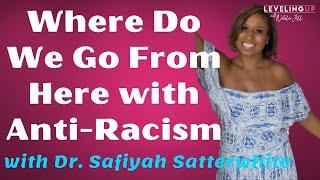
Natalie Jill talks with Dr. Safiyah Satterwhite about anti-racism, systemic oppression, and what individuals can actually do to create change. They discuss personal experiences with racism and how to build empathy and awareness in your community.
Hi, I'm Natalie Jill, fat loss expert turned high performance coach. When odds are stacked against us, how do we shift and create everything from nothing? How do we level up when we aren't feeling it yet or we've had a big setback? On this podcast, I'll be talking to some of the most inspiring and courageous men and women on this planet who, at their worst, learned how to achieve success greater than they ever dreamed possible. Leveling up and creating everything from nothing. Today on Leveling up, I've got Dr. Sophia Satterwhite. Thank you so much for being here today with me.
Oh, I am so happy to be here. Thank you so much for having me.
Now, I did not actually know her work at all until this last week, and the reason I got to know her work and started following her and have her on the show right now is because of the message that she sent me through Instagram about a week ago. And it was. That message was incredible. She wrote, and I don't have it exactly in front of me right now, but she basically said, natalie, I see your heart. I see what you're trying to do. I see that you're opening up. I would love to make myself available to help any way that I can. And this came after a lot of messages where I felt like I couldn't do anything right, where I was trying so hard with the right intentions to create awareness and couldn't do anything right. And your message just really made me feel. Well, I left you a voice message back right away, and I said, hey, I know it's not your job to make me feel better.
Thank you.
And I want to take you up on that. So thank you.
Yeah, no, thank you for being so open to it and for just being available. You know, we all are in the same place right now where everyone, black, white, Asian, Hispanic, everyone's trying to figure out what's our place, what do we do? How can we step into this, how can we rise? And so coming together and having these kinds of conversations, I think are a huge first step.
Yeah. And that's why I'm so grateful that you're here doing that with me. Thank you. And for even coming to me as offering a service like saying, let me help you, let me help educate. Let me start with that question. What made you reach out to me and some others.
Yeah. So I run a community called she Heals the World. And a lot of the women are business owners and coaches, and they are overall conscious people. And I think that many of them have felt really Targeted and attacked during this time, and guilty. Because they're kind of coming from the perspective of, we've known this has been an issue. We support this movement and now we kind of are feeling like, oh my goodness, we need to get defensive about how it's being talked about. And then on the other hand, they have people in there family and in their community who are, you know, they're kind of coming out of the closet, for lack of a better word, where they thought they were in support of what they stood for. But they're also realizing that, oh my goodness, my cousin or my old colleague, they're posting things on their page that make me feel uncomfortable as someone who of course wants to see equal treatment to everyone. And so they've also been trying to navigate this whole space. And so I tried to do whatever I can do by coming on my page and on our company page as a black woman who has been in this work for a little while before I became a coach and just to be a resource, a support and an ally in this work.
Yeah, and you're definitely showing up that way. So I appreciate that. So can you take us back? Because I want my audience listening. I've got a very open minded audience and I know they're here listening. And thank you, audience for being here listening. I think a lot of us were walking around a little bit in the dark about what it was like growing up in America as a black child, like what that was like. And I had a guest on recently, DeAndre Evans, who was so great. He was great sharing what it was like growing up as a black male in this country. I would love to get your perspective of what that was like for you.
Mm. Mm. Well, so I was born and raised in Brooklyn. My mother is Caribbean American. My father is native black or sometimes referred to as a descendant of American slavery. And so we're, we're native to this country. And growing up in the 80s in Brooklyn, it was really hard to see a lot of positive images of people who looked like me in the media. I mean, getting your hand on a black Barbie doll was almost impossible. And so my parents knew that. And because of that, they made it their mission to instill a very high sense of self worth within me. They wanted to make sure that their girls were confident, that their girls knew that they were valued. And that, to me, felt really good. It was very, very, very supportive. And I also think, you know, just kind of pivoting to what's happening today. What's interesting about the stats that are finally Becoming publicly available today about systemic oppression and discrimination in the healthcare system and in the education system and in the employment system. A lot of these have been realities that have been circling the black community for such a long time. And so for me, growing up, my parents always kind of wanted me to know that if you don't like it, it's up to you to change it. And so I always kind of felt like, you know, and no child should really feel like they have the br burden of the world on their shoulders. But I did feel like I had the burden of the world on my shoulders and that it was up to me to leave the world a better place than which I found it. And so I decided that my contribution to the world would be to get into education. I decided to be a teacher. I double majored in education and psychology, Got my first job in a local inner city school. And I loved that work. Loved, loved, loved that work. But there was always something in me that said, you gotta do more, you know, you gotta take it to the next level. Great, your kids are reading faster. Great, your kids are learning Spanish and they're performing at higher levels. But what about everybody else in the community, right? What about the graduation rates and what about the college acceptance rates and what about the employment rates? And I just had it within me that I had to do something to change, to change things. And so, way back then, this was over 10 years ago, I had been having some conversations with folks about starting a school.
And.
And when I was having those conversations, I never imagined that it would actually happen. And this is a little bit of my spiritual journey. So I hope that you guys are open, regardless of your spiritual background on this. But I never imagined that something like that would happen to me until I was sleeping one night and I was awoken by a voice that said to me, you are going to lead your own school. And I was overwhelmed with tears when I heard that. And it was so strange, I ended up going back to sleep. And for some odd reason, although I had never been to church before in that way, outside of a funeral, I had been agnostic. I believed in a higher power, but I didn't specifically affiliate with one religion or another. And so I ended up going to a local church. I felt led to go. And during that sermon, the pastor happened to be talking about starting and launching new schools and the importance of building schools in the community. And so that day, I became a Christian. And nine months later, I was appointed the CEO of a multimillion dollar school. I had raised over $350,000. I had acquired $2.5 million from the state and there I was, a 25 year old CEO leading my own school.
It's incredible. Truly incredible. Yeah.
I never, never imagined that something like that would have happened to me. Never, ever, ever. I mean, yes, it took hard work, but it was one of those things where it was like, this is a dream. And then like, oh my goodness, this dream is really happening. I had gotten Cory Booker to support us and local politicians and celebrities, and it just, people were just compelled with what I wanted to create and they got behind me and supported it. And so that kind of put me on the map. And from there I had gotten recruited to consult for various states and the Obama administration to help people all around the globe start and launch new schools and nonprofits. And that eventually brought me to the work that I do today at she Heals the World, helping women start and launch new ventures.
It's really incredible. I think I'm listening to you and I love even what you mentioned earlier about your parents, about how they, they really taught you that if you want change, you're going to have to take ownership of that. There was no victim mentality around it. It was about being accountable. And I, and I believe that that's amazing that you had that in your family. Speaking into that. Did you as a kid personally ever experience, or even as a young adult or now, have you ever experienced feeling that you had to hide your color or that you were being. Did you ever experience racism at all? Was that something. I know you know you were aware of it, but did you personally ever experience that?
Yeah, that's such a good question. And I think it's one that so many people wrestle with because when my parents were growing up, it was so easy to be able to say if you experienced racism or not. It was like right in your face. And for people who are millennials, who are in their 30s and early 40s right now, and even in their 20s, it's a little bit different. It feels almost systemic. It is systemic based on the data. And so it's more like you apply for a job and you didn't get the job, even though you were more qualified than the other candidates because you had a name like mine, which was Safiya. I had experience driving through my community and this only happened to me once, but it did happen where someone had sped up and cut me off. And it was somewhat of the area that I was driving through was a wealthier area than the rest of the community. And a cop Pulled out and pulled me over, even though the person had sped up and cut me off. And I said to the policeman, why did you pull me over? And he didn't have any response from me. He just asked me for my license and registration, and I gave it to him. And then he went and ran it. He came back and he said, have a nice day. And so there's all these little things that you start to put together and think about and wonder, was that because I was black? I mean, there's no way to actually prove it, but you know that there's something there, right? And then I think that coupled with the experience of people in your community and people that you know, and as a leader, seeing it happen firsthand to the people in your audiences and who are your clients and customers and students, that's when it really becomes very real for you.
What do you think? Right now with everything going on? First of all, how are you with what's going on in the world right now? Like, how are you navigating this? All of a sudden? Your black women especially are in the front right now. You probably have friends, I would imagine, texting you. Are you okay? How are you actually doing with all of this?
Yeah, you know, my heart is so mixed. And thank you for asking that question. On one hand, I am saddened. I'm saddened that it took something like a video for America to wake up and see that we had a problem. This data, you know, the data about discrimination in the healthcare system and in the employment system. And, you know, even Lathan Thomas, who is in our coach community, does a lot of work on the fact that the maternal death rate for black women is three times higher than for white women when giving birth. And so we knew for a long time these stats were out there. And it almost feels like, oh, my goodness, did it take a video? People had to see it with their own eyes. The data didn't say it. The personal accounts and people's testimony didn't wake everybody up. It was an actual video. And so on one hand, I am sad, and on another hand, I'm embarrassed. And I'm embarrassed because for me, my community is global. I have friends and family and colleagues and clients in the UK and in Paris and in Canada and in Australia. And they're just kind of weighing in on this and saying, oh, my God, what is up with America? Why can't they get this quote, unquote racism under control? And so I'm finding myself, even as a black woman, having to defend my country to people who are looking at this from the outside in and saying, what up with us? And then. But. But I am optimistic because I think for the first time ever, there are black people who are the minority at a lot of these protests. There are people who are showing up in numbers, and they're saying, this is not about black and white, and this has never been about black and white. That this has always been about right and wrong. And so for that, I am so lit up, so excited, so overjoyed, so positive, because people are holding it down. People are holding it down.
Wow. I'm so glad I asked you that and that you just shared that because, you know, I had a number of people send me messages like, Natalie, you've never spoken into politics. Why are you talking about this to me? This isn't politics. This is. I think of my daughter, who's Hispanic. I think of my family. I'm Jewish. I think of some of my closest friends that are Asian, that are black. And how can we not look at the lens of all this through our hearts right now? This isn't about. This is about so much more than racism. This is about. Racism needs to be abolished, for sure. And this is about loving other humans and understanding that we really all need to be equal. We all are equal. And that the fact that it's 2020 and we still have this happening, it is time that we fix this.
And, you know, with the politics thing, I think people there are worried about representation. And these things were happening when we had other presidents in office. Right. But the outcry has been so large because people honestly are a little bit nervous. They don't know if our current representation really get the importance of this issue. And so that has magnified it, because then it's like, okay, I kind of think you get this, but I kind of don't know. And so we want to make sure that we are heard. And. And I think it's just. It's a great thing for people to champion a message like this. And I want to speak, Natalie, specifically to, like, the audience in here who, you know, like we mentioned in the beginning of the talk show, you know, who feel targeted right now. And it's almost like, if it doesn't apply, let it fly. You know, like, we have to move from guilt right now into action. And if people. If you are not racist and if you are doing the work on your bias, then don't get offended when someone's posting something on social media. Don't get offended when someone is out there protesting or tagging you or sharing. I mean, Natalie, you could have easily thought when I tagged you, you could have thought like, oh my goodness, is she trying to call me a racist? I hope you didn't think that.
But I had no idea what to expect. But I was glad I opened your message because it was such a nice message. I had been. And I don't even want to use the word attack because it's not. That's not the word everybody's triggered right now. But I personally was feeling like no matter what I was saying wasn't right. And I did a whole post about this about people pleasing. And I still offended people like that. But what I do realize now is it's not about me. It's not about my feelings. And I hope everybody listening knows if you come from your heart, it makes a difference. Because I'll tell you, my last two posts, when you were not from my head, they were fully from my heart. And I thought to myself, what is it that I love and that I want to share, I want to want to believe? And that's what I'm standing for. And I'm putting that. And then it didn't matter what anyone said because I said it from my heart. And I think what's happening, and I'm curious, your take on this is a lot of people are thinking too much from their head and what other people are going to say and how am I going to be judged versus just come from your heart?
Yes, yes, I 100% agree. I want to really affirm people listening right now and especially coaches, coaches who are in this community. You need to be reminded that the world needs you, especially right now. If you are a coach, you are uniquely positioned to use the power of coaching to heal the hearts and minds of those around us. You are uniquely positioned. So if you are offended, that is taking you out of service. That's putting you back in your own body, getting into your own ego instead of being able to say, you know what? I have been trained to do this. Coaching is a social justice tool. When you coach, you help people reach their highest potential, which helps them to see gaps in equity and in other people's journey. Coaching is grounded in self awareness, which helps us become more aware of ourselves and how we impact the world around us. So when coaching is done right, you become aware of your bias naturally, and you can then tap into your intuition and receive clear guidance on what you need to do about it. So people are abandoning their intuition right now. They're looking for other people to say, okay, you tell Me. Oh, I'm supposed to post a Black Lives Matter. Okay, let me post that. Oh, I'm supposed to specifically tag these five people, like, no, Focus on your intuition. Focus on your heart. You know what to do. See yourself in someone else's story. If George Floyd was your daughter, if you are a white family and George Floyd was your white daughter, let's just say she somehow got herself into some issue and ended up having a conversation with a police officer, and then she ended up dead. What would you do? What would you do? And what would you want somebody else to do if it happened to you? These are the conversations that we need to have. So don't abandon yourself. Don't abandon your inner guidance. It's really important to step in and lean in and rise up right now. We have all trained for this moment. So.
Good. I'm so glad you said all of that. That is so powerful. And. And I. I think. I hope people are coming back to that versus checking out, because I. From my perspective, what was happening is people were reacting. They were doing what they thought they had to do. What. What am I supposed to do right now? Not. They're using more of their. Not using their heart. Then they didn't like the response they were getting. Like, I didn't initially. And the tendency is then to check out. Okay, delete social media. Okay, I won't. I don't. This is. It doesn't concern me. And I'm going to plead with you to not do that, to stay in it. It doesn't mean you have to be posting, but do have the conversations. Ask the questions. Listen. I honor you for listening to this interview right now, but listen to these conversations, because if there's going to be change, and this is with anything, really, you have to have an open mind and be willing to listen. If everyone's just talking at each other and nobody's listening, nothing will ever.
Mm. Mm. I 100% agree. We have to be with each other. We have to be with each other. We have to be present. You know, there was a study because. And I. And there's a lot. There is some insecurity because this situation has also revealed a lot of bias that everybody holds. Everybody has bias. Let's just put that on the table. Everyone has bias. Racial bias is dangerous, but we all have different biases. And I think what this whole scenario has done is it's revealed our biases to each other. But there's been some research that shows, you know what, Doing meditation decreases your likelihood from holding bias. And guess what most people in Natalie's community do, right? You do your wellness practice, you do your spiritual practice, you do your meditation. And so these are things that we are naturally and organically doing that really help us become more aware than a lot of the world. And so we got to get confident right now. We got to get confident and we got to step out and lead.
Yes. I love that. I love that. You know, I was questioning myself earlier. I'm like, I wanted to share what I'm doing to help ground me right now. Just my walks, my workouts. And I caught myself saying, well, I can't post workouts right now. It's going to offend somebody. But then I'm checking myself with no, if that's what I'm using to cope. And I'm like, why shouldn't I share that? So that's another example of. I think we just all have to take a step back and come from our hearts. Like, what? What intuitively do we need to share and offer? I do think staying completely avoiding is not the right thing at all. I'm going to say that. That I'm going to. I will probably interrupt people that are totally just avoiding right now, but however somebody needs to process is fine as long as you are processing it and having those conversations. So how do we resolve some of this hurt and anger? Like, what?
What?
Because there's hurt and anger all the way around. How do we, say, start to resolve this? What do we do from here?
Yeah, Well, I think the first thing that we all can do again is to really focus on putting ourselves in someone else's story. We have to see ourselves in the stories of others. You know, as someone who is a black American and a native black American to this country, I don't have much interaction with the immigration system. But when I saw those kids in cages who are probably still there, there was something within me that was just so upset and hurt. And I couldn't stop posting about. I couldn't stop again. I have no relationship with the immigration system, but this was something that just tugged at a moral part of me that really made me so vocal. And this is result of me seeing myself in the story of those children. And these are the kinds of practices that come naturally to us, but that we have to lean into and be okay with. Don't fight it if you're crying, don't fight the tears if you're feeling hurt, don't turn away from it. Lean into it. Lean into it. It's called empathy. And you know what? As you get higher up. So to my business owners out there and my leaders, as we get higher up and we rise higher, our level for empathy decreases. And so we have to become intentional about building in those practices, about becoming more aware about staying in coaching and doing your personal development work so that you can remind yourself to make it personal. Remind yourself to see yourself in someone else's story.
Say that again because I want to understand that. You said, as we rise up, empathy decreases. So what do you mean by that?
Yes. Yes. So there's been some research coming out of Psychology today that says that the higher up you get in status, that you become a little bit more detached from certain scenarios unless they've been personal for you. So for me, growing up in Brooklyn as a young black girl without a lot of money, that's always going to be personal for me. So I'm always going to be able to come back to that experience, bring myself back to that place, and be like, okay, what would need to happen for that girl? But for the most part, when we get into leadership roles in businesses and in organizations, we start to become detached from people who are not working right. We start to become a little bit removed from folks who may be in impoverished areas or who may be dealing with crime day in or day out, or who may not have food on the table. This is not our reality anymore. And so our level two of empathizing with those people starts to decrease. And so in order to keep your heart open and keep your heart in check, you have to intentionally work on keeping in contact with folks that can give you a reality check about what's happening in the world. We have to continue to do practices that keep our heart open, that feed our heart, our minds, our body and our soul, so that we are aware of ourselves, our, and of our impact on the world and of the unintended consequences of what we're doing in the world as business owners and as leaders. These things that become so naturally to people who are engaging and seeing these situations every single day are not as common for those of us who start to get a little bit more removed as we move up in.
I get it. I get what you're saying, and it makes sense. I think about. I went to Nicaragua. It was two years ago now, and I had never been in Nicaragua. And part of our. Part of it was a vacation, beautiful area. And then the other part, we were building homes for people living, literally living on landfills. They were living on landfills. They had. Living on dirt next to trash. I remember watching pregnant women Digging through the trash. And until I. That's something I could have read about until I was literally in there with them, talking to them, looking in their eyes, building with my hands, helping them build their homes. That changed me around them. And as you're speaking, I'm thinking, have I done that? Have I done that with the community here? No, I have not.
Yes.
So it's about. And it's interesting because as you're saying this, it's triggering a lot of thoughts around this about all the things that people keep bringing up, that they volunteered and they did this. And I'm like, okay, and are we aware of what's happening here in our country? And have we gotten into this? Cause I can't say that I have.
Let me talk about that for a minute. Because Americans, we're known for doing feed the children, right, or sponsoring a village in Africa. But there are.
Which I've done. I've done it.
Hey, we all have. We all have. But there are communities that are impoverished, that are suffering from concentrated poverty. Why do we still have concentrated poverty in this country where there are wealthy areas and then two blocks down, there's an entire neighborhood that's completely impoverished? Why haven't we found a way to spread the wealth out so that we don't have that happen? Because in concentrated poverty, there's lack of food, there's lack of resources, there's higher crime. There are schools that are struggling. So we already know this happens there. How come we're all not putting our heads together to figure out how can we fix that in this country? We're looking outside overseas, trying to sponsor a kid in Africa who's starving, and there's kids who are dying right down the block. So help me.
Help me with this.
I struggle with.
I want to tap into this because I want to learn more, too, here. So what I always believed, and I get now, that I need to be more aware and open my mind here. And I'm one of those people that has donated a lot to kids in Africa, and I feel good about that. I don't take that back. But what I always understood before was that they don't have the opportunity, that there is opportunity here. So can you speak into that for a minute? Because I'm opening my eyes that that's not necessarily true, that if you are living in one of those neighborhoods here, you don't have that same opportunity. So could you speak into that some?
Yeah, absolutely. Of course. Of course. I think that, yes, we have a lot of opportunity in America, but we have to remember that unconscious bias is something that is so real, that prevents so many opportunities from being equally distributed, that very often people are. People have a sense of learned helplessness when they're trying to get on their feet and even pursue these opportunities. And the reason for that are because of these stats, we see that if you went to school as a white, privileged, white, traditional, a privileged white person, you went to school, you got into a good college, you graduate, you apply for a job, and then Johnny went to school down the street. He came from a poor neighborhood. He didn't have as good teachers, he had fewer resources. He graduates, he somehow still gets into the same college that you do. And now he's done with college. You and Johnny are applying for the same job. There's a very high likelihood that if Johnny's name isn't Johnny, that he's not going to get that job. And so even though we have the pathways for opportunity, there are all of these hurdles. Women, as women, we know this, we know about the glass ceiling. The glass ceiling isn't something that you can necessarily describe, but you know that, like, you've been passed up for promotions, you know that you've been at job interviews and you haven't gotten picked for the position. And then on top of that, luckily, you don't face as many hurdles within the healthcare system. But people of color also face hurdles within the healthcare system and experience longer wait times in the emergency room room. And there's all these things that are stacked and stacked and stacked and stacked. And so though in theory, yes, we all have access to opportunity, but there are different barriers in place for different people. And it really does depend on your personality sometimes, right? I mean, you have to be. If you are a person of color in this country, I mean, talk about Oprah. You can't just be driven. You have to be super duper, duper, duper, duper driven to sometimes get to some of the places that other people have just walked right into. So it does require more. And so those are the things that I think as a country that we need to wrestle with, and we've been wrestling with them. People have been doing this work for years and years and years trying to dismantle this. But I think again, when everyone raises their consciousness, then we can become allies to those folks, because there are a lot of brilliant people in universities, in schools, in communities who are activists, who are aware of this and who are doing their best to try to dismantle it. And the best thing that we all can do is do Our darnest to support them.
What do you want white women to know right now? Because a lot of white women are feeling they're doing one of three things. They're either taking a stand and having people come at them from different directions. If it's not the same stand, or they are completely checking out. I'm noticing that. Or they are literally, like, in this place of wonder. Like, I don't know what to do. I don't know what to do. What do you want them to know right now?
Yeah.
Wow, that's a big.
That's a big one, Natalie. What do I want?
But it's a bit. It's a question that's really real. I think that if I'm not asking, then these conversations aren't being had. And I'm concerned that I don't want people checking out. I want people present to this. And there's a lot of people pleasers, me included, that we were trying to get it right, you know, And I don't believe all black people hate white people right now. I don't believe that at all.
No, of course not.
And that's how some white women are feeling now. Or at least that's some of the messages I'm getting. So what do we want them to. What do we want them to know?
I think as sisters, we all need to see the commonality in this struggle. And I think that the best thing that non women of color can do right now is to do your work. Continue to do your work. You know, Leila Saad has a beautiful book called Me and White Supremacy. And it is triggering. It is. The title's triggering. I'm not white. And I was triggered by white supremacy. And I said, oh, I don't know if I want to.
I literally didn't want to order it because of the title.
Exactly. I wanted to, like, say to her, what were you thinking when you did this book? That. But I promise you, I promise you from someone in the coaching space, it is such transformational work, not just for white women, but for any woman who is in the midst of this journey right now doing the work, being clear, being aware of your own biases and how we all interact with the world will help us to tap into our intuition so that we can make the right decision for us. Because I can tell you this. Everybody is not a protester. Everybody is not a social media person. Everybody's not gonna host a talk show. Everybody's not gonna start the next nonprofit or the next business. So your individual contribution to this work is Going to be grounded in what your intuition tells you is right for you. And so first, this awareness part is important. We all are aware. Everybody knows what happens. It's everywhere. Do your work. If you are a coach, stand up, rise up and lead. Order the books, do your own education, and then tap into that inner voice that will guide you on what exactly you should be doing for such a time as this. In this very moment. In this very moment.
I love what everything you just said is exactly. I think what I did, I interrupted myself from just putting things out there that I needed to. And I felt every word I said I meant. But I did it without taking my time to process and think fully. And then when I did exactly what you said, awareness, do the work. Rise up. Tap into my inner voice. My inner voice said, I need to do more interviews. And that's what I'm doing now. And I feel good about that. And I'm encouraging my friends to do the same. It doesn't have to be the way someone's telling you to do it.
Yes.
But I do think having these conversations is so important. It's so important.
Yeah.
What about. I want to ask about this, because this is definitely happening. I see it all the white people reaching out to their black friends. Now what do we do about that? Because I think there might be a right and a wrong way, and I'm sure I did some of the wrong things initially. Any words of advice around that, like, what are the texts that you like, getting now? And what are the texts that you're like, please don't text me that.
I mean, I don't even like to try to make it about me specifically. I think that if you have black people in your sphere and in your world, I think it's important for them to know that you are being an advocate, not just for them, but because this is the right thing to do. I think it's also important to know that every black person is not a statistician. Right. Like, they're not, like, don't come at them with, like, my friend said that there's crime in black communities. What do you have to say about that? It's like, every black person is not gonna have the Bureau of Justice Statistics right at their fingertips. Which, by the way, that statistic is incorrect. But, I mean, it's correct in terms of the crime. But there are, you know, the same amount of crime happens in poor white communities as it does in black communities at a similar level, according to the Department of the Bureau. The Department of Justice. But anyway, My point is, is that every black person is not going to be able to defend every argument that people have when they are committed to keeping their bias.
Right. Yes.
We have to make a very clear distinction that there are two groups of people. People in personal development know this. There are people with a fixed mindset and there are people with a growth mindset. People with a fixed mindset are going to be set right. They're locked into that scarcity mentality. They're locked into the mentality of fear. They don't want to hear anything about Black Lives Matter giving opportunity to black people because they believe it takes away from what they have. There are going to be people, which I believe are few and far between, but there are going to be people like that. Those people are not necessarily folks that I think you need to be working on bringing to the other side. Right. I think they're kind of committed to their beliefs, and we just kind of have to model a better path for them. And so please don't take their arguments to your black friends and say, can you defend this? What's the data on this that I can use to, you know, trump my uncle that keeps posting? Oh, my gosh, blah, blah, blah. Right. We don't want to do that.
No.
And by the way, you have access to the data too, like Google. Google for yourself. And so I think that's important. But if you want to support people of color and black people who are in your world, I think the most important thing that you can do is just keep showing up. Just keep showing up and make sure that they know that you are not again, doing it for them that black people don't want. We're not asking for anybody to do anything for us. We're asking for the right thing to be done. And I think we all together are asking for the right thing to be done. And that's important to know.
I love that. You know, I keep going back to. I'm Jewish, and I never even shared publicly that I'm Jewish until this year. For my own. From my own past trauma around that. I mean, my gosh, I have a Christmas tree. I don't do. I don't do anything Jewish because I grew up with this belief that I had to hide that. But what keeps coming up for me right now is about the Holocaust because 6 million Jews were killed, and a lot of people look the other way. Most people look the other way because it didn't pertain to them or they didn't believe it was happening, or they didn't want to see it or they had their reasons. And I keep thinking, gosh, what would people in my life do now with that? And I'm, and then I'm relating it to that and somebody can compare and say, well, it's not the same. It doesn't. It is the same thing because we're taking a group and we're saying that there this doesn't matter. And it does matter. And that's an example I think of coming from your heart and relating it. You mentioned related to something in your life. Think about if this was your kid and just be human and have that experience around this. This is not about taking one particular issue that you don't agree with and arguing around that. This is about humanity to me and love and what we're here for. And honestly, I had to dig deep and. But I dug deep and I'm like, I'm not here for people pleasing. I'm here to make a difference. And to me this is a way to make a difference.
Yeah, yeah. We all want to leave the world better than we found it. It is our personal responsibility to do so. And so we got to play. We got to play the long game here. We got to think about the end goal.
Right?
I mean, we all have to meet our maker in the end. And what are you going to say? How did you stand up? How did you do what's right? That's what matters. That's what matters.
This was really helpful for me, Sophia. Where can people find you? Where can they learn more? Where can they follow you?
Yeah, totally. They can go to Instagra. She heals the world and follow me there. Shehealstheworld.com as well. And if you know we're always looking for folks to partner with us in this work, you can email us@adminheillstheworld.com no hate mail, just love mail.
I love this. Thank you so much for taking the time today with me.
Thank you for having me. It was a pleasure.
Thanks for leveling up with us today. Please share this episode if you found it helpful so others can join in. And don't forget to hit that subscribe so you don't miss out on future shows. And if you would leave me a five star review, I appreciate those so much. I read all of them and it's how I know that I'm giving you information that you find valuable. And come interact with me over on Instagram at Natalie Jill Fit. I read all the direct messages and comments over there. Make it a great day. Creating everything from nothing. Sam.










