213: Healing Migraines, Pain, Functional Neurology and the BRAIN with Dr. Stephanie Barbakoff from..
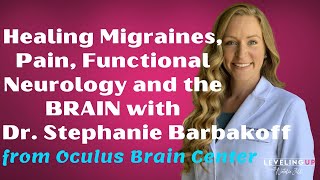
This is a YouTube video titled "213: Healing Migraines, Pain, Functional Neurology and the BRAIN with Dr. Stephanie Barbakoff" created in September 2020. It features a conversational podcast-style interview between Natalie Jill, a fat loss expert and lifestyle coach, and Dr. Stephanie Barbakoff, a board-certified chiropractic neurologist. The discussion covers topics such as functional neurology, chronic pain, migraines, neuroplasticity, and rehabilitation techniques, with Natalie Jill sharing her personal recovery experience and insights from working with Dr. Barbakoff.
Hi, I'm Natalie Jill, fat loss expert turned lifestyle and high performance coach. When odds are stacked against us, how do we shift and create everything from nothing? How do we level up when we aren't feeling it yet or have had a big setback? And how do we adjust quickly when life throws us major curveballs? On this podcast, I do what I do best, taking complicated information that is relevant to us now and breaking it down simply with with actionable steps you can implement to level up your own life. I also regularly interview some of the most inspiring and courageous men and women on the planet who at their worst, learn how to achieve success greater than they ever dreamed possible. Leveling up, Creating Everything from Nothing if you are new here, I encourage you to go back and listen from episode one for the full transformative experience. I had never heard of functional neurology until my own hand and wrist stopped working well after my distal bicep tear repair. When I met Dr. Barbakoff, the guest on today's show, I was blown away by the different approach to chronic pain, brain fog, healing, migraines and even athletic performance that she shared with me. Now it all sounded a little far.
Out there to me until I started.
Working with them directly on my own recovery.
They opened my eyes to a whole.
New approach to treatments and the whole idea of neuroplasticity. You see functional neurologists, they're trained to detect subtle changes in the nervous system and oftentimes they detect conditions early before they become pathological. The dysfunction of neurological systems that can occur at a level that many aren't aware of because they can't always be detected through advanced imaging techniques because there might not be a pathological origin of the damage.
Many of their patients.
When I interview her today, she'll share that end up winning with functional neurology. They had normal brain scans but were wondering why they were still having all these strange symptoms. This is because many higher imaging techniques are not sensitive enough to detect the subtle changes in the brain in people with conditions like migraines, chronic headaches, post concussion syndrome, and many forms of dizziness and even vertigo channels. Join us today as I chat with Dr. Barbakoff about functional neurology and why this form of treatment can help you.
Hi leveling up listeners Today I've got Dr. Stephanie Barbakoff with me and she practices functional neurology. Now I had never heard of functional neurology before I had my year of injuries between my disc rupture and then my torn bicep, she came into my life. Her and her partner. And they have opened my eyes so much about what our brains and our eyes have to do with pain and inflammation and recovery and performance and all the things. I've been working with them for a few months now. I've really enjoyed what I've learned. I've enjoyed what's changed on my body with them. So I wanted to get the story, like, how did they even get into this? And how can this help you as a listener? So thank you so much for being here today.
My pleasure.
Okay, so take us back. Because you started as a chiropractor. That's what you went to school for. Why? Like, how did that even come about? Were you interested in that as a kid, or where did that come from?
Yeah, that's a great question. So I actually had never seen a chiropractor my entire life. I was in my early 20s, living it up in New York, where I'm from. And I was driving home one day, and I got into a pretty bad car accident, which is a common story in chiropractic. That's how people typically find it. Some sort of accident or injury. But I didn't know where to turn. And my parents, who I was looking to for guidance at the time, sent me in a hundred different directions. Go see an orthopedic doctor, Go see a physical therapist or a medical doctor, a neurologist. Just so many different ways to handle what I was feeling. And I just felt off. I didn't have any major chronic pain or anything like that. I just didn't feel like myself, like something was just altered. And I had this just instinct that I knew that chiropractors worked on the spine. And maybe I thought a little bit about neurology and how the brain works. I'm not even really sure what I was thinking at the time, But I just had this instinct. So I called up a chiropractor, and I went in for an evaluation, and they took care of me, adjusted me a couple of times, and I was just right back to myself. So at the time, I was on a med school track, and I didn't. I wasn't really sure of the direction I was going in. I was just kind of blindly walking forward. And so at that time, I pivoted, and I decided to work for this chiropractor for not a ton of money. I was running my dad's corporations at the time. So I stepped back from the family business in order to really dive into chiropractic. And I saw so many amazing things that some people would consider miracles. But I saw them so frequently that I just changed up my whole life. Went to chiropractic instead of med school, and I packed up my car and I drove across the country to California to go to grad school.
So you go to chiropractor school and you know, you want to do something to help people because that's what you went through yourself in your own experience. Where did this functional neurology stuff come into play? Because most chiropractors don't do that. They don't go down that road. How did that happen?
So at the college that I went to, there's hundreds of different clubs and different ways that you can specialize your chiropractic program, practice. You can work with babies, you can work with pregnant mamas, you can work with athletes and work with sports medicine. There's so many different ways to go. And my boyfriend at the time, who's now my partner at Oculus, we were on like a 10 minute break from class and he was walking down the hall and I'm like, hey, where you going? He says, I'm going to funk Neuro club. And at the time I was really into live music back in New York. I would go to live music in New York City three, four, five nights a week. So I was like, funk, cool. Let's see what that has to offer. And I walk into this room of students, older students laying there last year teaching younger students about the brain. And I sat down and I had had pre med type of training in my undergraduate degree, so I knew enough and I sat down in this room and I felt like I didn't know anything. I was totally overwhelmed by the depth of information about the brain and the brainstem and how it works. And that explained for me why chiropractic works. It's all about the brain. And so I felt just so dumb, which was really refreshing for me. I wanted to sink my teeth into this brain based approach.
Okay, so that's interesting that you just said that because when most people think of chiropractors, there's a lot of jokes around chiropractors. There's a lot of. There's a lot of bad chiropractors. Just like there's a lot of good ones, but there's a lot. There's a bad wrap around it in a lot of ways about they just crack your back and they're not doctors or. What is this? I had never heard until I met you about this whole idea of the brain and working with that, how they go together I literally thought chiropractic was just crack your back and go. I didn't understand that. So was that a new connection for you or why is that so not talked about?
Yeah, that's a really good question. So for me, I didn't know it existed either until I was in chiropractic school. I thought that it was just different, a little bit more simple. For me, chiropractic is so beautiful. The beauty of it is you can practice it in so many different ways. But that's also the crux because that can be confusing to the public because you might go in to see a chiropractor that just does a quick adjustment and you walk out the door and you don't get a lot of other information or value. And that helps for people that are pretty healthy, maybe even people that are in chronic pain and have all these conditions. But for me it wasn't reproducible enough. I need to know why I went in and adjusted somebody and it worked sometimes and sometimes it didn't work. And those cases where it didn't work, I needed more, I needed more understanding, more tools, more control over that situation. So I started adding more tools to my tool belt, as we like to say. So that's how I got into functional neurology. Why it's not talked about? Well, that's a good question as well. I think it is. More recently, more athletes are speaking out about it. Just recently, Sidney Crosby, who is a well known athlete in the NHL has just come out and publicly thanked my mentor Dr. Ted Carrick, who basically is the founder of chiropractic neurology or functional neurology. So as the athletes start to speak out about it and all of these pro baseball players and hockey players and football players are taking advantage of what we have to offer, I think the word is definitely spreading. And it's a pretty new science. It's pretty new, yeah.
I had never heard of it. And I consider myself somebody that knows what's up and up, especially when it comes to athletes and things like that. And this was all new to me. Before I get into like what people do in this process and how this actually helps, I'm curious about. What's the difference? First of all, what does functional neurology mean and what's the difference between a medical neurologist and a functional neurologist and a chiro neurologist?
Great question. So medical neurology deals with pathology. So that's like a tumor, a stroke, something that is a life threatening disease process. So their tools include drugs and surgeries and invasive interventions like those. Whereas a functional neurologist would kind of approach, instead of a black and white approach, it's more of a gray area. So my patients might not have something on an MRI or a CT scan that shows pathology. So we have to test the function of different areas of the brain. And so when we find dysfunction, we try to correct that rather than treating a specific disease process or a specific condition.
So do they work back and forth with each other? Like if you. So if you have a patient and you're working and you're like, okay, wait, this is more than I can handle. Like, do you refer then to a medical neurologist and do they refer to you?
Absolutely. There's a lot of back and forth between us, but there's also a linear process where if you have something going on, let's say a stroke in this example, if you have an acute stroke going on, you don't want to come to see me. That's not what I do. And I probably can't help you. So you need to get that medically managed first. Then once you're stable and you need to rehabilitate these areas of the brain that were damaged or dysfunctional, then you would come to see me and we'd work on those processes. That's not something that connectivity issue is not something that medication can fix or a surgery can necessarily fix. We're talking about connectivity. So whereas a medical neurologist might deal with some hardware issues if the brain was a computer, I deal with software and the kind of function and connectivity of the brain.
Okay, got it.
As far as between functional neurology, chiropractic neurology, Functional neurology is an umbrella term and kind of like how functional medicine is an umbrella term. And within that, chiropractic neurology is kind of the board that certifies me, with the credentials that I have, that I'm a board certified chiropractic neurologist. But it's not specific to chiropractors. So any medical doctors, physical therapists, naturopathic doctors, anyone with a medical license can use a functional neurological approach to helping patients.
Okay. So when I learned about Oculus Brain center and Dr. Stephanie Barbakoff and her partner, what she had found me about was athletes. She thought, okay, athlete, let's get to know her. We could probably help with athletic performance. But what I wanted, as soon as I heard neurology was I had just recovered from my bicep tear, had a lot of pain. I still do as I'm even talking with you, it's improved. And I had some issues where my nerve isn't working correctly, so my hand wouldn't completely turn. So that was questioning. Is this a neurology issue now? Is this nerve damage? And I wanted to learn more about retraining my brain. So when we met, it was kind of like this perfect storm of oh, wow, I wanted to help you with this, but wow, we can help everything. So it was a big eye opener for me. So talk about that. What does a functional neurologist or a chiral neurologist, what can they help with for people?
Yeah, so that's a loaded question. That's a big one. Because when you're trying to seek and destroy dysfunction in the body and in the brain, there are so many different ways that that can manifest for people. So sometimes it can help with your brain fog, sometimes it can help with chronic pain in a certain area like yours. Sometimes it can help with headaches or mood or hormonal regulation. So it can really manifest in so many beautiful different way. So I try to keep it concise. And our practice specializes in a few different conditions that we tend to do really well with patients that see a lot of benefit. And that would be with post concussion patients, migraine or headache patients, dizziness is a big one, and then chronic pain. So when we talk about chronic pain, I know a lot of the listeners here interested in the chronic pain sector. And we have to understand that acute pain and chronic pain are very different. Acute pain, there's some sort of damage to tissue, either death or inflammation, or a cut or a tear, something like that. But with chronic pain, that's a brain based issue. That pain sensation is only processed when it gets to the brain. Nerve fibers that conduct pain sensations are firing all over our body all the time. They have to fire or be activated to stay alive and to stay healthy. Nerves need to fire. But our brain develops these control mechanisms that turns down or ignores those nociceptive pain fibers, those pain signals, until they're important. So once your brain determines it's important enough, then you have this type of pain stimulus. But you have to understand we have these signals happening all over our body all the time. So when those areas of the brain stop drowning out those nociceptive signals, you have pain. So what we can do for chronic pain patients is work on those areas of the brain that control or dampen pain in order to get you out of pain.
How do you do that? What types of things help to do that?
So for chronic pain we don't have a chronic pain program. We have Natalie's chronic pain program. Based on your evaluation, we would determine which brain areas are functioning well, which ones aren't. We would do what's called a functional neurological exam. Whereas when you go into a medical neurologist or any other type of doctor that's going to say, check your eye movements or your balance, we don't just say, can you move your eyes and can you balance? We want to know, how well do you do it? Do you do it better or worse in certain environments? Like, do your eyes move better, more efficiently when you're laying down on your back or when you're standing up? These little subtleties, these nuances, help us tailor our care to one person rather than having a kind of blanket program.
It's so precise and cool, too, because when I was going through this initial testing with you, what was so wild to me is I was so focused on my arm, and we were doing all these tests with my eyes and my balance, and I was just literally there for my arm, like, make my hand and my arm stop hurting. And you were able to see things about me just through the testing that I hadn't even told you. Like, they could tell I had adhd. They could tell. It was so wild to me that just from these eye tests and balance tests and games you had me doing, you could pick up all these things in my life. And who makes me up just from that?
Yeah, I think we are a product of our neurology because our brain determines how we interact with the environment, how we perceive ourselves in our body. Right. Our body awareness and our body maps and how we interact with the world. And so if I have some dysfunction in certain areas of my brain, maybe I'd be quick to anger or moody or. Some people come in and they say, oh, I'm just clumsy. I've been clumsy since I was younger. Well, I bet that the areas that control perception of your body and spatial awareness aren't so healthy if you're a clumsy person. So we work on that.
Yeah. Okay. Talk to me a little bit about. Because I went through the chronic pain stuff with you. Talk to me about, like, the migraine and the head stuff, because that's a common thing with people, too.
Yeah, very common. So we approach migraine a little differently than any other headaches because migraine has a few different components that feed into it. So migraine at its root is a neurological issue, and so we're very well equipped to take care of migraine patients. We used to think as the medical community that it was a blood vessel issue or vascular issue. Then we thought it was neurology and vascular. It turns out it's an autonomic issue, which means when I say autonomic, think automatic, like blood flow, heart rate, the control systems for where blood goes and how fast your heart pumps and those types of things. For migraine, we of course address that neurological dysfunction. But migraine is a genetic condition, and so things also play into it, like food intolerances and hormonal imbalances and musculoskeletal issues. So those four kind of prongs of migraine are how we approach handling that. Think of it like a pizza pie. I told you, I'm a New Yorker. And so I'm thinking about pizza all the time. And some people have a larger slice for, say, the musculoskeletal neck dysfunction and neck pain than others. Some people have hormonal imbalance, maybe they've been on birth control their whole life. And so we need to address that issue a little bit more. For headaches, it depends on the mechanism that's causing the headaches. Sometimes it's ice, a lot of the times it's eyes. But more often than not, it's a combination of neck muscles and eyes. And I'll tell you why. What you can do right now is if you put your fingertips on the back of your neck and then you move your eyes back and forth, left and right, you can actually feel your neck muscles.
Oh my gosh, you can.
I'm doing it because your neck muscles are linked embryologically from when you're a tiny little baby just in the womb. These systems are linked together. So every time you go to move your neck, your eyes are trying to work equal and opposite. And so we can use one of these systems to influence the others. So sometimes we use eye movements to correct some neck dysfunction or vice versa.
So when somebody has migraine issues and they take drugs for it, they take pills for it, whether it's over the counter like an Excedrin, or they go get a prescription for it, what's the danger in doing that versus getting to the root and correcting it through your brain and your eyes like this.
So any long term medication is going to have a consequence. Any OTC medication can damage your kidneys or your liver, your organs that are trying to process that stuff out of your body. So you don't want to use that stuff long term. You can absolutely use it as an abortive, but you don't want to use those types of medication as a preventative, as a daily occurrence, because it's just too much for your body to handle long term. And so we like to call it like, it's almost like an upside down triangle, like a pyramid. And so the worst thing that you can do is basically do really, really invasive, tough medications all the time. And then the less invasive stuff that you're going to do as you come down the pyramid all the way at the bottom would be something non invasive, like an ice pack.
Right.
There's really not a lot of consequences, so we have to think about that. But it depends on the patient because some patients combined medications with our care. So it's different for everybody.
When I went to them. This is pretty cool. So like when I. And I still have it on my hand as I'm talking to you right now. So from. Because my bicep was torn so late, because you're supposed to tear it with a repair within two weeks. And mine was repaired three weeks later. I did get have some nerve damage. And because of that, as it's regenerating, my hand always feels like it's burning and on fire. It's a lot of pain. So when I first went in to you all, I was taking a medication called gabapentin and I thought, oh, this is great because I don't feel the pain. My hand wasn't working, but I didn't feel the pain. I felt it, but it didn't bother me. And what you all challenged me with, which was really cool, is if I'm not seeing, feeling it, then how am I going to retrain it to work? Right? And that was super eye opening for me because I went to the instant gratification of I don't want to feel the pain, but long term, to not have pain and have it working right, you almost have to feel it. So instead they started working with me on exercises where I would actually feel it to get it moving again. Did I explain that right?
I don't even. Yep, perfectly, perfectly. The thing with any pain medications or something like gaba, gaba's a little different than a pain medication because you have GABA inside of you in your brain. We use it as an inhibitory neurotransmitter, which just means it's a chemical in your brain that turns down certain other processes like pain. And so what happens when you start taking GABA is it messes with your neurochemistry of your brain. So why would your brain continue to produce as much GABA if you're ingesting it, you wouldn't, because it's not efficient. And so GABA can kind of mess with things in that way.
And don't worry if you all are listening and you're like, but I wouldn't give up. They didn't tell me I had to give it up permanently. What they had me do is back off of it. And instead of taking it daily, like on schedule, to take it as desperate needed, like once a week or whatever it was, so I'd have the relief. But what I find is I don't even want it anymore because I'm seeing the progress without it.
Yeah, that's a great point, too. And that's part of the reason why we work back and forth with medical neurologists, because we don't prescribed medication. And so a medical neurologist would work to get you down off of that dose of gabapentin. But that's a really great point that you bring up, too, because anytime someone's trying to track progress but they can't feel their body, that's a big roadblock for us. Sometimes it's necessary because you're in 10 out of 10 pain, debilitating pain all the time. And so sometimes we get to the point where we can't get anything done unless you get out of pain a little bit. And so, again, it's different for everybody. You're gonna hear me say that a lot because we don't have, like, a cookie cutter approach to this. However, some patients come in with a goal in mind that they don't want to be on any medications, even when it comes to something benign, like using heat or ice for an injury. If it's a chronic injury, I don't like ice because ice changes your perception of a body part. Say I had shoulder pain and I put an ice pack on there. My brain cannot perceive what's going on in my shoulder now, so I've actually done a little bit more harm than good with a chronic injury. Whereas heat can help to relax muscles and calm the area down without changing the brain's perception of that body part.
Do you feel that way about things like cryotherapy and ice baths, or is that completely different?
A little different. I love cryo and I love ice baths for what they do for your antioxidant system. A really great person to follow for this, it's called Environmental hormesis is Dr. Paul Saladino. He's the carnivore guy, and he does a lot of podcasts and information that he puts out about hormesis because those ice baths can kickstart your immune system. That's why for thousands of years, people have been doing cold plunges and cold showers and ice baths in order to help our immune system and blood flow throughout our body.
So I've always loved cryotherapy and I just was introduced to ice baths. But I know your partner told me he didn't want me to do cryotherapy right now while recovering my arm. So help me out with that too. Like, why is that not so great when you're recovering with something like a nerve pain?
Yeah, that's a really good question. So if you have chronic pain, you typically have a very poor representation of where that body part is in space, whether it's your arm or your knee or your ankle. And so typically we try to increase your body awareness of that area while we're decreasing your pain. And so again, goes back to the ice, not really giving your doing your brain any favors by figuring out where that body part is in space. And so that would further your lack of ability to control that body part. So it kind of just works against you.
A few other cool things that I wanted to share with listeners because I learned them from you, mirroring. And I know it's not a new technique, but this is really cool. So my. If you guys can't see us on video right now, most of you, but if you. My supination on my right arm wasn't working. And supination, if you know what that means, is like to be able to turn my hand outwards so I could turn my left hand over, I could use a fork, carry things, my right hand having trouble using a fork, handwriting and turning it. And what I learned from them, this is one of those brain tricks, is if I put a mirror in between my legs, so I'm like looking in the mirror and I use my left hand, so the reflection of my left hand is in the mirror and I start turning my hand out with that supination. And I do it with my right hand on the other side of the mirror in the mirror, I'll see the reflection where it's going to look like my right hand. And that was an example of retraining your brain to regain use. And it's improved a lot since I've been doing that.
Yeah. So in my understanding, I think that therapy started for post stroke rehabilitation. I might be incorrect because, because it has so many applications, but we use it very commonly with stroke rehabilitation, which typically happens on one side of the body. And so sometimes these muscle groups, when you have a stroke, just don't relax. You have really tight muscles and the other ones are really weak. And so we use that therapy in order for your brain to perceive through your eyes, through your visual system that that arm or that body part is not moving in the correct pattern. A lot of the times your brain will do what keeps you safe, but not what makes you the healthiest. And so it'll lock down some muscles, make them really tight in order to protect you from further damage. And so what we need to do as doctors is train your brain to understand it can move in this specific way safely. We basically just have to hold your hand through it and let your brain be comfortable in these new ranges of motions and new positions where it knows it's not threatening. And then you can do it a little bit better each time until you're back to normal.
So good. So good. I've learned so much going through this process with you. I highly recommend people seek out, first of all, are there, can people find a functional neurologist where they live? Is this like a very rare thing? I mean, obviously I highly recommend you all because I work, worked with you, but is this could, I mean, what do people do? They just Google functional neurology. Like how do you, how do they even go about finding somebody reputable?
Yeah, great question. So there's a couple databases. The, the main one is through our credentialing agency, the American Chiropractic Neurology Board. And so you can go to acnb.org and there's a doctor locator on there. So that's the easiest way. I'm also happy to make recommendations. Most major cities have at least one functional neurologist. New York, Seattle, the Bay Area has a bunch, many in Texas, great centers in Florida and Chicago. And so you can either ask me, I'd be happy to recommend someone who's qualified in a specific area. Not all functional neurologists specialize in the same conditions. So whereas our practice sees more concussion and vertigo and migraines, chronic pain, some practices are specialized to see Parkinson's patients or kids with ADHD and autism, depending on their preferred way of practicing the tools that they have and also what they do really well with. Some people just get great success with certain conditions. Some functional neurologists incorporate much more metabolic support and nutrition. Some don't like to practice that way. Some just do brain based therapy. So we're not all practicing the exact same way, but we're all board certified chiropractic Neurologists.
And if someone wants to work directly with you, can you do virtual consultations? Is there any element that you could do virtually if they're not in San Diego near you?
Yeah, absolutely. So we do some telemedicine for a lot of these supportive therapies like nutrition and lifestyle changes that we can make. A lot of the times patients will come out for a boot camp, say they have a concussion or they have migraines and they want to come out and work with us. Or some people just travel to San Diego because it's so amazing here. While they're here, they'll come in for some care.
Tell me about this boot camp because I think people might be interested in that.
Sure. So this is reserved for our most severe patients. We're patients that are a little bit non compliant, I'll say. And they don't want so much work to be done at home. So we do more in the office.
Okay.
So in this case, if you qualify for this structure of care, you'd be seen a few times a day in the office for several days in a row.
Okay.
So we call it a neurological intensive, and it allows us to make the most neurological change in the shortest period of time. This is basically just repetition and intensity that allow us to create neuroplasticity or changes in the brain.
Can you explain? A lot of people don't know what that means. Neuroplasticity. What does that mean?
Sure. So we used to think that the brain was pretty much hardwired and you get what you get and everybody's kind of the same. You're wired the way that you are, like you can't teach an old dog new tricks. But actually we found that you can create these new connections. And so that plastic or malleable quality of the brain is what neuroplasticity is about. We can structurally change the connections in your brain.
So awesome. Is that the whole things that are fired together or wired together? Fired together. Wired together. I've heard little rumblings of this.
Yep. Yeah, you got it.
I love it. Okay. Where can people find you? Where can they find out more about your boot camp? How can they have a consult with you? What do you suggest? Where do they go?
Yeah. So we always offer free 15 minute phone consults. Whether you're in San Diego or elsewhere. I'm happy to help you find the right doctor for you, whether that's a functional neurologist or otherwise. We help a lot of people just figure out what the right next step is. We tend to get all the people that fall through those cracks. And so I'm happy to do a consult on our website@oculusbraincenters.com there's a contact form where you can choose whether you'd like to schedule a phone consultation, sign up as a new patient, things like that. And because we have so many other doctors that refer to our practice, say other chiropractors or naturopathic doctors, we also have a link on our website for other doctors to refer a patient over to us. So if there's any medical practitioners here, physical therapists or trainers, we work with them very heavily as well, especially in the concussion sector that they'll send over a patient that they have been managing for short term boot camp and then we send them back for long term care. So we work well with other practitioners.
Thank you so much for doing this and I'm sure lots of people are going to be sent your way and have more questions. Thank you.
Thank you so much for having me. It's a blast.
Thank you for taking the time out of your day to listen in as my guest today. If you found this episode valuable, please share it with friends and on social media. I don't advertise this show so so I rely on word of mouth and reviews to get it out in the world. The biggest thank you that you can give me is leaving me a review.
And a nice one. I hope.
By the way, this is how others find these episodes. If you do leave me a review, be sure to Message me@supportnataliejillfitness.com with a screenshot of your review because I would love to send you a free digital download of my DSR journal as a thank you. And please don't forget to to connect with me on social media at Natalie Jill Fit on Instagram and Facebook.










