243: Love is the Strongest Medicine with Dr. Steven Eisenberg
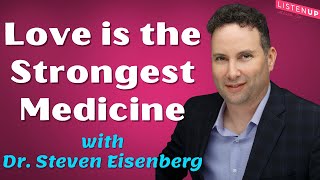
This is a YouTube video titled "243: Love is the Strongest Medicine with Dr. Steven Eisenberg" published in March 2021. It features a conversational podcast episode hosted by Natalie Jill, a fat loss expert and lifestyle coach, interviewing Dr. Steven Eisenberg, a traditional oncologist who integrates conventional cancer treatment with holistic and mind-body approaches. The discussion covers Dr. Eisenberg's personal near-death experience, his philosophy on combining traditional and alternative medicine, the importance of love and connection in healing, and advice for cancer patients and caregivers. The episode also promotes Dr. Eisenberg's book "Love is the Strongest Medicine."
Hi, I'm Natalie Jill, fat loss expert turned lifestyle and high performance coach. Welcome to Listen up the podcast. On this podcast, I do what I do best. Taking complicated information that is relevant to us now and breaking it down simply with actionable steps you can implement to level up your life. I also regularly interview some of the most inspiring and courageous men and women on the planet who at their worst, learned how to achieve success greater than anything they ever, ever dreamed possible. Creating everything from nothing. If you are new here, I encourage you to go back and listen from episode one when this podcast was previously called Leveling up for the Full Transformative Experience. Today I'm here with my friend, Dr. Steven Eisenberg. I've known him for years, in fact. Fun story. His wife is literally like my best friend on the planet. Even though I think I haven't talked to her in like a year. But no, not even kidding. We were born one day apart. Our dads were best friends. I've known her my whole life. We were born on the east coast. We both live in San Diego now. And I literally, I don't think I've seen her in a year. Steven. I don't know what that's about, but I haven't seen her in probably, but. But her husband, I connect with more and he. And he is. I'm so excited to chat with him today because he is a traditional oncologist. For those of you who don't know, that's a cancer doctor. But what I love about Steven is he combines like traditional oncology with a touch of like woo woo. You're like the woo Woo cancer doctor. He's like a singing doctor. He plays guitar. He's all about love and connection and the mind, body can. He's so, it's so cool. He's like literally who I would send if I had a loved one that was dealing with cancer. Like, that's who I would send them to him because he gets all the sides of natural medicine and traditional medicine and the woo woo woo woo woo woo sometimes works, you know.
Damn right it does.
Thanks so much for being receiving because you got a new book out. Love is the Strongest Medicine. And I'm so excited to dive into you, to your story and like how you got into this and more about the book. So thanks for being here today.
Thank you so much for having me. Oh my God. From you being in cribs with Julie to like here we are. And I'm so honored to be here. You're so special to us and me and thank you for having me.
Thanks, Steven. Okay, well, let's. I wanted to do this for a long time with you, so it's about time we finally are getting this, getting this happen in this interview. So take me back. Like, why? Who in the world decides I'm going to grow up and be a cancer doctor? Like, how did that happen?
Well, it all, it all. It's, it's, it's a crazy story. I was, I was dead on the street at age 13. I was hit by a car and I was on my bike and I did five flips in the air and landed on the street. Bashed my head through the windshield and I flipped, flatlined. That first night in the hospital, I had a near death experience. And for whatever reason, I really shouldn't be here right now. But I got a second chance at life. I got a second chance at life. And when I came, when my brain started coming down from the swelling and all that, I couldn't speak. I had expressive aphasia. I couldn't make any words. I'd be like in my mind, oh, talk to Natalie. And it'd be like, I couldn't do it. Wow. And they said, try to get him singing, try to get him saying anything. My mom brought in my boombox and Michael Jackson's Thriller album. It was 1983. The first words I made that were any sense was Billie Jean is like. It was the only thing I could make sense out of it was the. Were the first words out of my mouth. My brain, brain was so messed up. I had a broken brain. And so the power of music started me down this path. And I got the second chance at life. And I didn't think I'll be an oncologist, but I thought, you know what, you have to like, don't have regrets like you, you shouldn't. Like you were dead. Like, you couldn't. So many, so many things have happened in my life that come from these second chances. So I do remember thinking, don't blow it. If you like a girl, tell her, if you see something and you want to go for it, go for it. So I had this idea that I could do something fun and healing together. Like that was my. And I love the mind body connection. So that was the first thing that happened to me that got me on this road. A second chance at life.
When you say the mind body connection, I know what that means and I. You probably have a very different definition of that as an adult, as a oncologist, as a kid at age 13 when this was happening, what did you. How were you connecting that with a mind body connection? What did that mean then?
What it meant back then was I was in a wheelchair. I had a cast up to my. My. My. My whole leg, my whole face was torn apart. I had stitches everywhere. I looked like Young Frankenstein. I was so. I was just like, you know, I'm ugly, I'm skinny. I have a big fro. I have buck teeth, and now my whole face is torn apart. I was just like, very, very much. A very large part of me was like, was dying inside after this accident. And it was. It was love. It was the doctors, and it was love, family and friends that got me out of it. And the mind body connection came from picking up on my parents bookshelf. Wayne Dyer's book, your Erroneous Zones. Wayne Dyer was on my parents bookshelf. And I started reading about it, and I'm like, look, you know. Yeah, your face is messed up. Yeah, you're skinny. Yeah. You've got buck teeth, braces. Girls think girls aren't into you. But I started reading that my spirit, right? My spirit was alive and well, and I would heal and I would sort of grow into my looks over the years and. But it gave me hope. It gave me hope that I am not my body, I'm not my scars, I'm not my, you know, my skinniness. I was so skinny, everyone made fun of me. And so I was bullied. I was. I was broken. But my spirit, slowly and surely, from reading and like, and from Wayne, good old Wayne Dyer. And that's crazy because my book's coming out on Hay House, which was like his people. And so Wayne really was the first person, along with my loved ones, that started saving my soul. And in many ways, from. From realizing I'm a spirit. I'm a. I'm a soul who's very much alive and has a lot of healing to do. And that's how the healing really started on the inside. I love Face was messed up. Yeah.
Yeah. And it's interesting because at that age, 13, that's such a. Such a weird age for kids. My daughter's 13. As we're recording this. And I know it's just such a, like, hormonal time and they're trying to figure out themselves. It's the awkward stage, so I'm sure coupled with all that, it was just like this absolute, I can only imagine, catastrophe of having the teenage hormones and already issues with that.
Yeah, it was huge. It was crazy. And I just remember my dad taking me aside and saying, look, man, you. You stopped breathing that first night in the icu. And I do remember going somewhere. That light, I do remember a very bright light. And then all of a sudden there was nurses on either side of me looking. I was looking up at them and they said, you're going to be okay now. You're going to be okay now. And it was a long road. It was a long road, but it was. That's when I first realized there's more than just your physicality. There's more than just this body. There's your spirit, there's your heart. There's love around you, even if you can't always see it.
Did your personality change that day? I know your perspective changed, but do you think your personality changed with that?
I was always the class clown and I think, yeah. I mean, I always say I wasn't as good in school. I made that story up. I made up a lot of stories about the accident. I changed from it. I had, you know, my brain was hurt, I couldn't speak as well. And it took a lot for me to give up that story too. Right. That, this. But it did change. It did change in that I didn't want to have regrets. That was the, that just kept coming to me like, there's a big part of you that really shouldn't be here or you got lucky, you know?
Yeah. It's amazing how those near death experiences, just like they hold so much power over us and change us. And I've interviewed a number of people that. That was their transformation moment. That was, that was the pivot. That was the thing that happened that changed everything for them. So when. Take me forward more because that's, you know, your early teens, that's happening. When was the decision, I'm going to become a doctor then more specifically a cancer doctor. How did that happen?
So I come from, I, you know, I come from a long line of doctors. My dad, his two brothers. And I was like, well, I love entertainment, I love making people laugh. I love writing songs. I love. But I also love the mind body connection. I love the brain. I love neuroscience. I love. So I decided, you know what? I'm going to try and do this. I'm going to try to combine things. I'm going to try to combine mind, body, healing and spirit all together. And that was the decision to like, okay, I'm going to do this, but I got to do it this way. If I don't do it this way, then I failed. So I went in with that idea that I'm going to try to bring love and light to whatever kind of medicine I ended up doing and creativity.
So what's interesting, Steven, why did you choose that? I'm just picturing you, like, plugging away, going to medical school with this mindset, when a lot of people with that belief set or personality, they would become a naturopath or they would become something that's alternative medicine. So did you consider that at the time before traditional?
I never, I never went down that path. I just was following my. I was following my father's lead and my cousin's lead.
Got it.
And I wanted to keep it in the family. It was a bonding moment for us. It was a very special kind of moment for the Eisenberg side of the family that we all came together in this beautiful sharing of this school. Pcom Shout out PCOM in Philly. And so it was, it was never like. But I always said I worked in a medic. I worked in a health food store during medical school.
Yeah, you were the hippie in the health food store. I can only.
I was the hippie. I was in. I was wearing tied eyes through medical school. Sure. You are Grateful Dead. And. And I was. And everyone else was taking notos and I was taking ginseng.
You were taking psychedelics. I'm just kidding. I don't know. I'm just assuming. I don't know. I'm kidding. Kind of kidding. I just picture you. You've always been.
Well, psychedelics are very, very useful for end of life, as we know. Well, that's another topic. But people who are dying of cancer go. They take magic mushrooms in a very controlled. In a very controlled setting, and they feel that they're one with everything and they're. They. They're not afraid to die anymore. It's another whole topic that, that is amazing. And I'm sure you've had on, you know, those people.
Yes. And I've experienced magic mushrooms in my life, so I understand what that means. And I think there's a huge place for that in medicine. So I love, I love that, I love that that's been embraced lately, especially end of life.
So important. So I was the alternative medicine guy in the traditional medicine setting. And osteopathic medicine is a little more holistic, but it's very traditional. It's the same training, but we're trained from day one to look at the whole human being. And it was just beautiful to me, to, you know, that we were all. We were always taught, who is the person having the disease? Who are They a mother? Are they, are they struggling financially? What's their psychology? So the whole human being who got diabetes, not just the diabetes in room one, it's Mrs. Jones who has five kids, who's struggling, who's just lost her husband, it's that kind of thing. And that's what led me down the road of oncology. Because I thought where could I make the difference? Who's really scared? Who needs someone who can listen? Medicine, I think is about listening. And I think medicine at the time and still in many ways is broken. The system of traditional medicine is broken. I think we're getting better. I think a lot of the kids coming through nowadays are more open minded and more functional medicine minded.
Why do you think that is that? I see it's so many doctors and I don't want to say all because it's definitely not all, but there's a lot of doctors that truly look at patients as statistics and it almost comes off as cold hearted. Like, this is your diagnosis, this is the facts, this is the black and white and there is no love or compassion. Why do you think that is?
You know, we're trained to build this wall, right? We're trying. You go in the room, there's a wall between you and the patient, so you don't take home the stress. So you can just be objective and do your medicine. And you know, and, and I say f that wall, break down the wall. Because when you build that wall, that's what leads to burnout. In my humble opinion. There's so much burnout in medicine, especially after COVID 19 and it's still not over, but we're getting a little better. But there's so much burnout in medicine. It's because that wall slowly erodes who you are and why you went into medicine in the first place. Why do we go into medicine? Anybody? I want to help people. It's the canned answer, but it's so true. We have these great people, these beautiful souls with these hearts wide open and then we bust it and bang it out of them until they're burned out zombies walking around. And I talk about this in my burnout lecture. Hello, Mrs. Johnson, how are you today? Oh, I'm sorry, Mr. Johnson. I don't look at you, I just look at the screen. I don't even know who you are in front of me. We're just doing electronic medical records and we just. So it's to me, once you break down the wall and get to know that human being on the soul level, that's what really heals you as a doctor? Because it brings you back to your soul, why you're doing this in the first place. It's not to make money. It's not to. It's nothing else except two human beings in a room. Connecting. Connecting.
I love this approach. And do you? I mean, I already know the answer to this. Actually, as I'm going to ask this question, I was going to say, do you think this makes a difference in their healing and in their outcome having that type of relationship?
I do. And I've seen it. I've seen it. I've seen it because even, even if I can't cure you, I can help you heal your soul. Because I'm just your quarterback, right? Like you're the team owner. I always say when you come in, you're the team owner. I'm your quarterback, I'm your Tom Brady. And why we are winning the super bowl is you healing and whatever that means to you. It could be healing of your breast cancer and it never comes back in 10, 20, 30 years. But if you've got stage four cancer, it could be helping you heal on so many other levels. I talked to my sister, who I hadn't talked to for 20 years. I got complete with my children, who we had a falling out in 93 because of some stupid money thing. It's like healing, right? Real healing takes that soul connection. And when you, when you can heal those things that aren't working in your life, it does make a difference. Look at, look at Brittany. Julie's Julie's stepsister. Who?
Julie's his wife. He's talking about.
I'm talking about my wife. Her sister had leukemia and she got, she had this such as powerful treatment and it blew out her bone marrow and she had no blood counts for three years. And when she finally went through this process and realized got in her soul level, I don't have to die to have my mom and dad love me as much as my brother who died. Her bone marrow recovered like literally the next week it started recovering. So tell me, was that just coincidence after two years of like, of zero blood counts and now her bone marrow recovered. She didn't have to die to feel real love.
So what do you think, Stephen, about some of the like, like Joe Dispenza or like some of the talk around emotion and cancer? Do you think there is a true connection to that? Why? I know that's not in all cases, but do you think that some people do get it because of unhealed emotions?
Well, Louise Hay talks about this too. You know, she. That she was like one of the forefront. Like repressed anger can lead to issues. And I do, I do believe there's some connection because there's so much about it that we don't know. And the field of psychoneuroimmunology is exploding. Right? Our thoughts and feelings and emotions, how it affects our nervous system, our endocrine system, our immune system. We have to be careful, though, because I always do say. The first thing I say when I walk into a room is there's no room for the blame game in oncology because I don't feel that's very empowering either, to say for people to feel like it was their fault. So I don't want anyone out there who's listening to say, if only I hadn't been so angry, I wouldn't have gotten the cancer. That's not what I'm saying. What I'm saying is, here we are. Let's work on those things. Because I do feel it'll help heal you on many different levels and could make the chemo work better. It could make things better in terms of side effects. But what I think we have to be super cautious about is saying that those emotions caused it. Could it have been contributing to a weakened immune system because of cortisol levels and stress? Stress makes everything worse.
Yeah.
Fibromyalgia, chronic fatigue, everything. Can it weaken your immune system to one day, maybe one cell gain that mutation? That was a little, you know, and I do think there is something there. It's lifestyle meets genetics. It's both. It's not one or the other. It's not. I was just always destined to get this cancer and that's it. No, there was something in the lifestyle, I believe that also that helped that gene turn on. That's the epigenetics that. That Joe talks about that all the. That all the, you know, the wonderful people in the field of epigenetics that you're maybe helping your body not. Right. You can turn off those genes so you're not having those expressed and you're not getting the cancer that's been in your family because of the lifestyle changes that you talk about so much and you've been a maven of. For over 20 years. And now you're changing people, not just physically, but the mindset and the way you're. And it is. It's a mindset in cancer treatment, too. You have to say, I'm going to be unstoppable. I'm going to get through this. I can do it, but you can't. I want anyone blaming themselves that I caused my cancer because I'm an angry person. You have to let that go. And that's when the true healing can begin.
So good.
It's a letting go.
What about people that are told they're stage four, stage three? It's like, it feels like the end. And their doctors are saying, hey, you have two months to live. You have three months to live. What do you think of that approach and how do you talk with patients when you're seeing those statistics like that?
Well, first of all, every patient's different. You have to know you're walking into a room and that patient has 65 years of history, and you're walking in almost blind when you first meet someone. So I first tell them, you're not a statistic. You are Mrs. Johnson, and you're going to deal with this the way you deal with it, and you are not a statistic. Yes, there are some patients want to know. They go, I want the statistics. I was reading this. Here's the printouts. What do you think of these printouts? Go. Some people come in and go, hey, I just want a song. You know, they may have seen something about a song. I write songs for cancer patients to help them battle through. That's how I got into it. But. And then some patients, they just need love. They want. I just tell them, you're not a statistic. We're going to take this treatment by treatment, scan to scan. And look, there are people who beat the bell curve, right? There's the bell curve. You have the people in the middle, but then there's also people out here, all the way out here, that beat the statistics. And you're not a statistic. You listening right now. You're not a statistic. You are a human being who's dealing with this crossroads in your life. And with all of the things out there, you can beat the statistics. So that's the first thing I tell them.
Yeah. So you have a unique take on. I'd love you to speak into this, because I feel like it's very black and white in cancer treatment where there's like these two camps. People will decide between I'm going to have chemo, radiation, or I'm going to go alternative. And you really do a unique combination of both. Can you speak into that a little bit?
I beg people, I'm begging you. Listening your listeners right now. It's not one or the other. It's the best of the best. In my humble Opinion. I'm begging you to listen to this. It's the best of the best. It's not that traditional oncology is evil and alternative is good. It's not that alternative is quacks and traditional is. No, forget all of that. It's what works for you and we have to discover it. What are you open to be open to? The best of the west and the best of the East. It's the combination of the two. Take the best of nature and science and combine them. I was talking to this beautiful soul right before we got on, and he's dealing with stage four adrenal cortical cancer. This beautiful kid. And he's young, he's got a family and kids, and he's doing the best of the best. He's on this new biologic pill that targets. So smart. It's a smart pill. It targets the cell, the molecular alterations that tell cancer to grow. But he's also on this amazing traditional Chinese medicine herbal formula from a traditional Chinese medicine doctor. Both. And it's working. Nothing else worked, but he's doing both. So it's the best of the best. Nature, science, together. Nothing is evil.
Stephen. I.
Find it for yourself.
I have a theory about some of the alternative medicine, and I'm curious your thoughts here. My theory is it's not sometimes the natural alternative medicine, but what I do find is sometimes a lot of the traditional doctors are too into statistics and negative. They don't believe in the possibility. And then what happens is the alternative medicine doctor believes in the possibility. And because of that, the patient starts believing in the possibility. So I feel like there's a huge, huge mind body connection, alternative medicine, and it's missing from a lot of traditional medicine. I'm curious, curious your thoughts on that?
Yeah, it's so true. It's. It's missing big time. It's coming back with functional medicine. It's coming back into fashion with the functional medicine movement. It used to be called integrative medicine. Now it's functional. But it. Whatever you call it, and functional medicine is great. And, and Dr. Mark Hyman, he's a huge proponent. He's like the leader in that field. So what I'm saying is that it is coming back into fashion, but we can't forget that the mind is such a big part of healing. And so if you're out there and you're not getting that mind, body and that gut mind connection and the brain gut connection and all the things that functional medicine talks about, they're out there. There are doctors who are traditionally trained, who've done some additional training into that mind, body connection. You just have to dig a little deeper and find them. Reach out to Natalie and I and we can connect you with those people. They are out there. You just have to find them and then create a plan with them.
So good. So talk to me about music with what you do, because just a little funny side note, a story. He has no idea I'm going to say this, but I'll never forget. Steve had just finished medical school, and you had all the bills, as most medical students has. He's, like, fully in debt. His wife is, like, working our butt off the whole time he's in school and he finishes medical school, and he's like, you know, I think I actually want to be in a band. I'll never forget that. And Julie's like, how about.
No. How about get off your butt and get to the office?
Do you remember that?
Yes. Oh, my God. I still want to be in a band. I actually started one with this bone marrow transplant doctor.
That's cool.
We're called Blast crisis. It means acute leukemia. But anyway, what we're doing is the music came in because it came back to that creativity, that. That wanting to bring something to cancer patients that was missing, which to me was. It was just bringing them a lot of love and a lot of listening. And to me, it was breaking down that barrier and getting into their heart. So for me, songwriting, I was always a songwriter. So I started writing songs simply because someone did it for me when I was burned out after my. When I wanted to start that band, it was because I was so burned out in my early practice because I didn't know how to start a practice. I didn't know how to compete for patients. I didn't know how to beat everyone and be the number one oncologist in north County San Diego. And the stress of. Again, it was the stress. It brought me back to that accident that I was. Part of me was dying inside. I had to become a business person. And I lost that. I lost that love that I. That little spark of I can bring this to cancer patients. And so I entered a story writing contest from my favorite artist. His name's Peter Himmelman. And it was write a story of how Peter's music has impacted you. So I wrote a story about listening to his songs in Philly. And it made me feel. Feel a lot of love, and I wanted to help my patients. Basically. The song called Mission of my Soul. So I called the story Mission of My Medicine. I won the contest. What was the prize? Peter writes a song for you, and we'll connect it on this episode. I'll send you the song. And it's just a song about everything I wrote and who and that I was this oncologist who wanted to bring love to people, and then it made me feel better. All the symptoms started going away, and I started to feel better and rediscover who I was and what I wanted to do, and I remembered who I was. So the whole reason I write the songs for the cancer patients is to nudge them back to who they are. You're not a cancer patient. You're someone who's dealing with it. You are a human being dealing with cancer. The songs are about what you love, what lights you up, what moves, touches, and inspires you. You know everything.
Yes, I love, love, love that approach. How has 2020 now. Now we're 2021. How did that affect treatments for people? Because I don't know what to believe anymore, sometimes online or not, but lots of stories around, gosh, with COVID people aren't getting their treatments now. Is that. Is there truth to that? And would end because with a lot of what you're saying, I would think my. My willingness would be because people are at home and connecting with their families more. Maybe there was a little bit more healing. I don't know. I'm just curious how 2020 impacted this.
It was. It was crazy. It still is in many ways. It's half and half right now. Half telemedicine, half in person. But the telemedicine was interesting because you could bond with people in different ways. My whole thing's connection. So I'd be like, oh, my God, Natalie, I love that behind you. I love your magazines behind you. Tell me about that. And I would see their little art, and I'd see their cat. They'd be holding their cat, and it would be just another way to connect with people and see their homes. But there was a lot of delays in people getting diagnosed, and now they're all coming in with higher stages. So we're seeing more stage three and stage four. Stage three is still curable, thank God. Stage four is typically considered incurable cancer, and we are seeing more of that because there was delays.
See, that's. That's so heartbreaking right there.
It's heartbreaking. But we're getting people in now, and we're getting treat them treated. And remember, even stage four, there's hope. You know, you. Miracles do exist, and I'm never Ever going to take faith away from anybody. My favorite cardiologist at PCOM said, never look a patient in the eye and take away their faith. Yes, be honest. You can be honest and you can be loving, but you never take a patient's faith away.
There's so many that do that, Dr. Kenny. That's what's so heartbreaking, is that there's so many doctors that do. And I deal with it daily with. With my clients, with people coming to me with fat loss. Their doctors told them this and told them no chance or told them, like, doomsday stuff. And it's. It's just. It's an irk that I have in a lot of. Not all, but a lot of doctors in medicine. I don't. And that's why I was asking where that comes from.
This is from. This is what love is. The strongest medicine is about. It's taking a stand and loving yourself. You got to love yourself first, and that's when they come to you. People are looking for love. They're looking for a way to boost themselves up. And to find a team, you have to find the team that's going to empower you. And you're connected to so many powerful people that it's about finding a team that you connect with. And if you're getting that negative message, get rid of them. Get a second opinion. You're always entitled to a second opinion, no matter who you are, where you are. And with telemedicine, you can do it now. You can get a second opinion with someone across the country.
If you have to tell me what you want somebody listening that has cancer right now. They've just been diagnosed. They're dealing with it, or maybe they've been dealing with. What do you want them to know from you?
I want you to know that you're not alone. There's a community out there that you can tap into. You can count on me to listen to you, and you can find doctors that will listen and hear you at the mind, body, soul level. And that you're not a statistic. You are a unique human being who's just on this path. For whatever reason, you're on this path. Don't blame yourself. But start connecting with who you are. Start remembering you at your core. You're not defined by your cancer. You are not your cancer. You are just on this detour. You are going to get through it. We are going to help you get through it. You have to first connect with yourself and then connect with a team of loving people around you. And that includes your doctors. Be with loving doctors. Find them. They're out there. I will help you.
What do you want? The parents or the spouses or the family members that are listening, that are struggling with this, with a family member that's feeling depressed or defeated or giving up. What do you want them to know?
Caregiving caregivers are. They feel the stress many times more than the patient. I've had patients come in and go, I'm just worried about her. I'm fine. But she's a mess because she's taking care of me. So what I would say is, you must take care of yourself. To take care of them, you have to take care of yourself. You have to follow Natalie Jill's program and get sleep and exercise so you can have the energy to take care of them. And so what does that mean? It means loving yourself so you can love them. And. And just listening. Right? The first thing cancer patients often tell me, they hate when people say, just think positive, because they don't want to think positive. When 20 people a day going, all you have to do is think positive. It irks them. They want people to say, it's okay to have a shitty day. Embrace the crappiness of today. Embrace it and say, okay, I am fully experiencing the shit that this day is. I don't like getting this chemo. I don't like it. I hate it. But I'm going to slowly start to embrace it. And then something else opens up. Now you've made peace with it, and now that little light at the end of the tunnel opens up, and all of a sudden you're more connected, you're more whole. You're more complete with your family. So let people have the day they're having. Don't tell them. Just think positive.
Yeah.
Many times they don't want to.
Yeah.
Let them be who they are that day. And then something will open up. Just get them right. Right, Natalie, Just get them where they are. I get it. You're having a shitty day. There's. I understand. I hear you.
So you're not saying so. It's not validating it. It's not saying. You're right. Let's just give up. You're just saying, let them get it out of them. Let them.
Let them express who they are. Let them vent. Let them be where they are. Let them fully embrace that. Today was hard.
Yeah, because I'm imagining it's very hard. I can't even imagine.
It's super hard. It's super hard. It's the hardest thing Asking someone to do is to hear, we're going to poison you to shrink cancer cells. And it's really hard. And sometimes I don't like giving chemo to patients, but sometimes it's really necessary if you have stage three breast cancer and you can be cured. Like, they found it, they took it out, but it's in the lymph nodes under the arm. Stage three. I know there's so many people listening. They're like, chemo bad. But I want you to hear this. I want you to hear this. You can get through it in a loving, compassionate, natural way. You can still take herbs, you can still do all your nutrition, you can still meditate, do yoga, do all the alternatives, and do chemo and have a higher percentage of cure. Those are patients who it's like, yeah, positive lymph nodes, breast cancer. That makes a huge difference. So it doesn't come back in five, 10, 15 years later. Those are the patients that I get so sad, the ones who said, no, chemo's evil. Screw that, I'm never gonna do it. But then it comes back like, we could have gotten you through it with love. It seems like there's mixed messages. It's like you can find an oncologist who can work with you so you can do both.
Yeah. And it sounds like you're pretty darn conservative, too. Like you're doing it as a last resort when you know that it's going to make a huge difference. You're not doing it as a first choice. You're not doing it as a guess. It's like, you know it's going to.
Make a difference when chemo can majorly affect your cure rate. I'm going to, I'm going to talk to you like you're my sister, you're my aunt. I said, look, this is how I would talk to my little sister. And I've, I've had women come in, like 40 years old, breast cancer. Like, I, you know, I just thought I would never want to do chemo. We sit down, I sit down next to them and I really have them get it. Like, this is going to have. You have a much higher cure rate than if we didn't do it. And so when they're cancer free, 10 years later, they're like, I got through it. And it was because you really treated me like a family member. You have to treat your patients. For the doctors listening, I don't have to tell you, but I think what works is, is talk to people like they're your family member and Natalie's like family to me. So talk to patients like they're your sister, your mom, so they get that you're coming from a place of heart, not a place of coldness.
Yes.
So love.
So Steve has a new book, Stephen has a new book out. Love is the Strongest Medicine. It's connection, creativity, and compassion. Who is this book for, Steven?
It's. It's for anyone who's struggling with a chronic illness, especially cancer, and their caregivers and their providers. It's anyone in the health profession who's dealing with sick people. Because we need to break down the wall. And when you can break down the wall, true healing can come. And so it's really about connecting, busting through the walls that divide us as doctor and patient. Because I say every one of us is a patient. Every single one of us has been a patient. When you're born, you're a patient. When you die, you're a patient. In between, you've been a patient lots of times. Even those cancer researchers out there listening, you've been a patient. We're all patients. So start loving each other that way. And then I do say that it affects healing on a grand scale, starting at the soul level, moving out to all the different cells of the body. Because I just read something yesterday that your cells, who I think it was Mark Hyman, said your cells hear every thought that you have.
Wow, that's scary.
Your cells hear every thought that you have. I love that. I love that. I just saw that shout out to you for writing that, Mark. But it was just. It made me think if we could, if we could, if we could start with medical students and start spreading the love outward. Yeah, it could cause a wave of, you know, a tidal wave of love in medicine. And I think, I think, I think this is the start.
That's really good. Everyone go and pre order this book. The time of this airing it, we're. It'll be out very soon. So pre order it pre ordered on Amazon. You can also go to. It's Dr. Steve.com. is that correct or what?
Stephen.
Dr. Stephen doctorsteven.com Go there or go to Amazon. But pre order the book, help spread his message. I love your whole approach. This is so good. So good. And I'm, I've known him literally like almost my whole life. So this is. He's, he's fantastic. Look him up if you're dealing with this, if you want to know more. But pre order his book. And you know, Steven, I changed the name of my podcast recently. It used to be called leveling up. I changed it to listen up. So I changed the listen up because I want people to listen up on some things. If you had just kind of like a quick last sentence to say and you're leaving your mark on listen up, what do you want to what do you want people to know?
Boy, listen to your heart. Listen to your heart. It will never lie to you. Listen to your heart. It'll never lie to you.
So good. Thank you so much for doing this today and being here. We're going to link up all the information on how to pre order his book, where to find him and check him out. He is very entertaining in addition to his vast knowledge of medicine. Thank you so much for being here today. Steven.
Thanks Natalie. You're the best.
Thank you. Thank you for taking the time out of your day to listen in as my guest today. If you found this episode valuable, please share it with friends and on social media. I don't advertise this show so I rely on word of mouth and reviews to get it out in the world. The biggest thank you that you can give me is leaving me a review and a nice one, I hope. By the way, this is how others find these episodes. If you do leave me a review, be sure to message me@supportataliejo fitness.com with a screenshot of your review because I would love to send you a free digital download of my DSR journal as a thank you. And please don't forget to connect with me on social media at Natalie Jill Fit on Instagram and Facebook.










