Bone Broth: All About Diet and Benefits | Natalie Jill Fitness LIVE
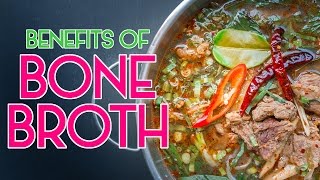
This is a YouTube video titled "Bone Broth: All About Diet and Benefits | Natalie Jill Fitness LIVE" recorded in April 2017 featuring a live discussion between Natalie Jill, a licensed master sports nutritionist and functional fitness trainer, and Chef Lance, the Flavor Chef, who owns a bone broth company. They discuss the health benefits of bone broth, its preparation, nutritional value, and options for different diets including vegan alternatives. The conversation also covers practical tips for making and consuming bone broth, emphasizing its role in gut health, joint support, and overall wellness.
Hi, guys. We are talking bone broth today. All about bone broth. The benefits to our skin, to our gut, health to fat loss, everything. I know it's a trendy topic lately, but I want to get deep into it today talking about all the benefits. And I've got my friend Chef Lance here today, who owns a fabulous bone broth company, but he's also a chef, and I wanted him to share why he got into bone broth and why you should consider adding it to your diet, stat. And for those of you that don't know me or that are new to my platforms, I'm Natalie Jill. I'm a licensed master sports nutritionist and a functional fitness trainer. And what I do is I simplify fat loss and exercise for people like you. And I love to bring on guests that have products or programs or books that fit right into my plans that I know you would find enjoyable. And that's why I've got Chef Lance here today. So thanks for being here.
I'm so glad to be here. Thank you.
And do you mind sharing with my audience a little bit about why you even got into bone broth? Where did this even come from? Because I know that this was not something that it's so trendy now, but it wasn't trendy when you got into it?
Yeah, it wasn't trendy for a long time. Matter of fact, it kind of came out of the history, out of our diets around the beginning of processed food, when processed food came in, and kind of that stuff. So in 2006, I was going through some transformation, and I met a gentleman named Paul Check here in Vista, and he introduced me to the West, A Price foundation, and this book, Nourishing traditions, and said, chef, if you're gonna cook for my people, you're gonna cook from this book, and you're gonna. You're gonna do real food for my folks, and you're gonna eat real healthy food.
Had you heard of bone broth at the time? Do you know what this was?
Well, you know, I've been a classically trained chef. I've been a chef for 29 years. So I started way back when, and I was classically trained in stock stock, making sauces, all of which is awesome for broth. So a little difference for your audience. Stock is more of a. Always get this question. Stock is always something that is made for cooking, and broth is made for sipping and for drinking. So usually adds a little more meat, a little more flavor. With bone broth in particular, it's cooked a Certain amount of time. So stocks can be cooked short. But our bone broth, so cooked 18 hours for chicken, 24 hours for beef, and that's to extract all the beauty and the essence of the bones and vegetables.
Okay. Before that, because I know you guys are probably thinking, well, I don't have 18 hours to cook bone broth. And what is this? I want to get into some of the benefits. He's 95 and he looks just. I'm just kidding, he's not 95. But let's talk about the benefits because there's so many of them. And I can tell you I feel so much different since I started adding bone broth to my diet. So share some of those.
Sure, absolutely. Well, you know, like I said, a little bit back in 2008, we took out bonebroth.com and that's kind of how we got started on that things was the benefits for GI health. So the mission statement@bone broth.com is to heal the planet one GI tract at a time. And as a sports nutritionist, you know that the GI tract is the center for the immune system. So I created this trademark right here. Broth is good for you, promotes a healthier you 2008 because it synergistically. Bone broth synergistically helps all of the things you're doing. It's not one single protocol that's going to. Bone broth is not a panacea. It's not a fix all. It's not a simple fix. It's part of proper hydration, regular exercise, mental emotional health, those type of things. So it fits right into that protocol. But the main thing, as Luis Hay and Heather Dane have said in their book, the big deal is collagen. And the thing about collagen, we're going to talk a little bit about bone broth. And the B in bone stands for bioavailability. And bioavailability is what you get from food.
Yes, food.
Food. Our bodies are molecular. Paul Chek sat there with a cup and said, this is hitting me at a molecular level because our body understands what food is, what energy comes from the food, the energy exchange. And so there's three types of collagen. And what happens in bone broth simmering right here in the pot is simply you get all three types because you have all the different bones, ligaments, cartilage and the feet, all those different things. We're going to make it a little later. But the point being is you have type 1, type 2 and type 3, all bioavailable in a cup of bone broth, whether it be beef or chicken or another kind of animal or duck or whatever you're making. But typically beef and chicken for the main two. And so that's the main thing. And then the collagen is the building block of your body.
So I know a lot of people in the cosmetic industry. They'll inject collagen and stuff. This is your eating it, which is building things from the inside out. So it's helping with your joints, it's helping with your skin elasticity, it's helping with your gut health. So many things when you actually are eating it.
Correct, correct. And again, the other thing you get is a meal.
Yeah, I'm drinking it right now, by the way.
You get this satiating, delicious feeling. You get this warm, delicious cup of bone broth that you have in your hand. You have sort of an experience. Yeah.
And people are calling this liquid gold lately. That's like liquid gold.
And this is the liquid gold right here. The stuff that's actually been simmered for 18 hours. And you drink it. This is just a tiny bit of salt in there. And it's got beautiful mouthfeel. Delicious. Our broth has 10 grams of protein per cup on the chicken, 11 to 12 on the beef. So you got like a protein supplement as well. So some of the other things too, like you were saying about skin, helps with the collagen, helps with the skin health. Hair, nails are helpful. So if you're that kind of thing. But also with the vegetables that we usually get electrolytes. So we have a really. For your athletic, you know, I mean, you're fit fitness guru at this point. And I think the. For your fitness fans out there, and everyone's a fitness fan of yours, it's a great replenisher. There was a recent article written by Ben Greenfield in the Weston A. Price Journal, and one of his go to Ancient Rent. You know, ancient was about ancient wisdom was the, the fact that you had bone broth as. After your. Your fitness exercise or even before.
Same way someone would add like BCAAs. They're doing it with bone broth though, right?
Exactly, exactly. It's sort of. And then you've got the other, other benefits. Amino acids. So there's lots of amino acids and minerals. And again, the main thing about all that is it's a complex.
Okay.
It's not an isolated mineral. It's not an isolated amino acid. And the. They call them glucosamino glycans, which are the, the. The glycogens or something like that. They're called gags, in short. But those are the glucosamine, hyaluronic acid. Those are the things that you find for joint health. So you're going to get definite benefit to your joints, fingers, arthritis. They have a lot of recovery with arthritis. So those are some of the big benefits.
And that's a big reason I turned to bone broth was for joint pain, for hip back, all of that. And it definitely makes a difference. Okay, so talk about how somebody would make it. And then I personally, I'm not making anything in my kitchen that involves chicken feet. I just can't. I want to pretend that my bone broth grows on trees. So I want to. But I want to tell for you guys listening, because some of you do want to make it. How do we make it? And if we don't want to make it, where do we get it?
Exactly. Well, you know, I'm going to just pour this out here. This is just some bones I brought today from our mixture of bones, but we can go through them. But you can see here, there's going to be feet. This is a chicken broth as well, not a beef broth. One of the differences, Natalie, with beef broth is you roast the bones ahead of time. And we do use a mix of bones. So in here, we've got feet, we've got carcass, what they call frames. The top part, which again, is really nice because this is this beautiful piece of collagen right there, or, you know, it's a cartilage connective tissue, and that will melt when we cook the bone broth. So literally, what we have is we have a cacophony of different things, and then we're going to finish with this. So over here, a couple of things we're going to use. We're going to use carrots, celery, onions, and ginger. The main thing, again, for your audience, the O in bone broth is for organic. So whenever you start making bone broth, you're going to simmer for a long time. You're going to want to make sure you use organic vegetables, organic chickens, preferably verified non GMO like ours, which is a really important characteristic right now. And then really good water. This is Palomar Mountain spring water. So we use spring water@bonebroth.com. it's really important to us. You know, my mission is to heal the planet one GI tract at a time. And we're talking about a healing protocol. This simmers for 18 hours. And again, there's you know, that's one of the ingredients you want to look for. Ours is, again, we're branding with them and we love that they're right up here in about an hour from here in San Diego. So what we're going to do, we got the bones. So the first thing we do is we're going to cover the bones with water. This is just a gallon. We don't have 18 hours to simmer it, but we want to cover the bones once they've been rinsed. And we're going to cover them with water. That was a gallon. That's about three to four pounds of bone broth. Three to four pounds of bones. We're going to put a little pin. We're going to put a little splash of apple cider vinegar in there. About 2 ounces maybe for this much bone broth. And what we would do, again, this is just going to be the process, speed it up. This would come to a simmer and we would skim the scum and what they call. That's a skimming process. And then we would add chopped vegetables. So over here we're just going to chop some carrots, celery, onions.
So a little prep with that, because you don't need to really. You're just using them for the stock so you don't have to shred the.
Carrots or anything is washed. Everything is always washed. So you want to use the skins. The onion skins actually add a lot of. A lot of color and flavor. And you can even put them in bigger than that because they're going to be in there for a long time. We do take the not so nice parts off, Leave them out, and you can just put those in there. We're not going to cook this now. I'm going to take the organic sticker off there. But again, we want to keep the skins in there. This is going to take a little butt end off. Might be some dirt in there. We're just going to cut this down here. I'm going to cut them in four pieces. There's plenty. We'll put this in here. So this is. Again, this would be after the first simmer and then we're going to go ahead. We're going to add some ginger to our broth, some fresh ginger. Put that in there. We're going to put a nice clove or two of garlic in there. And again, these are great antioxidant, antiviral, antibacterial properties.
He just throws the whole garlic in there.
You throw it all in there.
That's how I like to cook. Just throw things in. I don't have to. I can't make it look pretty. It just, you know, it's perfect.
And acidic component does help to draw minerals out of the bone. And. But with the lemon, it's more about flavor. We got all that beautiful essential oil in the lemon zest and the fresh lemon. Just the whole thing goes right in there. So the only thing missing for this pot is going to be some peppercorns and bay leaves. And, you know, it really depends. So at the end, we'd let. Now, that would go. We'd end up with this at about 18 hours. So you're going to see how this is just really melted down. You can see that all the bones you get, the wing tips, everything in there, the feet are just falling apart. Basically, we just mush them down. We end up with a bowl of mush. The carrots are mushy. And then at the very end, about 15 minutes before the end, we take fresh parsley, we just plunge it right in there. Beautiful fresh parsley in there. And then we're going to take some fresh thyme and put it in there as well. And we're going to let that thyme and parsley simmer for about 15 minutes. Then we're going to decant it or we're gonna strain it. This is the part two, like we said, a lot of our clients since 2008 have told us they believe in bone broth. They make bone broth, they drink bone broth, but they're just glad they don't have to do it.
Yeah, that's me. I love it. I just want to, again, pretend it grows on trees. And if I don't want to do.
Any of this, like I said, 95%. We've been in business since 2008, when we founded bone broth.com and when we founded the Flavor Chef. And again, this is a process we do every night with our chicken. And the beef is slightly different.
But, yeah, especially people that are like, if you think about it when we're eating and I'm somebody who is mindful when I'm eating chicken or fish, like, I want to finish everything I want to waste because I'm aware that that was in an animal. And so I like that we're then using the bones we're using. We're using every part. And that makes me feel better to do that. To use every part of.
Part of the analogy with the bone broth acronym was that the. The. That was part of the whole reason we did bone broth. And again, up until recently, all you could get was bone broth. And really, in essence, it was the caregiver, the caregiver in the household. This is a cultural, historical liquid. This is used in many cultures around the globe. Asian cultures, Caribbean cultures, South American cultures, Native American cultures, Mexican. Wherever you go, there was always someone in the tribe, so to speak, or the family. They would harvest the animal. Then they would say, what are we going to do? Well, let's put all these in a pot, bring it to a simmer, extract the final nutrients out of it, and then of course, the rest would go back waste into the earth as well. So at that point, then you drink the delicious elixir. My good friend Krista Arecchio calls this a blood elixir because of the marrow extraction from the bones. And it's one of the benefits as.
Well, because I know next you're going to strain it. You could take the bones then. I guess what I would probably do is grind them all up in a blender and feed that to my dog. So you're still using.
You could. And with the pet. I mean, we made a pet product recently that has no onions and no garlic, depending on your pet.
Oh, that's true. Because you don't want the onions and garlic in there.
Yeah, so we have onions and garlic, but we make a product without that. But you could grind that as well. And you were telling me that actually about a pate you're making for your.
Should I do with the bones? I make it into a little pate for.
And this is the part that people don't enjoy. So it's 18 hours later. This is what we're gonna do. We just start taking this up and put it through a strainer. You know, you can see there's a little fat, A little fat on the top there. We're just going to let that get strained out and we're going to move it into this again, some kind of strainer into some kind of pot. It could be a pot, it could be a Bain Marie. Like this is. We're going to keep straining that. And then eventually when we have it all out, you know, and again, you'll see all those bones in there. You want to just kind of maybe squeeze those out. You can take a little tong when you get to the bottom of it, and you can just. You can just sort of squeeze out the rest of the liquid. And that would sort of knock out the last little bit of nutrients in there. Gonna get the last Little bit of flavor. So I'm known as the flavor chef, and I have these little secrets and tips and tricks, and that's one of them to get the last little bit out there. And then what we would do, Natalie, is take a nice little ball jar like this. It's already been through the 5 mesh strainer. We'd simply fill up a ball jar or smaller jars. Just fill this up, and I'm going to grab one from the fridge.
Oh, that's awesome.
So, yeah, you're going to see what's going to happen, and I'm going to show you one I made yesterday. So we chilled this last night. And again, this is going to be the key for you folks out there shopping for bone broth, looking for a good bone broth company. And you can see how much fat is on there.
Oh, yeah, look at all that.
But when we strain ours and our product has no fat in it, because it's very hard to think. So you wanted this. This is what you want.
You want jelly, but not.
Yeah, you want. This is the chicken. It's not quite as gelatinous as the beef, but that's a very good gel content.
Yes.
And that's one day, once you heat it once again, it kind of reduces a little bit.
Now, I want to tell people you're not supposed to heat bone broth in the microwave. To heat it on, reheat it on that.
Absolutely. Do not use microwave.
Can you explain why?
Yeah, basically, again, you have a situation, what we call denatured processed food, denaturing of food. And the microwave jumbles all the micro. The molecules up, really confuses them, and it actually confuses your body.
Okay.
So we not only don't recommend microwaves for bone broth, but basically for anything maybe heating up. My wife wishes work for the heating the neck pillow.
Yep.
You know, you're doing something like this.
But nothing you're consuming.
And we do get. We do get questions about, you know, cooking bone broth quickly and all these different things. And basically we recommend this long, slow simmer. And this is very safe as well. And of course, crock pots are a.
Great way to do it. Oh, yeah, that's a great. And then. And I. I'll say I reheat bone broth every night, but I just do it on. It takes literally a minute to heat it on the stove. And then. And I, I drink it. I make different soups with it. I use it as a. I. I'll sip it throughout the day. I love it. It's just Become this habit instead of grabbing coffee or tea or you can drink bone broth and you're getting the benefits.
I I'll say make a public statement. I was never the one to say replace coffee with bone broth. So have coffee and then have both.
I'm just. Some people are drinking coffee all day long or you know absolutely replacement like anything.
It's moderation.
Yes.
You know you want to do everything in moderation. I enjoy. I'm not against a 50, 50 cup in the morning and yeah. And then bone broth again. And bone broth is like this, you know again it's a satiating food. You know Dr. Kellyanne we talked a little bit about her. She wrote a book the bone broth diet. So there's a way she uses intermittent fasting with bone broth and you know they say broughing now instead of juicing or both again let's not throw the baby out with bathroom.
The broth bar is open soon. Probably just like juice bar.
There are broth bars already open. Oh there are. Don't look for me to open one. But I'm not opening. And this article here, Broth is beautiful. This is a fun little story. Broth is beautiful came out 20002000 January 1st by Sally Fowle. And this was the article that set me off on the path.
Wow.
And my vision came to me 111107 to actually bring this product, this frozen product we have right now.
Oh yeah, look at his.
This is our delicious.
We have guys you can get these.
So Natalie, these were a vision I had and I had no idea what it would look like in the end. An 111107 and sort of spurred on by Sally Fowling and the Weston A. Price foundation and she predicted in here she said there'll be a brothel in every town. So we changed it to the brothery.
Brothel in every town.
So we need to the brothery and we own the brothery as well as one of our trademarks. And so we say we're the flavor chef Inc. And we go into the brothery@bonebroth.com to get our bone broth.
So you guys can if you want information I'm going to throw the link in after too but nataliejillfitness.com tri-bone broth and you can get redirected direct to where to get this. It's in stores.
It ships all over the country. The main thing about stores right now we're mostly in Southern California high end independent retailers. So we're in stores like in Los Angeles at Air1, all three locations, Santa Monica, Coopertunity.
But if you don't live in Southern California, you can order it online. And he said that there's free shipping if you get a certain amount and you can ship it anywhere. So you can keep in your freezer, in your fridge.
Yep, these fit 10ol. These fit in your freezer easy. And again, with bone broth, like I said, it's not a one time shot. It's something we want people to incorporate into their lives, into their diets. And we have found plenty of people who've written in this book Nourishing Broth, which came out in 2014. Around September of 2014, nourishing broth came out. And there's testimonies in here all throughout the book. There's these nice little beauty, there's a test, all these, oh, here's the chapter with sports and cancer recovery, Recovery anti. There's a thing over here.
What's interesting is people that say, you know, have chicken. The whole thing about having chicken soup when you're not feeling well, really that stemmed from bone broth. Because just having chicken soup without the bone broth part is not the same benefit. It's all those nutrients you're getting from the bone broth that was healing that or helping you feel better.
Yeah. And what grandma was doing, grandma was actually taking a whole chicken, usually maybe even some parts if she could get them from the butcher or wherever she had them from. Definitely the feet, sometimes the head as well. And she was simmering that chicken, pulling the meat off to eat, simmering the bones. And then like I said, it was really this, you know, the O was organic, the N was nourishment, the E was excellence. And except experience and also energy. There was an energy exchange. There was a person in the home who said, I love you and I want to feed you this product, this beautiful thing I made to help you get better. So it was really, that was where the vision came from for me to help, you know, how am I going to make an impact? And as a chef, you know, I got into my own business after 18 years of cooking and for other people. And I called the flavor Chef. So we trademark love is the ultimate spice.
I love it.
You know, we went in and said, yeah, we're going to fill all this food with love. Because we know everything is energy. I mean, even Einstein, if you go there, you know, we're not going to go there right now. But essentially everything is energy. Molecules vibrating at certain levels. And so the energy of love is the energy that goes into our food. We do that with the Palomar Mountain spring water, with the bones. Certified organic. With the certification organic, too. And I wrote a note. Talk about like some people. There's a lot of products out there that are, again, look for USDA certified organic. Those folks have done the. Done the work. I've done the work. It's not as hard as people say it is. The most important thing is that with that certification, you get no GMOs. No GMOs. So no.
Genetically modified.
Yeah. No. And that could be causing more of the problems than some of the things they say are causing problems. So. So the broth itself, again, part of what we're in this movement as well is the basic broth, basic return of traditional healing.
Love it. This is awesome. I do have a question, because I do get questions sometimes. I know somebody might be thinking, what if I'm a vegan? What if I'm a vegetarian? I don't want to have bone broth. And I've always said, well, unfortunately, plants don't have bones, but you actually have. And I have an option for that for vegans.
Yeah. We have a delicious vegan broth. We are definitely working on the research on it. We have a mushroom component.
And what are you using? Are you using seaweed or are you using.
Yeah, we have a mushroom component, a seaweed component.
Kale, cauliflower, zucchini, unless I'm mistaken. I'm assuming from what I understand, that comes from the idea of, like, you get what fish are eating, or you get what they're eating and you make the bone broth of that. Is that where the seaweed comes in play?
Yeah, the seaweed has an iodine component, and we're getting seaweed from Maine coast, so we're getting east coast seaweed right now from Maine. Wild, harvested. And like I said, there's. For us@bonebroath.com, it's. You know, we had a call for it, so we're sort of just in the. We're using turmeric root, which, of course is anti everything, you know, anti inflammatory. Most importantly, burdock root, which is a liver and heart cleanser or something like this. And so I want to work with nutritionists as well to figure out exactly what we want to put in there. But we have about 20 ingredients.
That's awesome. I love that you're being progressive and coming up with different options, and you started this before it became such a trendy thing.
Yeah.
I hope you. I'm gonna. I will make sure I put links so you guys all know where to find. But I think his product is fabulous. Whether you try to make it yourself or buy it like I'm doing, I'll put exactly where to find it.
Yeah, we're all over San Diego county as well. So this is our beautiful chicken bone broth. Certified organic. 10 grams of protein per serving. And last but not least, GratefulNet approved.
Awesome. Thanks, you guys for chiming in. I'll make sure I answer questions later. Bye.
Take care.
Wow. Let's see.










