Family Board Meeting - How to Create a Lasting Connection with Your Children with Jim and Jamie...
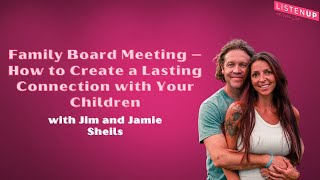
This is a YouTube video titled "Family Board Meeting - How to Create a Lasting Connection with Your Children with Jim and Jamie..." published in September 2021. It features a podcast-style conversation hosted by Natalie Jill, a fat loss expert turned lifestyle and high performance coach, interviewing Jim and Jamie Shields, creators of 18 Summers and the book "Family Board Meeting." The discussion centers on navigating blended families, balancing entrepreneurship with family life, setting boundaries with technology, and making the most of the limited time parents have with their children. The content is motivational and offers practical advice for parents, especially entrepreneurs, on fostering strong family connections.
Hi, I'm Natalie Jill, fat loss expert turned lifestyle and high performance coach. Welcome to Listen up the podcast. On this podcast, I do what I do best. Taking complicated information that is relevant to us now and breaking it down simply with actionable steps you can implement to level up your life. I also regularly interview some of the most inspiring and courageous men and women on the planet who at their worst, learned how to achieve success greater than anything they ever, ever dreamed possible. Creating everything from nothing. If you are new here, I encourage you to go back and listen from episode one when this podcast was previously called Leveling up for the Full Transformative Experience. Today on Listen Up, I'm super excited to talk with the creators of 18 Summers and the popular book the Family Board Meeting Jim and Jamie Shields. They have mastered the blended family and enjoying family life, navigated with business. And I thought, especially after every. Everything we've been through these last almost two years, being sort of forced at home with families and having to change our schedules around and really navigating that, navigating more time with our, with our kids, our teens, it was a perfect time to have them on. Thank you so much for being here today.
Thanks for having us.
Thanks for having us, Natalie.
So take us back. I want to kind of rewind in the journey because I know that initially you, Jamie, were newly divorced, you had two kids that you had gained custody of, you were navigating that world, you met your now partner in all areas and you were navigating the blended thing. Can you tell me what was going on in your world then? Were you super focused on kids who were you at that time, before you even got together?
So before I met Jim, you know, I had been in a really bad situation and without support financially or emotionally managed to leave that situation. I'm incredibly grateful for that inner compass of just knowing that there was something different and not right and to really protect myself and our boys and to maintain not just custody, but I ended up terminating rights on my own. And, you know, now on the hindsight, I'm like, I can't believe I did that by myself without an attorney. But we did. And what was incredible, at the time, I was very focused on my children. I was very focused. I was running a private Waldorf school and initiating the first public charter Waldorf school. So I was just super focused on work and the children. And this guy wasn't really a part of any plan that I had made. And I was just excited to have met him. I was enlivened and thought, okay, so maybe this is not the end of the story. And so it was a wonderful thing to meet him and to see his curiosity in my boys and to love them so much that when he would show up, they never knew if he was coming to date me or to date them.
That's cool. Sort of. You were prepared to have put your superhero cape on and just sort of be single mom powering through. I've got this. I took custody, I'm doing all of the work. And you didn't expect to meet him?
No, I definitely wasn't trying too interested. I was very focused. So yeah, it was an incredible surprise and still is.
And then Jim, you when you met because you didn't have kids yet at the time, was that in your plan? I'm going to meet somebody who already has two kids that just went through this.
So Jamie had a little tattoo on her wedding ring finger showing that I'll never get married again. She's had it removed since I did.
It like literally said I'll never get married again.
Symbolization of I can do it on my own. And I had, you know, I had always said verbally I won't date girls with kids.
Yeah.
Because I just, I said it's not the girl, not the kids, but the potential other element that could get dragged in. And I just said, I just don't, I don't want to do that. So I just had this verbal rule. But the funny thing is I had written this list that eventually I gave to her nine years after I wrote it. And T and on there it didn't show that I didn't want kids. But all my friends and everything, I literally said no, you know, they're nice. I'm not going to date a growth kids because I don't want to get into the trauma or the situation. And then I made, I just said, well no, I don't care about that rule.
Yeah, I get that. My husband was the same. When I met my husband now I had a three year old. So I can relate to that.
Okay.
He was definitely not expecting to meet somebody divorced with a kid. The whole, you know. So I get that. I get that.
Such a bonus and now the fact we've had more kids, like we're the lucky blendest family in the world. You know, I to know the love of an adoptive child and a biological child. I think I have such a fun perspective on life and I can tell anyone listening to this, once you love a kid, there is no difference. I forget that I adopted the boys when they were little. I'LL explain it for this. But you just, you don't look and say, oh, that one's adopted, that one's you. Just you. All those lines disappear.
So amazing.
It can be a very special thing.
Yeah, yeah, I love that. So you were, you came from very different backgrounds. What you were doing in the world too. And I know you were, you were in real estate, is that correct? And you had gone through the whole.
Investment company for many years. I brought it out of the 08 meltdown successfully, but not without a lot of pain, like most of us real estate investors. And yeah, Jamie ran alternative education, but it went together like peanut butter and jelly. The more we started to talk and share our skills and viewpoints together.
So tell me what 18 summers is and where that even came from. Because as I was looking at your website, I was so intrigued. I thought, I never really thought of it that way. For those of you listening that never heard of it, they call their business 18 summers because you literally have 18 summers with your children. If you think about it before they're on their own. And when you think of it that way, it's, whoa, that's quick. That's just literally 18 summers. And especially us working parents, I don't, we don't really think about that and we just look back on pictures and go, oh my gosh, where did the time go? But in our day to day actions, we are putting things before our kids. I see it all the time. Even the parents that say there is no one involved, they are putting things before their kids. So talk to us about that. Like, what were you seeing in your world? What was going on that made you create this?
Well, it's super interesting. We actually heard a study say that 80 to 85% of the time you'll ever have with your children happens before that 18th summer. Because, you know, so often they move out and then they go to college or they just aren't returning home as much as they were previously. And really, you know, if you do those first 18 years, right, they do come back for the holiday stuff and the Sunday dinners or whatever it may be, but really the main chunk of that time is in those first 18 summers. And we thought, gosh, we have to start helping people harness this time. And it's such a simple math equation. So you know, we have four children, one of which just finished his 18th summer. So we're like, oh, and our youngest one is four. And so we're thinking we've got 14 with the little one. But, but our summers really are done with the oldest one. And those years go so fast and they're not, you know, Jim always says they're not all created equal. Some years are different than others and just really harnessing the time that you have. So for us, you know, he got the boys at 5 and 7. He was a little bit behind on those 18 summers, but once it became something that was in the front of his mind, he worked that much harder thinking, okay, now I'm here and let's make the most of this time that we do have.
It changed my mindset saying, well, 18 minus 7, 11, that's 11, that's nothing. And so I think it really changed the way I did business, the way I handled certain things, my travel schedule, where I was putting my time. Because a lot of people, Natalie, when I went to these bigger events, there'd be some really successful people up there. They'd have a huge balance sheet and be relationally bankrupt.
Yeah.
And that scared me. And what I found was there was this advice going around. I'm sure you've heard it. Look, put your head down for the next five to 10 years, go all out and your family will understand. I think that's horrendous advice.
I agree with you. It is horrendous advice. And that is what we learn.
Yeah, yeah. And it's. But I think like, just like, you know, you know how to get someone into really great shape, I don't think that requires. It's more. It's the effectiveness of your time in the gym or with your family where you're making those constant deposits that you'll see the results. Health and wealth and relationships work, I think, under the same principles. And that's what we found. I was going to be busy. There were lots of things we wanted to do, but we could keep certain things in the forefront by holding strong rhythms and a couple of traditions. And that made 80% of the difference.
You know, I love that you're sharing that because I think back, I divorced when my daughter was one and I didn't have my current husband yet. I didn't know him yet, and I started a business. So her most critical years, like from 2 7, I'm head down growing a business and in my mind I'm working from home. So I'm around her, you know, that's in my mind now as a teenager. The things that she struggles with, she'll tell you herself. My mom was always working like. And I have this tremendous guilt and I can't deny it. Like, I thought I was spending time with her. But what was she seeing? She was seeing the head down. So I think you're. What you just said is so critical, and I wish I had understood that more because in my mind, in my world, I'm working hard for my family. I'm working, working, working. I'm going to create a life for her. But what did I do in those critical years that now she's a different, you know, at 14, a different person.
Yeah. Well, I think the one thing we have to learn, too, Natalie and Jamie will be the first. We can't beat ourselves up. And a lot of people, you have to realize, of course, we always wanted to stay young, start younger with that. But she's only 14. Some people figure this out when their child's 34.
Yeah.
And so there's. There's what I've learned, like through the pandemic, through certain business breakups, changes, that I've just tried to give all of our children sincere apologies. And I'm not saying that you haven't done that. One of the things that's worked for me, though, is, man, I mess up and sometimes I go head down still. But there is something about a sincere apology that I just say. And some parents go, what do you mean? I'm providing. I'm not apologizing for anything. I could be like that. But it doesn't go.
Spouses can say that to each other, too, if you think about it.
Exactly. The awareness goes a long way, you know, because sometimes as a. As a spouse of a busy entrepreneur, like, I'm a busy entrepreneur as well, but I'm mama first. And so, you know, and he's a busy entrepreneur, but he's the entrepreneur first and then papa's. And so it. It just is a good balance. But, you know, there's some times when I totally lost my wheel. We can end it. Sorry. Since, you know, I value you apology. You had it.
I mean.
Yeah, you're right. I was just like, not just what.
We'Re doing with our kids.
Yeah, they're out the door. So I'm like, oh, kids. So anyways. Yeah. And so there's sometimes when, you know, he's entering my world, but he still has work on the mind, or sometimes I'm entering the work world, and I'm still like, right now paying attention to our children. And so just an awareness of saying, hey, I see you, and I know I didn't show up the way in which I intended to, you know, just because sometimes a spouse thinks, oh, they're not going to notice. Or, oh, I don't need to apologize. But really, the awareness goes a long.
Way of just the acknowledgement, too, I think people just feeling like they were.
Heard, right, just saying, hey, I see you, and I know that that's not, you know, and setting boundaries and expectations are huge, too. So in our home, even though during the pandemic, we moved our office home, our children came home for schooling, we had two additional foster children. You know, I mean, everything is at home and we are all on top of each other, but we started setting very clear boundaries and expectations.
We.
When I am in this space, I'm not available, but when I come out there, bet your butt I'm playing, you know, and so that was for Jim to understand, but also our children to understand. You know, setting boundaries and expectations. Here's when I'm available, here's when I'm not, when I'm in this space or at this time. And it just really helps the children and it helps the spouses. I mean, all of what we talk about, you know, I'm just a big kid, too, so it's nice.
Can you give me an example of that? Cause I'm trying to, like, think of that as real time. So, like, for instance, right now, my. As we're recording this, my daughter's homeschooled, and I work from home home. So how, like, what would that look like? Saying that you're creating these boundaries? Like, when I'm physically, like, in my office with the door closed, that's the boundary. Or were you saying, like, certain times? Or how does that actually. What does that translate to? Real world?
So both. So for with. If your daughter is homeschooling and you're podcasting, so say a communication with your daughter is from 2 to 5 every day. That's when you're going to do your homeschooling in your space at the dining room table, two to five. I'm podcasting in my studio. During this time, I'm not available. If you have an emergency, text me. I'll see it between podcasts, you know, just really setting that schedule. And she also knows, like, that's her time to put her head down. And as we set rhythms, just like you were referencing Jim in the gym, you know, you. As you guide people through fitness, when you put those shoes on, you're like, I'm running. You know, or when you. Certain things that you put on or spaces that you enter tell you, this is what's going to happen here now. Yeah, Just setting those. Those frameworks and those expectations and with one another.
So what I see that's very common is there's certain traits I see in, like the hustle entrepreneur. Because I tend to encounter a lot of hustle entrepreneurs. Not the ones that are like uber successful and have already made it or the ones that are just starting, but it's like the hustle stage. And they're the ones that they typically are the ADHD personality and they're go, go, go, and they're juggling a million things. And I'm just thinking, like, what would they be saying right now? They'd be like, okay, that's good, but I'm a multitasker. I do things at all times. They maybe aren't even realizing that they're in this constant work mode. They haven't created boundaries. What would you say to them? And I'm assuming that's what you encounter a lot with people that you end up working with.
Yeah. So half in parenting does not work, Natalie. And we've all done it. And I'll give you a good story example. But one of our principles for family life, again, health and wealth and relationships is instead of just not intermittent fasting, which I know you know about, and for weight maintenance and control and getting in shape, we do tech fasting. So there's time where we are. We're not saying we don't use tech, but there's certain times we don't. So we try to at the end of the day, have a one to two hour window of no tech for anyone. And that's very important. And I'll tell you, right, it was towards the beginning of the pandemic, or right before my daughter Maggie, who was 5 at the time, asked me to go out on the trampoline. And my phone was supposed to be off, right? And I'm getting on the trampoline and I feel the. We all know that awful, awful noise that brings you into seven different tailspins as I'm getting on the trampoline on my phone is someone is really screwed up on a detail for a property that I'm closing on. I mean, a simple thing. You're going, how did this happen? And man, I'm frustrated, I'm swearing under my breath. I get on and my daughter's looking at me and she goes, daddy, why are you so mad at me? And I was like, oh, gosh. And of course I'm trying to say no. And then the more I thought about it, even while I'm jumping on it, that really hit me. But I'm still going into Details how to fix this and all that. If I had been completely and totally unavailable for an hour, that problem couldn't have been changed in that hour. It was already the end of the day. There's nothing I could have done. My mind would have been there with my daughter. And I broke my own rule of doing a tech fast when I'm supposed to be there. So the problem where I see the half in parenting, that hustle row is half in. Yeah, I'm available for a call. I'm available for a text. I can answer that thread real quick. But what that does is it gives you not. You're not even half aware of what's in front of you. You're maybe 20% aware, and then that thing is still controlling you and bringing you off and just having that, you're never fully present. And then for our children, we say, well, why didn't you come to us? They have a serious issue. Well, you never seem like you're available.
You know, you're busy.
Yeah. You're too busy. I can tell you, in any of the times that our teens have had challenges, it's because, well, we thought you were too busy. And they were right. There was something big going on. So I think you have to have complete. In total times of unavailability, Hustle has to die for an hour.
Yeah. And I'm. I'm so guilty of that too. And I think just having your phone near you, it's almost. It's addictive. It's literally like a drug. Those phones, I. I get it. And if it's even. It's too tempting to, like, pick it up or look or check. So do you physically, like, put it in another room now and turn them off?
Like, I've been trying to put it, like, in a spot where I can't get to it. I had a friend, Sean, who was in a dad's group with me. He used to come home from work and put it in a gun safe.
Oh, that's good.
And I was like, that's. I found the more I put it into my bag and away from me, the better I do. If I put it on too close a counter, it can be too tempting, easy to sneak. So the more. The better it goes. You're right. There is. There is a physical distance because there's even studies on that. That. That instant dopamine reaction.
Yeah.
If you have to go into a closet, open a door, go into a bag and pull it out, that's just enough space.
Yeah.
So what we try to keep it at a distance. Although I'll be to say Jamie seems to have a lot more control than me over this. So I'm the one who needs more. The space.
Yeah. Oh, I definitely have a problem with it. I have no question. I'm owning it. I have to. And I talk about habit hacking. Like I literally have to physically put it someplace totally differently. I'll put it my car or something. Otherwise it's just too tempting.
Yeah, I agree.
Tempting. Okay, so what do you tell families that sort of have this awareness of like, oh my gosh, okay, I've got kids, I've been doing this, they're obviously on self beat up. They're aware. Where do they start?
I think an awareness like you said. Oh, I feel guilty. I think an awareness that you feel guilty means you're already doing a good job. You know, it's already on your mind, you're already thinking. And I try to remind myself of that a lot to mitigate that guilt. Like, okay, the fact that you noticed means you're paying attention and maybe you won't do it again, you know. So I just think that as we become more aware, as we know better, we do better. Just like with fitness and health and anything in life, as we know better, we do better. So, so make the most of the time that you do have. So if you don't have an hour a night to put your phone away and connect or be present, start with 5 minutes, start with just for dinner time, you know, and if you don't have the same time every day, then maybe just start with one day a week. But let those people in your life know, hey, this is when I really am going to be available. This is when I'm going to be present. I would love to meet you there, you know, and just start somewhere with whatever you do have, Whether you have 18 years of summers or five minutes a week, just starting somewhere is really important.
And how do you do that with teenagers? And the reason I say that is now your teenagers are doing the same thing because our teenagers learn from us. So like now they've got their phone. So, so any, what's your guidance around that?
I think teenagers again, we've been pretty lucky. I mean we have, you know, teen grumpiness and things like that and little issues. But we haven't had, you know, nuclear explosions. And I think, you know, it's a trickle down effect. Teens see hypocrites, you know, they know hypocrisy. So if you're saying you're on your phone too Much. And you turn and you're on. They get it. And they're like, hold on. So what I found is when, you know, our whole book is about me spending a day, a quarter, with each of our children and now me and Jamie individually. And one of the most important things to make that day really potent is to turn off my phone. So I would start to set that example at a young age. That helped. But even now, people who didn't start at a young age with their teens, I think it's easier to show, like, I'm going to turn my phone off. I'm not saying you cannot use your phone and this and that for other times of the day, but for this one hour a day between 5:30 and 6:30, we're just. We're not going to have phones on. We don't have to sit here and stare at each other. We're going to just totally disconnect.
We're going to rewind. We're going to hang out or do.
Something other exercise, you know, swim in the pool, go up and surf. But we're off our electronics. We've worked up from one hour to two hours a day. But that's the starting point. And if the kids see that, that you set the example, and also you're not putting them in tech jail for like two weeks.
Yeah. Because that's. If you're all of a sudden. I see that happen to, like, all of a sudden we have this new rule, like, no electronics after 3pm and.
It'S like, wait a minute, Mutiny.
And we found teens to be pretty fair. And when I do talks on this, I say, look, if. For one hour a day, if you're not on technology, is it going to ruin your social life? This and that? No. Okay. And if all of a sudden everyone's supposed to be off technology and you're on Instagram, you're not supposed to be, and someone that you don't really like, post something that really annoys you, and you can't believe they posted it. And it's, it's being mean to your friends. Are you going to be, you know, nicer to your mom and dad? Are you going to be nicer to your little sister? And they're like, no, probably not. I'm like, exactly. So can we let those things wait for just an hour? And I found once we started to do this and we got really serious about this through the pandemic, we started to joke around more. We started to plan more adventures. Like, adventure is a big core value of our Family, we started to plan more adventures, have more like memory reflections. And we're only talking for a short amount of time, but if everybody's off their electronics, then everybody's present. They know that often.
I love that you just shared that, because if you think about. I was thinking about this recently, that everything we've been through this last year and a half during the pandemic, if this had happened 20 years ago, when none of us had social media phones, we would have had such a very different response. I don't believe depression, anxiety, any of that would have been as high. Because what happened was everyone's at home. Instead of communicating with each other, they're just doing more electronics, more social media, more this, and then more of this whole echo chamber to whatever you're already believing, finding more and more of that. It put everyone in a bad mood.
I agree.
What's really interesting is that all of us, you know, teenagers and older, we all think, oh, this totally sucks. But if you take a moment and think about anybody that doesn't have a phone, like toddlers, you know, tweens, they're all thinking, wow, that was the best year and a half of my life.
Yeah, you're right.
Parents were home, everybody was in the house. We ate dinner together. You know, like, if you think about it, I mean, gosh, our toddlers think that this was the most incredible thing that ever happened. Yeah, and you're so right.
My dog does, too, even though that's not about this. But dogs are very happy this last year. Yes, they are.
You know, everybody's together now, and so it seems. It seems like a lovely thing for. For the beings in the house.
Yeah, that's. This is a whole. You need another book on that whole topic on tech, because that is. Is a real. I believe that so much going on with teens, and I'm living it firsthand, like anxiety and depression, like I watch all my daughter's friends. Like all. It's like this whole thing, this new teen awareness, because it used to be you just had your high school friends that you're around. You know, you only have that your neighborhood now you've got the whole world you're trying to show up for and getting opinions from, and it's creating this just. You're not going to your family for guidance. You're going to social media and the World Wide Web. It's a whole different experience. I think. I'm worried of what that's going to create in our children and our teens years from now.
Well, even the pictures we're capturing are different. We were just at Disney for our daughter 7th and you remember if you went, you know, there'd be a fun picture. And now it's like all the guys are, you know, doing this or the women are stretched out and like over the.
And you can just eat it if you don't like it.
And it's like, you know, and it's like you wouldn't be doing that for like a memory maker. You're doing that to try to put it out. And it's, it's just changing experiences. So it's kind of.
It's like that avatar. It's like literally we're all living in this fake world for social and online. Like how we, how are we going to show up? What are we going to look like for people? And then did I get likes. Did I get. I mean, it's really, I think it really affects families. Really affects them.
And if we worried more about how we showed up at home, you know, like, yes.
Yeah, that's been our challenge. The one thing we try to end a lot of our talks on and say we. I believe in using fame for good and I think it can be. But I think the most important, the most important place to be famous is at home. Try to be famous at home. That's what's going to really, really stick. That's what's really going to have substance. And no one really looks at that, say I want to. And that's just been a rule of ours. Let's be famous at home.
That's so good. I'm the mean mom because I've told my daughter no social media. It's a hard no. I took it. She had it for a little while. I saw what it was doing. I said, no, she's taking it away certain times too. Yeah, no, it's. It's gone until she's like 18. She doesn't like that. But I said I'd rather her be mad at me about that than the alternative of what I know it creates.
Yeah, it's terrible.
I think, yeah, you're going to see a different side of her. And I think it could be. It'll be a rebellious damn you, mom. But I think there's going to be more creative juices coming out. We saw it with our oldest son who's on a really good track, but he lost it for a long time and. But it re grounded him and helped him look into some of his bigger wants, gifts and talents. And that's a pretty cool thing to watch when there's not that distraction.
And I am hypocritical on that though because my whole business is social media. But what my story is, but I'm 50.
So I was about to say is.
It hypocritical because you know, you don't. What's suitable at 14 might not be at 50.
Like yeah, I don't believe our brains are can deal with social media as they're developing like that. Like I think it's hard enough in our 40s and 50s dealing with it. It really, it is. I know what a negative comment does. I know what, even though, you know, overall, okay, I'm serving, I've got all these great things. You get one bad spin what it creates. So I'm thinking of 14 year old brains. You know, it used to be the one kid at school that gave you a dirty look. Now it's on the worldwide web. It's a whole different.
As, as the kids grow and we do, you know, at 14 it was really important to be invited to the big party on Saturday night. At this age now I could really give a shit about being invited to the big party on Saturday night. So I think it does fade and that's my hope. But it's still a danger for everyone. But especially that age, that coming of age of who they are being accepted, you know. Yeah, it's tough.
So what do you do at 18 summers? What, what is that experience for people?
Yeah, we started with the book and retreats. We did a lot of parent child retreats for entrepreneurs and their kids for about five years and that morphed into a book and talks, workshops, retreats for a lot of entrepreneur groups. Because we're saying, look, you want to be successful in business and you want to be successful at home. There's a lot of things out there that allow you to be successful in business, whether it's marketing, sales, online presence. But there's very little of a workout plan for families as entrepreneurs. And so we try to bring in simple workout plans for families while they're building their businesses.
That's so awesome. And I would imagine it actually helps our business because they become happier. That's huge.
It is such a yin and yang growth. You know, I found when I'm happier at home, my business starts to grow or it grows easier anyway, which is.
So cool because I think sometimes people, the reason they dive so much into their business and they say it's because they're growing, whatever, but it's actually the avoidance of family because they don't know what to do with it. I noticed that, too.
We've heard that a lot, too, that, you know, with the pandemic as well. Like, I don't want to be home. I don't know how to be home with my family. You know, I always have, you know, when people had that escape of, well, I'm going to go to the office, or, well, I have to work. Well, now work is at home. And so that was a, you know, a chunk of our clients as well was people saying, like, I don't know how to be at home. So really just guiding, you know, families into what it's like to be a part of a family. Yeah, let's look at your calendar and look at your values and see if they align. You know, where are you spending your time? And let's. Let's adjust those things.
That's so good. So good.
Answer the question of, do you feel like you deserve to be at home? Because for us guys, honestly, if we really get. You start to pull away the layers of myself and other entrepreneur men, you think you're going to screw it up if you're at home too much. At least I can provide. I don't want to screw it up. I don't know if I can be at home. I don't want to mess it up. Like, there is that underlying, I'm not good enough. No one really talks about that, but it exists myself. And I bury myself in work. Well, at least I'm providing something. And it's a lot harder, I think, to be a good father than it is to be a good businessman and.
Or a woman.
Or woman. Or woman. Yeah, I think. I think women, to give a thought, you guys are naturally better at relationships. I really believe that. But I think that for guys, yeah, we will hide in business because we don't think we can be the best husband could be.
Well, there's a huge need for what you do. It's funny. One of the things I do on social media, on my Instagram, is I do a lot of funny reels and I do things with people, things that people will relate to. So lately I've been doing a bunch of what it's like being a parent of a teen daughter. And you'll have to see some of the comments on the video, but everyone's like, I'm dealing with that, too. Like, so many people are dealing with this with their teens. So what I want people to know talking to you is, it's not too late. So some people have it in their mind, like, oh, I didn't do this when they were kids. I didn't do this when they were as little. But what I'm hearing from you is it's really never too late as long as you're acknowledging it and then carving space in the future to figure this out. Absolutely.
We even had a client that came to us, and his youngest was like 20 or 23, and I believe he had seven. And so we decided. Yeah, yeah. What he decided was, okay, they're not at home anymore. I've kind of missed that window. But what I am going to do is fly to them one weekend. You know, each of them gets a weekend with dad, and it is me by myself, and I show up and we do whatever you want to do. And he said that that intensity time, you know, they get excited like, wow, my dad's coming all the way. That's so cool.
I got chills. That's.
I love that. And so he started doing that with his children, and it made a huge difference. We have another client who had grandchildren, and he was like, well, missed it with my own kids, but now he has like, grandpa boo camp or summer camp every summer and has all of the kids. And so the thing is, is that it's not necessarily one size fits all, but it is doing what you can with what you have.
It also sounds like it's kind of quality over quantity. So, like, if you just take a few, like, just like you said, the one day a month or the. The weekend, like, that's that deep quantity. Quality. Time is where they. The memories are created and what they remember versus, like, it has to be every day a certain amount of time or whatever, which might stress people out.
Yeah, well, and to implement, you're not going to go to the gym eight hours a day, twice a month. Right. That's probably not going to get you where you want to go. So what I say is, you know, people probably come to you and they say, oh, I'm so out of shape. It seems so far away to get back into shape. But you say, look, if you will start to see results, but if you give it six months, you'll be in a totally different situation. The same thing with family life, you know, if you will just. You're saying, I'm so far behind, but if you start to get into an exercise program for family, in six months, you can be in such a different situation. I'm not going to say you're 100% of the way there, but you might be 75% of the way further than you thought you ever could be just in six months and that's not that long a time. We all know.
So good. Yeah. I love this. So, so good. I love. This is so fascinating to me. So your book, family board meeting and you've got 18 Summerscom, is that correct? Yeah. Check them out so much. Great. I loved your website. I love checking out all that. What do you want your like, what do you want listeners to know? Like if they, they're beating themselves up, they're hearing what you're saying here. What are the takeaways that you want them to remember and know right now?
Oh, that's great. Yeah. So just take a moment and get intentional. Right. You don't have to, you know, people say, oh, we have to balance family and business and we have to have a balanced life. Have an integrated life. Make your goal be to that you can do both things. You can do all things and you can feel confident and successful in both of them. Carve out intentional time and make the most of that time that you do have.
I like that.
And I would just say in the last 10 years of us doing this and us being our own self experimentation, we've learned that there is no perfect family. Whoever created that same perfect family did an injustice. We haven't.
Well, the dang Brady Bunch did that.
They did.
And they were a blended family too. But they were like perfect.
It's like, I don't know how, but they. Again, for TV shows, they only have to be on air a half hour a week.
Yeah.
How many cuts to get that perfect. Right. And that's real life where there's no perfect family. And when you take that pressure off yourself, off your spouse, off your kids and say we're not going to be perfect but let's, let's make the most of time we have and keep consistent with a few rhythms and principles. You'd be amazed how far you can go.
So good. This was so helpful. Thank you for doing this today. I will link up below where to find you. Where are you most active on social media, by the way?
Instagram. It would be where we're most active. Yeah. 18 summers tribe.
Awesome.
Thank you.
Thank you both so much for being here today.
Thanks for having us. Take care.
Thank you for taking the time out of your day to listen in as my guest today. If you found this episode valuable, please share it with friends and on social media. I don't advertise this show so I rely on word of mouth and reviews to get it out in the world. The biggest thank you that you can give me is leaving me a review. And a nice one. I hope. By the way, this is how others find these episodes. If you do leave me a review, be sure to message me@supportnataliejill fitness.com with a screenshot of your review, because I would love to send you a free digital download of my DSR journal as a thank you. And please don't forget to connect with me on social media at Natalie Jill Fit on Instagram and Facebook SA.










