Pain Free Aging: Key Insights from The Fitness Doctor
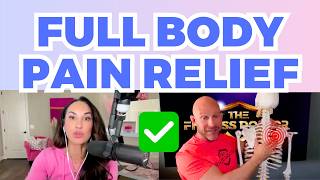
Robbie Stahl, a fitness doctor specializing in anti-aging fitness for people over 50, discusses knee pain, joint mechanics, and injury prevention with Natalie Jill. He covers biomechanics, the mind-body connection, and practical strategies for maintaining physical health and functionality in midlife.
What the heck is actually going on with our bodies as we age? Why does pain seem to pop up? Why do we get injured so much more frequently? And why do all these like imbalances and weird things happen, like our knees start hurting or our hips or oh my gosh, the lower back thing. Today I've got the fitness doctor. He is the go to expert here, Robbie Stahl. I can't wait to dive into this midlife conversation. Robbie, we need help. We need a lot of help here.
Let's do it.
So I gotta tell you, when I met Robbie, I, you know, he told me that he does anti aging fitness for people over 50. And I'm looking at him and I'm like, are you even close to 50? What do you mean you do anti aging 50? If it is over 50. The more I talk to him, the more I realized how flipping knowledgeable he is. I love his focus. He is correcting people, getting them out of pain, helping them be much more functional in life, which is truly the key to longevity. So Robbie, I've got a lot of questions with for you, but I want to just start with just a little brief intro. Can you just share a little bit about your background and how this even became your topic of interest?
Yes, I will give you a big background in the shortest amount of time and interesting as I possibly can. Ready?
Great.
Here we go. Read my first exercise physiology textbook when I was 12. Started lifting weights around 8 years old, having no idea what I'm doing. Had a brother nine years older, sister seven years older. They were both total gym goers. So I got this natural passion from a very young age. Read my literally university exercise physiology textbook when I was 12. I had this huge passion. Not a great student. I would actually, I had a few classes I had failed through my schooling, but guess what? You'd find me in the library studying everything from psychology to nutrition to the endocrine system to biomechanics. I just had this natural passion. Went to school to be a PT doctor in pt. Also quite interesting. Back up just a step. In high school I had all kind athletes, female and male athletes. I had the girls in school, like they start developing their legs, their butt muscles and then other girls would come to me and want me to write their programs for them. So like, this was my youth, it was always a passion. And went to school to be a physical therapist. Doctor in physical therapy. And out of school I decided, you know what, I really want to focus in fitness. And I did. I trained some of the best athletes in the world figure physique athletes, Navy SEALs, pretty much every sport, football, baseball, soccer, like you name it, tennis. And I ended up realizing that after having three clients get divorced after bodybuilding shows, I realized, you know what, that's not what fitness is. Yeah, it's about so much more than that. And you know what, it really does seem like that most of the people, the more fit they get, the more broken they get. And when you're really inside the fitness circle, you will actually know that. Yeah, you know what, that's actually pretty true. And so I started looking at the research heavily with one of my colleagues who's a co creator in our systems, Dr. Trent Nestler. And he's done over 100,000 3D movement assessments on every detail of what happens with the body mechanics as we move. And we've done literally five year research study a million case sub, over a million case subjects looking at what is the ideal functionality of human body, where does it go wrong, why do people get injured? And most of the things that go wrong with us, it's not impact injuries, these are overuse injuries. So long story short, I wanted to develop literally the world's best system for optimizing your body functionality instead of most of the knucklehead stuff that everybody else and I used to do in fitness and most people are still doing. So that's pretty much.
Yeah. No, this is so good. I have so many questions for you. And by the way y', all, if you don't know this about me, if you've not followed me on social, I am that person who had multiple injuries. I am that person who had a disc rupture and had all these things go wrong, probably really stemming back to some of the stuff that you teach here. So I've got a lot of questions, I'm not gonna start firing them at you. And you help us here. Like first of all, do we all have to age and be in pain?
Absolutely not.
Ok, okay. What are we doing wrong? Why are so many in pain?
I think there's multiple aspects to it. One part of it is mind, energy, emotions.
Okay.
Part of it is definitely nutritional in our lifestyle and things around us. And part of it is mechanical and it's really all three. Like regardless of how messed up you feel or how big your issues are, you know, tackling all three of those is going to make like a wow. I didn't have any idea that I could transform that much type of result. And if you don't have like a major life altering pain and dysfunction Then really tackling, you know, your mechanics is usually going to do the trick. But there's things that you need to have on track with your mind, energy, emotions, which I know you're an expert on, Natalie, as well as the nutrition. And so I can't go forward too far into the mechanics unless we at least quickly.
Yep, let's do it.
Let's quickly adjust. Address the mind, energy, emotions. Basically you got to love yourself. You can't go to workout and think, I'm not good enough, I'm in too much pain, I'm overweight, I'm whatever, and, and hold that stuff in your mind or think of this like, no pain, no gain. And then like basically you're training your body to go through pain and exercise. That means you're training your neurological system to have pain in it. How well is that going to work out for you over years? So basically in the mind, energy, emotions stuff, in 60 seconds or less, that's what I would share. On the nutritional side, you got to follow an anti inflammatory diet, especially if you're not, especially if your metabolic conditions are off. You have to have your blood sugar regulated, not being in a bunch of processed carbs, dairy, wheat, gluten. These things for most people make a huge difference. So optimizing those and then we get to talk about biomechanics after that.
Okay, before we. I get into the biomechanics part because I got a lot of questions about like knees and hips and back and all of those things. If somebody hears this about the mind body connection. I know you and I are on the same page here, but some people roll their eyes at it and they're like, what do you mean I can't think away my feeling overweight or I can't think away my really bad knee pain or my injury. What do you want that person to know?
I want you to know that you're right. It's not going to just happen overnight. You've trained yourself into your current condition and to train yourself out, you're going to do the same thing but in the positive direction as you've done in the negative direction. So positively. What does that look like? Taking one exercise session at a time? If you're what Natalie just explained, you're not an individual. That's going to be a good idea to go and do exercise that's painful, that you dread, that you don't like and like push yourself through hit circuits and all this stuff. That's a horrible idea. I don't care what the YouTubers are telling you that is a horrible idea. What you need to do is really simple. Like you should start your exercise session with a meditation is self love and connecting and like starting to process your emotions of the negative out in the positive in. And no, it's not going to happen in one day. But if you repeatedly do a process before exercise to get your para sympathetic nervous system activated and start quieting your sympathetic nervous system so really quick, you have something called the autonomic nervous system.
Okay.
Many of you have heard this possibly before, but the parasympathetic nervous system is rest and digest. It's the calming activation of your body basically. And the sympathetic is the opposite. Most of us are running around with way too much sympathetic nervous system stimulus because of stressors, because of diet, because of lack of sleep, because of, you name it, because of potentially body pains you've gotten yourself into as well. And when you activate parasympathetic by calming and relaxing, you're going to have way better results. So in exercise you have a very prolific, profound way to change the way you feel and function because you're truly practicing mind body retraining.
Okay.
And so when you're exercising, you should be exhaling the negative emotions or thoughts that are coming into your head and whatever you think as the opposite. So I'm overweight, I'm not where I want to be. Look at all this flab on my abdomen. My knee hurts. All okay, so exhale that. And what would you inhale instead? And it might start small.
Yeah.
But long story short, what will happen is if you start to attach some emotion to the inhale of the positive emotions, over time you will become an expert on retraining your mind for that if you keep staying consistent with that retraining. So you will literally retrain the thing, the way you think and you feel. And while doing this during exercise, you're training these things into your mechanics. And so now all of your tissues and your body, body to mind connection, are learning that you feel good, you function good, you're connecting with positive emotions. You'll begin to retrain your subconscious and you'll literally retrain feel good sensations into your body tissues.
I love that you share this because this is a really interesting thing we figured out we have in common about what we teach. Because when I teach nutrition, I start with that mindset piece of being really clear on what you've decided for yourself, what you want for yourself and what you like about yourself. And a lot of women look at me like I'm crazy when we Start with that. But it's the same, same reason you're maybe rolling your eyes at Robbie right now, if you are. But we know that this works because when you do approach things with this isn't going to work or I hate myself or I don't like it, you're just basically reinforcing that. And like you just said, Robbie, that makes a lot of sense. You go exercise with that wrong mindset, you're reinforcing these bad beliefs. It's not. You have the wrong foundation to start then you have the wrong foundation to start.
And I'll tell you, you know what's even is really interesting for you, the individual listening to this that might be like you really see some light at the end of the tunnel all of a sudden. Let me give you even more encouragement. Let me share this with you. Pretty much every super fit person I know who's done what I call just hardcore, constant, consistent knucklehead training, which is like prescribing to or subscribing, I should say, to all the like high intensity stuff which has its place. Yes, yeah. And if you're currently unfit, not the time for you. And so what happens is they're consistently, consistently trained themselves with pain. They literally, I don't know anyone that doesn't is pushes like that and hasn't had a lot of body issues as a result. Because once you start to think about it, it's like obviously like you're training your nervous system while you do physical activity and your nervous system is part of your mind, your energy and your emotions. You're training yourself for how you want to function. So if you're pushing yourself through pain, although that's like the thing that everyone subscribes to for like having higher level fitness, that's not the way to do it. I'm here to tell you, I've been there, done that, trained hundreds of people to do that. And I know all of the best who have also trained hundreds and thousands of people to do that in a better way is approaching yourself like we're sharing here with love, care, connection, finding comfort. And this is actually what I call we have a three filter process to improving fitness functionality. And the first filter is what Natalie and I are talking about right now. And that's filter one where you're interoceptic mind, energy, emotion retraining so that you have functionality being built into your performance. Because what most people do is they have dysfunction in mind, energy and emotions and mechanics which we'll get to next. And they go and they start focusing on what performance sets, reps, how much should I do, how long should I do, all these kind of things. And what happens is they build dysfunction into their performance. So they're putting. They're increasing performance, they're getting stronger, they're getting better endurance that might. Might be losing body fat, but simultaneously, they're getting a tremendous amount of negative results which will come back ultimately to bite them in the butt. Okay. Yeah, so that's for one. Yeah.
So we have to do that part first. Even if you're thinking you don't want to. This is the critical component. And I love. And it just feels better to be starting from that place, honestly, like, when you start training yourself to do that, I know that when I do my workouts now, I would say my. The first, probably 20, 30 minutes is not just like a warmup of me going through motions, but it is me thinking, like, you're talking about, like, even if I didn't really connect that until you said this, it. It really is. It's focusing on what I want to create, what I. How I want to feel, versus, like, oh, I have to do this, and it's going to hurt. And it's that. And it does make a big difference. It really does. It makes it very intentional. I want to talk about some physical things I know people are going to want to know. Like, okay, so let's spot knees to start. Why do knees seem to be hurting and so many people in midlife.
Well, thank you for that question. And that gets us into Filter 2, which is what we call mechanical optimization or biomechanical optimism or body alignment. Okay, and why are knees hurting for so many people? And the answer depends on the individual. But if we look at, like, any thousand people that really have knee issues that weren't, like, hit by a car.
Right.
Even in this case, they can end up falling in the same bucket here that I'm going to share. But they have body misalignments, and they have tissue functionality that's not working how your body ideally was designed. So just like the immune system. So the immune system's job is to find foreign invaders, and when they find foreign invaders, they attack it. Your nervous system and your somatosensory system is defined body dysfunction also amongst its other key aspects. And to find, oh, this part's out of alignment or this tissue isn't working the way. And it creates pain signals to help teach you to move into the right position. And also what happens is, mechanically speaking, because your body's not aligning Properly, it causes sheer stress in your joints. And the knee joint is specifically designed to be a hinge joint. So imagine a hinge on a door. The door opens one direction and closes one direction. That's basically what your knee does. It's a little bit more complex than that, but 98% that's about what your knee does in terms of functionality, hinge joint. So when your feet are dysfunctional, which in extreme majority of human period, but especially female feet, are dysfunctional because of the casted footwear that they use and change their toe alignment, so they start to lose toe splay. And when you lose the separation of the spacing between your feet toes, you lose the functionality of how the foot supposed to ideally stabilize. And the foot starts to move in positions that it shouldn't, such as pronation or rolling inward and creating bunions and hammer toes. And all these things that are really common for, for people, especially women. And so those mechanics and those dysfunctions go up the chain to the knee and they cause sheer stress. Which means sheer stress is like. Well, first you need to understand there's two types of mechanical stress, primarily compressive stress and shear stress. Compressive stress is like where the knee, the top, the thigh bone connects to the two lower leg bones and they compress just like if you were to put your hands together, they compress. Shear is like if you rubbed your hands across each other. So now what happens is the knee for most people starts to shift inward because of the foot loss of stability. And then so that causes excessive stress in the knee, which creates things like meniscal tears and other tissue breakdown within the knee. And so you're feeling the pain and dysfunction from that. And the other thing that happens for many females especially is their pelvis is wider than their knees. For almost like all females, right, pelvis is wider especially than a male. So that's a Q angle from the hip to the knee is a more is a sharper angle. And so this angle also leads to the knee falling inward with misalignment. And so then most people don't have well developed but muscles. And so because the butt muscle is not stabilizing, that is the key muscle that stabilizes the knee. The thing that stabilizes the knee mostly is the hip muscles, not actually the knee muscles. Yes, they're important, the knee muscles, but the hip is even more important for knee alignment. And because of Q angle plus weakness and glute medius, especially hip muscle that leads to the knee also falling inward. So when you have all these different dynamics of the knee not being a hinge joint, then you start to get sheer stress. And this is what causes breakdown and pain in the knee. And then when you have an inflamed body because you don't have a good mind, energy, emotion and nutritional habits. Yeah, Your whole system is more inflamed. So then your whole system is going to find that mechanical irritant and make that be the area that becomes inflamed.
Okay, so as you're saying all this, I'm like, okay, okay, okay. There's all these different layers, so where does one even start? And when you answer that question, what goes wrong when someone just says, oh, you know what, I'm just going to do like a cortisone injection to not feel it and tough it out. Or they go even more extreme and say, oh, I'm just going to, I'm going to do a knee replacement. Or they go the complete opposite direction. They're like, I'm going to wear barefoot shoes. And I'm just going to start like, talk to us about kind of like the quick fixes people try to do and then like, what's the right way to actually fix this?
Yeah. So let's make sure we comment on cortisone quickly and quick.
Cortisone knee replacement. And then the other extreme when we just go to like, I'm gonna do barefoot shoes.
Okay, well, that's another. So let me go cortisone and knee replacement. So. So a lot of people I call like the cortisone people, like lotions and potions. We all remember that store. Like, we're gonna buy this thing or do this thing, it's gonna have this magical cure. Usually the magical cure is what people don't want to accept because it usually takes some work and it's inside you. You're walking around with a trillion dollar piece of equipment that's absolutely phenomenal. Better than every AI we have right now. And yeah, if you just take care of it properly. So a cortisone shot, what does it do? It changes the regeneration cycle of your cells. So it decreases inflammation. You need some inflammation. Cortisone comes in completely, almost shuts off the inflammation. And so if you don't have breakdown, you're not going to have regeneration. So most people, their tissue where they have more than one cortisone especially, it starts to become like tissue paper, fibrotic scar tissue that's no longer healthy, functional skeletal muscle structure, which is going to make you very weak.
Wow. That's why they say you shouldn't do more than X amount or whatever it is. But it sounds like it's just a band aid. It's just taking the inflammation away temporarily.
Yeah. And it does help because it's a great anti inflammatory. But where are you going to be at in the future? So if you want to have a better life, better body, better quality of life, live your best life. You should always be being the butler for your future self. So what do you do now so that the future continues to get even better? It's certainly usually not cortisone shot. It's optimal for your mechanics and your body functionality. Knee replacement.
So before you say knee replacement, so the cortisone shot I would imagine would have a place if like you're an athlete and you need to do it for something that's like temporary or something like that, would you ever think there's a time for it like, like you're competing in something? I would imagine that would be where it would ideally actually be used.
Yeah, yeah, exactly. I have a lot of friends who are like X mlb, Major League Baseball, X NFL.
Okay.
Their body is like wrecked.
Yeah.
Because of these cortisone shots because that's what they need to do to stay in the game. But most of the people, which is interesting Natalie, because a lot of these hit training and like this method and like tax your muscle more, max muscle gain. And then on the bone density people, it's hey, you're gonna plyometrics and of course is gonna build your bone density. Okay, well first of all you probably, if you're having bone density issues, most, not all, but most people, you're in no mechanical condition to be doing high velocity. So we have to apply these methods, the right tool to the right situation. So that's why I specialize in people over the age of 50 or close to the age of 50 because there's amazing science that can be applied if you do things in the right way. So yes, that could be right for an athlete that might have the most lucrative part of their adult career money earning life and it's worth them getting some fibrotic tissue. Makes sense of their life to make an extra few million. Right?
Yeah.
But that's not most people's case. So I would strongly encourage them to make a more intelligent choice. And so like okay, so knee replacement quickly on that. Here think about this. If your car is out of alignment and due to that the position of the tire on the road is wearing out the tread on the outside of the.
Oh, I see. Where you're going. Yeah, you're going to replace your tires, but you'd also. But you should rely on it too, right?
And that tire replacement. Yes, ma'. Am. And that tire replacement is synonymous with the knee surgery, the shoulder surgery, the back surgery, the hip shirt. Great.
Wow.
Tire, you're good to go. But guess what, that your alignment is still out.
Wow.
Because you ended up there because of lack of good body mechanics that wore out your joint. So now you still have the weakness. Except for now you went through a surgery which is major trauma on your body. Yes, it helps improve, yes, it fixed things, but it's a lot of trauma and it's temporary. The research on these big surgeries and most surgery is usually people get back upwards of about, about 50 of the functionality they could have. Usually it's about 30 to 50%. So if you're optimizing your body mechanics, your alignment, your tissue functionality, you're going to get fully functional. And here's what happens is we have specific positions, a spectrum of specific positions, alignment, functionality. We should hold our, our pelvis in the way our feet should move, the way our knees, shoulders, back, spine, everything. And when that alters towards misaligned, you're training your tissues to basically be in misaligned positions which ingrain excessive wear and tear on your body. But if you train the mechanics of your body to be ideally aligned, it's going to significantly reduce the amount of stress that's placed on your body as you age. So as you're exposed to more degeneration and inflammation with age, your body's going to have less of that mechanically because you're ideally functioning. And then barefoot shoes. So then, so then, oh, I'm gonna go like extreme with this. Body alignment mechanical optimization. Almost thinking, almost thinking in the right direction, not quite. So if your feet are not used to being in a barefoot shoe or a foot shaped shoe, these type of things which are great for your feet, you're going to all of a sudden add a significant amount of new stress on your feet, on your calves, on your body mechanics. And so I strongly discourage people to like just jump to a barefoot shoe do because very likely you're going to develop different forms of injury and excessive wear and tear unless you do a very intelligent, step by step, progressive process towards improving your functionality.
So it's like in an ideal world, if you had always worn them, it'd be amazing because like you've always walked that way. Right? Like, so if you from the time you were a kid were in those types of shoes that would be supported. But if you're not done that and now you've got these issues and you just go to that, you're going to create almost other problems. Problems. So it has to be gradual. Yes.
And really quick. So on that 5,500 people studied China and India, these were barefoot populations and what they found was like bunion. Nobody had a bunion who was barefoot because they grew up with that. And all these feed issues that we have there was like max of 1.5% whereas like we have population that has upwards of like 50, 60 of people have some of these feedback heat issues.
Wow. But yeah, I, that is something that I always will when I, when people go to those shoes right away I'm like, I get the point if you've been doing that or if you've worked to do that, but just to go right from I'm wearing these big wedge shoes to doing that, that's going to create more damage right away. So interesting how we, we all, we're always looking for the shortcut. Right. So you're like, oh, you jump to the conclusion, oh well that fixed. That would prevent that. So therefore we should just go do that all the time. What about when people tape things? So like you see somebody who has a knee pain and they're going to wear like a splint over it or they're going to tape it or is that doing anything?
Let me share the research with you quickly. And this, what I share in the research will apply to all. Should I brace it? Like should I brace it and. Or guard it? So they did their research on Home Depot workers and they had one group of Home Depot workers wearing the back support during work and one not. And what they found was the incidence of injury on the people who wore the back braces during work. Work had less injuries during work.
Okay.
And then the injuries that they had outside of work surpassed.
Wow.
Those that didn't wear the back brace during work. Conclusion. By wearing a brace, it's an artificial external support which will weaken your mechanics so that you're less stable and less injury proof.
So good. Yeah, it makes sense.
So the when should you. You the time you should wear bracing is when you're going to be doing something that's significantly outside of what your body's currently used to or adapted to do. So those who choose to do heavy strength training and back squats and this type of thing, if they're going to do, for example, someone's really serious in strength training, might do six or seven sets of squats. Well, the sixth or seventh heaviest set of squat. Good time to wear the back belt. First four or five sets building up bad. Not a bad time to wear the back belt.
Makes total sense. Okay, I still have so many more questions for you, but all those listening, you're probably understanding why I have Robbie on now. He's just so knowledgeable when it comes to here. Depending on when you're listening to this, he is doing something super epic. He does this four times a year. I think you mentioned four times a year. So. So depending on when you're listening to this, hopefully you can still get into this. He does a free challenge, which we'll explain more later, but it's a free challenge where he really dives deep into a lot of this over a week. It is totally free if you go to. And I'll put this in the show links too, but if you go to conversations.com forward/fit Doc, like F, I, T, D, O, c. So midlife conversations.com forward/fit doc doc that will help you receive a spot in the challenge. If the challenge is over, I'll have it redirected to something else where you can get help with Robbie. But I wanted to just make sure I got that in before we keep going. Okay, so that's knees. I'm assuming you're going to say kind of a similar answer to ankles and hips, but I want to ask about that because it's knees seem to be the most common. But then we hear ankles and hips.
Hips. Just really quick on what you just shared. So what you just invited people to. I go through their whole body. So things I literally show them. Here's how the foot and ankle should ideally function. Here's knees, hip, back, lower, lower back, pelvis, shoulders, neck. Like the whole body.
So you have a guide to compare you like. No.
And then I show them how to look at their current functionality and then I show them exactly what to do to improve their alignment and their functionality. So if they're a couch potato, this is awesome because it's very approachable body alignment. Approachable body if they're super fit or anywhere in between. Also awesome for them because they're currently causing a lot of havoc to their body that they could be preventing and improving the mechanics.
So good. So good. I've got to do it. I know I've got a lot of stuff to learn there, so I'm. I'm in. That's awesome. Talk to us about ankles and hips. What's happening there?
So ankles and hips. So Feet, ideally, within reason, they should be stable. Okay. Then when you go up a joint and the ankle should be mobile and then you get to knee, it should be stable. Staying okay. When you get to hip is mostly about mobility.
Okay.
Ankles and hips, the thing that's synonymous in terms of mobility, thing you're trying to optimize, it's very important for them to be stable too. It's not that it's not, it's just, it's mostly about mobility. So a lot of people lack what's called in the ankle dorsi flexion. So simply what this means is when your foot comes towards your shin, forward towards your shin. Okay. So top of the foot coming towards the shin. This is dorsiflexion.
So opposite of wearing high heels.
Yes, exactly. And so that's one of the major causes for females especially males have the same thing. Because a lot of males have heel lifts in their shoes. What happens is because the backside lower leg tissues get restricted, you're not able to dorsiflex as much. And when you can't dorsiflex. So this is like front back movement pattern. When you run out of ability to properly do front back movement patterns, you're going to go into one of the two other movement patterns. And most of the time in this case it's the side to side. So that causes the rolling in of the ankle because you run out of motion in one direction and then this causes issues in the knees. So like if we're, you know, we could go on all daytime, little details about the ankle. But like the one big thing that makes the biggest difference in ankle is you want to have really good dorsiflexion. So okay, calf stretching within reason. Again, don't go like, like jump in the deep.
I'm literally stretching my calf as we're talking right now. Like awesome, because you said that, I'm like, okay, gotta work on that.
So dorsiflexion is really important. And then when you get to the hip, there's multiple planes of motion that are really important. It kind of just depends on which one are you deficient on. When you get to the hip, it's more of like which one are you deficient on? So the hip primary ranges of motion internal. So the femur bone will rotate inside, the femur bone will rotate outside. The femur bone will come towards your chest. Chest. The femur bone will go away from your pelvis and chest torso backwards. That's extension and kind of wherever you're most limited is really where you're going to want to optimize. So like for example, one of the things we do in the event you just shared, we actually look at all these ranges of motion and help you see where you're at currently. So the thing about hip motion is you want them to be symmetrical, left hip capability to right hip capability, and you want it to have a good amount of rotation because the lumbar spine going up the body, the neck chain, the lumbar spine, if you look at the mechanics and it actually, Natalie, if you want me to, I could grab the skeleton and literally show. Okay, so for those of you that are only listening to the podcast version, I'm showing my good buddy here, Johnny Bones, which is a full si life size skeleton. And now we're going to look at the lumbar spine. Okay, and so as we come to the lumbar spine, what happens is, so if the hips don't have good motion, right Rotation, what happens is the lumbar spine will start to. And apologies for the change of audio here, guys. So the lumbar spine will then rotate. Like if I'm going to turn and I don't have good mobility, I'm going to move my lumbar spine, right? So if you look at the facet joints, you'll see the facet joints have a bony block. So this bone runs into this bone. Your spine is literally designed to have a block walk. So you can see mechanically that the lumbar spine is not designed to have a lot of rotation ranges of motion. But a lot of people, for example, with their training, they don't respect that and that's they develop a lot of lumbar issues, which is why the number one way to injure the lumbar spine is picking something up off the floor while doing rotation with your lumbar spine because you're bending your spine while you're rotating and that tears the disc because you can can tear the disc. And so in the research, what we see is those who have greater than about 3 degrees her bone, disc, bone interface, they will have significantly more pain and dysfunction in their lumbar spine. So you actually want to have less rotation in your lumbar spine. Within reason, some is good, more than moderate is not. And then, you know, as you go up, really interesting point while you're understanding this, this is as you go up to the thoracic spine, the thoracic spine is the opposite. I know it's a little bit difficult to see in the video, but basically what you're seeing is, is the facet joints are now designed with a sliding element so that they slide over each other. So now you would immediately know that the thoracic spine is absolutely designed for mobility and you want to have good rotation. So mechanically speaking, if you want a good structure, you want stability, then mobility, then stability, then mobility. And so as we look at the skeleton, you'll see feet stable, ankle mobile, knee stable, hip mobile, lumbar spine stable, thoracic spine mobile. And then when you get to the shoulders, that's where it really gets tricky. It's the most easily injured joint in the body. You actually want both stability and mobility because of the huge ranges of motion motion that the shoulder has.
You know what's coming up for me, this is really an interesting analogy I just thought of. So in fat loss, in weight loss, people a lot of times will say, how do I lose weight in my stomach? Or how do I lose weight on my thighs? And our answer is, you can't spot reduce. You have to lose overall and strengthen overall. And then we can make a difference. Like. Right. We would say that, like, you can't just spot reduce your stomach. You can't spot reduce the back of your arms. What's coming up for me is it's almost the same thing with correcting an injury. You can't do just spot correct where you're feeling the pain. If I'm hearing you correctly, like, really, wherever you're feeling the pain is kind of like the result of the imbalances from the other areas. Am I saying that right?
Yeah. And usually the place of the pain is not the cause of the pain.
Yeah, Right. So like, if I said I want to spot reduce my stomach and I'm going to just tape my stomach and like make like, you know, wear Spanx all day long and just make it in. I didn't fix the problem. I just maybe made it look different. So when you treat pain on the hip or the knee or wherever you're feeling it, it and you're just targeting right there without looking at the whole body, it's kind of like spot reduction in fat is what's coming up for me, that you really have to look at all the mechanics.
Yes. I would tell you, hey, go see Natalie Jill to reduce your stomach size and nutritional mind protocol and then come see us to build your booty and your muscles. And now you'll really be cooking with awesome.
Yeah, you do it all together. But it's the whole approach. You can't just say, my knee's Hurting. I'm just gonna go get a replacement or I'm just gonna tape it or I'm just gonna inject cortisone. Like I'm hearing this. Like, you have to really look at this. This. I'm going to bounce up to a whole nother area because this is super common in menopausal women. You might know what I'm going to ask. But this is. Tends to correlate to drops in estrogen. But frozen shoulder. What can you tell us about frozen shoulder? Where is that coming from and can we even fix that? What is that?
Yeah, so the humeral head here. So this is the humor at the top of the arm bone. And what happens is they also call this capsulitis. So the. So you have labrum that surrounds the humeral head, head. And then you have the glenoid of the shoulder capsule here. And basically the tissues get really adhesive.
Okay.
And they start to get stuck. It can be because of some inflammation, but the capsule of the shoulder is becoming inflamed, hence the word capsulitis. And so you start to lose range of motion. A lot of times this is with people who are doing repetitive motion or not, of course, never, usually never by. I say never by choice. But they're not respecting the mechanics that their should. That their body should be doing. So they end up losing ranges of. Of motion. And a lot of people, like, for example, there's a lot of people who exercise who think they should be doing all this overhead motion. There's an entire science body for working with people that are choosing to do a lot of overhead motion because it's so damaging for your body that we had to develop a special whole of science just for swimmers, baseball throwers, and all these people who are very commonly get overhead use injuries. So.
Wow.
The shoulder is the most complex joint. Has to be one of my favorite because of that. And quite simply, if you keep the front side of your upper body immobile. So all this area around your chest.
Chest.
Your lats, which come up here and attach into the humeral head and have a tendency to roll your shoulders inward. If you keep this area mobile and you keep the back area strong, you're. You're almost all the way there to having great shoulder functionality. I'll add a little bit more. But the same things I'm sharing are the same kind of things that from a functional standpoint could really help redevelop your shoulder for frozen shoulder. Capsulitis can also really help anybody not have shoulder issues or who've had Shoulder surgery and any number of things like this is the approach. So you want your back to be really strong. It's actually much more important than your chest to be strong. And look at the design of the human body. So the scapula, Right. So the scapula is basically floating here in tissue between the scapula, which is your shoulder blade. There's no bone connection back here. So the only thing that creates stability between your shoulder blades is all the muscle tissue, the rhomboids, the trapezius, the lower trapezius, all these tissues that connect. Yeah, there's many others which I won't get into full now. The point is, is it's really important for your back to be strong because the bone attaches to the connective and soft tissue, muscle tissue. Whereas if you look at any other bone, pretty much every other bone in the body is all bone to bone connections. And so it creates the stability because of the bone to bone connection. The scapula doesn't have that. So another thing for most people to know is a lot of people will, oh, I have tension in my back. I have a knot. So I go to the massage therapist. That's like one of the worst things to do. Long, long term, short term, you're going to feel, why? Because here's what happens. The shoulder starts getting pulled forward and then you get a knot in the back. This is really common because this is being pulled on. So if I walked around and did this to you for even. Yep, 10 minutes, let alone like all day, every day, you're gonna get tension in the back because the back is consistently pulled on. So then they go to a massage therapist and they get massage on the back, which then makes the tissue even more relaxed and even weaker and actually causes even more of an issue. When really the massage therapist should be focused on massaging the front side. And they might even just be able to. The client might not like it because everyone's thinking that the problem is. Exactly. Promise felt. So if they were focusing on the. On the front side upper body, that would help mobilize the shoulder and make the actual causation go away. Where they don't have that issue anymore long term.
Wow, that's. So I want to add on to that about. I'll be careful here because I don't want to upset people. But with chiropractic, what would you say? Is that helpful? Does that just feel good? What, what are your thoughts there?
I actually love chiropractic. It when it's like everything, right? When it's applied in the right way. I love chiropractic. I think chiropractic can be incredibly helpful. Our nerves and our central nervous system is what connects to everything else in the body. And if you don't have good nerve conductivity and flow to the, to the organs, the tissues, that can drastically affect the health of your body. So having those, what they call subluxations, pressure on the nerves relieved, can really be helpful. So, you know, really responsible, ethical, highly educated, skilled chiropractors can make a gigantic difference in your life. The one thing I would really say though, is a lot of people trying to find themselves back into this band aid situation. Like the cortisone chiropractic, I would see being drastically more helpful and, and holistically beneficial, of course. But your bones don't move on their own. So like, if. So we're adjusting the bones with chiropractic and the joints and everything. And if I had that Johnny bones is never going to move. Move.
Yeah.
So I hope he doesn't break me out.
Yeah.
The point being, your body moves because of your soft tissue, because of your nervous system connection with all of your muscles. So if you want to align your body and optimize the functionality, you have to start in the mind, in the brain, in the higher centers of the brain. And so you will feel 20 years or more younger when you, you understand your body motion and movement as a skill. Because for you to do that, you have to retrain the higher centers of the brain, which is where the. All this processing begins. Those messages go through the spinal cord and then, and then go to the peripheral body structures. When you understand how to move, ideally position, align, function, then that will naturally train your spinal cord connection with the body. And then now you start to change the mechanical characteristics of your body and your literature, really reprogramming. So anything that's focuses external or little quick fixes and band aids and braces and all this stuff. Yeah, you're never going to optimize the route. So all people that do those things say something along this lines. It was really helpful until. Or it's really helpful for a day or a week or some very short time period. But it doesn't stay. And the reason why it's not staying is because you're not working from the foundation of the functionality reality of your.
Body makes total sense. I have one more area I want to ask you about, and then I want to talk a little bit more about your challenge and who this is for. So I have shared publicly many times about L5s one that I had a disc rupture there. So my theory, and I'm going to tell you my theory and what I'm going to share what my knowledge to be up until now. But I want, if. If it's not accurate, don't worry about correcting me. Like, I want to hear what I should know. So I've had this belief that this generation can happen as we age, that all of us could, could have this generation. Some of us feel it, some of us don't. In my case, I had this generation like a lot of people will. And I was over training, which we talked about earlier. I was actually on set years ago, and I was doing like nine hours of intense stuff I shouldn't have been doing. And my disc ruptured out, like full ruptured out, where I had foot drop, leg stops working. I was like literally dragging my leg. It was a whole thing. And I had an emergency laser surgery just to remove the ruptured part so I could get used to my right leg back. I did not do a disc replacement. I did not do a fusion, and I didn't do either because I figured if you do that, then I would create other issues in my body. So what I learned to do instead, what I realized was that I had a very strong AB core area, but I had very weak glutes. I had really overlooked glutes. So what I learned is, well, if I'm going to not feel pain between L5s1, which a lot of women have L5s1 pain, a lot of them do from wearing heels, from sitting a lot. Just all those reasons that if I wanted to take that area out of the equation, I really would need to develop glutes. And the stronger my glutes are tied with my core, so that whole area, then I would almost take L5s1 out of the equation and not feel that pain. So till this day, if I sit too much or if I'm not training regular, like, if I. If I get off track, I will feel lower back pain, but I'd be able to manage it by standing more than I sit, you know, stretching hip flexors, training glutes. So I wanted to share that first because that's kind of what I've been teaching around lower back pain. But I want to get your thoughts. Was. Is that correct? Am I missing a component here? What do you want people to know about lower back pain? Especially women? They talk about it all the time.
Yeah, you're absolutely right. There's nothing that I Would disagree with it. I would. To take it a step further, it's. What are you missing? Like, are you. Do you have mobility restrictions? Do you have. For example, those who have limitation in internal hip rotation, Their hips don't rotate internally very much. One is usually because of a pelvic alignment factor, which can be helped by.
Totally.
But it's very common to couple with lower back pain. And so especially like in golfers, because.
Yeah.
Good hip mobility, rotation. We talked about this core and breathing. I would say the biggest things that I see. Yes, yes. Glute activation, huge. Interestingly, I would say breathing is one of the number one thing, like proper. Obviously, we're all breathing or we want to be here. But proper breathing, proper diaphragmatic breathing and understanding how to hold your posture and something called Costo, which is your ribs.
Yep.
And pelvis alignment. The way the pelvis and the ribs. So a lot of people look at pelvic alignment, but you want to have the proper rib alignment alignment, too. So all this to say that if you have, like, a really tight psoas or you have some specific glute muscle that's not firing the way it should, or if you have a rounded upper back.
Yeah.
Some people have a flat lower back, Some people have an excessive arch lower back. All of these things can cause an issue. And yes, glute functionality is a huge part of that. So I think you're absolutely right. But there's.
There's.
There's more pieces to the puzzle. Someone might have pretty good glute functionality, but they're really missing somewhere else. And that could cause.
That makes sense. I will say most women, again, I'm generalizing, but most women I see come through my stuff that complain of lower back pain. They do not have glutes like they have. I call it the grandpa butt, like the flat. So just when I started making that connection, I'm like, okay, just even being able to do a glute bridge or being like just getting some mobility there. Some strength there can make a big difference. And then the also standing more than you're sitting, like doing these counter things. Robbie, this is so good. Tell us more about your challenge. I know I talked about it a little bit early on. If you all go to midlife conversations.com forward/fit doc. So midlife conversations.com fit doc D, O, C you depending on when you're listening to this, you can save a spot in his free challenge. They do these quarterly. Tell us what they can expect. I know you do it over a Week. It sounds phenomenal.
Yeah. And I, I would love to share one other thing that your listeners would have access to, please. And so if you go to the fitness doctor, all spelled out so the fitness doctor, just like you see here. And we'll link below too dot com. You can schedule a consultation.
That's even better. Yeah, yeah.
You can schedule a private consultation. Like, if you're listening to this and you go to see our event page and it's not for like two months, you're like, I really want to meet with someone. Yeah, you can meet with me directly or one of my clinicians and by just going to our site and there's a tab there for you to schedule a consultation.
And you can even do both. You can do the challenge and you can do that. And that's amazing. Exactly. I love this. I love this. So, okay, so tell us about this challenge. I know you do it. I mean, I was asking him a million questions about it. And I love how you do it over a week. Right. It's how does this work? And then.
Yeah, so it starts on a Saturday and we do this four times a year. And whenever you're listening to this, you would just go to the link that Natalie shared and then you would see when the next one coming. And it's a five sessions. It's five sessions. It starts on a Saturday and it goes Saturday, Monday, Wednesday, Friday, Saturday. Five sessions. We have three different time of options for each day, same session.
Amazing.
We make it really easy for you to attend. When you go to the site and you schedule yourself in, you'll start getting notices once the event is coming. And as I shared in today's episode, we literally go through almost your entire body. Foot, ankles, knees, hips, back, pelvis, lower back, upper back, shoulders, neck. And I'm literally looking at how should your body ideally function and helping you to see where you're at now. For example, like the hip mobility things, I literally show you how to do those hip mobility tests and then we match. Like, okay, if you had deficiency there, do this. If you had deficiency in body alignment, here, do this in. Long story short, here's what people walk away with, regardless of if you're currently a couch potato and you're looking to get off the couch, or you're like an elite athlete and you just want to stay super functional and fit and young forever. It's good for everybody. So you're going to walk away with being able to understand where movement and the foundation of movement starts, which is in the higher centers of your brain, you're going to understand your body alignment, your positioning so that when you move throughout your daily life, you're much more aligned mind or when you do exercise, you're doing it as a skill and not a mindless activity anymore. And all these things that we talked about in today's episode and much, much more, you're going to be able to apply to yourself in anything you're doing, whether it's daily movement or exercise.
So good. Thank you so much, Robbie, for doing. I know when I asked him to come educate my audience like, well, we have this challenge, I'm like, I know, but I still want to do a deep dive episode. I want to like, I want to hear these main things. So thank you so much, much for doing this. I will link below on how to do his challenge but also how to consult with them directly if you want to have like a personal conversation about yours. Thank you so much for being here today. Thanks everyone for joining in.










