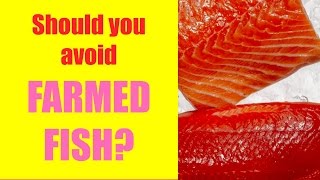
This is a YouTube video titled "Should You Avoid Farmed Fish? | Natalie Jill" featuring a conversation between Natalie Jill and her guest Maria, recorded in August 2015. They discuss the differences between wild and farm-raised fish, focusing on nutritional content, environmental impact, and food safety concerns. Maria also introduces a seafood and poultry wash product designed to clean fish and chicken, reducing harmful chemicals and bacteria. The video aims to educate viewers on making healthier seafood choices and proper food handling practices.
Hi, guys. Natalie, Jill here. Welcome back to Unprocessed yous Diet. I'm here with my friend Marea and we are talking today about wild versus farm raised fish and what the difference is. So thanks for being here. Maria, by the way, developed eat cleaner product and she is extremely knowledgeable when it comes to all of this and what is in our food supply.
Thank you.
So talk to me about wild versus farm raised.
Yeah, so when it comes to meat and fish, I always say go wild. And the big reason is that the nutrient content in wild versus farm raised is so much higher. When you look at fish, like salmon for example, it can be up to 30% more nutrient dense than the normal.
Why is that? What does that make? Explain that.
Most of it is what they're feeding the fish, right? So when it comes to fish and chicken, it's all about what they're, the food that they're actually eating. And the food that wild caught fish eat are small fish and other natural substances. In the farm raised fish community, they're eating these little pellets that are made from other ingredients that are actually flammable and toxic.
Oh my gosh.
So they can be carcinogens.
So processed food to the max, basically.
Basically you're actually feeding processed food to the fish. So it's a difference in the nutritional quality, it's a difference in the taste. It actually looks different. Like if you've ever seen wild caught salmon versus farm raised, you can actually see a color difference. The wild caught is really beautiful, rich, ruby red, while the farm raised is almost like a pale pink. And sometimes they'll add color coloring to the farm raised to make it look more red.
You get the food coloring problem as.
Well, which is also artificial for people that don't know.
How did farm raise even come about? What is the point of that versus the wild?
Well, the farm raised is just really about containing the crop. Right. In a way. So instead of going out and actually sourcing it naturally and fishing for it, they're keeping it all in a contained area. The problem with that is it actually infests the fish that are swimming around it too. You have a really high parasite rate because they're all jammed up next to each other. It's just not a healthy environment. It's kind of like, you know, grass fed or, you know, roaming cattle versus, you know, the CAFOs where they're all contained. You have a much healthier animal when it gets to roam around and be in its natural environment. It's the same with fish.
So wild obviously is going to be more healthy because the diet the fish is eating and the activity level they're they're in and how they're roaming around. So somebody just taking it to a human, somebody that is very active and eating natural, unprocessed food versus being cooped up inside all day eating processed foods.
That's exactly it. I mean, they are actually eating what they're supposed to in the wild versus eating what they're being fed in a contained environment.
Interesting.
And you can really taste the difference. I mean, I don't know about you, but even my little son at three years old was like, mommy, it looks different and it tastes different.
Yes. And I personally prefer the taste of wild and have known that there are better benefits, but not to the extent of what you just went over. So that's interesting. Now, what else, whether you get wild or farm raised, what else could be wrong with our fish? Talk to me about that because I know a lot of people get fish from the store, whether it is wild or farm raised. They don't even rinse it. They go to put it in their oven or the grill, cook it. What else could be happening that we need to be aware about?
Well, you know, you also have issues where sometimes fish are being treated with different predictions preservatives to help extend shelf life and keep it moist. There is a chemical called tripolyphosphate and it's used pretty, pretty aggressively, especially on fish coming from other countries. Because if you think about it, it's delicate, it has the ability to dry out. So you want to look for any seafood that's been treated with tripolyphosphate. Ask your fishmonger, ask the person that you're buying fish from, has it been treated?
Will it save it on ingredients or. It doesn't have to.
Usually it doesn't. So you have to actually ask. That's a really. That chemical can actually affect your nervous system. So you want to avoid it at all costs. And you see it a lot with scallops and shrimp and other shellfish too.
So if you don't know if your fish has that and you don't have a way to ask. So let's say it comes in, it's in a package, or you're at a restaurant or whatever. Is that something that can be washed off?
It can be washed off. And we created a wash that can actually clean the surface of your seafood. And it's our seafood and poultry wash. And I don't know.
Oh, I smell that. Yeah, it's like this is A white fish out of the bag, and it's. I can smell it.
It's really stinky.
What is that fishy smell? What is that?
It's just, you know, fish should not actually smell fishy. Fresh fish should smell just like the sea. So when it has that fishy smell, it's usually because it hasn't been cleaned or handled properly. Now you can use our seafood and poultry wash to not only clean that tripolyphosphate.
Okay, the smell just totally went away.
But the smell just kind of diminished, right?
Yeah. You sprayed that, and it literally went away.
It's almost like lemon juice. But you have other ingredient, natural ingredients in here that help to address the bacteria issue.
So for all fish, when you're preparing it, you would suggest spraying it with that. Do you rinse it after or you just spray it on?
You don't have to rinse it. You can just spray it on and go ahead and cook. When it comes to shellfish, anything like mussels or shrimp, I suggest that you spray it on and rinse it, because those shells will flavor the taste of your food. And if they're really not cleaned well, they can transmit back to it.
So here's my question. By spraying this on, it's gonna get rid of the smell. So we're applying something. How does it now take away anything that's bad? Explain that. If we're not rinsing it.
Well, what it's doing, it's actually kind of adhering to the stuff that you don't want on it. Now you could give it a rinse. We recommend careful. If you do rinse it so you don't spatter bacteria in your sink, you can give it a rinse. But what this is really doing is helping with, you know, that flavor, the smell, and anything visible, like on shellfish, you will rinse that off. You want to get rid of that.
So you could rinse it off.
Definitely.
Got it. So now we're talking about fish. But do you use this on other meats? Do you use this on chicken, for instance?
Yeah, I'm a big fan of using this on chicken. A lot of culture cultures clean their chicken. We aren't really conditioned to do that in the United States, but a lot of cultures will soak it in, like, salt water, for example. You're kind of doing the same thing with the Eat Cleaner product, but it's lab proven and more effective than salt on its own. So what you would do is you would take your chicken, any piece of chicken, also spray the surface, let it sit, you can go ahead and cook it right on there or you can rinse it off either one. Just make sure that when you rinse and wash your hands really well after you touch any raw poultry or fish. And then if you use this to like say for example, you have your chicken, you spray it, you leave it in the refrigerator the night before. By the time you cook it the next day, it will cook in half the time because it's helping to tenderize it. And the ingredients in here actually help to kind of pre cook it.
Wow.
And you can do the same thing with your fish. Like if you're making sushi at home, I highly recommend you use this because it's helping with the bacteria, the surface bacteria.
Got it. This is awesome. I did not know this about chicken and fish and that you could clean it with this. I'm guilty of just literally rinsing it under water. I guess it wasn't doing anything well.
And a lot of people don't even do that. But the cool thing is you can use this to clean your food and clean the cutting board after you're done. You know, you just want to take measures whenever you're handling something raw to really, you know, handle it properly. Clean it properly because not, I mean, yes, you're cooking it. So in theory you're cooking off the bacteria, but if you've treated it properly in the process, you're going to limit your risk of foodborne illness.
This is awesome. So I did a previous video with Maria on what's in our fruits and vegetables. And I'm going to put the link below so you can see that because we did a longer, a longer segment on that where you actually could see what comes off of those things, whether you're using organic or non organic fruits and vegetables and how this can help improve your health. Thank you for being here. Where can they find you? Where's the website?
So we're on eatcleaner.com we also have our products on Amazon.com but you can get our whole lineup of fruit and vegetable wash, seafood and poultry wash and our wipes on our website.
Awesome. And I'll put down below all that information and even a little discount code for you.