The 10 Minute Yogi for Beginners and Busy People | Natalie Jill
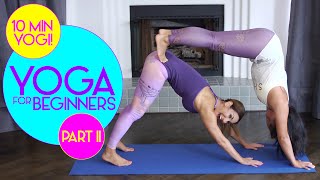
Natalie Jill and yoga expert Kim demonstrate six restorative poses in ten minutes. They focus on poses that calm your mind and connect you to your body, designed for people too busy for longer yoga sessions.
Hi guys. Natalie, Jill here. Welcome back to Happy, Healthy and Fit. Today I'm here with my good friend Kim, my yoga guru who makes me do yoga. Well, now I like it. I didn't used to like yoga. She's gotten me into it and I love to call what she does yoga for busy people. Because Kim is an expert at working with people, especially people type A personality, doesn't have time for yoga, doesn't want to shut their mind off, but she's great at working with you on what the most important things to do, how you can do them on your own time, your own body weight, in your own home and get the benefits. So we did a first video Yoga for Beginners 1. If you haven't seen that, make sure you check that out on my channel as well. And today we're doing a part two where we're going to go through six postures that you can do on your own time. So thanks Kim for being here.
Thanks for having me.
So what are we doing today? What are we going through?
We're actually going to go through six different postures today. Two of them are ones that we've done in the past video, but we'll review those again and then they're all again restorative type postures that are going to really open up your body and allow you to be, to feel more, I guess, mobile and agile throughout the day.
If you can remind everyone what are the benefits of yoga? Why do we have to do it? Why isn't it so important to do so?
The benefits of yoga, they're definitely started as being something physical. So especially in our culture we do go, go, go like you were talking about, Natalie. But yoga is the essence of being able to connect to your body in order to connect to a softer space in your mind.
And that does what? Why do we need to connect to our body and a softer space in our mind? These are things I never thought of my type A go go personality.
So it's just a really great. Yoga is just a huge way to access yourself, to be a little bit connected to a quieter mind, to calm the chatter in your head and to have you be more relaxed and to really breathe through your life rather than feeling so uptight or so stressed out about certain things. Yoga is a really amazing tool to come to, to allow yourself to completely relax and to ease yourself.
I like it. And what I found is I used to think of it as an annoyance. I don't have time to stop. I don't have time to do this. I couldn't quiet my mind now that I love the way it feels and I've gotten into it. I look forward to it. I feel like it is a time to really get out of my to do list and just work on restoring my body.
Love it. Yay.
All right, well, let's get started. So what are we starting with today?
All right, so let's start in child's pose.
Now, why do we always start in child's pose?
Child's pose is an amazing posture to allow your body to open up and to settle into the four corners of your mat. And so, like we were just talking about, it's so easy to go through your day and have no idea where the time went. And child's pose is that space to reconnect and to allow yourself just settle in for these few moments here and to let go of anything that might be clouding your mind. And so I'm going to give you some adjustments, Natalie, just to help you get a little bit deeper into the poses. And so all I'm doing here is adjusting your hip bones down to stretch more in your hip creases. So child's pose is a really great posture that opens up across your pelvic area, your hips, and then as you connect in.
Is there an incorrect way to do this? Could people mess this up, or what's the proper form for this?
I would say an incorrect thing to do with this posture would be to have your chin to the mat rather than your forehead to the mat. It's going to crunch and crank the back of your neck, but essentially to. A modification for this pose is to draw your knees together to touch, and that will release any pressure from your hips. If it's too much to have your knees wide. Good. And now tuck your toes and lift up to tabletop pose. Stock your knees beneath your hips and press back to downward facing dog. Pick your hips up into the air.
Perfect.
Spread your fingertips really, really wide. And then notice how Natalie's palms are shoulder width apart and her feet are hip width distance apart. That's going to allow you the perfect foundation to root down into this posture.
And this one just feels like it stretches out my entire body.
Exactly. So stay strong in the arms. The elbow creases turn slightly in. Shoulders are soft and apart from the middle of the back. And then as you extend your heels down towards the ground. So it's not important that the heels ever touch. They actually may never touch. It's just an energetic pull of the heels down, and that's what digs into the stretch and the calf muscles, as well as the hamstrings and down dog and child's pose are perfect postures to come to at any time during your practice. They allow you to reset and they allow you to come back to your breath and just to center your mind. If you feel a little scattered.
Good.
Look forward. Step your feet to the top of the mat. Forward fold.
Awesome.
And now rise up to mountain pose. Tadasana. Take your arms high overhead.
Perfect.
Squeeze your feet together. Drop your tailbone down. Pull your belly in tight. Relax your shoulders and keep your arm bones nice and strong.
Great.
So mountain pose is a really great grounding posture because you're literally just extending and rooting down through the heels of your feet to lighten your body up a little bit taller. Now we're going to move into a variation of half moon pose. Ardha Chandasana. Clasp your palms together and find a steeple Mudra. And so your hands will point up like this.
Okay, I have a strange question. Why all the funny names in yoga? What do they mean? I just have a hard time pronouncing them.
Yeah, that's a really good question because. So there's a mix of Sanskrit with English. And so I'm kind of giving you both languages so that you can start to familiarize yourself with hearing it. But so I'm just giving you both the Sanskrit plus the English so you can start to connect. And the more you hear it, the more you'll be like, oh, okay, that's down dag or that's half moon. Okay, so big breath in on your exhale. Talk your body to the right. For a variation of half moon pose, bump your left hip over and glide your upper body to the right.
Good.
So now what we're doing here, the purpose of this pose is to start stretch on your left side body. So press your left hip down and then begin to extend your right side shoulder. Your left shoulder up and over. And that's going to create space all along here between your left rib bones. Make sure that the shoulders stay down. Arm bones pull back and head rest back in line with your two shoulder blades. Drop your tailbone down a little deeper. Awesome.
Good.
Continue to send your hips to the left and your shoulders to the right to get into that stretch on the left side body. And now with your inhale, rise up and we'll go to the other side. Move to the left. Bump your right hip over. Left shoulder over. And now we're working into the opposite side, creating space on your right side rib bones Pull your belly in nice and tight. Drop your tailbone slightly down and just focus on softening the shoulders and sending your breath to opening up the right side of your body. Inhale, Come to mountain pose. Release your palms apart, and exhale.
Fold forward. Good.
Step your left leg back and come into a low lunge. Place your left knee down to the mat and inhale to low crescent lunge. Crescent moon, arms up.
Perfect.
This one I really feel on my hip flexor. So this is an amazing posture to open up your hip flexors, which are these parts right here that allow you to move your legs and to step onto stairs. That's your hip flexor. And so as you dip your hips down and forward, you'll feel the stretch on your left side hip. So it's important here to dig down into the heel of your front foot. That's also gonna help you to to use your hamstring muscle as you glide the knee forward. And it's okay in this posture to have your knee extend beyond your ankle and more over your toes. And you can see that the further that you're dipping your hips down and forward, the more of a stretch you feel on the left side.
Perfect.
So to protect the lower spine in this posture, squeeze your right foot towards your left knee. So think about that right foot hugging to your left knee, and that's what naturally pulls your right hip back and your left hip forward. That also is going to help you to take some of the weight of your body out of your lower back. So think strong core, strong legs, and that will prevent you from dumping the weight of your body into your lower spine. Nice. Take a big breath in. And on your exhale, palms to the mat. Straighten out your front leg for half splits.
Good.
Flex your right foot high. So that's important to flex your foot to protect your ankle. I really feel this in my hands here. Hover your hips over your left knee. And this is a really big stretch, like you said, into your hamstrings. But you might also feel this in your lower back if your lower back is tight. And so oftentimes if someone complains about having their lower back. So it could be just the fact that their hamstrings are really tight because your hamstrings pull on your lower back. So it might be just that all you need to do is to stretch open the hamstrings to release your lower back.
Good.
So in this posture, the more that you fold your body forward and flex your foot, keep your front leg straight. You'll really work into the opening of your right leg.
Good.
Now walk your hands forward. Come back into a low lunge. Pick your left knee off the mat, place your hands to the ground actually and then crawl your hands to the left into Prasa riddha padottanasana. Wide legged forward fold. So you're crawling around like this?
Yep.
Wide legged forward fold.
All right.
So in this posture, it's important to start from the ground up by having a firm foundation there. Notice how your feet are parallel to each other. In fact, you can actually slightly even pigeon toe your feet. Heels in or heels out. Toes slightly in. And keep a soft bend in your knees. And from that space, tilt your weight forward so the weight of your body is in the fronts of your feet rather than the heels of your feet. And then just fold.
Straighten up this foot a little bit. There you go. Perfect.
So the weight of your body is in the ball mounds of your feet as you tower your body forward. And I'm just pressing the heel of my hand to your sacrum to your lower back to help anchor your body into the pose to keep your tailbone flipped high. All right, take your arms out wide like wings and slowly rise up.
Good.
And now just to even your body out, we're going to switch to the other side. So step towards the top of your mat. Natalie.
Feet to touch.
Fold forward and this time, step your right leg back.
Good.
Come down to your back knee. Inhale, rise to low crescent lunge.
Crescent moon. Perfect.
And the funny word for this one is anjanesana.
I think sometimes learning the words is harder than learning the poses.
Probably.
Yeah.
All right, so again we're focused on stretching the right hand, the right hip flexor, but without dumping the weight of your body into your lower spine. And that comes from engaging your inner leg. So pull your front heel to your back knee. You can't see that motion, but you're just tugging your body together. And that's what turns on your inner legs to allow you to lift the weight of your body up and out of your lower back. And again, in this posture, you can glide your front knee forward to stretch in the hamstring. The hip flexor even more.
Good.
Take a full breath in and exhale. Palms frame your left foot, half split. Straighten out your front leg. Flex a lot through your left toes. Dig your left heel into the mat and then find that same dragging sensation that we just did in the pose before this. Drag your front heel to your right knee and your right knee to your left heel. So that hugging sensation is what's going to drive the stretch. Then fold your body even deeper forward.
Perfect.
You might even feel this in your glutes, your left glute and your left side. It band. It band is what runs on the outside of the hip.
All through there.
All right, crawl forward to low lunge. Pick up your right knee and crawl to the right into a second set of wide legged forward fold. Prasa riddha padhasanasana. So walk around like this and parallel your feet.
Good, perfect.
And so we'll just get in the second set of this to do the same motions on both sides. And again, remember that your feet are parallel and the weight of your body shifts to the ball mount of your feet. Your heels are still on the mat, but the pressure of your body's on the front. And keep that gentle bend at the knee joints. Now take your palms behind you for a second variation and clasp your hands together.
Good.
So this is an added bonus. I love this posture. It's called a chest expansion because it allows you to pull your shoulders back into space. So much of what we do in our day rounds our body forward, whether we know it or not. So whether you're eating, talking to a friend, talking on the phone, driving, we tend to cave our shoulders inward. And this is an amazing stretch to pull the shoulders back. All right. Take a full breath in and rise all the way up to standing. Step your feet together.
Good.
And those are our six postures.
Love it. Is that six? Yeah.
Yeah. It's amazing to me how you can do such few amount of postures and it just completely resets your mind and resets your body and you feel. I almost feel like you've had a massage after.
Right, Exactly. I didn't understand that before.
And I think that's because I wasn't doing the postures right and I wasn't getting into the right rhythm on them.
And there's this amazing connection with the body that I don't think that we conceptualize or really think about. But the more you can connect to how your body feels and open your body up, the more you can be present to what's happening inside of you internally. So it's a really good work in. When you do yoga, we call it a work in.
So yoga for busy people, anyone can do it, Even beginners. You can try it. You can quiet your mind. Do just a few poses. Thank you, Kim. You can find out where to reach Kim below. I have all of her information down there.
Thanks for having me, Natalie.
See you guys next time.
Bye.










